
Earthquakes Forces in Earths Crust l l The

- Slides: 60
Earthquakes
Forces in Earth’s Crust l l The movement of Earth’s plates creates enormous forces that _____ or ____ the rock in the crust as if it were a candy bar. These forces are examples of _____, a force that acts on rock to change its shape or volume. A rock’s _____ is the amount of space the rock takes up. Stress adds _____ to the rock.
Forces in Earth’s Crust l Types of Stress l Three different kinds of stress can occurs in the crust. l ______________ l Tension, compression, and shearing work over _________ to change the _________ of rock.
Forces in Earth’s Crust l Tension l _______________________________ l The _____ on rock is somewhat like pulling apart a piece of warm _______. l Occurs where _____ plates are moving apart.
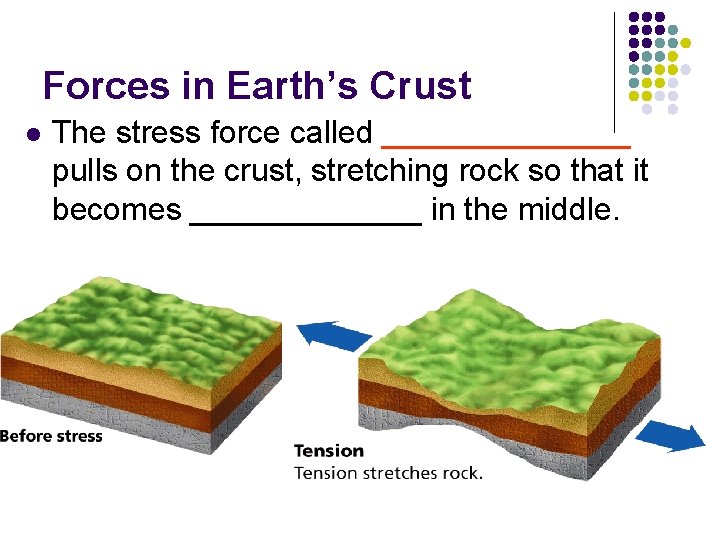
Forces in Earth’s Crust l The stress force called _______ pulls on the crust, stretching rock so that it becomes _______ in the middle.
Forces in Earth’s Crust l Compression l _______________________________ l One plate pushing ______ another can compress rock like a giant __________.
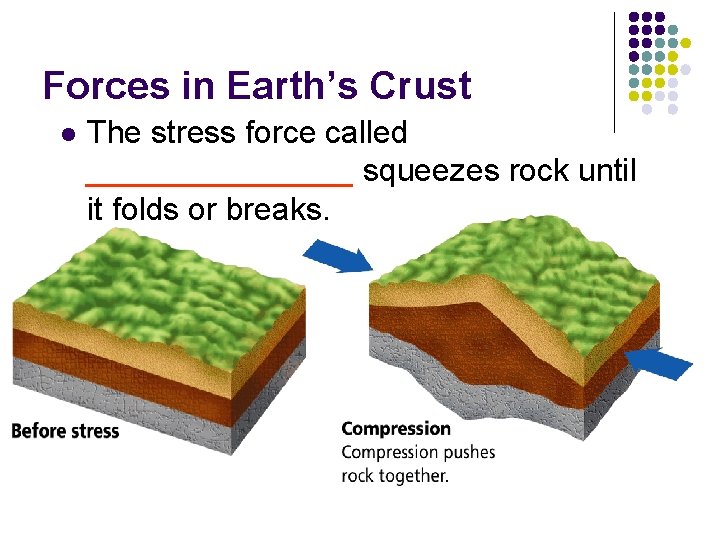
Forces in Earth’s Crust l The stress force called ________ squeezes rock until it folds or breaks.
Forces in Earth’s Crust l Shearing l _______________________________. l Can cause rock to break and slip apart or to change its shape.
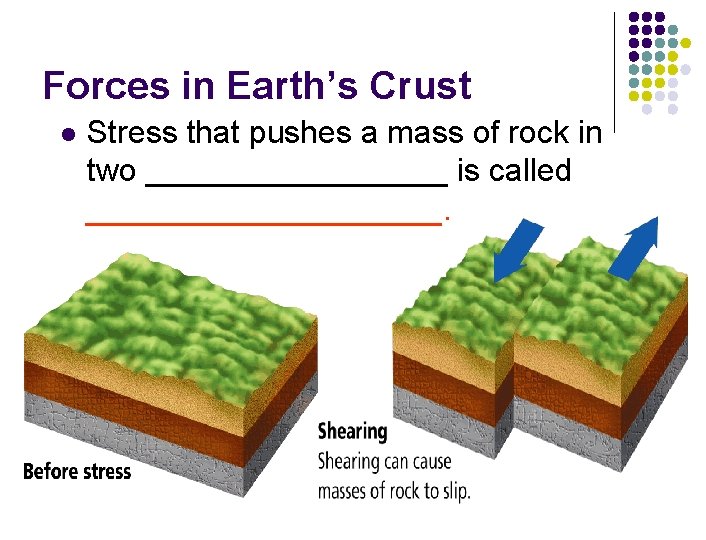
Forces in Earth’s Crust l Stress that pushes a mass of rock in two _________ is called __________.
Forces in Earth’s Crust l Kinds of Faults l When enough stress builds up in rock, the rock breaks, creating a fault. l Recall that a ______ is a break in the rock of the crust where rock surfaces slip past each other. l The rocks on both sides of a fault can move up or down or sideways.
Forces in Earth’s Crust l Kinds of Faults l Most faults occur along ________, where the forces of plate motion push or pull the crust so much that the crust breaks. l There are _____ main types of faults: l _________________ l _________
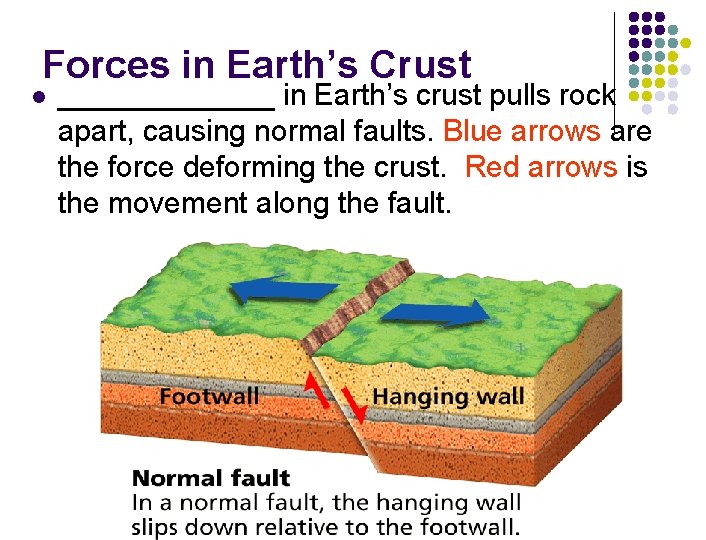
Forces in Earth’s Crust l ___________ l Tension in Earth’s crust pulls rock ______. l _______________________________ l The block that lies _____ is called the __________. l The rock that lies _____ is called the __________.
Forces in Earth’s Crust l Normal Faults l When movement occurs along a normal fault, the hanging wall slips ______. l _______________________________. l For example, normal faults are found along the _________ in New Mexico, where two pieces of Earth’s crust are under ______.
Forces in Earth’s Crust l _______ in Earth’s crust pulls rock apart, causing normal faults. Blue arrows are the force deforming the crust. Red arrows is the movement along the fault.
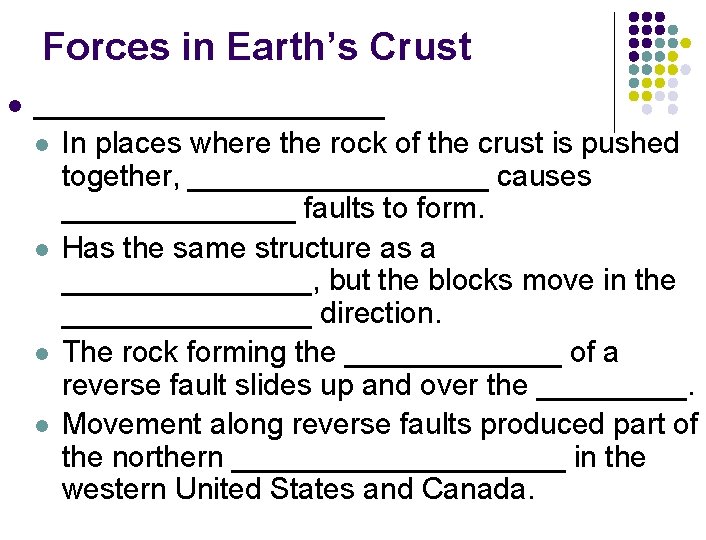
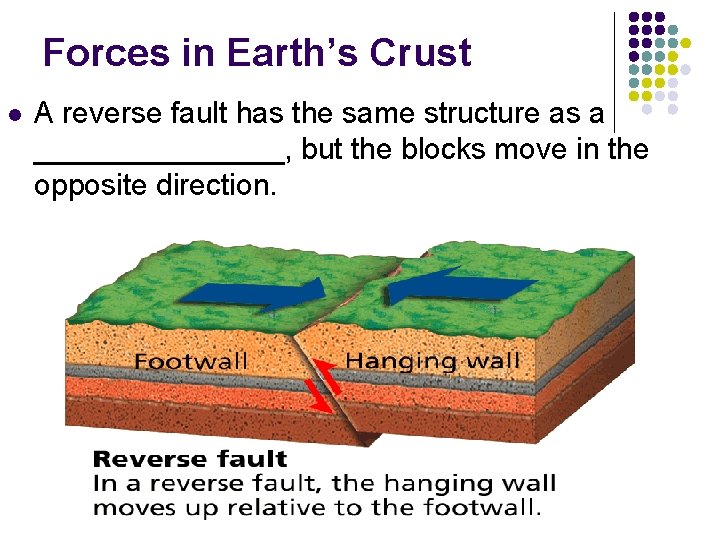
Forces in Earth’s Crust l ___________ l In places where the rock of the crust is pushed together, _________ causes _______ faults to form. l Has the same structure as a ________, but the blocks move in the ________ direction. l The rock forming the _______ of a reverse fault slides up and over the _____. l Movement along reverse faults produced part of the northern __________ in the western United States and Canada.
Forces in Earth’s Crust l A reverse fault has the same structure as a ________, but the blocks move in the opposite direction.
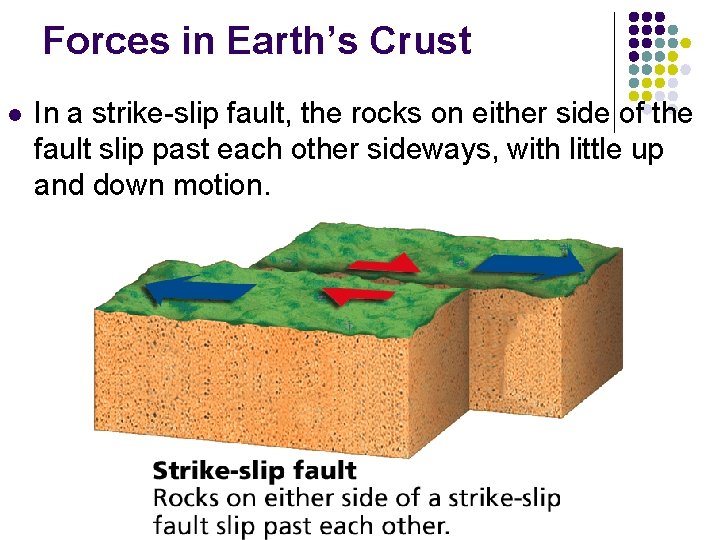
Forces in Earth’s Crust l Strike-Slip Faults l ___________________. l The rocks on either side of the fault slip past each other sideways, with little up or down _______. l A strike-slip fault that forms the boundary between two plates is called a __________. l The ___________ in California is an example of a strike-slip fault that is a transform boundary.
Forces in Earth’s Crust l In a strike-slip fault, the rocks on either side of the fault slip past each other sideways, with little up and down motion.
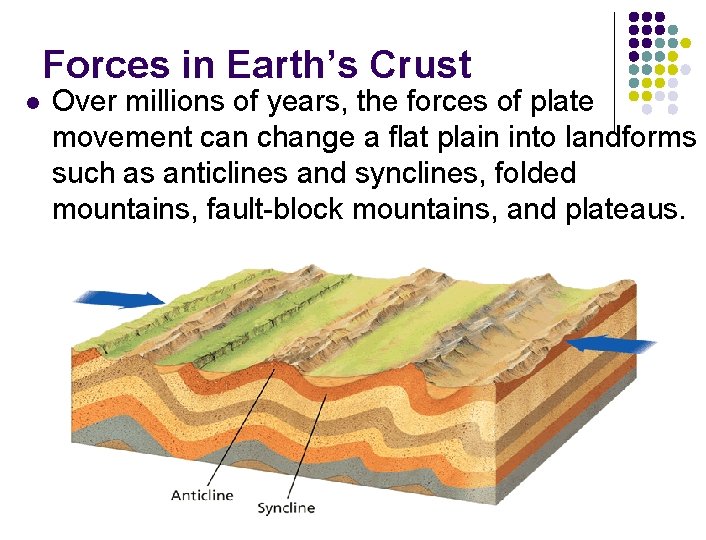
Forces in Earth’s Crust l l The forces produced by the movement of Earth’s plates can ________________ the crust. Over millions of years, the forces of plate movement can change a flat plain into landforms such as _______ and synclines, ________, faultblock mountains, and _______.
Forces in Earth’s Crust l Folding Earth’s Crust l Sometimes plate movement causes the crust to _______. l Rock stressed by ________ may bend without ________. l Folds are _______ in the rock that form when compression shortens and thickens part of Earth’s crust. l A fold can be only a few ________ across or hundreds of ________ wide. l You can often see small folds in the rock exposed where a ______ has been cut through a hillside.
Forces in Earth’s Crust l l l Geologists use the terms _______ and _______ to describe upward and downward folds in rock. A fold in rock that bends upward into an arch is an ________. A fold in rock that bends downward to form a valley is a ________. Anticlines and synclines are found in many places where _________ forces have folded the crust. The central _____________ in Pennsylvania are folded mountains made up of anticlines and synclines.
Forces in Earth’s Crust l Over millions of years, the forces of plate movement can change a flat plain into landforms such as anticlines and synclines, folded mountains, fault-block mountains, and plateaus.
Forces in Earth’s Crust l l l The __________ of two plates cause compression and folding of the crust over a wide area. Folding produced some of the world’s largest _____________. The ________in Asia and the _____in Europe formed when pieces of the crust folded during the collision of two _________.
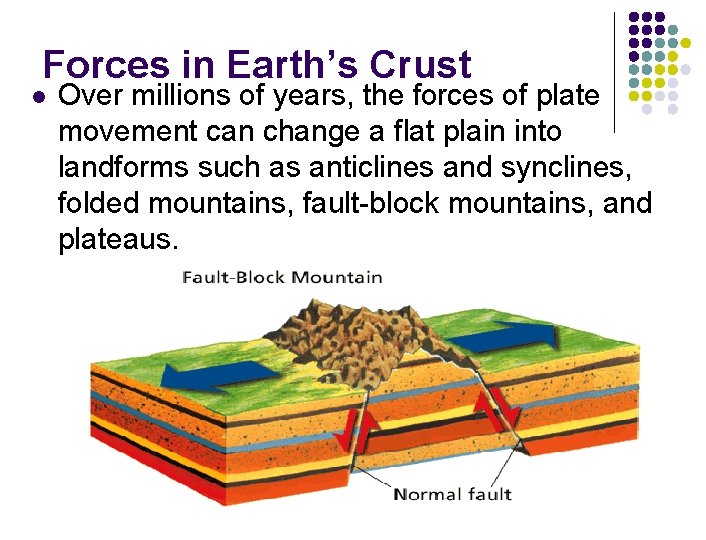
Forces in Earth’s Crust l Stretching Earth’s Crust l When two normal faults cut through a block of rock, a ___________ forms. l How does this process begins? l _______________________________________ _______________________________________.
Forces in Earth’s Crust l Over millions of years, the forces of plate movement can change a flat plain into landforms such as anticlines and synclines, folded mountains, fault-block mountains, and plateaus.
Forces in Earth’s Crust l Uplifting Earth’s Crust l The forces that raise mountains can also uplift, or raise, _______. l A ______ is a large area of flat land elevated high above _____. l Some plateaus form when forces in Earth’s _____push up a large, flat ______ of rock. l A plateau consists of many _____flat layers, and is wider than it is tall.
Earthquake and Seismic Waves l l l An ________ is the shaking and trembling that results from the movement of rock beneath Earth’s surface. The forces of __________ cause earthquakes. Plate movements produce ______ in Earth’s _______, adding energy to rock and forming faults.
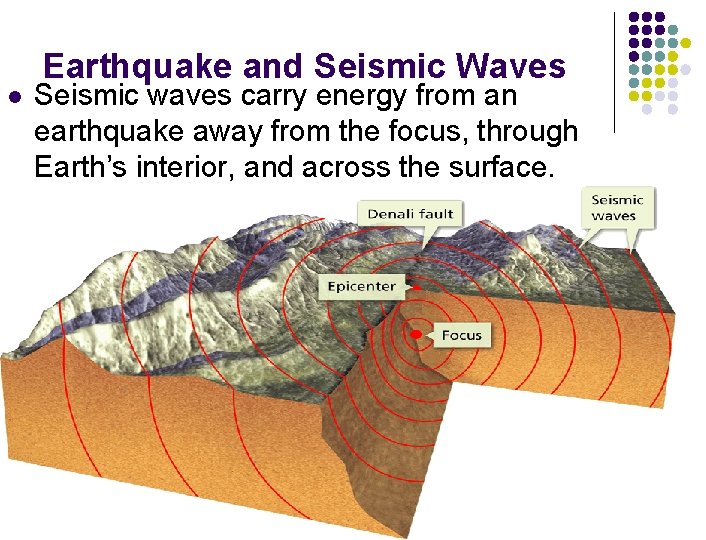
l l l Earthquake and Seismic Waves Stress _________ along a fault until the rock breaks. An earthquake begins. Most earthquakes begin in the _______ within about _______ kilometers of Earth’s surface. The ______ is the area beneath Earth’s surface where rock that is under _____ breaks, triggering an earthquake. The point on the surface directly above the focus is called the _______.
Earthquake and Seismic Waves l Types of _________ l An earthquake produces ______ called ______. l These waves carry _____ as they travel _______. l During an earthquake, seismic waves race out from the ____ in all directions. l ________ are vibrations that travel through Earth carrying the energy released during an earthquake.
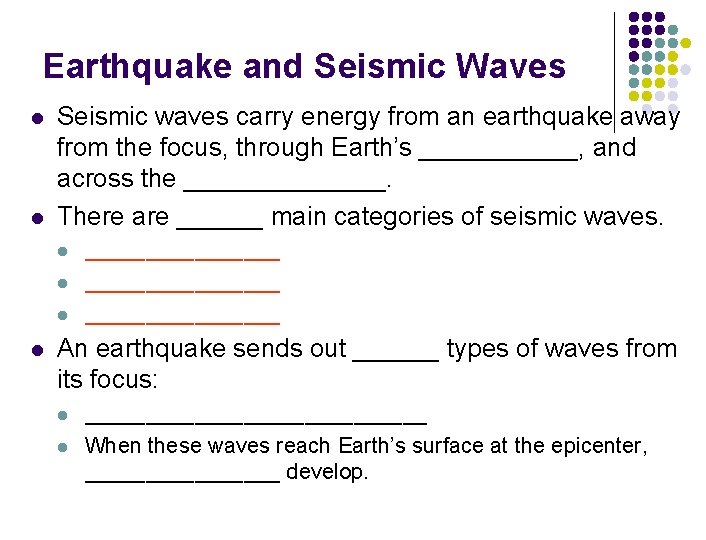
Earthquake and Seismic Waves l l Seismic waves carry energy from an earthquake away from the focus, through Earth’s ______, and across the _______. There are ______ main categories of seismic waves. l l ________________ An earthquake sends out ______ types of waves from its focus: l l ______________ When these waves reach Earth’s surface at the epicenter, ________ develop.
l Earthquake and Seismic Waves Seismic waves carry energy from an earthquake away from the focus, through Earth’s interior, and across the surface.
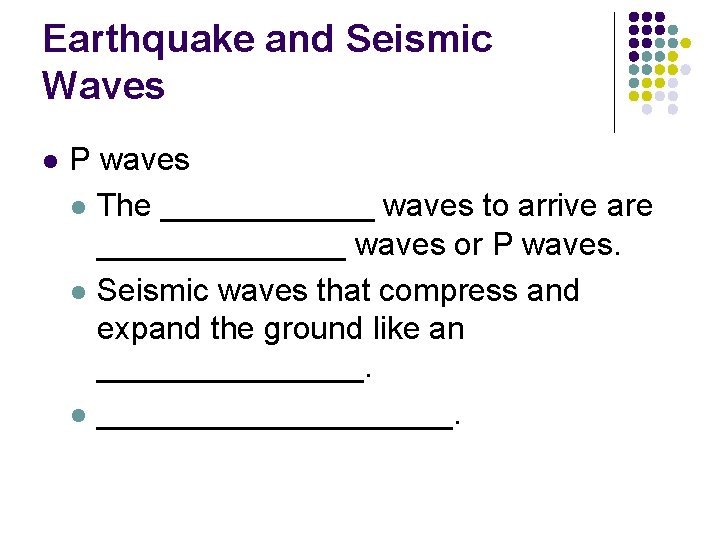
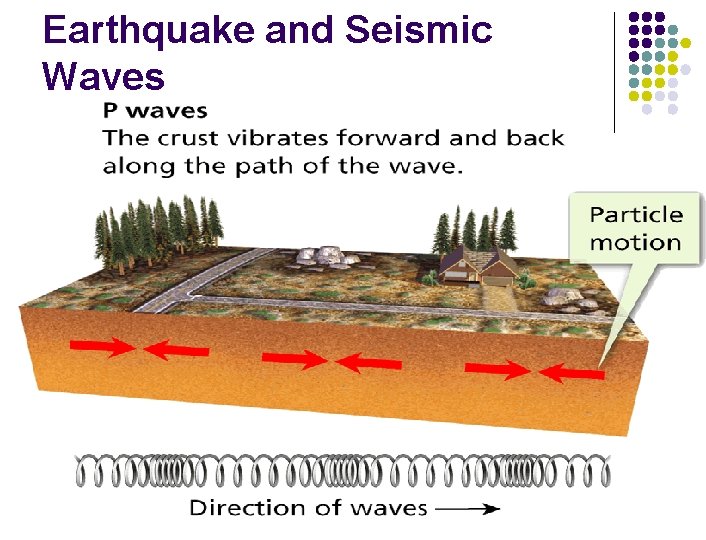
Earthquake and Seismic Waves l P waves l The ______ waves to arrive are _______ waves or P waves. l Seismic waves that compress and expand the ground like an ________. l __________.
Earthquake and Seismic Waves
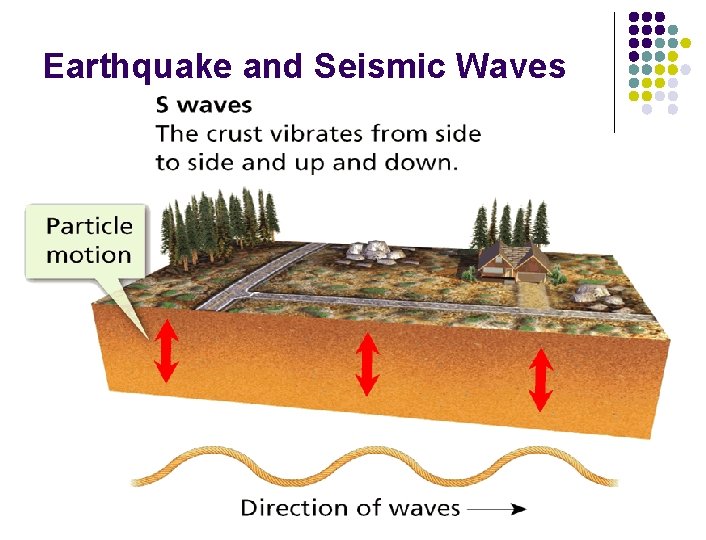
Earthquake and Seismic Waves l __________ l l l After P waves come _______ waves, or S waves. Seismic waves that vibrate from _______ as well as _______. They shake the _____ back and forth. When they reach the surface, they shake structures ________. Unlike P waves, which travel through both _________, S waves cannot move through ________.
Earthquake and Seismic Waves
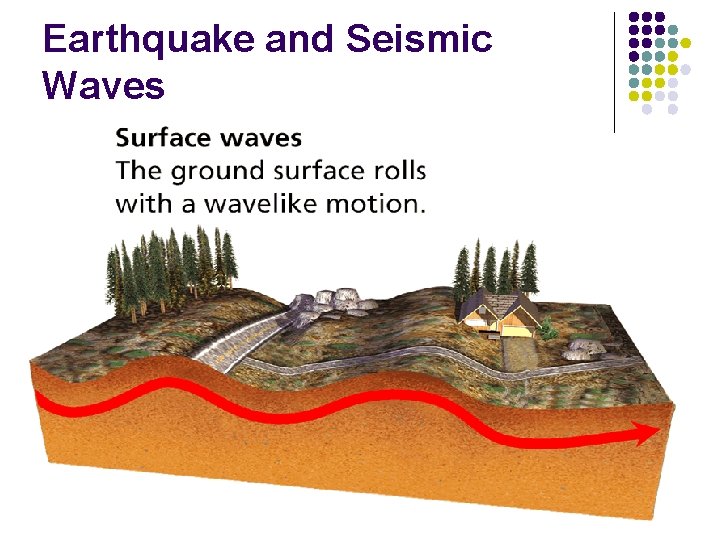
Earthquake and Seismic Waves l ________ Waves l When P waves and S waves reach the _______, some of them become _______ waves. l Move more _____ than P waves and S waves, but they can produce __________ movements. l Some make the ground roll like _____ waves. l Others shake buildings from ______.
Earthquake and Seismic Waves
Earthquake and Seismic Waves l Measuring Earthquakes l There at least _______ different measures for rating earthquakes, each with its strengths and short comings. l ______ commonly used methods of measuring earthquakes are: l ____________________ l __________
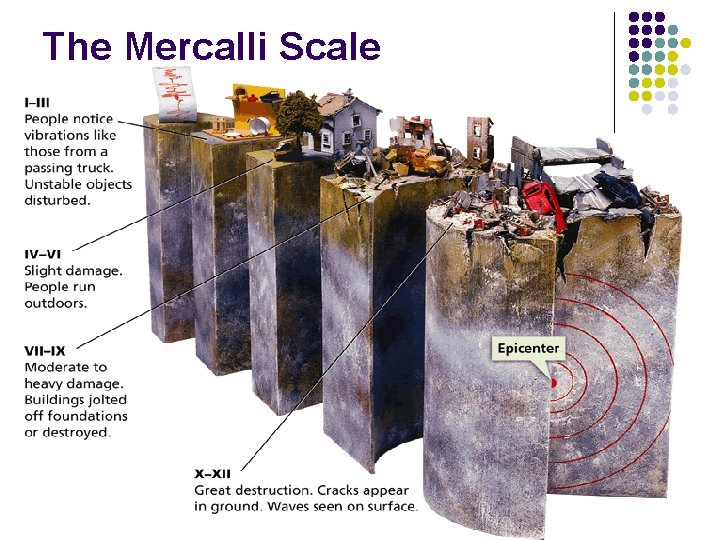
Earthquake and Seismic Waves l The Mercalli Scale l _______________________________. l The _____ steps of this scale describe an earthquake’s effects. l The same earthquake can have _____ Mercalli ratings because it caused different amounts of ground motion at different locations.
The Mercalli Scale
Earthquake and Seismic Waves l ____________ l l l An earthquake’s ________ is a number that geologists assign to an earthquake based on the earthquake’s size. Geologists determine magnitude by measuring the ______ and _____ movement that occur during an earthquake. The Richter Scale is a ______ of an earthquake’s _______ based on the _______ of the earthquake’s seismic waves.
Earthquake and Seismic Waves l l l The seismic waves are measured by a ________. A seismograph is an _______ that ________ and _______ seismic waves. The Richter scale provides ______ measurements for small, nearby earthquakes.
Earthquake and Seismic Waves l The ___________ Scale l A rating system that _______ the total energy released by an earthquake. l Can be used to rate earthquakes of all _______, near or far. l You may hear news reports that mention the Richter scale, but the number they quote is almost always the moment magnitude for that earthquake.
Earthquake and Seismic Waves l l l To rate an earthquake on the moment magnitude scale, geologist first study ______ from seismographs. The data show what kinds of _________ the earthquake produced and how strong they were. The data also help geologists ______ how much movement occurred along the fault and the strength of the rocks that broke when the fault slipped.
Earthquake and Seismic Waves l Comparing Magnitudes l Earthquake’s ________ tells geologists how much ______ was released by the earthquake. l Each ________ increase in magnitude represents the release of roughly _____ times more energy. l The effects of an earthquake _______ with magnitude.
Earthquake and Seismic Waves l l Earthquakes with a magnitude below ___ are small and cause ____ damage. Those with a magnitude between __ and __ can cause moderate damage. Earthquakes with a magnitude ______ 6 can cause ____ damage. The most powerful earthquakes, with a magnitude of ____ or above, are rare.
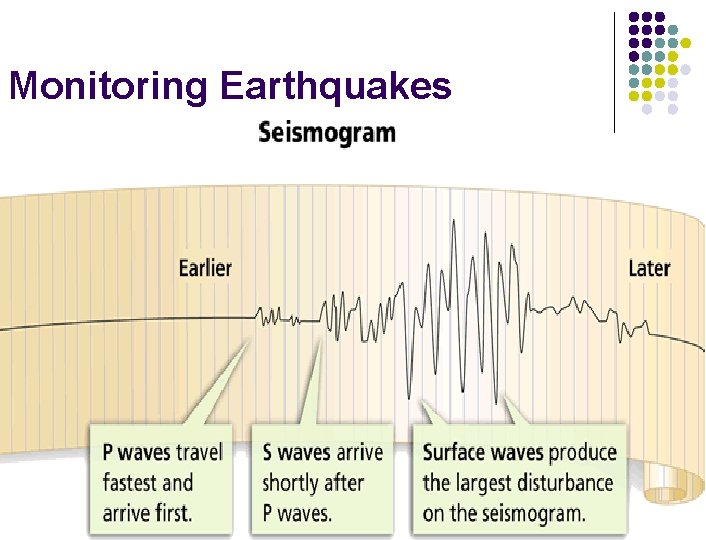
Earthquake and Seismic Waves l Locating the _________ l Geologists use ______ waves to locate an earthquake’s epicenter. l P waves arrive at a seismograph _______, with ____ waves following close behind. l To tell how far the epicenter is from the seismograph, scientists measure the _______ between the arrival times of the P waves and S waves. l The ______ away an earthquake is, the ______ the time between the arrival of the P waves and the S waves.
Earthquake and Seismic Waves l l l Geologists then draw at least three _______ using data from different seismographs set up at ______ all over the _______. The ______ of each circle is a particular seismograph’s location. The _____ of each circle is the distance from that seismograph to the ______.
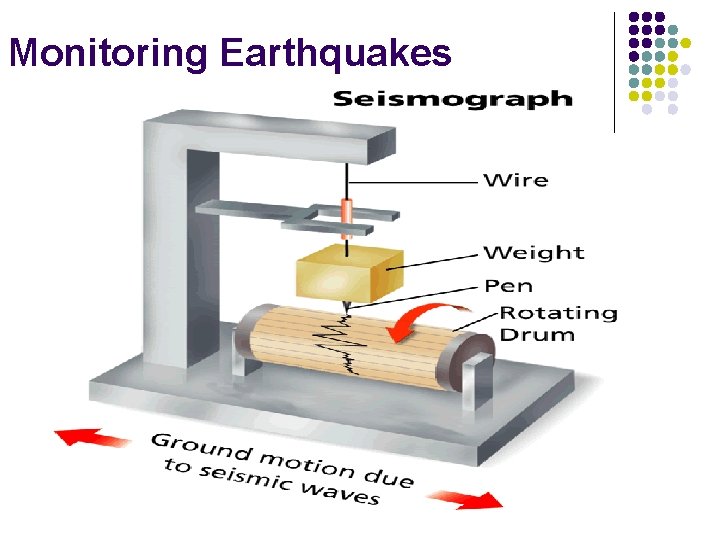
Monitoring Earthquakes l The Seismograph l A _______ seismograph can consist of a heavy weight attached to a frame by a spring or wire. l Seismic waves cause the seismograph’s _______ to vibrate. But the suspend weight with the pen attached moves very little. Therefore, the _____ stays in place and records the drum’s vibrations.
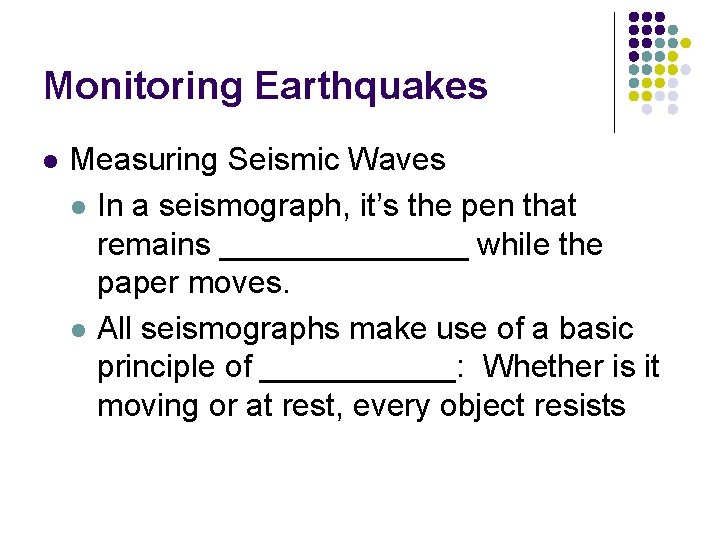
Monitoring Earthquakes l Measuring Seismic Waves l In a seismograph, it’s the pen that remains _______ while the paper moves. l All seismographs make use of a basic principle of ______: Whether is it moving or at rest, every object resists
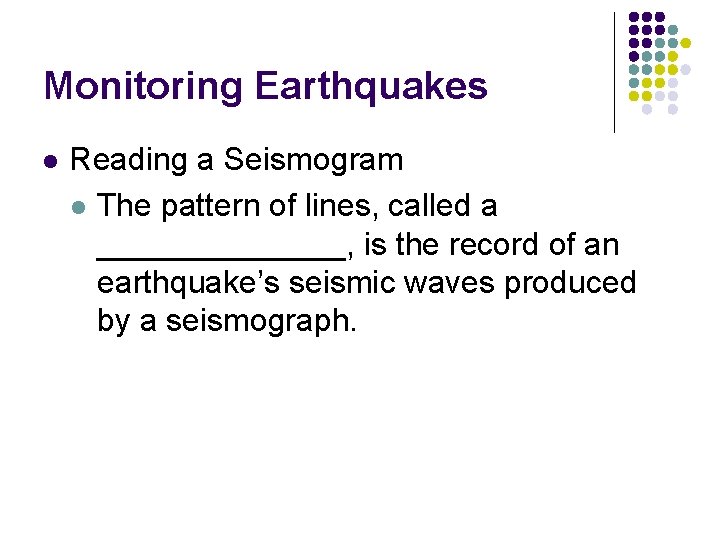
Monitoring Earthquakes l Reading a Seismogram l The pattern of lines, called a _______, is the record of an earthquake’s seismic waves produced by a seismograph.
Monitoring Earthquakes
Monitoring Earthquakes
Monitoring Earthquakes l How Earthquakes Cause Damage l When a major earthquake strikes, it can cause great damage. l Causes of earthquake damage include shaking, liquefaction, aftershocks, and tsunamis.
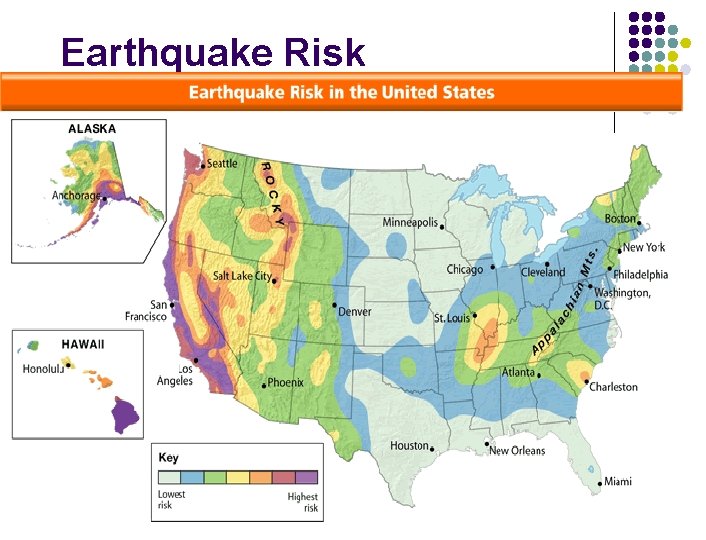
Earthquake Risk
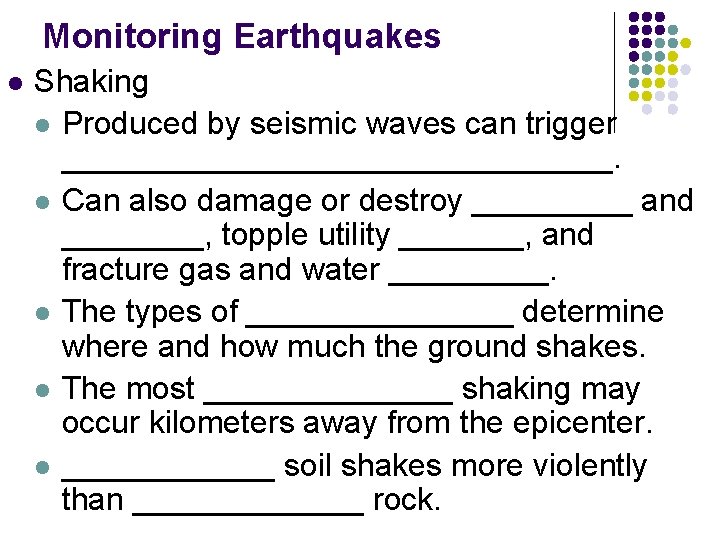
Monitoring Earthquakes l Shaking l Produced by seismic waves can trigger ________________. l Can also damage or destroy _____ and ____, topple utility _______, and fracture gas and water _____. l The types of ________ determine where and how much the ground shakes. l The most _______ shaking may occur kilometers away from the epicenter. l ______ soil shakes more violently than _______ rock.
Monitoring Earthquakes l _______________________________. l Is likely where the soil is full of ________. l As the ground gives way, buildings _______ and _______ apart.
Monitoring Earthquakes l _________ l Sometimes, buildings weakened by an earthquake ________ during an _________. l ________________. l May strike ____, _____, or even ______ later.
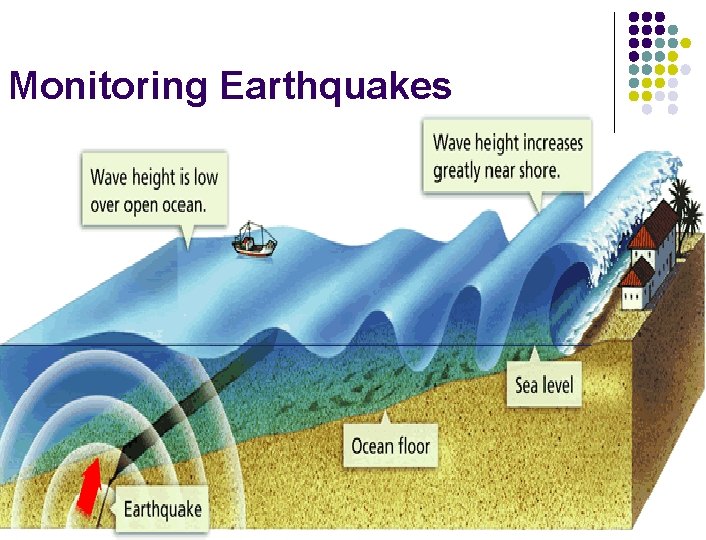
Monitoring Earthquakes l ________ l When an earthquake _____ the ocean floor, _________ causes the ocean floor to rise slightly and push water out of its way. l The water ________ by the earthquake may form a large wave. l Spreads out from an earthquake’s _______ and _______ across the ocean. l As a tsunami approaches _______ water, the wave grows into a mountain of water.
Monitoring Earthquakes