Equal Employment Opportunity EEO South Africa Australia Wesley




- Slides: 26
Equal Employment Opportunity (EEO) South Africa & Australia Wesley van Zyl 2809759
What is Equal Employment Opportunity? � Creating a work environment where employees have equal access to opportunities that are available. - An environment free of unlawful discrimination, racism and harassment providing programs to assist members of EEO groups to overcome past or present disadvantage
Why is there a need for EEO? Main reasons for EEO: � Perceived Fair= increased commitment � Society pressures � Globalization required diverse workforces to enhance innovation � Mention about women
Factors affecting EEO in Different nations � “EEO laws are expressions of social value with regards to employment and reflect the values of a society or country” � History, Culture & Religions � Scope of EEO law & jurisdiction (Dowling et al, 2008)
Class discussion If an employee from a US MNE is on an expatriate assignment in Saudi Arabi should his or her employment rights be that of his home country or current country? Why?
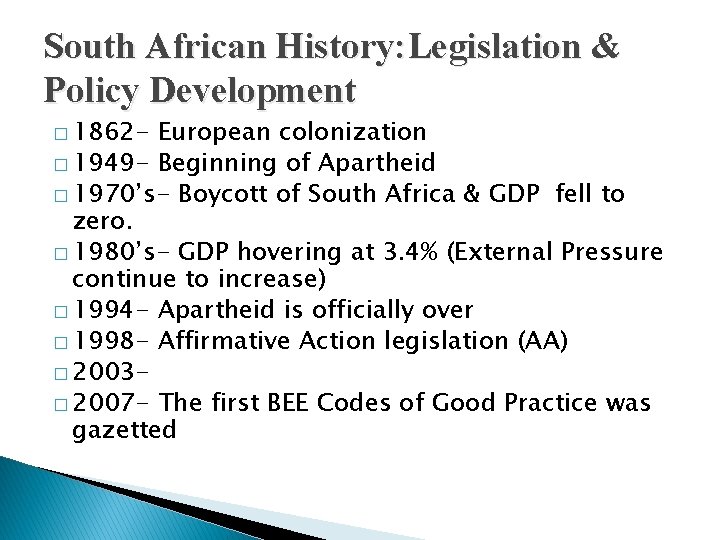
South African History: Legislation & Policy Development � 1862 - European colonization � 1949 - Beginning of Apartheid � 1970’s- Boycott of South Africa & GDP fell to zero. � 1980’s- GDP hovering at 3. 4% (External Pressure continue to increase) � 1994 - Apartheid is officially over � 1998 - Affirmative Action legislation (AA) � 2003� 2007 - The first BEE Codes of Good Practice was gazetted
Affirmative Action (AA) � “steps taken to increase the representation of women and minorities (race, colour, religion, sex or national origin) in areas of employment, education, and business from which they have been historically excluded”()
Black Economic Empowerment (BEE) � “It is a pragmatic growth strategy that aims to realize the country's full economic potential while helping to bring the black majority into the economic mainstream". (South African info, 2011)
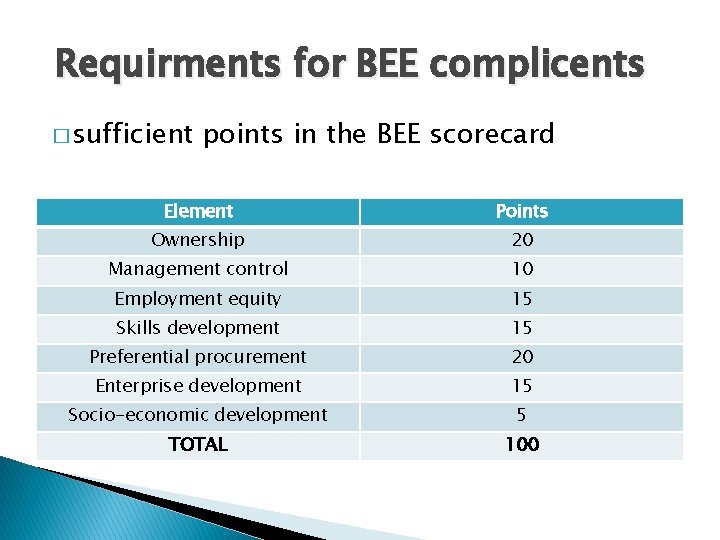
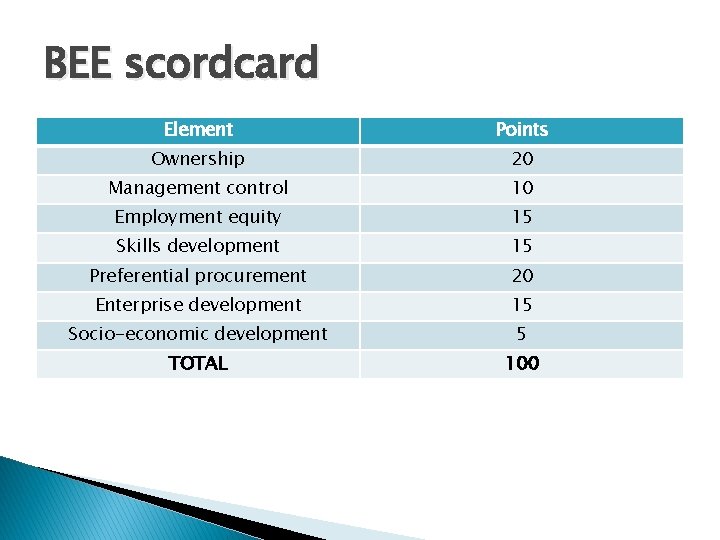
Requirments for BEE complicents � sufficient points in the BEE scorecard Element Points Ownership 20 Management control 10 Employment equity 15 Skills development 15 Preferential procurement 20 Enterprise development 15 Socio-economic development 5 TOTAL 100
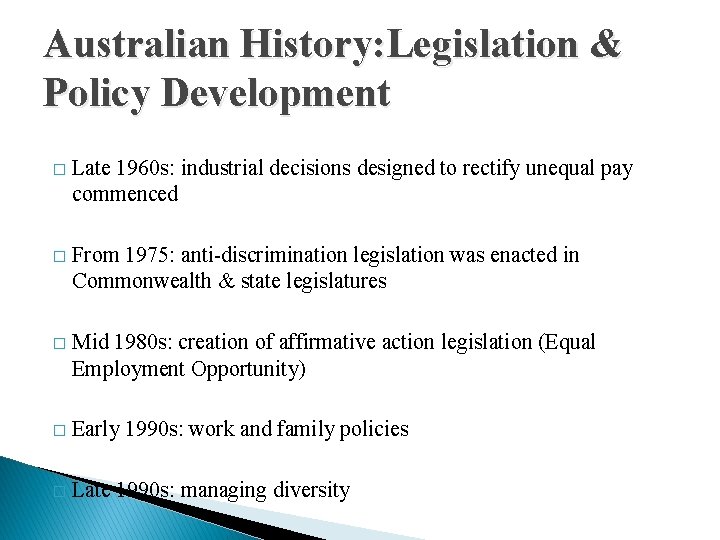
Australian History: Legislation & Policy Development � Late 1960 s: industrial decisions designed to rectify unequal pay commenced � From 1975: anti-discrimination legislation was enacted in Commonwealth & state legislatures � Mid 1980 s: creation of affirmative action legislation (Equal Employment Opportunity) � Early 1990 s: work and family policies � Late 1990 s: managing diversity
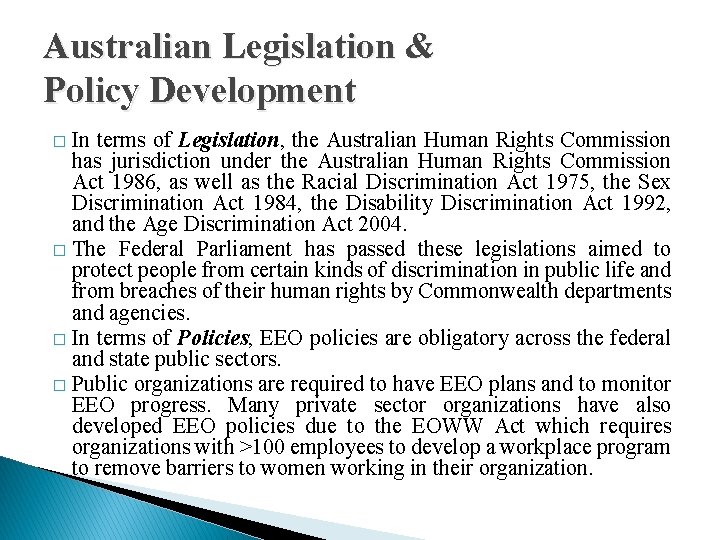
Australian Legislation & Policy Development In terms of Legislation, the Australian Human Rights Commission has jurisdiction under the Australian Human Rights Commission Act 1986, as well as the Racial Discrimination Act 1975, the Sex Discrimination Act 1984, the Disability Discrimination Act 1992, and the Age Discrimination Act 2004. � The Federal Parliament has passed these legislations aimed to protect people from certain kinds of discrimination in public life and from breaches of their human rights by Commonwealth departments and agencies. � In terms of Policies, EEO policies are obligatory across the federal and state public sectors. � Public organizations are required to have EEO plans and to monitor EEO progress. Many private sector organizations have also developed EEO policies due to the EOWW Act which requires organizations with >100 employees to develop a workplace program to remove barriers to women working in their organization. �
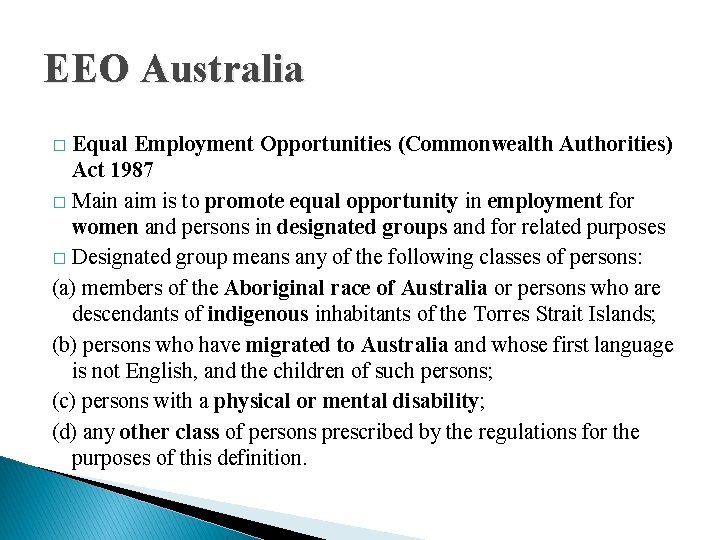
EEO Australia Equal Employment Opportunities (Commonwealth Authorities) Act 1987 � Main aim is to promote equal opportunity in employment for women and persons in designated groups and for related purposes � Designated group means any of the following classes of persons: (a) members of the Aboriginal race of Australia or persons who are descendants of indigenous inhabitants of the Torres Strait Islands; (b) persons who have migrated to Australia and whose first language is not English, and the children of such persons; (c) persons with a physical or mental disability; (d) any other class of persons prescribed by the regulations for the purposes of this definition. �
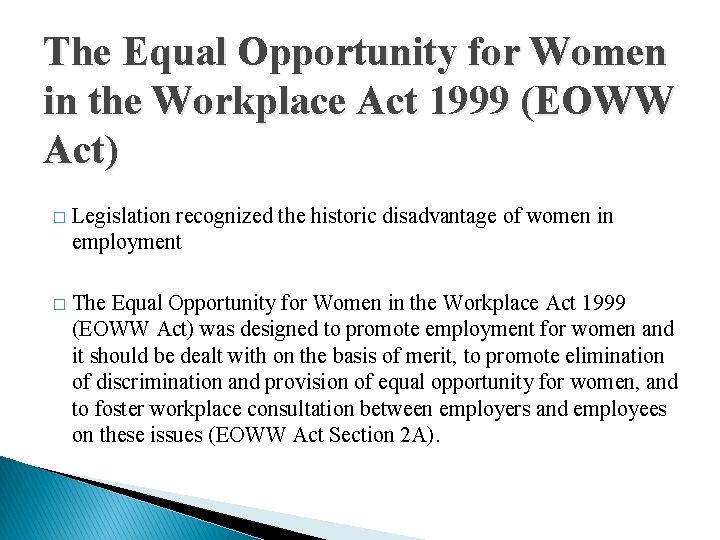
The Equal Opportunity for Women in the Workplace Act 1999 (EOWW Act) � Legislation recognized the historic disadvantage of women in employment � The Equal Opportunity for Women in the Workplace Act 1999 (EOWW Act) was designed to promote employment for women and it should be dealt with on the basis of merit, to promote elimination of discrimination and provision of equal opportunity for women, and to foster workplace consultation between employers and employees on these issues (EOWW Act Section 2 A).
EEO For Aboriginal and Islander (Indigenous Population) � The census data shows slight but significant improvements in Indigenous participation in the labour force over 2001– 06 � In the 2006 Census, 55% of Indigenous peoples aged 15 years and over were participating in the work force, up from 52% in 2001 � The labour force participation rate for the NON-Indigenous population was 63% in 2001 compared with 65% in 2006
EEO In Different States of Australia � In Australia, national and state laws cover equal employment opportunity and anti-discrimination in the workplace � Every state has its different laws which covers the equal employment opportunities � Queensland : The Anti-Discrimination Commission Queensland is an independent statutory authority established under the Anti. Discrimination Act 1991. Their core goal is to receive and deal with complaints of discrimination and other contraventions of the Act, and to promote human rights in Queensland
Overall Benefits of EEO in Australia To promote equal opportunity and fair treatment in employment for all employees without any sort of discrimination. � To ensure the increasing women’s employment opportunities and advancing women’s equality in the workplace. � Consider opportunities to reduce the cost of existing regulation and/or ways to ensure that any new legislation is cost-effective and well-targeted. � To guarantee the growth of country’s economy, labor market, business competitiveness and general wellbeing of the Australian community. �
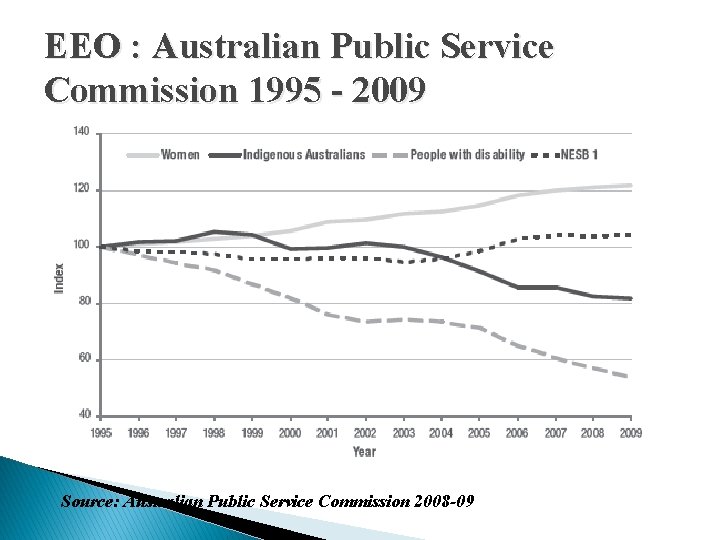
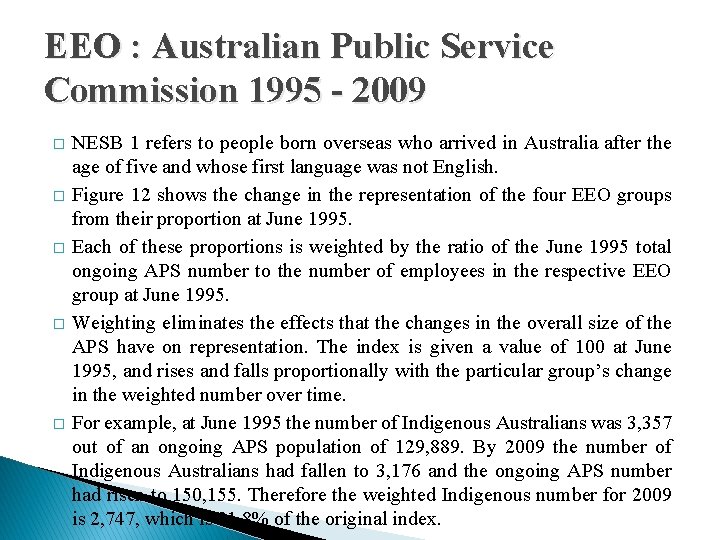
EEO : Australian Public Service Commission 1995 - 2009 Source: Australian Public Service Commission 2008 -09
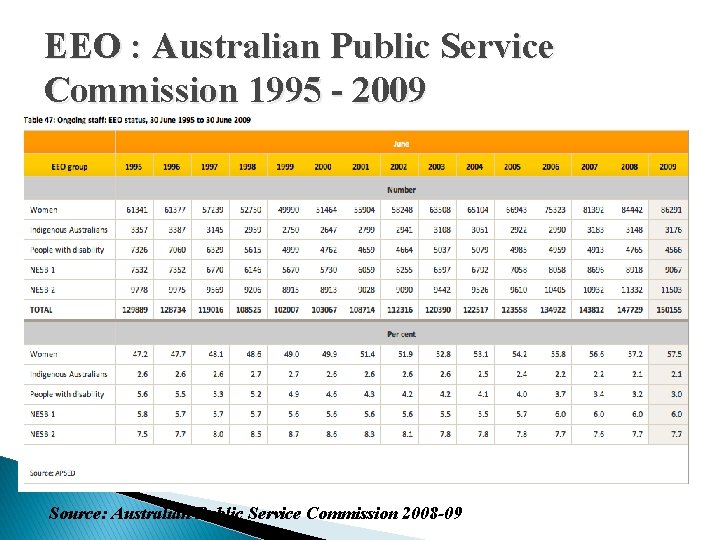
EEO : Australian Public Service Commission 1995 - 2009 Source: Australian Public Service Commission 2008 -09
EEO : Australian Public Service Commission 1995 - 2009 � � � NESB 1 refers to people born overseas who arrived in Australia after the age of five and whose first language was not English. Figure 12 shows the change in the representation of the four EEO groups from their proportion at June 1995. Each of these proportions is weighted by the ratio of the June 1995 total ongoing APS number to the number of employees in the respective EEO group at June 1995. Weighting eliminates the effects that the changes in the overall size of the APS have on representation. The index is given a value of 100 at June 1995, and rises and falls proportionally with the particular group’s change in the weighted number over time. For example, at June 1995 the number of Indigenous Australians was 3, 357 out of an ongoing APS population of 129, 889. By 2009 the number of Indigenous Australians had fallen to 3, 176 and the ongoing APS number had risen to 150, 155. Therefore the weighted Indigenous number for 2009 is 2, 747, which is 81. 8% of the original index.
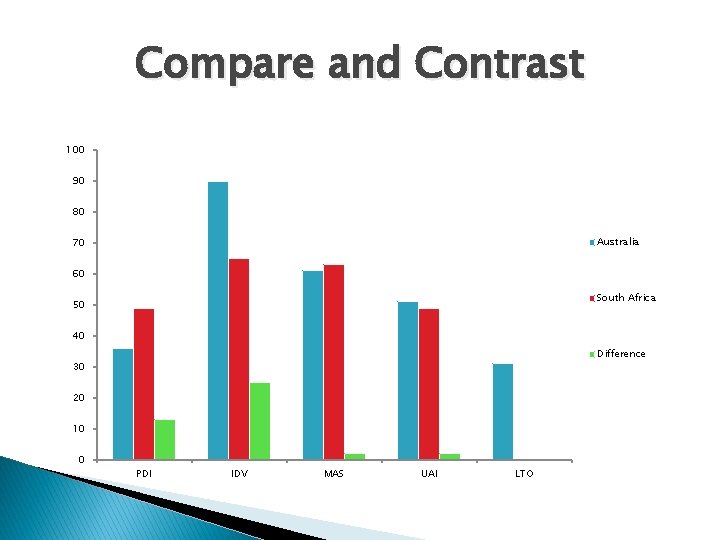
Compare and Contrast 100 90 80 Australia 70 60 South Africa 50 40 Difference 30 20 10 0 PDI IDV MAS UAI LTO
Summary
BEE Objectives: � Empower more ‘black’ people to own and manage enterprises. (Black owned- 51% & substantial Mgt control). � Achieve a significant change in the racial composition of ownership, mgt structures and in the skilled occupations of existing and new ventures. � Promote finance accessible. � Enable access to economic activities in order to empower rural and local communities.
BEE Objectives: � Endorse HR development of ‘black’ people through development programs. � Increase the extent to which communities, workers, co-operatives and other collective enterprises own and manage existing and new enterprises, and increase their access to economic activities, infrastructure and skills. � Government's preferential procurement policies must benefit black-owned enterprises
BEE Objectives: � Focus on developing the operational & financial capacity of BEE enterprises (SME’s & Black owned SME’s) � Increase the extent to which ‘black’ women own and manage existing and new enterprises, and facilitate their access to economic activities, infrastructure and skills training.
BEE scordcard Element Points Ownership 20 Management control 10 Employment equity 15 Skills development 15 Preferential procurement 20 Enterprise development 15 Socio-economic development 5 TOTAL 100
References: � http: //plato. stanford. edu/entries/affirmative -action/