
Chapter 2 Equal Opportunity and the Law Part

- Slides: 49
Chapter 2 Equal Opportunity and the Law Part One | Introduction Copyright © 2011 Pearson Education, Inc. publishing as Prentice Hall Power. Point Presentation by Charlie Cook The University of West Alabama
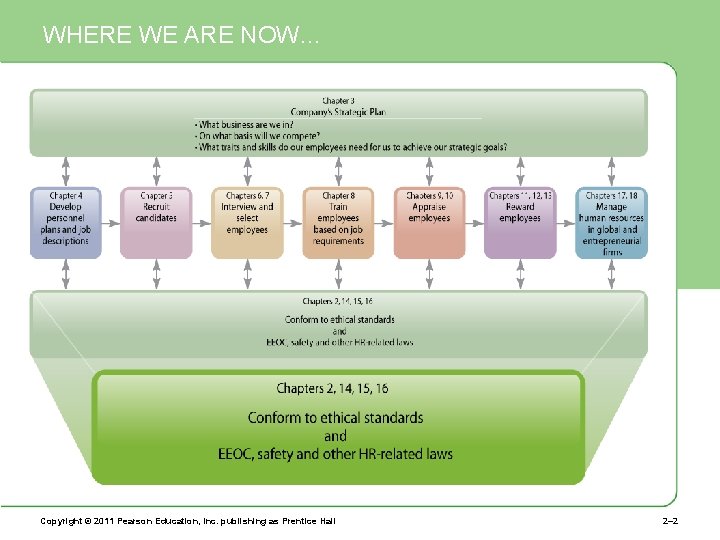
WHERE WE ARE NOW… Copyright © 2011 Pearson Education, Inc. publishing as Prentice Hall 2– 2
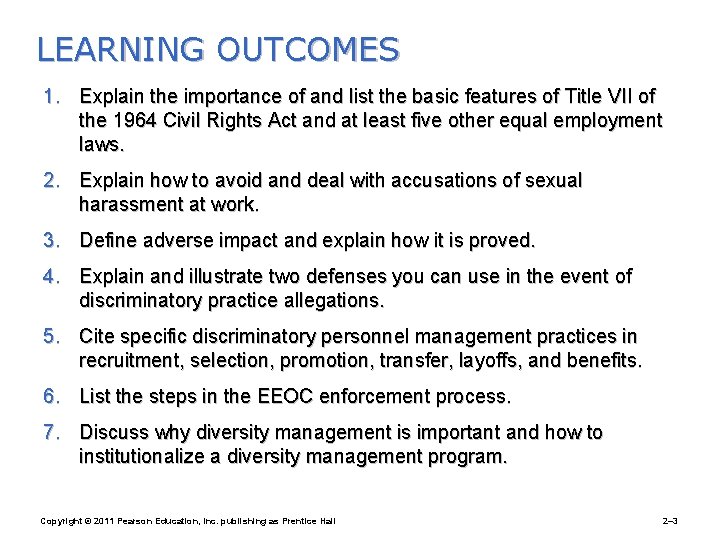
LEARNING OUTCOMES 1. Explain the importance of and list the basic features of Title VII of the 1964 Civil Rights Act and at least five other equal employment laws. 2. Explain how to avoid and deal with accusations of sexual harassment at work. 3. Define adverse impact and explain how it is proved. 4. Explain and illustrate two defenses you can use in the event of discriminatory practice allegations. 5. Cite specific discriminatory personnel management practices in recruitment, selection, promotion, transfer, layoffs, and benefits. 6. List the steps in the EEOC enforcement process. 7. Discuss why diversity management is important and how to institutionalize a diversity management program. Copyright © 2011 Pearson Education, Inc. publishing as Prentice Hall 2– 3
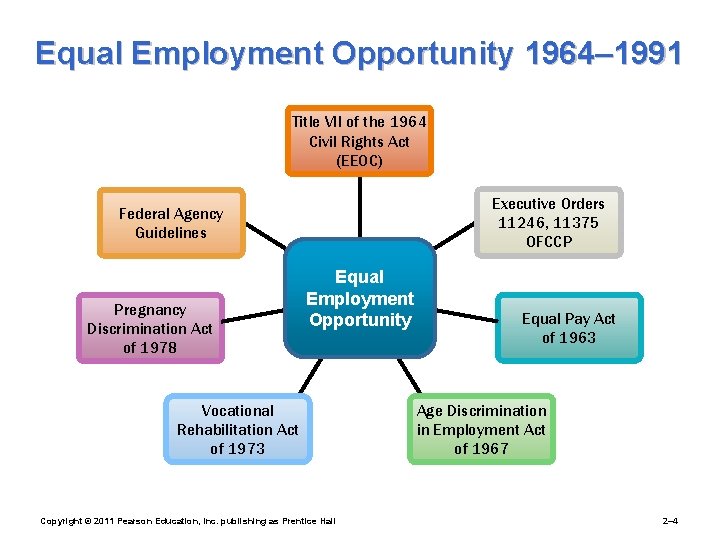
Equal Employment Opportunity 1964– 1991 Title VII of the 1964 Civil Rights Act (EEOC) Executive Orders 11246, 11375 OFCCP Federal Agency Guidelines Pregnancy Discrimination Act of 1978 Equal Employment Opportunity Vocational Rehabilitation Act of 1973 Copyright © 2011 Pearson Education, Inc. publishing as Prentice Hall Equal Pay Act of 1963 Age Discrimination in Employment Act of 1967 2– 4
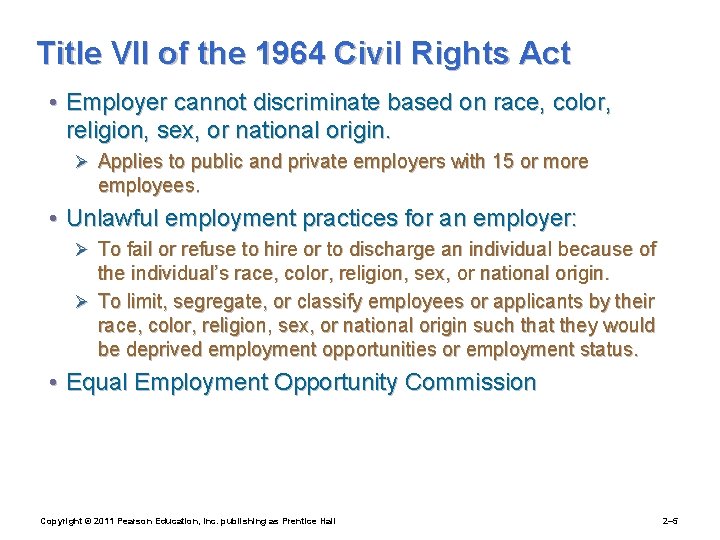
Title VII of the 1964 Civil Rights Act • Employer cannot discriminate based on race, color, religion, sex, or national origin. Ø Applies to public and private employers with 15 or more employees. • Unlawful employment practices for an employer: Ø To fail or refuse to hire or to discharge an individual because of the individual’s race, color, religion, sex, or national origin. Ø To limit, segregate, or classify employees or applicants by their race, color, religion, sex, or national origin such that they would be deprived employment opportunities or employment status. • Equal Employment Opportunity Commission Copyright © 2011 Pearson Education, Inc. publishing as Prentice Hall 2– 5
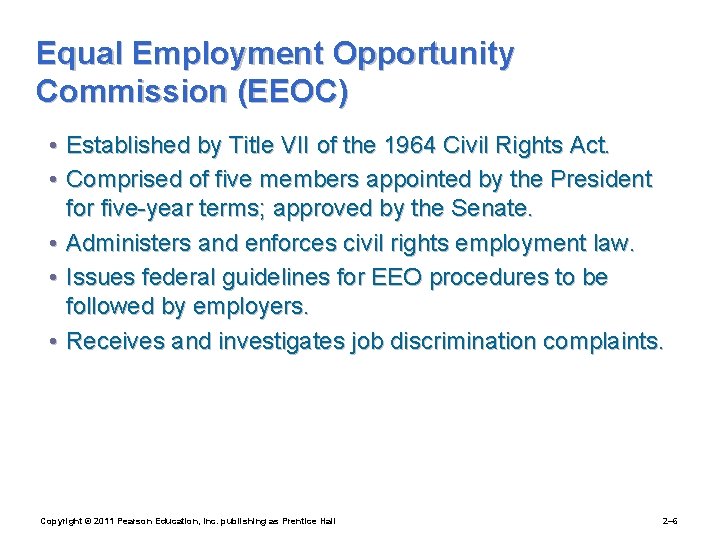
Equal Employment Opportunity Commission (EEOC) • Established by Title VII of the 1964 Civil Rights Act. • Comprised of five members appointed by the President for five-year terms; approved by the Senate. • Administers and enforces civil rights employment law. • Issues federal guidelines for EEO procedures to be followed by employers. • Receives and investigates job discrimination complaints. Copyright © 2011 Pearson Education, Inc. publishing as Prentice Hall 2– 6
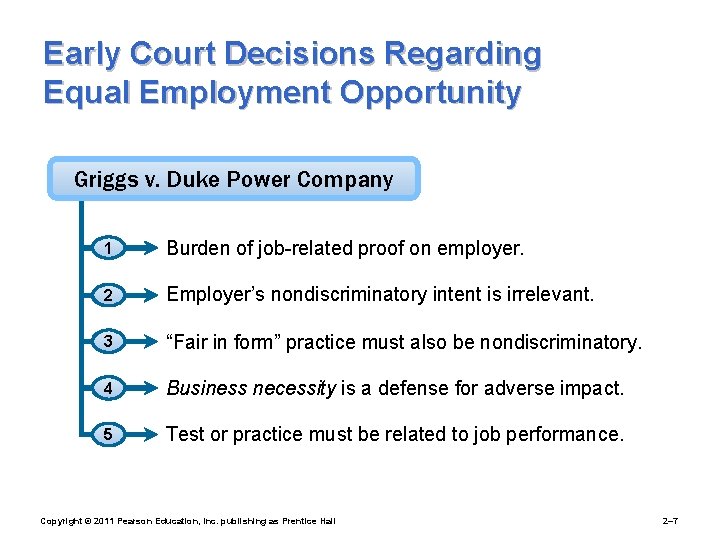
Early Court Decisions Regarding Equal Employment Opportunity Griggs v. Duke Power Company 1 Burden of job-related proof on employer. 2 Employer’s nondiscriminatory intent is irrelevant. 3 “Fair in form” practice must also be nondiscriminatory. 4 Business necessity is a defense for adverse impact. 5 Test or practice must be related to job performance. Copyright © 2011 Pearson Education, Inc. publishing as Prentice Hall 2– 7
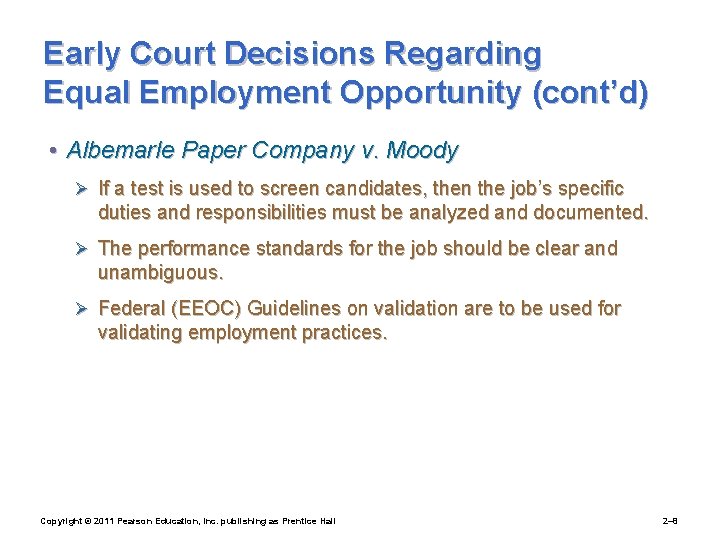
Early Court Decisions Regarding Equal Employment Opportunity (cont’d) • Albemarle Paper Company v. Moody Ø If a test is used to screen candidates, then the job’s specific duties and responsibilities must be analyzed and documented. Ø The performance standards for the job should be clear and unambiguous. Ø Federal (EEOC) Guidelines on validation are to be used for validating employment practices. Copyright © 2011 Pearson Education, Inc. publishing as Prentice Hall 2– 8
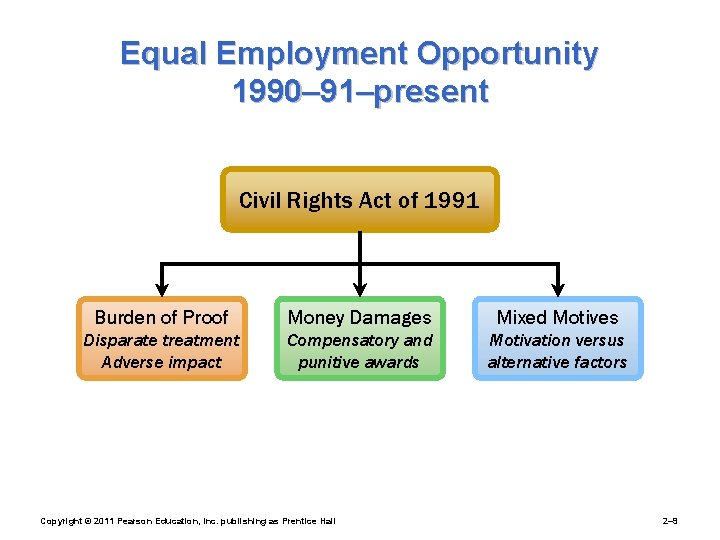
Equal Employment Opportunity 1990– 91–present Civil Rights Act of 1991 Burden of Proof Money Damages Mixed Motives Disparate treatment Adverse impact Compensatory and punitive awards Motivation versus alternative factors Copyright © 2011 Pearson Education, Inc. publishing as Prentice Hall 2– 9
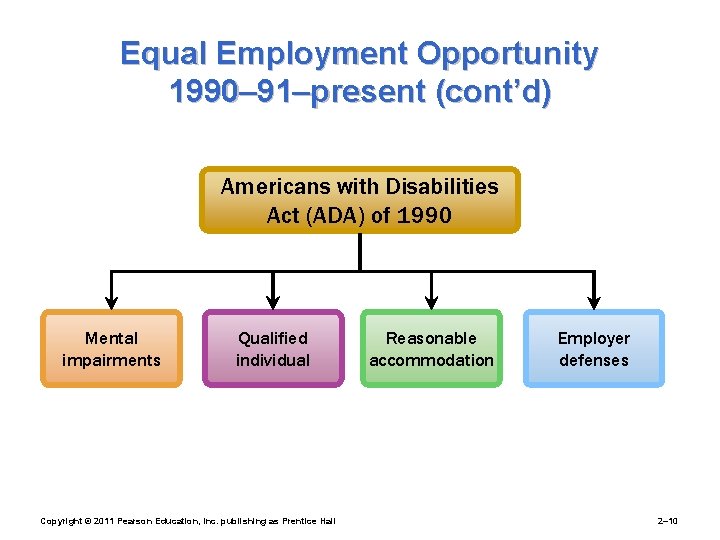
Equal Employment Opportunity 1990– 91–present (cont’d) Americans with Disabilities Act (ADA) of 1990 Mental impairments Qualified individual Copyright © 2011 Pearson Education, Inc. publishing as Prentice Hall Reasonable accommodation Employer defenses 2– 10
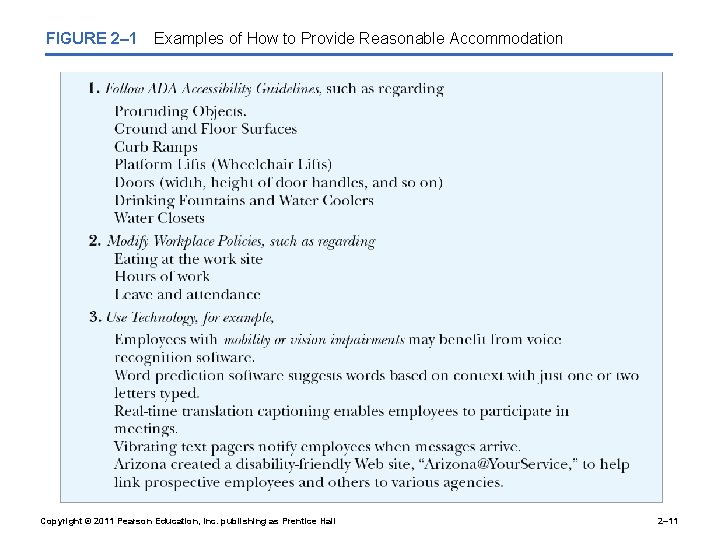
FIGURE 2– 1 Examples of How to Provide Reasonable Accommodation Copyright © 2011 Pearson Education, Inc. publishing as Prentice Hall 2– 11
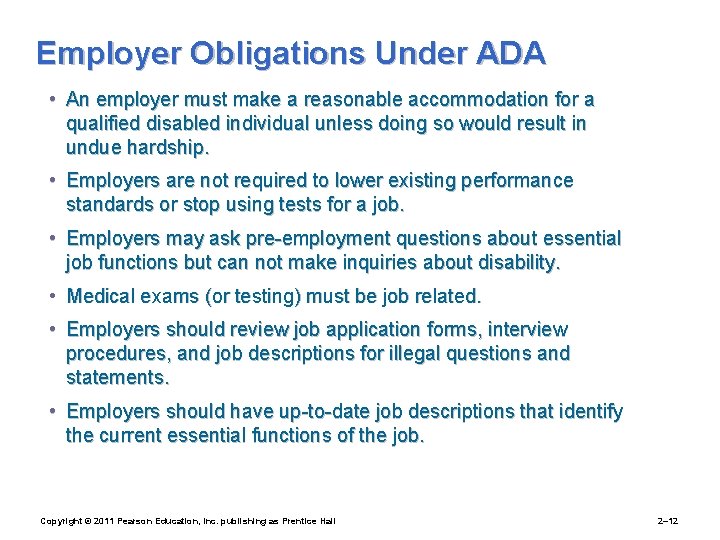
Employer Obligations Under ADA • An employer must make a reasonable accommodation for a qualified disabled individual unless doing so would result in undue hardship. • Employers are not required to lower existing performance standards or stop using tests for a job. • Employers may ask pre-employment questions about essential job functions but can not make inquiries about disability. • Medical exams (or testing) must be job related. • Employers should review job application forms, interview procedures, and job descriptions for illegal questions and statements. • Employers should have up-to-date job descriptions that identify the current essential functions of the job. Copyright © 2011 Pearson Education, Inc. publishing as Prentice Hall 2– 12
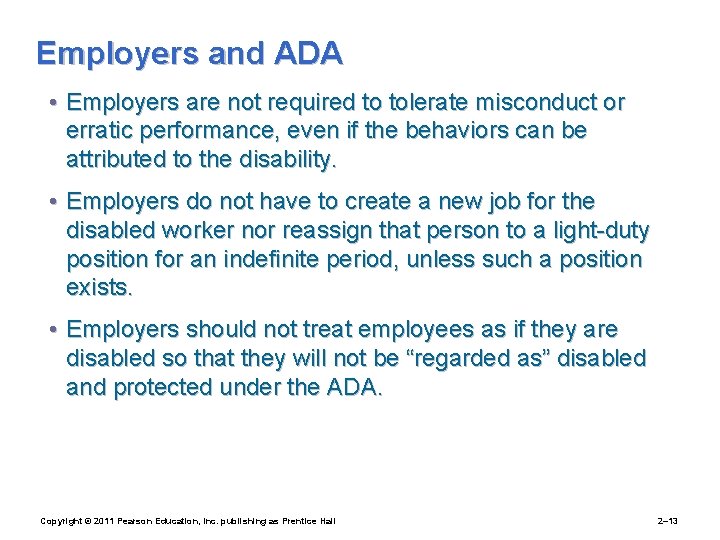
Employers and ADA • Employers are not required to tolerate misconduct or erratic performance, even if the behaviors can be attributed to the disability. • Employers do not have to create a new job for the disabled worker nor reassign that person to a light-duty position for an indefinite period, unless such a position exists. • Employers should not treat employees as if they are disabled so that they will not be “regarded as” disabled and protected under the ADA. Copyright © 2011 Pearson Education, Inc. publishing as Prentice Hall 2– 13
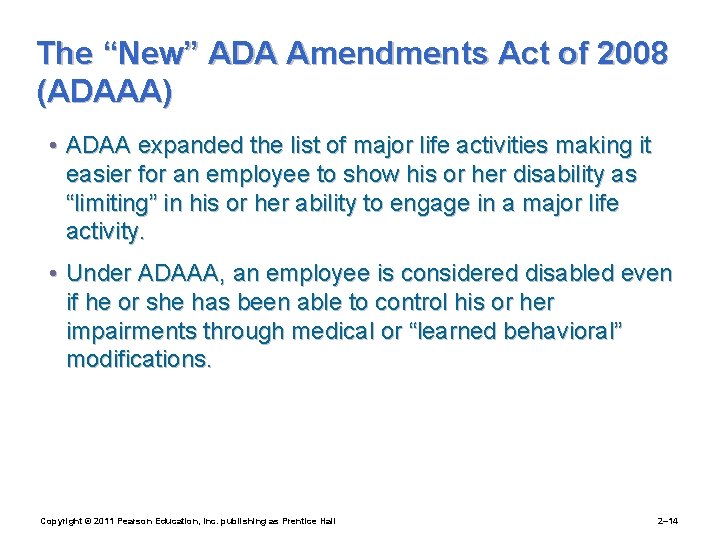
The “New” ADA Amendments Act of 2008 (ADAAA) • ADAA expanded the list of major life activities making it easier for an employee to show his or her disability as “limiting” in his or her ability to engage in a major life activity. • Under ADAAA, an employee is considered disabled even if he or she has been able to control his or her impairments through medical or “learned behavioral” modifications. Copyright © 2011 Pearson Education, Inc. publishing as Prentice Hall 2– 14
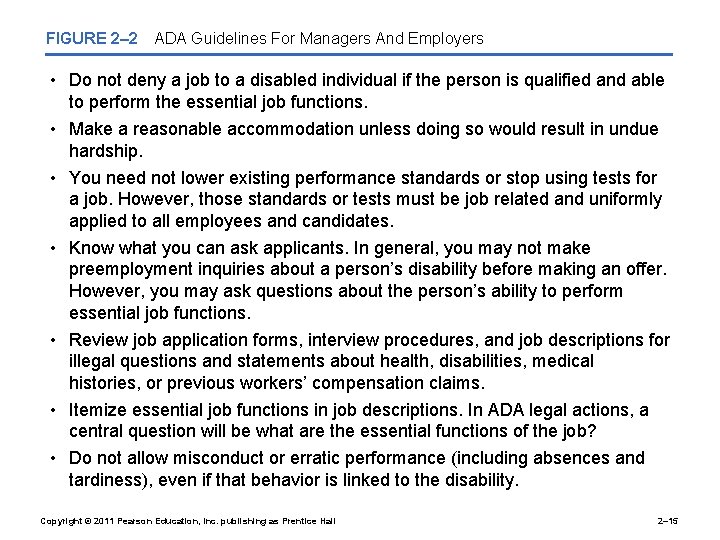
FIGURE 2– 2 ADA Guidelines For Managers And Employers • Do not deny a job to a disabled individual if the person is qualified and able to perform the essential job functions. • Make a reasonable accommodation unless doing so would result in undue hardship. • You need not lower existing performance standards or stop using tests for a job. However, those standards or tests must be job related and uniformly applied to all employees and candidates. • Know what you can ask applicants. In general, you may not make preemployment inquiries about a person’s disability before making an offer. However, you may ask questions about the person’s ability to perform essential job functions. • Review job application forms, interview procedures, and job descriptions for illegal questions and statements about health, disabilities, medical histories, or previous workers’ compensation claims. • Itemize essential job functions in job descriptions. In ADA legal actions, a central question will be what are the essential functions of the job? • Do not allow misconduct or erratic performance (including absences and tardiness), even if that behavior is linked to the disability. Copyright © 2011 Pearson Education, Inc. publishing as Prentice Hall 2– 15
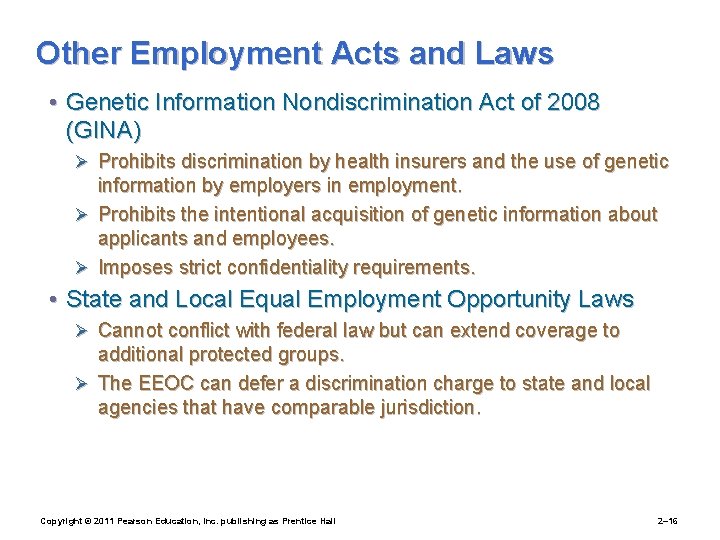
Other Employment Acts and Laws • Genetic Information Nondiscrimination Act of 2008 (GINA) Ø Prohibits discrimination by health insurers and the use of genetic information by employers in employment. Ø Prohibits the intentional acquisition of genetic information about applicants and employees. Ø Imposes strict confidentiality requirements. • State and Local Equal Employment Opportunity Laws Ø Cannot conflict with federal law but can extend coverage to additional protected groups. Ø The EEOC can defer a discrimination charge to state and local agencies that have comparable jurisdiction. Copyright © 2011 Pearson Education, Inc. publishing as Prentice Hall 2– 16
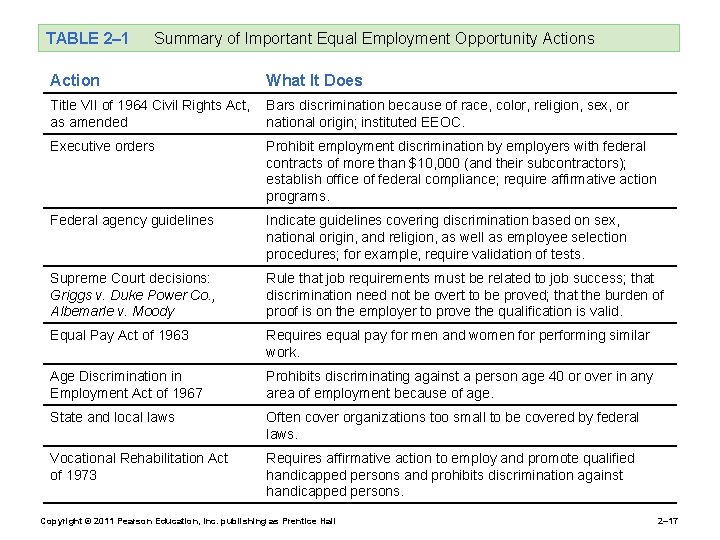
TABLE 2– 1 Summary of Important Equal Employment Opportunity Actions Action What It Does Title VII of 1964 Civil Rights Act, as amended Bars discrimination because of race, color, religion, sex, or national origin; instituted EEOC. Executive orders Prohibit employment discrimination by employers with federal contracts of more than $10, 000 (and their subcontractors); establish office of federal compliance; require affirmative action programs. Federal agency guidelines Indicate guidelines covering discrimination based on sex, national origin, and religion, as well as employee selection procedures; for example, require validation of tests. Supreme Court decisions: Griggs v. Duke Power Co. , Albemarle v. Moody Rule that job requirements must be related to job success; that discrimination need not be overt to be proved; that the burden of proof is on the employer to prove the qualification is valid. Equal Pay Act of 1963 Requires equal pay for men and women for performing similar work. Age Discrimination in Employment Act of 1967 Prohibits discriminating against a person age 40 or over in any area of employment because of age. State and local laws Often cover organizations too small to be covered by federal laws. Vocational Rehabilitation Act of 1973 Requires affirmative action to employ and promote qualified handicapped persons and prohibits discrimination against handicapped persons. Copyright © 2011 Pearson Education, Inc. publishing as Prentice Hall 2– 17
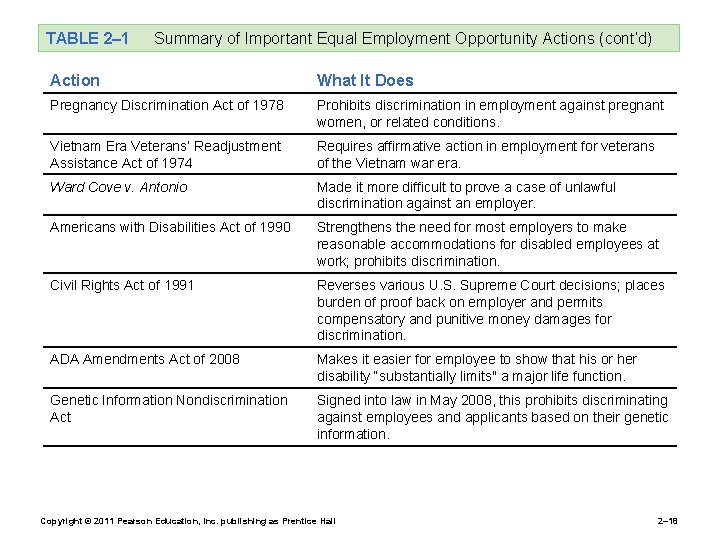
TABLE 2– 1 Summary of Important Equal Employment Opportunity Actions (cont’d) Action What It Does Pregnancy Discrimination Act of 1978 Prohibits discrimination in employment against pregnant women, or related conditions. Vietnam Era Veterans’ Readjustment Assistance Act of 1974 Requires affirmative action in employment for veterans of the Vietnam war era. Ward Cove v. Antonio Made it more difficult to prove a case of unlawful discrimination against an employer. Americans with Disabilities Act of 1990 Strengthens the need for most employers to make reasonable accommodations for disabled employees at work; prohibits discrimination. Civil Rights Act of 1991 Reverses various U. S. Supreme Court decisions; places burden of proof back on employer and permits compensatory and punitive money damages for discrimination. ADA Amendments Act of 2008 Makes it easier for employee to show that his or her disability “substantially limits" a major life function. Genetic Information Nondiscrimination Act Signed into law in May 2008, this prohibits discriminating against employees and applicants based on their genetic information. Copyright © 2011 Pearson Education, Inc. publishing as Prentice Hall 2– 18
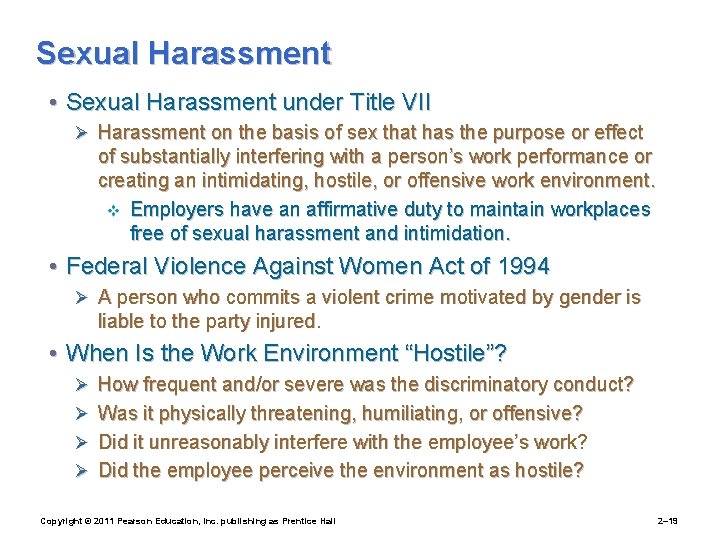
Sexual Harassment • Sexual Harassment under Title VII Ø Harassment on the basis of sex that has the purpose or effect of substantially interfering with a person’s work performance or creating an intimidating, hostile, or offensive work environment. v Employers have an affirmative duty to maintain workplaces free of sexual harassment and intimidation. • Federal Violence Against Women Act of 1994 Ø A person who commits a violent crime motivated by gender is liable to the party injured. • When Is the Work Environment “Hostile”? Ø How frequent and/or severe was the discriminatory conduct? Ø Was it physically threatening, humiliating, or offensive? Ø Did it unreasonably interfere with the employee’s work? Ø Did the employee perceive the environment as hostile? Copyright © 2011 Pearson Education, Inc. publishing as Prentice Hall 2– 19
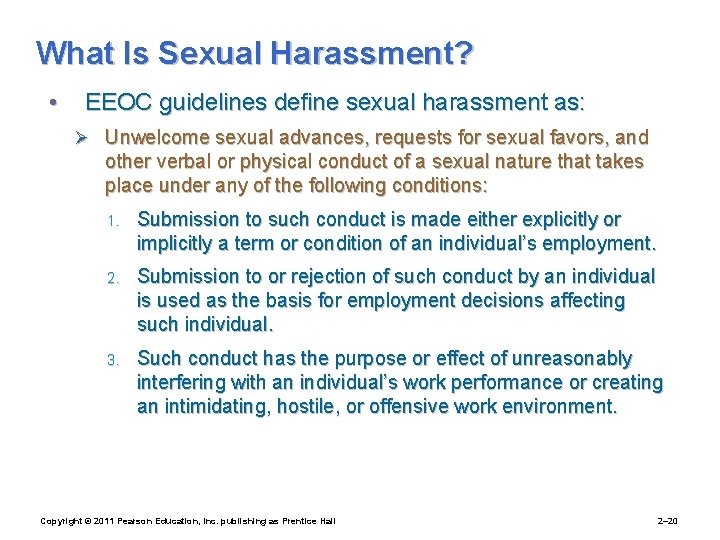
What Is Sexual Harassment? • EEOC guidelines define sexual harassment as: Ø Unwelcome sexual advances, requests for sexual favors, and other verbal or physical conduct of a sexual nature that takes place under any of the following conditions: 1. Submission to such conduct is made either explicitly or implicitly a term or condition of an individual’s employment. 2. Submission to or rejection of such conduct by an individual is used as the basis for employment decisions affecting such individual. 3. Such conduct has the purpose or effect of unreasonably interfering with an individual’s work performance or creating an intimidating, hostile, or offensive work environment. Copyright © 2011 Pearson Education, Inc. publishing as Prentice Hall 2– 20
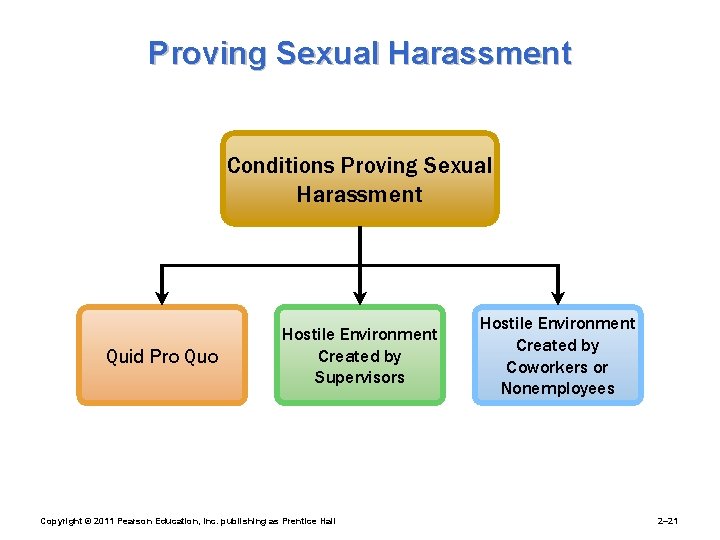
Proving Sexual Harassment Conditions Proving Sexual Harassment Quid Pro Quo Hostile Environment Created by Supervisors Copyright © 2011 Pearson Education, Inc. publishing as Prentice Hall Hostile Environment Created by Coworkers or Nonemployees 2– 21
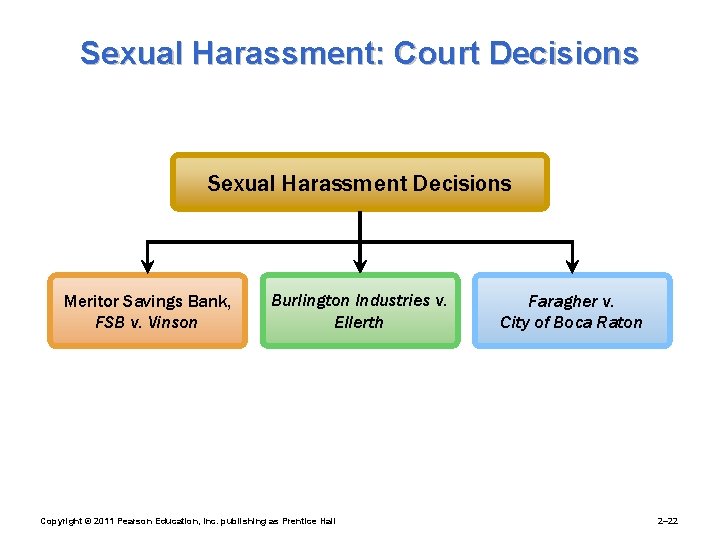
Sexual Harassment: Court Decisions Sexual Harassment Decisions Meritor Savings Bank, FSB v. Vinson Burlington Industries v. Ellerth Copyright © 2011 Pearson Education, Inc. publishing as Prentice Hall Faragher v. City of Boca Raton 2– 22
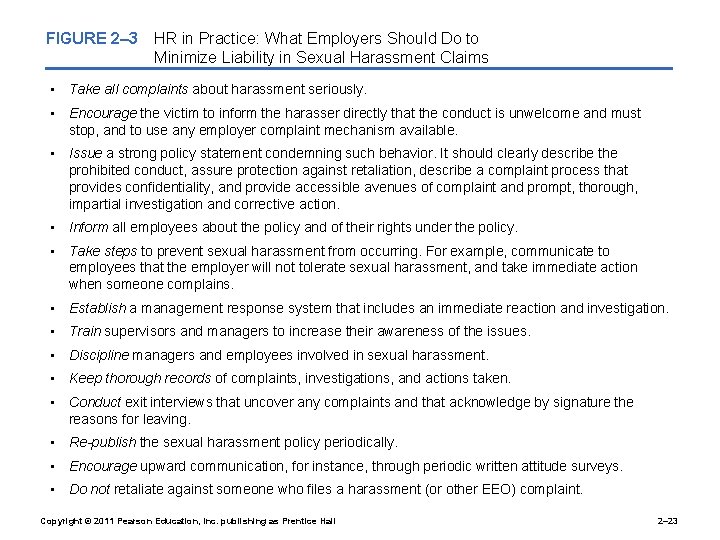
FIGURE 2– 3 HR in Practice: What Employers Should Do to Minimize Liability in Sexual Harassment Claims • Take all complaints about harassment seriously. • Encourage the victim to inform the harasser directly that the conduct is unwelcome and must stop, and to use any employer complaint mechanism available. • Issue a strong policy statement condemning such behavior. It should clearly describe the prohibited conduct, assure protection against retaliation, describe a complaint process that provides confidentiality, and provide accessible avenues of complaint and prompt, thorough, impartial investigation and corrective action. • Inform all employees about the policy and of their rights under the policy. • Take steps to prevent sexual harassment from occurring. For example, communicate to employees that the employer will not tolerate sexual harassment, and take immediate action when someone complains. • Establish a management response system that includes an immediate reaction and investigation. • Train supervisors and managers to increase their awareness of the issues. • Discipline managers and employees involved in sexual harassment. • Keep thorough records of complaints, investigations, and actions taken. • Conduct exit interviews that uncover any complaints and that acknowledge by signature the reasons for leaving. • Re-publish the sexual harassment policy periodically. • Encourage upward communication, for instance, through periodic written attitude surveys. • Do not retaliate against someone who files a harassment (or other EEO) complaint. Copyright © 2011 Pearson Education, Inc. publishing as Prentice Hall 2– 23
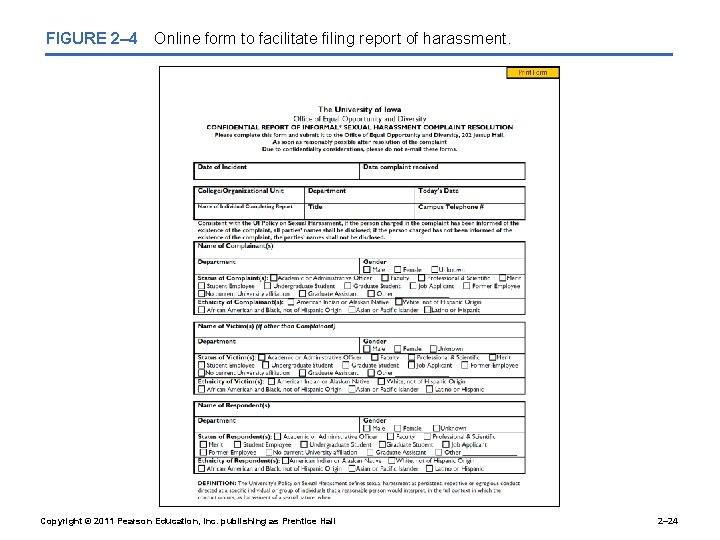
FIGURE 2– 4 Online form to facilitate filing report of harassment. Copyright © 2011 Pearson Education, Inc. publishing as Prentice Hall 2– 24
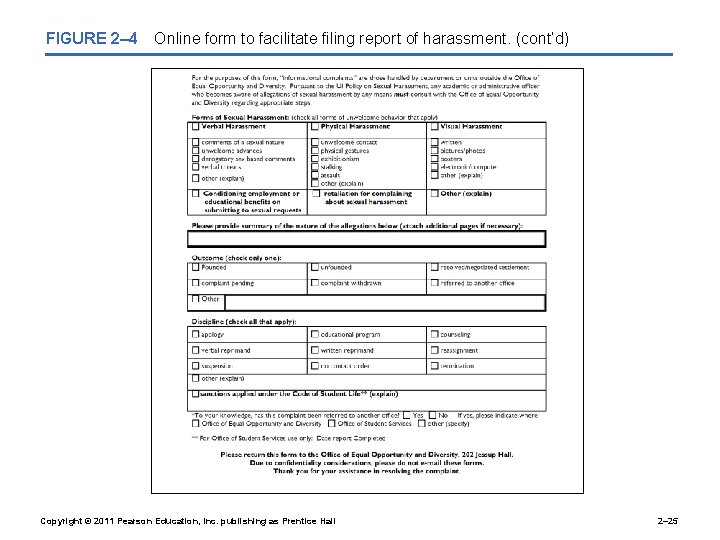
FIGURE 2– 4 Online form to facilitate filing report of harassment. (cont’d) Copyright © 2011 Pearson Education, Inc. publishing as Prentice Hall 2– 25
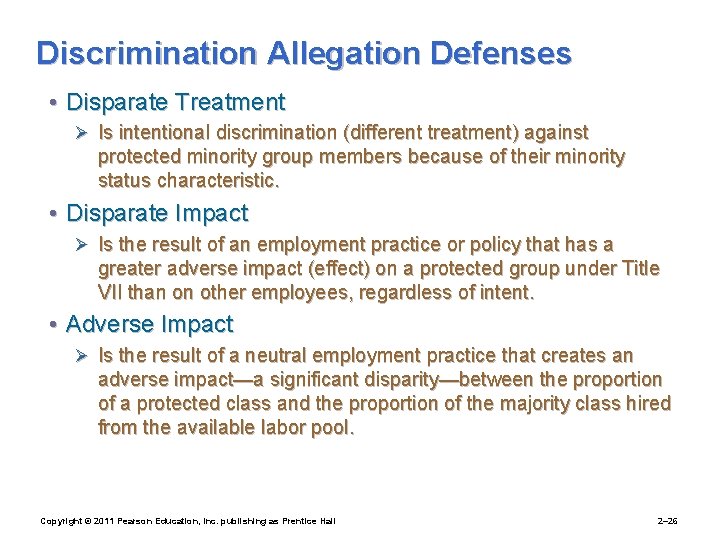
Discrimination Allegation Defenses • Disparate Treatment Ø Is intentional discrimination (different treatment) against protected minority group members because of their minority status characteristic. • Disparate Impact Ø Is the result of an employment practice or policy that has a greater adverse impact (effect) on a protected group under Title VII than on other employees, regardless of intent. • Adverse Impact Ø Is the result of a neutral employment practice that creates an adverse impact—a significant disparity—between the proportion of a protected class and the proportion of the majority class hired from the available labor pool. Copyright © 2011 Pearson Education, Inc. publishing as Prentice Hall 2– 26
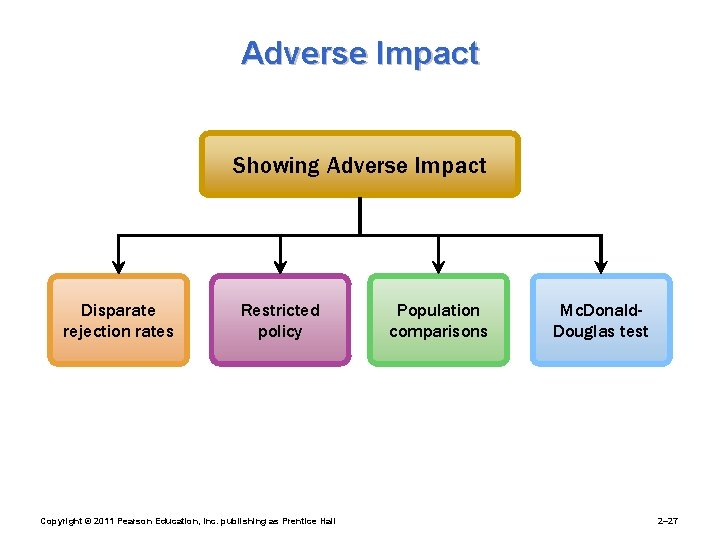
Adverse Impact Showing Adverse Impact Disparate rejection rates Restricted policy Copyright © 2011 Pearson Education, Inc. publishing as Prentice Hall Population comparisons Mc. Donald. Douglas test 2– 27
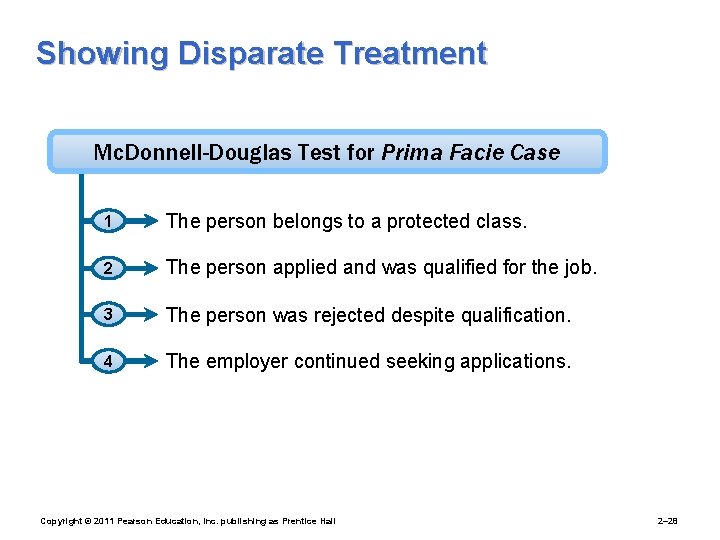
Showing Disparate Treatment Mc. Donnell-Douglas Test for Prima Facie Case 1 The person belongs to a protected class. 2 The person applied and was qualified for the job. 3 The person was rejected despite qualification. 4 The employer continued seeking applications. Copyright © 2011 Pearson Education, Inc. publishing as Prentice Hall 2– 28
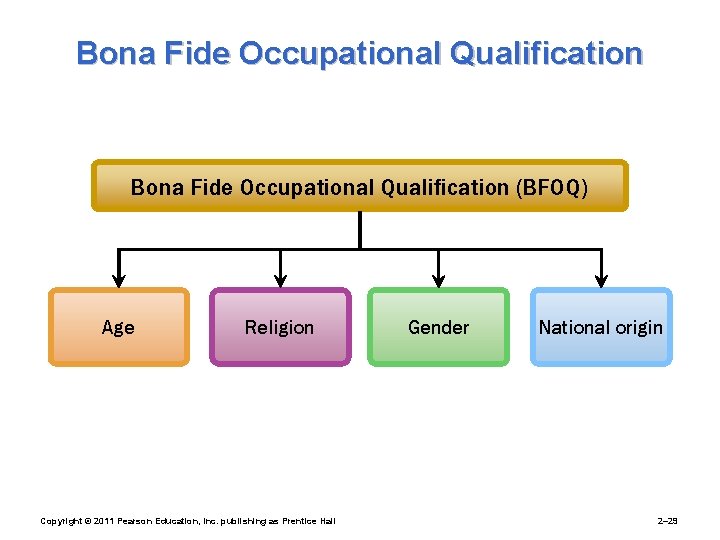
Bona Fide Occupational Qualification (BFOQ) Age Religion Copyright © 2011 Pearson Education, Inc. publishing as Prentice Hall Gender National origin 2– 29
Business Necessity • “Business Necessity” Ø A defense requiring employers to show that there is an overriding business purpose (i. e. , “irresistible demand”) for a discriminatory practice. v Spurlock v. United Airlines • Validity Ø The degree to which the test or other employment practice is related to or predicts performance on the job can serve as a business necessity defense. Copyright © 2011 Pearson Education, Inc. publishing as Prentice Hall 2– 30
Other Considerations in Discriminatory Practice Defenses 1. Good intentions are no excuse. 2. Employers cannot hide behind collective bargaining agreements—equal opportunity laws override union contract agreements. 3. Firms should react by agreeing to eliminate an illegal practice and (when required) by compensating the people discriminated against. Copyright © 2011 Pearson Education, Inc. publishing as Prentice Hall 2– 31
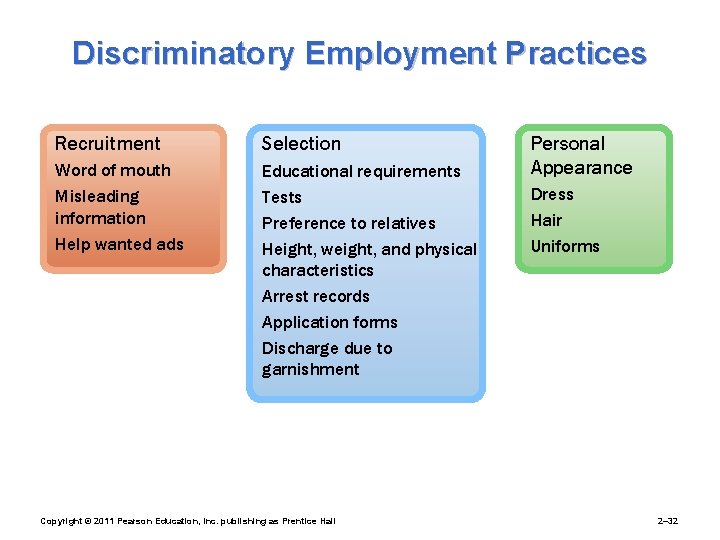
Discriminatory Employment Practices Recruitment Selection Word of mouth Misleading information Help wanted ads Educational requirements Tests Preference to relatives Height, weight, and physical characteristics Arrest records Application forms Discharge due to garnishment Copyright © 2011 Pearson Education, Inc. publishing as Prentice Hall Personal Appearance Dress Hair Uniforms 2– 32
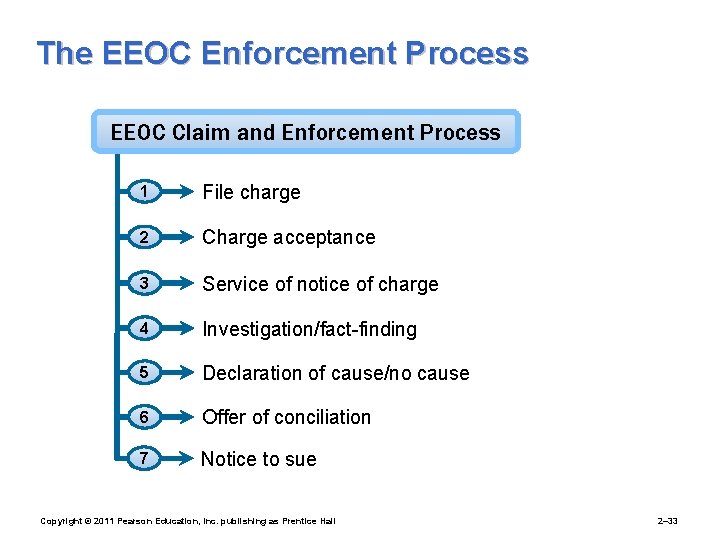
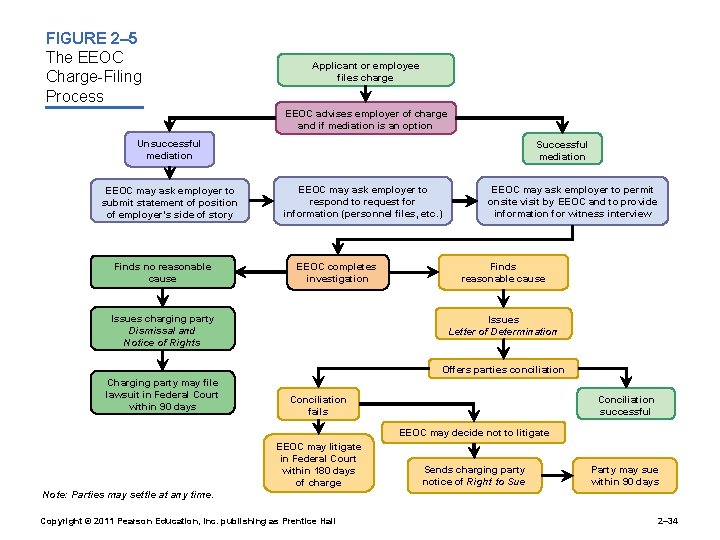
The EEOC Enforcement Process EEOC Claim and Enforcement Process 1 File charge 2 Charge acceptance 3 Service of notice of charge 4 Investigation/fact-finding 5 Declaration of cause/no cause 6 Offer of conciliation 7 Notice to sue Copyright © 2011 Pearson Education, Inc. publishing as Prentice Hall 2– 33
FIGURE 2– 5 The EEOC Charge-Filing Process Applicant or employee files charge EEOC advises employer of charge and if mediation is an option Unsuccessful mediation EEOC may ask employer to submit statement of position of employer’s side of story Finds no reasonable cause Successful mediation EEOC may ask employer to respond to request for information (personnel files, etc. ) EEOC completes investigation Issues charging party Dismissal and Notice of Rights EEOC may ask employer to permit onsite visit by EEOC and to provide information for witness interview Finds reasonable cause Issues Letter of Determination Offers parties conciliation Charging party may file lawsuit in Federal Court within 90 days Conciliation successful Conciliation fails EEOC may decide not to litigate EEOC may litigate in Federal Court within 180 days of charge Sends charging party notice of Right to Sue Party may sue within 90 days Note: Parties may settle at any time. Copyright © 2011 Pearson Education, Inc. publishing as Prentice Hall 2– 34
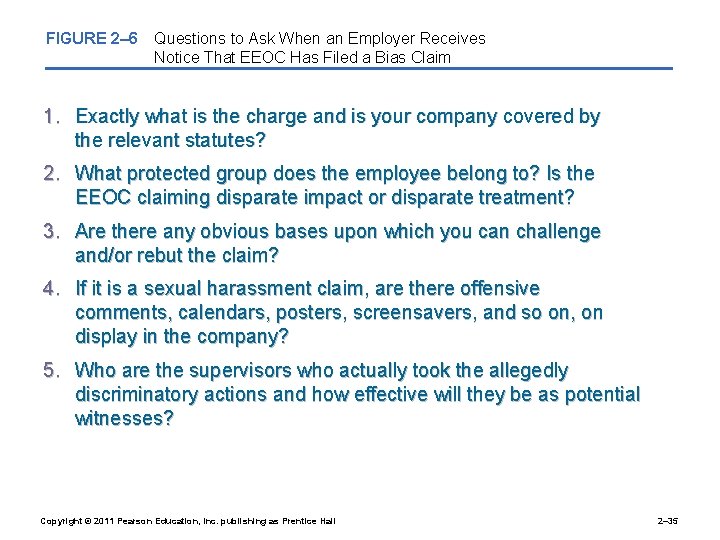
FIGURE 2– 6 Questions to Ask When an Employer Receives Notice That EEOC Has Filed a Bias Claim 1. Exactly what is the charge and is your company covered by the relevant statutes? 2. What protected group does the employee belong to? Is the EEOC claiming disparate impact or disparate treatment? 3. Are there any obvious bases upon which you can challenge and/or rebut the claim? 4. If it is a sexual harassment claim, are there offensive comments, calendars, posters, screensavers, and so on, on display in the company? 5. Who are the supervisors who actually took the allegedly discriminatory actions and how effective will they be as potential witnesses? Copyright © 2011 Pearson Education, Inc. publishing as Prentice Hall 2– 35
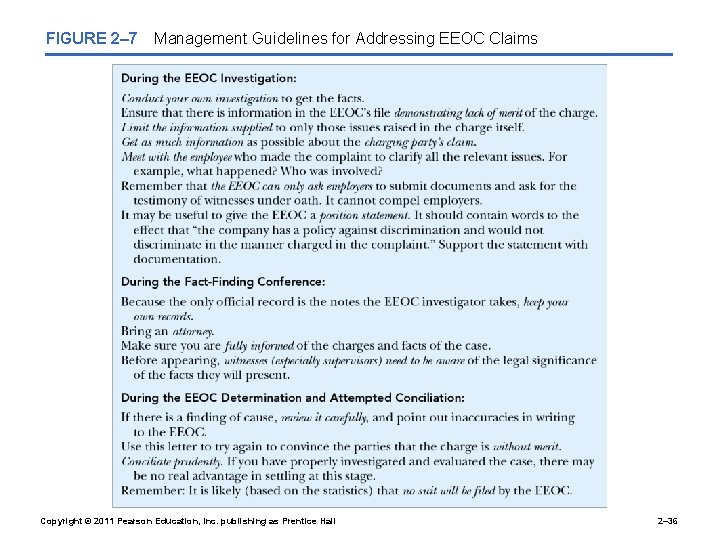
FIGURE 2– 7 Management Guidelines for Addressing EEOC Claims Copyright © 2011 Pearson Education, Inc. publishing as Prentice Hall 2– 36
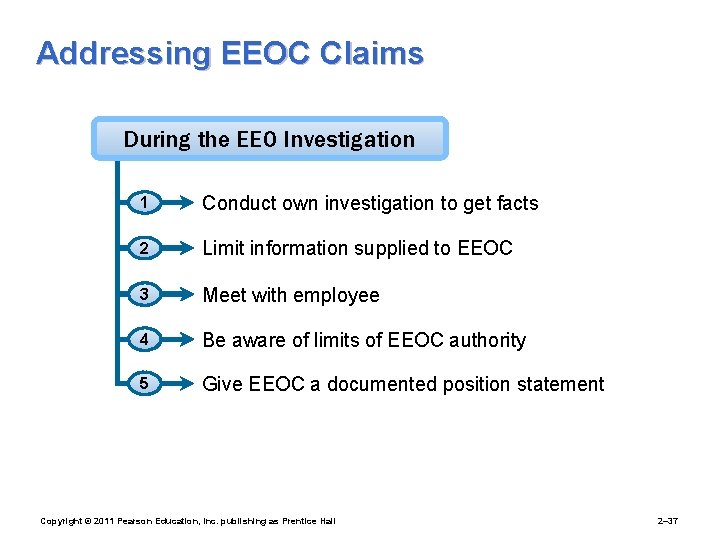
Addressing EEOC Claims During the EEO Investigation 1 Conduct own investigation to get facts 2 Limit information supplied to EEOC 3 Meet with employee 4 Be aware of limits of EEOC authority 5 Give EEOC a documented position statement Copyright © 2011 Pearson Education, Inc. publishing as Prentice Hall 2– 37
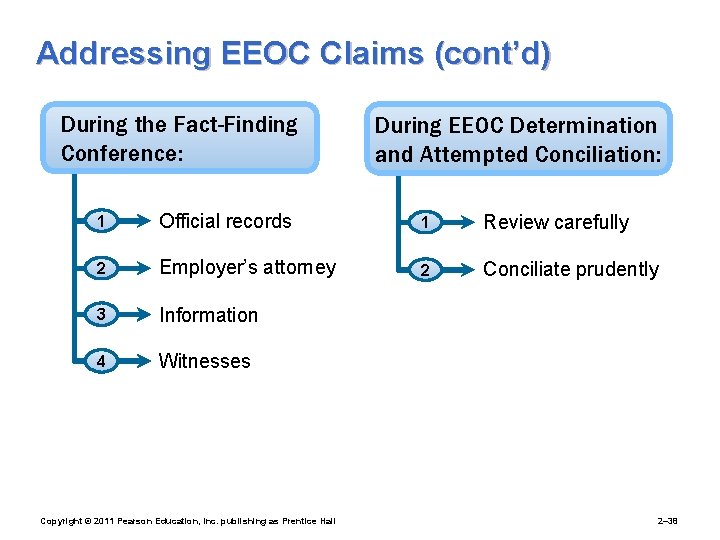
Addressing EEOC Claims (cont’d) During the Fact-Finding Conference: During EEOC Determination and Attempted Conciliation: 1 Official records 1 Review carefully 2 Employer’s attorney 2 Conciliate prudently 3 Information 4 Witnesses Copyright © 2011 Pearson Education, Inc. publishing as Prentice Hall 2– 38
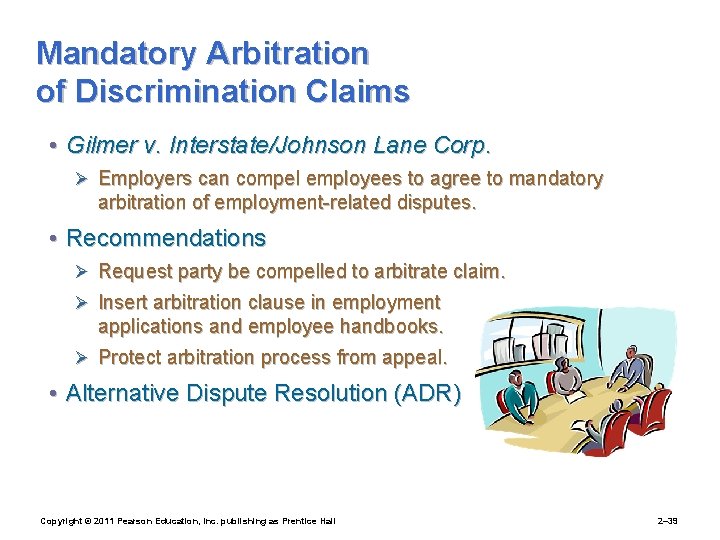
Mandatory Arbitration of Discrimination Claims • Gilmer v. Interstate/Johnson Lane Corp. Ø Employers can compel employees to agree to mandatory arbitration of employment-related disputes. • Recommendations Ø Request party be compelled to arbitrate claim. Ø Insert arbitration clause in employment applications and employee handbooks. Ø Protect arbitration process from appeal. • Alternative Dispute Resolution (ADR) Copyright © 2011 Pearson Education, Inc. publishing as Prentice Hall 2– 39
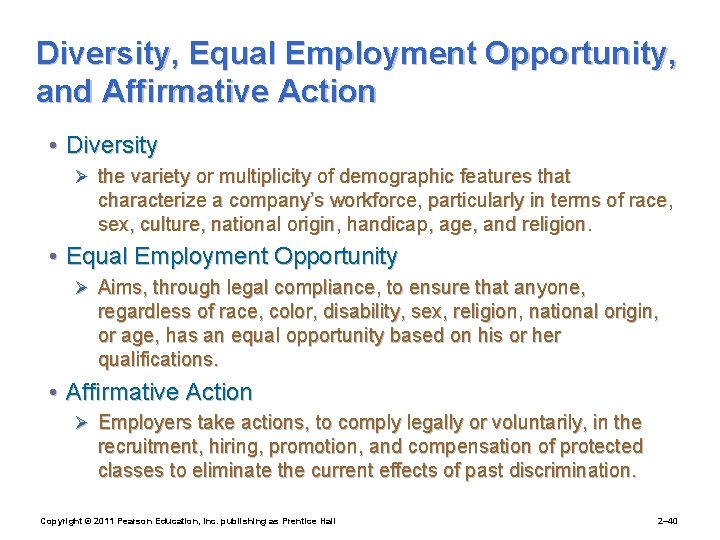
Diversity, Equal Employment Opportunity, and Affirmative Action • Diversity Ø the variety or multiplicity of demographic features that characterize a company’s workforce, particularly in terms of race, sex, culture, national origin, handicap, age, and religion. • Equal Employment Opportunity Ø Aims, through legal compliance, to ensure that anyone, regardless of race, color, disability, sex, religion, national origin, or age, has an equal opportunity based on his or her qualifications. • Affirmative Action Ø Employers take actions, to comply legally or voluntarily, in the recruitment, hiring, promotion, and compensation of protected classes to eliminate the current effects of past discrimination. Copyright © 2011 Pearson Education, Inc. publishing as Prentice Hall 2– 40
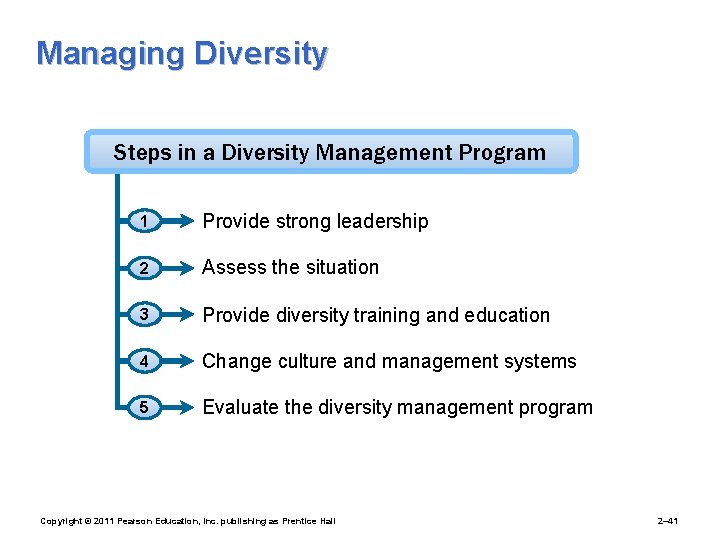
Managing Diversity Steps in a Diversity Management Program 1 Provide strong leadership 2 Assess the situation 3 Provide diversity training and education 4 Change culture and management systems 5 Evaluate the diversity management program Copyright © 2011 Pearson Education, Inc. publishing as Prentice Hall 2– 41
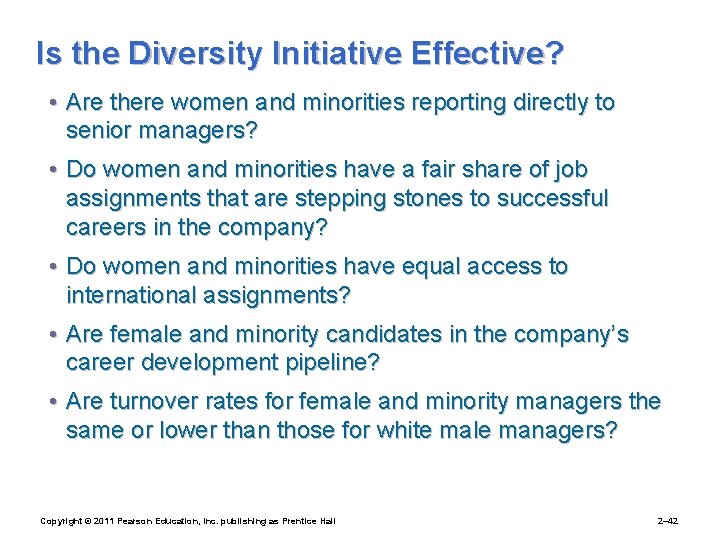
Is the Diversity Initiative Effective? • Are there women and minorities reporting directly to senior managers? • Do women and minorities have a fair share of job assignments that are stepping stones to successful careers in the company? • Do women and minorities have equal access to international assignments? • Are female and minority candidates in the company’s career development pipeline? • Are turnover rates for female and minority managers the same or lower than those for white male managers? Copyright © 2011 Pearson Education, Inc. publishing as Prentice Hall 2– 42
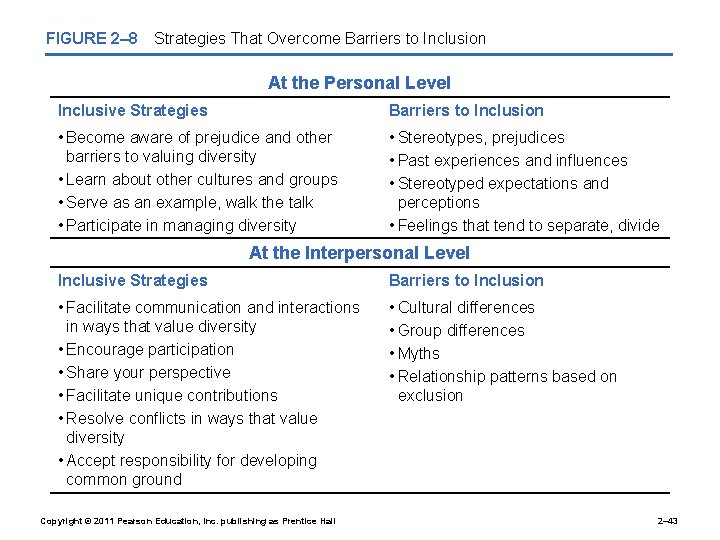
FIGURE 2– 8 Strategies That Overcome Barriers to Inclusion At the Personal Level Inclusive Strategies Barriers to Inclusion • Become aware of prejudice and other barriers to valuing diversity • Learn about other cultures and groups • Serve as an example, walk the talk • Participate in managing diversity • Stereotypes, prejudices • Past experiences and influences • Stereotyped expectations and perceptions • Feelings that tend to separate, divide At the Interpersonal Level Inclusive Strategies Barriers to Inclusion • Facilitate communication and interactions in ways that value diversity • Encourage participation • Share your perspective • Facilitate unique contributions • Resolve conflicts in ways that value diversity • Accept responsibility for developing common ground • Cultural differences • Group differences • Myths • Relationship patterns based on exclusion Copyright © 2011 Pearson Education, Inc. publishing as Prentice Hall 2– 43
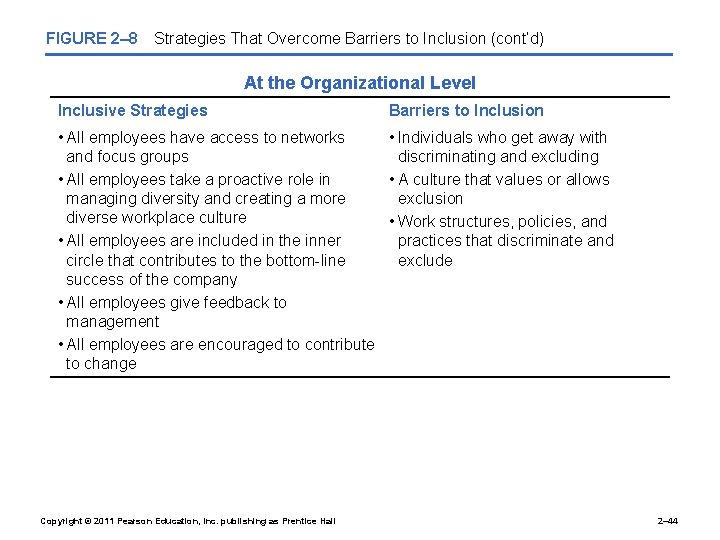
FIGURE 2– 8 Strategies That Overcome Barriers to Inclusion (cont’d) At the Organizational Level Inclusive Strategies Barriers to Inclusion • All employees have access to networks • Individuals who get away with and focus groups discriminating and excluding • All employees take a proactive role in • A culture that values or allows managing diversity and creating a more exclusion diverse workplace culture • Work structures, policies, and • All employees are included in the inner practices that discriminate and circle that contributes to the bottom-line exclude success of the company • All employees give feedback to management • All employees are encouraged to contribute to change Copyright © 2011 Pearson Education, Inc. publishing as Prentice Hall 2– 44
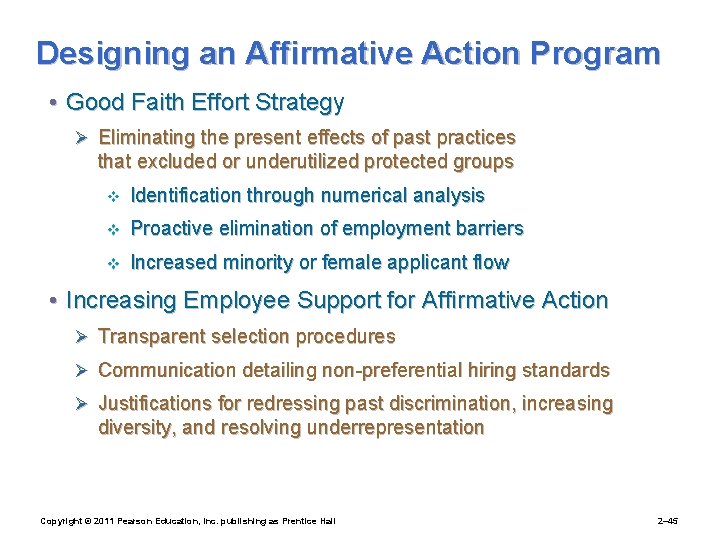
Designing an Affirmative Action Program • Good Faith Effort Strategy Ø Eliminating the present effects of past practices that excluded or underutilized protected groups v Identification through numerical analysis v Proactive elimination of employment barriers v Increased minority or female applicant flow • Increasing Employee Support for Affirmative Action Ø Transparent selection procedures Ø Communication detailing non-preferential hiring standards Ø Justifications for redressing past discrimination, increasing diversity, and resolving underrepresentation Copyright © 2011 Pearson Education, Inc. publishing as Prentice Hall 2– 45
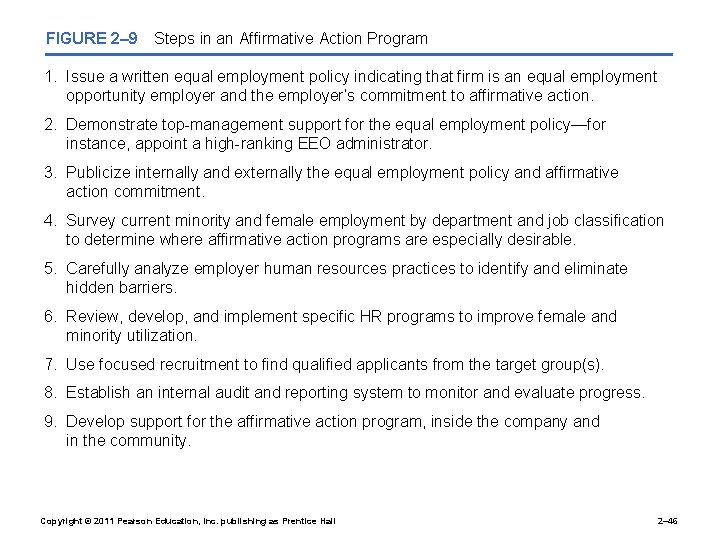
FIGURE 2– 9 Steps in an Affirmative Action Program 1. Issue a written equal employment policy indicating that firm is an equal employment opportunity employer and the employer’s commitment to affirmative action. 2. Demonstrate top-management support for the equal employment policy—for instance, appoint a high-ranking EEO administrator. 3. Publicize internally and externally the equal employment policy and affirmative action commitment. 4. Survey current minority and female employment by department and job classification to determine where affirmative action programs are especially desirable. 5. Carefully analyze employer human resources practices to identify and eliminate hidden barriers. 6. Review, develop, and implement specific HR programs to improve female and minority utilization. 7. Use focused recruitment to find qualified applicants from the target group(s). 8. Establish an internal audit and reporting system to monitor and evaluate progress. 9. Develop support for the affirmative action program, inside the company and in the community. Copyright © 2011 Pearson Education, Inc. publishing as Prentice Hall 2– 46
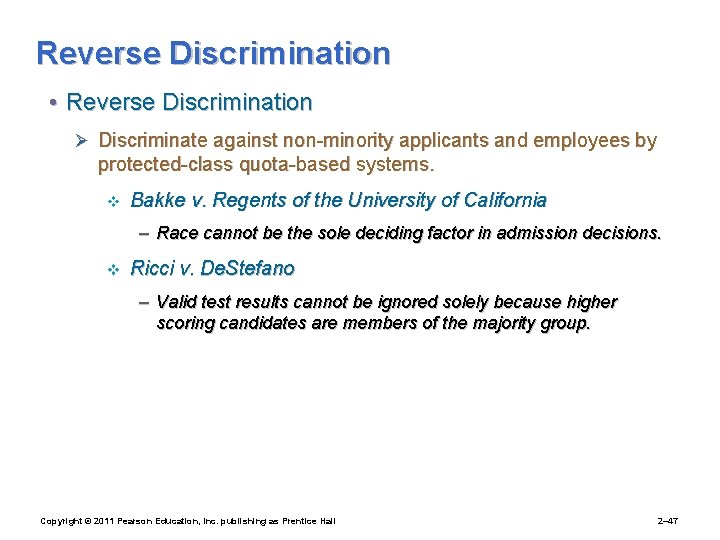
Reverse Discrimination • Reverse Discrimination Ø Discriminate against non-minority applicants and employees by protected-class quota-based systems. v Bakke v. Regents of the University of California – Race cannot be the sole deciding factor in admission decisions. v Ricci v. De. Stefano – Valid test results cannot be ignored solely because higher scoring candidates are members of the majority group. Copyright © 2011 Pearson Education, Inc. publishing as Prentice Hall 2– 47
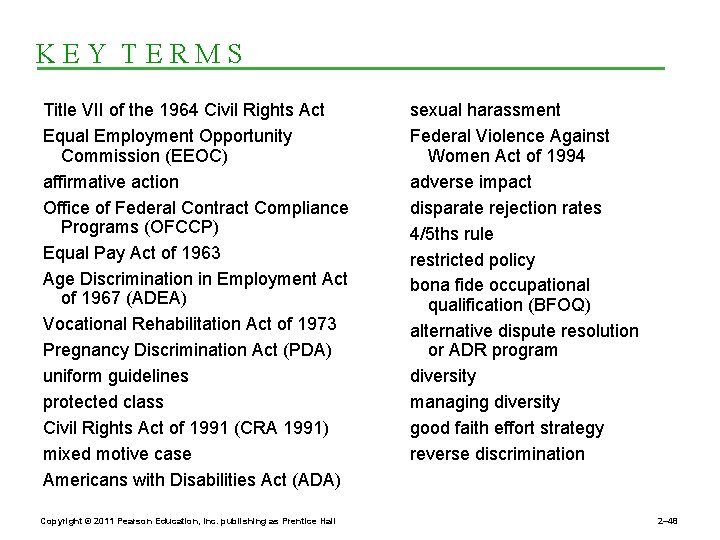
KEY TERMS Title VII of the 1964 Civil Rights Act Equal Employment Opportunity Commission (EEOC) affirmative action Office of Federal Contract Compliance Programs (OFCCP) Equal Pay Act of 1963 Age Discrimination in Employment Act of 1967 (ADEA) Vocational Rehabilitation Act of 1973 Pregnancy Discrimination Act (PDA) uniform guidelines protected class Civil Rights Act of 1991 (CRA 1991) mixed motive case Americans with Disabilities Act (ADA) Copyright © 2011 Pearson Education, Inc. publishing as Prentice Hall sexual harassment Federal Violence Against Women Act of 1994 adverse impact disparate rejection rates 4/5 ths rule restricted policy bona fide occupational qualification (BFOQ) alternative dispute resolution or ADR program diversity managing diversity good faith effort strategy reverse discrimination 2– 48
All rights reserved. No part of this publication may be reproduced, stored in a retrieval system, or transmitted, in any form or by any means, electronic, mechanical, photocopying, recording, or otherwise, without the prior written permission of the publisher. Printed in the United States of America. Copyright © 2011 Pearson Education, Inc. publishing as Prentice Hall 2– 49