Enhancing Reuse with Information Hiding ITT Proceedings of
- Slides: 15
“Enhancing Reuse with Information Hiding” ITT Proceedings of the Workshop on Reusability in Programming, 1983 Reprinted in Software Reusability, Volume I, Concepts and Models, 1989 Presented by: Brian Kellogg and Michelle Pirtle
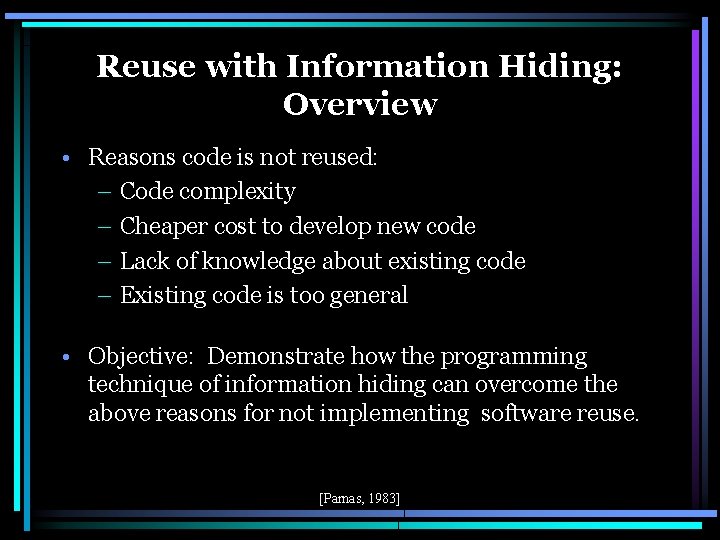
Reuse with Information Hiding: Overview • Reasons code is not reused: – Code complexity – Cheaper cost to develop new code – Lack of knowledge about existing code – Existing code is too general • Objective: Demonstrate how the programming technique of information hiding can overcome the above reasons for not implementing software reuse. [Parnas, 1983]
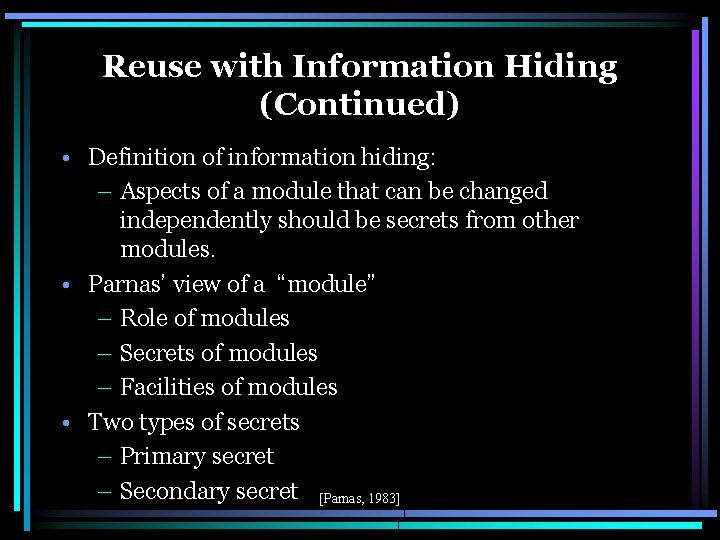
Reuse with Information Hiding (Continued) • Definition of information hiding: – Aspects of a module that can be changed independently should be secrets from other modules. • Parnas’ view of a “module” – Role of modules – Secrets of modules – Facilities of modules • Two types of secrets – Primary secret – Secondary secret [Parnas, 1983]
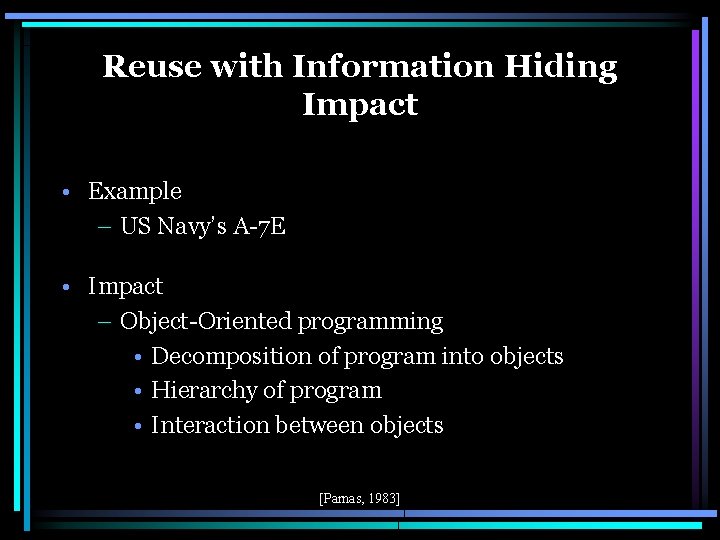
Reuse with Information Hiding Impact • Example – US Navy’s A-7 E • Impact – Object-Oriented programming • Decomposition of program into objects • Hierarchy of program • Interaction between objects [Parnas, 1983]
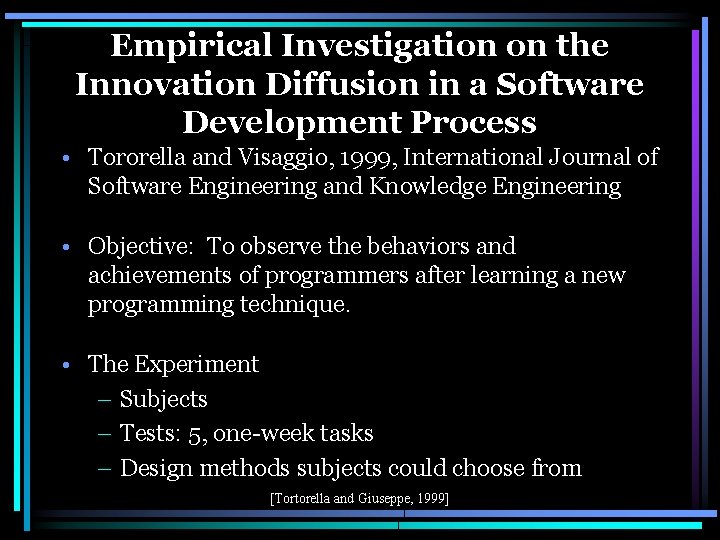
Empirical Investigation on the Innovation Diffusion in a Software Development Process • Tororella and Visaggio, 1999, International Journal of Software Engineering and Knowledge Engineering • Objective: To observe the behaviors and achievements of programmers after learning a new programming technique. • The Experiment – Subjects – Tests: 5, one-week tasks – Design methods subjects could choose from [Tortorella and Giuseppe, 1999]
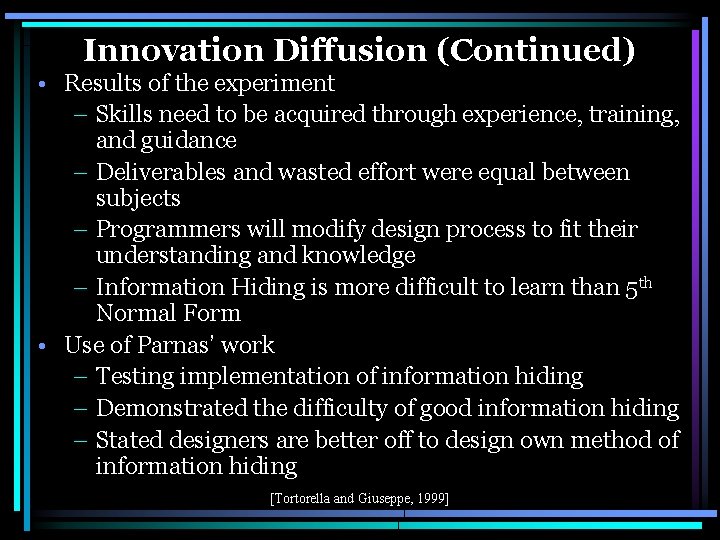
Innovation Diffusion (Continued) • Results of the experiment – Skills need to be acquired through experience, training, and guidance – Deliverables and wasted effort were equal between subjects – Programmers will modify design process to fit their understanding and knowledge – Information Hiding is more difficult to learn than 5 th Normal Form • Use of Parnas’ work – Testing implementation of information hiding – Demonstrated the difficulty of good information hiding – Stated designers are better off to design own method of information hiding [Tortorella and Giuseppe, 1999]
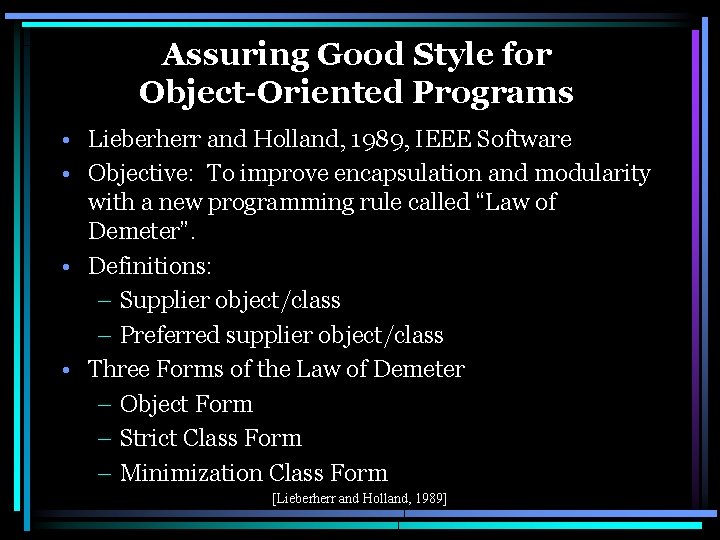
Assuring Good Style for Object-Oriented Programs • Lieberherr and Holland, 1989, IEEE Software • Objective: To improve encapsulation and modularity with a new programming rule called “Law of Demeter”. • Definitions: – Supplier object/class – Preferred supplier object/class • Three Forms of the Law of Demeter – Object Form – Strict Class Form – Minimization Class Form [Lieberherr and Holland, 1989]
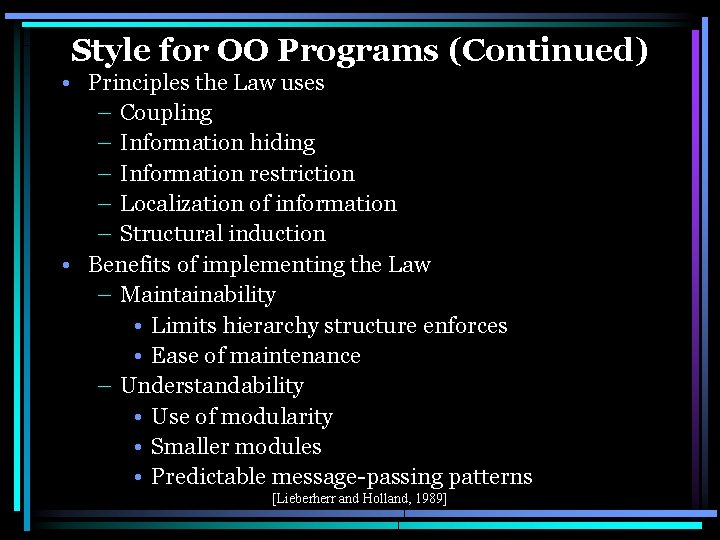
Style for OO Programs (Continued) • Principles the Law uses – Coupling – Information hiding – Information restriction – Localization of information – Structural induction • Benefits of implementing the Law – Maintainability • Limits hierarchy structure enforces • Ease of maintenance – Understandability • Use of modularity • Smaller modules • Predictable message-passing patterns [Lieberherr and Holland, 1989]
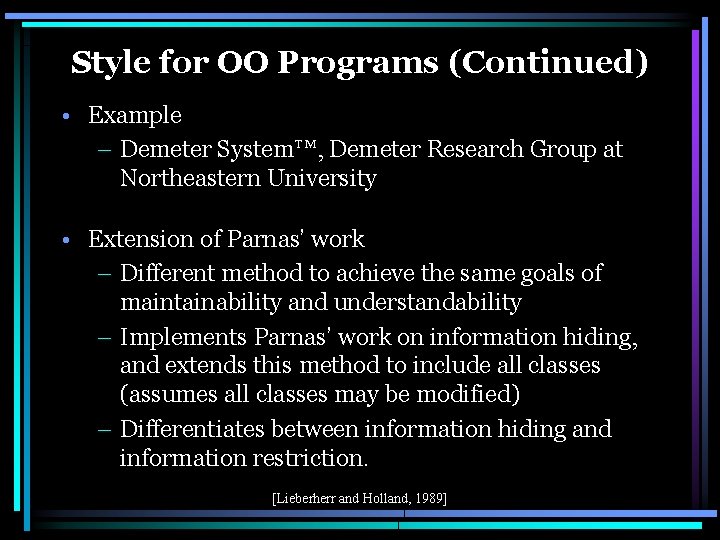
Style for OO Programs (Continued) • Example – Demeter System™, Demeter Research Group at Northeastern University • Extension of Parnas’ work – Different method to achieve the same goals of maintainability and understandability – Implements Parnas’ work on information hiding, and extends this method to include all classes (assumes all classes may be modified) – Differentiates between information hiding and information restriction. [Lieberherr and Holland, 1989]
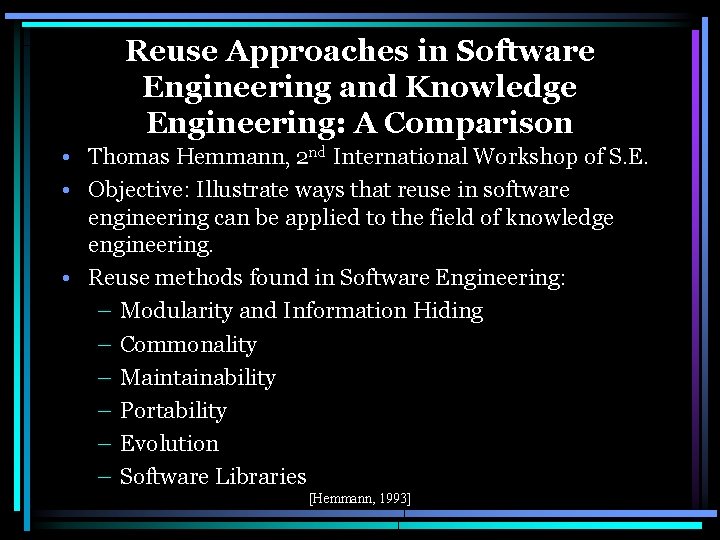
Reuse Approaches in Software Engineering and Knowledge Engineering: A Comparison • Thomas Hemmann, 2 nd International Workshop of S. E. • Objective: Illustrate ways that reuse in software engineering can be applied to the field of knowledge engineering. • Reuse methods found in Software Engineering: – Modularity and Information Hiding – Commonality – Maintainability – Portability – Evolution – Software Libraries [Hemmann, 1993]
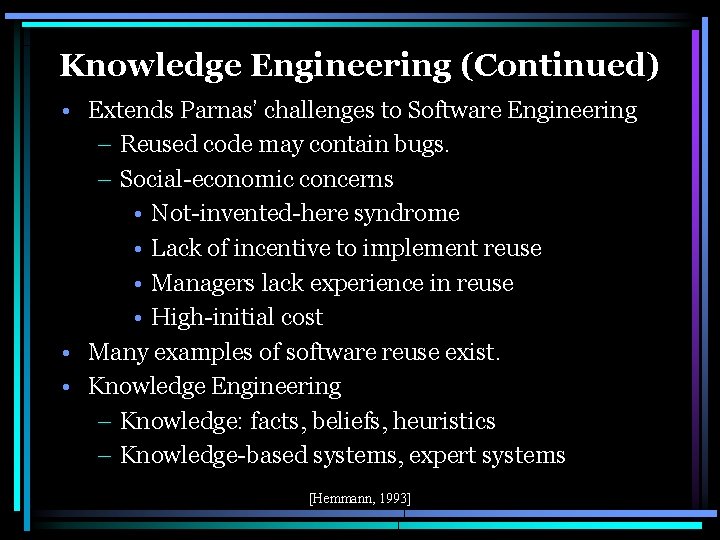
Knowledge Engineering (Continued) • Extends Parnas’ challenges to Software Engineering – Reused code may contain bugs. – Social-economic concerns • Not-invented-here syndrome • Lack of incentive to implement reuse • Managers lack experience in reuse • High-initial cost • Many examples of software reuse exist. • Knowledge Engineering – Knowledge: facts, beliefs, heuristics – Knowledge-based systems, expert systems [Hemmann, 1993]
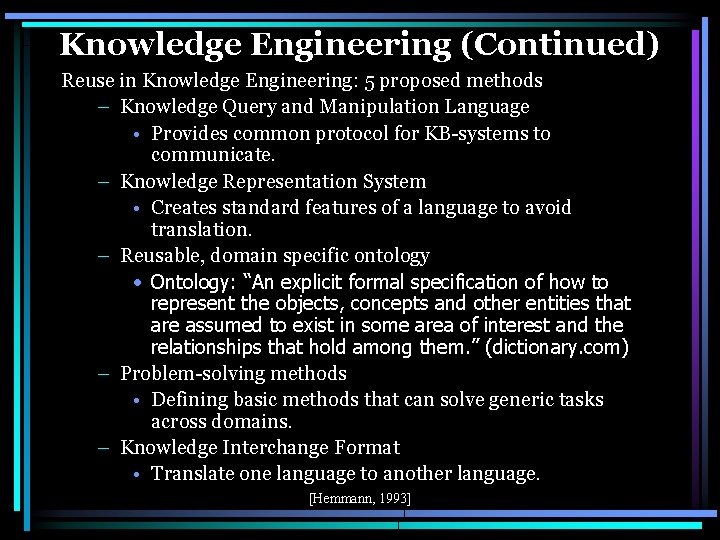
Knowledge Engineering (Continued) Reuse in Knowledge Engineering: 5 proposed methods – Knowledge Query and Manipulation Language • Provides common protocol for KB-systems to communicate. – Knowledge Representation System • Creates standard features of a language to avoid translation. – Reusable, domain specific ontology • Ontology: “An explicit formal specification of how to represent the objects, concepts and other entities that are assumed to exist in some area of interest and the relationships that hold among them. ” (dictionary. com) – Problem-solving methods • Defining basic methods that can solve generic tasks across domains. – Knowledge Interchange Format • Translate one language to another language. [Hemmann, 1993]
Object-Oriented Documentation • Johannes Sametinger, Journal of Computer Documentation • Objective: To enhance the reusability of documentation by applying techniques found in object-oriented programming. • Distinguishes between reusers and those responsible for maintaining/updating a class. • Documentation can not be contained in one document, six aspects: – Static overview – Dynamic overview – Class interface description – Task interface description – Class implementation description – Task implementation description [Sametinger, 1994]
OO Documentation (Continued) • OO techniques applied to documentation: – Inheritance • Decompose document in to sections: name, summary description, use, variable descriptions, method descriptions. • Sections can be reused, removed, replaced, or extended. – Information Hiding • Distinguishes between public, private, and protected parts of the documentation. • Only displays documentation relevant to the user. [Sametinger, 1994]
OO Documentation (Continued) • Introduces a tool named DOg. MA. – Has the ability to browse classes and their documentation. – Applied documentation using DOg. MA to a framework ET++. • This paper extends Parnas’ work by extending information hiding in to documentation. [Sametinger, 1994]