Elasticity and Dynamics of LC Elastomers Leo Radzihovsky

- Slides: 33
Elasticity and Dynamics of LC Elastomers Leo Radzihovsky Xiangjing Xing Ranjan Mukhopadhyay Olaf Stenull 5/23/05 IMA
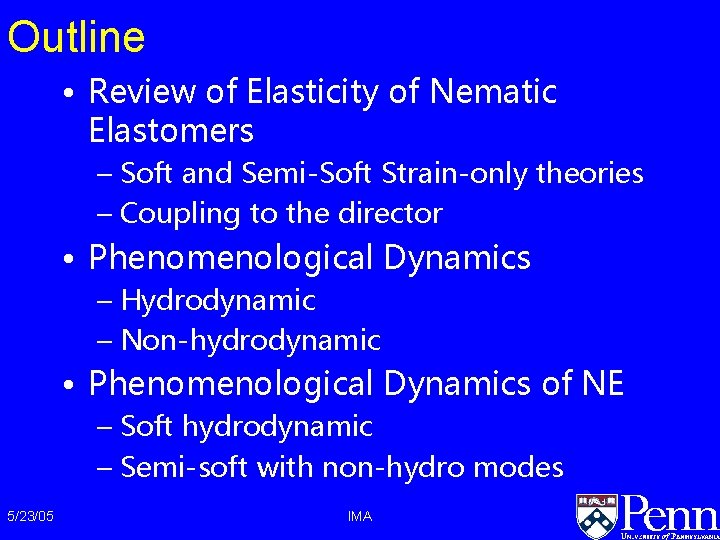
Outline • Review of Elasticity of Nematic Elastomers – Soft and Semi-Soft Strain-only theories – Coupling to the director • Phenomenological Dynamics – Hydrodynamic – Non-hydrodynamic • Phenomenological Dynamics of NE – Soft hydrodynamic – Semi-soft with non-hydro modes 5/23/05 IMA
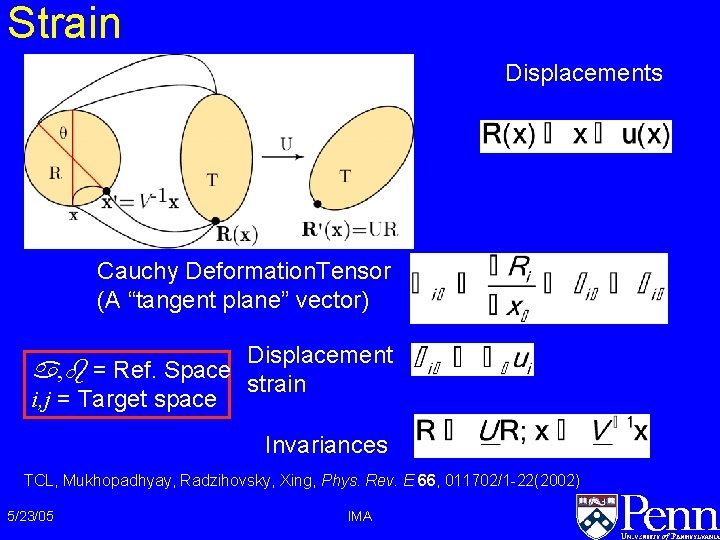
Strain Displacements Cauchy Deformation. Tensor (A “tangent plane” vector) Displacement a, b = Ref. Space strain i, j = Target space Invariances TCL, Mukhopadhyay, Radzihovsky, Xing, Phys. Rev. E 66, 011702/1 -22(2002) 5/23/05 IMA
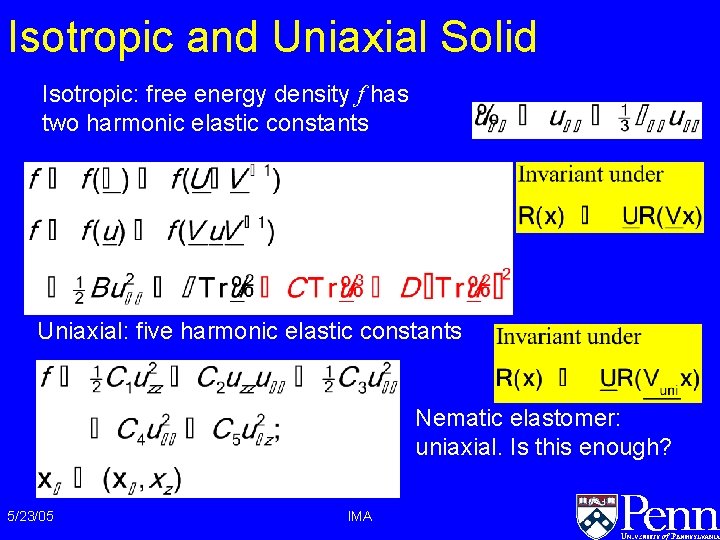
Isotropic and Uniaxial Solid Isotropic: free energy density f has two harmonic elastic constants Uniaxial: five harmonic elastic constants Nematic elastomer: uniaxial. Is this enough? 5/23/05 IMA
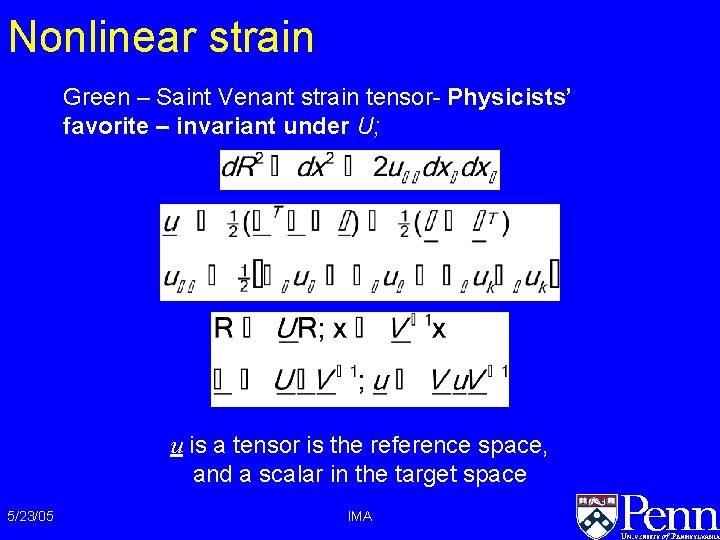
Nonlinear strain Green – Saint Venant strain tensor- Physicists’ favorite – invariant under U; u is a tensor is the reference space, and a scalar in the target space 5/23/05 IMA
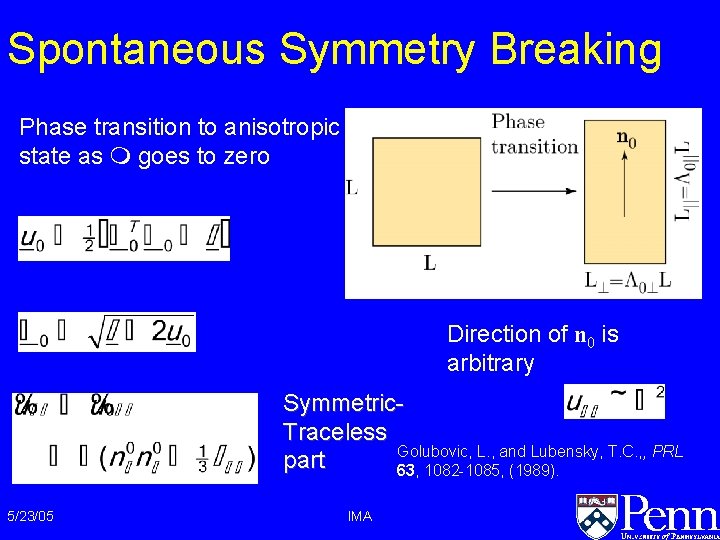
Spontaneous Symmetry Breaking Phase transition to anisotropic state as m goes to zero Direction of n 0 is arbitrary Symmetric. Traceless Golubovic, L. , and Lubensky, T. C. , , PRL part 63, 1082 -1085, (1989). 5/23/05 IMA
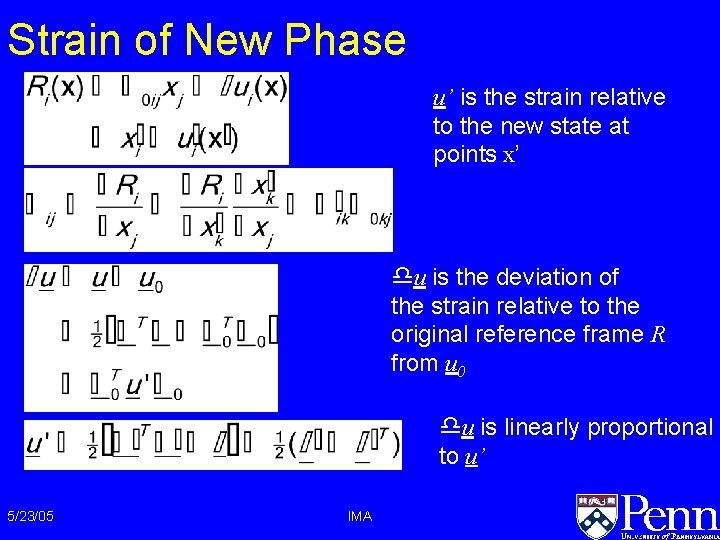
Strain of New Phase u’ is the strain relative to the new state at points x’ du is the deviation of the strain relative to the original reference frame R from u 0 du is linearly proportional to u’ 5/23/05 IMA
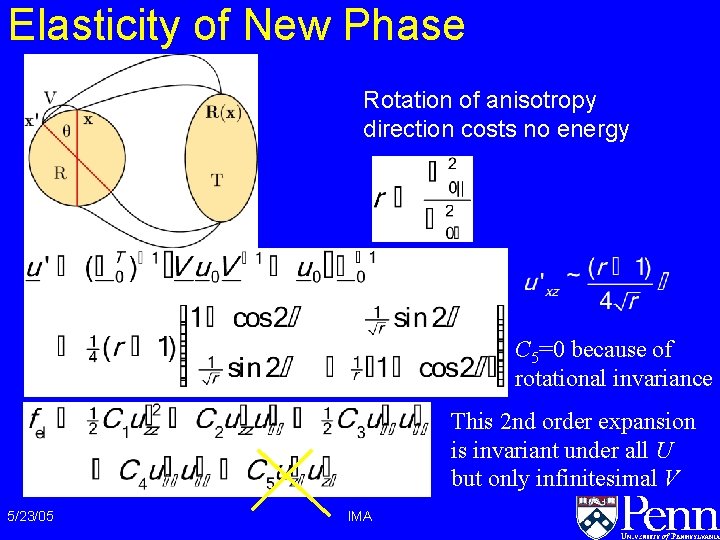
Elasticity of New Phase Rotation of anisotropy direction costs no energy C 5=0 because of rotational invariance This 2 nd order expansion is invariant under all U but only infinitesimal V 5/23/05 IMA
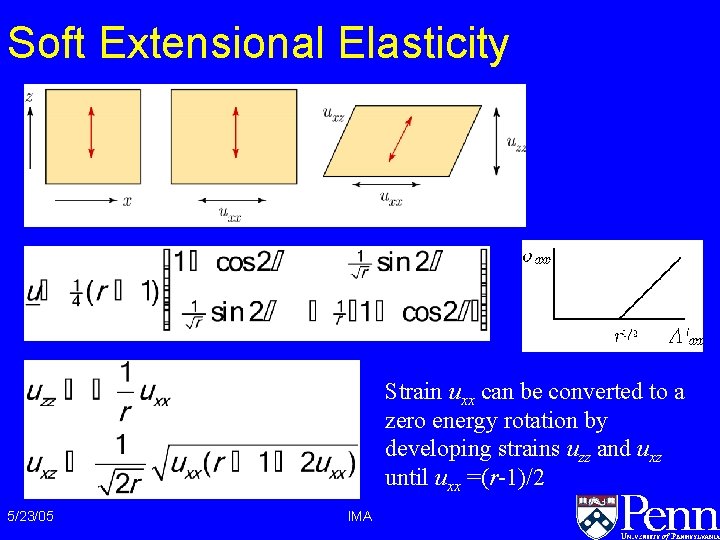
Soft Extensional Elasticity Strain uxx can be converted to a zero energy rotation by developing strains uzz and uxz until uxx =(r-1)/2 5/23/05 IMA
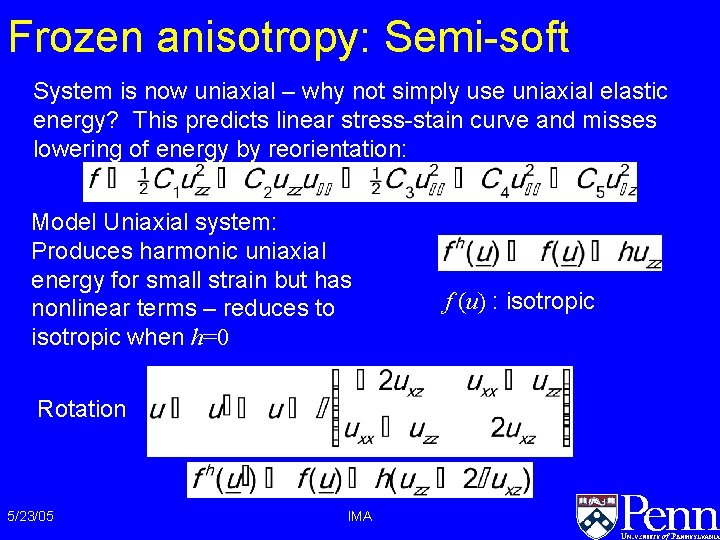
Frozen anisotropy: Semi-soft System is now uniaxial – why not simply use uniaxial elastic energy? This predicts linear stress-stain curve and misses lowering of energy by reorientation: Model Uniaxial system: Produces harmonic uniaxial energy for small strain but has nonlinear terms – reduces to isotropic when h=0 Rotation 5/23/05 IMA f (u) : isotropic
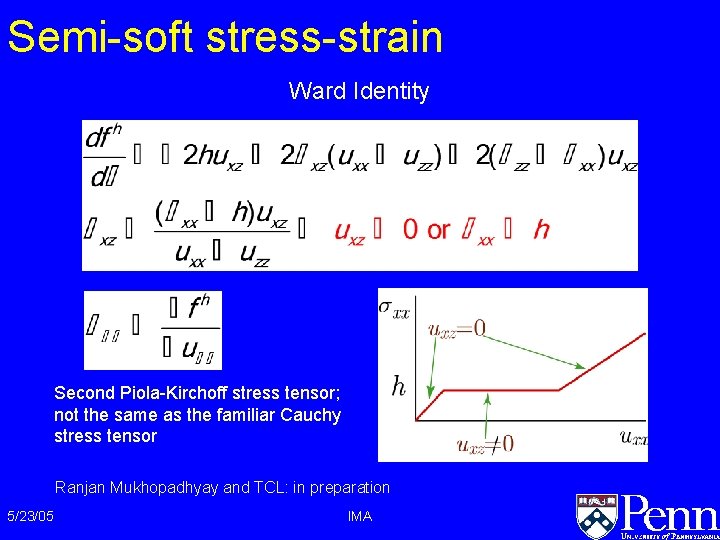
Semi-soft stress-strain Ward Identity Second Piola-Kirchoff stress tensor; not the same as the familiar Cauchy stress tensor Ranjan Mukhopadhyay and TCL: in preparation 5/23/05 IMA
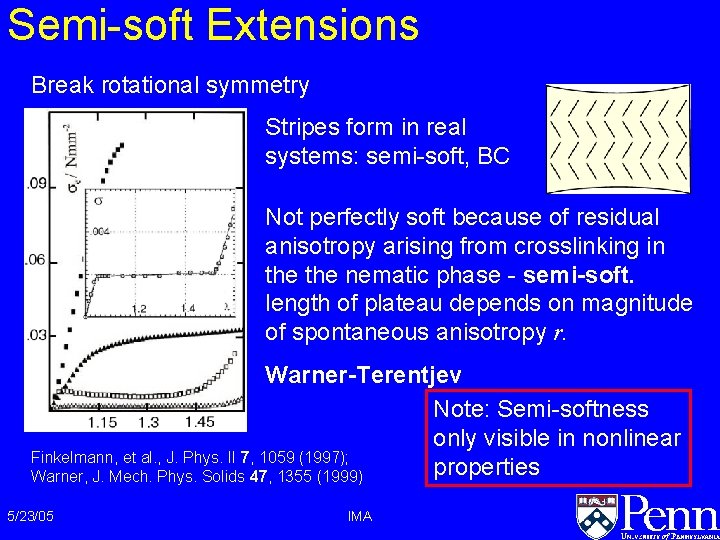
Semi-soft Extensions Break rotational symmetry Stripes form in real systems: semi-soft, BC Not perfectly soft because of residual anisotropy arising from crosslinking in the nematic phase - semi-soft. length of plateau depends on magnitude of spontaneous anisotropy r. Warner-Terentjev Note: Semi-softness only visible in nonlinear Finkelmann, et al. , J. Phys. II 7, 1059 (1997); properties Warner, J. Mech. Phys. Solids 47, 1355 (1999) 5/23/05 IMA
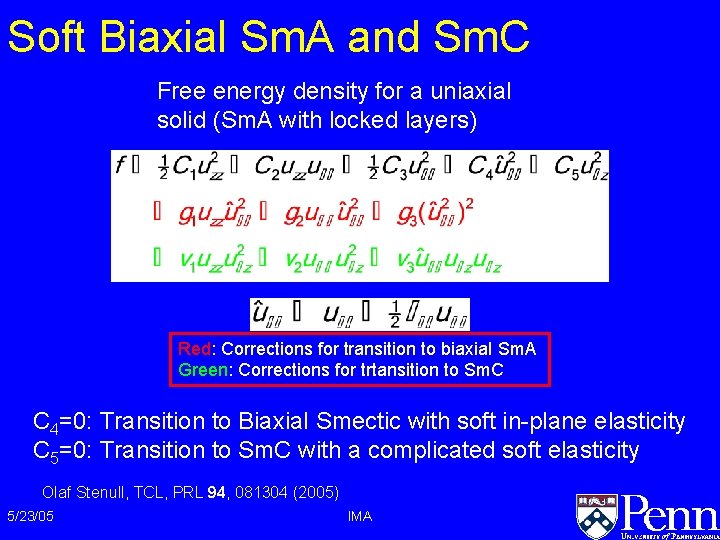
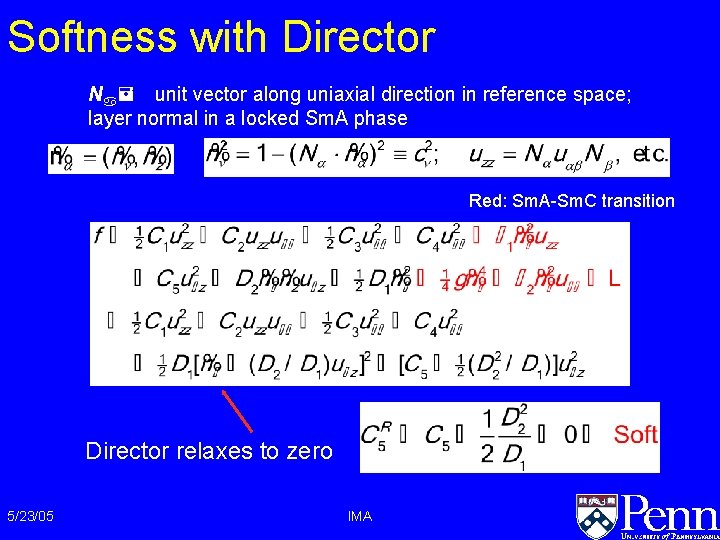
Soft Biaxial Sm. A and Sm. C Free energy density for a uniaxial solid (Sm. A with locked layers) Red: Corrections for transition to biaxial Sm. A Green: Corrections for trtansition to Sm. C C 4=0: Transition to Biaxial Smectic with soft in-plane elasticity C 5=0: Transition to Sm. C with a complicated soft elasticity Olaf Stenull, TCL, PRL 94, 081304 (2005) 5/23/05 IMA
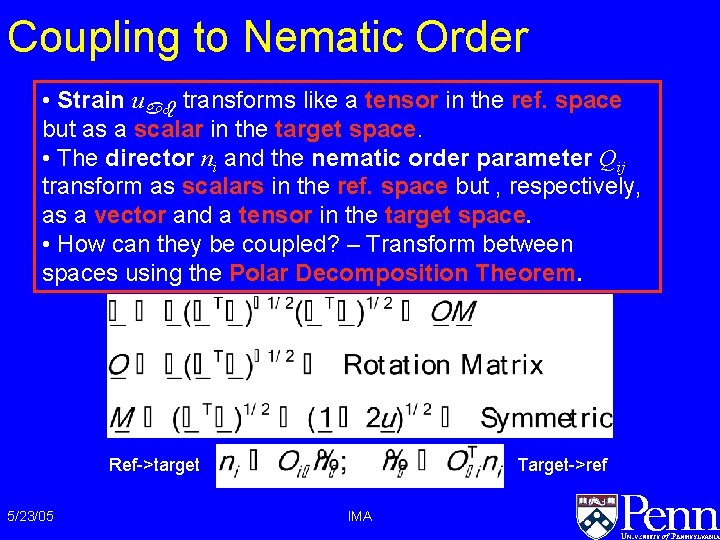
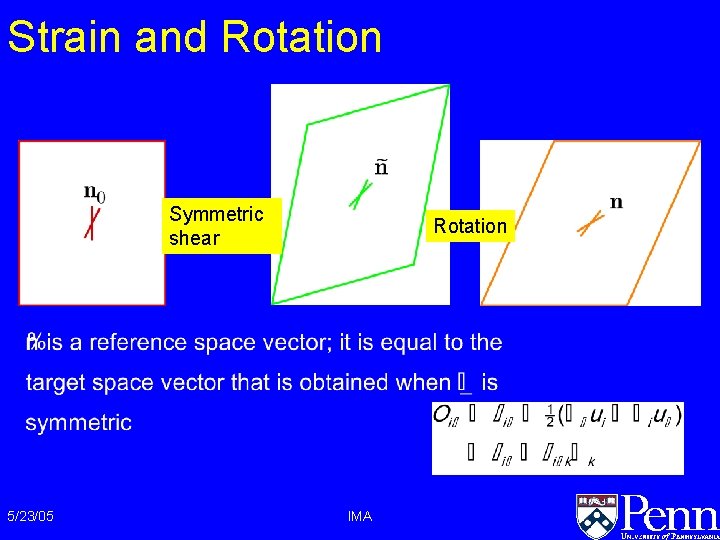
Coupling to Nematic Order • Strain uab transforms like a tensor in the ref. space but as a scalar in the target space. • The director ni and the nematic order parameter Qij transform as scalars in the ref. space but , respectively, as a vector and a tensor in the target space. • How can they be coupled? – Transform between spaces using the Polar Decomposition Theorem. Ref->target 5/23/05 Target->ref IMA
Strain and Rotation Symmetric shear 5/23/05 Simple Shear IMA Rotation
Softness with Director Na= unit vector along uniaxial direction in reference space; layer normal in a locked Sm. A phase Red: Sm. A-Sm. C transition Director relaxes to zero 5/23/05 IMA
Harmonic Free energy with Frank part 5/23/05 IMA
NE: Relaxed elastic energy Uniaxial solid when C 5 R>0, including Frank director energy 5/23/05 IMA
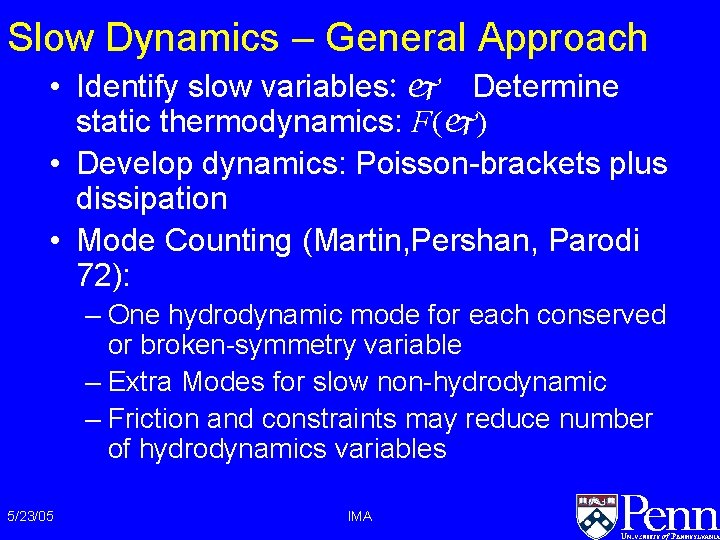
Slow Dynamics – General Approach • Identify slow variables: Determine static thermodynamics: F( ) • Develop dynamics: Poisson-brackets plus dissipation • Mode Counting (Martin, Pershan, Parodi 72): – One hydrodynamic mode for each conserved or broken-symmetry variable – Extra Modes for slow non-hydrodynamic – Friction and constraints may reduce number of hydrodynamics variables 5/23/05 IMA
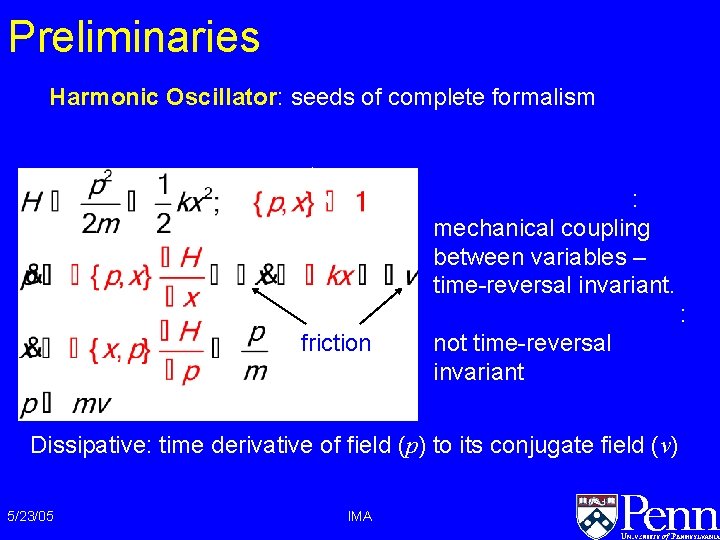
Preliminaries Harmonic Oscillator: seeds of complete formalism Poisson bracket friction Poisson brackets: mechanical coupling between variables – time-reversal invariant. Dissipative couplings: not time-reversal invariant Dissipative: time derivative of field (p) to its conjugate field (v) 5/23/05 IMA
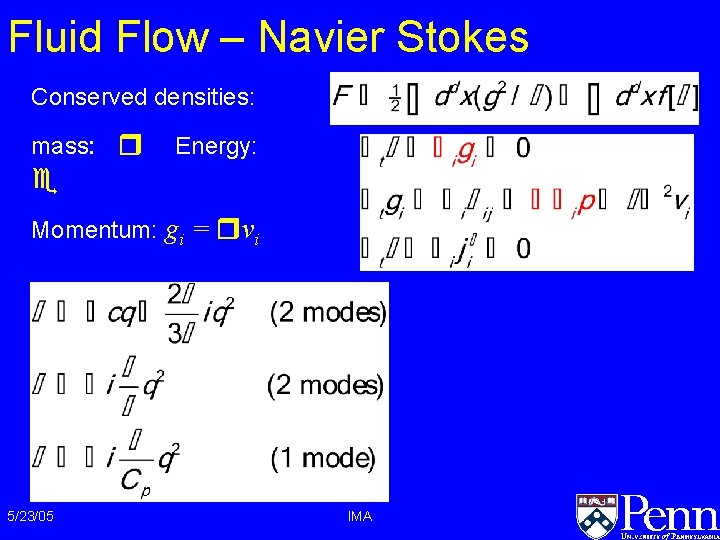
Fluid Flow – Navier Stokes Conserved densities: mass: r Energy: e Momentum: gi = rvi 5/23/05 IMA
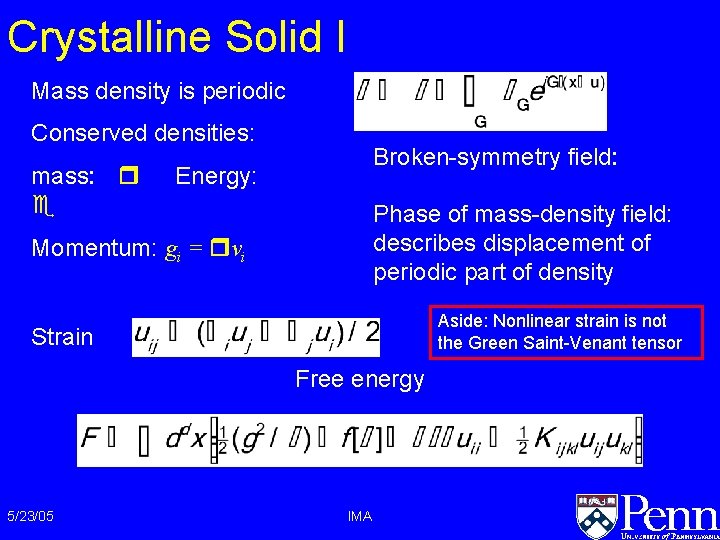
Crystalline Solid I Mass density is periodic Conserved densities: mass: e r Broken-symmetry field: Energy: Phase of mass-density field: u describes displacement of periodic part of density Momentum: gi = rvi Aside: Nonlinear strain is not the Green Saint-Venant tensor Strain Free energy 5/23/05 IMA
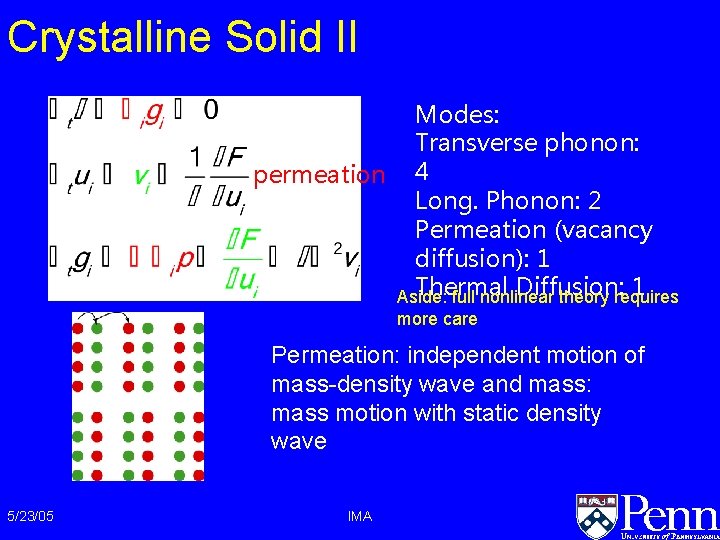
Crystalline Solid II Modes: Transverse phonon: permeation 4 Long. Phonon: 2 Permeation (vacancy diffusion): 1 Thermal Diffusion: 1 Aside: full nonlinear theory requires more care Permeation: independent motion of mass-density wave and mass: mass motion with static density wave 5/23/05 IMA
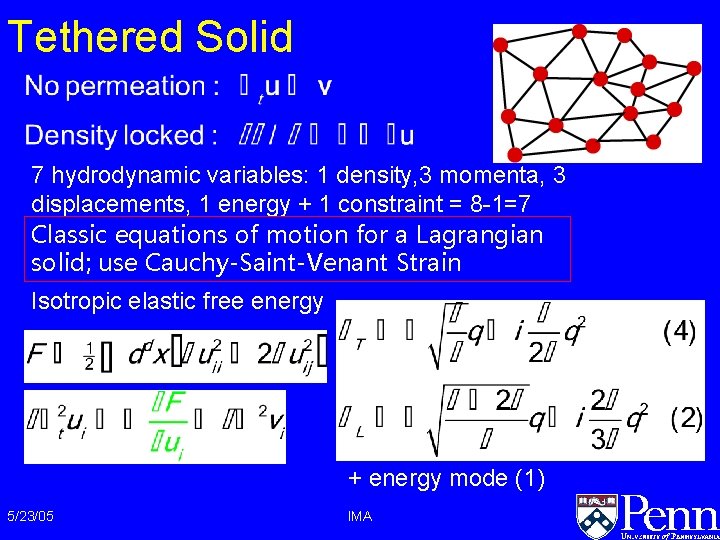
Tethered Solid 7 hydrodynamic variables: 1 density, 3 momenta, 3 displacements, 1 energy + 1 constraint = 8 -1=7 Classic equations of motion for a Lagrangian solid; use Cauchy-Saint-Venant Strain Isotropic elastic free energy + energy mode (1) 5/23/05 IMA
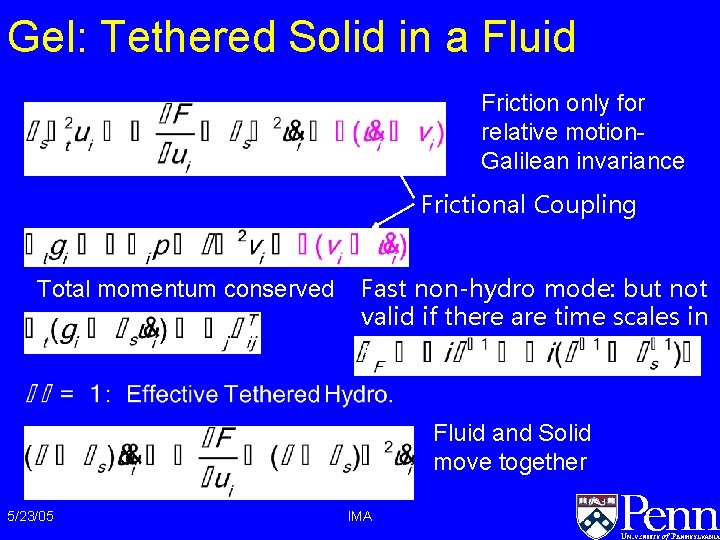
Gel: Tethered Solid in a Fluid Tethered solid Friction only for relative motion. Galilean invariance Fluid Total momentum conserved Frictional Coupling Fast non-hydro mode: but not valid if there are time scales in G Fluid and Solid move together 5/23/05 IMA
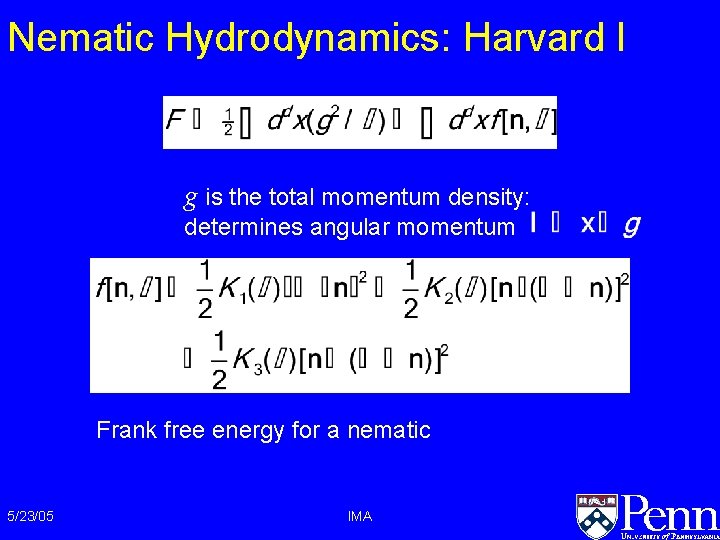
Nematic Hydrodynamics: Harvard I g is the total momentum density: determines angular momentum Frank free energy for a nematic 5/23/05 IMA
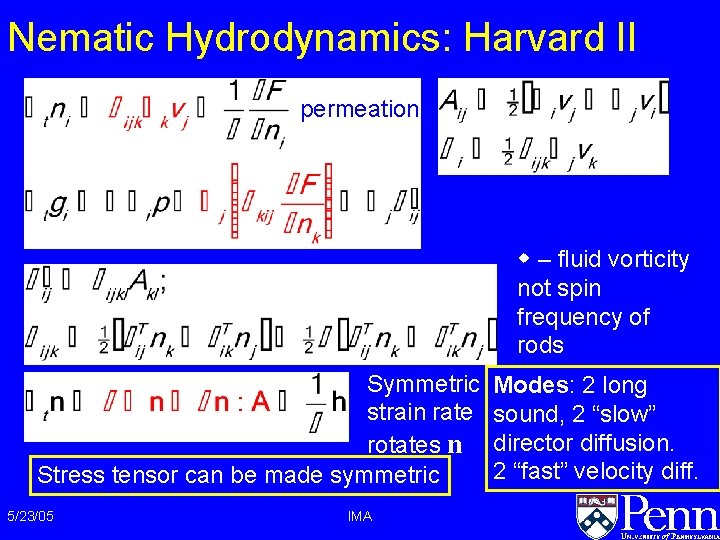
Nematic Hydrodynamics: Harvard II permeation w – fluid vorticity not spin frequency of rods Symmetric strain rate rotates n Stress tensor can be made symmetric 5/23/05 IMA Modes: 2 long sound, 2 “slow” director diffusion. 2 “fast” velocity diff.
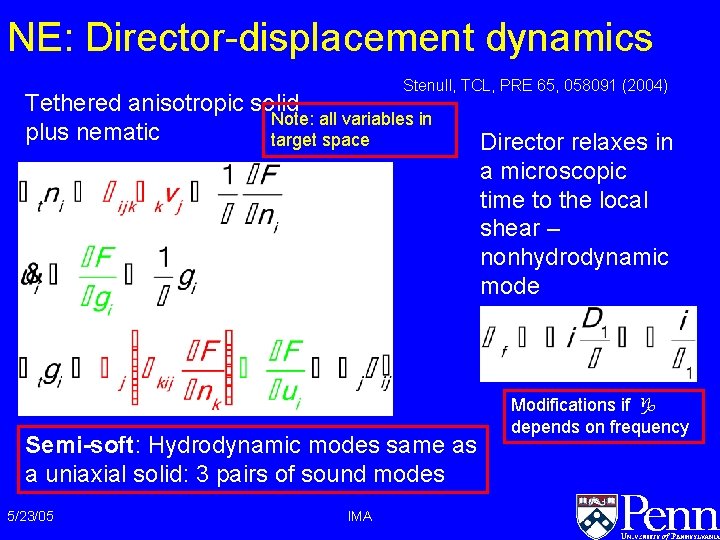
NE: Director-displacement dynamics Stenull, TCL, PRE 65, 058091 (2004) Tethered anisotropic solid Note: all variables in plus nematic target space Semi-soft: Hydrodynamic modes same as a uniaxial solid: 3 pairs of sound modes 5/23/05 IMA Director relaxes in a microscopic time to the local shear – nonhydrodynamic mode Modifications if g depends on frequency
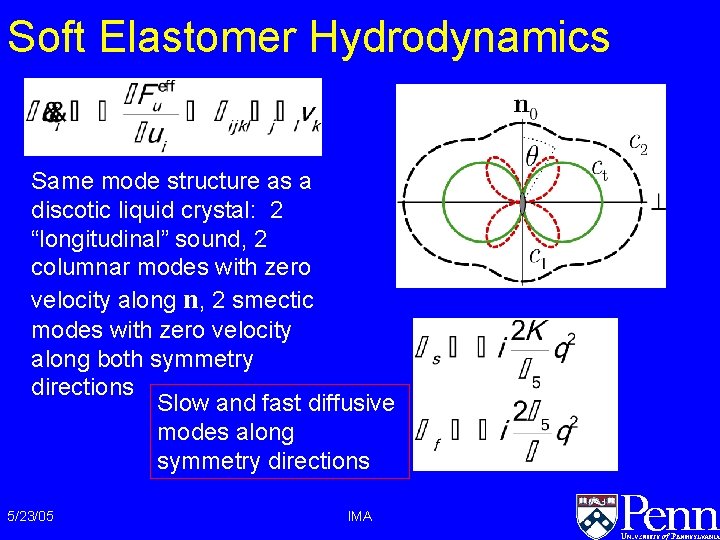
Soft Elastomer Hydrodynamics Same mode structure as a discotic liquid crystal: 2 “longitudinal” sound, 2 columnar modes with zero velocity along n, 2 smectic modes with zero velocity along both symmetry directions Slow and fast diffusive modes along symmetry directions 5/23/05 IMA
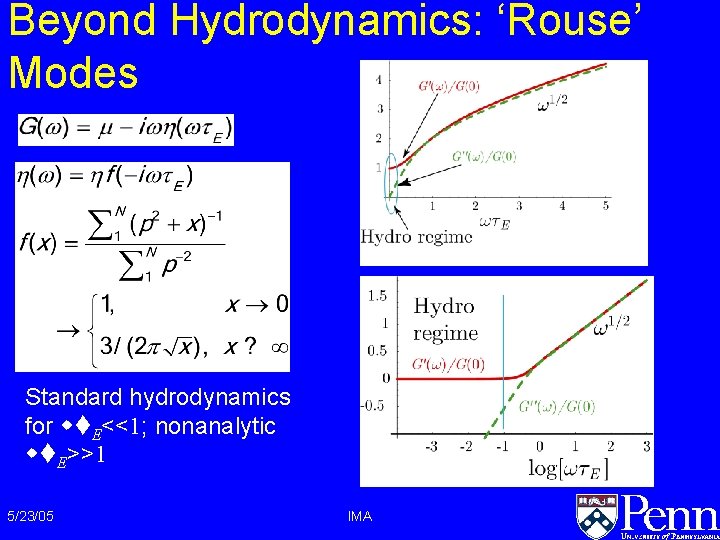
Beyond Hydrodynamics: ‘Rouse’ Modes Standard hydrodynamics for wt. E<<1; nonanalytic wt. E>>1 5/23/05 IMA
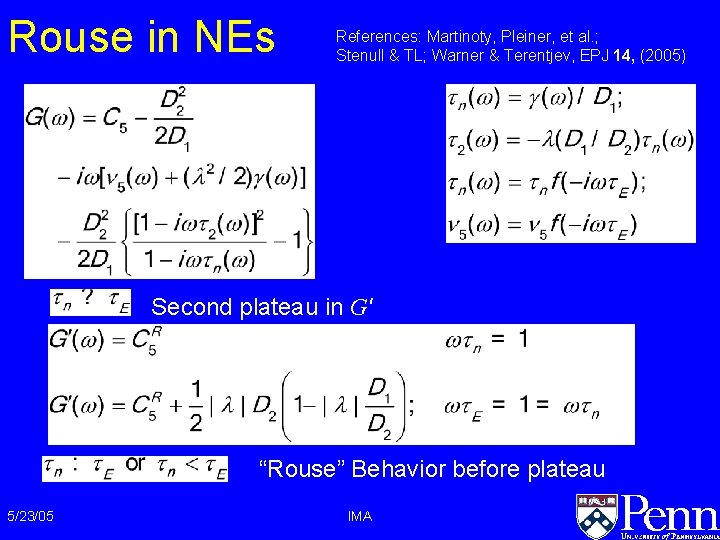
Rouse in NEs References: Martinoty, Pleiner, et al. ; Stenull & TL; Warner & Terentjev, EPJ 14, (2005) Second plateau in G' “Rouse” Behavior before plateau 5/23/05 IMA
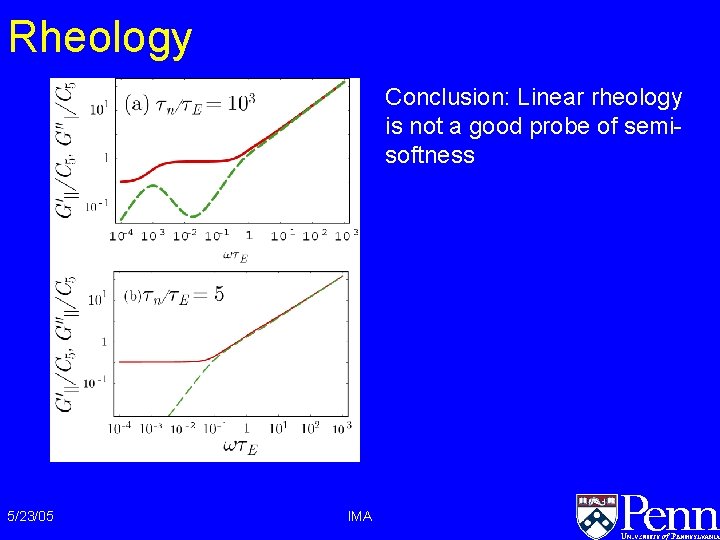
Rheology Conclusion: Linear rheology is not a good probe of semisoftness 5/23/05 IMA
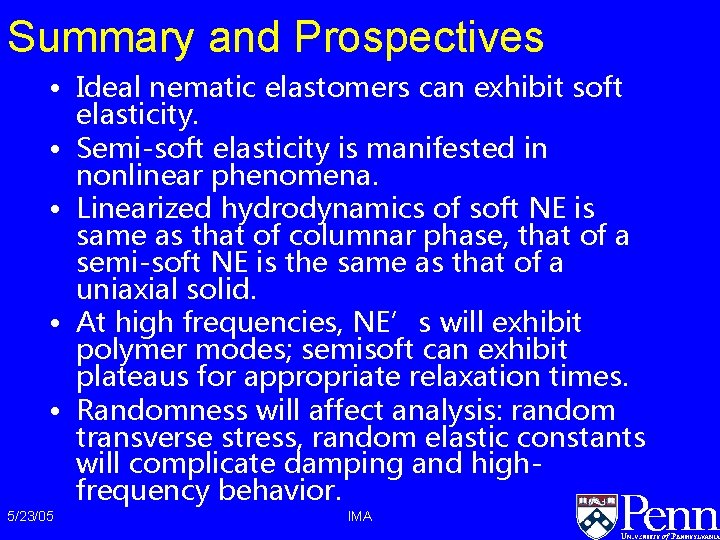
Summary and Prospectives • Ideal nematic elastomers can exhibit soft elasticity. • Semi-soft elasticity is manifested in nonlinear phenomena. • Linearized hydrodynamics of soft NE is same as that of columnar phase, that of a semi-soft NE is the same as that of a uniaxial solid. • At high frequencies, NE’s will exhibit polymer modes; semisoft can exhibit plateaus for appropriate relaxation times. • Randomness will affect analysis: random transverse stress, random elastic constants will complicate damping and highfrequency behavior. 5/23/05 IMA