ELA Learning Progressions Susan Richmond 1 The Common


- Slides: 22
ELA Learning Progressions Susan Richmond 1
The Common Core Standards Guide the Summative I. Key Ideas and Details 1. CCSS. ELA-Literacy. RL. 4. 1 Refer to details and examples in a text when explaining what the text says explicitly and when drawing inferences from the text. 2. CCSS. ELA-Literacy. RL. 4. 2 Determine a theme of a story, drama, or poem from details in the text; summarize the text. 3. CCSS. ELA-Literacy. RL. 4. 3 Describe in depth a character, setting, or event in a story or drama, drawing on specific details in the text (e. g. , a character’s thoughts, words, or actions). IV. Range of Reading and Level of Text Complexity II. Craft and Structure 4. CCSS. ELA-Literacy. RL. 4. 4 Determine the meaning of words and phrases as they are used in a text, including those that allude to significant characters found in mythology (e. g. , Herculean). 5. CCSS. ELA-Literacy. RL. 4. 5 Explain major differences between poems, drama, and prose, and refer to the structural elements of poems (e. g. , verse, rhythm, meter) and drama (e. g. , casts of characters, settings, descriptions, dialogue, stage directions) when writing or speaking about a text. 6. CCSS. ELA-Literacy. RL. 4. 6 Compare and contrast the point of view from which different stories are narrated, including the difference between first - and third-person narrations. Assessments III. Integration of Knowledge and Ideas 7. CCSS. ELA-Literacy. RL. 4. 7 Make connections between the text of a story or drama and a visual or oral presentation of the text, identifying where each version reflects specific descriptions and directions in the text. 8. (RL. 4. 8 not applicable to literature) 9. CCSS. ELA-Literacy. RL. 4. 9 Compare and contrast the treatment of similar themes and topics (e. g. , opposition of good and evil) and patterns of events (e. g. , the quest) in stories, myths, and traditional literature from different cultures. 10. CCSS. ELA-Literacy. RL. 4. 10 By the end of the year, read and comprehend literature, including stories, dramas, and poetry, in the grades 4– 5 text complexity band proficiently, with scaffolding as needed at the high end of the range Common Core State Standards
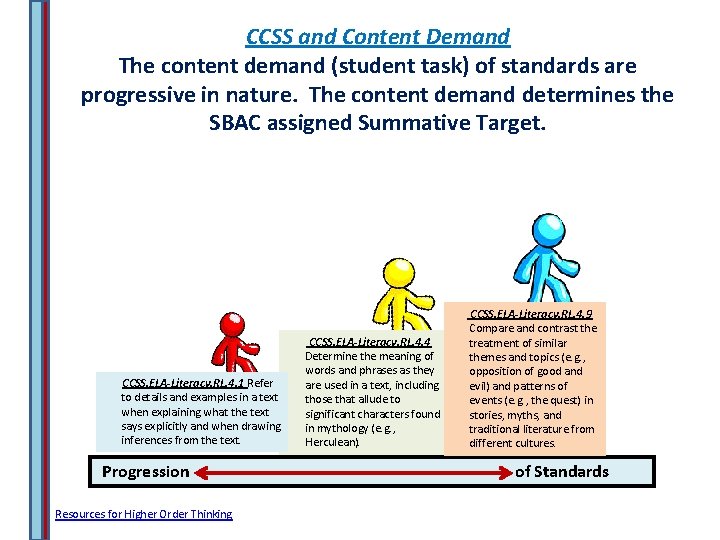
CCSS and Content Demand The content demand (student task) of standards are progressive in nature. The content demand determines the SBAC assigned Summative Target. CCSS. ELA-Literacy. RL. 4. 1 Refer to details and examples in a text when explaining what the text says explicitly and when drawing inferences from the text. Progression Resources for Higher Order Thinking CCSS. ELA-Literacy. RL. 4. 4 Determine the meaning of words and phrases as they are used in a text, including those that allude to significant characters found in mythology (e. g. , Herculean). CCSS. ELA-Literacy. RL. 4. 9 Compare and contrast the treatment of similar themes and topics (e. g. , opposition of good and evil) and patterns of events (e. g. , the quest) in stories, myths, and traditional literature from different cultures. of Standards
Content Demands… SBAC Summative Assessment Targets Common Core State Standards have been grouped by similarities of content demand into Summative Assessment Targets by SBAC. http: //www. ode. state. or. us/wma/teachlearn/commoncore/sbac_ela_literacycontentspecific ations. pdf Observe the fourth grade reading literature standards grouped into Summative Assessment Targets. 4
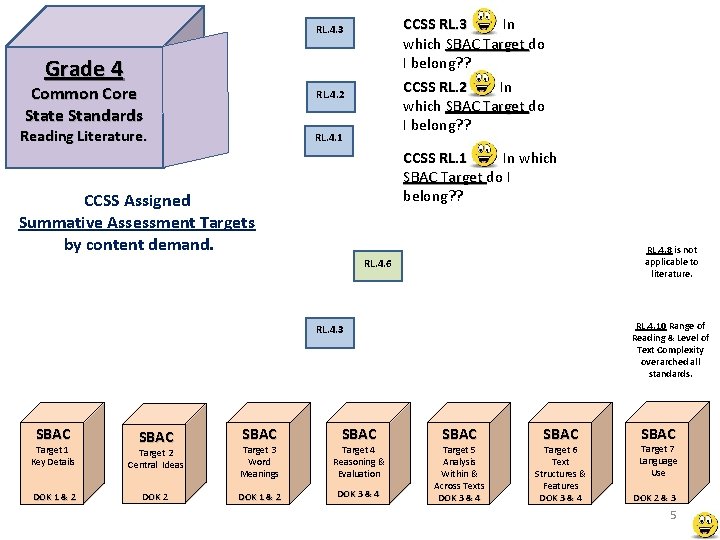
RL. 4. 3 RL. 4. 10 RL. 4. 9 RL. 4. 8 CCSS RL. 3 In RL. 3 which SBAC Target do SBAC Target I belong? ? CCSS RL. 2 In RL. 2 which SBAC Target do SBAC Target I belong? ? RL. 4. 3 Grade. RL. 4. 64 RL. 4. 5 Common Core RL. 4. 4 State RL. 4. 7 Standards Reading Literature. RL. 4. 2 RL. 4. 1 CCSS RL. 1 In which RL. 1 SBAC Target do I SBAC Target belong? ? CCSS Assigned Summative Assessment Targets by content demand. RL. 4. 8 is not applicable to literature. RL. 4. 6 RL. 4. 10 Range of Reading & Level of Text Complexity overarched all standards. RL. 4. 3 SBAC Target 1 Key Details Target 2 Central Ideas Target 3 Word Meanings Target 4 Reasoning & Evaluation DOK 1 & 2 DOK 3 & 4 SBAC Target 5 Analysis Within & Across Texts DOK 3 & 4 SBAC Target 6 Text Structures & Features DOK 3 & 4 SBAC Target 7 Language Use DOK 2 & 3 5
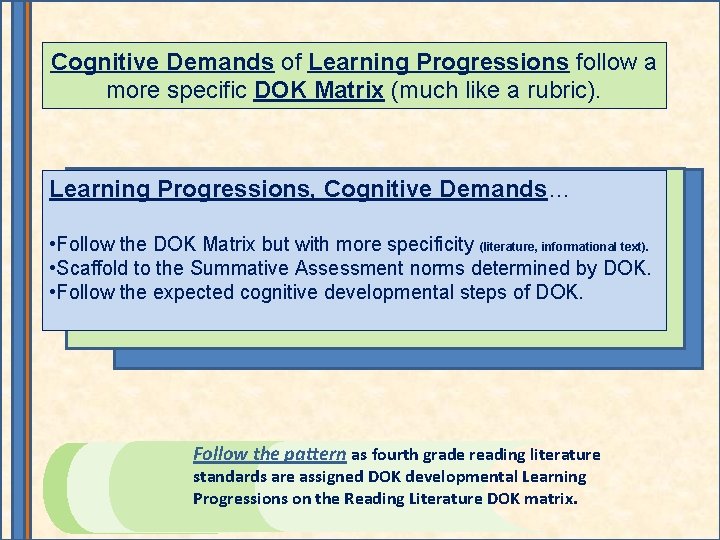
Cognitive Demands of Learning Progressions follow a more specific DOK Matrix (much like a rubric). Learning Progressions, Cognitive Demands… • Follow the DOK Matrix but with more specificity (literature, informational text). • Scaffold to the Summative Assessment norms determined by DOK. • Follow the expected cognitive developmental steps of DOK. Follow the pattern as fourth grade reading literature standards are assigned DOK developmental Learning Progressions on the Reading Literature DOK matrix.
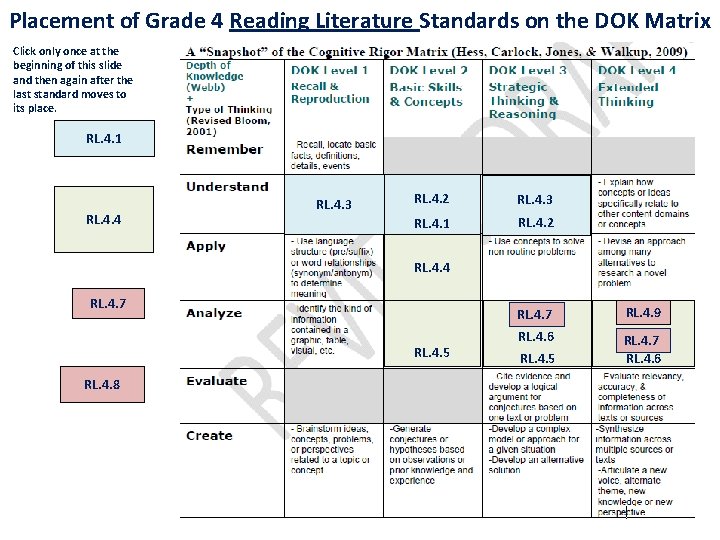
Placement of Grade 4 Reading Literature Standards on the DOK Matrix Click only once at the beginning of this slide and then again after the last standard moves to its place. RL. 4. 1 RL. 4. 4 RL. 4. 3 RL. 4. 2 RL. 4. 3 RL. 4. 1 RL. 4. 2 RL. 4. 4 RL. 4. 7 RL. 4. 5 RL. 4. 8 RL. 4. 7 RL. 4. 9 RL. 4. 6 RL. 4. 7 RL. 4. 6 RL. 4. 5
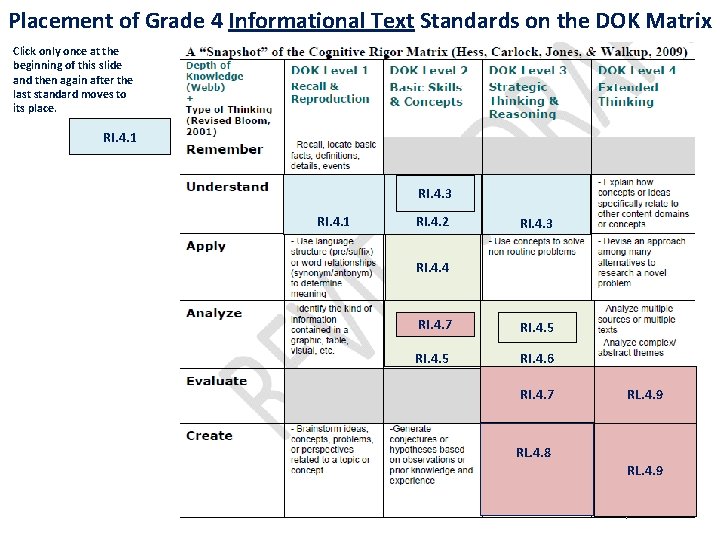
Placement of Grade 4 Informational Text Standards on the DOK Matrix Click only once at the beginning of this slide and then again after the last standard moves to its place. RI. 4. 1 RI. 4. 3 RI. 4. 1 RI. 4. 2 RI. 4. 3 RI. 4. 4 RI. 4. 7 RI. 4. 5 RI. 4. 6 RI. 4. 7 RL. 4. 9 RL. 4. 8 RL. 4. 9
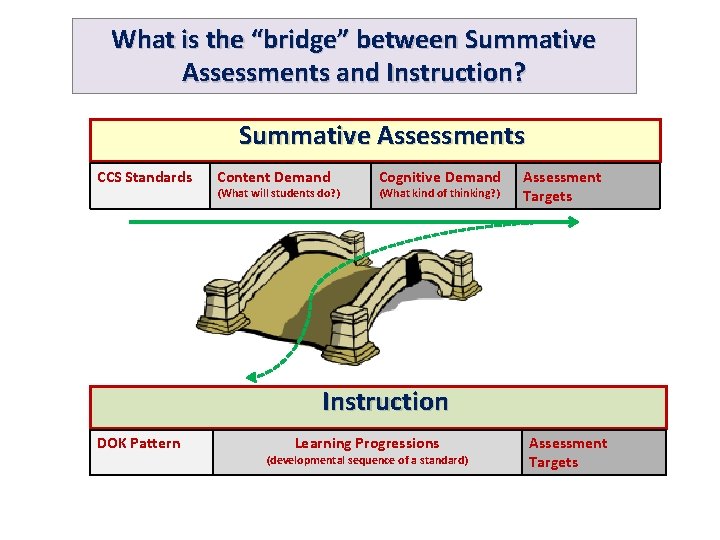
What is the “bridge” between Summative Assessments and Instruction? Summative Assessments CCS Standards Content Demand (What will students do? ) Cognitive Demand (What kind of thinking? ) Assessment Targets Instruction DOK Pattern Learning Progressions (developmental sequence of a standard) Assessment Targets
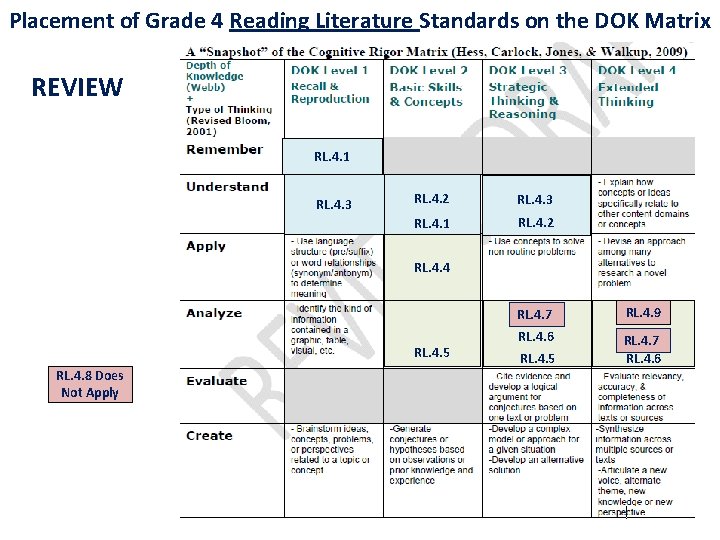
Placement of Grade 4 Reading Literature Standards on the DOK Matrix REVIEW RL. 4. 1 RL. 4. 3 RL. 4. 2 RL. 4. 3 RL. 4. 1 RL. 4. 2 RL. 4. 4 RL. 4. 5 RL. 4. 8 Does Not Apply RL. 4. 7 RL. 4. 9 RL. 4. 6 RL. 4. 7 RL. 4. 6 RL. 4. 5
Learning Progressions bridge instructional assessment to summative assessment. Learning Progressions are based on the difficulty of a task (Bloom’s) and the complexity of a task (Depth of Knowledge/DOK (Webb). These progressions are sequenced by both Bloom’s Taxonomy and Webb’s Depth of Knowledge. DOK Examples
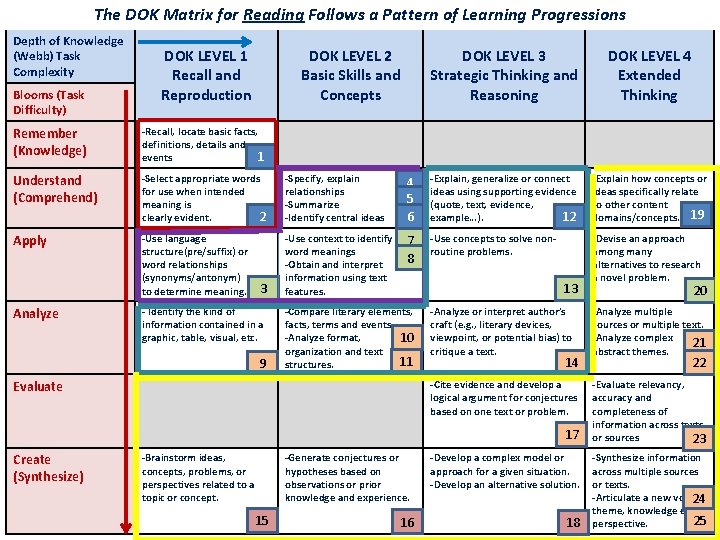
Understanding the reading literature DOK pattern allows us to align the Learning Progressions of each standard for developmentally cognitive instruction. • The Cognitive Rigor DOK Matrix (Hess, Jones, Carlock, Walkup 2009) has been decoded into a learning progressions chart (Richmond 2013). Differentiation with Cognitive Knowledge 12
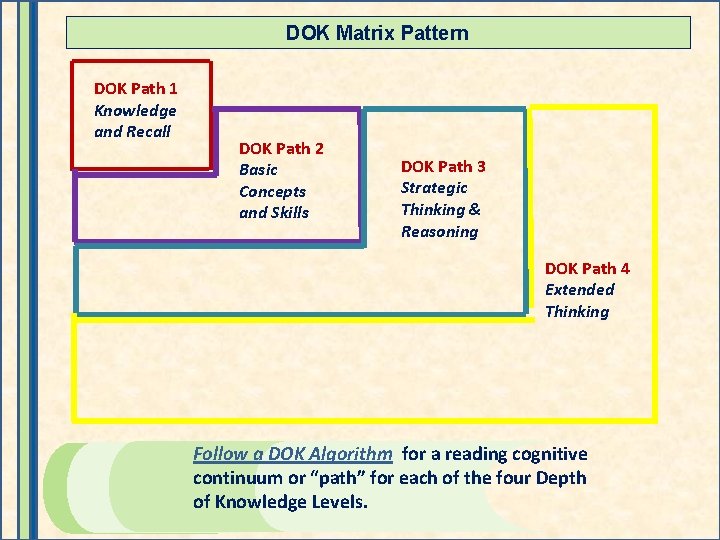
DOK Matrix Pattern DOK Path 1 Knowledge and Recall DOK Path 2 Basic Concepts and Skills DOK Path 3 Strategic Thinking & Reasoning DOK Path 4 Extended Thinking Follow a DOK Algorithm for a reading cognitive continuum or “path” for each of the four Depth of Knowledge Levels.
The DOK Matrix for Reading Follows a Pattern of Learning Progressions Depth of Knowledge (Webb) Task Complexity Blooms (Task Difficulty) DOK LEVEL 1 Recall and Reproduction DOK LEVEL 2 Basic Skills and Concepts DOK LEVEL 3 Strategic Thinking and Reasoning DOK LEVEL 4 Extended Thinking Remember (Knowledge) -Recall, locate basic facts, definitions, details and 1 events Understand (Comprehend) -Select appropriate words for use when intended meaning is 2 clearly evident. -Specify, explain relationships -Summarize -Identify central ideas 4 5 6 -Explain, generalize or connect ideas using supporting evidence (quote, text, evidence, 12 example…). -Explain how concepts or ideas specifically relate to other content domains/concepts. 19 Apply -Use language structure(pre/suffix) or word relationships (synonyms/antonym) to determine meaning. -Use context to identify word meanings -Obtain and interpret information using text features. 7 8 -Use concepts to solve nonroutine problems. -Devise an approach among many alternatives to research a novel problem. Analyze 3 - Identify the kind of information contained in a graphic, table, visual, etc. 9 13 -Compare literary elements, facts, terms and events. -Analyze format, 10 organization and text 11 structures. Evaluate -Analyze or interpret author’s craft (e. g. , literary devices, viewpoint, or potential bias) to critique a text. -Analyze multiple sources or multiple text. -Analyze complex 21 abstract themes. -Cite evidence and develop a logical argument for conjectures based on one text or problem. -Evaluate relevancy, accuracy and completeness of information across texts or sources 23 14 17 Create (Synthesize) -Brainstorm ideas, concepts, problems, or perspectives related to a topic or concept. -Generate conjectures or hypotheses based on observations or prior knowledge and experience. 15 16 20 -Develop a complex model or approach for a given situation. -Develop an alternative solution. 18 22 -Synthesize information across multiple sources or texts. -Articulate a new voice, 24 theme, knowledge or 25 perspective.
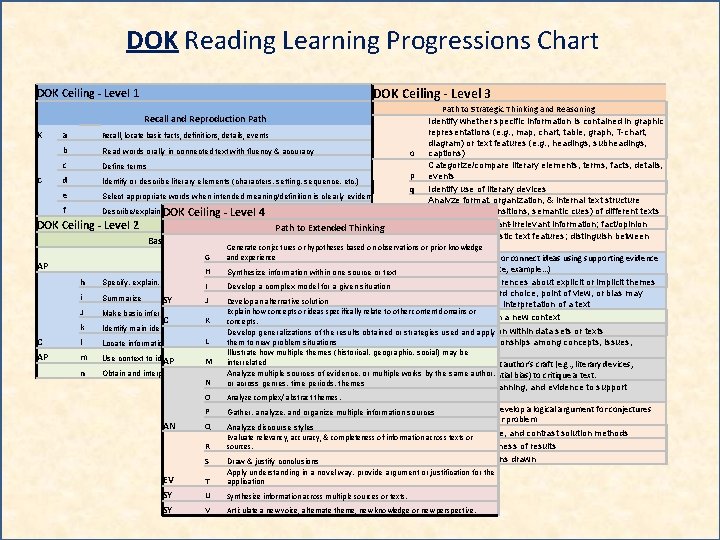
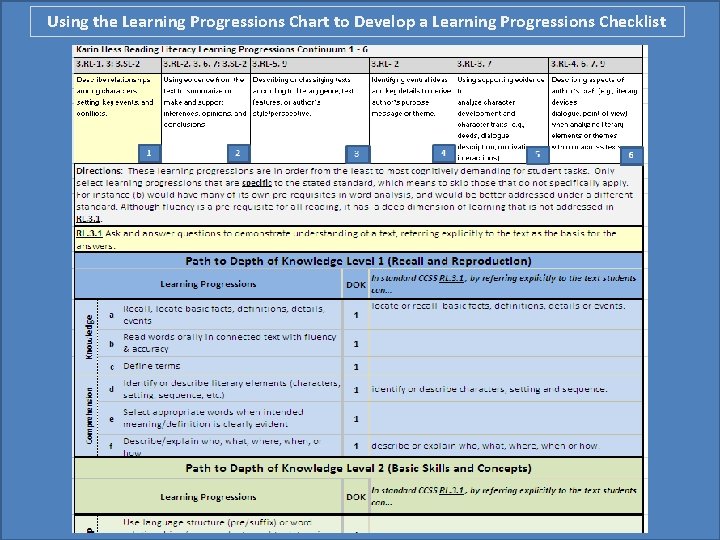
DOK Reading Learning Progressions Chart DOK Ceiling - Level 3 DOK Ceiling - Level 1 Path to Strategic Thinking and Reasoning Identify whether specific information is contained in graphic representations (e. g. , map, chart, table, graph, T-chart, Recall, locate basic facts, definitions, details, events diagram) or text features (e. g. , headings, subheadings, Read words orally in connected text with fluency & accuracy o captions) Categorize/compare literary elements, terms, facts, details, Define terms p events Identify or describe literary elements (characters, setting, sequence, etc. ) q Identify use of literary devices Select appropriate words when intended meaning/definition is clearly evident Analyze format, organization, & internal text structure r Describe/explain who, what, where, when, or how (signal words, transitions, semantic cues) of different texts DOK Ceiling - Level 4 AN s Distinguish: relevant-irrelevant information; fact/opinion - Level 2 Path to Extended Thinking Identify characteristic text features; distinguish between Basic Skills & Concepts Path t texts, genres Generate conjectures or hypotheses based on observations or prior knowledge G and experience Explain, generalize, or connect ideas using supporting evidence C u (quote, text evidence, example…) H Synthesize information within one source or text v Identify/ make inferences about explicit or implicit themes Specify, explain, show relationships; explain why, cause-effect I Develop a complex model for a given situation Describe how word choice, point of view, or bias may Summarize SY J Develop an alternative solution w affect the readers’ interpretation of a text Explain how concepts or ideas specifically relate to other content domains or Make basic inferences or logical predictions from data or text AP x Apply a concept in a new context C K concepts. Identify main ideas or accurate generalizations of texts y Analyze information within data sets or texts Develop generalizations of the results obtained or strategies used and apply L them to new problem situations Analyze interrelationships among concepts, issues, Locate information to support explicit-implicit central ideas Illustrate how multiple themes (historical, geographic, social) may be AN z problems Use context to identify the meaning of words/phrases AP M interrelated Analyze or interpret author’s craft (e. g. , literary devices, Analyze multiple sources of evidence, or multiple works by the same author, Obtain and interpret information using text features A viewpoint, or potential bias) to critique a text. N or across genres, time periods, themes Use reasoning, planning, and evidence to support O Analyze complex/ abstract themes. B inferences Cite evidence and develop a logical argument for conjectures P Gather, analyze, and organize multiple information sources EV C based on one text or problem AN Q Analyze discourse styles D Describe, compare, and contrast solution methods Evaluate relevancy, accuracy, & completeness of information across texts or E Verify reasonableness of results R sources. F Critique conclusions drawn S Draw & justify conclusions Recall and Reproduction Path K a b C d e c f DOK Ceiling AP h i J k C l AP m n EV SY SY T Apply understanding in a novel way, provide argument or justification for the application U Synthesize information across multiple sources or texts. V Articulate a new voice, alternate theme, new knowledge or new perspective.
Using the Learning Progressions Chart to Develop a Learning Progressions Checklist
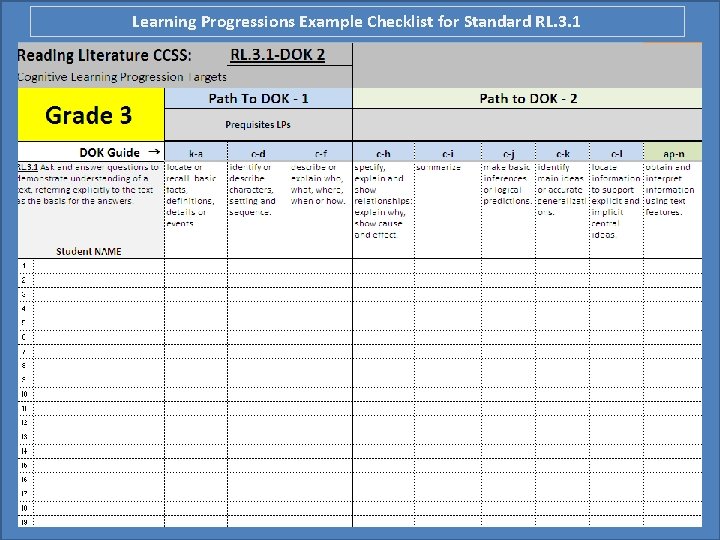
Learning Progressions Example Checklist for Standard RL. 3. 1
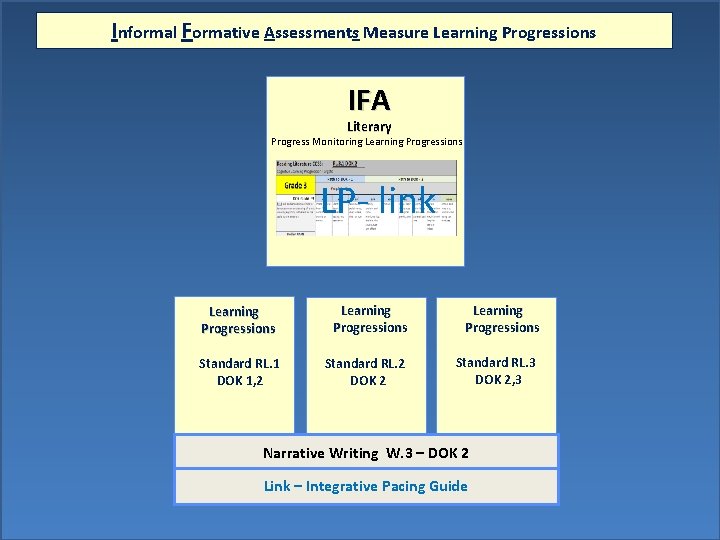
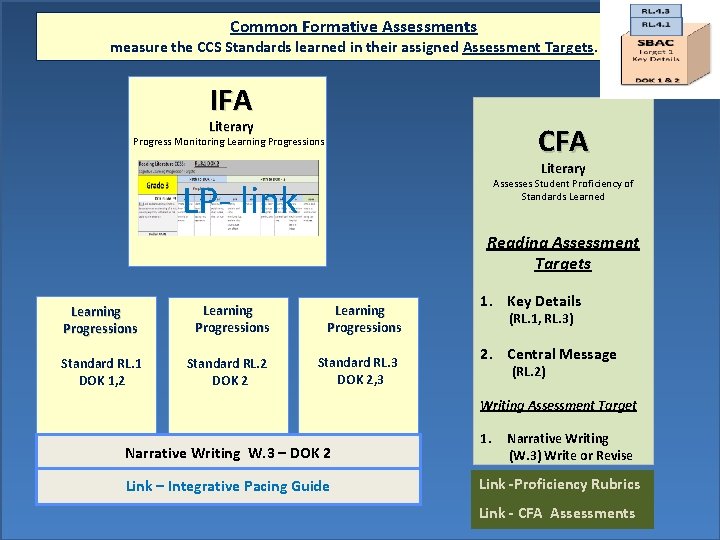
Informal Formative Assessments Measure Learning Progressions IFA Literary Progress Monitoring Learning Progressions LP- link Learning Progressions Standard RL. 1 DOK 1, 2 Standard RL. 2 DOK 2 Standard RL. 3 DOK 2, 3 Narrative Writing W. 3 – DOK 2 Link – Integrative Pacing Guide
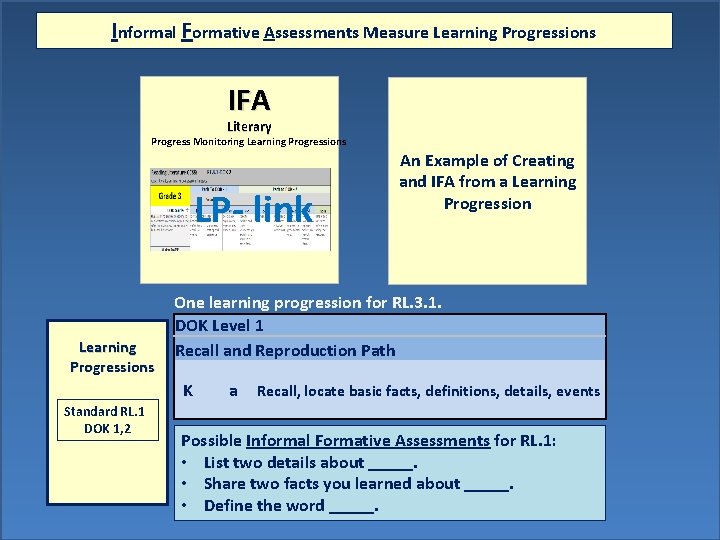
Informal Formative Assessments Measure Learning Progressions IFA Literary Progress Monitoring Learning Progressions LP- link Learning Progressions One learning progression for RL. 3. 1. DOK Level 1 Recall and Reproduction Path K Standard RL. 1 DOK 1, 2 An Example of Creating and IFA from a Learning Progression a Recall, locate basic facts, definitions, details, events Possible Informal Formative Assessments for RL. 1: • List two details about _____. • Share two facts you learned about _____. • Define the word _____.
Common Formative Assessments measure the CCS Standards learned in their assigned Assessment Targets. IFA Literary CFA Progress Monitoring Learning Progressions Literary LP- link Assesses Student Proficiency of Standards Learned Reading Assessment Targets Learning Progressions Standard RL. 1 DOK 1, 2 Standard RL. 2 DOK 2 Standard RL. 3 DOK 2, 3 1. Key Details (RL. 1, RL. 3) 2. Central Message (RL. 2) Writing Assessment Target Narrative Writing W. 3 – DOK 2 Link – Integrative Pacing Guide 1. Narrative Writing (W. 3) Write or Revise Link -Proficiency Rubrics Link - CFA Assessments
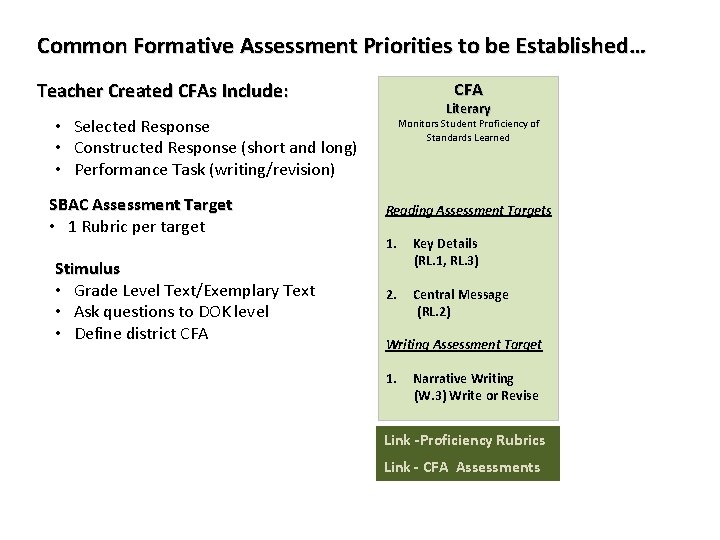
Common Formative Assessment Priorities to be Established… CFA Teacher Created CFAs Include: Literary • Selected Response • Constructed Response (short and long) • Performance Task (writing/revision) SBAC Assessment Target • 1 Rubric per target Stimulus • Grade Level Text/Exemplary Text • Ask questions to DOK level • Define district CFA Monitors Student Proficiency of Standards Learned Reading Assessment Targets 1. Key Details (RL. 1, RL. 3) 2. Central Message (RL. 2) Writing Assessment Target 1. Narrative Writing (W. 3) Write or Revise Link -Proficiency Rubrics Link - CFA Assessments
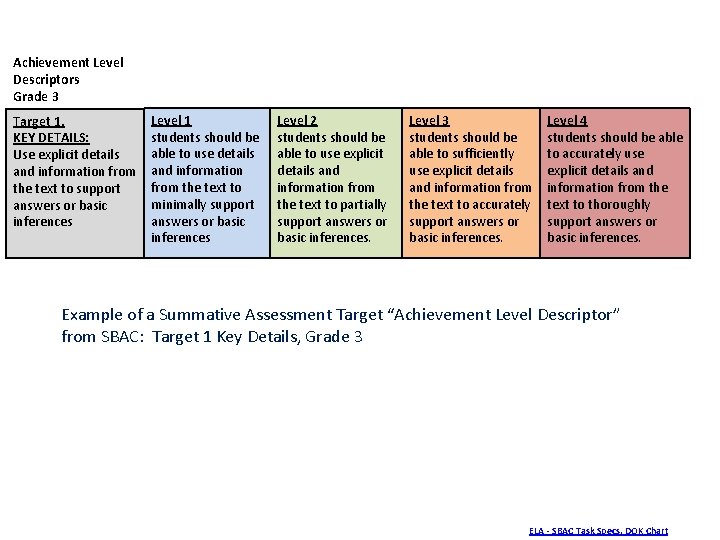
Achievement Level Descriptors Grade 3 Target 1. KEY DETAILS: Use explicit details and information from the text to support answers or basic inferences Level 1 students should be able to use details and information from the text to minimally support answers or basic inferences Level 2 students should be able to use explicit details and information from the text to partially support answers or basic inferences. Level 3 students should be able to sufficiently use explicit details and information from the text to accurately support answers or basic inferences. Level 4 students should be able to accurately use explicit details and information from the text to thoroughly support answers or basic inferences. Example of a Summative Assessment Target “Achievement Level Descriptor” from SBAC: Target 1 Key Details, Grade 3 ELA - SBAC Task Specs. DOK Chart