Eduqas GCE A level Music Component 3 Answering


- Slides: 21
Eduqas GCE A level Music Component 3 Answering the Essay Question
Accessing this guidance This presentation has accompanying audio. If you cannot hear anything, please check your speakers or headphones are connected and working properly.
The Essay Question The task There is only one question in the Eduqas A Level Music paper which needs to be answered as an essay. It is the final question, which is on the development of the symphony. The specification describes it as: “an essay-based question which assesses knowledge of the development of the symphony in relation to both set symphonies and to the wider social, cultural and historical context. ”
Preparation Things to cover The musical elements: • • • Structure Harmony and tonality Texture Melody and thematic development Sonority Tempo, metre and rhythm
Preparation Things to cover Context Development and changes • • The Orchestra, including individual sections Patronage and commissions Programme music Representative composers and works See page 16 of the A level specification
Time period covered A level: 1750 – 1900 (AS: 1750 – 1830)
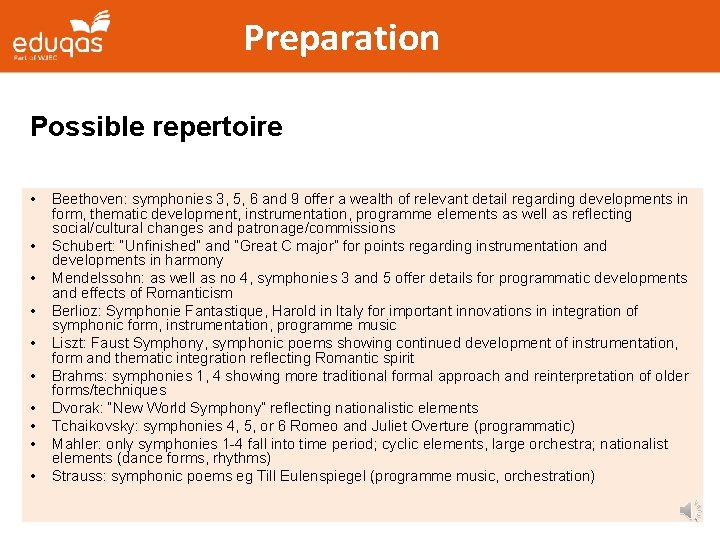
Preparation Possible repertoire • • • Beethoven: symphonies 3, 5, 6 and 9 offer a wealth of relevant detail regarding developments in form, thematic development, instrumentation, programme elements as well as reflecting social/cultural changes and patronage/commissions Schubert: “Unfinished” and “Great C major” for points regarding instrumentation and developments in harmony Mendelssohn: as well as no 4, symphonies 3 and 5 offer details for programmatic developments and effects of Romanticism Berlioz: Symphonie Fantastique, Harold in Italy for important innovations in integration of symphonic form, instrumentation, programme music Liszt: Faust Symphony, symphonic poems showing continued development of instrumentation, form and thematic integration reflecting Romantic spirit Brahms: symphonies 1, 4 showing more traditional formal approach and reinterpretation of older forms/techniques Dvorak: “New World Symphony” reflecting nationalistic elements Tchaikovsky: symphonies 4, 5, or 6 Romeo and Juliet Overture (programmatic) Mahler: only symphonies 1 -4 fall into time period; cyclic elements, large orchestra; nationalist elements (dance forms, rhythms) Strauss: symphonic poems eg Till Eulenspiegel (programme music, orchestration)
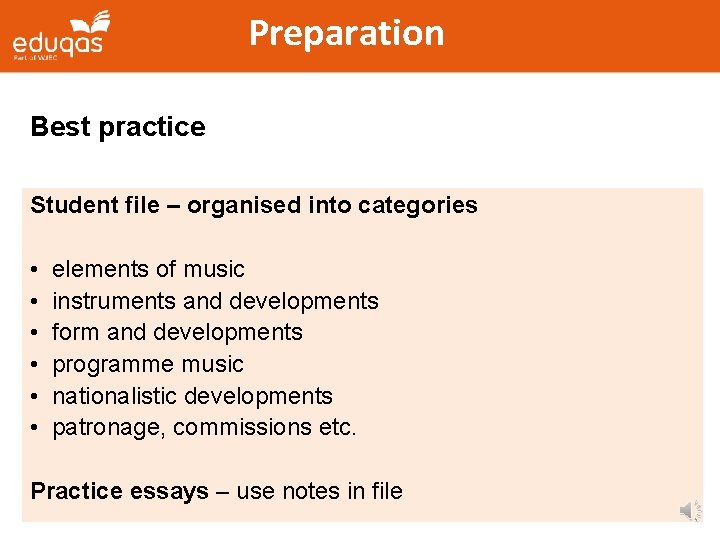
Preparation Best practice Student file – organised into categories • • • elements of music instruments and developments form and developments programme music nationalistic developments patronage, commissions etc. Practice essays – use notes in file
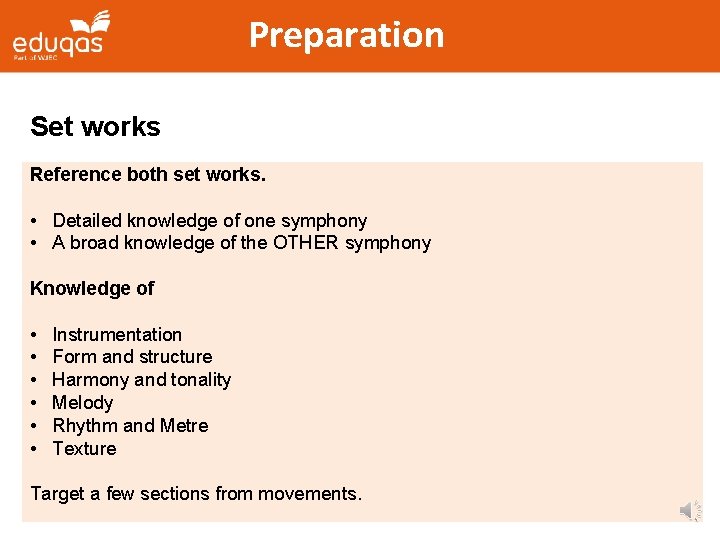
Preparation Set works Reference both set works. • Detailed knowledge of one symphony • A broad knowledge of the OTHER symphony Knowledge of • • • Instrumentation Form and structure Harmony and tonality Melody Rhythm and Metre Texture Target a few sections from movements.
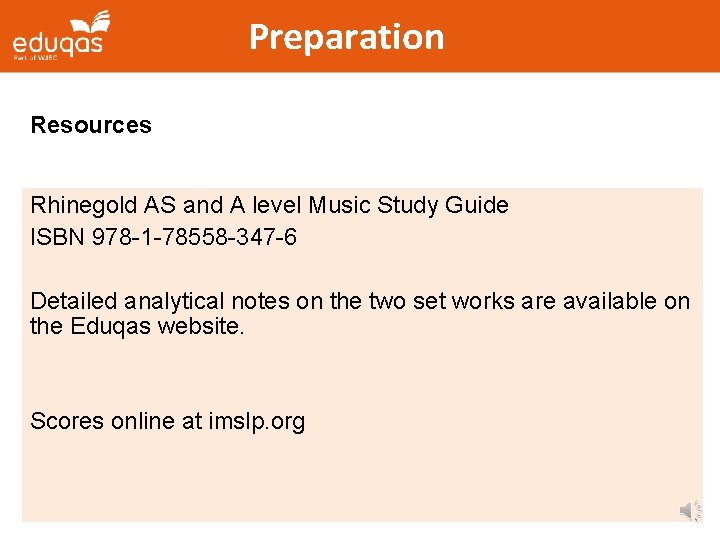
Preparation Resources Rhinegold AS and A level Music Study Guide ISBN 978 -1 -78558 -347 -6 Detailed analytical notes on the two set works are available on the Eduqas website. Scores online at imslp. org
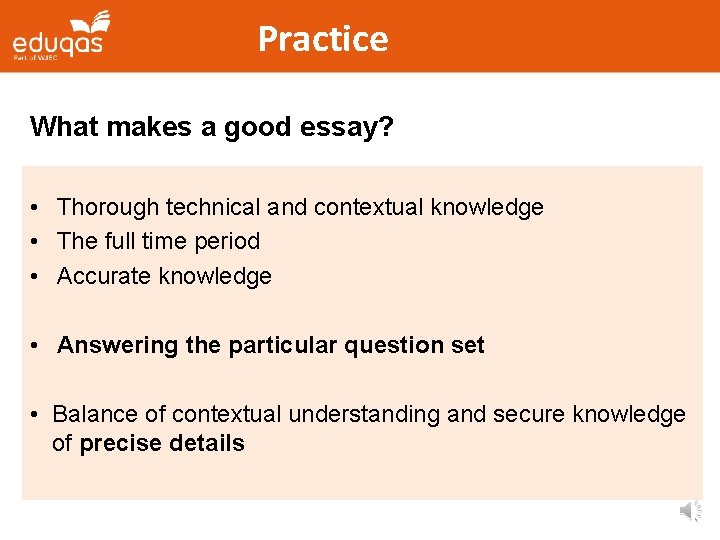
Practice What makes a good essay? • Thorough technical and contextual knowledge • The full time period • Accurate knowledge • Answering the particular question set • Balance of contextual understanding and secure knowledge of precise details
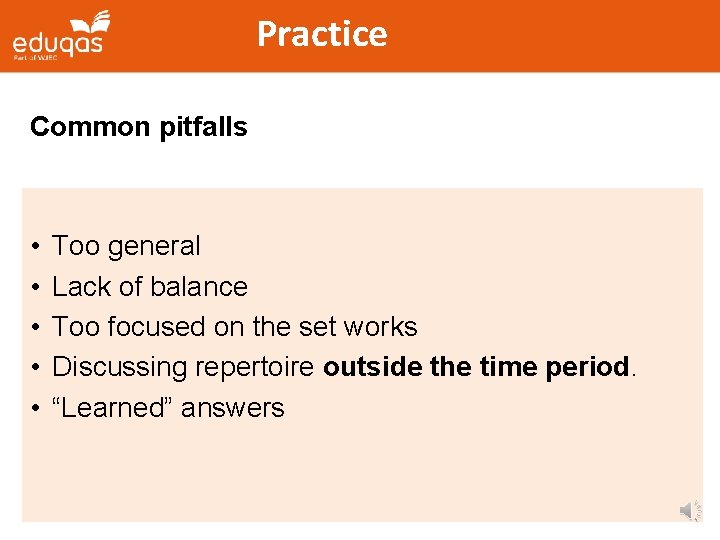
Practice Common pitfalls • • • Too general Lack of balance Too focused on the set works Discussing repertoire outside the time period. “Learned” answers
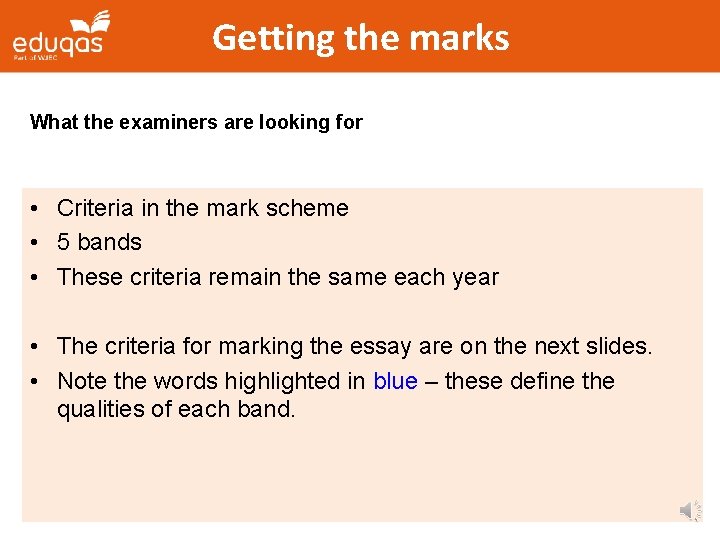
Getting the marks What the examiners are looking for • Criteria in the mark scheme • 5 bands • These criteria remain the same each year • The criteria for marking the essay are on the next slides. • Note the words highlighted in blue – these define the qualities of each band.
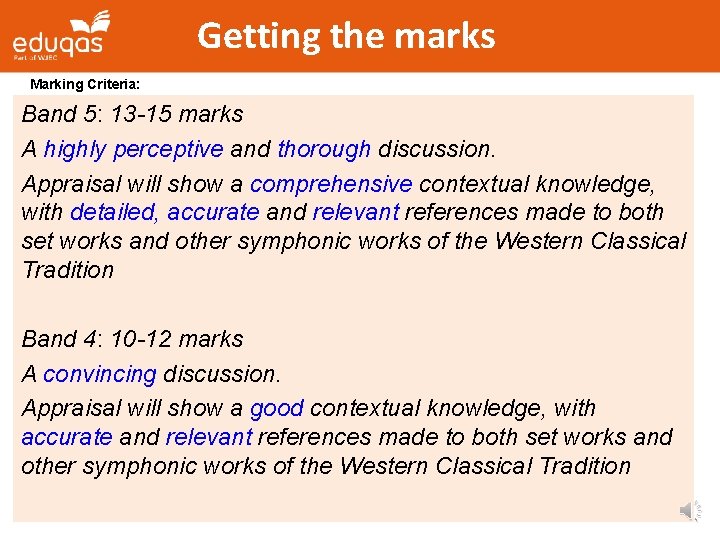
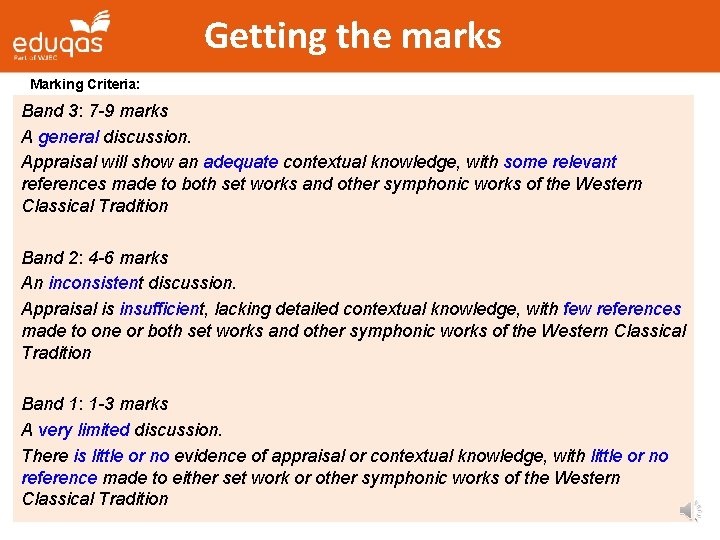
Getting the marks Marking Criteria: Band 5: 13 -15 marks A highly perceptive and thorough discussion. Appraisal will show a comprehensive contextual knowledge, with detailed, accurate and relevant references made to both set works and other symphonic works of the Western Classical Tradition Band 4: 10 -12 marks A convincing discussion. Appraisal will show a good contextual knowledge, with accurate and relevant references made to both set works and other symphonic works of the Western Classical Tradition
Getting the marks Marking Criteria: Band 3: 7 -9 marks A general discussion. Appraisal will show an adequate contextual knowledge, with some relevant references made to both set works and other symphonic works of the Western Classical Tradition Band 2: 4 -6 marks An inconsistent discussion. Appraisal is insufficient, lacking detailed contextual knowledge, with few references made to one or both set works and other symphonic works of the Western Classical Tradition Band 1: 1 -3 marks A very limited discussion. There is little or no evidence of appraisal or contextual knowledge, with little or no reference made to either set work or other symphonic works of the Western Classical Tradition
Getting the marks Using the criteria • Go through the criteria with your teacher. • Peer marking
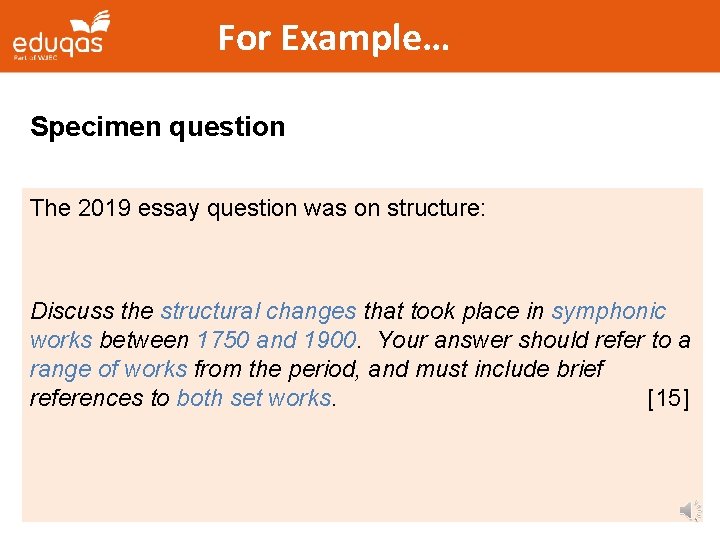
For Example… Specimen question The 2019 essay question was on structure: Discuss the structural changes that took place in symphonic works between 1750 and 1900. Your answer should refer to a range of works from the period, and must include brief references to both set works. [15]
For Example… Indicative content Though it is not expected by any means that all the indicative content should be included, it shows the nature and level of contextual knowledge, critical awareness and specific detail expected in order to access the highest bands of the marking criteria.
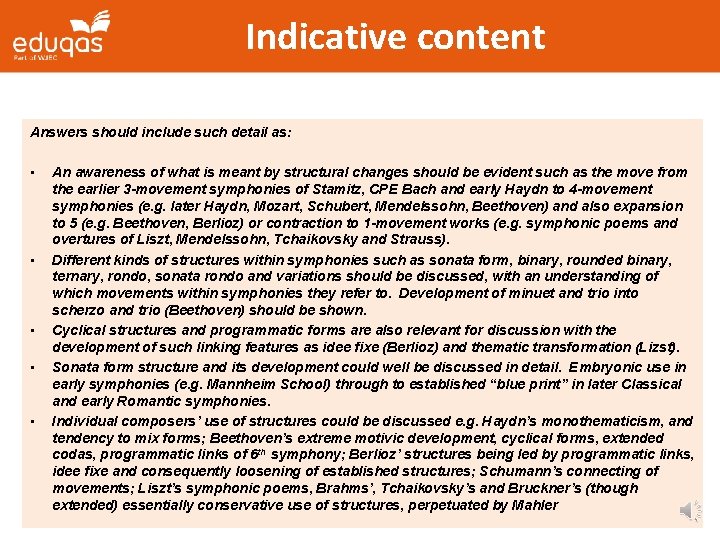
Indicative content Answers should include such detail as: • • • An awareness of what is meant by structural changes should be evident such as the move from the earlier 3 -movement symphonies of Stamitz, CPE Bach and early Haydn to 4 -movement symphonies (e. g. later Haydn, Mozart, Schubert, Mendelssohn, Beethoven) and also expansion to 5 (e. g. Beethoven, Berlioz) or contraction to 1 -movement works (e. g. symphonic poems and overtures of Liszt, Mendelssohn, Tchaikovsky and Strauss). Different kinds of structures within symphonies such as sonata form, binary, rounded binary, ternary, rondo, sonata rondo and variations should be discussed, with an understanding of which movements within symphonies they refer to. Development of minuet and trio into scherzo and trio (Beethoven) should be shown. Cyclical structures and programmatic forms are also relevant for discussion with the development of such linking features as idee fixe (Berlioz) and thematic transformation (Lizst). Sonata form structure and its development could well be discussed in detail. Embryonic use in early symphonies (e. g. Mannheim School) through to established “blue print” in later Classical and early Romantic symphonies. Individual composers’ use of structures could be discussed e. g. Haydn’s monothematicism, and tendency to mix forms; Beethoven’s extreme motivic development, cyclical forms, extended codas, programmatic links of 6 th symphony; Berlioz’ structures being led by programmatic links, idee fixe and consequently loosening of established structures; Schumann’s connecting of movements; Liszt’s symphonic poems, Brahms’, Tchaikovsky’s and Bruckner’s (though extended) essentially conservative use of structures, perpetuated by Mahler
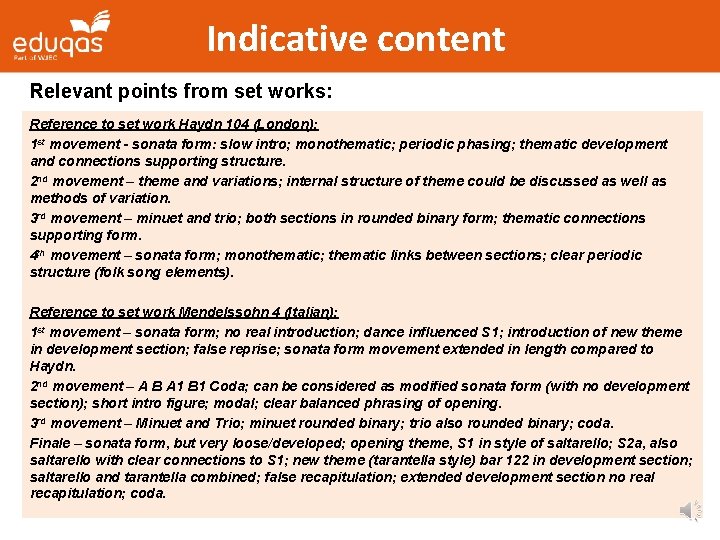
Indicative content Relevant points from set works: Reference to set work Haydn 104 (London): 1 st movement - sonata form: slow intro; monothematic; periodic phasing; thematic development and connections supporting structure. 2 nd movement – theme and variations; internal structure of theme could be discussed as well as methods of variation. 3 rd movement – minuet and trio; both sections in rounded binary form; thematic connections supporting form. 4 th movement – sonata form; monothematic; thematic links between sections; clear periodic structure (folk song elements). Reference to set work Mendelssohn 4 (Italian): 1 st movement – sonata form; no real introduction; dance influenced S 1; introduction of new theme in development section; false reprise; sonata form movement extended in length compared to Haydn. 2 nd movement – A B A 1 B 1 Coda; can be considered as modified sonata form (with no development section); short intro figure; modal; clear balanced phrasing of opening. 3 rd movement – Minuet and Trio; minuet rounded binary; trio also rounded binary; coda. Finale – sonata form, but very loose/developed; opening theme, S 1 in style of saltarello; S 2 a, also saltarello with clear connections to S 1; new theme (tarantella style) bar 122 in development section; saltarello and tarantella combined; false recapitulation; extended development section no real recapitulation; coda.
Any Questions? Contact our specialist Subject Officers and administrative support team for your subject with any queries. music@eduqas. co. uk