EDME 111 L3 Dr Poonam Kumari SCALES A

- Slides: 29
ED-ME 111 L-3 Dr. Poonam Kumari
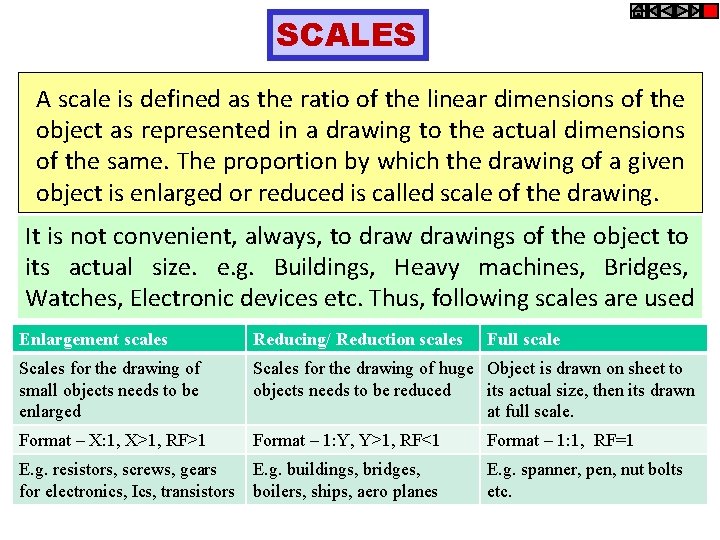
SCALES A scale is defined as the ratio of the linear dimensions of the object as represented in a drawing to the actual dimensions of the same. The proportion by which the drawing of a given object is enlarged or reduced is called scale of the drawing. It is not convenient, always, to drawings of the object to its actual size. e. g. Buildings, Heavy machines, Bridges, Watches, Electronic devices etc. Thus, following scales are used Enlargement scales Reducing/ Reduction scales Scales for the drawing of small objects needs to be enlarged Scales for the drawing of huge Object is drawn on sheet to objects needs to be reduced its actual size, then its drawn at full scale. Format – X: 1, X>1, RF>1 Format – 1: Y, Y>1, RF<1 E. g. resistors, screws, gears E. g. buildings, bridges, for electronics, Ics, transistors boilers, ships, aero planes Full scale Format – 1: 1, RF=1 E. g. spanner, pen, nut bolts etc.
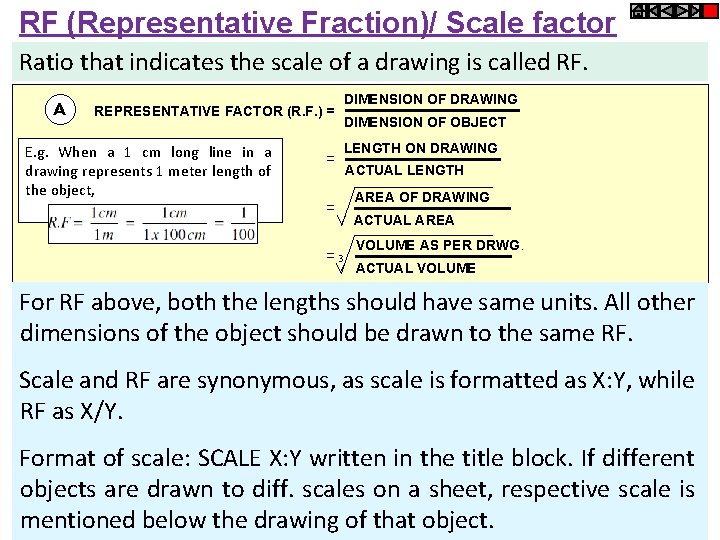
RF (Representative Fraction)/ Scale factor Ratio that indicates the scale of a drawing is called RF. A REPRESENTATIVE FACTOR (R. F. ) = E. g. When a 1 cm long line in a drawing represents 1 meter length of the object, = = DIMENSION OF DRAWING DIMENSION OF OBJECT LENGTH ON DRAWING ACTUAL LENGTH AREA OF DRAWING V ACTUAL AREA =3 VOLUME AS PER DRWG. V ACTUAL VOLUME For RF above, both the lengths should have same units. All other dimensions of the object should be drawn to the same RF. Scale and RF are synonymous, as scale is formatted as X: Y, while RF as X/Y. Format of scale: SCALE X: Y written in the title block. If different objects are drawn to diff. scales on a sheet, respective scale is mentioned below the drawing of that object.
BIS (SP 46: 2003) recommended scales . used in exceptional cases where Intermediate scales can be recommended scales can not be applied for functional reasons. LOS (Length of Scale) (mm) LENGTH OF SCALE (LOS)= R. F. X MAX. LENGTH TO BE MEASURED. All the scales (except the scale of chords) are constructed by drawing a line of length equivalent to the actual distance to be represented. This length is called length of scale (LOS).
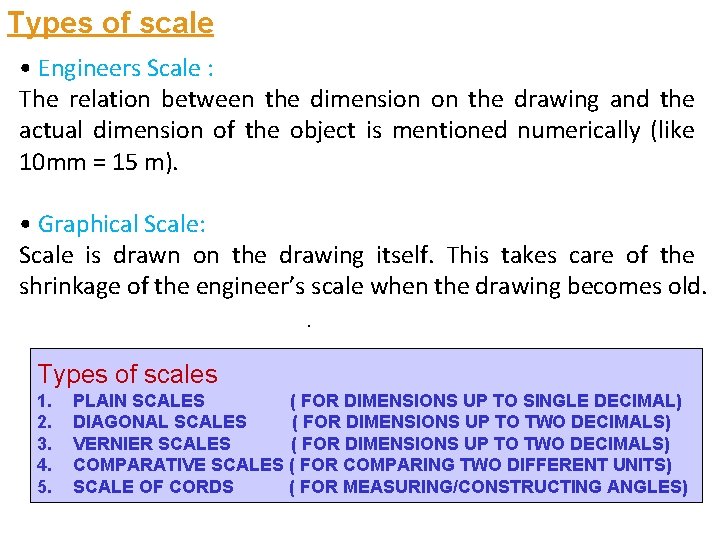
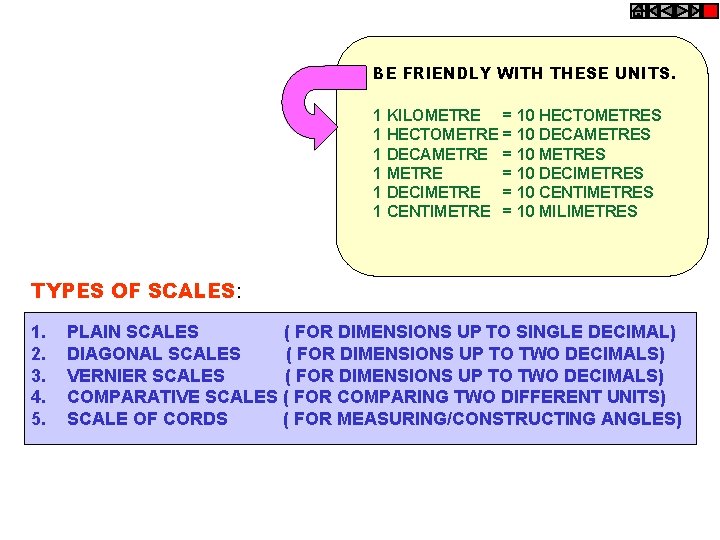
Types of scale • Engineers Scale : The relation between the dimension on the drawing and the actual dimension of the object is mentioned numerically (like 10 mm = 15 m). • Graphical Scale: Scale is drawn on the drawing itself. This takes care of the shrinkage of the engineer’s scale when the drawing becomes old. . Types of scales 1. 2. 3. 4. 5. PLAIN SCALES ( FOR DIMENSIONS UP TO SINGLE DECIMAL) DIAGONAL SCALES ( FOR DIMENSIONS UP TO TWO DECIMALS) VERNIER SCALES ( FOR DIMENSIONS UP TO TWO DECIMALS) COMPARATIVE SCALES ( FOR COMPARING TWO DIFFERENT UNITS) SCALE OF CORDS ( FOR MEASURING/CONSTRUCTING ANGLES)
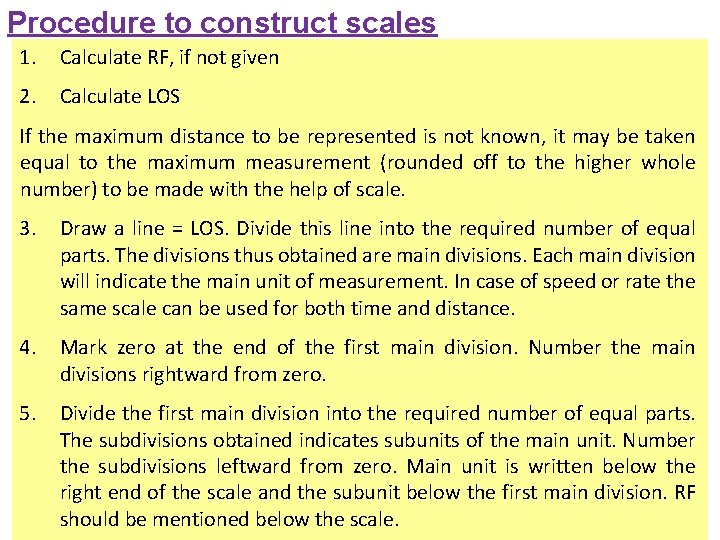
Procedure to construct scales 1. Calculate RF, if not given 2. Calculate LOS If the maximum distance to be represented is not known, it may be taken equal to the maximum measurement (rounded off to the higher whole number) to be made with the help of scale. 3. Draw a line = LOS. Divide this line into the required number of equal parts. The divisions thus obtained are main divisions. Each main division will indicate the main unit of measurement. In case of speed or rate the same scale can be used for both time and distance. . 4. Mark zero at the end of the first main division. Number the main divisions rightward from zero. 5. Divide the first main division into the required number of equal parts. The subdivisions obtained indicates subunits of the main unit. Number the subdivisions leftward from zero. Main unit is written below the right end of the scale and the subunit below the first main division. RF should be mentioned below the scale.
BE FRIENDLY WITH THESE UNITS. 1 KILOMETRE = 10 HECTOMETRES 1 HECTOMETRE = 10 DECAMETRES 1 DECAMETRE = 10 METRES 1 METRE = 10 DECIMETRES 1 DECIMETRE = 10 CENTIMETRES 1 CENTIMETRE = 10 MILIMETRES TYPES OF SCALES: 1. 2. 3. 4. 5. PLAIN SCALES ( FOR DIMENSIONS UP TO SINGLE DECIMAL) DIAGONAL SCALES ( FOR DIMENSIONS UP TO TWO DECIMALS) VERNIER SCALES ( FOR DIMENSIONS UP TO TWO DECIMALS) COMPARATIVE SCALES ( FOR COMPARING TWO DIFFERENT UNITS) SCALE OF CORDS ( FOR MEASURING/CONSTRUCTING ANGLES)
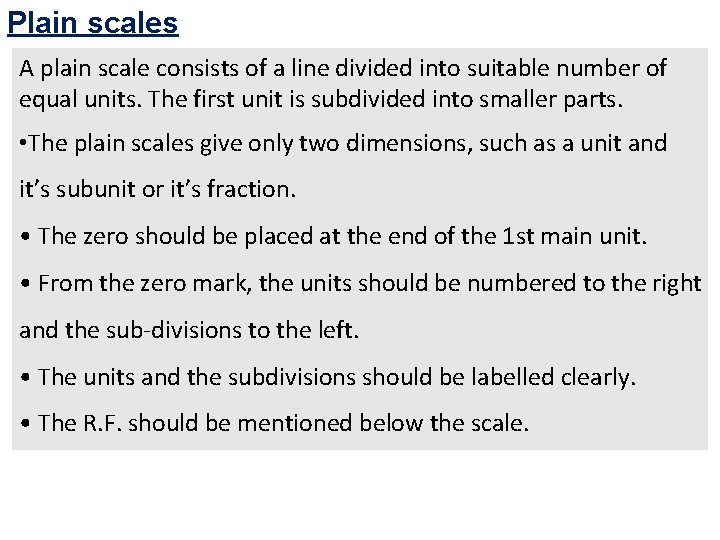
Plain scales A plain scale consists of a line divided into suitable number of equal units. The first unit is subdivided into smaller parts. • The plain scales give only two dimensions, such as a unit and it’s subunit or it’s fraction. • The zero should be placed at the end of the 1 st main unit. • From the zero mark, the units should be numbered to the right . and the sub-divisions to the left. • The units and the subdivisions should be labelled clearly. • The R. F. should be mentioned below the scale.
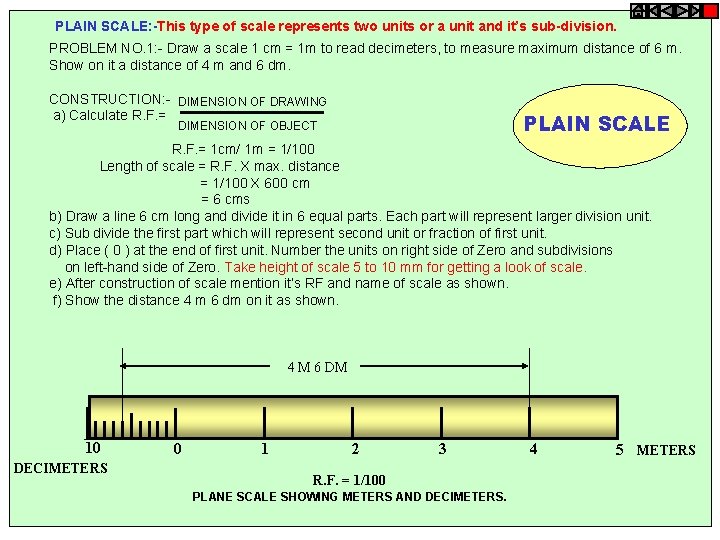
PLAIN SCALE: -This type of scale represents two units or a unit and it’s sub-division. PROBLEM NO. 1: - Draw a scale 1 cm = 1 m to read decimeters, to measure maximum distance of 6 m. Show on it a distance of 4 m and 6 dm. CONSTRUCTION: - DIMENSION OF DRAWING a) Calculate R. F. = PLAIN SCALE DIMENSION OF OBJECT R. F. = 1 cm/ 1 m = 1/100 Length of scale = R. F. X max. distance = 1/100 X 600 cm = 6 cms b) Draw a line 6 cm long and divide it in 6 equal parts. Each part will represent larger division unit. c) Sub divide the first part which will represent second unit or fraction of first unit. d) Place ( 0 ) at the end of first unit. Number the units on right side of Zero and subdivisions on left-hand side of Zero. Take height of scale 5 to 10 mm for getting a look of scale. e) After construction of scale mention it’s RF and name of scale as shown. f) Show the distance 4 m 6 dm on it as shown. 4 M 6 DM 10 DECIMETERS 0 1 2 3 R. F. = 1/100 PLANE SCALE SHOWING METERS AND DECIMETERS. 4 5 METERS
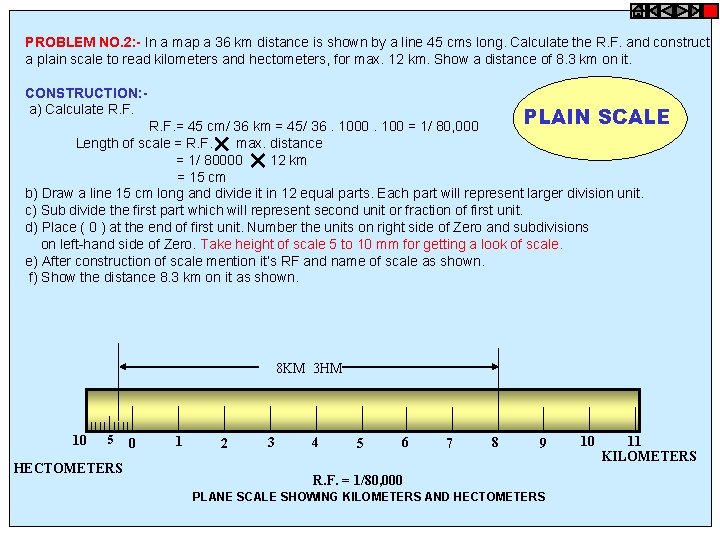
PROBLEM NO. 2: - In a map a 36 km distance is shown by a line 45 cms long. Calculate the R. F. and construct a plain scale to read kilometers and hectometers, for max. 12 km. Show a distance of 8. 3 km on it. CONSTRUCTION: a) Calculate R. F. PLAIN SCALE R. F. = 45 cm/ 36 km = 45/ 36. 1000. 100 = 1/ 80, 000 Length of scale = R. F. max. distance = 1/ 80000 12 km = 15 cm b) Draw a line 15 cm long and divide it in 12 equal parts. Each part will represent larger division unit. c) Sub divide the first part which will represent second unit or fraction of first unit. d) Place ( 0 ) at the end of first unit. Number the units on right side of Zero and subdivisions on left-hand side of Zero. Take height of scale 5 to 10 mm for getting a look of scale. e) After construction of scale mention it’s RF and name of scale as shown. f) Show the distance 8. 3 km on it as shown. 8 KM 3 HM 10 5 HECTOMETERS 0 1 2 3 4 5 6 7 8 9 R. F. = 1/80, 000 PLANE SCALE SHOWING KILOMETERS AND HECTOMETERS 10 11 KILOMETERS
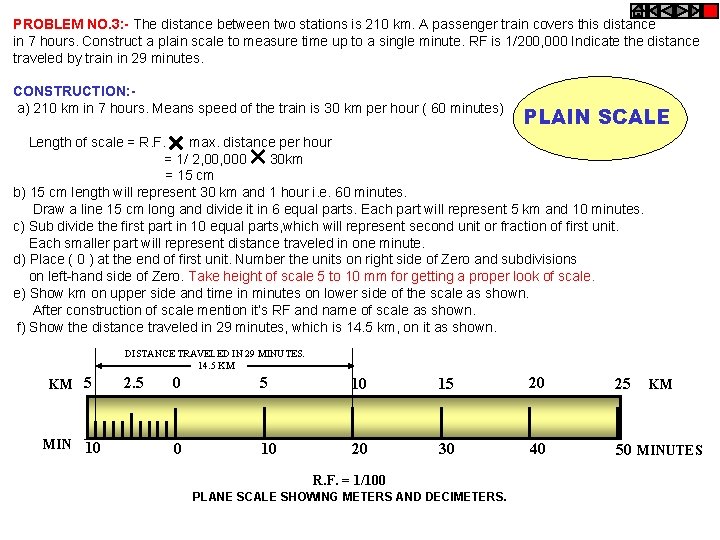
PROBLEM NO. 3: - The distance between two stations is 210 km. A passenger train covers this distance in 7 hours. Construct a plain scale to measure time up to a single minute. RF is 1/200, 000 Indicate the distance traveled by train in 29 minutes. CONSTRUCTION: a) 210 km in 7 hours. Means speed of the train is 30 km per hour ( 60 minutes) PLAIN SCALE Length of scale = R. F. max. distance per hour = 1/ 2, 000 30 km = 15 cm b) 15 cm length will represent 30 km and 1 hour i. e. 60 minutes. Draw a line 15 cm long and divide it in 6 equal parts. Each part will represent 5 km and 10 minutes. c) Sub divide the first part in 10 equal parts, which will represent second unit or fraction of first unit. Each smaller part will represent distance traveled in one minute. d) Place ( 0 ) at the end of first unit. Number the units on right side of Zero and subdivisions on left-hand side of Zero. Take height of scale 5 to 10 mm for getting a proper look of scale. e) Show km on upper side and time in minutes on lower side of the scale as shown. After construction of scale mention it’s RF and name of scale as shown. f) Show the distance traveled in 29 minutes, which is 14. 5 km, on it as shown. DISTANCE TRAVELED IN 29 MINUTES. 14. 5 KM KM 5 MIN 10 2. 5 0 5 10 15 20 25 0 10 20 30 40 50 MINUTES R. F. = 1/100 PLANE SCALE SHOWING METERS AND DECIMETERS. KM
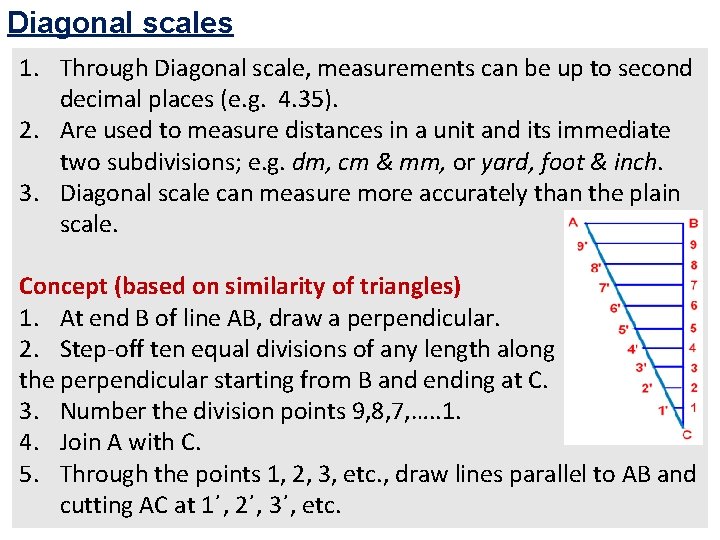
Diagonal scales 1. Through Diagonal scale, measurements can be up to second decimal places (e. g. 4. 35). 2. Are used to measure distances in a unit and its immediate two subdivisions; e. g. dm, cm & mm, or yard, foot & inch. 3. Diagonal scale can measure more accurately than the plain scale. Concept (based on similarity of triangles) 1. At end B of line AB, draw a perpendicular. . 2. Step-off ten equal divisions of any length along the perpendicular starting from B and ending at C. 3. Number the division points 9, 8, 7, …. . 1. 4. Join A with C. 5. Through the points 1, 2, 3, etc. , draw lines parallel to AB and cutting AC at 1΄, 2΄, 3΄, etc.
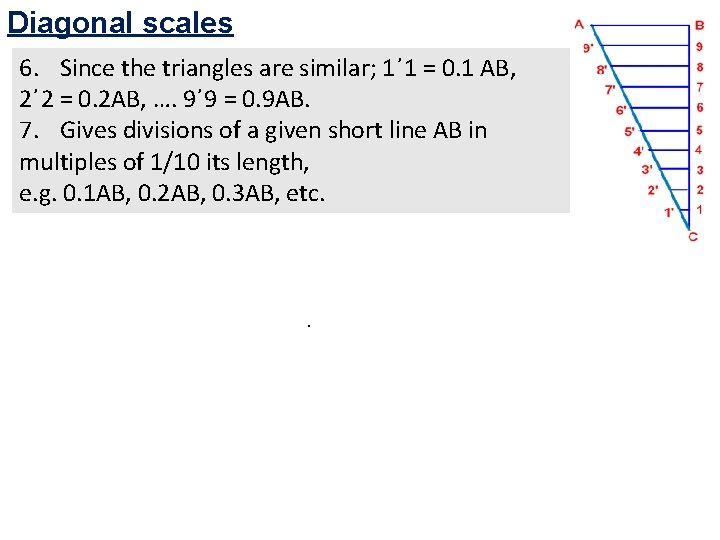
Diagonal scales 6. Since the triangles are similar; 1΄1 = 0. 1 AB, 2΄2 = 0. 2 AB, …. 9΄9 = 0. 9 AB. 7. Gives divisions of a given short line AB in multiples of 1/10 its length, e. g. 0. 1 AB, 0. 2 AB, 0. 3 AB, etc. .
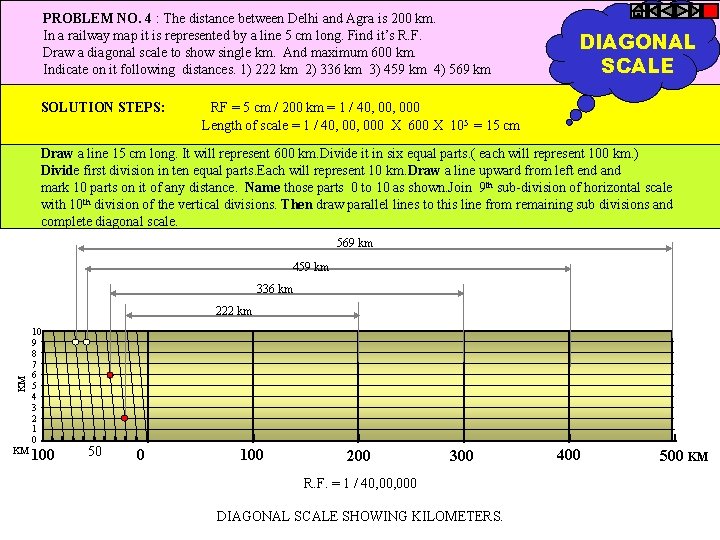
PROBLEM NO. 4 : The distance between Delhi and Agra is 200 km. In a railway map it is represented by a line 5 cm long. Find it’s R. F. Draw a diagonal scale to show single km. And maximum 600 km. Indicate on it following distances. 1) 222 km 2) 336 km 3) 459 km 4) 569 km SOLUTION STEPS: DIAGONAL SCALE RF = 5 cm / 200 km = 1 / 40, 000 Length of scale = 1 / 40, 000 X 600 X 105 = 15 cm Draw a line 15 cm long. It will represent 600 km. Divide it in six equal parts. ( each will represent 100 km. ) Divide first division in ten equal parts. Each will represent 10 km. Draw a line upward from left end and mark 10 parts on it of any distance. Name those parts 0 to 10 as shown. Join 9 th sub-division of horizontal scale with 10 th division of the vertical divisions. Then draw parallel lines to this line from remaining sub divisions and complete diagonal scale. 569 km 459 km 336 km KM 222 km KM 10 9 8 7 6 5 4 3 2 1 0 100 50 0 100 200 300 R. F. = 1 / 40, 000 DIAGONAL SCALE SHOWING KILOMETERS. 400 500 KM
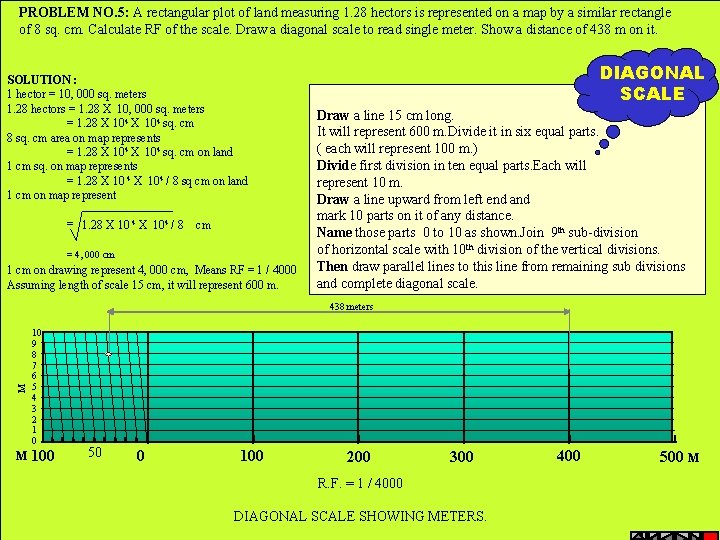
PROBLEM NO. 5: A rectangular plot of land measuring 1. 28 hectors is represented on a map by a similar rectangle of 8 sq. cm. Calculate RF of the scale. Draw a diagonal scale to read single meter. Show a distance of 438 m on it. SOLUTION : 1 hector = 10, 000 sq. meters 1. 28 hectors = 1. 28 X 10, 000 sq. meters = 1. 28 X 104 sq. cm 8 sq. cm area on map represents = 1. 28 X 104 sq. cm on land 1 cm sq. on map represents = 1. 28 X 10 4 X 10⁴ / 8 sq cm on land 1 cm on map represent = 1. 28 X 10 4 X 10⁴ / 8 cm = 4, 000 cm 1 cm on drawing represent 4, 000 cm, Means RF = 1 / 4000 Assuming length of scale 15 cm, it will represent 600 m. DIAGONAL SCALE Draw a line 15 cm long. It will represent 600 m. Divide it in six equal parts. ( each will represent 100 m. ) Divide first division in ten equal parts. Each will represent 10 m. Draw a line upward from left end and mark 10 parts on it of any distance. Name those parts 0 to 10 as shown. Join 9 th sub-division of horizontal scale with 10 th division of the vertical divisions. Then draw parallel lines to this line from remaining sub divisions and complete diagonal scale. M 438 meters 10 9 8 7 6 5 4 3 2 1 0 M 100 50 0 100 200 300 R. F. = 1 / 4000 DIAGONAL SCALE SHOWING METERS. 400 500 M
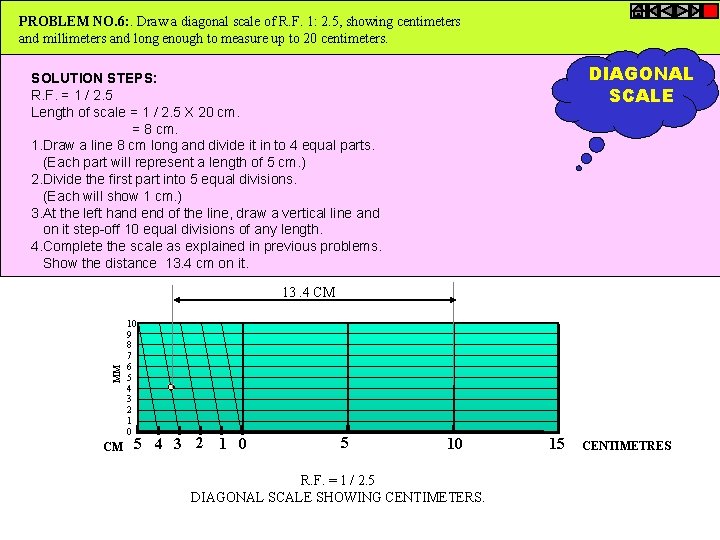
PROBLEM NO. 6: . Draw a diagonal scale of R. F. 1: 2. 5, showing centimeters and millimeters and long enough to measure up to 20 centimeters. DIAGONAL SCALE SOLUTION STEPS: R. F. = 1 / 2. 5 Length of scale = 1 / 2. 5 X 20 cm. = 8 cm. 1. Draw a line 8 cm long and divide it in to 4 equal parts. (Each part will represent a length of 5 cm. ) 2. Divide the first part into 5 equal divisions. (Each will show 1 cm. ) 3. At the left hand end of the line, draw a vertical line and on it step-off 10 equal divisions of any length. 4. Complete the scale as explained in previous problems. Show the distance 13. 4 cm on it. MM 13. 4 CM CM 10 9 8 7 6 5 4 3 2 1 0 5 10 R. F. = 1 / 2. 5 DIAGONAL SCALE SHOWING CENTIMETERS. 15 CENTIMETRES
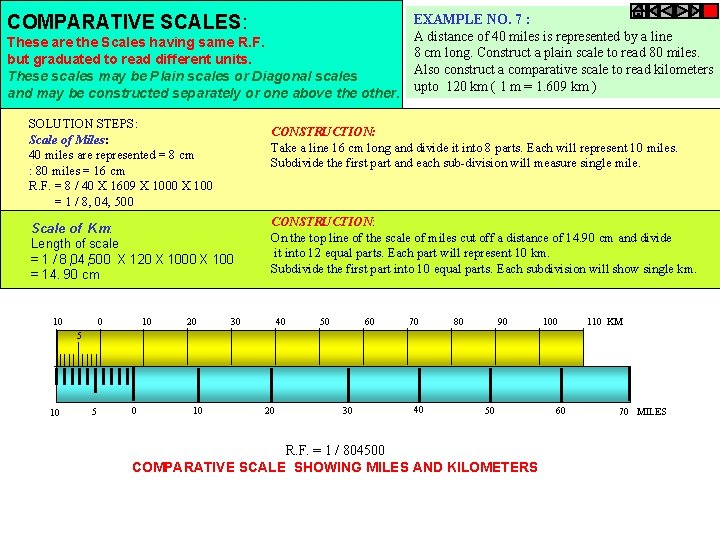
COMPARATIVE SCALES: EXAMPLE NO. 7 : A distance of 40 miles is represented by a line These are the Scales having same R. F. 8 cm long. Construct a plain scale to read 80 miles. but graduated to read different units. Also construct a comparative scale to read kilometers These scales may be Plain scales or Diagonal scales and may be constructed separately or one above the other. upto 120 km ( 1 m = 1. 609 km ) SOLUTION STEPS: Scale of Miles: 40 miles are represented = 8 cm : 80 miles = 16 cm R. F. = 8 / 40 X 1609 X 1000 X 100 = 1 / 8, 04, 500 CONSTRUCTION: Take a line 16 cm long and divide it into 8 parts. Each will represent 10 miles. Subdivide the first part and each sub-division will measure single mile. Scale of Km: Length of scale = 1 / 8, 04, 500 X 120 X 100 = 14. 90 cm 10 0 10 20 CONSTRUCTION: On the top line of the scale of miles cut off a distance of 14. 90 cm and divide it into 12 equal parts. Each part will represent 10 km. Subdivide the first part into 10 equal parts. Each subdivision will show single km. 30 40 50 60 70 80 90 100 110 KM 5 10 5 0 10 20 30 40 50 R. F. = 1 / 804500 COMPARATIVE SCALE SHOWING MILES AND KILOMETERS 60 70 MILES
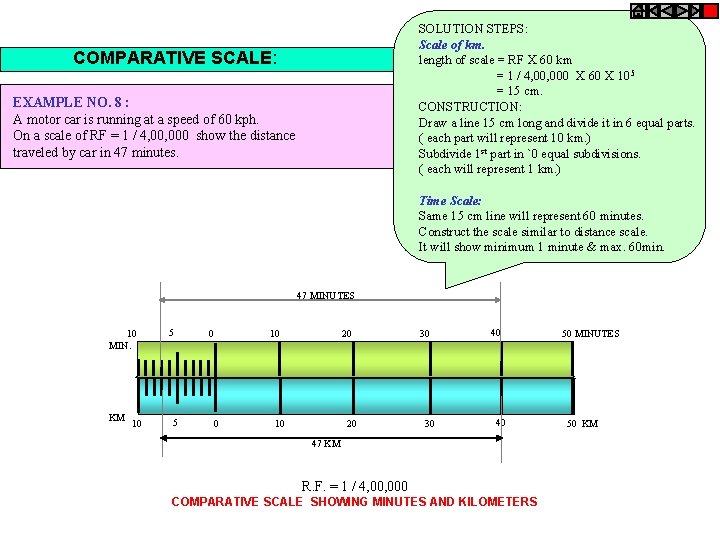
SOLUTION STEPS: Scale of km. length of scale = RF X 60 km = 1 / 4, 000 X 60 X 105 = 15 cm. CONSTRUCTION: Draw a line 15 cm long and divide it in 6 equal parts. ( each part will represent 10 km. ) Subdivide 1 st part in `0 equal subdivisions. ( each will represent 1 km. ) COMPARATIVE SCALE: EXAMPLE NO. 8 : A motor car is running at a speed of 60 kph. On a scale of RF = 1 / 4, 000 show the distance traveled by car in 47 minutes. Time Scale: Same 15 cm line will represent 60 minutes. Construct the scale similar to distance scale. It will show minimum 1 minute & max. 60 min. 47 MINUTES 10 MIN. KM 10 5 5 0 0 20 10 30 30 40 40 47 KM R. F. = 1 / 4, 000 COMPARATIVE SCALE SHOWING MINUTES AND KILOMETERS 50 MINUTES 50 KM
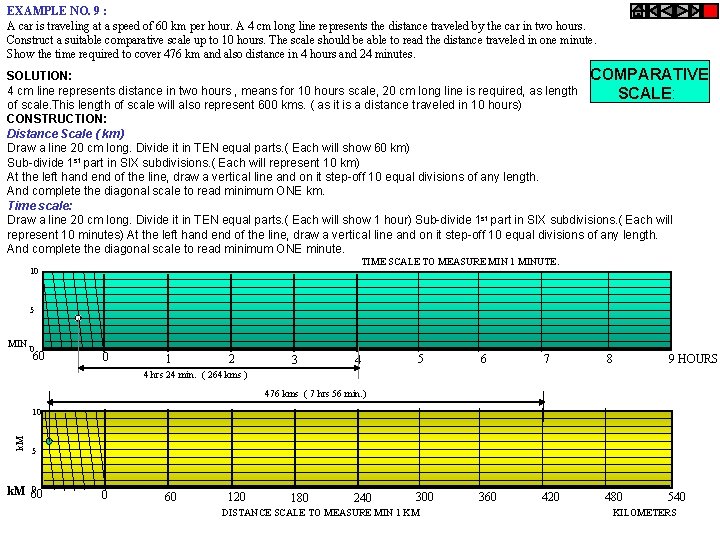
EXAMPLE NO. 9 : A car is traveling at a speed of 60 km per hour. A 4 cm long line represents the distance traveled by the car in two hours. Construct a suitable comparative scale up to 10 hours. The scale should be able to read the distance traveled in one minute. Show the time required to cover 476 km and also distance in 4 hours and 24 minutes. COMPARATIVE SOLUTION: 4 cm line represents distance in two hours , means for 10 hours scale, 20 cm long line is required, as length SCALE: of scale. This length of scale will also represent 600 kms. ( as it is a distance traveled in 10 hours) CONSTRUCTION: Distance Scale ( km) Draw a line 20 cm long. Divide it in TEN equal parts. ( Each will show 60 km) Sub-divide 1 st part in SIX subdivisions. ( Each will represent 10 km) At the left hand end of the line, draw a vertical line and on it step-off 10 equal divisions of any length. And complete the diagonal scale to read minimum ONE km. Time scale: Draw a line 20 cm long. Divide it in TEN equal parts. ( Each will show 1 hour) Sub-divide 1 st part in SIX subdivisions. ( Each will represent 10 minutes) At the left hand end of the line, draw a vertical line and on it step-off 10 equal divisions of any length. And complete the diagonal scale to read minimum ONE minute. TIME SCALE TO MEASURE MIN 1 MINUTE. 10 5 MIN. 0 60 0 1 2 3 4 5 6 7 8 9 HOURS 300 360 420 480 540 4 hrs 24 min. ( 264 kms ) 476 kms ( 7 hrs 56 min. ) k. M 10 5 0 k. M 60 0 60 120 180 240 DISTANCE SCALE TO MEASURE MIN 1 KM KILOMETERS
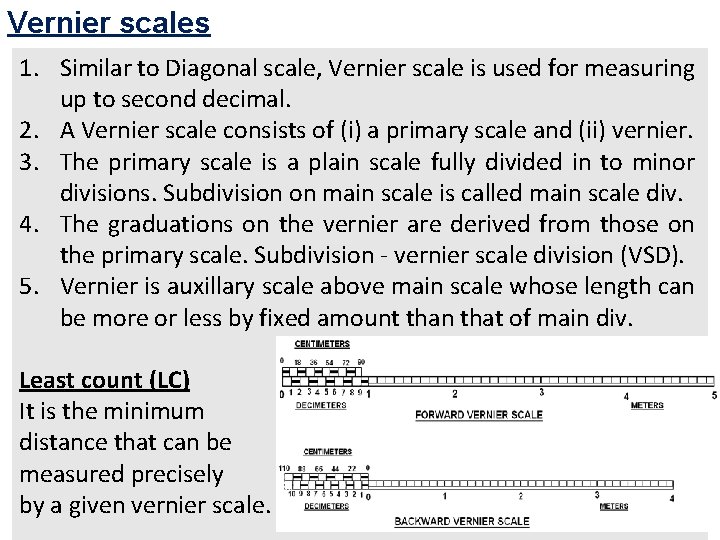
Vernier scales 1. Similar to Diagonal scale, Vernier scale is used for measuring up to second decimal. 2. A Vernier scale consists of (i) a primary scale and (ii) vernier. 3. The primary scale is a plain scale fully divided in to minor divisions. Subdivision on main scale is called main scale div. 4. The graduations on the vernier are derived from those on the primary scale. Subdivision - vernier scale division (VSD). 5. Vernier is auxillary scale above main scale whose length can be more or less by fixed amount than that of main div. . Least count (LC) It is the minimum distance that can be measured precisely by a given vernier scale.
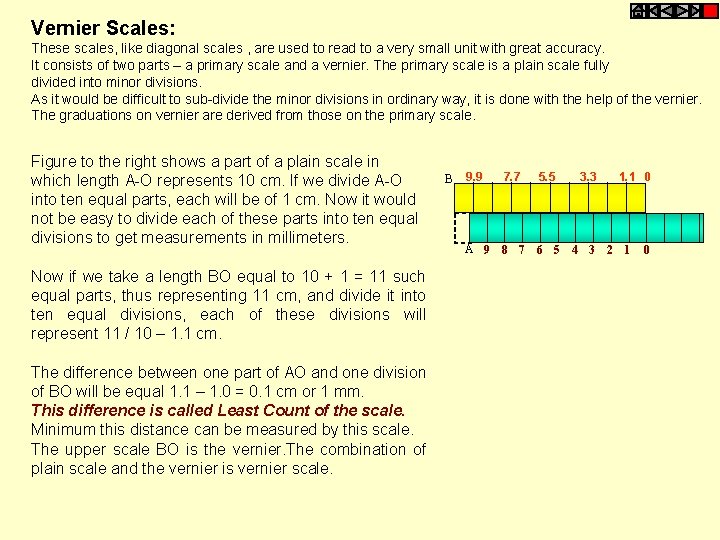
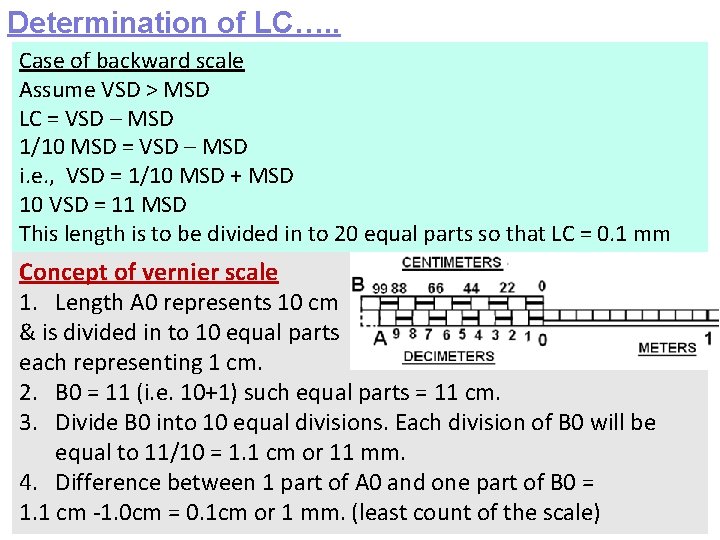
Vernier Scales: These scales, like diagonal scales , are used to read to a very small unit with great accuracy. It consists of two parts – a primary scale and a vernier. The primary scale is a plain scale fully divided into minor divisions. As it would be difficult to sub-divide the minor divisions in ordinary way, it is done with the help of the vernier. The graduations on vernier are derived from those on the primary scale. Figure to the right shows a part of a plain scale in which length A-O represents 10 cm. If we divide A-O into ten equal parts, each will be of 1 cm. Now it would not be easy to divide each of these parts into ten equal divisions to get measurements in millimeters. Now if we take a length BO equal to 10 + 1 = 11 such equal parts, thus representing 11 cm, and divide it into ten equal divisions, each of these divisions will represent 11 / 10 – 1. 1 cm. The difference between one part of AO and one division of BO will be equal 1. 1 – 1. 0 = 0. 1 cm or 1 mm. This difference is called Least Count of the scale. Minimum this distance can be measured by this scale. The upper scale BO is the vernier. The combination of plain scale and the vernier is vernier scale. B 9. 9 7. 7 5. 5 3. 3 1. 1 0 A 9 8 7 6 5 4 3 2 1 0
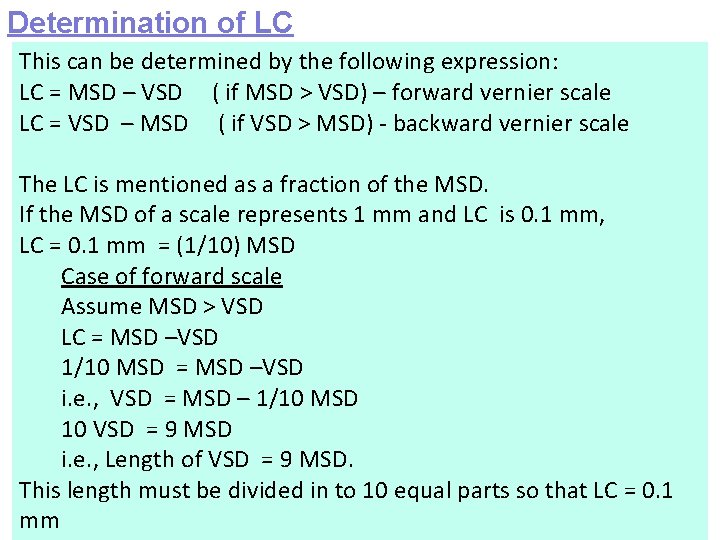
Determination of LC This can be determined by the following expression: LC = MSD – VSD ( if MSD > VSD) – forward vernier scale LC = VSD – MSD ( if VSD > MSD) - backward vernier scale The LC is mentioned as a fraction of the MSD. If the MSD of a scale represents 1 mm and LC is 0. 1 mm, LC = 0. 1 mm = (1/10) MSD Case of forward scale Assume MSD > VSD . LC = MSD –VSD 1/10 MSD = MSD –VSD i. e. , VSD = MSD – 1/10 MSD 10 VSD = 9 MSD i. e. , Length of VSD = 9 MSD. This length must be divided in to 10 equal parts so that LC = 0. 1 mm
Determination of LC…. . Case of backward scale Assume VSD > MSD LC = VSD – MSD 1/10 MSD = VSD – MSD i. e. , VSD = 1/10 MSD + MSD 10 VSD = 11 MSD This length is to be divided in to 20 equal parts so that LC = 0. 1 mm Concept of vernier scale 1. Length A 0 represents 10 cm. & is divided in to 10 equal parts each representing 1 cm. 2. B 0 = 11 (i. e. 10+1) such equal parts = 11 cm. 3. Divide B 0 into 10 equal divisions. Each division of B 0 will be equal to 11/10 = 1. 1 cm or 11 mm. 4. Difference between 1 part of A 0 and one part of B 0 = 1. 1 cm -1. 0 cm = 0. 1 cm or 1 mm. (least count of the scale)
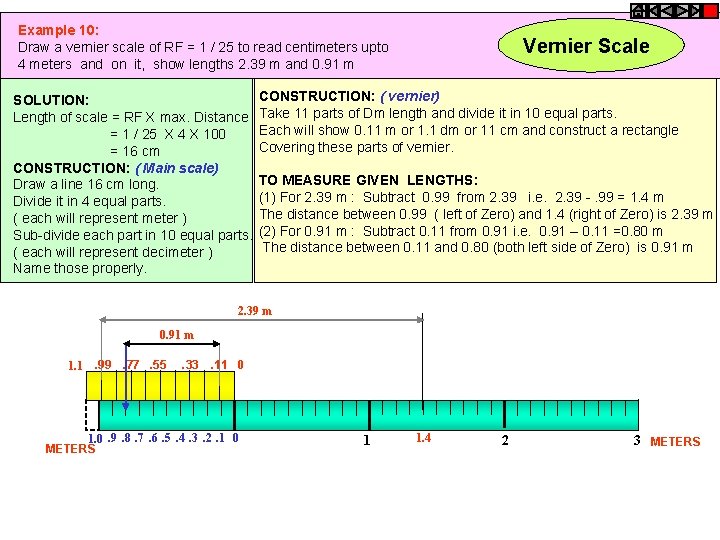
Example 10: Draw a vernier scale of RF = 1 / 25 to read centimeters upto 4 meters and on it, show lengths 2. 39 m and 0. 91 m SOLUTION: Length of scale = RF X max. Distance = 1 / 25 X 4 X 100 = 16 cm CONSTRUCTION: ( Main scale) Draw a line 16 cm long. Divide it in 4 equal parts. ( each will represent meter ) Sub-divide each part in 10 equal parts. ( each will represent decimeter ) Name those properly. Vernier Scale CONSTRUCTION: ( vernier) Take 11 parts of Dm length and divide it in 10 equal parts. Each will show 0. 11 m or 1. 1 dm or 11 cm and construct a rectangle Covering these parts of vernier. TO MEASURE GIVEN LENGTHS: (1) For 2. 39 m : Subtract 0. 99 from 2. 39 i. e. 2. 39 -. 99 = 1. 4 m The distance between 0. 99 ( left of Zero) and 1. 4 (right of Zero) is 2. 39 m (2) For 0. 91 m : Subtract 0. 11 from 0. 91 i. e. 0. 91 – 0. 11 =0. 80 m The distance between 0. 11 and 0. 80 (both left side of Zero) is 0. 91 m 2. 39 m 0. 91 m 1. 1. 99 . 77. 55 . 33. 11 0 1. 0. 9. 8. 7. 6. 5. 4. 3. 2. 1 0 METERS 1 1. 4 2 3 METERS
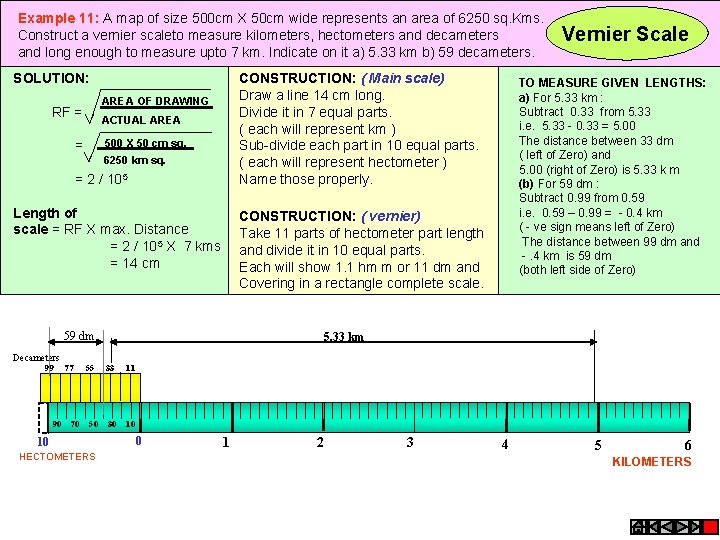
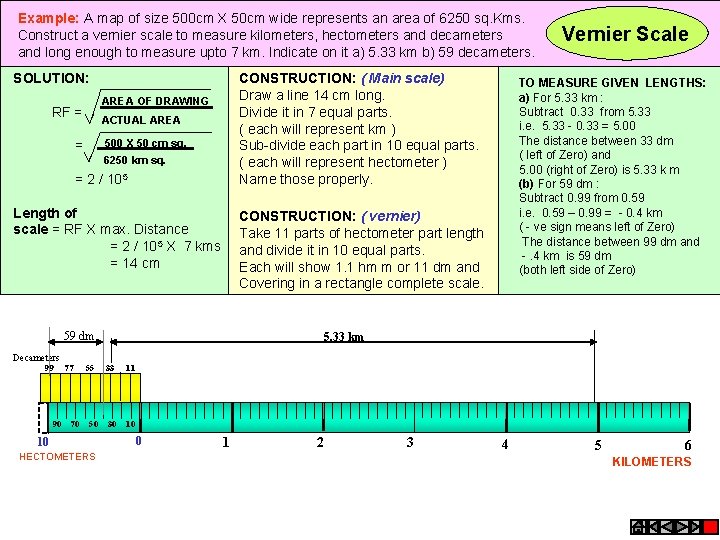
Example 11: A map of size 500 cm X 50 cm wide represents an area of 6250 sq. Kms. Construct a vernier scaleto measure kilometers, hectometers and decameters and long enough to measure upto 7 km. Indicate on it a) 5. 33 km b) 59 decameters. SOLUTION: RF = = CONSTRUCTION: ( Main scale) Draw a line 14 cm long. Divide it in 7 equal parts. ( each will represent km ) Sub-divide each part in 10 equal parts. ( each will represent hectometer ) Name those properly. AREA OF DRAWING V ACTUAL AREA 500 X 50 cm sq. V 6250 km sq. = 2 / 105 Length of scale = RF X max. Distance = 2 / 105 X 7 kms = 14 cm Decameters 99 90 77 70 55 50 10 HECTOMETERS TO MEASURE GIVEN LENGTHS: a) For 5. 33 km : Subtract 0. 33 from 5. 33 i. e. 5. 33 - 0. 33 = 5. 00 The distance between 33 dm ( left of Zero) and 5. 00 (right of Zero) is 5. 33 k m (b) For 59 dm : Subtract 0. 99 from 0. 59 i. e. 0. 59 – 0. 99 = - 0. 4 km ( - ve sign means left of Zero) The distance between 99 dm and -. 4 km is 59 dm (both left side of Zero) CONSTRUCTION: ( vernier) Take 11 parts of hectometer part length and divide it in 10 equal parts. Each will show 1. 1 hm m or 11 dm and Covering in a rectangle complete scale. 59 dm Vernier Scale 5. 33 km 33 11 30 10 0 1 2 3 4 5 6 KILOMETERS
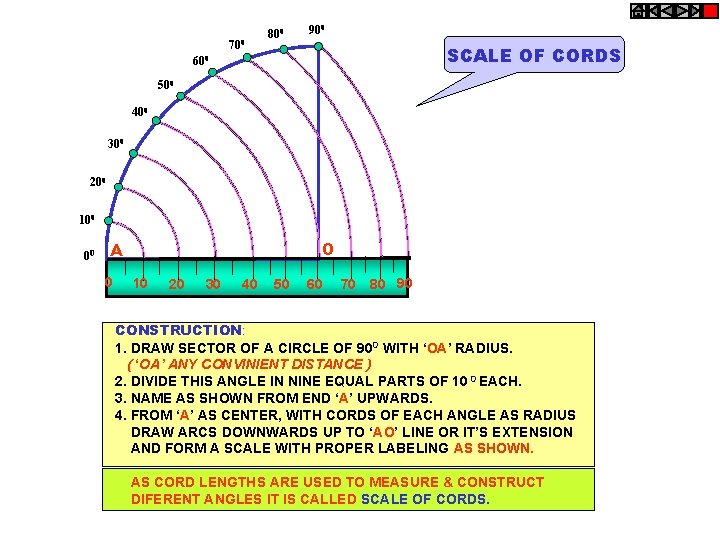
700 800 900 SCALE OF CORDS 600 500 400 300 200 100 00 O A 0 10 20 30 40 50 60 70 80 90 CONSTRUCTION: 1. DRAW SECTOR OF A CIRCLE OF 900 WITH ‘OA’ RADIUS. ( ‘OA’ ANY CONVINIENT DISTANCE ) 2. DIVIDE THIS ANGLE IN NINE EQUAL PARTS OF 10 0 EACH. 3. NAME AS SHOWN FROM END ‘A’ UPWARDS. 4. FROM ‘A’ AS CENTER, WITH CORDS OF EACH ANGLE AS RADIUS DRAW ARCS DOWNWARDS UP TO ‘AO’ LINE OR IT’S EXTENSION AND FORM A SCALE WITH PROPER LABELING AS SHOWN. AS CORD LENGTHS ARE USED TO MEASURE & CONSTRUCT DIFERENT ANGLES IT IS CALLED SCALE OF CORDS.
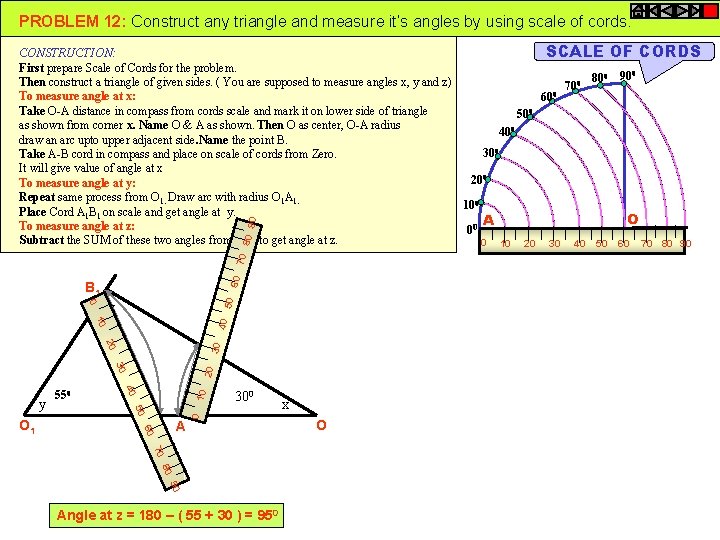
PROBLEM 12: Construct any triangle and measure it’s angles by using scale of cords. 60 70 80 9 0 CONSTRUCTION: SCALE OF CORDS First prepare Scale of Cords for the problem. 0 800 90 Then construct a triangle of given sides. ( You are supposed to measure angles x, y and z) 700 To measure angle at x: 600 Take O-A distance in compass from cords scale and mark it on lower side of triangle 500 as shown from corner x. Name O & A as shown. Then O as center, O-A radius 400 draw an arc upto upper adjacent side. Name the point B. 300 Take A-B cord in compass and place on scale of cords from Zero. It will give value of angle at x 200 To measure angle at y: Repeat same process from O 1. Draw arc with radius O 1 A 1. 100 Place Cord A 1 B 1 on scale and get angle at y. O A To measure angle at z: 00 Subtract the SUM of these two angles from 1800 to get angle at z. 0 10 20 30 40 50 60 70 80 90 B 1 50 0 z 40 10 30 20 B 50 A 1 60 A 300 0 10 40 O 1 20 30 y 550 70 80 90 Angle at z = 180 – ( 55 + 30 ) = 950 x O
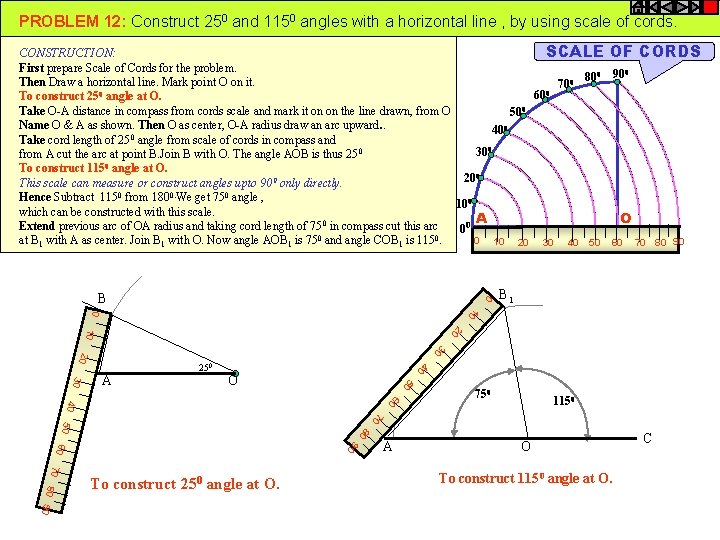
PROBLEM 12: Construct 250 and 1150 angles with a horizontal line , by using scale of cords. CONSTRUCTION: SCALE OF CORDS First prepare Scale of Cords for the problem. 0 800 90 0 Then Draw a horizontal line. Mark point O on it. 70 600 To construct 250 angle at O. Take O-A distance in compass from cords scale and mark it on on the line drawn, from O 500 Name O & A as shown. Then O as center, O-A radius draw an arc upward. . 400 Take cord length of 250 angle from scale of cords in compass and 300 from A cut the arc at point B. Join B with O. The angle AOB is thus 25 0 To construct 1150 angle at O. 200 This scale can measure or construct angles upto 900 only directly. Hence Subtract 1150 from 1800. We get 750 angle , 100 which can be constructed with this scale. O A Extend previous arc of OA radius and taking cord length of 75 0 in compass cut this arc 00 0 10 20 30 40 50 60 70 80 90 at B 1 with A as center. Join B 1 with O. Now angle AOB 1 is 750 and angle COB 1 is 1150. 0 B B 1 10 0 20 10 30 40 20 O 50 30 A 250 60 40 750 1150 70 80 50 90 60 70 8 0 90 To construct 250 angle at O. A O To construct 1150 angle at O. C
Example: A map of size 500 cm X 50 cm wide represents an area of 6250 sq. Kms. Construct a vernier scale to measure kilometers, hectometers and decameters and long enough to measure upto 7 km. Indicate on it a) 5. 33 km b) 59 decameters. SOLUTION: RF = = CONSTRUCTION: ( Main scale) Draw a line 14 cm long. Divide it in 7 equal parts. ( each will represent km ) Sub-divide each part in 10 equal parts. ( each will represent hectometer ) Name those properly. AREA OF DRAWING V ACTUAL AREA 500 X 50 cm sq. V 6250 km sq. = 2 / 105 Length of scale = RF X max. Distance = 2 / 105 X 7 kms = 14 cm Decameters 99 90 77 70 55 50 10 HECTOMETERS TO MEASURE GIVEN LENGTHS: a) For 5. 33 km : Subtract 0. 33 from 5. 33 i. e. 5. 33 - 0. 33 = 5. 00 The distance between 33 dm ( left of Zero) and 5. 00 (right of Zero) is 5. 33 k m (b) For 59 dm : Subtract 0. 99 from 0. 59 i. e. 0. 59 – 0. 99 = - 0. 4 km ( - ve sign means left of Zero) The distance between 99 dm and -. 4 km is 59 dm (both left side of Zero) CONSTRUCTION: ( vernier) Take 11 parts of hectometer part length and divide it in 10 equal parts. Each will show 1. 1 hm m or 11 dm and Covering in a rectangle complete scale. 59 dm Vernier Scale 5. 33 km 33 11 30 10 0 1 2 3 4 5 6 KILOMETERS