E 103 Learning and teaching in the primary



- Slides: 25
E 103 Learning and teaching in the primary years Tutorial 5 EMA planning and preparation 8 th April 2017 Catherine Barnett Weymouth 1
Aims of the tutorial • To plan and manage time and tasks • To articulate own approaches to learning, identifying strengths and areas for development • To seek and learn from feedback • To deepen learning and sense-making through greater engagement with learning resources • To prepare for assessment (EMA). 2
Agenda • Welcome and introductions • Review of TMA 04 and a reflection on the study topics 12 -14 • Reflecting back on your learning over the whole module- ST 19, activity 19. 10 • The requirements for the EMA and how best to plan your study time to support EMA preparation • Conclusions - a look forward to the study planner. 3
Welcome and introductions Please spend a few minutes talking to someone…if possible, someone you have never met before. How are you enjoying the online study topics? What are your thoughts and feelings about the EMA? 4
Review of TMA 04 • What did you learn from the writing of TMA 04 and study topics 12 -14? • How will you use your tutor’s feedback? 5
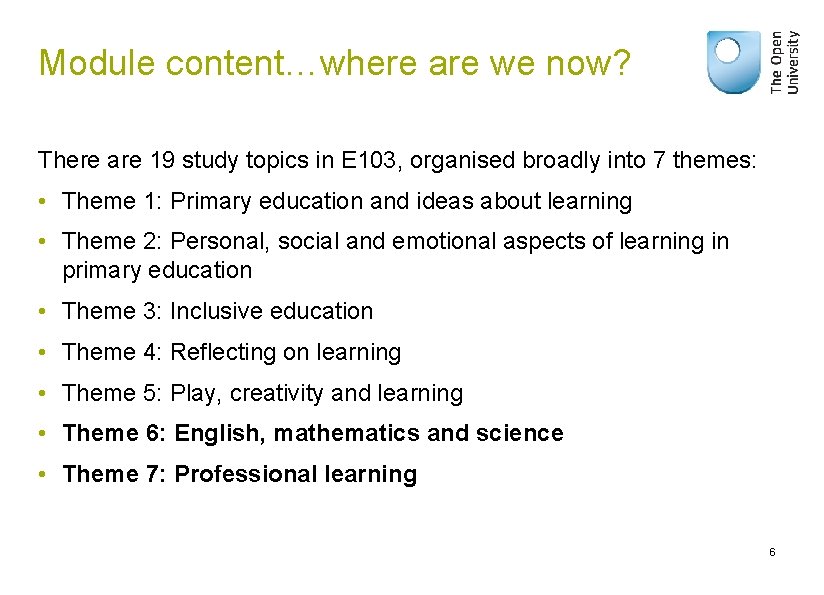
Module content…where are we now? There are 19 study topics in E 103, organised broadly into 7 themes: • Theme 1: Primary education and ideas about learning • Theme 2: Personal, social and emotional aspects of learning in primary education • Theme 3: Inclusive education • Theme 4: Reflecting on learning • Theme 5: Play, creativity and learning • Theme 6: English, mathematics and science • Theme 7: Professional learning 6
Key Themes for EMA Note that the EMA -Reflecting on the module draws on themes 6 and 7 and concepts and principles considered across all Study Topic materials, the E 103 video sequences, the online activities and the chapters from the two module Readers. Theme 6: English, mathematics and science This theme considers what are often regarded as the key academic areas of the primary curriculum: language and literacy, mathematics and science. It includes Study Topics 15 to 17. Theme 7: Professional learning In this concluding theme you will consider the impact of home and the community on children’s education, and think about ways in which schools and families might work productively together. Finally, you will be asked to look back over the module to consider your learning in the light of your studies and identify areas for further study and career development. 7
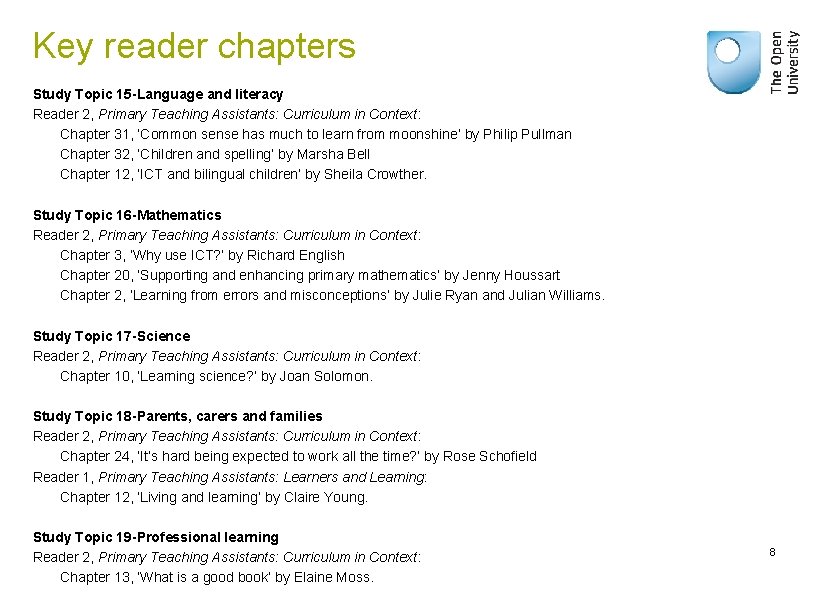
Key reader chapters Study Topic 15 -Language and literacy Reader 2, Primary Teaching Assistants: Curriculum in Context: Chapter 31, ‘Common sense has much to learn from moonshine’ by Philip Pullman Chapter 32, ‘Children and spelling’ by Marsha Bell Chapter 12, ‘ICT and bilingual children’ by Sheila Crowther. Study Topic 16 -Mathematics Reader 2, Primary Teaching Assistants: Curriculum in Context: Chapter 3, ‘Why use ICT? ’ by Richard English Chapter 20, ‘Supporting and enhancing primary mathematics’ by Jenny Houssart Chapter 2, ‘Learning from errors and misconceptions’ by Julie Ryan and Julian Williams. Study Topic 17 -Science Reader 2, Primary Teaching Assistants: Curriculum in Context: Chapter 10, ‘Learning science? ’ by Joan Solomon. Study Topic 18 -Parents, carers and families Reader 2, Primary Teaching Assistants: Curriculum in Context: Chapter 24, ‘It’s hard being expected to work all the time? ’ by Rose Schofield Reader 1, Primary Teaching Assistants: Learners and Learning: Chapter 12, ‘Living and learning’ by Claire Young. Study Topic 19 -Professional learning Reader 2, Primary Teaching Assistants: Curriculum in Context: Chapter 13, ‘What is a good book’ by Elaine Moss. 8
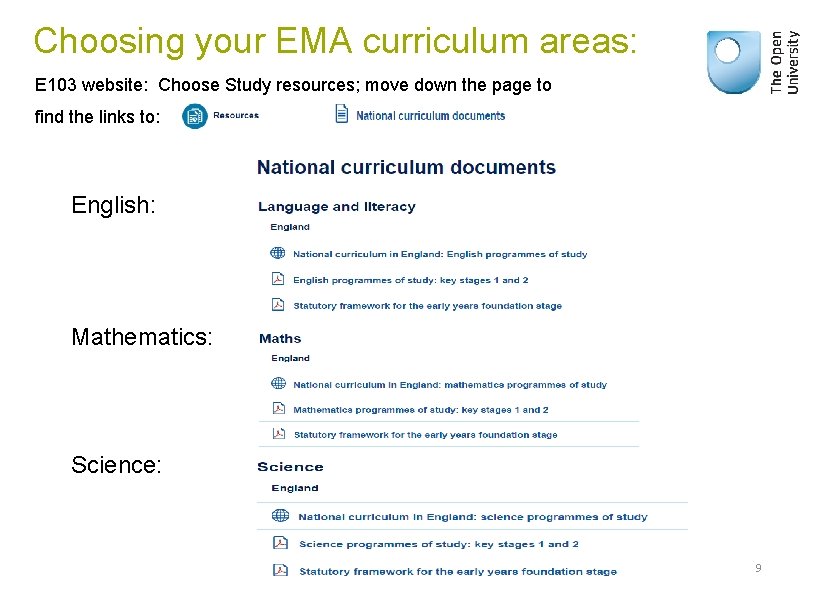
Choosing your EMA curriculum areas: E 103 website: Choose Study resources; move down the page to find the links to: English: Mathematics: Science: 9
What makes a strong EMA? “The stronger, higher scoring, EMAs (Bands A and B) revealed the necessary retrospective and prospective voices. This meant they took a long view over the whole module, citing a number of the 19 study topics where relevant, including the Readers and the CDs (video sequences), and doing this in each of the three main sections of the EMA. These scripts did not just describe current practice at the end of a module but considered this alongside previous practice, and integrated specific thoughts for future work and training. ” (The E 111 module team, 2007). 10
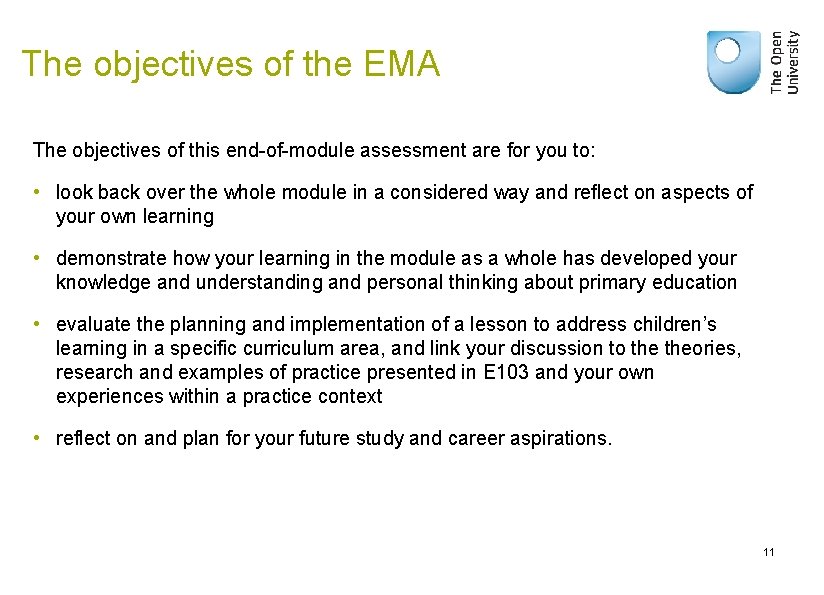
The objectives of the EMA The objectives of this end-of-module assessment are for you to: • look back over the whole module in a considered way and reflect on aspects of your own learning • demonstrate how your learning in the module as a whole has developed your knowledge and understanding and personal thinking about primary education • evaluate the planning and implementation of a lesson to address children’s learning in a specific curriculum area, and link your discussion to theories, research and examples of practice presented in E 103 and your own experiences within a practice context • reflect on and plan for your future study and career aspirations. 11
Reflection… Reflection has an important role to play in learning and self-development. There are some key elements of reflection, and you'll need decide on your preferred ways. Reflection could be described as • thinking with a purpose • being critical, but not negative • analysing how effective your learning is • questioning and probing • making judgements and drawing conclusions. http: //www 2. open. ac. uk/students/skillsforstudy/be-aware-of-your-habits. php 12
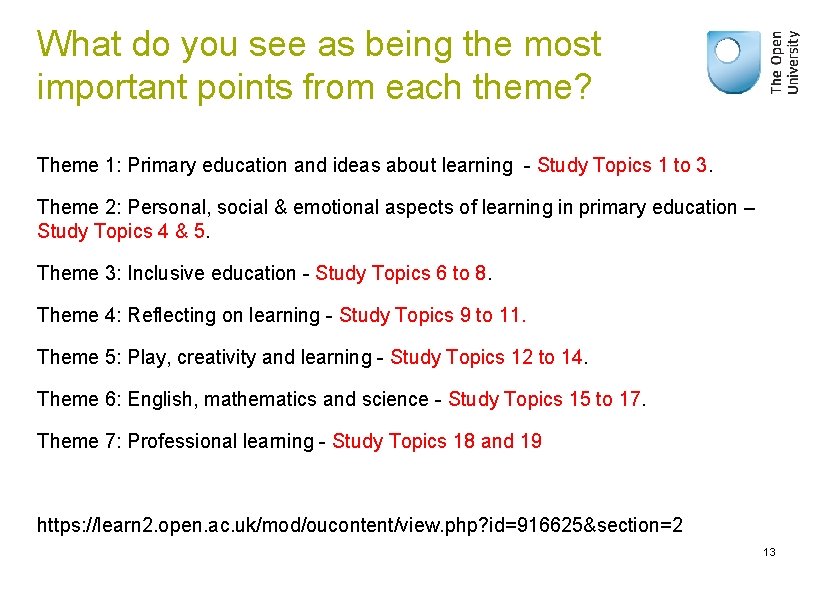
What do you see as being the most important points from each theme? Theme 1: Primary education and ideas about learning - Study Topics 1 to 3. Theme 2: Personal, social & emotional aspects of learning in primary education – Study Topics 4 & 5. Theme 3: Inclusive education - Study Topics 6 to 8. Theme 4: Reflecting on learning - Study Topics 9 to 11. Theme 5: Play, creativity and learning - Study Topics 12 to 14. Theme 6: English, mathematics and science - Study Topics 15 to 17. Theme 7: Professional learning - Study Topics 18 and 19 https: //learn 2. open. ac. uk/mod/oucontent/view. php? id=916625§ion=2 13
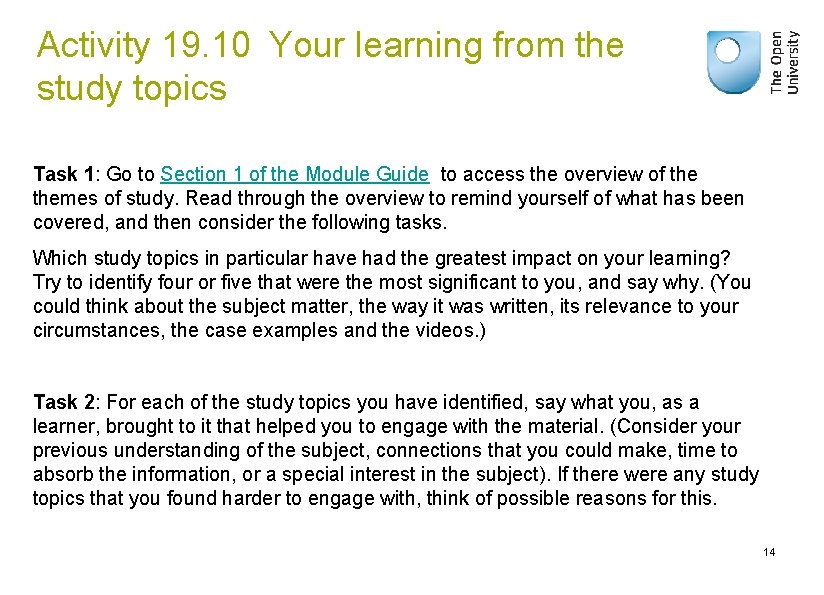
Activity 19. 10 Your learning from the study topics Task 1: Go to Section 1 of the Module Guide to access the overview of themes of study. Read through the overview to remind yourself of what has been covered, and then consider the following tasks. Which study topics in particular have had the greatest impact on your learning? Try to identify four or five that were the most significant to you, and say why. (You could think about the subject matter, the way it was written, its relevance to your circumstances, the case examples and the videos. ) Task 2: For each of the study topics you have identified, say what you, as a learner, brought to it that helped you to engage with the material. (Consider your previous understanding of the subject, connections that you could make, time to absorb the information, or a special interest in the subject). If there were any study topics that you found harder to engage with, think of possible reasons for this. 14
Planning your EMA The crux of your success lies in careful planning. You need to tease out what you are being asked to do and do it. For example, if Part 1 asks you to show what you have changed in your thinking & practice then do that. What is the first thing you do when planning? Think about: • the EMA guidance and consider which Study Topic you are asked to refer to etc. • the Assessment criteria • what you are asked to do. For example, describe, explain etc. and what do they mean? Reflect means to ask ‘why’ and ‘how’ • your word count and what can you realistically do within that. • how are you going to save your work in several places as a back up as you go along? 15
Preparing and planning for EMA • Please see the Assessment Handbook which provides information on the determination of results, resits/resubmissions etc. • Please see the booklet Information for Students Submitting Examinable Work Electronically. This will be emailed to you by the OU 4 -6 weeks before the cut-off date. • Read the guidance in the EMA brief carefully all the way through. • Ensure that you have this, the main Assessment Guide and the Quick Referencing Guide to hand when you are writing. • Ensure that you have close access to the BERA (2011) guidelines. https: //www. bera. ac. uk/wp-content/uploads/2014/02/BERA-Ethical-Guidelines-2011. pdf? noredirect=1 • Ensure that you have worked through the online study topics 15 -19 including the reader chapters and activities. You will also need to refer back to previous study topics where relevant, so you will need all your module materials to hand. • Ensure you have carried out an observation of a lesson in school that focuses on English, mathematics or science for part 2. See part 2 for further details. • Ensure that you have carried out Activity 19. 12 ‘My future plans’ in Study Topic 19. • Consider how you will electronically save your work in more than one place to back it up. 16
EMA requirements • To pass E 103, you must pass the EMA; so if you do not submit the EMA, you will automatically fail the module, although you may be offered the opportunity to resubmit your EMA. • Submission date is Thursday 25 th May 2017 (midday) • Three sections. You do not need to complete and submit the Self-Assessment Language and Learning Checklist for the EMA. • Word count - 3000 words. • Relates to the ideas presented in E 103 as a whole. • Consider the four objectives for the assignment. • All students MUST include an ethical statement at the beginning of your EMA. See Section 5. 3 of the Assessment Guide. In doing this you are adhering to British Educational Research Association (BERA, 2011) guidelines. • Use subheadings to structure your assignment • See section 5 of the Assessment Guide for presenting your work. • Note that your EMA will not be marked by your tutor but by an E 103 tutor who has been appointed as a marker. 17
Section 1. My thinking about primary education (1200 words) During your study of E 103, you have considered many aspects of the world of the primary school including: • pupils • teaching staff • parents • the school community • the curriculum. For your EMA, we would now like you to reflect on and write about some of the ways that your knowledge, understanding and thinking in relation to each of these aspects of primary education has developed as a result of your study on E 103. You may find looking back through your learning notes will help you to identify examples of this. For example, you might choose to write about how: • particular readings, activities or audio-visual materials influenced your thinking about how children learn and how their learning might be supported effectively • your appreciation has developed of some of the challenges faced by school staff in their roles, and what theory and research has to say about these issues. Use the five areas above as heading to structure your writing, and make sure that you support your points by drawing on a range of materials from across the module. Make sure 18 that you write about each of the five areas.
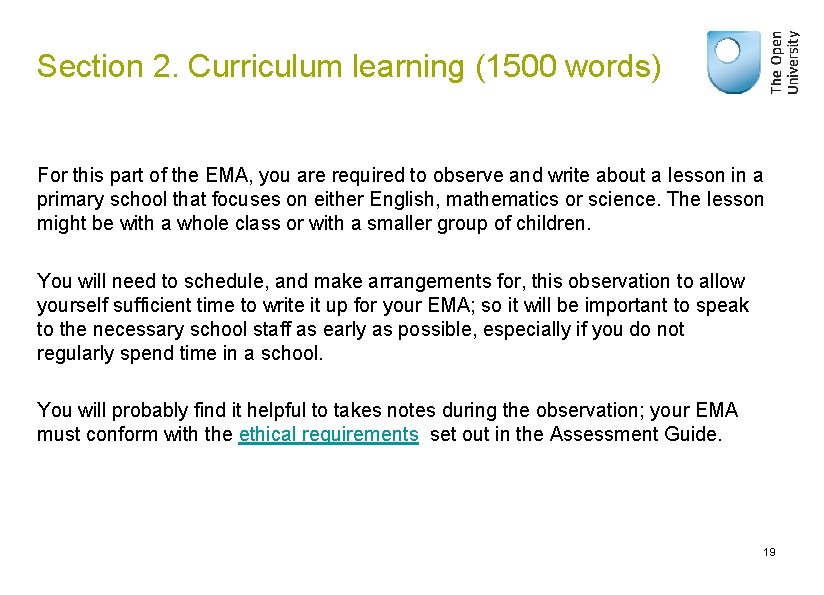
Section 2. Curriculum learning (1500 words) For this part of the EMA, you are required to observe and write about a lesson in a primary school that focuses on either English, mathematics or science. The lesson might be with a whole class or with a smaller group of children. You will need to schedule, and make arrangements for, this observation to allow yourself sufficient time to write it up for your EMA; so it will be important to speak to the necessary school staff as early as possible, especially if you do not regularly spend time in a school. You will probably find it helpful to takes notes during the observation; your EMA must conform with the ethical requirements set out in the Assessment Guide. 19
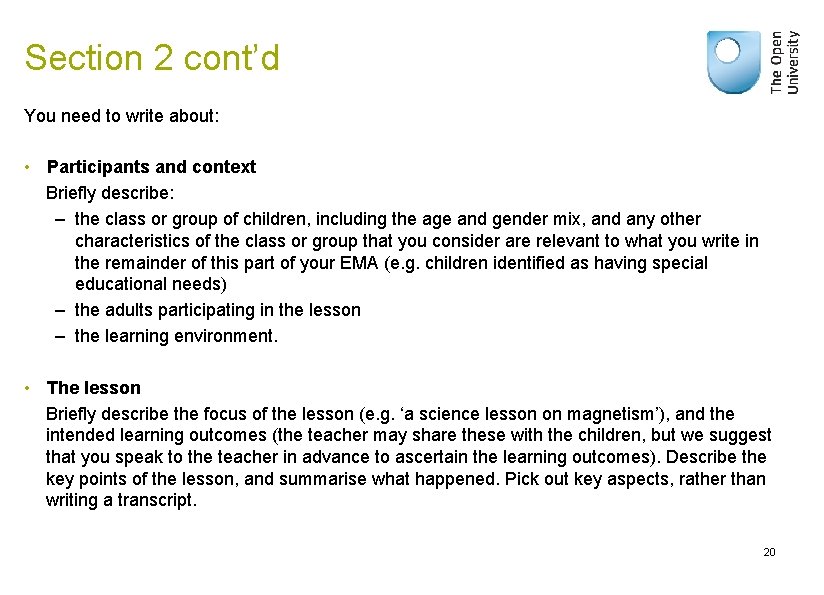
Section 2 cont’d You need to write about: • Participants and context Briefly describe: – the class or group of children, including the age and gender mix, and any other characteristics of the class or group that you consider are relevant to what you write in the remainder of this part of your EMA (e. g. children identified as having special educational needs) – the adults participating in the lesson – the learning environment. • The lesson Briefly describe the focus of the lesson (e. g. ‘a science lesson on magnetism’), and the intended learning outcomes (the teacher may share these with the children, but we suggest that you speak to the teacher in advance to ascertain the learning outcomes). Describe the key points of the lesson, and summarise what happened. Pick out key aspects, rather than writing a transcript. 20
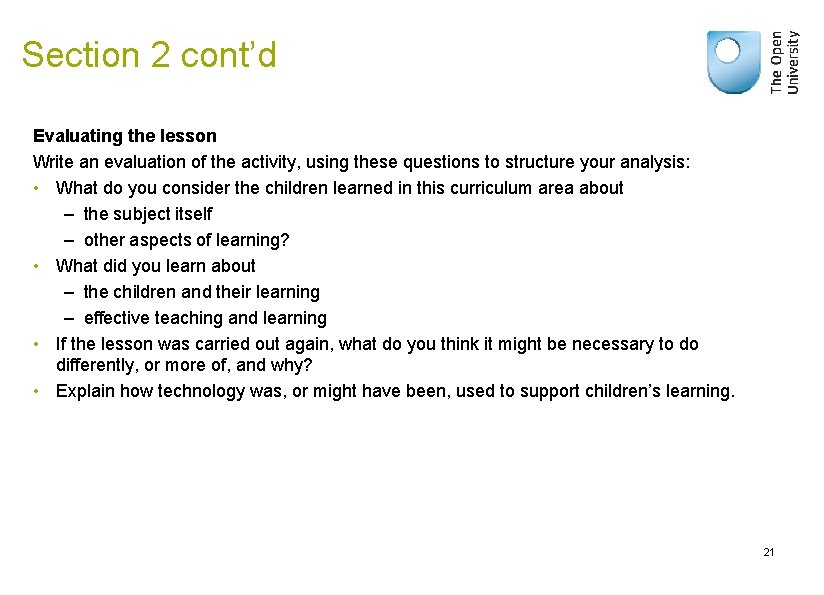
Section 2 cont’d Evaluating the lesson Write an evaluation of the activity, using these questions to structure your analysis: • What do you consider the children learned in this curriculum area about – the subject itself – other aspects of learning? • What did you learn about – the children and their learning – effective teaching and learning • If the lesson was carried out again, what do you think it might be necessary to do differently, or more of, and why? • Explain how technology was, or might have been, used to support children’s learning. 21
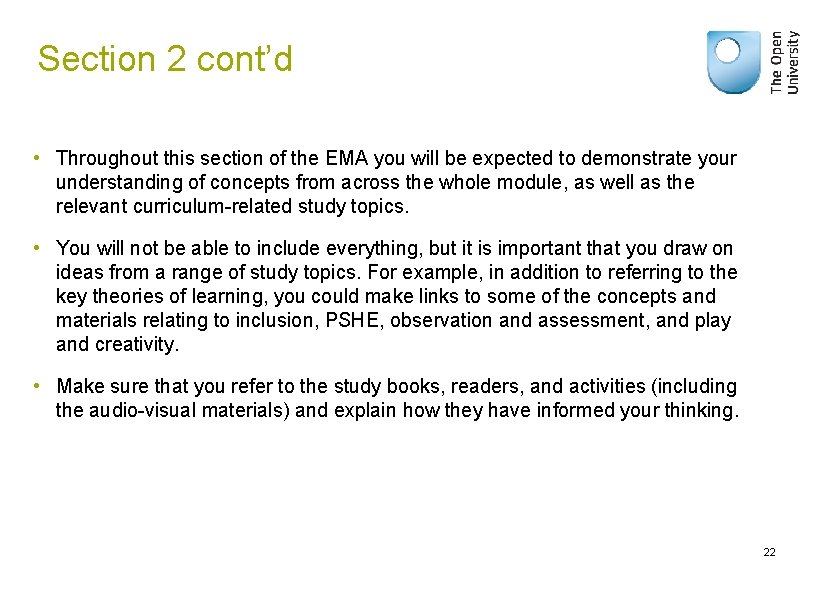
Section 2 cont’d • Throughout this section of the EMA you will be expected to demonstrate your understanding of concepts from across the whole module, as well as the relevant curriculum-related study topics. • You will not be able to include everything, but it is important that you draw on ideas from a range of study topics. For example, in addition to referring to the key theories of learning, you could make links to some of the concepts and materials relating to inclusion, PSHE, observation and assessment, and play and creativity. • Make sure that you refer to the study books, readers, and activities (including the audio-visual materials) and explain how they have informed your thinking. 22
Section 3. My future study and career plans (300 words) Copy and paste into your assignment document the longer term study and career plan that you made for Activity 19. 12, ‘My future plans’ in Study Topic 19. Your EMA marker will be looking for evidence that you have thought carefully about your plan, and expressed your ideas clearly; so you may wish to develop your ideas further before submitting your EMA, if you feel this is necessary. 23
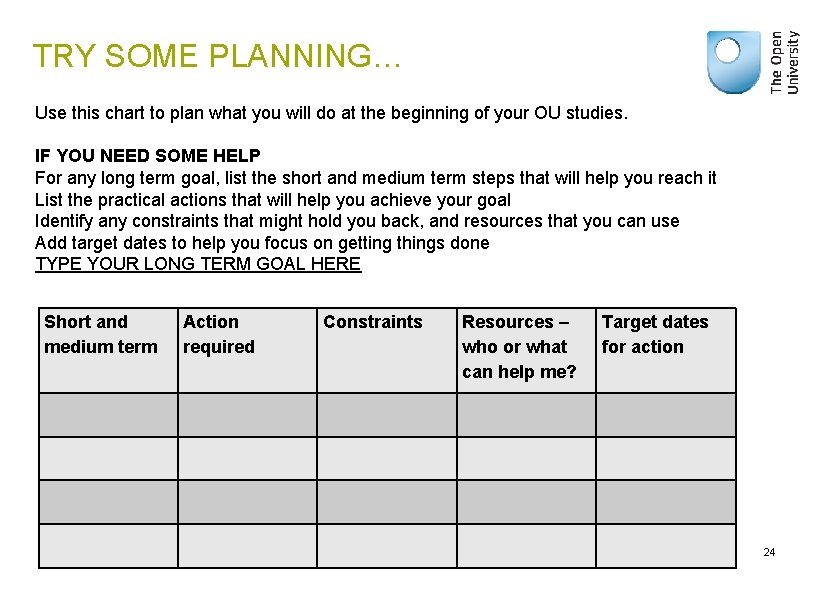
TRY SOME PLANNING… Use this chart to plan what you will do at the beginning of your OU studies. IF YOU NEED SOME HELP For any long term goal, list the short and medium term steps that will help you reach it List the practical actions that will help you achieve your goal Identify any constraints that might hold you back, and resources that you can use Add target dates to help you focus on getting things done TYPE YOUR LONG TERM GOAL HERE Short and medium term Action required Constraints Resources – who or what can help me? Target dates for action 24
Review, conclusions and questions…. 25