Dr Md Enamul Hoque Associate Professor Department of

- Slides: 19
Dr Md Enamul Hoque Associate Professor Department of Mechanical, Materials & Manufacturing Engineering University of Nottingham Malaysia Campus Editorial Board Member Automatic Control of Physiological State and Function
January 2011 – To date Associate Professor, Department of Mechanical, Materials & Manufacturing Engineering; University of Nottingham Malaysia Campus August 2007 – December 2010 Assistant Professor, Department of Mechanical, Materials & Manufacturing Engineering; University of Nottingham Malaysia Campus May 2000 – July 2007 Research Scholar, Division of Bioengineering, Department of Mechanical Engineering National University of Singapore March 1999 – April 2000 System Support Engineer, Spectra Solutions Limited, Bangladesh
Ø Rapid Prototyping Technology Ø Biomaterials Ø Tissue Engineering Ø Stem Cells Ø Bioenergy Ø Polymeric Composites Ø Nanomaterials Ø Food Technology
Md Enamul Hoque, Terrence Teh Hooi Meng, Leng Chuan Yong, Moniruddin Chowdhury, Gunnaeswara Prasad Rangabhatala. Hybrid 3 D scaffolds for potential tissue engineering applications: Fabrication and characterization. Materials Letters, Vol. 131, pp. 255, 2014; doi: http: //dx. doi. org/10. 1016/j. matlet. 2014. 05. 111 Azizeh-Mitra Yousefi, Md Enamul Hoque, R. G. S. V. Prasad, Nicholas Uth. Current Strategies in Gradient-based Scaffold Design for Osteochondral Tissue Engineering: A Review. Journal of Biomedical Materials Research: Part A (Published online on 01 October 2014); DOI: 10. 1002/jbm. a. 35356 M. Enamul Hoque, M. A. I. M. Aminudin, M. Jawaid, M. S. Islam, Naheed Saba, M. T. Paridah. Physical, Mechanical, and Biodegradable Properties of Meranti Wood Polymer Composites. Materials and Design, Vol. 64, pp. 743, 2014. http: //dx. doi. org/10. 1016/j. matdes. 2014. 08. 024 Sheikh Imranudin Sheikh-Ali, Akil Ahmad, Siti-Hamidah Mohd-Setapar, Zainul Akmal Zakaria, Norfahana Abdul-Talib, Aidee Kamal Khamis, Md Enamul Hoque. The Potential Hazards of Aspergillus sp. in Food and Feeds, and the Role of Biological Treatment: A Review. Journal of Microbiology, Vol. 52(10), pp. 807 -818, 2014; DOI: 10. 1007/s 12275014 -4294 -7 Sheik Mohideen Mohamed Nainar, Shahida Begum, M. N. M. Ansari, Md. Enamul Hoque, S. Sharen Aini, M. H. Ng, B. H. I. Ruszymah. Effect of compatibilizers on in vitro biocompatibility of PLA-HA bioscaffold. Bioinspired, Biomimetic and Nanobiomaterials (Published online on 07 August 2014); DOI: 10. 1680/bbn. 14. 00014
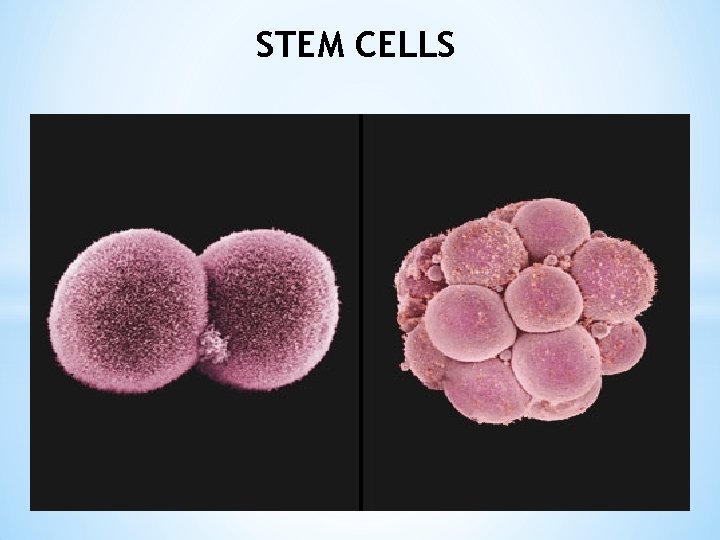
STEM CELLS
STEM CELLS • The body is made up of about 200 different kinds of specialised cells such as muscle cells, nerve cells, fat cells and skin cells etc. • All cells in the body come from stem cells • A stem cell is a cell that is not yet specialised • The process of specialisation is called differentiation • Once the differentiation pathway of a stem cell has been decided, it can no longer become another type of cell on its own
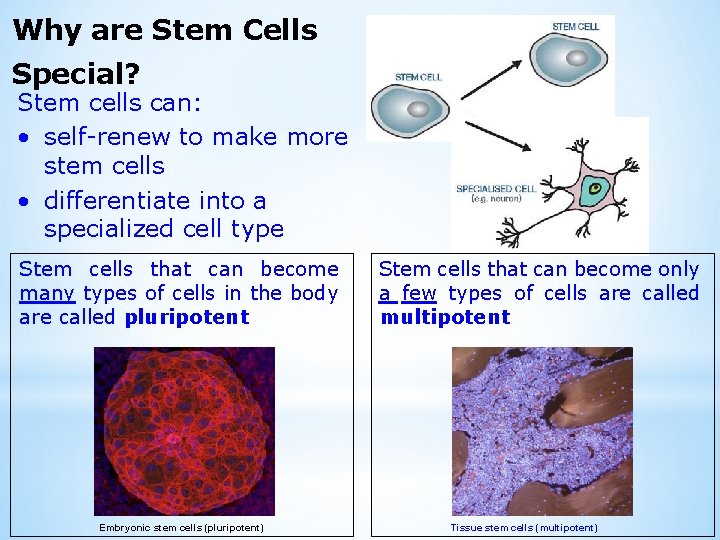
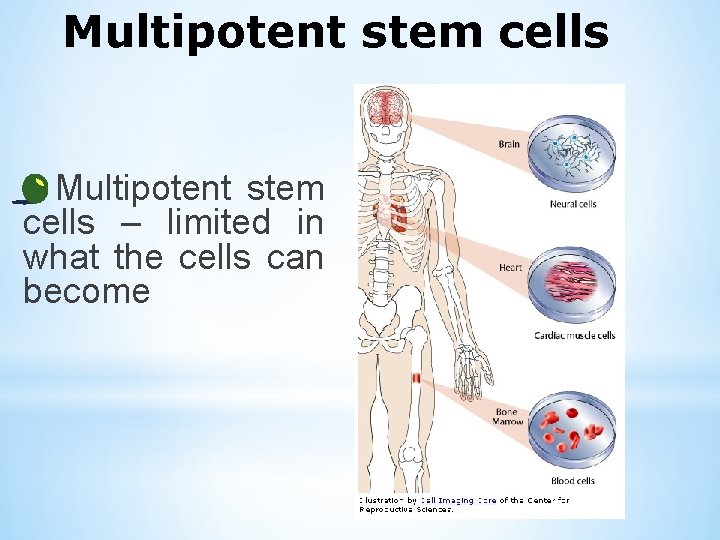
Why are Stem Cells Special? Stem cells can: • self-renew to make more stem cells • differentiate into a specialized cell type Stem cells that can become many types of cells in the body are called pluripotent Embryonic stem cells (pluripotent) Stem cells that can become only a few types of cells are called multipotent Tissue stem cells (multipotent)
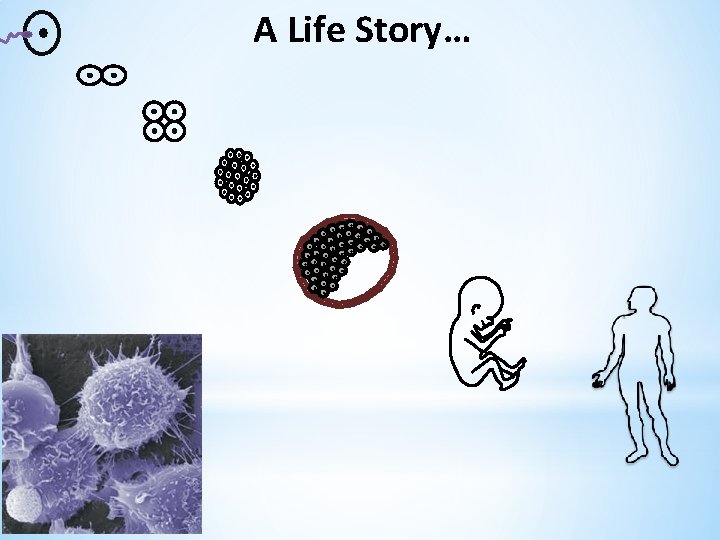
A Life Story…
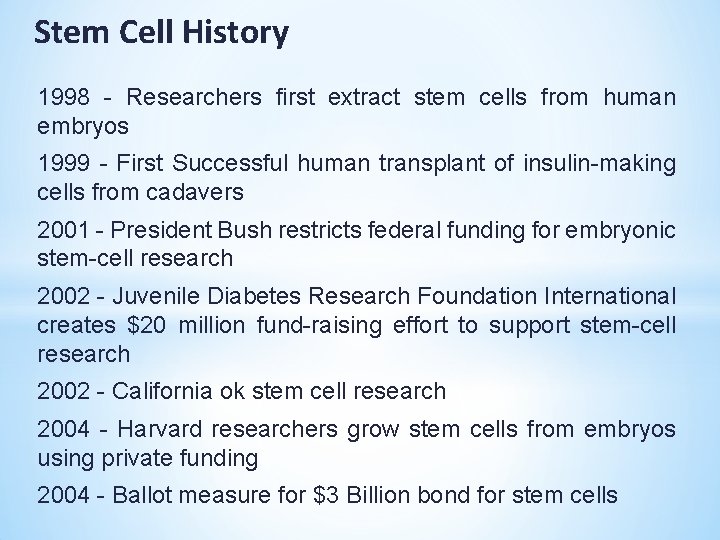
Stem Cell History 1998 - Researchers first extract stem cells from human embryos 1999 - First Successful human transplant of insulin-making cells from cadavers 2001 - President Bush restricts federal funding for embryonic stem-cell research 2002 - Juvenile Diabetes Research Foundation International creates $20 million fund-raising effort to support stem-cell research 2002 - California ok stem cell research 2004 - Harvard researchers grow stem cells from embryos using private funding 2004 - Ballot measure for $3 Billion bond for stem cells
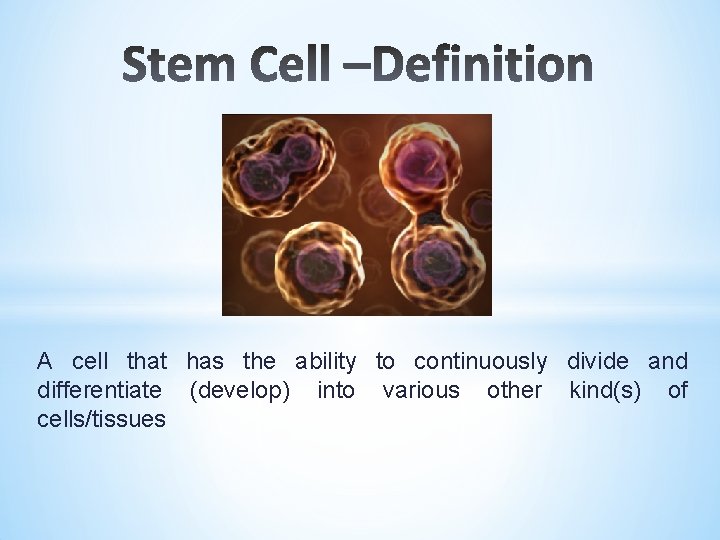
A cell that has the ability to continuously divide and differentiate (develop) into various other kind(s) of cells/tissues
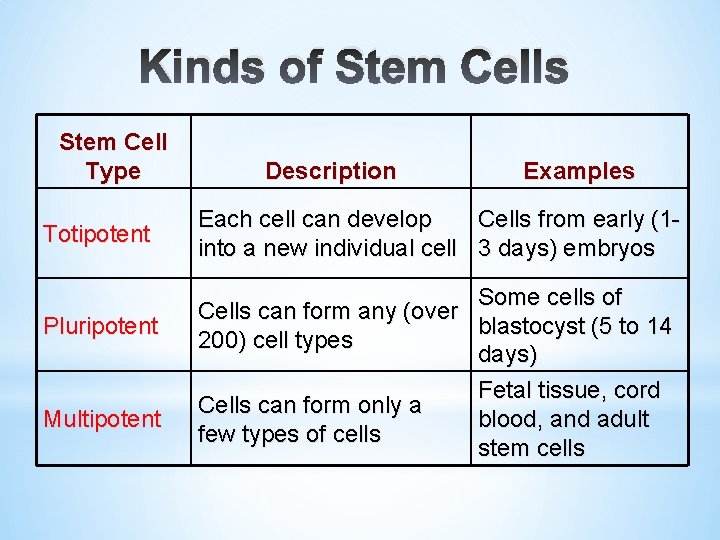
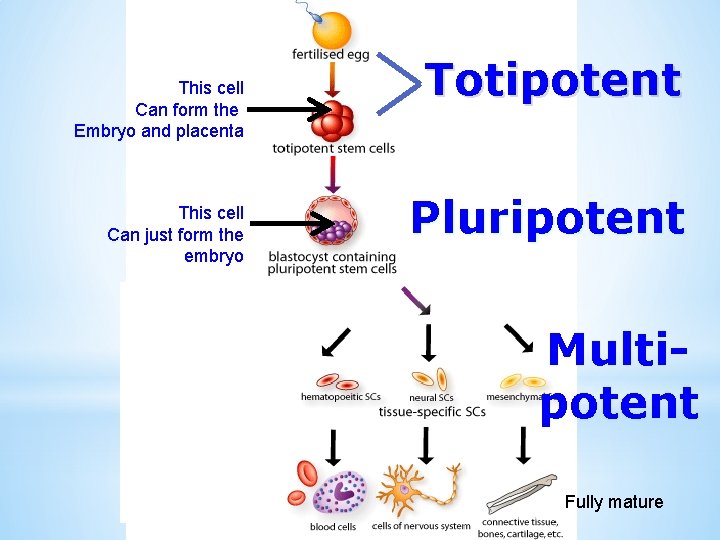
Kinds of Stem Cells Stem Cell Type Totipotent Pluripotent Multipotent Description Examples Each cell can develop Cells from early (1 into a new individual cell 3 days) embryos Some cells of Cells can form any (over blastocyst (5 to 14 200) cell types days) Fetal tissue, cord Cells can form only a blood, and adult few types of cells stem cells
This cell Can form the Embryo and placenta This cell Can just form the embryo Totipotent Pluripotent Multipotent Fully mature
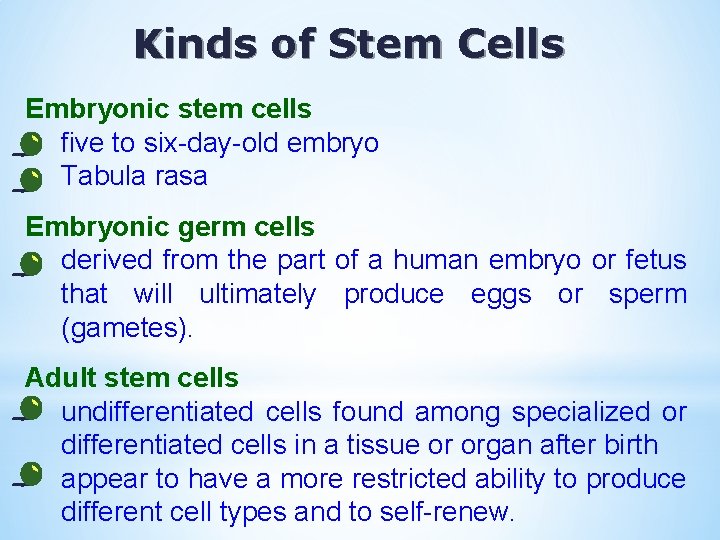
Kinds of Stem Cells Embryonic stem cells • five to six-day-old embryo • Tabula rasa Embryonic germ cells • derived from the part of a human embryo or fetus that will ultimately produce eggs or sperm (gametes). Adult stem cells • undifferentiated cells found among specialized or differentiated cells in a tissue or organ after birth • appear to have a more restricted ability to produce different cell types and to self-renew.
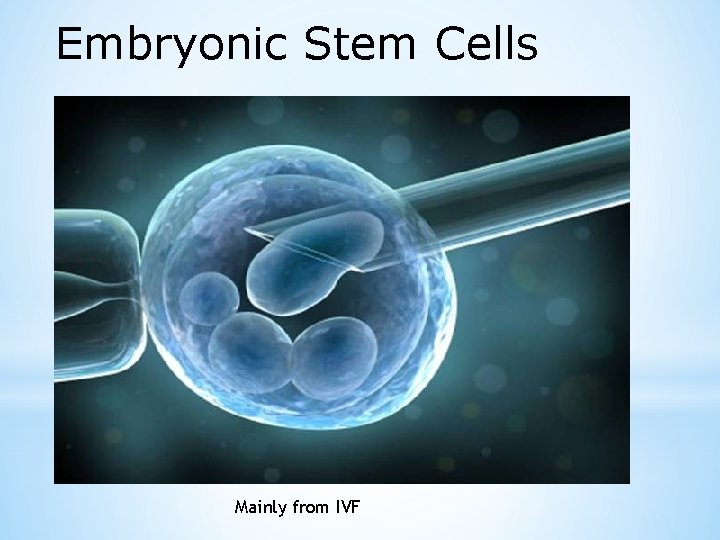
Embryonic Stem Cells Mainly from IVF
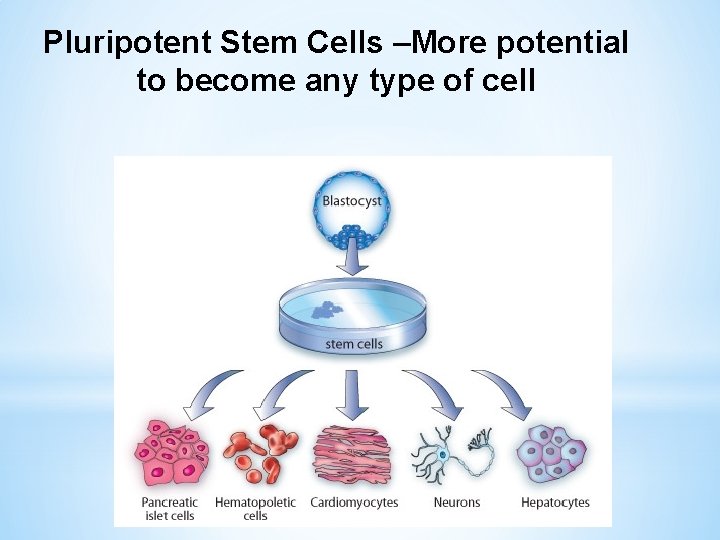
Pluripotent Stem Cells –More potential to become any type of cell
Multipotent stem cells – limited in what the cells can become
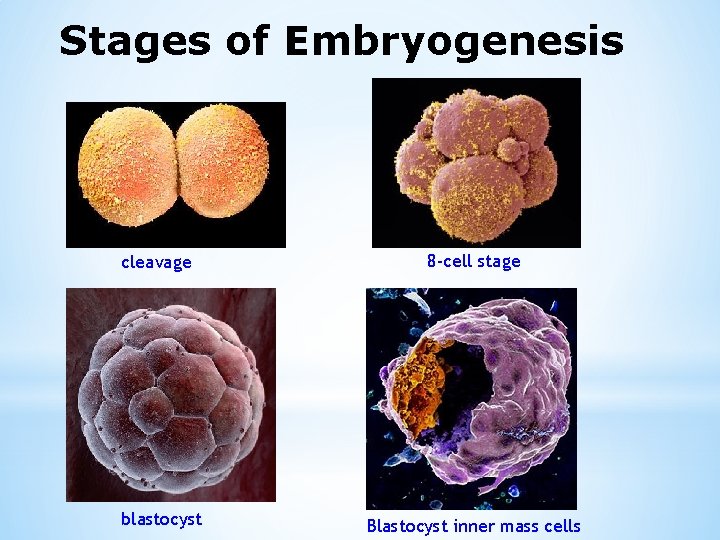
Stages of Embryogenesis cleavage 8 -cell stage blastocyst Blastocyst inner mass cells
Approved By M. Enamul Hoque
OMICS International Open Access Membership enables academic and research institutions, funders and corporations to actively encourage open access in scholarly communication and the dissemination of research published by their authors. For more details and benefits, click on the link below: http: //omicsonline. org/membership. php