Dont drink the Koolaid Discussion My Childhood in

- Slides: 8
Don’t drink the Kool-aid…
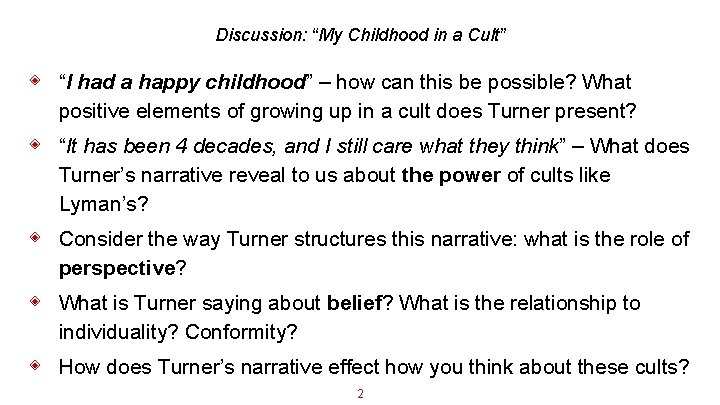
Discussion: “My Childhood in a Cult” ◈ “I had a happy childhood” – how can this be possible? What positive elements of growing up in a cult does Turner present? ◈ “It has been 4 decades, and I still care what they think” – What does Turner’s narrative reveal to us about the power of cults like Lyman’s? ◈ Consider the way Turner structures this narrative: what is the role of perspective? ◈ What is Turner saying about belief? What is the relationship to individuality? Conformity? ◈ How does Turner’s narrative effect how you think about these cults? 2
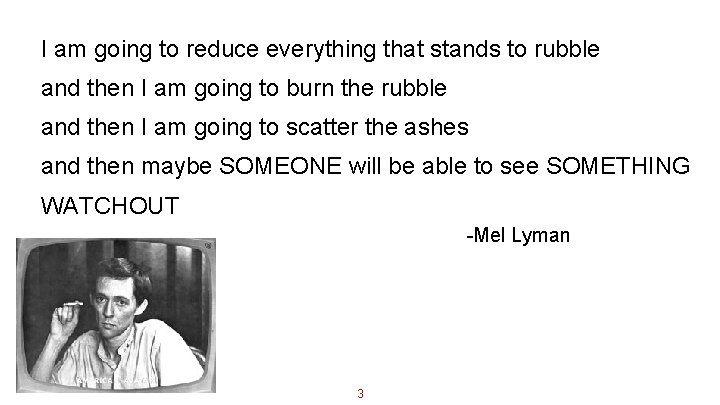
I am going to reduce everything that stands to rubble and then I am going to burn the rubble and then I am going to scatter the ashes and then maybe SOMEONE will be able to see SOMETHING WATCHOUT -Mel Lyman 3
What is a cult? ◈ A religious or social group with socially deviant or novel beliefs and practices ◈ The word often carries derogatory connotations ◈ The word has always been controversial because it is considered a somewhat subjective term and lacks a clear of consistent definition ◈ Cults are protected under the 1 st amendment in the United States New Religious Movements (NRMs) ◈ A religious community or spiritual group of modern origins, which has a peripheral place within society’s dominant religious culture
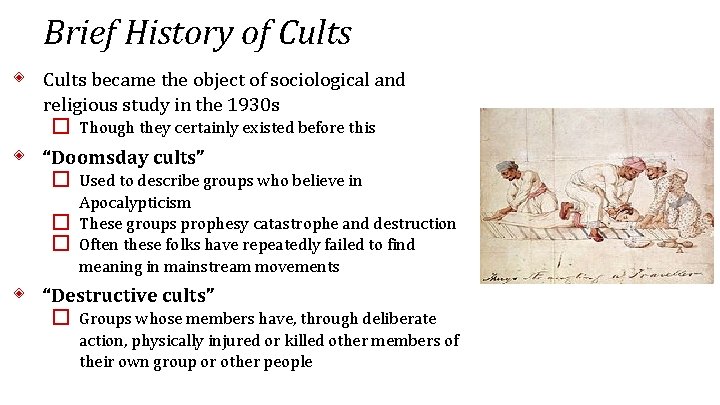
Brief History of Cults ◈ Cults became the object of sociological and religious study in the 1930 s � Though they certainly existed before this ◈ “Doomsday cults” � Used to describe groups who believe in Apocalypticism � These groups prophesy catastrophe and destruction � Often these folks have repeatedly failed to find meaning in mainstream movements ◈ “Destructive cults” � Groups whose members have, through deliberate action, physically injured or killed other members of their own group or other people
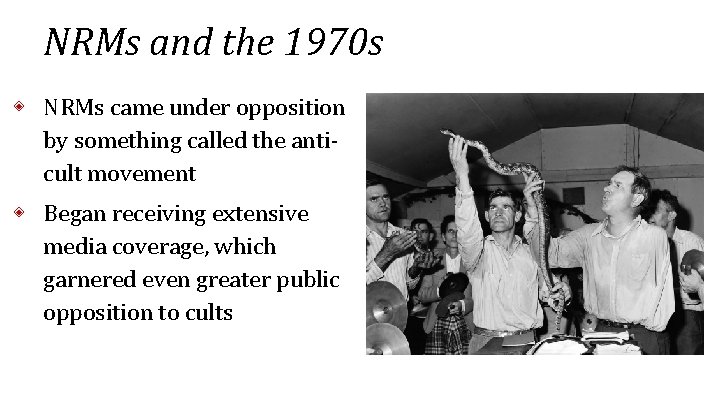
NRMs and the 1970 s ◈ NRMs came under opposition by something called the anticult movement ◈ Began receiving extensive media coverage, which garnered even greater public opposition to cults
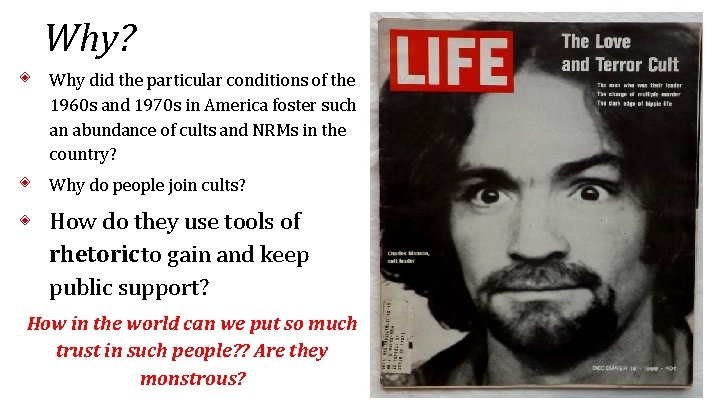
Why? ◈ Why did the particular conditions of the 1960 s and 1970 s in America foster such an abundance of cults and NRMs in the country? ◈ Why do people join cults? ◈ How do they use tools of rhetoric to gain and keep public support? How in the world can we put so much trust in such people? ? Are they monstrous?
◈ ◈ ◈ Groups no bigger than 5 Cults Presentation Select a cult from the Google doc on my website Requirements � 12 -15 minute presentation � Tell us about your cult, brief history, leader(s) � How did it end? (Or is it still around? ) � How did the leaders of these cults use rhetoric to recruit and maintain membership? � PRIMARY SOURCES � Video, transcript, photos, etc. � What fears do these leaders invoke in order to attract followers? (If they are not appealing to fear, what are they appealing to? ) ◈ Works Cited Slide (does not need to be MLA), must include at least 3 different sources