Doing Research into DSO with Space Syntax an

- Slides: 15
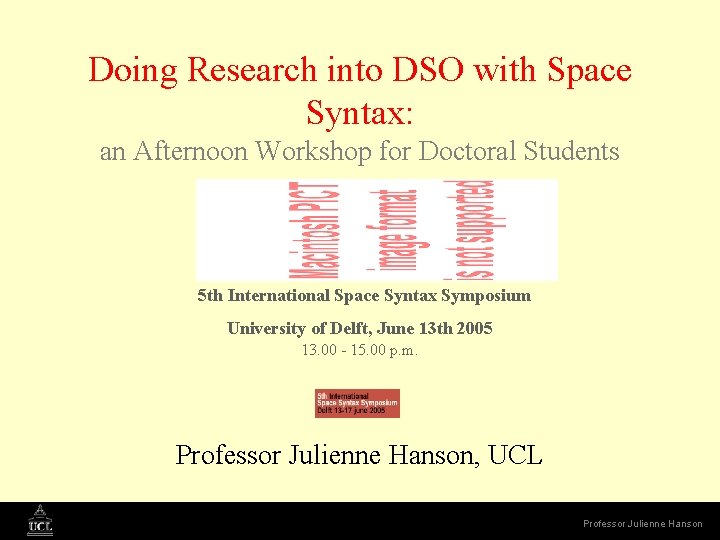
Doing Research into DSO with Space Syntax: an Afternoon Workshop for Doctoral Students 5 th International Space Syntax Symposium University of Delft, June 13 th 2005 13. 00 - 15. 00 p. m. Professor Julienne Hanson, UCL Professor Julienne Hanson
Welcome and Introductions (time check 13. 00 -13. 30 max) • Workshop attendees briefly introduce themselves and their research topic to the rest of the audience; and • Each attendee reads out the most important question or issue they want to bring to the discussion for consideration by the group. • As this is going on JH groups and classifies the points raised, by clustering the cards. Professor Julienne Hanson
Prioritisation of Topics (time check - allow 10 minutes) • Briefly review what people have flagged up, what can be achieved in the next hour and what expertise there is available in the room to address the issues; and • Invite the delegates to ‘vote’ for the three most popular themes they want to discuss (bring red dots to stick on their ‘favourite’ cards). This will give rank order themes. Professor Julienne Hanson
Open Discussion of Most Popular Topics (time check - stop at 2. 45 p. m. ) • Julienne initiates and facilitates the discussion, starting with the issue or topic that most people want talk about and working down through all the suggestions on the cards from the most to the least popular. Professor Julienne Hanson
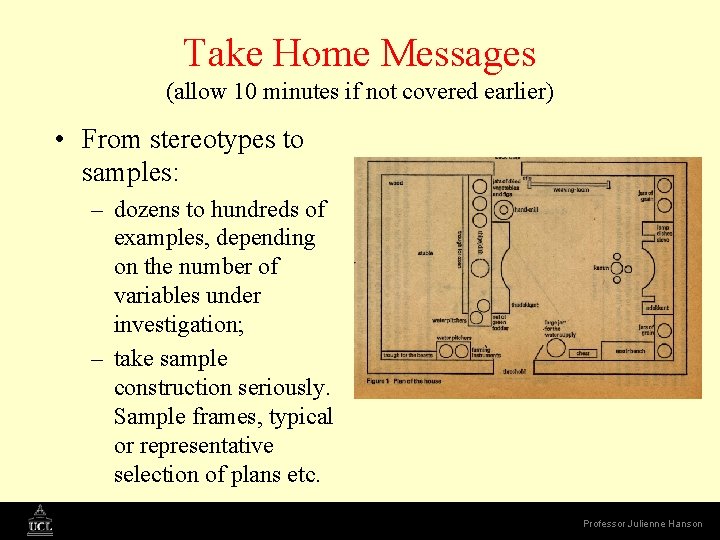
Take Home Messages (allow 10 minutes if not covered earlier) • From stereotypes to samples: – dozens to hundreds of examples, depending on the number of variables under investigation; – take sample construction seriously. Sample frames, typical or representative selection of plans etc. Professor Julienne Hanson
Representation • How to get from a plan to a space break up: – people used to agonise about this but are now becoming more relaxed; – depends on the research question or hypothesis; – select the most appropriate method and stick with it; – describe the protocol used and its rationale; – be consistent. Professor Julienne Hanson
Software Developments • Software developments for the analysis of DSO: – Netbox; – Alasdair’s VGA; – Sheep’s latest version of PESH; – Bendik’s new programme, AGRAPH; – Because houses are small, we can hand calculate everything. Professor Julienne Hanson
Classifying Your Data • Handy hints for sorting and classifying house plans: – Unlike buildings or towns, classification of plans an important aspect of this enterprise; – Still hard to beat visual inspection, put on cards so can pin on a design wall and shuffle about using different criteria; – Ruth’s ‘string theory’ programme to compare the degree of identity of plans. Professor Julienne Hanson
Inequality Genotypes • Theoretically, the strong hypothesis is that these exist where we have stable cultures / traditions, and that most cultures will have more than one, reflecting the different sub-cultures within society: – Phenotypes present themselves as messy data with few repeat plans; – Rank order of rooms / functions activities / zones not invariant; – Students are often disappointed at this stage. Persevere. Try all options. Professor Julienne Hanson
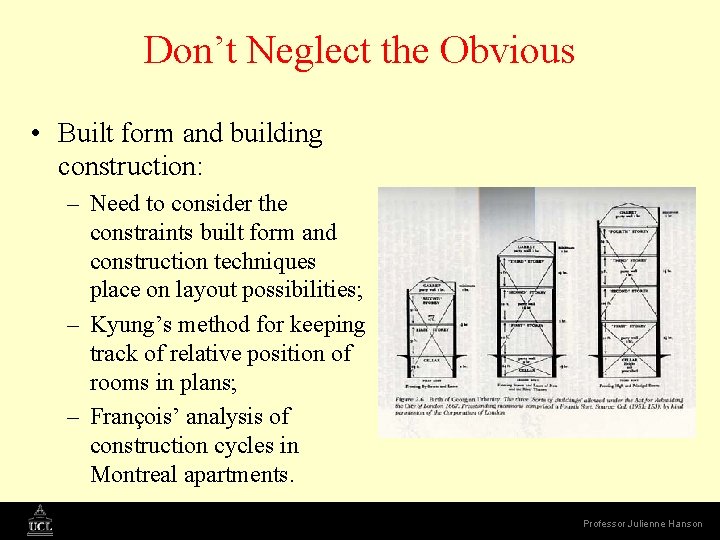
Don’t Neglect the Obvious • Built form and building construction: – Need to consider the constraints built form and construction techniques place on layout possibilities; – Kyung’s method for keeping track of relative position of rooms in plans; – François’ analysis of construction cycles in Montreal apartments. Professor Julienne Hanson
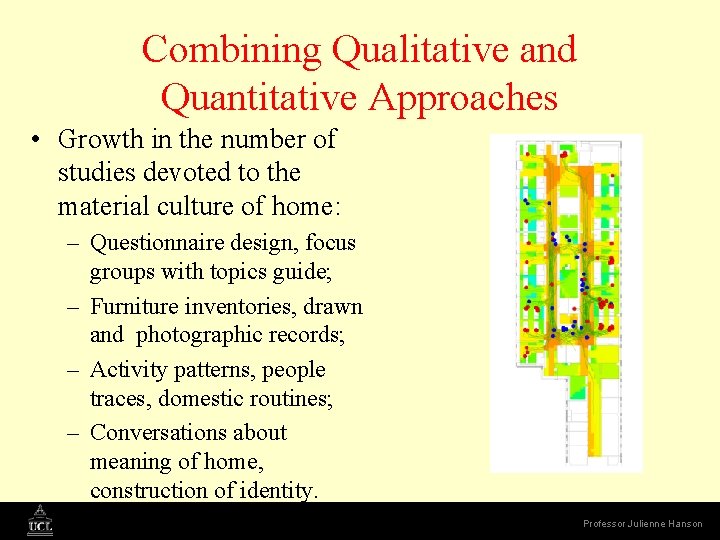
Combining Qualitative and Quantitative Approaches • Growth in the number of studies devoted to the material culture of home: – Questionnaire design, focus groups with topics guide; – Furniture inventories, drawn and photographic records; – Activity patterns, people traces, domestic routines; – Conversations about meaning of home, construction of identity. Professor Julienne Hanson
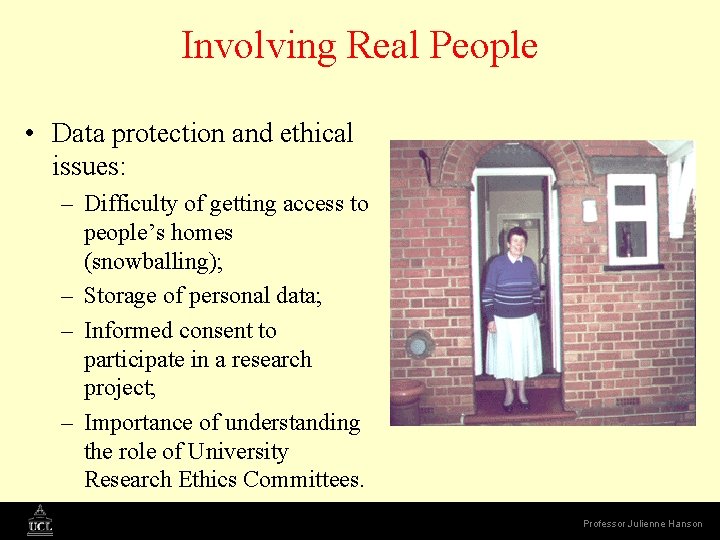
Involving Real People • Data protection and ethical issues: – Difficulty of getting access to people’s homes (snowballing); – Storage of personal data; – Informed consent to participate in a research project; – Importance of understanding the role of University Research Ethics Committees. Professor Julienne Hanson
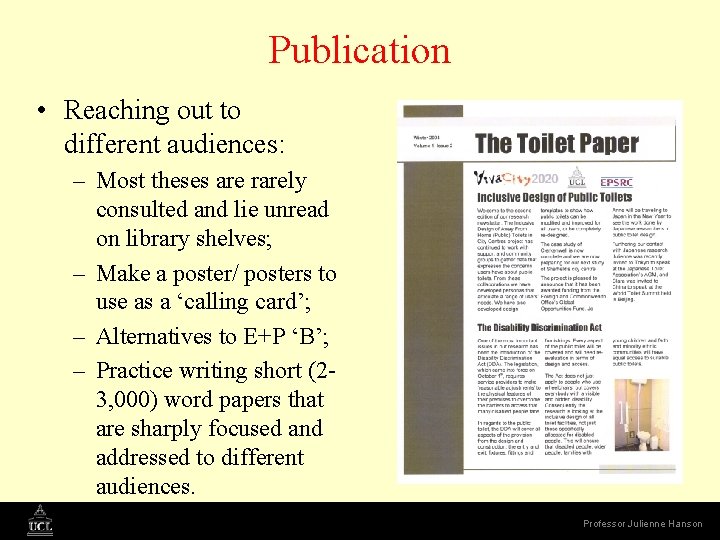
Publication • Reaching out to different audiences: – Most theses are rarely consulted and lie unread on library shelves; – Make a poster/ posters to use as a ‘calling card’; – Alternatives to E+P ‘B’; – Practice writing short (23, 000) word papers that are sharply focused and addressed to different audiences. Professor Julienne Hanson
Next Steps • Suggestions to build on the momentum of the workshop: – One of the challenges of a Ph. D is social isolation; – Space syntax mailbase; – International Housing Database; – Housing network within the larger space syntax community; – Virtual mentoring. Professor Julienne Hanson
Wrap Up (time check - 14. 55 -15. 00 p. m. ) Thank everyone for their contributions and insights. Will ensure that the presentation is mounted on the Symposium Website. Remind everyone that the next event is Professor Julienne Hanson