
The JJDPA Updating Federal Law to Reflect New
- Slides: 24
The JJDPA: Updating Federal Law to Reflect New Reforms
The JJDPA �Celebrated 40 years of the Act in September 2014. �On Dec. 11, 2014, Sen. Sheldon Whitehouse (D-RI) and Sen. Charles Grassley (R-IA) introduced S. 2999. �The bill would reauthorize the JJDPA and strengthen its core protections.
Background �Juvenile Justice & Delinquency Prevention Act (JJDPA) authorizes federal funds to go to the states for juvenile justice. �Expectation that states comply with core requirements and write plans for delinquency prevention and intervention. �OJJDP has reporting, oversight and technical assistance responsibilities. �Each state has an advisory group to guide plans and decide how to allocate funds.
HISTORY Ø 1974 – Juvenile Justice & Delinquency Prevention Act first passed Ø Overwhelming bi-partisan from both Houses of Congress Ø Included support from organizations ranging from the ACLU to the American Legion, and included organizations like the ABA and the Boys Clubs of America
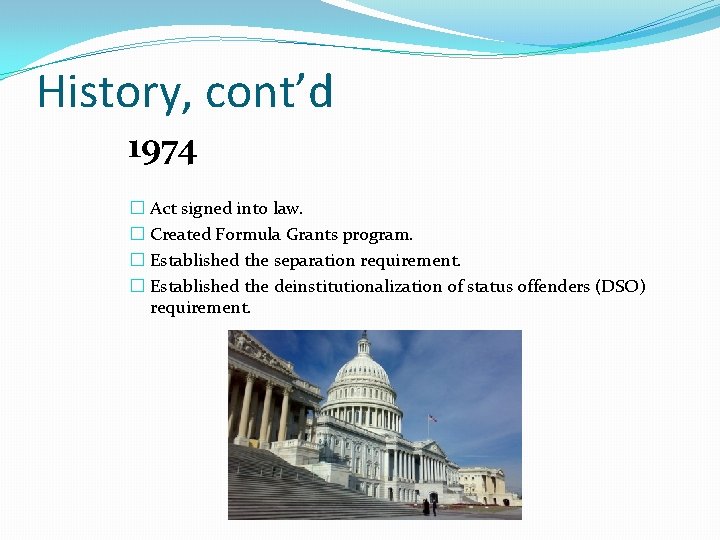
History, cont’d 1974 � Act signed into law. � Created Formula Grants program. � Established the separation requirement. � Established the deinstitutionalization of status offenders (DSO) requirement.
1974: Findings Sec. 101. (a) The Congress hereby finds that— * * * (3) present juvenile courts, foster and protective care programs, and shelter facilities are inadequate to meet the needs of the countless, abandoned, and dependent children, who, because of this failure to provide effective services, may become delinquents; (4) existing programs have not adequately responded to the particular problems of the increasing numbers of young people who are addicted to or who abuse drugs, particularly nonopiate or polydrug abusers; (5) juvenile delinquency can be prevented through programs designed to keep students in elementary and secondary schools through the prevention of unwarranted and arbitrary suspensions and expulsions; . . .
Purpose Sec. 102. (a) It is the purpose of this Act— *** (6) to assist States and local communities with resources to develop and implement programs to keep students in elementary and secondary schools and to prevent unwarranted and arbitrary suspensions and expulsions; and (7) to establish a Federal assistance program to deal with the problems of runaway youth.
Purpose, cont. (b) It is therefore the further declared policy of Congress to provide the necessary resources, leadership, and coordination (1) to develop and implement effective methods of preventing and reducing juvenile delinquency; (2) to develop and conduct effective programs to prevent delinquency, to divert juveniles from the traditional juvenile justice system and to provide critically needed alternatives to institutionalization; . . .
PART B: FORMULA Grants STATE PLANS SEC. 223. (a) In order to receive formula grants under this part, a State shall submit a plan for carrying out its purposes consistent with the provisions. . . In accordance with regulations established under this title, such plan must—
State Plans must: (10) provide that not less than 75 per centum of the funds available to such State. . . , whether expended directly by the State or by the local government or through contracts with public or private agencies, shall be used for advanced techniques in developing, maintaining, and expanding programs and services designed to prevent juvenile delinquency, to divert juveniles from the juvenile justice system, and to provide community-based alternatives to juvenile detention and correctional facilities. That advanced techniques include—
Advanced techniques include: (A) community-based programs and services for the prevention and treatment of juvenile delinquency through the development of foster-care and shelter-care homes, group homes, halfway houses, homemaker and home health services, and any other designated community-based diagnostic, treatment, or rehabilitative service; (B) community-based programs and services to work with parents and other family members to maintain and strengthen the family unit so that the juvenile may be retained in his home;
Advanced techniques include: (C) youth service bureaus and other community-based programs to divert youth from the juvenile court or to support, counsel, or provide work and recreational opportunities for delinquents and youth in danger of becoming delinquent; (D) comprehensive programs of drug and alcohol abuse. . . (E) educational programs or supportive services designed to keep delinquents and to encourage other youth to remain in elementary and secondary schools or in alternative learning situations; * * * (G) youth initiated programs and outreach programs designed to assist youth who otherwise would not be reached by assistance programs; . . .
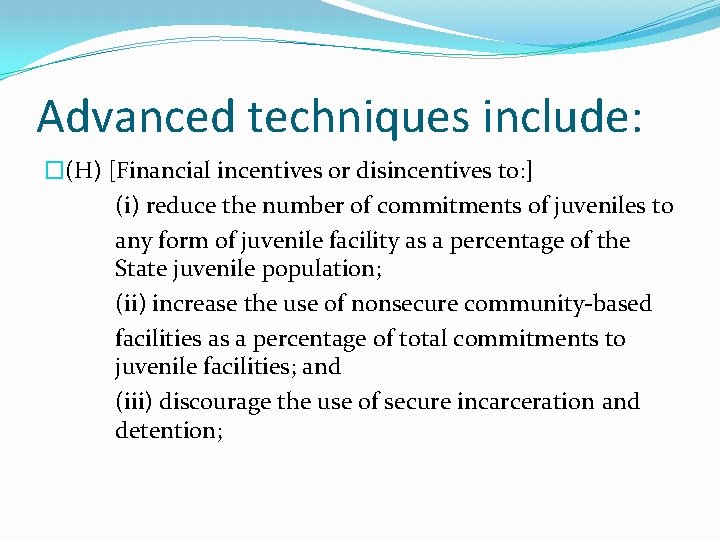
Advanced techniques include: �(H) [Financial incentives or disincentives to: ] (i) reduce the number of commitments of juveniles to any form of juvenile facility as a percentage of the State juvenile population; (ii) increase the use of nonsecure community-based facilities as a percentage of total commitments to juvenile facilities; and (iii) discourage the use of secure incarceration and detention;
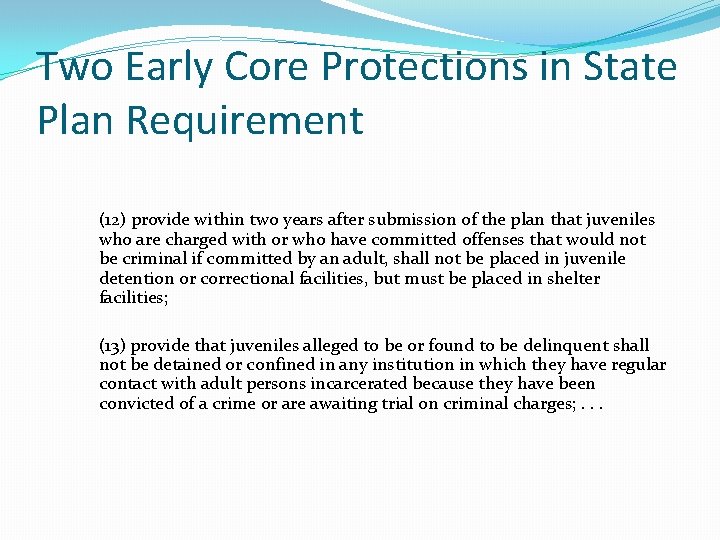
Two Early Core Protections in State Plan Requirement (12) provide within two years after submission of the plan that juveniles who are charged with or who have committed offenses that would not be criminal if committed by an adult, shall not be placed in juvenile detention or correctional facilities, but must be placed in shelter facilities; (13) provide that juveniles alleged to be or found to be delinquent shall not be detained or confined in any institution in which they have regular contact with adult persons incarcerated because they have been convicted of a crime or are awaiting trial on criminal charges; . . .
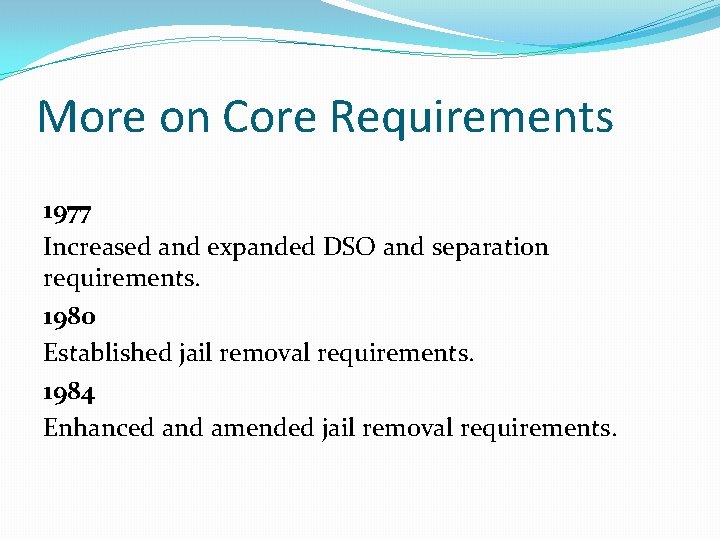
More on Core Requirements 1977 Increased and expanded DSO and separation requirements. 1980 Established jail removal requirements. 1984 Enhanced and amended jail removal requirements.
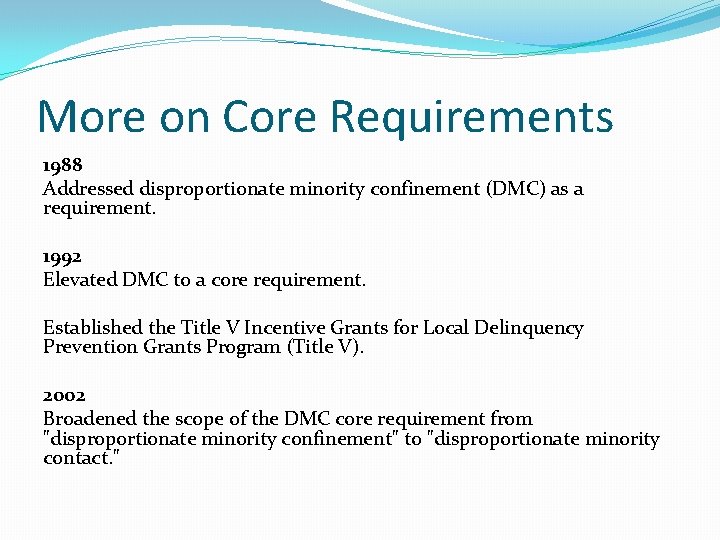
More on Core Requirements 1988 Addressed disproportionate minority confinement (DMC) as a requirement. 1992 Elevated DMC to a core requirement. Established the Title V Incentive Grants for Local Delinquency Prevention Grants Program (Title V). 2002 Broadened the scope of the DMC core requirement from "disproportionate minority confinement" to "disproportionate minority contact. "
Observations Establishment of National Values Importance of State Advisory Groups SAG partnerships with other state agencies SAG partnerships with foundations
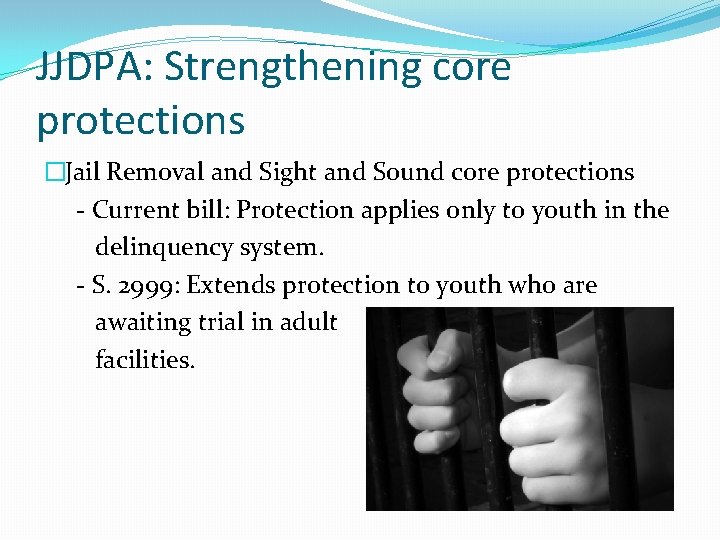
JJDPA: Strengthening core protections �Jail Removal and Sight and Sound core protections - Current bill: Protection applies only to youth in the delinquency system. - S. 2999: Extends protection to youth who are awaiting trial in adult facilities.
JJDPA: Strengthening core protections �Racial and Ethnic Disparities core protection - Gives clear direction to states and localities to help: (1) implement data-driven approaches to ensure fairness and reduce racial and ethnic disparities; (2) set measurable objectives for disparity reduction; and (3) publicly report such efforts.
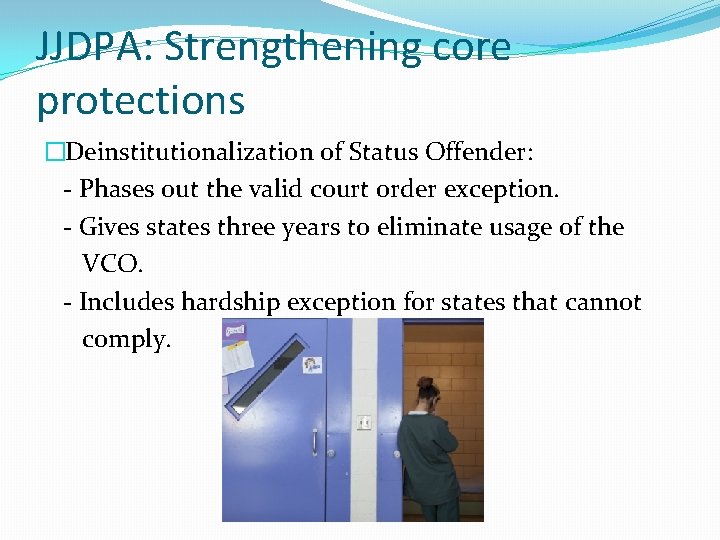
JJDPA: Strengthening core protections �Deinstitutionalization of Status Offender: - Phases out the valid court order exception. - Gives states three years to eliminate usage of the VCO. - Includes hardship exception for states that cannot comply.
New Provisions �Recognizes exposure to trauma and its impact on adolescent behavior. �Supports state efforts to expand access to counsel. �Creates incentive grants and reauthorizes Juvenile Accountability Black Grant program.
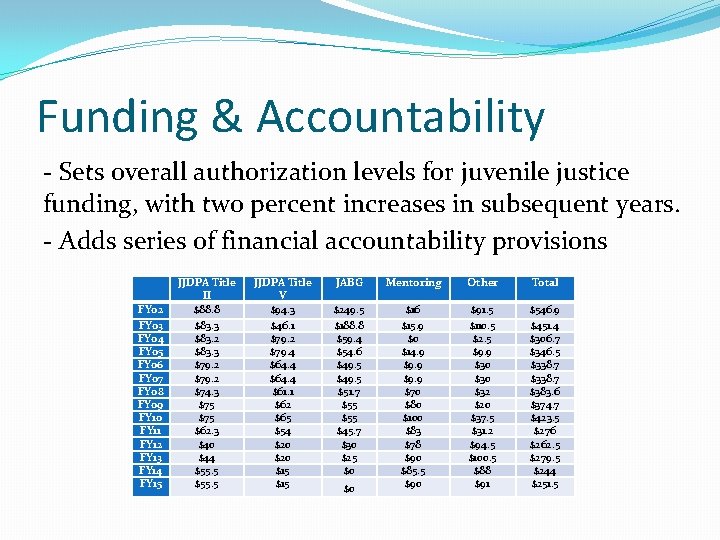
Funding & Accountability - Sets overall authorization levels for juvenile justice funding, with two percent increases in subsequent years. - Adds series of financial accountability provisions FY 02 FY 03 FY 04 FY 05 FY 06 FY 07 FY 08 FY 09 FY 10 FY 11 FY 12 FY 13 FY 14 FY 15 JJDPA Title II $88. 8 $83. 3 $83. 2 $83. 3 $79. 2 $74. 3 $75 $62. 3 $40 $44 $55. 5 JJDPA Title V $94. 3 $46. 1 $79. 2 $79. 4 $64. 4 $61. 1 $62 $65 $54 $20 $15 JABG Mentoring Other Total $249. 5 $188. 8 $59. 4 $54. 6 $49. 5 $51. 7 $55 $45. 7 $30 $25 $0 $16 $15. 9 $0 $14. 9 $9. 9 $70 $80 $100 $83 $78 $90 $85. 5 $90 $91. 5 $110. 5 $2. 5 $9. 9 $30 $32 $20 $37. 5 $31. 2 $94. 5 $100. 5 $88 $91 $546. 9 $451. 4 $306. 7 $346. 5 $338. 7 $383. 6 $374. 7 $423. 5 $276 $262. 5 $279. 5 $244 $251. 5 $0
Changes to SAGs and their structure �Bill would add legal counsel representing youth, experts in truancy and victims advocates to SAGs. �Changes youth membership from 24 “at time of appointment” to 28. �Requires posting of three year plans on public website.
Contact Information Robert G. Schwartz Executive Director Juvenile Law Center (215) 625 -0551 ext. 106 RSchwartz@jlc. org www. jlc. org Naomi Smoot Senior Policy Associate Coalition for Juvenile Justice (202) 467 -0864 ext. 109 smoot@juvjustice. org www. juvjustice. org Lara Quint Legislative Counsel U. S. Sen. Sheldon Whitehouse (202) 228 -6659 lara_quint@judiciary-dem. senate. gov http: //www. whitehouse. senate. gov/