
DiskLocality in Datacenter Computing Considered Irrelevant Ganesh Ananthanarayanan
![Fast Networks [1] �Three-layer hierarchy, traditionally ◦ Access, Aggregate, Core switches �Link rates are](https://slidetodoc.com/presentation_image/99091cb62f5194b67e01ca14d97deae4/image-5.jpg "Fast Networks [1] �Three-layer hierarchy, traditionally ◦ Access, Aggregate, Core switches �Link rates are")
![Fast Networks [2] �Over-subscription is fast reducing… �Full bisection bandwidth topologies [SIGCOMM-’ 08, ‘](https://slidetodoc.com/presentation_image/99091cb62f5194b67e01ca14d97deae4/image-6.jpg "Fast Networks [2] �Over-subscription is fast reducing… �Full bisection bandwidth topologies [SIGCOMM-’ 08, ‘")
![Storage Crunch [1] �Data mining algorithms perform better when fed with more data ◦](https://slidetodoc.com/presentation_image/99091cb62f5194b67e01ca14d97deae4/image-7.jpg "Storage Crunch [1] �Data mining algorithms perform better when fed with more data ◦")
![Storage Crunch [2] �Data Hadoop logs from Facebook (Rack-local/Offrack) compression less data to read](https://slidetodoc.com/presentation_image/99091cb62f5194b67e01ca14d97deae4/image-8.jpg "Storage Crunch [2] �Data Hadoop logs from Facebook (Rack-local/Offrack) compression less data to read")
- Slides: 15
Disk-Locality in Datacenter Computing Considered Irrelevant Ganesh Ananthanarayanan, Ali Ghodsi, Scott Shenker, Ion Stoica 1
Data Intensive Computing �Basis of analytics in modern Internet services ◦ Infrastructure of O(10, 000) machines ◦ Peta-bytes of storage ◦ E. g. , Google Map. Reduce [OSDI’ 04], Hadoop [Open Source], Dryad [Euro. Sys’ 07]… �Job {Phase} {Task} 2
Disk Locality �Disk bandwidth >> Network bandwidth �Tasks are I/O intensive Co-locate tasks with their input �Solutions focus on disk-locality: �Improve it [Euro. Sys’ 10, Euro. Sys’ 11] �Fairness considerations [SOSP’ 09] �Evaluation metric [NSDI’ 11] �… 3
Datacenter trends indicate… 4
Fast Networks [1] �Three-layer hierarchy, traditionally ◦ Access, Aggregate, Core switches �Link rates are improving… ◦ Rack-local ~ Disk-local [Google, Facebook] Hadoop logs from Facebook (Rack-local/Disk -local) Rate = In 85% of jobs, racklocal tasks are as fast as disk -local tasks 5
Fast Networks [2] �Over-subscription is fast reducing… �Full bisection bandwidth topologies [SIGCOMM-’ 08, ‘ 09] �Commodity switches cost saving ($$$) Ø Adoption in today’s datacenters (Google? ) 6
Storage Crunch [1] �Data mining algorithms perform better when fed with more data ◦ Recommendations, advertisements etc. �Storage is no longer plentiful [Facebook] ◦ Limits to growing the datacenter, nonlinear if to move to a new datacenter ◦ Data is stored compressed 7
Storage Crunch [2] �Data Hadoop logs from Facebook (Rack-local/Offrack) compression less data to read Off-rack tasks only 1. 4 x slower (oversubscription of 10 x) Rate = (Data)/(Time) 8
Disk Locality will be irrelevant! 1. Networks are getting faster, disks aren’t § Disks are the bottleneck 2. Storage is becoming a precious commodity § Data compression ( reads don’t dominate) 9
Run any task anywhere? � Not so fast… Memory reads are two magnitudes faster � Machines have memory of a few GB � Ø Memory-locality is relevant! 10
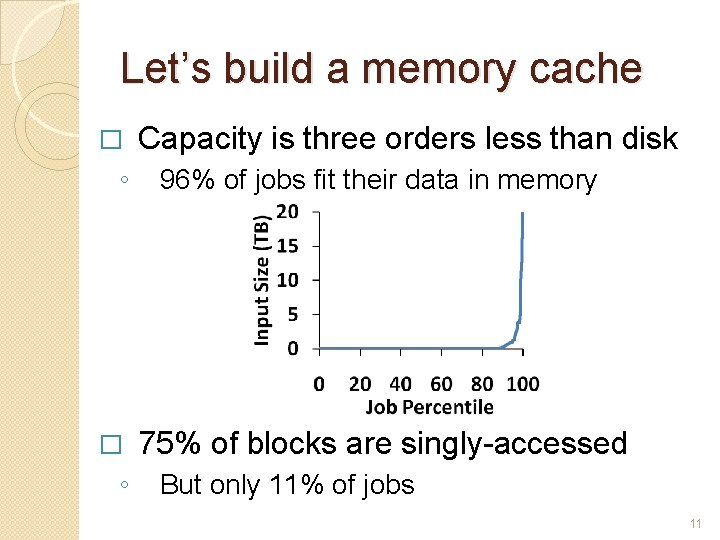
Let’s build a memory cache � ◦ Capacity is three orders less than disk 96% of jobs fit their data in memory 75% of blocks are singly-accessed But only 11% of jobs 11
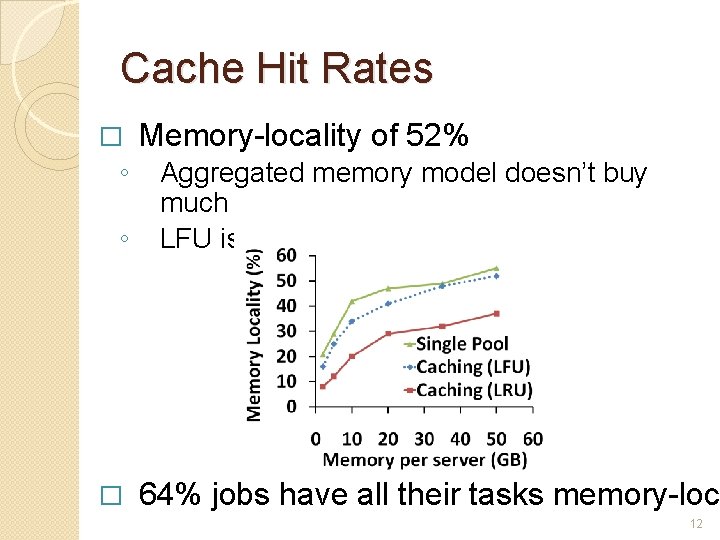
Cache Hit Rates � ◦ ◦ � Memory-locality of 52% Aggregated memory model doesn’t buy much LFU is better than LRU 64% jobs have all their tasks memory-loca 12
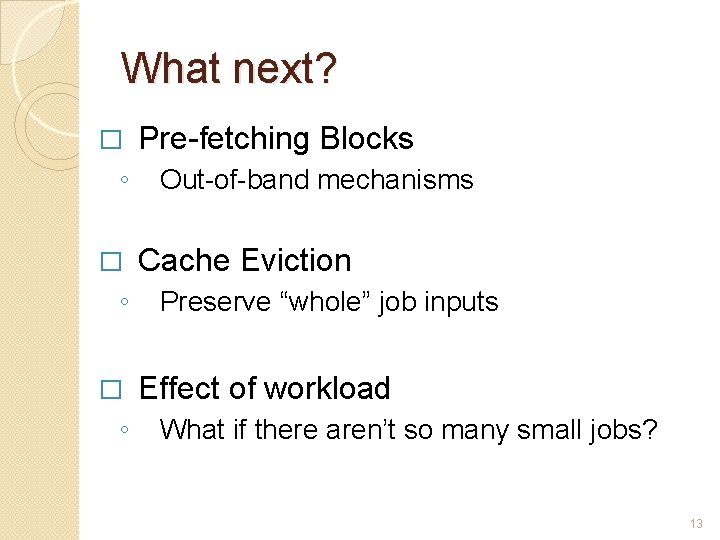
What next? � ◦ � ◦ Pre-fetching Blocks Out-of-band mechanisms Cache Eviction Preserve “whole” job inputs Effect of workload What if there aren’t so many small jobs? 13
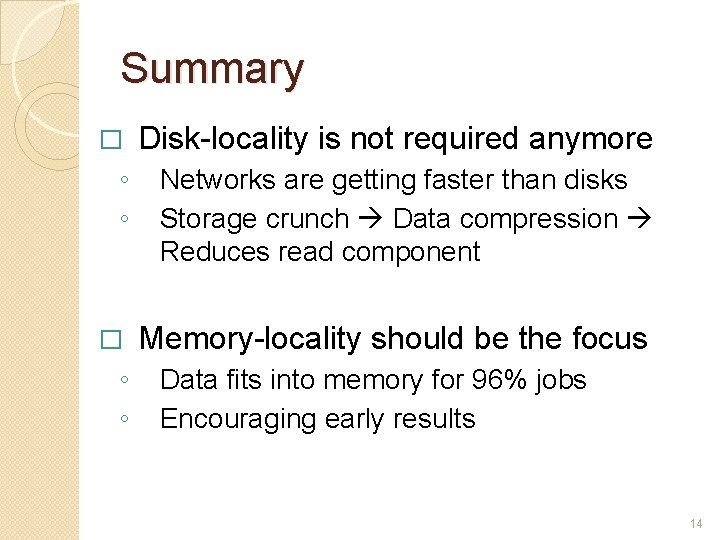
Summary � Disk-locality is not required anymore ◦ ◦ Networks are getting faster than disks Storage crunch Data compression Reduces read component � Memory-locality should be the focus ◦ ◦ Data fits into memory for 96% jobs Encouraging early results 14
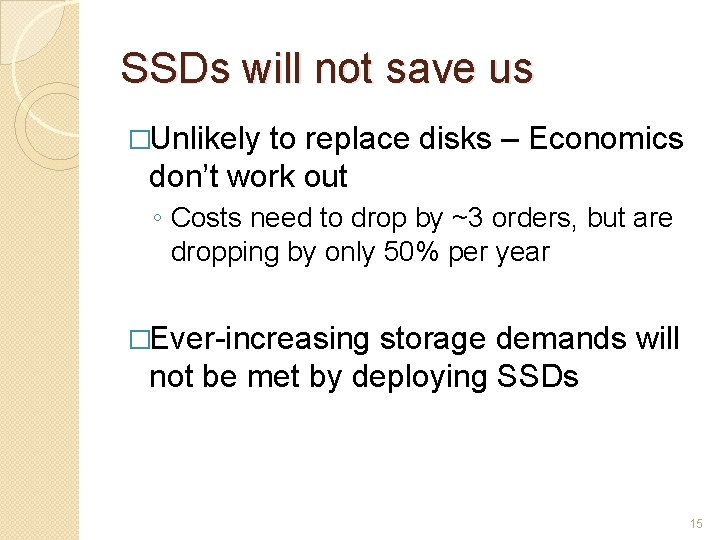
SSDs will not save us �Unlikely to replace disks – Economics don’t work out ◦ Costs need to drop by ~3 orders, but are dropping by only 50% per year �Ever-increasing storage demands will not be met by deploying SSDs 15