Discovery of Alternative Splicing First discovered with an
- Slides: 14
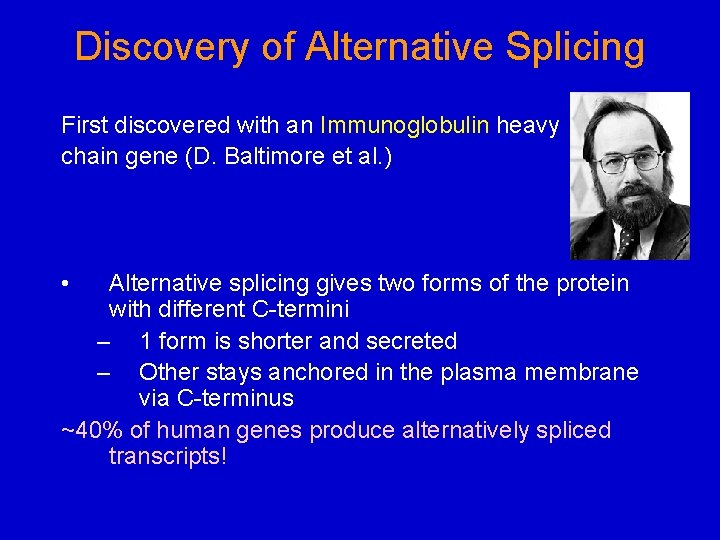
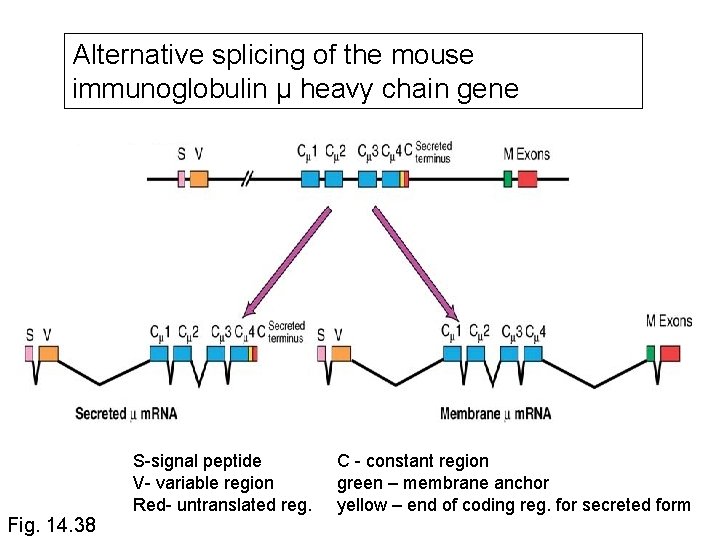
Discovery of Alternative Splicing First discovered with an Immunoglobulin heavy chain gene (D. Baltimore et al. ) • Alternative splicing gives two forms of the protein with different C-termini – 1 form is shorter and secreted – Other stays anchored in the plasma membrane via C-terminus ~40% of human genes produce alternatively spliced transcripts!
Alternative splicing of the mouse immunoglobulin μ heavy chain gene Fig. 14. 38 S-signal peptide V- variable region Red- untranslated reg. C - constant region green – membrane anchor yellow – end of coding reg. for secreted form
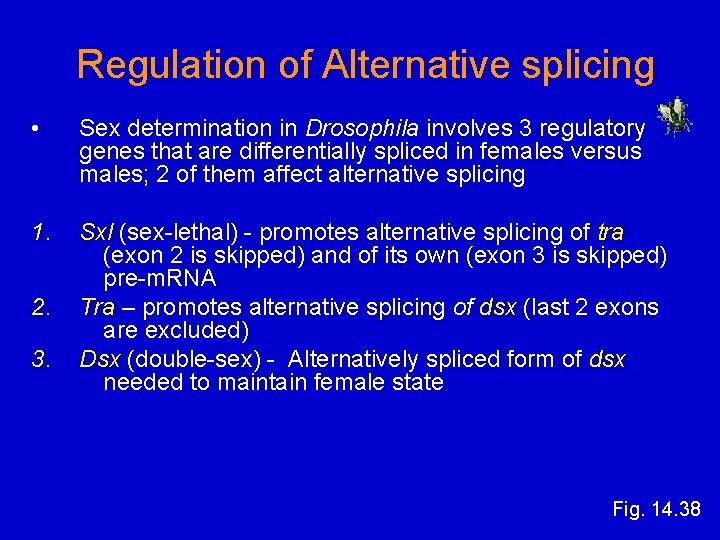
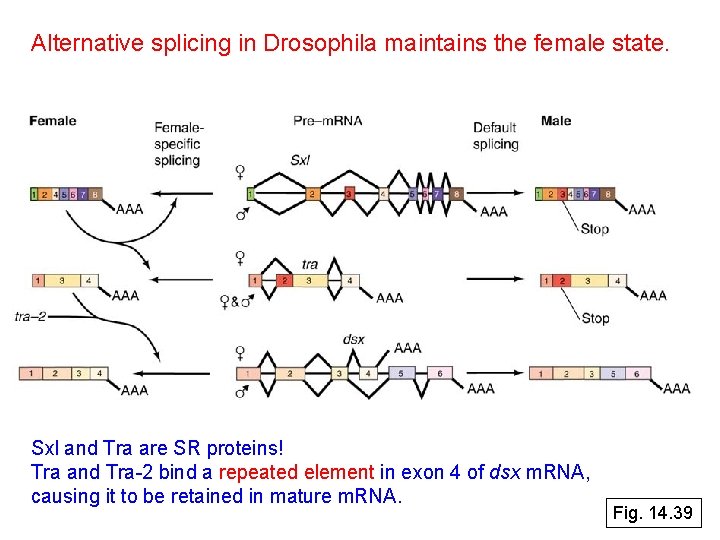
Regulation of Alternative splicing • Sex determination in Drosophila involves 3 regulatory genes that are differentially spliced in females versus males; 2 of them affect alternative splicing 1. Sxl (sex-lethal) - promotes alternative splicing of tra (exon 2 is skipped) and of its own (exon 3 is skipped) pre-m. RNA Tra – promotes alternative splicing of dsx (last 2 exons are excluded) Dsx (double-sex) - Alternatively spliced form of dsx needed to maintain female state 2. 3. Fig. 14. 38
Alternative splicing in Drosophila maintains the female state. Alternative splicing Sxl and Tra are SR proteins! Tra and Tra-2 bind a repeated element in exon 4 of dsx m. RNA, causing it to be retained in mature m. RNA. Fig. 14. 39
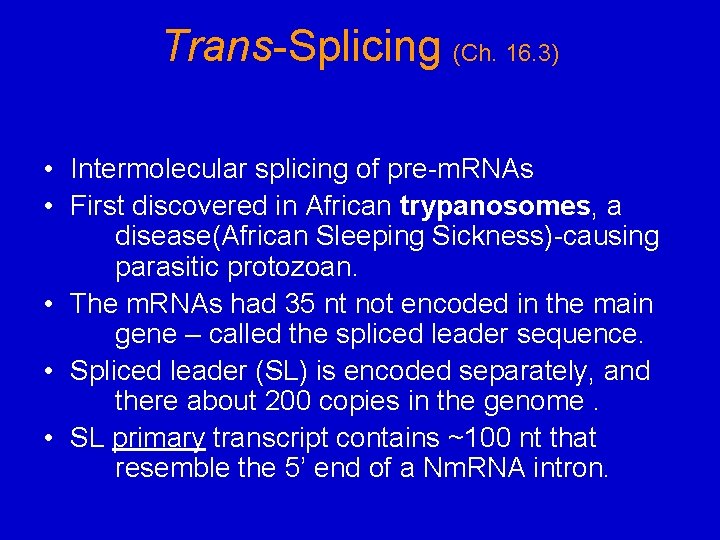
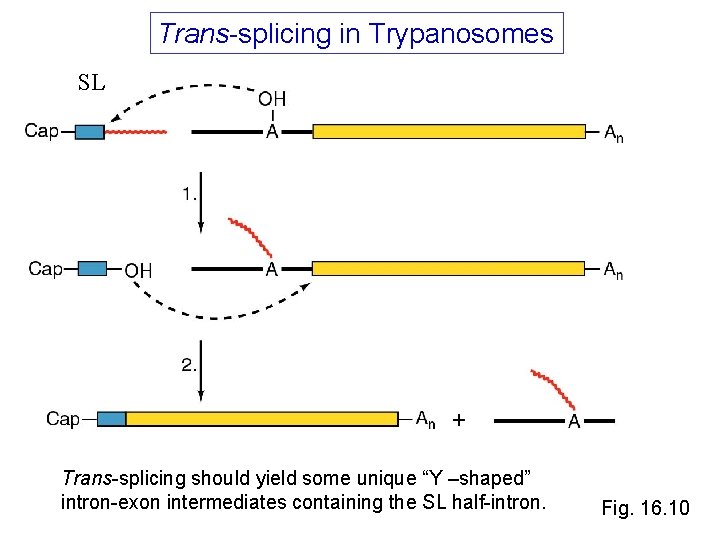
Trans-Splicing (Ch. 16. 3) • Intermolecular splicing of pre-m. RNAs • First discovered in African trypanosomes, a disease(African Sleeping Sickness)-causing parasitic protozoan. • The m. RNAs had 35 nt not encoded in the main gene – called the spliced leader sequence. • Spliced leader (SL) is encoded separately, and there about 200 copies in the genome. • SL primary transcript contains ~100 nt that resemble the 5’ end of a Nm. RNA intron.
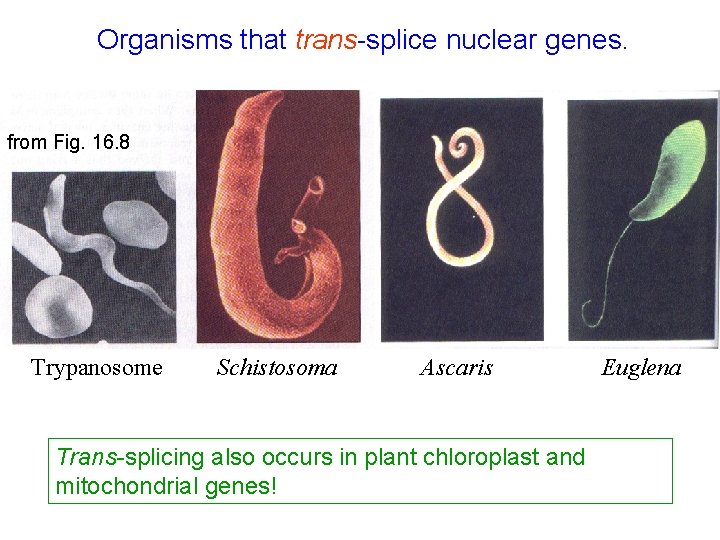
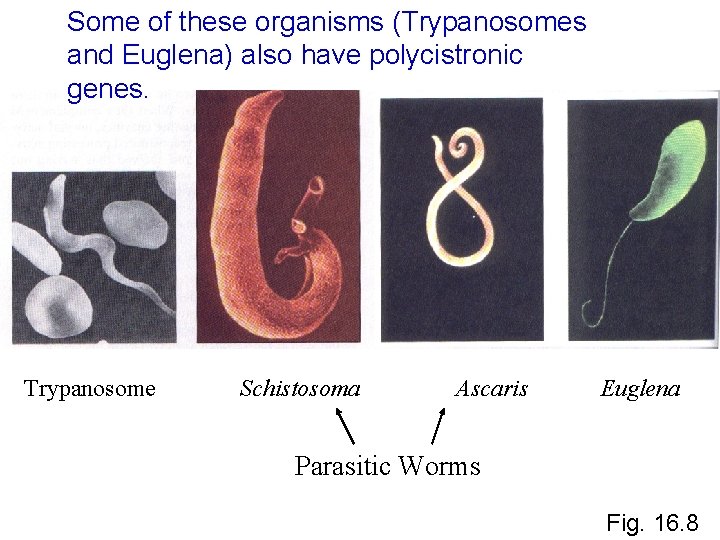
Organisms that trans-splice nuclear genes. from Fig. 16. 8 Trypanosome Schistosoma Ascaris Trans-splicing also occurs in plant chloroplast and mitochondrial genes! Euglena
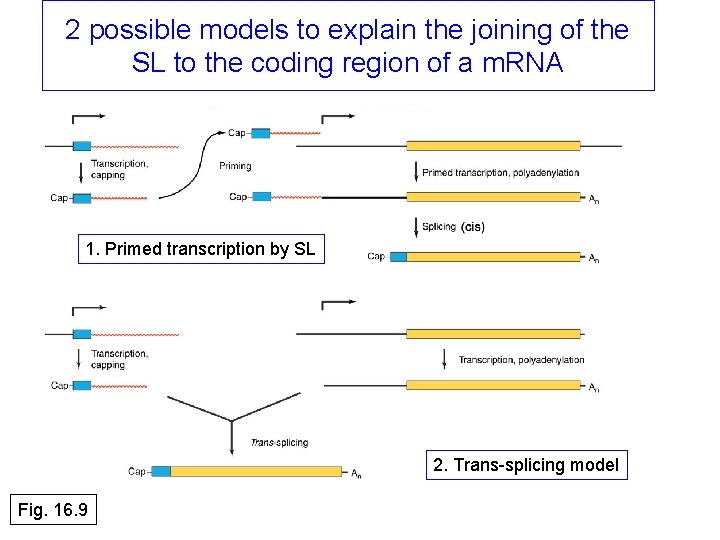
2 possible models to explain the joining of the SL to the coding region of a m. RNA 1. Primed transcription by SL 2. Trans-splicing model Fig. 16. 9
Trans-splicing in Trypanosomes SL Trans-splicing should yield some unique “Y –shaped” intron-exon intermediates containing the SL half-intron. Fig. 16. 10
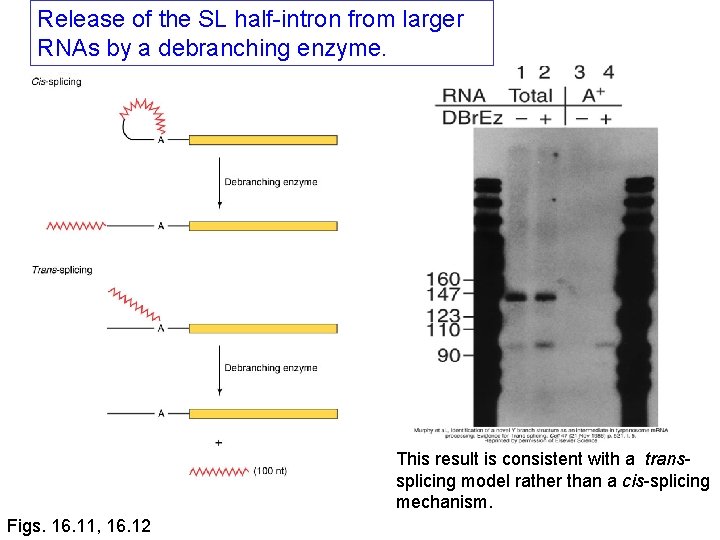
Release of the SL half-intron from larger RNAs by a debranching enzyme. This result is consistent with a transsplicing model rather than a cis-splicing mechanism. Figs. 16. 11, 16. 12
Some of these organisms (Trypanosomes and Euglena) also have polycistronic genes. Trypanosome Schistosoma Ascaris Euglena Parasitic Worms Fig. 16. 8
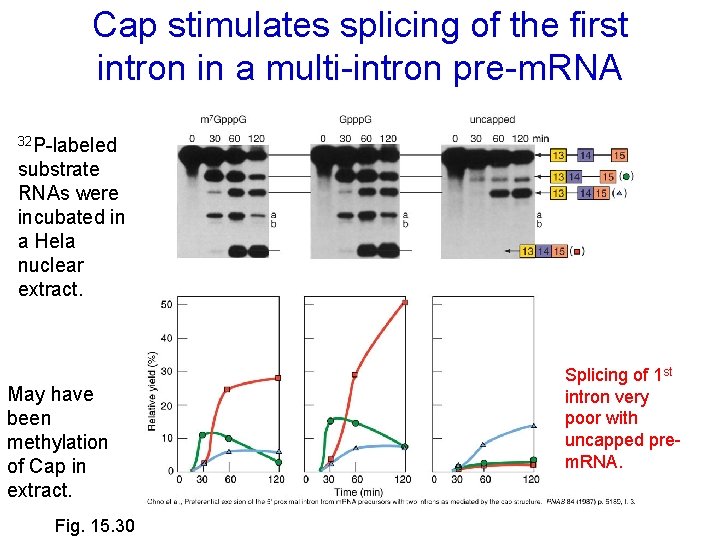
Cap stimulates splicing of the first intron in a multi-intron pre-m. RNA 32 P-labeled substrate RNAs were incubated in a Hela nuclear extract. May have been methylation of Cap in extract. Fig. 15. 30 Splicing of 1 st intron very poor with uncapped prem. RNA.
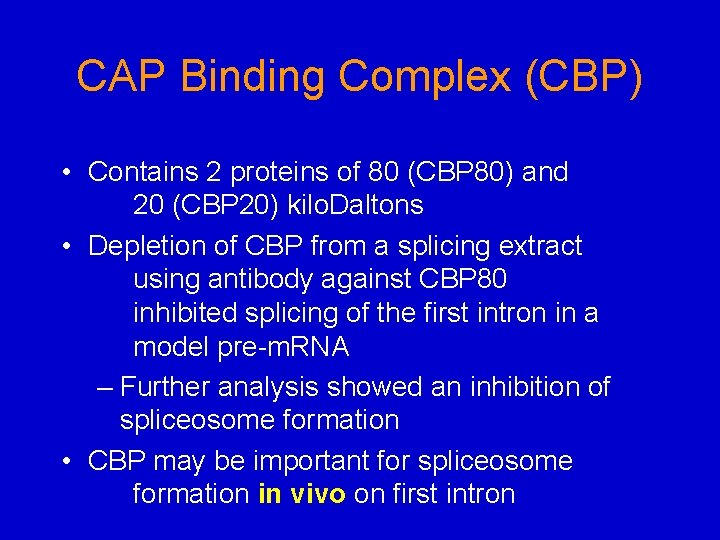
CAP Binding Complex (CBP) • Contains 2 proteins of 80 (CBP 80) and 20 (CBP 20) kilo. Daltons • Depletion of CBP from a splicing extract using antibody against CBP 80 inhibited splicing of the first intron in a model pre-m. RNA – Further analysis showed an inhibition of spliceosome formation • CBP may be important for spliceosome formation in vivo on first intron
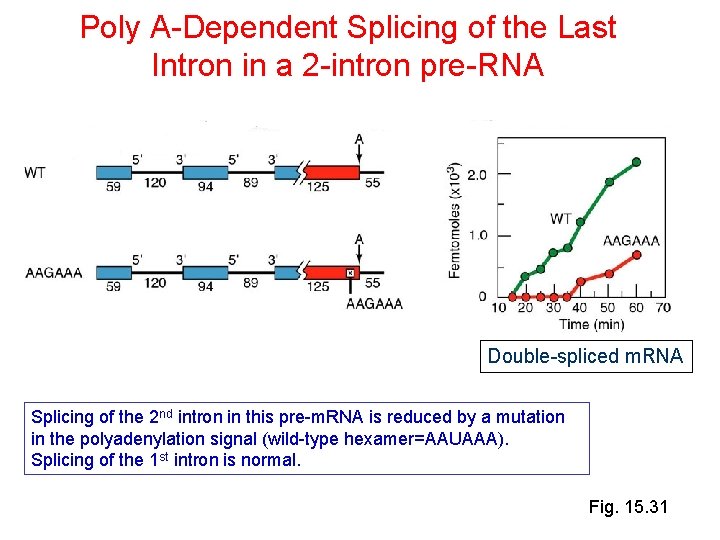
Poly A-Dependent Splicing of the Last Intron in a 2 -intron pre-RNA Double-spliced m. RNA Splicing of the 2 nd intron in this pre-m. RNA is reduced by a mutation in the polyadenylation signal (wild-type hexamer=AAUAAA). Splicing of the 1 st intron is normal. Fig. 15. 31
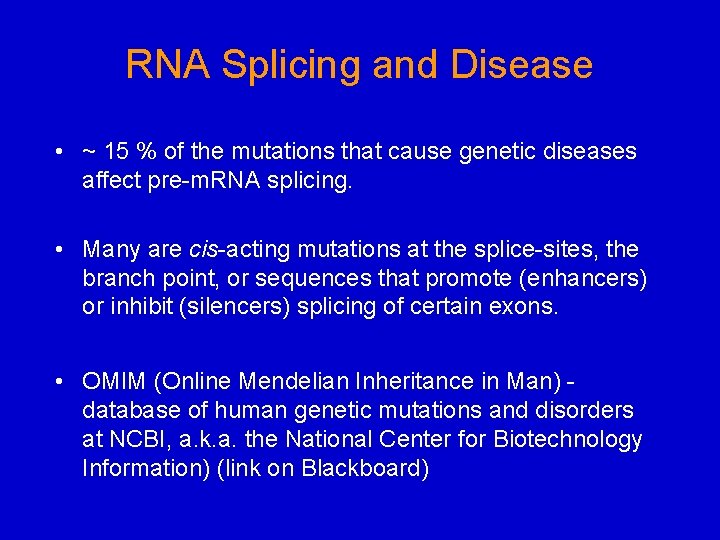
RNA Splicing and Disease • ~ 15 % of the mutations that cause genetic diseases affect pre-m. RNA splicing. • Many are cis-acting mutations at the splice-sites, the branch point, or sequences that promote (enhancers) or inhibit (silencers) splicing of certain exons. • OMIM (Online Mendelian Inheritance in Man) database of human genetic mutations and disorders at NCBI, a. k. a. the National Center for Biotechnology Information) (link on Blackboard)