Dilemmas of School Organizations What is a Dilemma



- Slides: 23
Dilemmas of School Organizations
What is a Dilemma? • They are neither problems to be solved nor issues to be faced. • They reveal deeper, more fundamental dichotomies. • They present situations with equally valued alternatives. • Consequence: Dilemmas cannot be solved or resolved.
What is the Cause? • Dilemmas occur when “competing, highly prized values cannot be fully satisfied. ” » Cuban 1992
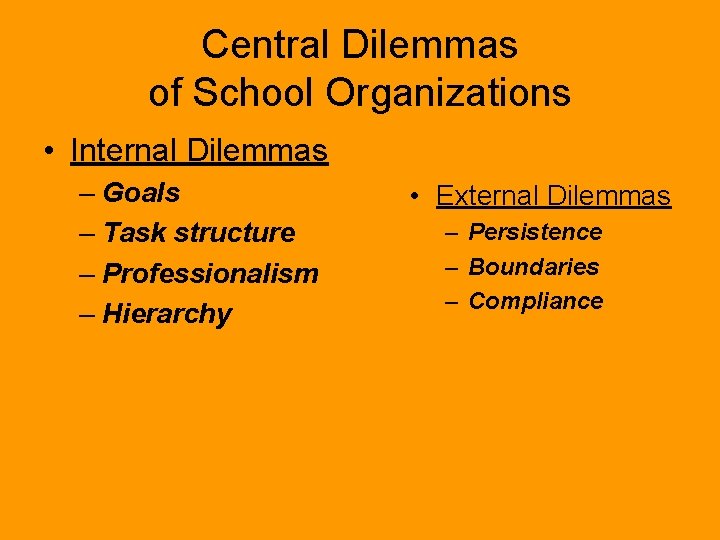
Central Dilemmas of School Organizations • Internal Dilemmas – Goals – Task structure – Professionalism – Hierarchy • External Dilemmas – Persistence – Boundaries – Compliance
4 Dilemmas of Internal Relations 1. Pursuing organizational & Individual goals 2. Formal task structures vs. Informal social relations 3. Professionals in bureaucratic structures 4. Juxtaposition of centralized and participative decision making structures.
Dilemmas of Organizational Goals Stems from the tension between organizational objectives and individual member’s motives and interests. • An organization must seek both effectiveness and efficiency. » Barnard 1938
A Prime Example Merit pay based on teacher/school performance • Teachers are resistant to it because: 1. They value intrinsic rewards rather than financial compensation. 2. It introduces competition into a profession that prizes equity. 3. Assessment of performance is unreliable.
Dilemma of Task Structure • Task structure is: the patterned or regularized aspects of t he relationships existing among participants in an organization. » Scott 1992
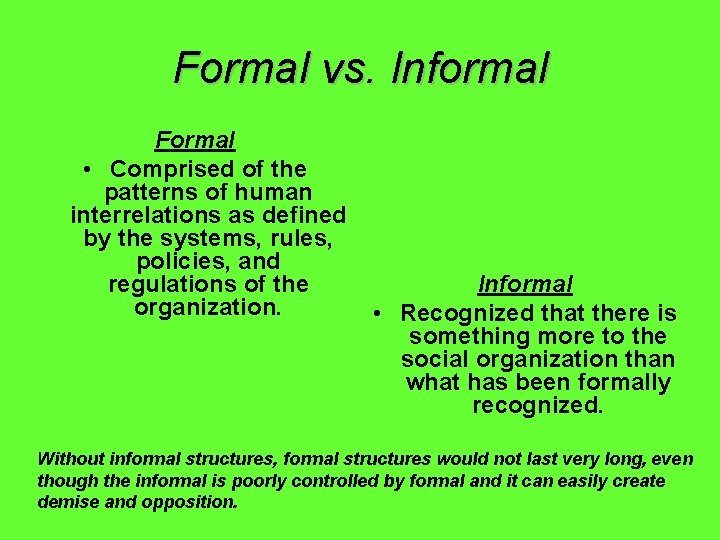
Formal vs. Informal Formal • Comprised of the patterns of human interrelations as defined by the systems, rules, policies, and regulations of the organization. Informal • Recognized that there is something more to the social organization than what has been formally recognized. Without informal structures, formal structures would not last very long, even though the informal is poorly controlled by formal and it can easily create demise and opposition.
Dilemma of Professionalism • What are the two task-related demands on education? • Discretion and Coordination
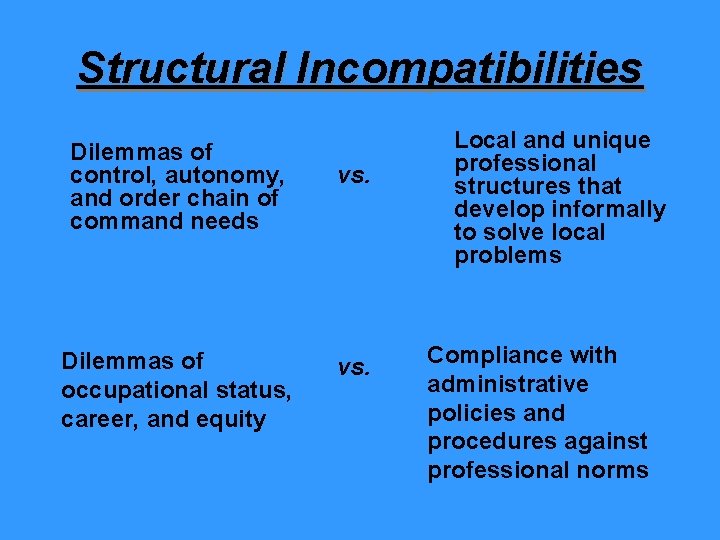
Structural Incompatibilities Dilemmas of control, autonomy, and order chain of command needs Dilemmas of occupational status, career, and equity vs. Local and unique professional structures that develop informally to solve local problems Compliance with administrative policies and procedures against professional norms
A Concern • Expertise laden professionals- work independently even though organizations require a cohesive working front. • Professionals are constrained by certain norms that prevent them from operating as their super ordinates would dictate. • There is a conflict between a professional’s need for autonomy vs. the organization’s need for compliance with formal structures.
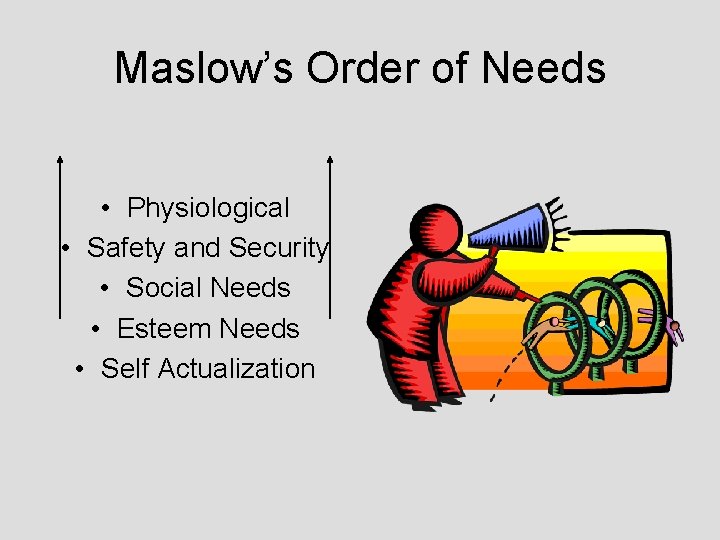
Maslow’s Order of Needs • Physiological • Safety and Security • Social Needs • Esteem Needs • Self Actualization
What About My Needs? An individual is motivated to satisfy the need that is most important at a given point in time. Chislom, et al 1980
Leaders in the Field School- Community Relationships • James Comer 1980; 1996 • James Coleman 1994 • Joyce Epstein 1988; 1996 • Joy Dryfoos 1994 • John Goodlad 1987 • Seymour Sarason 1995
Dilemma of Hierarchy • Top-Down vs. Bottom-Up • Centralized vs. Decentralized • Often time what the top office wants is not readily visible based on the adaptive “street level bureaucracy”that is needed to run a system!
Inside Bureaucracy • Anthony Downs wrote a book that details the perils and methods of setting up a scenario that enables people to stay in place and never truly achieve enough placement that they can “jump ship. ”
Dilemmas of External Relations • Dilemmas of Persistence • Organizational Boundaries • Compliance
Adapt or Be Destroyed • Persistence depends heavily on the capacity for adaptiveness. • Ginseng stated, “Schools have been discovered to be actively adaptive systems. ” (1995)
Organizational Boundaries • Boundary Language – Self-contained – Elementary – Middle school – In-School/Out-School Suspension – Staff members – District Level Staff – School Enrollment
3 Features that define…. • Organizational Boundaries – The people – Their relations – Their activities Note: These boundary groups often compete among self for prioritization and status.
Dilemma of Compliance • Does performing pomp and circumstance events and curriculum truly have a impact on education? ? • Kamens did a “graduation mythology” study that looked at the effectiveness of “the ceremony. ” • Doing for doings sake in education (desegregation mandates)
In Conclusion • Dilemmas are still neither problems to be solved nor issues to be faced, but they are items that must be addressed under the auspices of educational leadership.