
The Utilitarian Bargaining Solution Revisited Michael Brand Game
The Utilitarian Bargaining Solution Revisited Michael Brand
Game Theory = The mathematics of joint decision-making
? Game Theory = The mathematics of joint decision-making

Some simple (not-atypical) games Prisoner’s Dilemma Stag Hunt (1, 1) (0, 5) (5, 0) (3, 3) Player 1 Player 2 Player 1 Battle of the Sexes (2, 3) (0, 0) (1, 1) (1, 0) (2, 2) Player 1 Player 2 * (3, 2) (0, 1) Chicken Player 1 (0, 0) (1, 1) (-9, -9) (-1, 1) (1, -1) (0, 0) von Neumann and Morgenstern (1944)

The bargaining problem (2, 3) ideal(S) (3, 2) d (0, 0) S The utility feasibility is set • Convex • Comprehensive • Nontrivial • Closed • Bounded from above The disagreement point * Nash (1950)
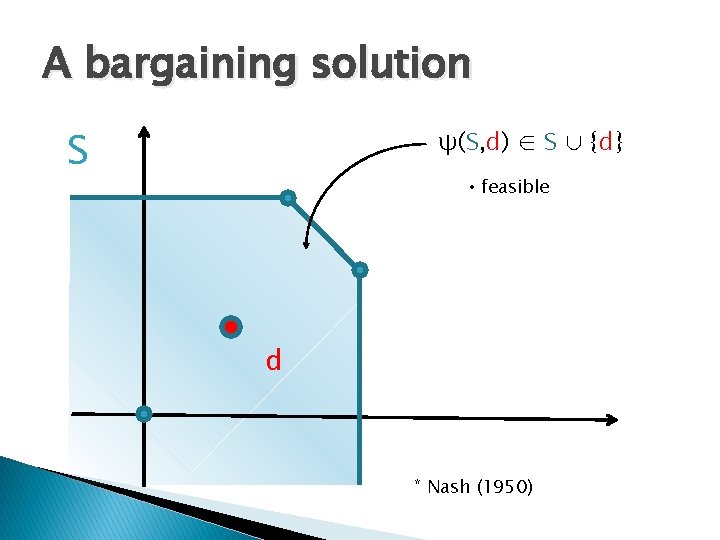
A bargaining solution S ψ(S, d) ∈ S ∪ {d} • feasible d * Nash (1950)
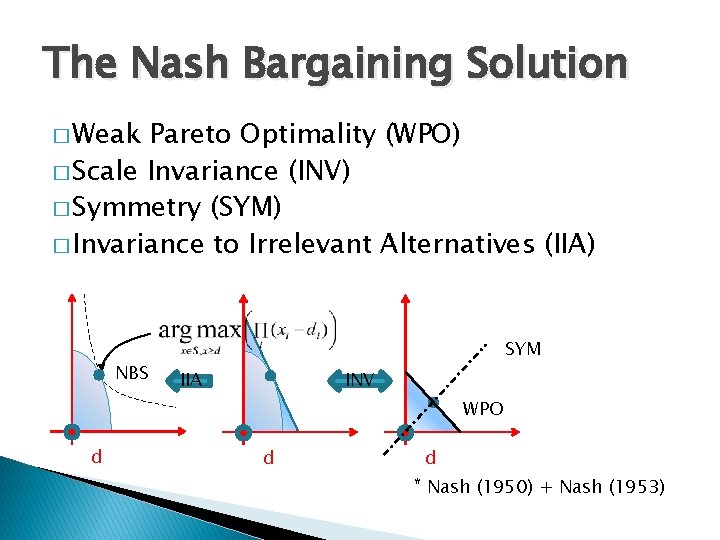
The Nash Bargaining Solution � Weak Pareto Optimality (WPO) � Scale Invariance (INV) � Symmetry (SYM) � Invariance to Irrelevant Alternatives (IIA) NBS SYM IIA INV WPO d d d * Nash (1950) + Nash (1953)
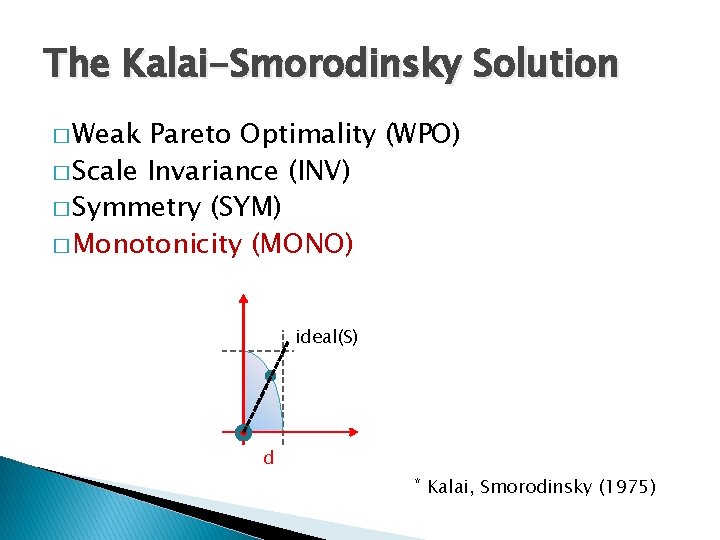
The Kalai-Smorodinsky Solution � Weak Pareto Optimality (WPO) � Scale Invariance (INV) � Symmetry (SYM) � Monotonicity (MONO) ideal(S) d * Kalai, Smorodinsky (1975)
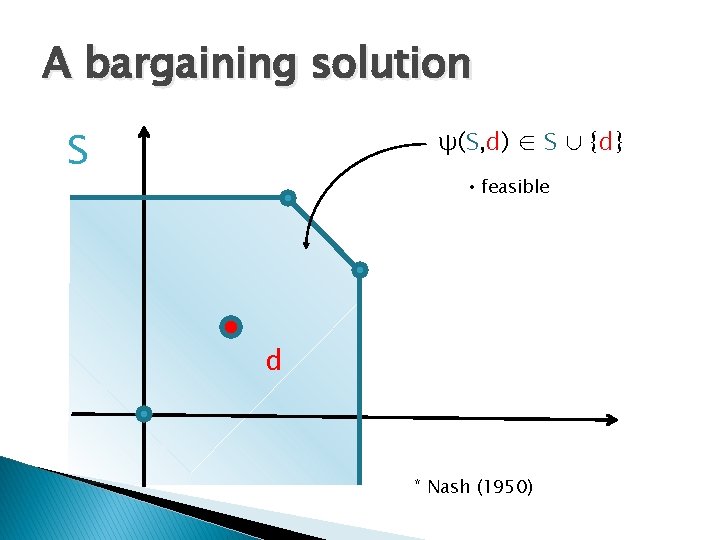
A bargaining solution S ψ(S, d) ∈ S ∪ {d} • feasible d * Nash (1950)
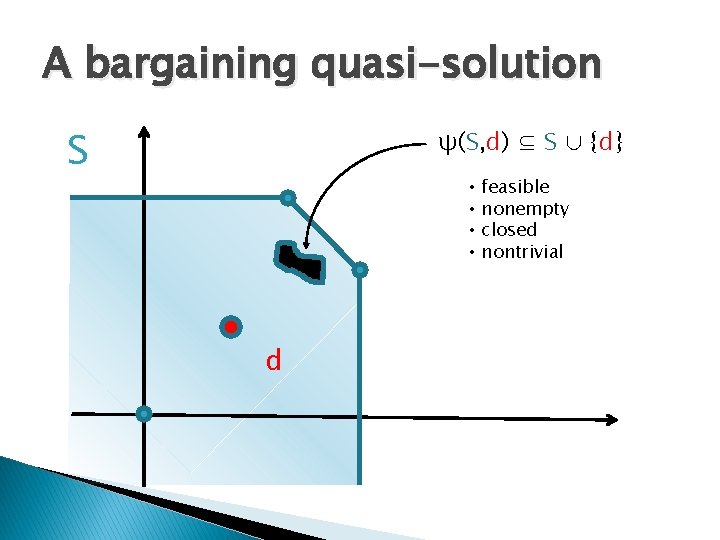
A bargaining quasi-solution S ψ(S, d) ⊆ S ∪ {d} • • d feasible nonempty closed nontrivial
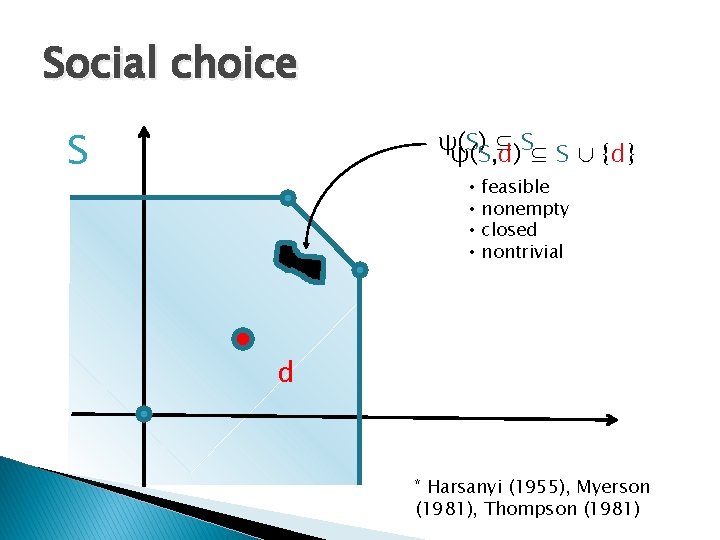
Social choice S ψ(S) ⊆ S ψ(S, d) ⊆ S ∪ {d} • • feasible nonempty closed nontrivial d Harsanyi (1955), Myerson (1981), Thompson (1981) *
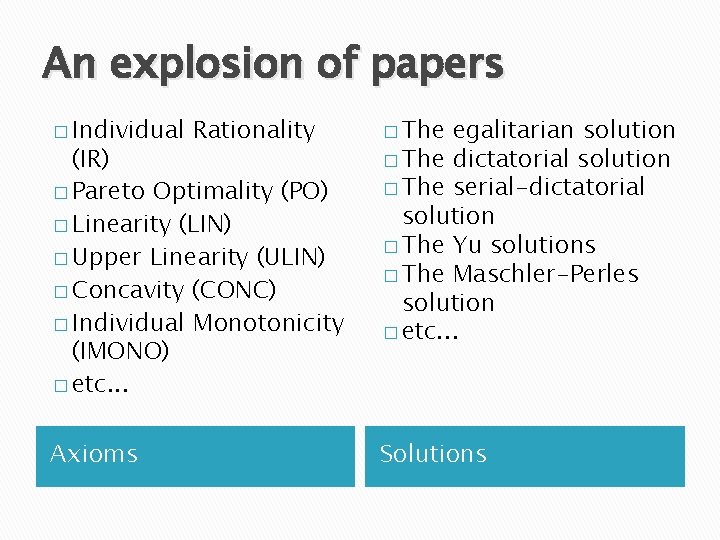
An explosion of papers � Individual Rationality (IR) � Pareto Optimality (PO) � Linearity (LIN) � Upper Linearity (ULIN) � Concavity (CONC) � Individual Monotonicity (IMONO) � etc. . . Axioms � The egalitarian solution � The dictatorial solution � The serial-dictatorial solution � The Yu solutions � The Maschler-Perles solution � etc. . . Solutions
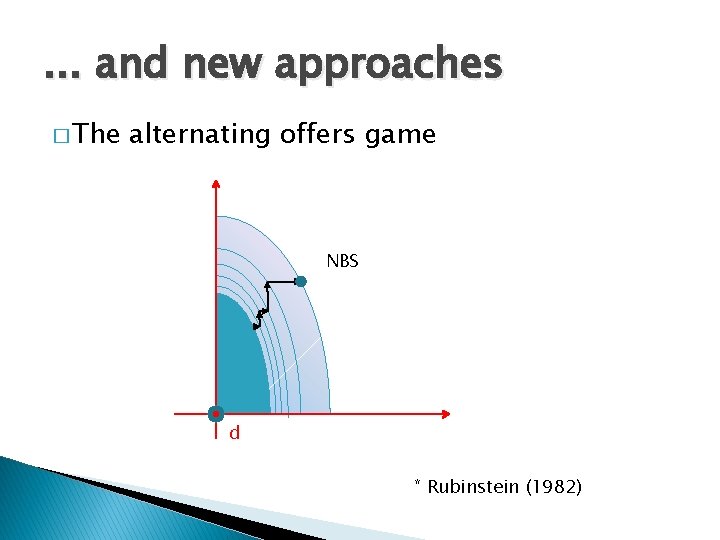
. . . and new approaches � The alternating offers game NBS d * Rubinstein (1982)
Why has nobody heard about any of this?
Breaking down the old axioms � Invariance to Irrelevant Alternatives (IIA) ◦ How can we know this, until we consider how the feasibility set is explored? (Kalai+Smorodinsky) � Weak Pareto optimality (WPO) ◦ The same question applies. ◦ Commodity space may have a different topology. � Symmetry (SYM) ◦ Why, exactly, are we assuming this? ◦ Is life fair? ◦ Are all negotiations symmetric?
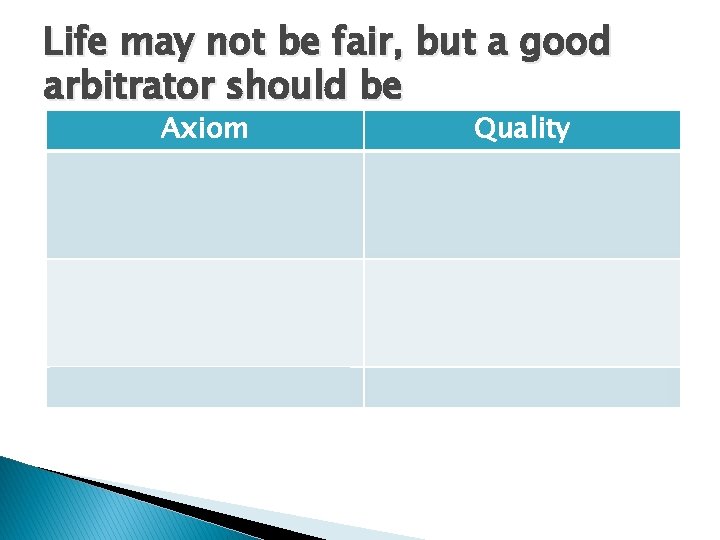
Life may not be fair, but a good arbitrator should be Axiom Quality Invariance to Irrelevant Alternatives Thorough (IIA) Weak Pareto Benevolent Optimality (WPO) / Pareto Optimality (PO) Symmetry (SYM) Impartial
What about INV? � INV claims that by rescaling to other v. N-M utility units, the solution cannot be altered. � It is considered to be a statement regarding the inability to compare utility interpersonally. � In fact, it is a stronger statement than this. It is a claim that all arbitrators must necessarily reach the same conclusion, because their decisions must refrain from subjective interpersonal assessment of utilities. � It is a claim that justice is objective.
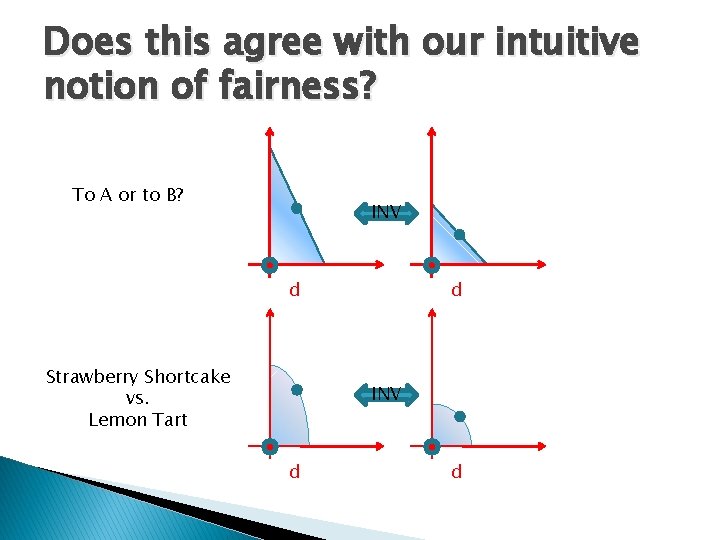
Does this agree with our intuitive notion of fairness? To A or to B? INV d Strawberry Shortcake vs. Lemon Tart d INV d d
So, good arbitration cannot be “objective” � The most we can require of an arbitrator is that her method of interpersonal utility comparisons is consistent. ◦ Or else, again, we are back at the “Strawberry Shortcake vs. Lemon Tart” dilemma. � SYM now has to be reformulated. ◦ The arbitrator should now be required to be impartial within her subject world view. � We assume the problem to be scaled into this world view.
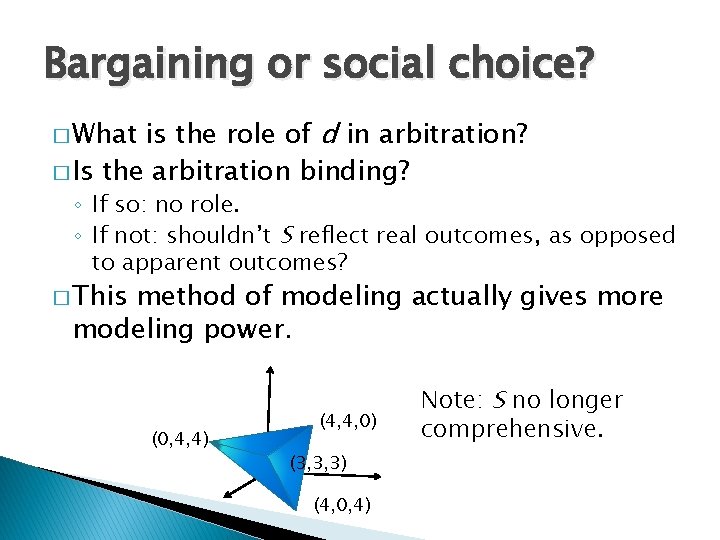
Bargaining or social choice? is the role of d in arbitration? � Is the arbitration binding? � What ◦ If so: no role. ◦ If not: shouldn’t S reflect real outcomes, as opposed to apparent outcomes? � This method of modeling actually gives more modeling power. (0, 4, 4) (4, 4, 0) (3, 3, 3) (4, 0, 4) Note: S no longer comprehensive.
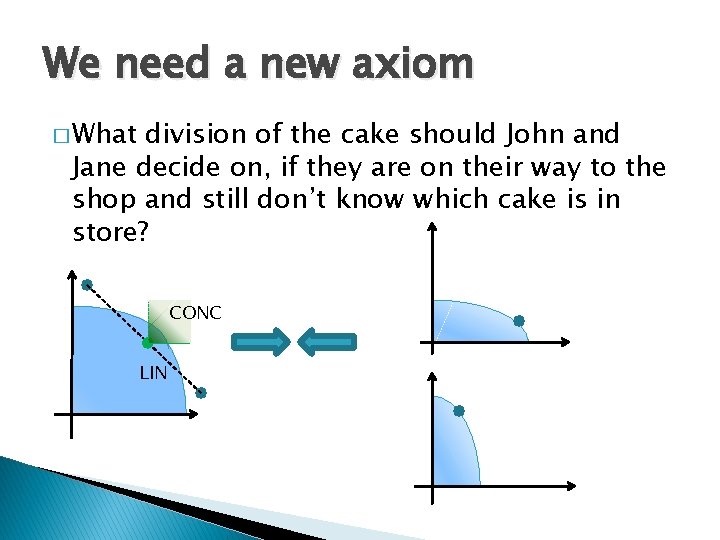
We need a new axiom � What division of the cake should John and Jane decide on, if they are on their way to the shop and still don’t know which cake is in store? CONC LIN
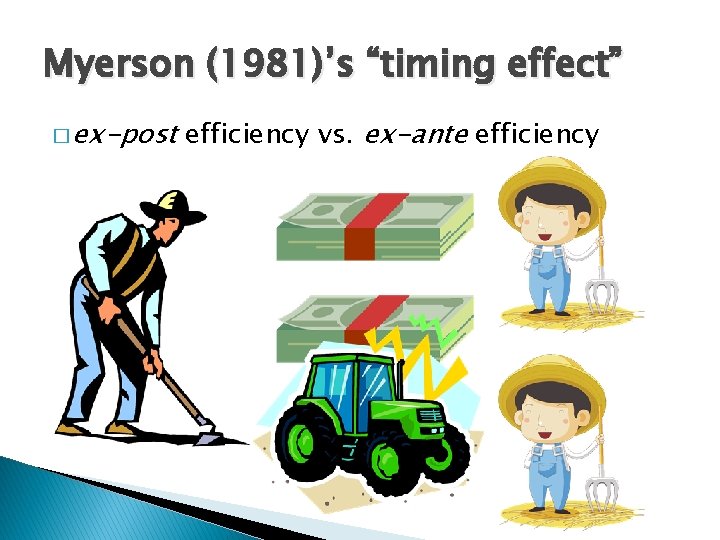
Myerson (1981)’s “timing effect” � ex-post efficiency vs. ex-ante efficiency
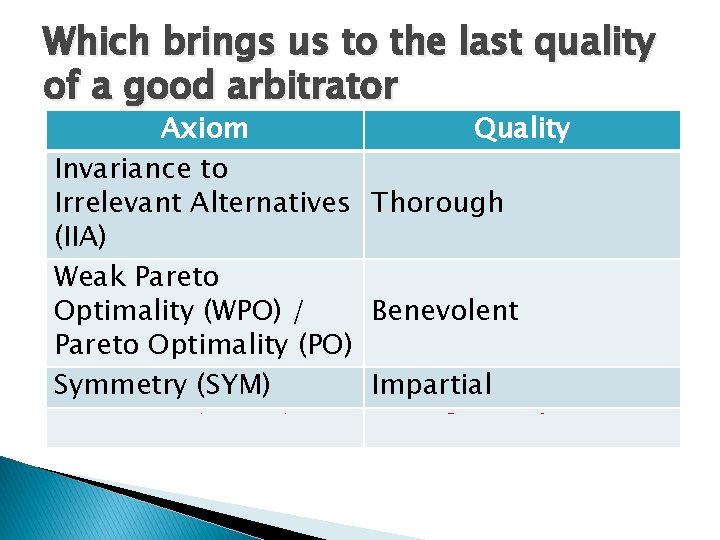
Which brings us to the last quality of a good arbitrator Axiom Invariance to Irrelevant Alternatives (IIA) Weak Pareto Optimality (WPO) / Pareto Optimality (PO) Symmetry (SYM) Concavity (CONC) Quality Thorough Benevolent Impartial Uses foresight
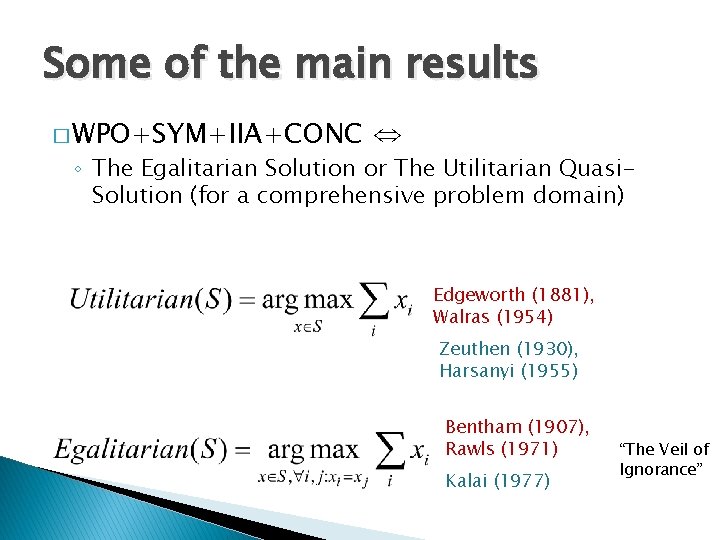
Some of the main results � WPO+SYM+IIA+CONC ⇔ ◦ The Egalitarian Solution or The Utilitarian Quasi. Solution (for a comprehensive problem domain) Edgeworth (1881), Walras (1954) Zeuthen (1930), Harsanyi (1955) Bentham (1907), Rawls (1971) Kalai (1977) “The Veil of Ignorance”
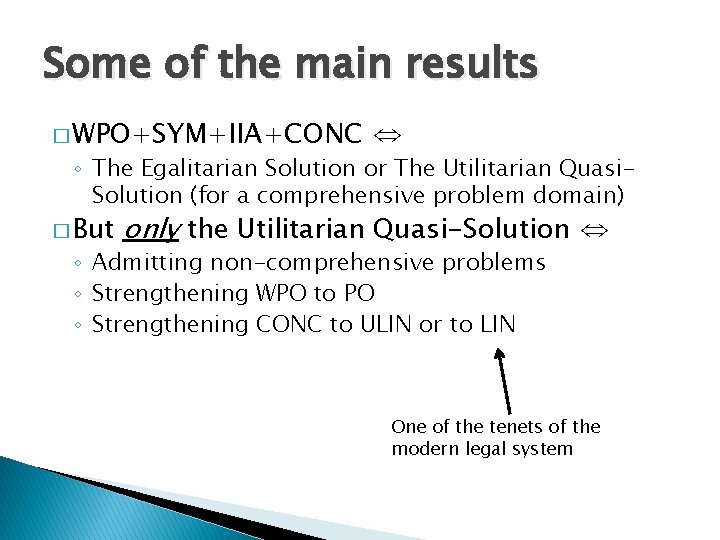
Some of the main results � WPO+SYM+IIA+CONC ⇔ ◦ The Egalitarian Solution or The Utilitarian Quasi. Solution (for a comprehensive problem domain) � But only the Utilitarian Quasi-Solution ⇔ ◦ Admitting non-comprehensive problems ◦ Strengthening WPO to PO ◦ Strengthening CONC to ULIN or to LIN One of the tenets of the modern legal system
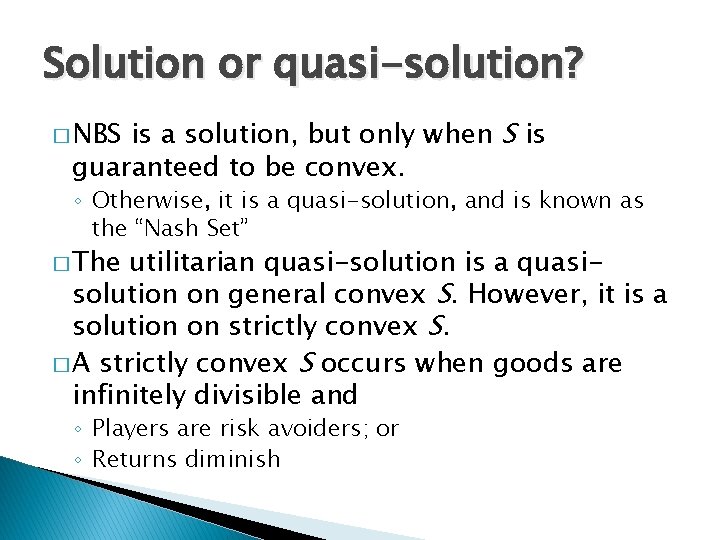
Solution or quasi-solution? is a solution, but only when S is guaranteed to be convex. � NBS ◦ Otherwise, it is a quasi-solution, and is known as the “Nash Set” � The utilitarian quasi-solution is a quasisolution on general convex S. However, it is a solution on strictly convex S. � A strictly convex S occurs when goods are infinitely divisible and ◦ Players are risk avoiders; or ◦ Returns diminish
A simplified proof for a simplified case � IIA implies that there is a social utility function � PO implies that this function is monotone increasing in each axis � LIN implies that it is convex � SYM implies that it maps all coordinate permutations to the same value ◦ which, together with convexity, leads to being a function on the sum of the coordinates.
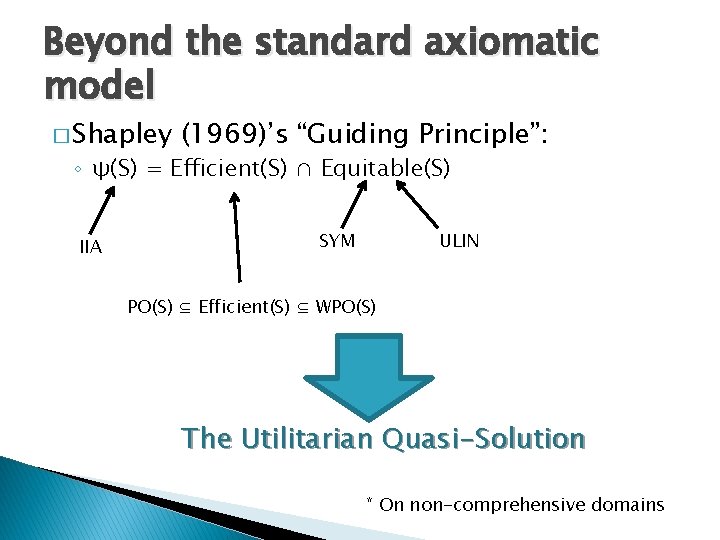
Beyond the standard axiomatic model � Shapley (1969)’s “Guiding Principle”: ◦ ψ(S) = Efficient(S) ∩ Equitable(S) IIA SYM ULIN PO(S) ⊆ Efficient(S) ⊆ WPO(S) The Utilitarian Quasi-Solution * On non-comprehensive domains
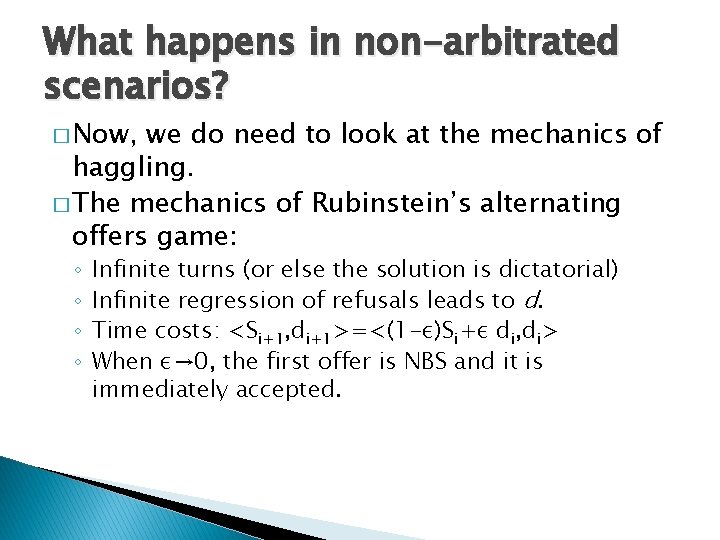
What happens in non-arbitrated scenarios? � Now, we do need to look at the mechanics of haggling. � The mechanics of Rubinstein’s alternating offers game: ◦ ◦ Infinite turns (or else the solution is dictatorial) Infinite regression of refusals leads to d. Time costs: <Si+1, di+1>=<(1 -ε)Si+ε di, di> When ε→ 0, the first offer is NBS and it is immediately accepted.
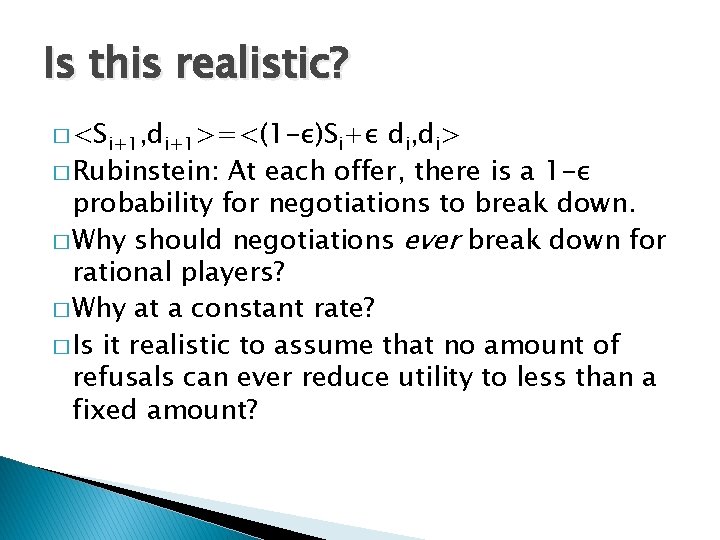
Is this realistic? � <Si+1, di+1>=<(1 -ε)Si+ε di, di> � Rubinstein: At each offer, there is a 1 -ε probability for negotiations to break down. � Why should negotiations ever break down for rational players? � Why at a constant rate? � Is it realistic to assume that no amount of refusals can ever reduce utility to less than a fixed amount?
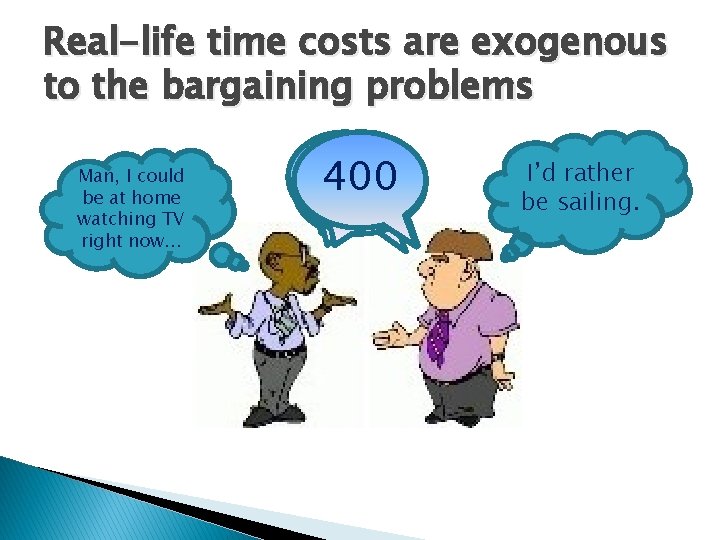
Real-life time costs are exogenous to the bargaining problems Man, I could be at home watching TV right now. . . 900 800 400 200 300 700 100 600 I’d rather be sailing.
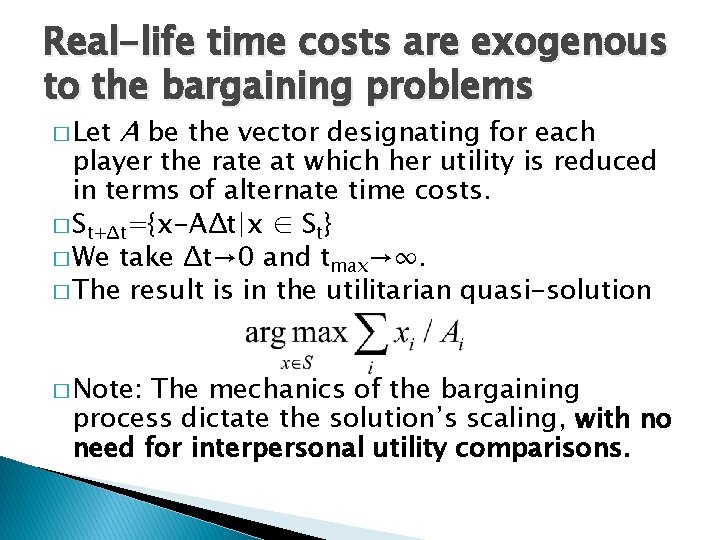
Real-life time costs are exogenous to the bargaining problems � Let A be the vector designating for each player the rate at which her utility is reduced in terms of alternate time costs. � St+Δt={x-AΔt|x ∈ St} � We take Δt→ 0 and tmax→∞. � The result is in the utilitarian quasi-solution � Note: The mechanics of the bargaining process dictate the solution’s scaling, with no need for interpersonal utility comparisons.
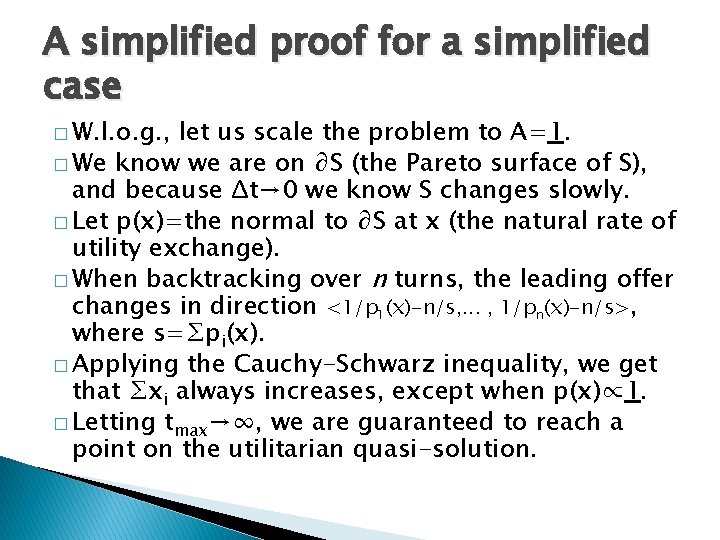
A simplified proof for a simplified case � W. l. o. g. , let us scale the problem to A=1. � We know we are on ∂S (the Pareto surface of S), and because Δt→ 0 we know S changes slowly. � Let p(x)=the normal to ∂S at x (the natural rate of utility exchange). � When backtracking over n turns, the leading offer changes in direction <1/p 1(x)-n/s, . . . , 1/pn(x)-n/s>, where s=∑pi(x). � Applying the Cauchy-Schwarz inequality, we get that ∑xi always increases, except when p(x)∝ 1. � Letting tmax→∞, we are guaranteed to reach a point on the utilitarian quasi-solution.
Conclusion: Never haggle when you are in a hurry. � We know this from experience. � We now know that it is rational behavior. � It is not accounted for by NBS (Or Rubinstein’s alternating offers game).
Thank you! � questions?
- Slides: 35