
THE DILEMMA OF THE ENVELOPS A GAME ABOUT

THE DILEMMA OF THE ENVELOPS A GAME ABOUT « COMMON GOOD »
HOW TO PLAY • First, we need 20 volunteers to go on stage! All year! Come on, don’t be shy. • You receive a starting capital – money - ($ 500) to use as efficiently as possible and an envelop. • Decide, without communicating with other players, whether you put your money in your envelope or if you keep it for yourself. It has to be all the money!
HOW TO PLAY • Put your name on the envelop and wait. • Then, groups of two players are formed at random. • The two players in each group exchange their envelops and receive the contents of their teammate's envelop.
HOW TO PLAY • Your result consists of what you find in the envelope you received and your starting capital if you kept it for yourself. • If there is money in the received envelope, the player receives 2 points. • If the received envelope is empty, the player does not win any points. • If the player has kept his money, he adds 1 point to his total
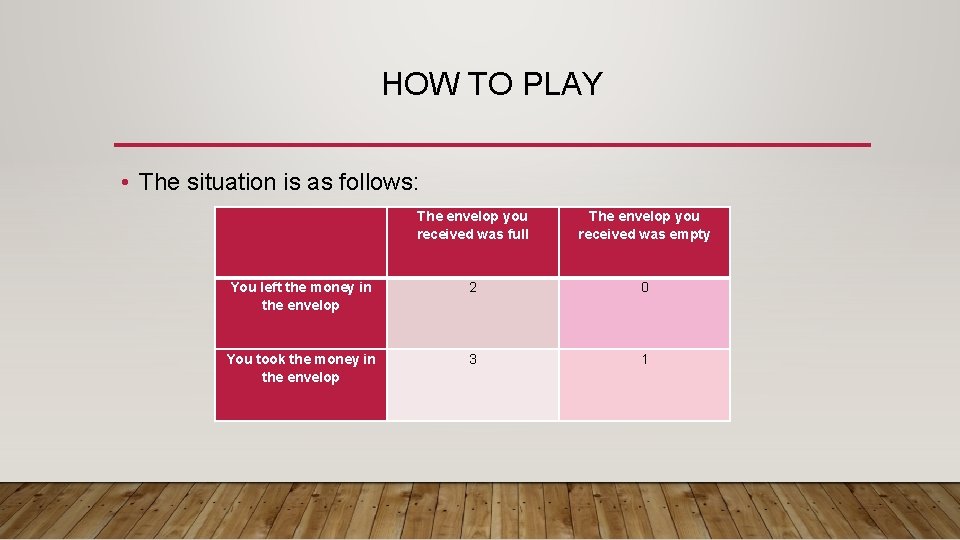
HOW TO PLAY • The situation is as follows: The envelop you received was full The envelop you received was empty You left the money in the envelop 2 0 You took the money in the envelop 3 1
INTERPRETATION • Tell your results to the leader of the game. How many points do you have? • What could have been the maximum potential result? • If each player places all his credit in the envelope, they can all double their stake. • Why was this result not achieved? • From the individual point of view, each rational player tends to want to keep all his money, because he is sure to obtain a better score systematically.
EXAMPLE • Fishing: if I fish all the fishes in the lake for me and my family, no fish will remain. • Earth and nature resources (raw materials: oil, water, wood, …) • Team management • Break on customer’s trust • Short-term money
LET’S TALK ABOUT THE « PRISONER’S DILEMMA » , A GAME THEORY • Bonnie and Clyde's have together committed a serious crime for which they risk life imprisonment. • The police arrest the two criminals and separately detain them. • However, the police has evidence only in relation to a minor offense for which the two accomplices risk a one-year imprisonment. • The police can take advantage of this situation. • The police suggests that each of the two prisoners cancel the one-year prison sentence if he testifies against his accomplice.
LET’S TALK ABOUT THE « PRISONER’S DILEMMA » , A GAME THEORY • If the two testify against each other, they will be judged for the serious crime, but the life sentence will be reduced to 10 years. • Bonnie and Clyde must therefore take, alone, in their cell, a big decision with consequences. • Both are aware of the situation: • if both of them are silent (that is, if they cooperate with each other), then the police do not have sufficient evidence, and they can only be sentenced to one year in prison. • If one of them is silent and his accomplice speaks, the first is held for life and the other is released. • If the two denounce each other, they are each sentenced to 10 years in prison.
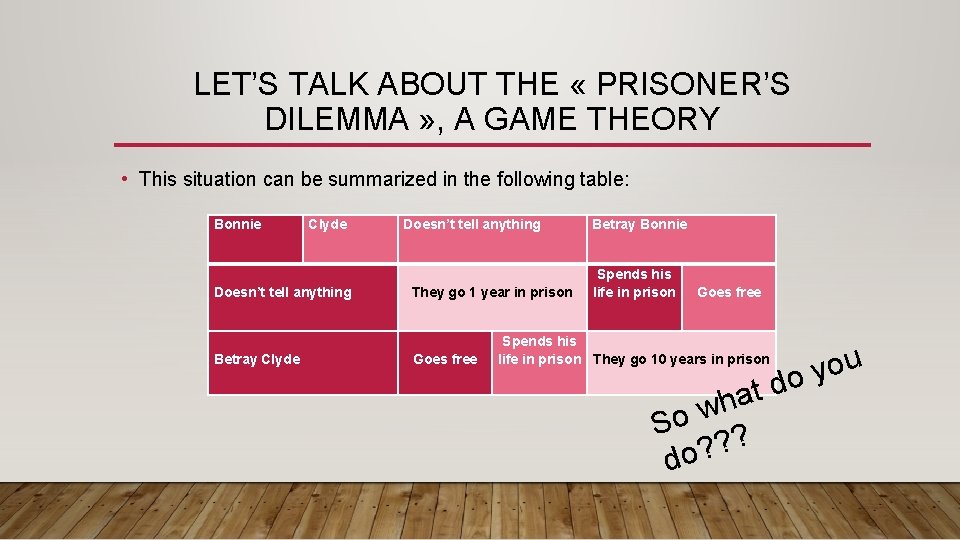
LET’S TALK ABOUT THE « PRISONER’S DILEMMA » , A GAME THEORY • This situation can be summarized in the following table: Bonnie Clyde Doesn’t tell anything Betray Clyde Doesn’t tell anything They go 1 year in prison Goes free Betray Bonnie Spends his life in prison Goes free Spends his life in prison They go 10 years in prison d t a h w So ? ? ? o d u o o y
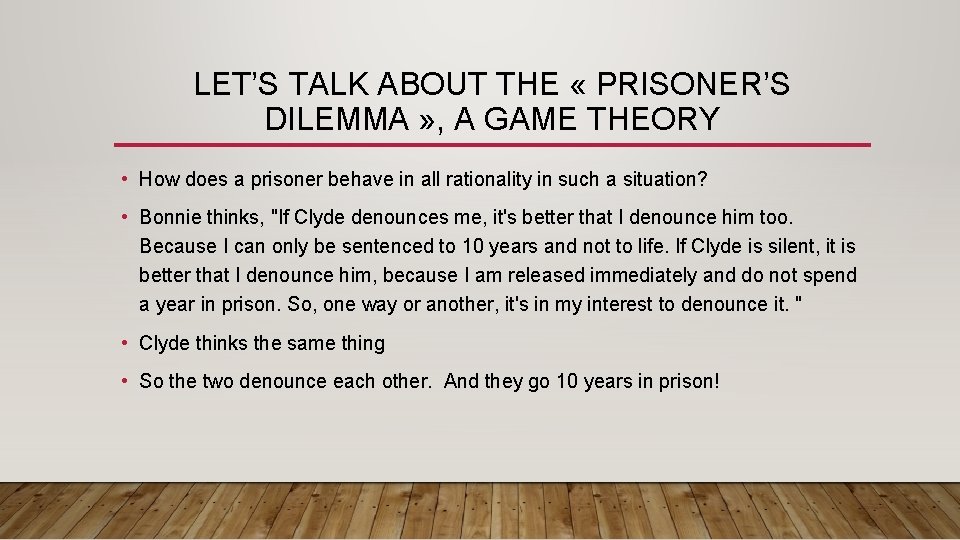
LET’S TALK ABOUT THE « PRISONER’S DILEMMA » , A GAME THEORY • How does a prisoner behave in all rationality in such a situation? • Bonnie thinks, "If Clyde denounces me, it's better that I denounce him too. Because I can only be sentenced to 10 years and not to life. If Clyde is silent, it is better that I denounce him, because I am released immediately and do not spend a year in prison. So, one way or another, it's in my interest to denounce it. " • Clyde thinks the same thing • So the two denounce each other. And they go 10 years in prison!
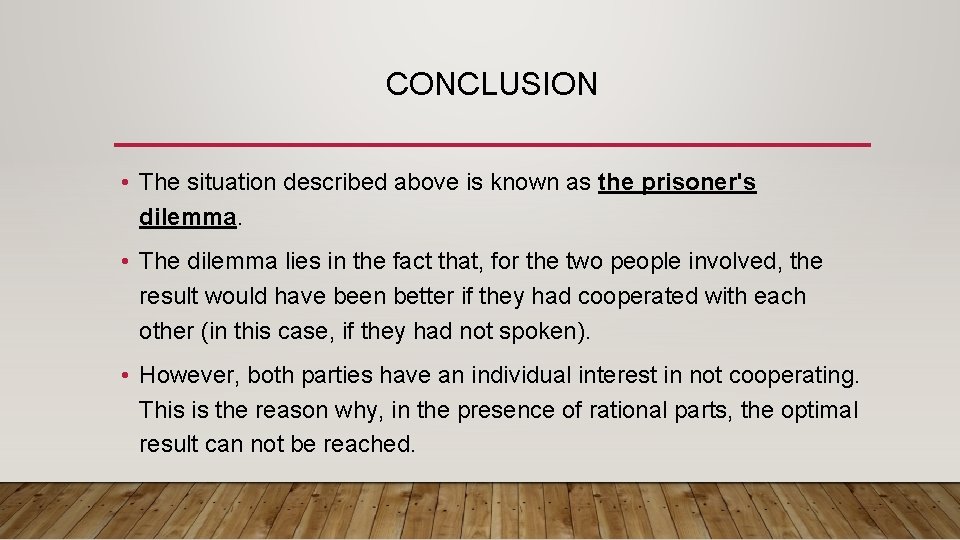
CONCLUSION • The situation described above is known as the prisoner's dilemma. • The dilemma lies in the fact that, for the two people involved, the result would have been better if they had cooperated with each other (in this case, if they had not spoken). • However, both parties have an individual interest in not cooperating. This is the reason why, in the presence of rational parts, the optimal result can not be reached.
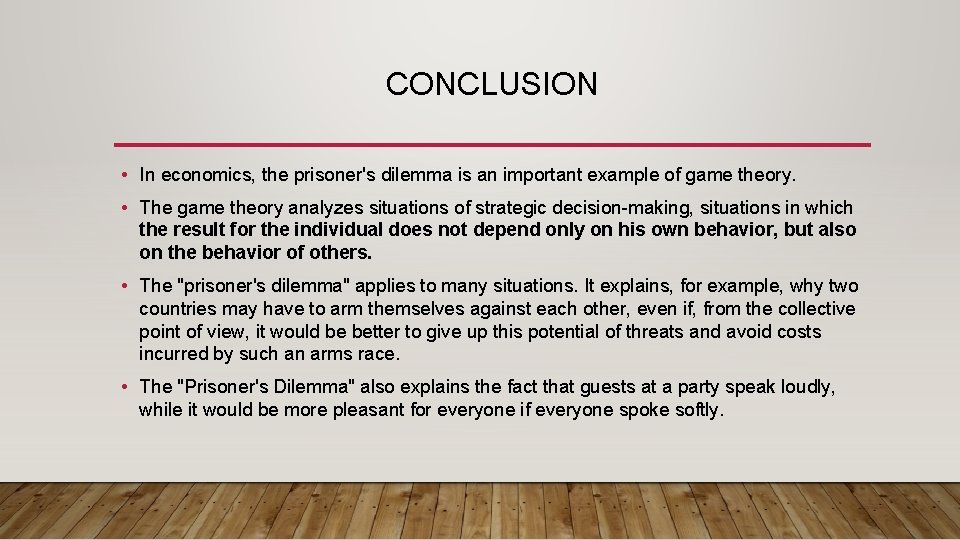
CONCLUSION • In economics, the prisoner's dilemma is an important example of game theory. • The game theory analyzes situations of strategic decision-making, situations in which the result for the individual does not depend only on his own behavior, but also on the behavior of others. • The "prisoner's dilemma" applies to many situations. It explains, for example, why two countries may have to arm themselves against each other, even if, from the collective point of view, it would be better to give up this potential of threats and avoid costs incurred by such an arms race. • The "Prisoner's Dilemma" also explains the fact that guests at a party speak loudly, while it would be more pleasant for everyone if everyone spoke softly.
OTHER EXAMPLE • Corruption • Dopping • Cheating at the exam • Cheating on quality of my production • The run for military equipments
WHAT ABOUT THE FIRST GAME? • In economic terms, students are in the "prisoner" position. • They each have an individual interest in not placing the money in the envelope. • But from the collective point of view, it would be better for each of them to leave his money in the envelope given to him. • With this game, students are well aware of the antinomy (=the opposition) that exists between personal interest and that of the community.

DO YOU HAVE ANY QUESTION?

THANK YOU VERY MUCH FOR YOUR ATTENTION!

- Slides: 18