Diamond and IRIS Dr Andrew Richards Head of
- Slides: 14
Diamond and IRIS Dr Andrew Richards: Head of Scientific Computing and Data Management November 2020 andrew. j. richards@diamond. ac. uk
IRIS as part of Diamond Computing Strategy From the SSCC strategy, Scientific Computing is tasked to ‘Objective 1: Provide Scientific Computing Infrastructure to facilitate best science at Diamond’ Scientific Computing roadmap under development. To deliver this roadmap a set of High Level Objectives are defined: • Engage with Diamond computational heavy users to define requirements and steer priorities, • Deliver Sufficient data centre capacity for research related computing over next 10 years utilising a mixture of on-premise (own build), shared (UKRI), and off-premise cloud, • Deliver hybrid compute platforms that address data acquisition, data analysis, simulation and modelling requirements as appropriate, • Deliver staff development plan for ensuring suitably skilled staff are available in Diamond computing teams to support ongoing activities and future R+D
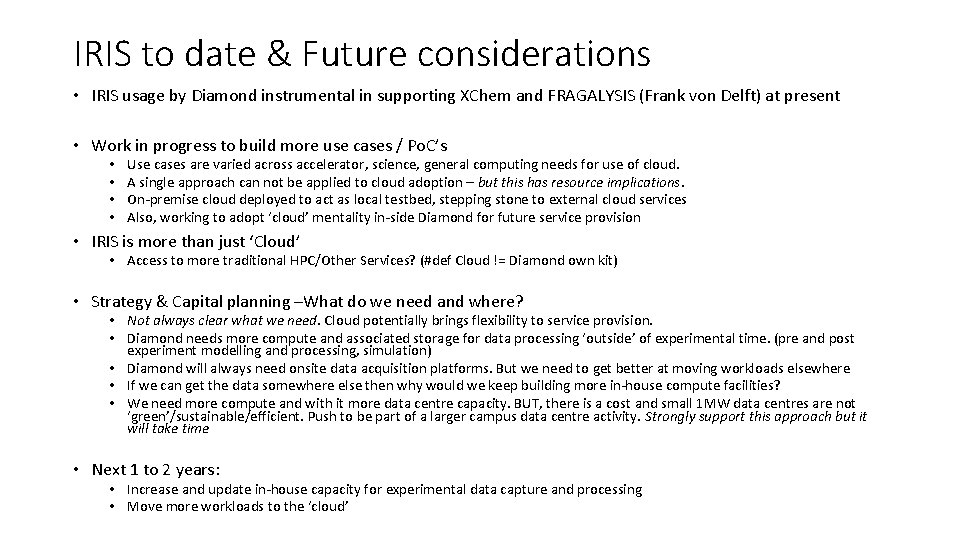
IRIS to date & Future considerations • IRIS usage by Diamond instrumental in supporting XChem and FRAGALYSIS (Frank von Delft) at present • Work in progress to build more use cases / Po. C’s • • Use cases are varied across accelerator, science, general computing needs for use of cloud. A single approach can not be applied to cloud adoption – but this has resource implications. On-premise cloud deployed to act as local testbed, stepping stone to external cloud services Also, working to adopt ‘cloud’ mentality in-side Diamond for future service provision • IRIS is more than just ‘Cloud’ • Access to more traditional HPC/Other Services? (#def Cloud != Diamond own kit) • Strategy & Capital planning –What do we need and where? • Not always clear what we need. Cloud potentially brings flexibility to service provision. • Diamond needs more compute and associated storage for data processing ‘outside’ of experimental time. (pre and post experiment modelling and processing, simulation) • Diamond will always need onsite data acquisition platforms. But we need to get better at moving workloads elsewhere • If we can get the data somewhere else then why would we keep building more in-house compute facilities? • We need more compute and with it more data centre capacity. BUT, there is a cost and small 1 MW data centres are not ‘green’/sustainable/efficient. Push to be part of a larger campus data centre activity. Strongly support this approach but it will take time • Next 1 to 2 years: • Increase and update in-house capacity for experimental data capture and processing • Move more workloads to the ‘cloud’
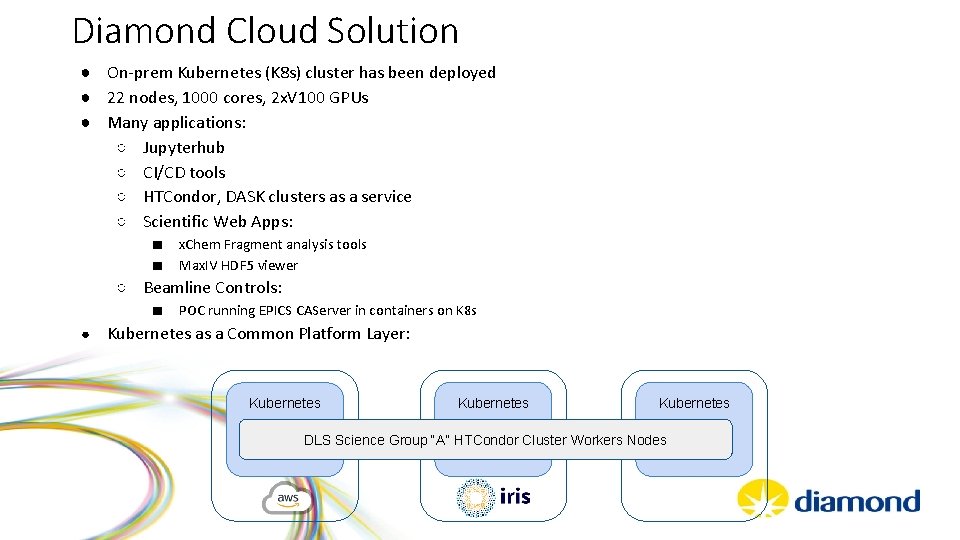
Diamond Cloud Solution ● On-prem Kubernetes (K 8 s) cluster has been deployed ● 22 nodes, 1000 cores, 2 x. V 100 GPUs ● Many applications: ○ Jupyterhub ○ CI/CD tools ○ HTCondor, DASK clusters as a service ○ Scientific Web Apps: ■ x. Chem Fragment analysis tools ■ Max. IV HDF 5 viewer ○ Beamline Controls: ■ POC running EPICS CAServer in containers on K 8 s ● Kubernetes as a Common Platform Layer: Kubernetes DLS Science Group “A” HTCondor Cluster Workers Nodes
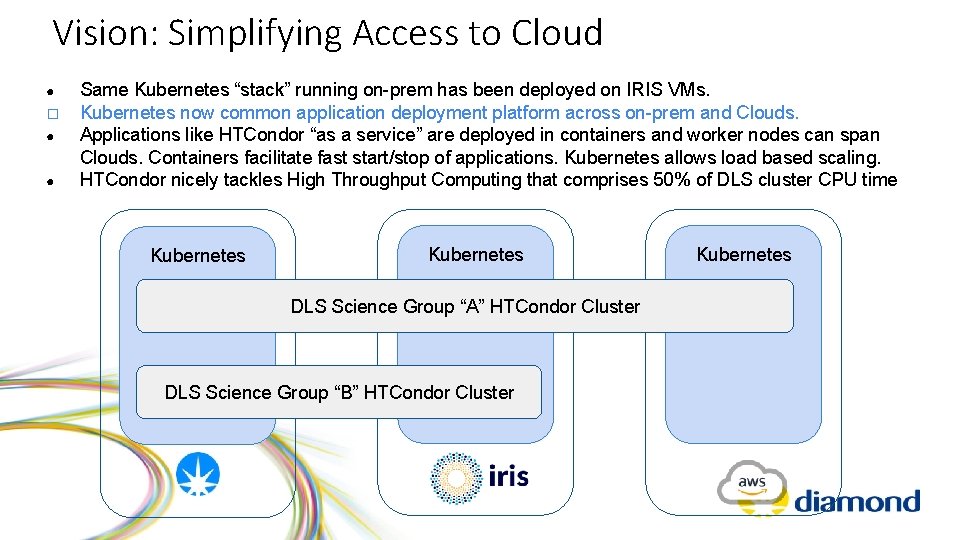
Vision: Simplifying Access to Cloud ● � ● ● Same Kubernetes “stack” running on-prem has been deployed on IRIS VMs. Kubernetes now common application deployment platform across on-prem and Clouds. Applications like HTCondor “as a service” are deployed in containers and worker nodes can span Clouds. Containers facilitate fast start/stop of applications. Kubernetes allows load based scaling. HTCondor nicely tackles High Throughput Computing that comprises 50% of DLS cluster CPU time Kubernetes DLS Science Group “A” HTCondor Cluster DLS Science Group “B” HTCondor Cluster Kubernetes
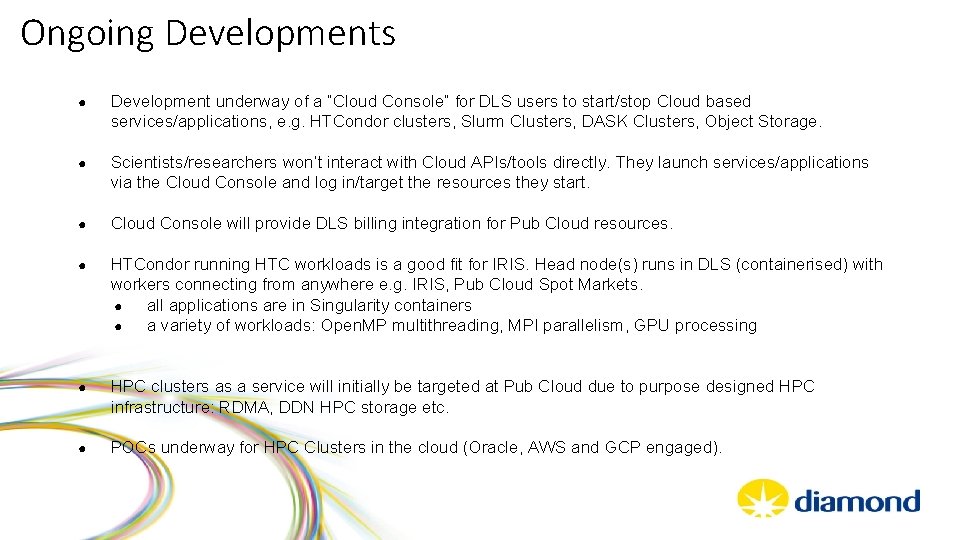
Ongoing Developments ● Development underway of a “Cloud Console” for DLS users to start/stop Cloud based services/applications, e. g. HTCondor clusters, Slurm Clusters, DASK Clusters, Object Storage. ● Scientists/researchers won’t interact with Cloud APIs/tools directly. They launch services/applications via the Cloud Console and log in/target the resources they start. ● Cloud Console will provide DLS billing integration for Pub Cloud resources. ● HTCondor running HTC workloads is a good fit for IRIS. Head node(s) runs in DLS (containerised) with workers connecting from anywhere e. g. IRIS, Pub Cloud Spot Markets. ● all applications are in Singularity containers ● a variety of workloads: Open. MP multithreading, MPI parallelism, GPU processing ● HPC clusters as a service will initially be targeted at Pub Cloud due to purpose designed HPC infrastructure: RDMA, DDN HPC storage etc. ● POCs underway for HPC Clusters in the cloud (Oracle, AWS and GCP engaged).
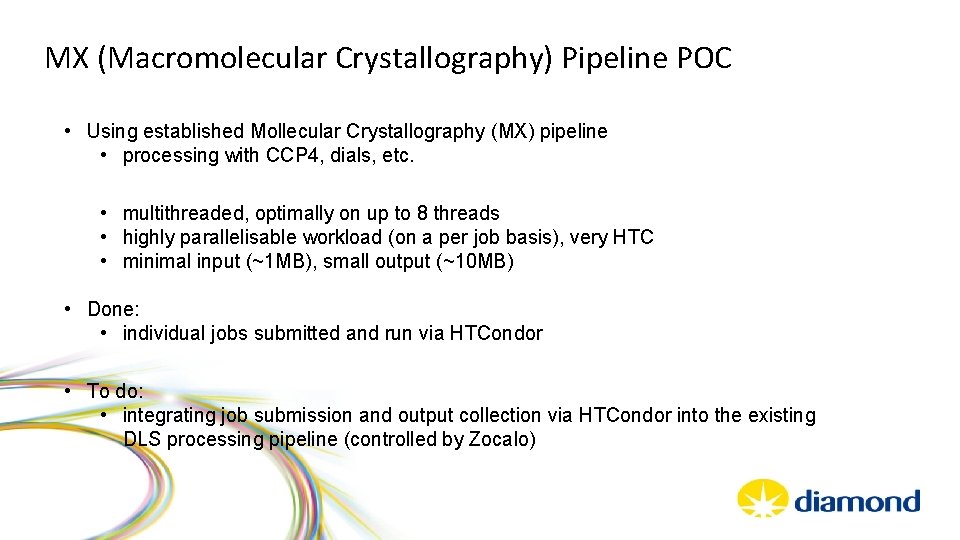
MX (Macromolecular Crystallography) Pipeline POC • Using established Mollecular Crystallography (MX) pipeline • processing with CCP 4, dials, etc. • multithreaded, optimally on up to 8 threads • highly parallelisable workload (on a per job basis), very HTC • minimal input (~1 MB), small output (~10 MB) • Done: • individual jobs submitted and run via HTCondor • To do: • integrating job submission and output collection via HTCondor into the existing DLS processing pipeline (controlled by Zocalo)
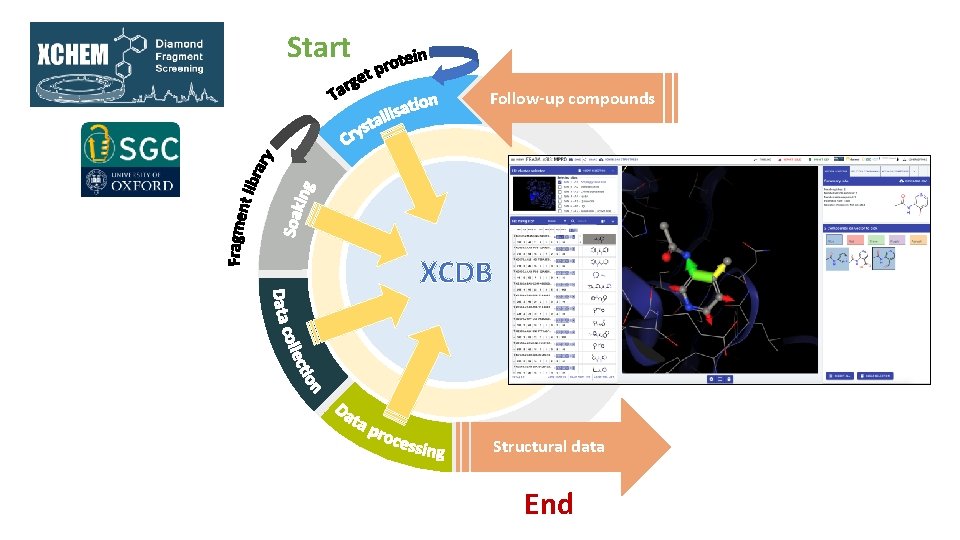
Start Follow-up compounds XCDB Structural data End
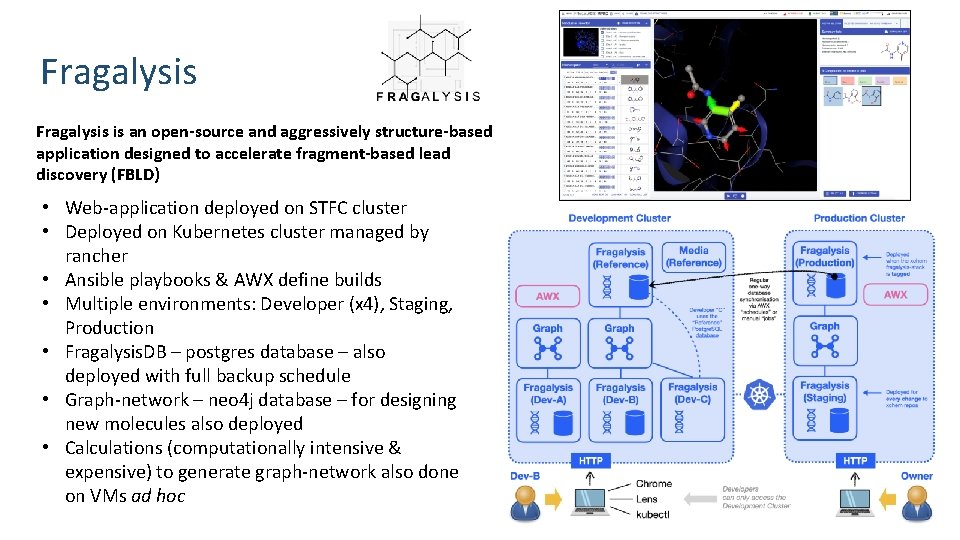
Fragalysis is an open-source and aggressively structure-based application designed to accelerate fragment-based lead discovery (FBLD) • Web-application deployed on STFC cluster • Deployed on Kubernetes cluster managed by rancher • Ansible playbooks & AWX define builds • Multiple environments: Developer (x 4), Staging, Production • Fragalysis. DB – postgres database – also deployed with full backup schedule • Graph-network – neo 4 j database – for designing new molecules also deployed • Calculations (computationally intensive & expensive) to generate graph-network also done on VMs ad hoc
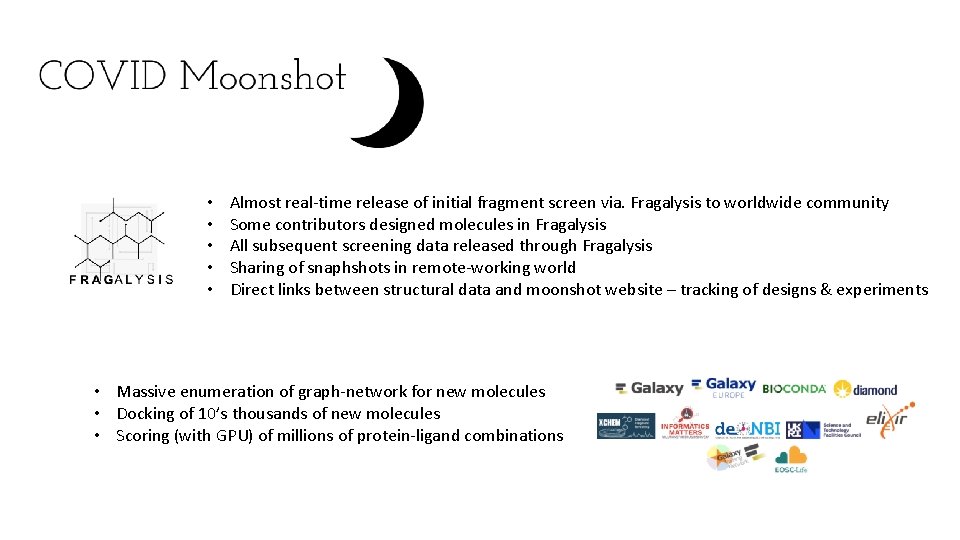
• • • Almost real-time release of initial fragment screen via. Fragalysis to worldwide community Some contributors designed molecules in Fragalysis All subsequent screening data released through Fragalysis Sharing of snaphshots in remote-working world Direct links between structural data and moonshot website – tracking of designs & experiments • Massive enumeration of graph-network for new molecules • Docking of 10’s thousands of new molecules • Scoring (with GPU) of millions of protein-ligand combinations
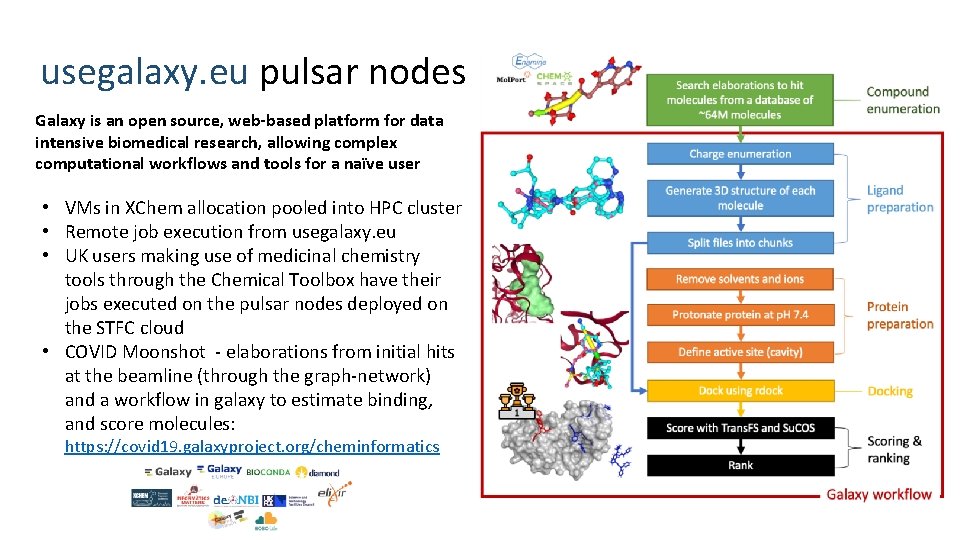
usegalaxy. eu pulsar nodes Galaxy is an open source, web-based platform for data intensive biomedical research, allowing complex computational workflows and tools for a naïve user • VMs in XChem allocation pooled into HPC cluster • Remote job execution from usegalaxy. eu • UK users making use of medicinal chemistry tools through the Chemical Toolbox have their jobs executed on the pulsar nodes deployed on the STFC cloud • COVID Moonshot - elaborations from initial hits at the beamline (through the graph-network) and a workflow in galaxy to estimate binding, and score molecules: https: //covid 19. galaxyproject. org/cheminformatics
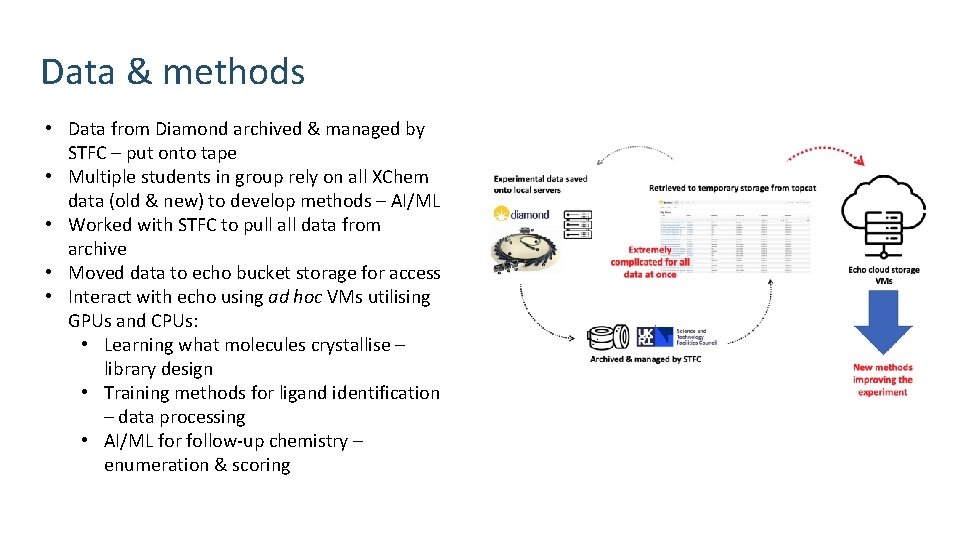
Data & methods • Data from Diamond archived & managed by STFC – put onto tape • Multiple students in group rely on all XChem data (old & new) to develop methods – AI/ML • Worked with STFC to pull all data from archive • Moved data to echo bucket storage for access • Interact with echo using ad hoc VMs utilising GPUs and CPUs: • Learning what molecules crystallise – library design • Training methods for ligand identification – data processing • AI/ML for follow-up chemistry – enumeration & scoring
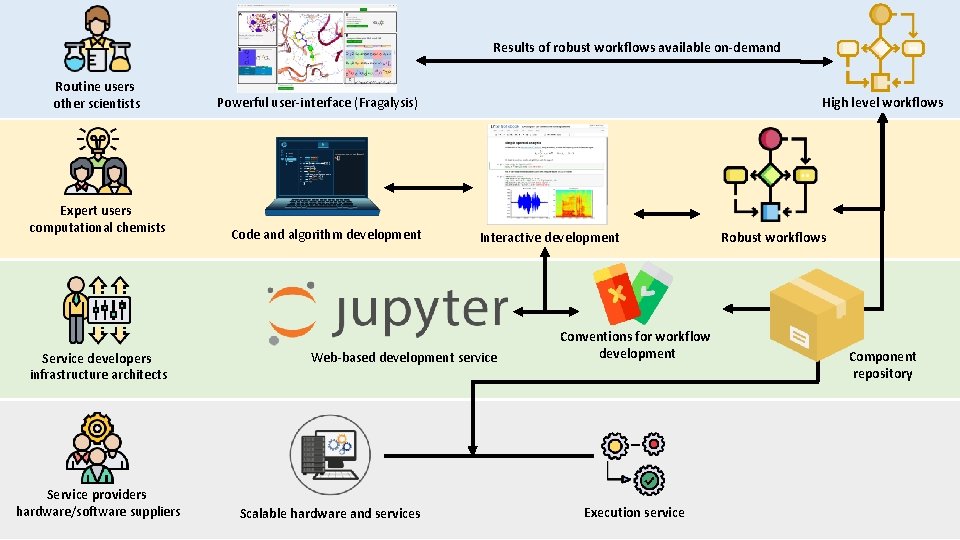
Results of robust workflows available on-demand Routine users other scientists Expert users computational chemists Service developers infrastructure architects Service providers hardware/software suppliers High level workflows Powerful user-interface (Fragalysis) Code and algorithm development Interactive development Web-based development service Scalable hardware and services Conventions for workflow development Execution service Robust workflows Component repository
IRIS to date & Future considerations • IRIS usage by Diamond instrumental in supporting XChem and FRAGALYSIS (Frank von Delft) at present • Work in progress to build more use cases / Po. C’s • • Use cases are varied across accelerator, science, general computing needs for use of cloud. A single approach can not be applied to cloud adoption – but this has resource implications. On-premise cloud deployed to act as local testbed, stepping stone to external cloud services Also, working to adopt ‘cloud’ mentality in-side Diamond for future service provision • IRIS is more than just ‘Cloud’ • Access to more traditional HPC/Other Services? (#def Cloud != Diamond own kit) • Strategy & Capital planning –What do we need and where? • Not always clear what we need. Cloud potentially brings flexibility to service provision. • Diamond needs more compute and associated storage for data processing ‘outside’ of experimental time. (pre and post experiment modelling and processing, simulation) • Diamond will always need onsite data acquisition platforms. But we need to get better at moving workloads elsewhere • If we can get the data somewhere else then why would we keep building more in-house compute facilities? • We need more compute and with it more data centre capacity. BUT, there is a cost and small 1 MW data centres are not ‘green’/sustainable/efficient. Push to be part of a larger campus data centre activity. Strongly support this approach but it will take time • Next 1 to 2 years: • Increase and update in-house capacity for experimental data capture and processing • Move more workloads to the ‘cloud’