Developmental Theory Understanding Eriksons Theory Learning Targets Identify







- Slides: 14
Developmental Theory Understanding Erikson’s Theory
Learning Targets Identify the 8 stages of Erikson’s theory. Explain the positive and negative outcomes of each stage of Erikson’s theory. Summarize Erikson’s theory.
Who is Erikson? n n n A psychologist Developed a way of looking at personality and life-span development Was influenced by Sigmund Freud
Erikson’s Beliefs n n n Personality develops in a predetermined order Saw personality as developing throughout the lifetime Believed that at each stage of development we face an identity crisis
Psychosocial Development Theory n n Eight distinct stages Each stage has two possible outcomes: ¡ ¡ n Successful completion results in a healthy personality and positive interactions with others Failure to complete a stage can result in the inability to complete further stages and an unhealthy personality and sense of self Stages can be resolved successfully at a later time.
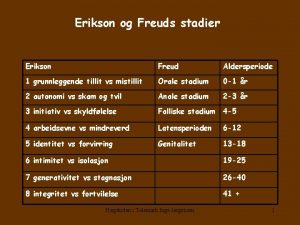
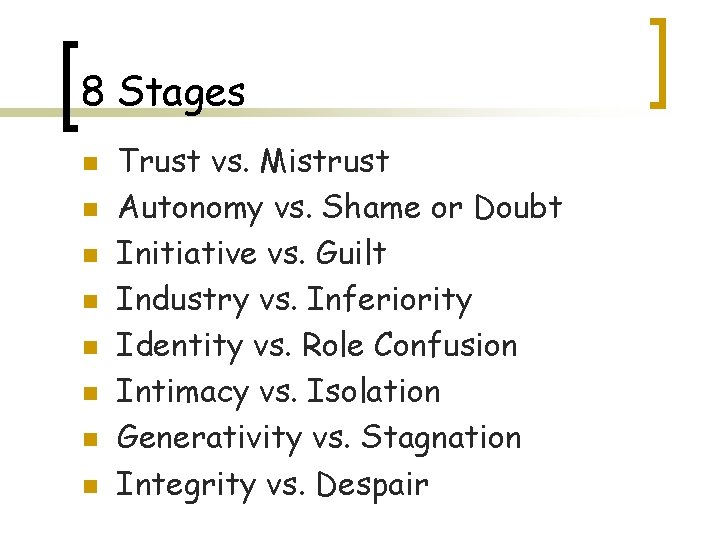
8 Stages n n n n Trust vs. Mistrust Autonomy vs. Shame or Doubt Initiative vs. Guilt Industry vs. Inferiority Identity vs. Role Confusion Intimacy vs. Isolation Generativity vs. Stagnation Integrity vs. Despair
1: Trust vs. Mistrust n n Birth – 1 year (Infancy) Stage Developments ¡ n Positive Outcome ¡ n Learning the ability to trust based upon the consistency of caregivers Trust that allows the child to gain confidence and security in the world Negative Outcome ¡ Inability to trust and a sense of fear about the inconsistent world
2: Autonomy vs. Shame & Doubt n n Ages 1 -3 (Toddler) Stage Developments ¡ Asserting independence Positive Outcome ¡ If supported and encouraged, they become more confident and secure in their own ability to survive in the world Negative Outcome ¡ If criticized or not given the opportunity to assert themselves, they become overly dependent on others, lack self-esteem, and doubt their own abilities
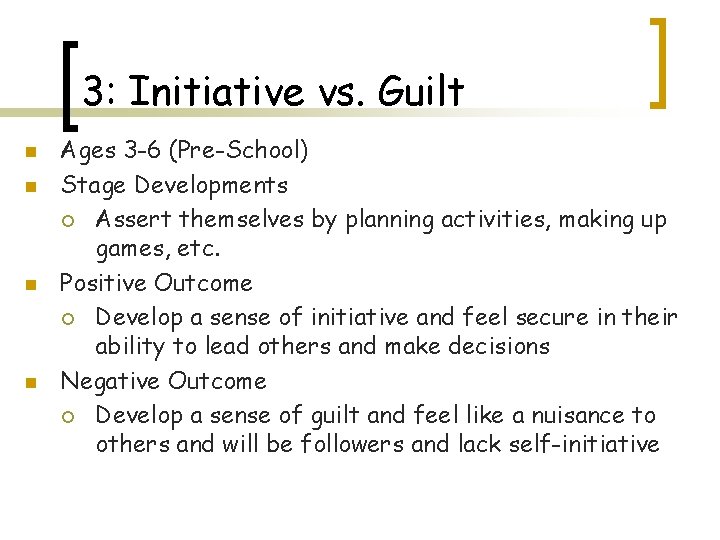
3: Initiative vs. Guilt n n Ages 3 -6 (Pre-School) Stage Developments ¡ Assert themselves by planning activities, making up games, etc. Positive Outcome ¡ Develop a sense of initiative and feel secure in their ability to lead others and make decisions Negative Outcome ¡ Develop a sense of guilt and feel like a nuisance to others and will be followers and lack self-initiative
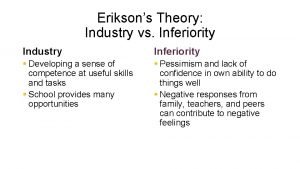
4: Industry vs. Inferiority n n Age 6 -Puberty (Elementary School) Stage Developments ¡ n Positive Outcome ¡ n Developing pride in accomplishments If encouraged and reinforced for initiative, they begin to feel industrious and feel confident in the ability to achieve goals Negative Outcome ¡ Feeling of inferiority, doubt own abilities, and may not reach potential
5: Identity vs. Role Confusion n n Ages 13 -18 (Adolescence) Stage Developments ¡ Transition from childhood to adulthood; becoming more independent Positive Outcome ¡ Explore possibilities for the future and form an identity based on the outcome of their explorations Negative Outcome ¡ Hindered sense of self which results in confusion of self and their role in the world
6: Intimacy vs. Isolation n n Ages 19 -30 (Young Adulthood) Stage Developments ¡ Sharing intimacy with others and exploring relationships Positive Outcome ¡ Comfortable relationships and sense of commitment, safety, and care within a relationship Negative Outcome ¡ Avoiding intimacy, fear of commitment, isolation, loneliness, and depression
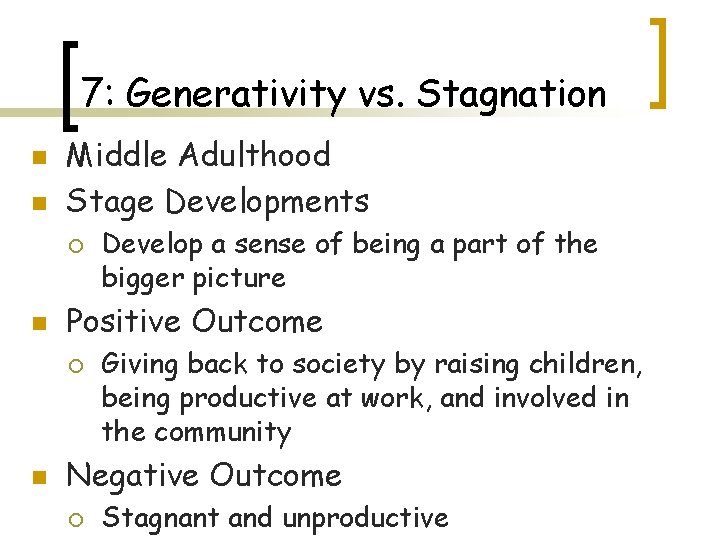
7: Generativity vs. Stagnation n n Middle Adulthood Stage Developments ¡ n Positive Outcome ¡ n Develop a sense of being a part of the bigger picture Giving back to society by raising children, being productive at work, and involved in the community Negative Outcome ¡ Stagnant and unproductive
8: Ego Integrity vs. Despair n n Senior Citizens (Late Adulthood) Stage Developments ¡ Exploration of life as a retired person Positive Outcome ¡ Contemplate accomplishments and develop integrity if you view yourself as leading a successful life Negative Outcome ¡ If you view yourself as unproductive, feel guilt over your past, or feel you did not accomplish goals, you become dissatisfied with life and develop hopelessness and depression