Determining the Chemical Makeup of the Flavoring of



- Slides: 25
Determining the Chemical Make-up of the Flavoring of Coca-Cola and the Degradation of Plastic Bottles Jill Fisher Science Seminar Dr. Heyen, Advisor
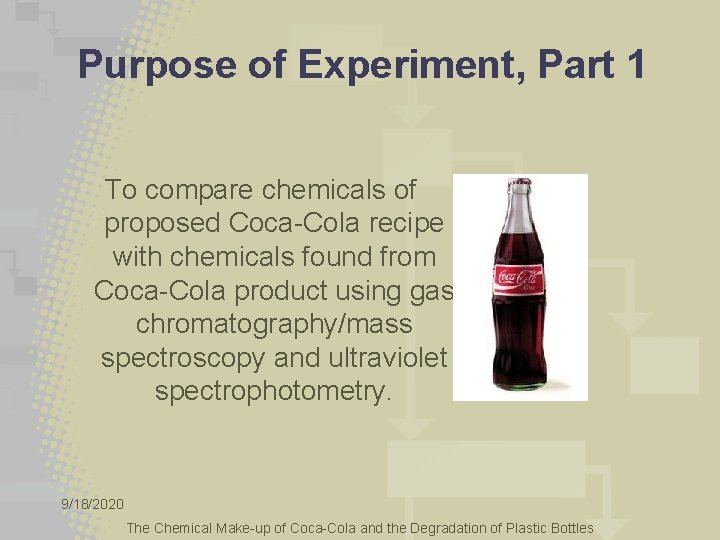
Purpose of Experiment, Part 1 To compare chemicals of proposed Coca-Cola recipe with chemicals found from Coca-Cola product using gas chromatography/mass spectroscopy and ultraviolet spectrophotometry. 9/18/2020 The Chemical Make-up of Coca-Cola and the Degradation of Plastic Bottles
Methods 1. Extract organic compounds with ethyl ether, compare using gas chromatography/mass spectroscopy (GCMS), run spectrum using ultraviolet (UV) spectrophotometer 2. Dilute with methanol, compare using GCMS 3. Dilute with water, run spectrum with UV spectrophotometer 9/18/2020 The Chemical Make-up of Coca-Cola and the Degradation of Plastic Bottles
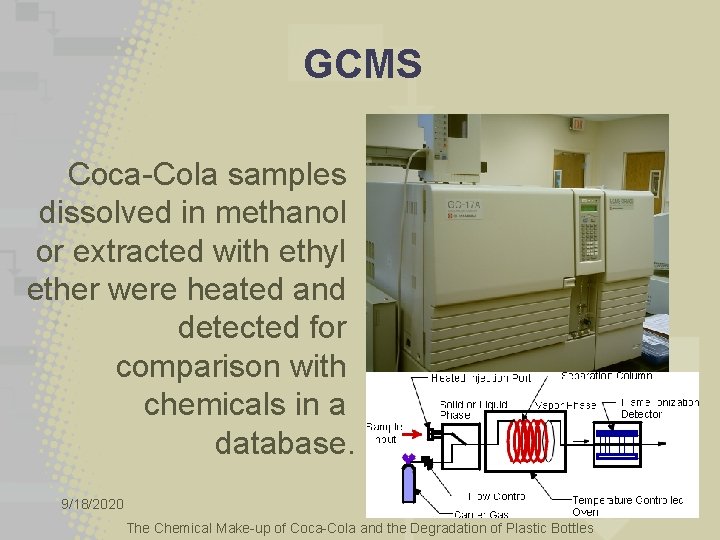
GCMS Coca-Cola samples dissolved in methanol or extracted with ethyl ether were heated and detected for comparison with chemicals in a database. 9/18/2020 The Chemical Make-up of Coca-Cola and the Degradation of Plastic Bottles
9/18/2020 The Chemical Make-up of Coca-Cola and the Degradation of Plastic Bottles
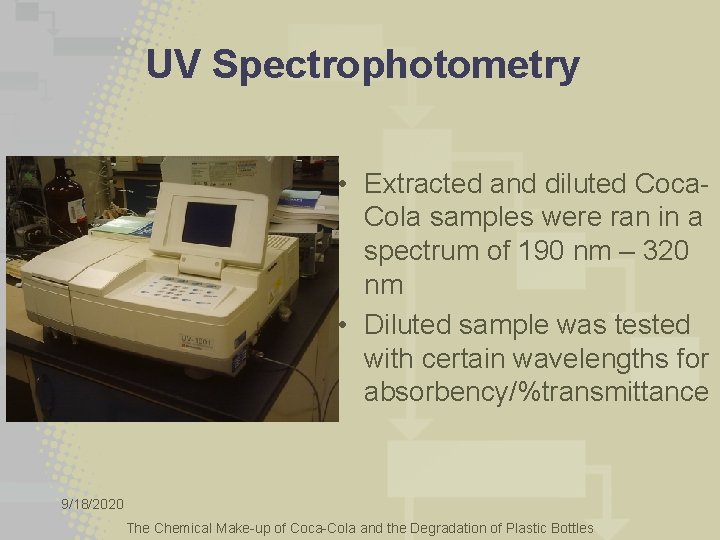
UV Spectrophotometry • Extracted and diluted Coca. Cola samples were ran in a spectrum of 190 nm – 320 nm • Diluted sample was tested with certain wavelengths for absorbency/%transmittance 9/18/2020 The Chemical Make-up of Coca-Cola and the Degradation of Plastic Bottles
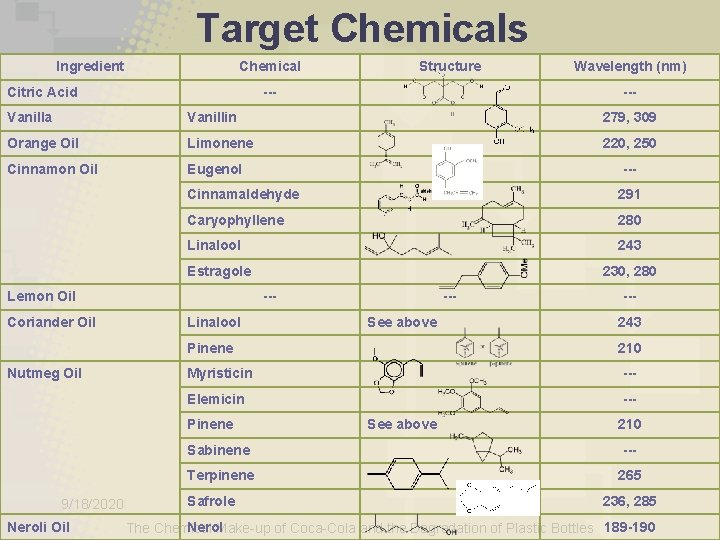
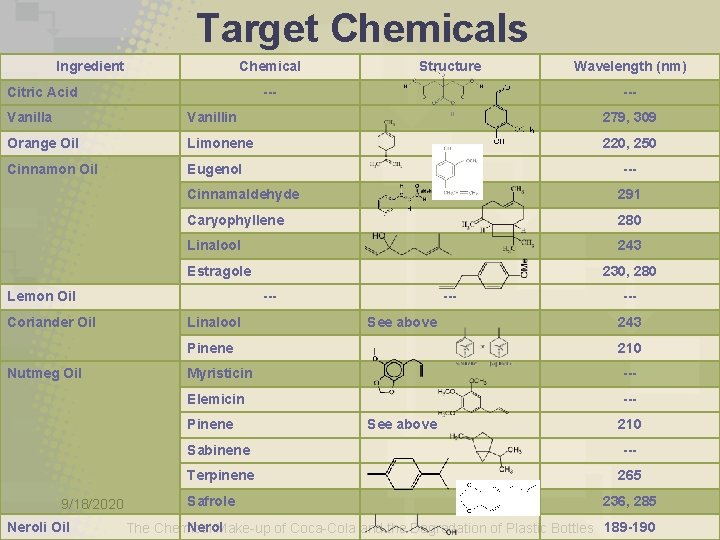
Target Chemicals Ingredient Chemical Citric Acid Structure --- Wavelength (nm) --- Vanilla Vanillin 279, 309 Orange Oil Limonene 220, 250 Cinnamon Oil Eugenol --- Cinnamaldehyde 291 Caryophyllene 280 Linalool 243 Estragole Lemon Oil Coriander Oil 230, 280 --- Linalool --See above Pinene Nutmeg Oil Neroli Oil 243 210 Myristicin --- Elemicin --- Pinene 9/18/2020 --- See above 210 Sabinene --- Terpinene 265 Safrole 236, 285 Nerol. Make-up of Coca-Cola and the Degradation of Plastic Bottles 189 -190 The Chemical
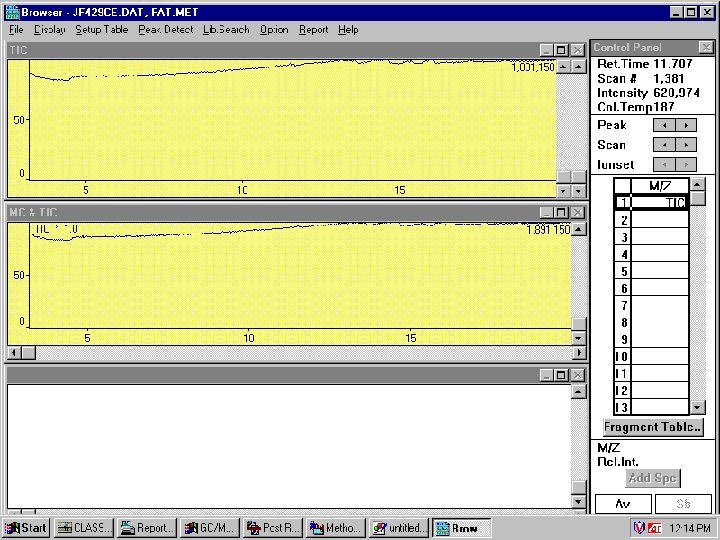
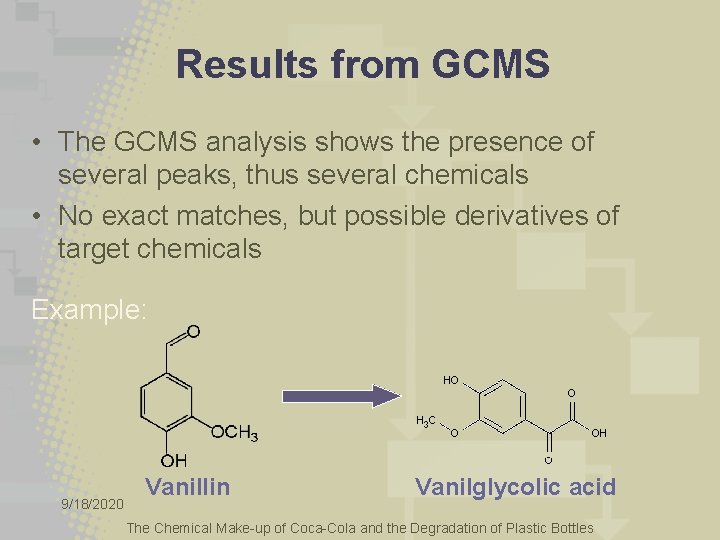
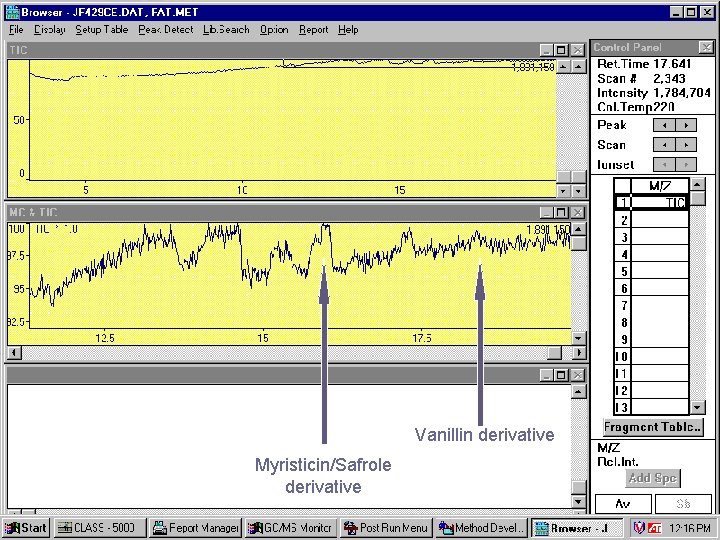
Results from GCMS • The GCMS analysis shows the presence of several peaks, thus several chemicals • No exact matches, but possible derivatives of target chemicals Example: 9/18/2020 Vanillin Vanilglycolic acid The Chemical Make-up of Coca-Cola and the Degradation of Plastic Bottles
9/18/2020 The Chemical Make-up of Coca-Cola and the Degradation of Plastic Bottles
Vanillin derivative Myristicin/Safrole derivative 9/18/2020 The Chemical Make-up of Coca-Cola and the Degradation of Plastic Bottles
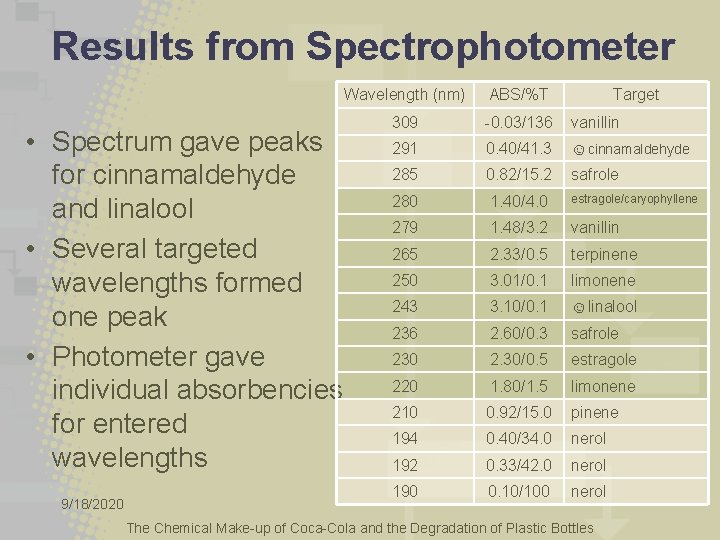
Results from Spectrophotometer • Spectrum gave peaks for cinnamaldehyde and linalool • Several targeted wavelengths formed one peak • Photometer gave individual absorbencies for entered wavelengths 9/18/2020 Wavelength (nm) ABS/%T Target 309 -0. 03/136 vanillin 291 0. 40/41. 3 ☺cinnamaldehyde 285 0. 82/15. 2 safrole 280 1. 40/4. 0 estragole/caryophyllene 279 1. 48/3. 2 vanillin 265 2. 33/0. 5 terpinene 250 3. 01/0. 1 limonene 243 3. 10/0. 1 ☺linalool 236 2. 60/0. 3 safrole 230 2. 30/0. 5 estragole 220 1. 80/1. 5 limonene 210 0. 92/15. 0 pinene 194 0. 40/34. 0 nerol 192 0. 33/42. 0 nerol 190 0. 10/100 nerol The Chemical Make-up of Coca-Cola and the Degradation of Plastic Bottles
Target Chemicals Ingredient Chemical Citric Acid Structure --- Wavelength (nm) --- Vanilla Vanillin 279, 309 Orange Oil Limonene 220, 250 Cinnamon Oil Eugenol --- Cinnamaldehyde 291 Caryophyllene 280 Linalool 243 Estragole Lemon Oil Coriander Oil 230, 280 --- Linalool --See above Pinene Nutmeg Oil Neroli Oil 243 210 Myristicin --- Elemicin --- Pinene 9/18/2020 --- See above 210 Sabinene --- Terpinene 265 Safrole 236, 285 Nerol. Make-up of Coca-Cola and the Degradation of Plastic Bottles 189 -190 The Chemical
Conclusions • The secret flavoring of Coca-Cola does include citric acid, vanilla, and cinnamon oil. • Coriander and nutmeg oil have a high possibility of being included. • Recipe may have changed over the decades. 9/18/2020 The Chemical Make-up of Coca-Cola and the Degradation of Plastic Bottles
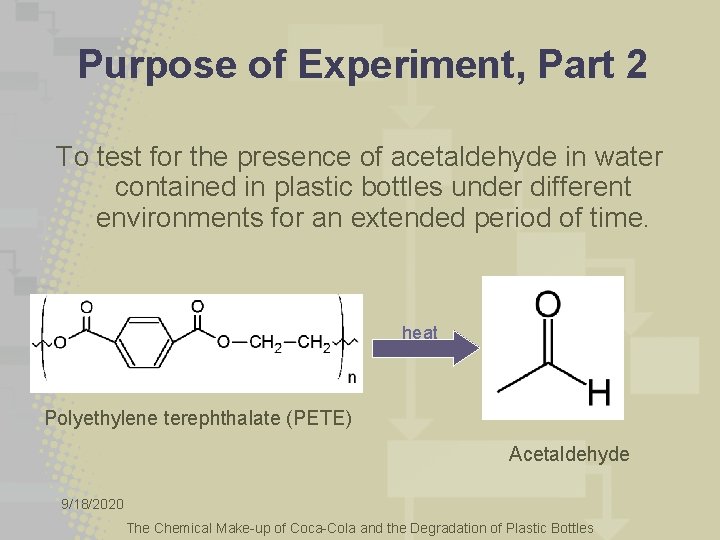
Purpose of Experiment, Part 2 To test for the presence of acetaldehyde in water contained in plastic bottles under different environments for an extended period of time. heat Polyethylene terephthalate (PETE) Acetaldehyde 9/18/2020 The Chemical Make-up of Coca-Cola and the Degradation of Plastic Bottles
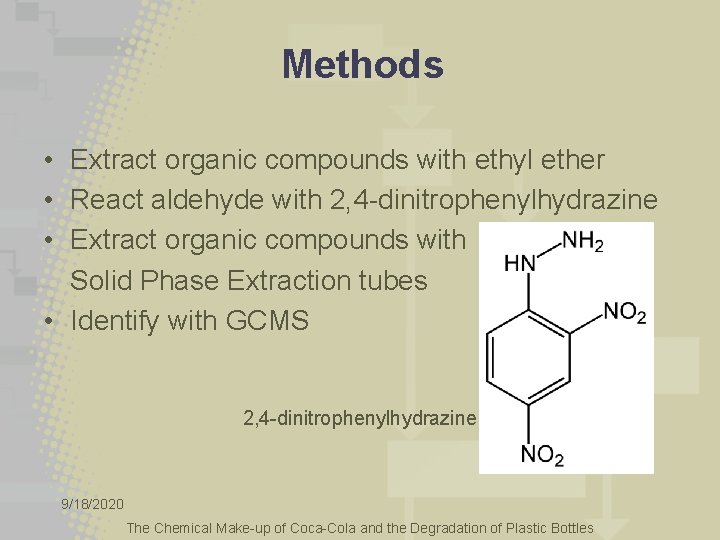
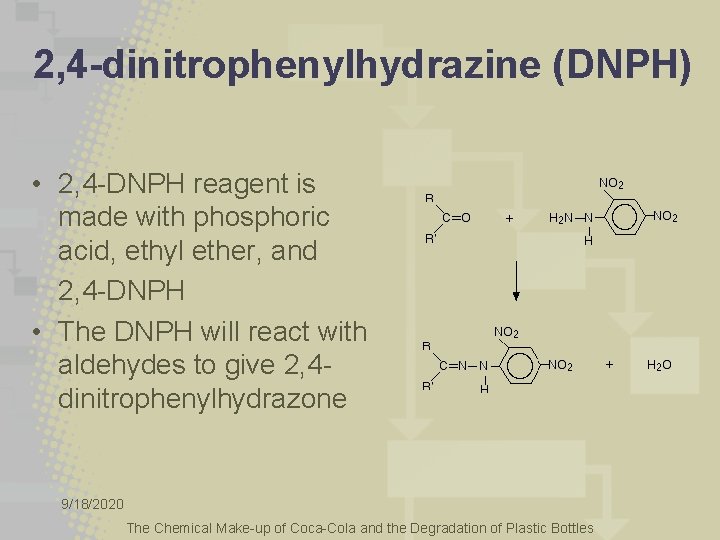
Methods • Extract organic compounds with ethyl ether • React aldehyde with 2, 4 -dinitrophenylhydrazine • Extract organic compounds with Solid Phase Extraction tubes • Identify with GCMS 2, 4 -dinitrophenylhydrazine 9/18/2020 The Chemical Make-up of Coca-Cola and the Degradation of Plastic Bottles
2, 4 -dinitrophenylhydrazine (DNPH) • 2, 4 -DNPH reagent is made with phosphoric acid, ethyl ether, and 2, 4 -DNPH • The DNPH will react with aldehydes to give 2, 4 dinitrophenylhydrazone 9/18/2020 The Chemical Make-up of Coca-Cola and the Degradation of Plastic Bottles
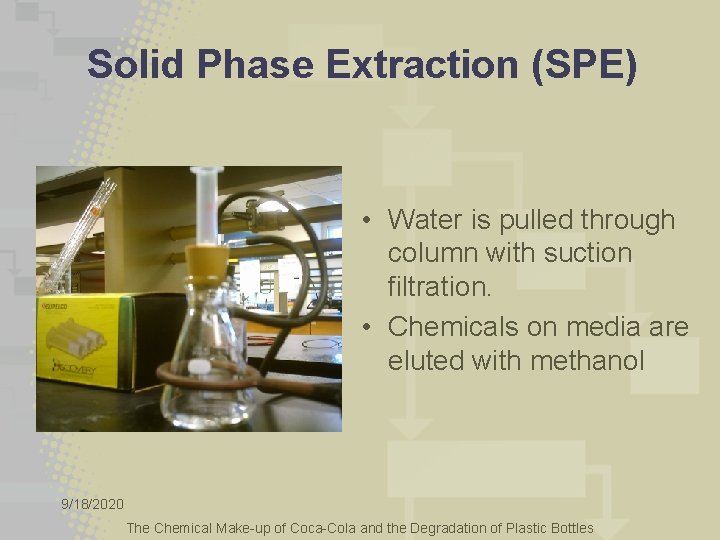
Solid Phase Extraction (SPE) • Water is pulled through column with suction filtration. • Chemicals on media are eluted with methanol 9/18/2020 The Chemical Make-up of Coca-Cola and the Degradation of Plastic Bottles
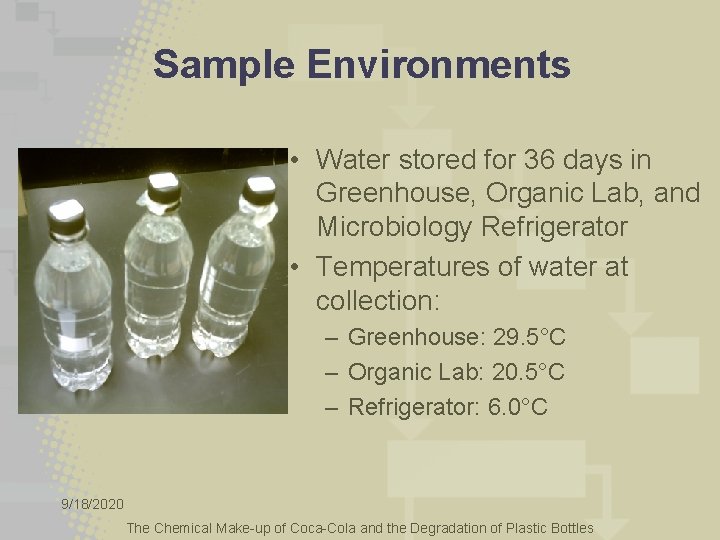
Sample Environments • Water stored for 36 days in Greenhouse, Organic Lab, and Microbiology Refrigerator • Temperatures of water at collection: – Greenhouse: 29. 5°C – Organic Lab: 20. 5°C – Refrigerator: 6. 0°C 9/18/2020 The Chemical Make-up of Coca-Cola and the Degradation of Plastic Bottles
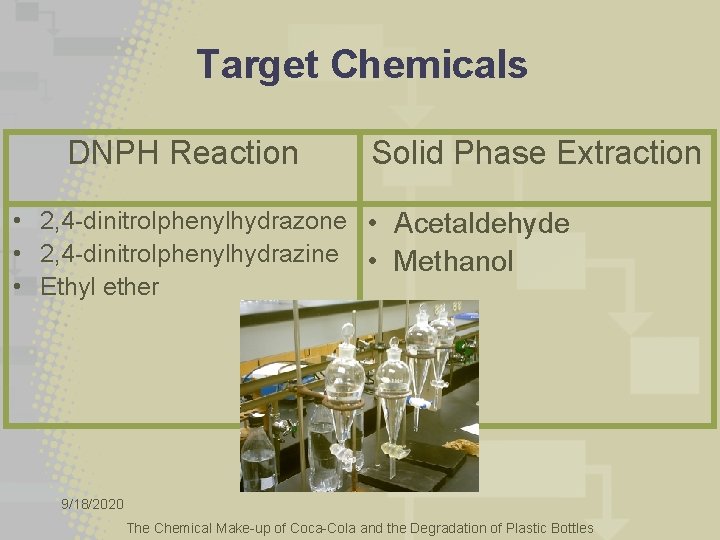
Target Chemicals DNPH Reaction Solid Phase Extraction • 2, 4 -dinitrolphenylhydrazone • Acetaldehyde • 2, 4 -dinitrolphenylhydrazine • Methanol • Ethyl ether 9/18/2020 The Chemical Make-up of Coca-Cola and the Degradation of Plastic Bottles
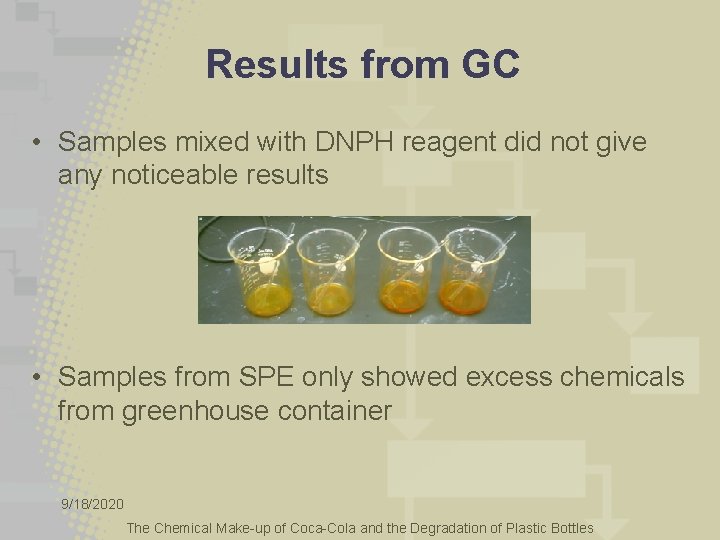
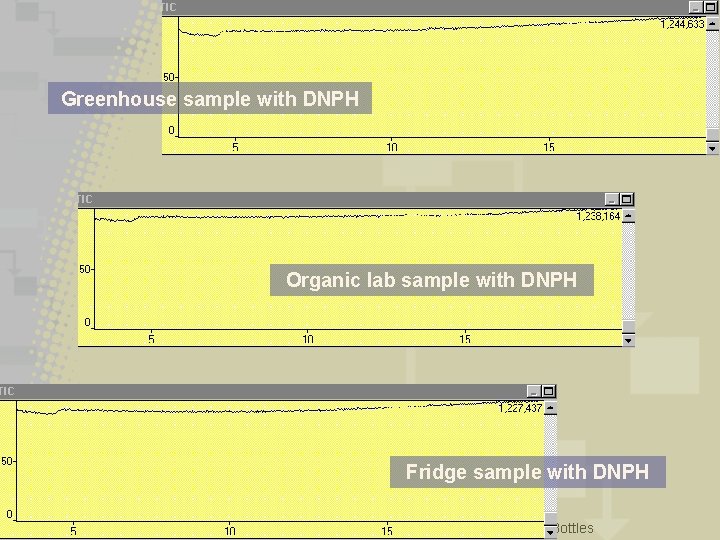
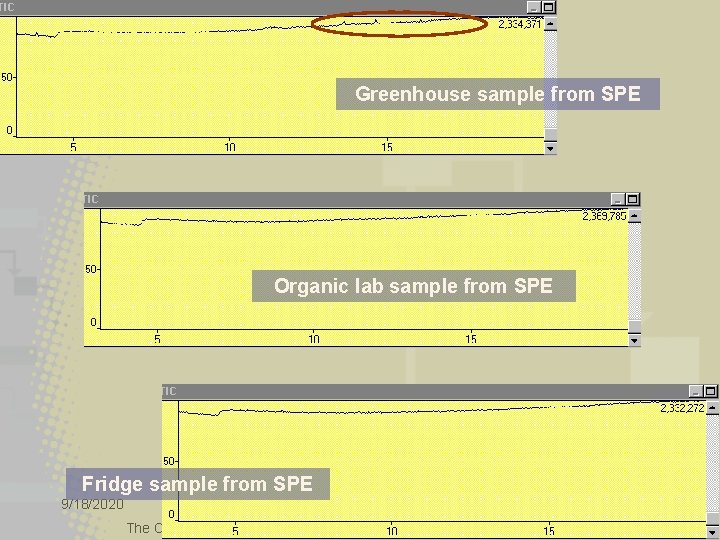
Results from GC • Samples mixed with DNPH reagent did not give any noticeable results • Samples from SPE only showed excess chemicals from greenhouse container 9/18/2020 The Chemical Make-up of Coca-Cola and the Degradation of Plastic Bottles
Greenhouse sample with DNPH Organic lab sample with DNPH Fridge sample with DNPH 9/18/2020 The Chemical Make-up of Coca-Cola and the Degradation of Plastic Bottles
Greenhouse sample from SPE Organic lab sample from SPE Fridge sample from SPE 9/18/2020 The Chemical Make-up of Coca-Cola and the Degradation of Plastic Bottles
Conclusion • The DNPH did not show the presence of acetaldehyde. • The SPE did show a presence of a larger compound, perhaps from the PETE or from the silica gel matrix. 9/18/2020 The Chemical Make-up of Coca-Cola and the Degradation of Plastic Bottles
Acknowledgements and Thanks to Dr. Heyen for being my advisor and helping with the equipment and procedure. Thanks to Diane Soldan and Caleb Mason for chugging Coca-Cola. 9/18/2020 The Chemical Make-up of Coca-Cola and the Degradation of Plastic Bottles
Sources 2, 4 -dinitrophenylhydrazine. Wikipedia Free Encyclopedia. http: //en. wikipedia. org/wiki/2%2 C 4 -dinitrophenylhydrazine Acetaldehyde. Wikipedia Free Encyclopedia. http: //en. wikipedia. org/wiki/Acetaldehyde Cinnamon. Wikipedia Free Encyclopedia. http: //en. wikipedia. org/wiki/Cinnamon Coca-Cola. Wikipedia Free Encyclopedia. http: //en. wikipedia. org/wiki/Coca-Cola_formula Coriander. Wikipedia Free Encyclopedia. http: //en. wikipedia. org/wiki/Coriander Neroli. Wikipedia Free Encyclopedia. http: //en. wikipedia. org/wiki/Neroli Nutmeg. Wikipedia Free Encyclopedia. http: //en. wikipedia. org/wiki/Nutmeg Orange Oil. Wikipedia Free Encyclopedia. http: //en. wikipedia. org/wiki/Orange_oil Polyethylene Terephthalate. Wikipedia Free Encyclopedia. http: //en. wikipedia. org/wiki/Polyethylene_terephthalate The Coca-Cola Recipe. Soda Museum. http: //www. sodamuseum. bigstep. com/generic. jhtml? pid=10 The Safety of Convenience-Size Plastic Beverage Bottles. Plastics Info. http: //www. plasticsinfo. org/beveragebottles/apc_faqs. html Van Aardt, Marleen. “Effect of Shelf-Life and Light Exposure on Acetaldehyde Concentration in Milk Packaged in HDPE and PETE Bottles. ” Virginia Polytechnic Institute and State University, 2000. Vanilla. Wikipedia Free Encyclopedia. http: //en. wikipedia. org/wiki/Vanilla Weast, Robert C, ed. CRC Handbook of Chemistry and Physics. 57 th Ed. Cleveland: CRC Press, 1976. Williamson, Kenneth. Macroscale and Microscale Organic Experiments. 3 rd Ed. Boston: Houghton Mifflin, 1999. Zubrick, James W. The Organic Chem Lab Survival Manual. New Jersey: John Wiley & Sons, Inc. 2004. 9/18/2020 The Chemical Make-up of Coca-Cola and the Degradation of Plastic Bottles