Determination of the gluon polarisation in experiment CERN
- Slides: 19
Determination of the gluon polarisation in experiment @ CERN Adam Mielech, INFN Trieste on behalf of the COMPASS collaboration
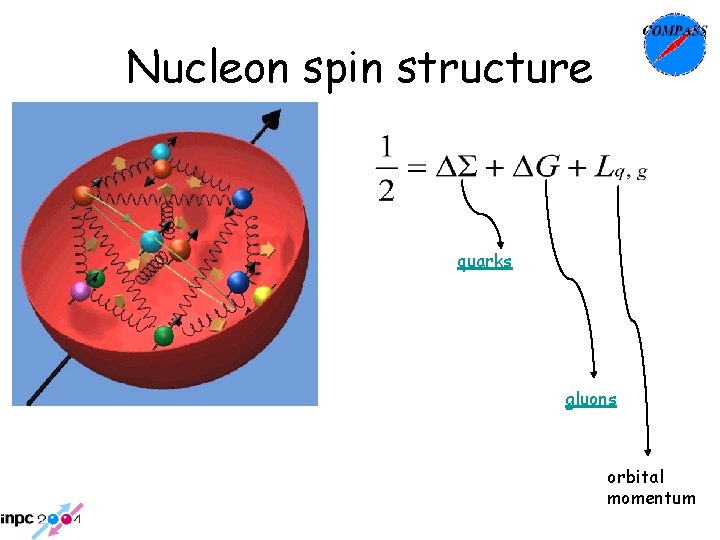
Nucleon spin structure quarks gluons orbital momentum
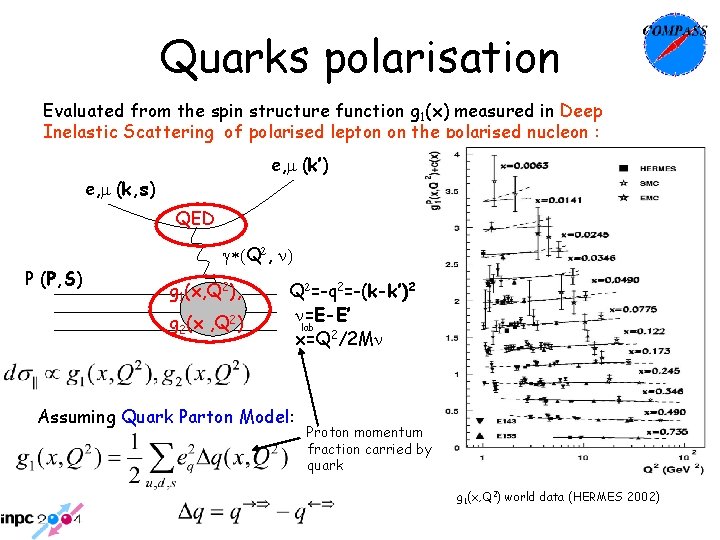
Quarks polarisation Evaluated from the spin structure function g 1(x) measured in Deep Inelastic Scattering of polarised lepton on the polarised nucleon : e, m (k’) e, m (k, s) QED P (P, S) g*(Q 2, n) g 1(x, Q 2), g 2(x , Q 2) Q 2=-q 2=-(k-k’)2 n=E-E’ lab x=Q 2/2 Mn Assuming Quark Parton Model: Proton momentum fraction carried by quark g 1(x, Q 2) world data (HERMES 2002)
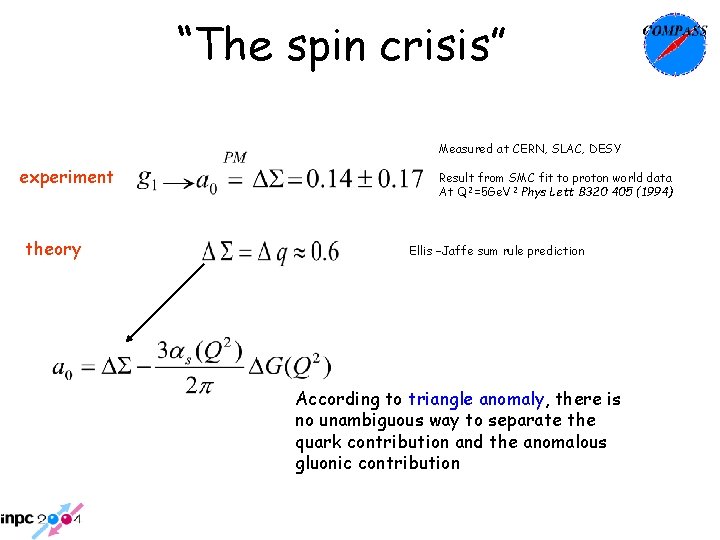
“The spin crisis” Measured at CERN, SLAC, DESY experiment theory Result from SMC fit to proton world data At Q 2 =5 Ge. V 2 Phys Lett B 320 405 (1994) Ellis –Jaffe sum rule prediction According to triangle anomaly, there is no unambiguous way to separate the quark contribution and the anomalous gluonic contribution
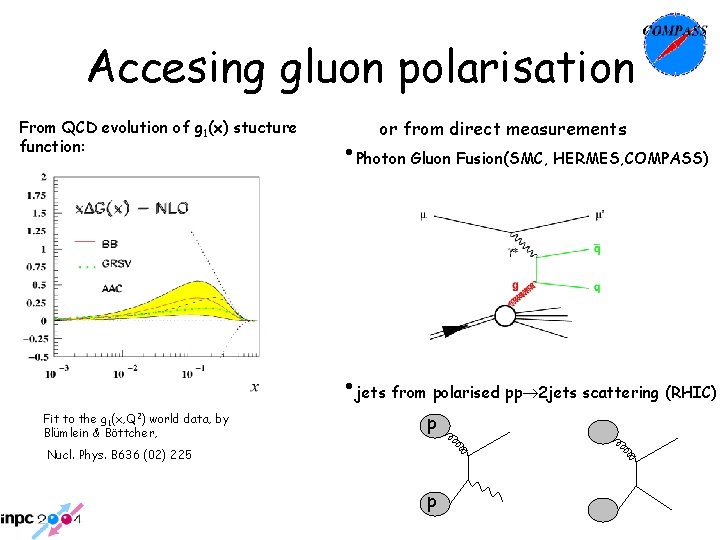
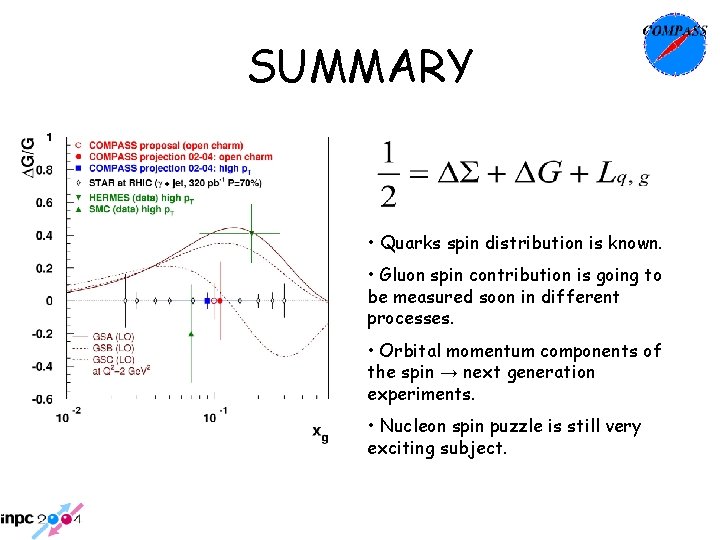
Accesing gluon polarisation From QCD evolution of g 1(x) stucture function: or from direct measurements • Photon Gluon Fusion(SMC, HERMES, COMPASS) • jets from polarised pp 2 jets scattering (RHIC) Fit to the g 1(x, Q 2) world data, by Blümlein & Böttcher, p Nucl. Phys. B 636 (02) 225 p
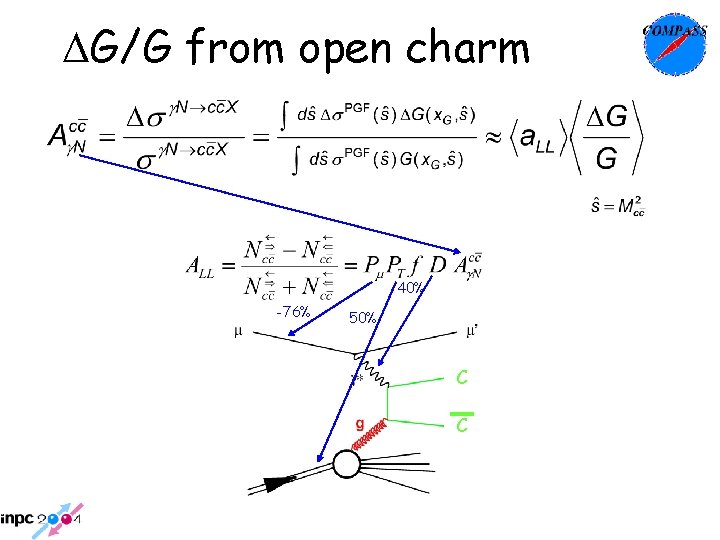
DG/G from open charm 40% -76% 50% C C
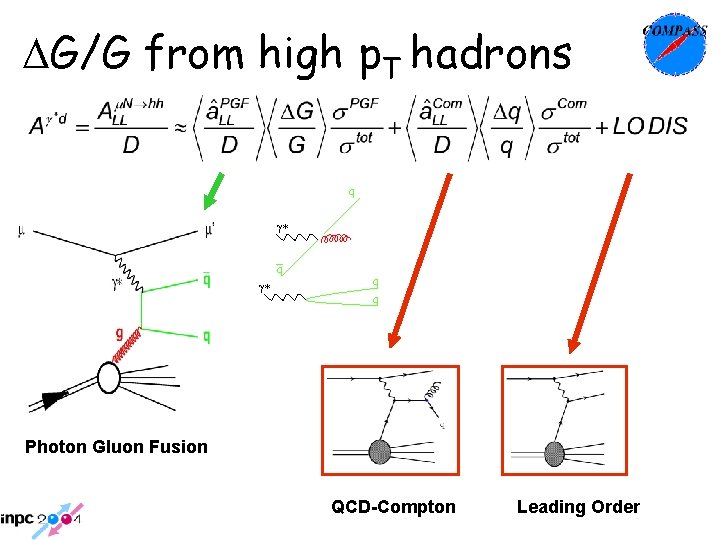
DG/G from high p. T hadrons q g* q q Photon Gluon Fusion QCD-Compton Leading Order
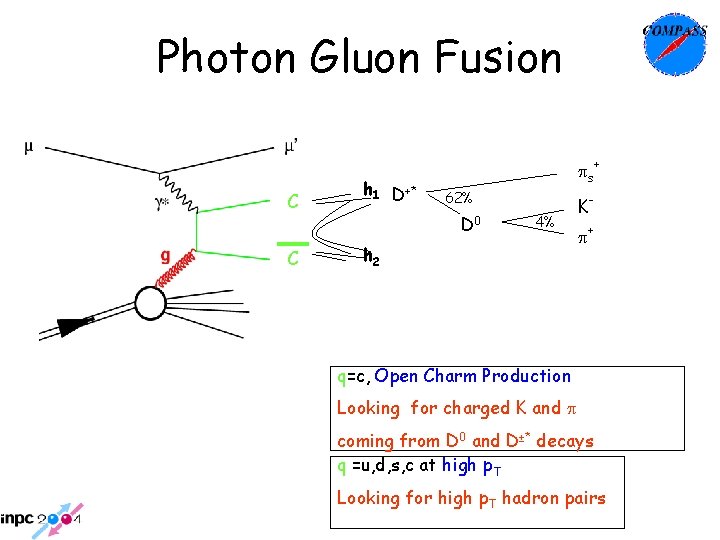
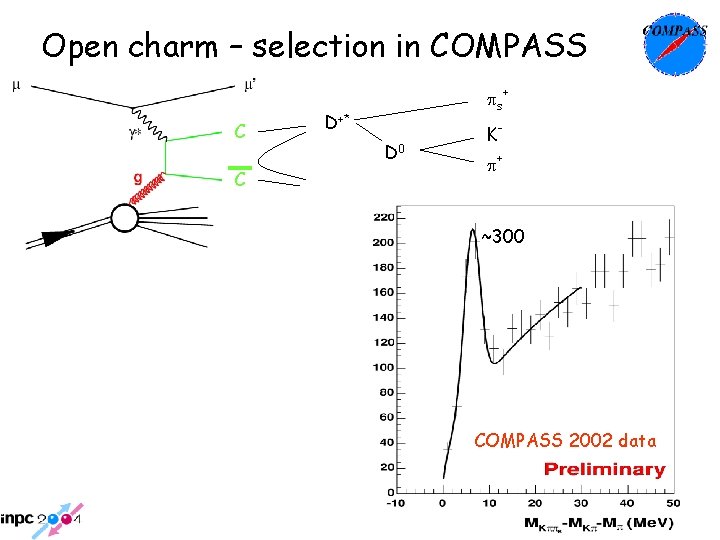
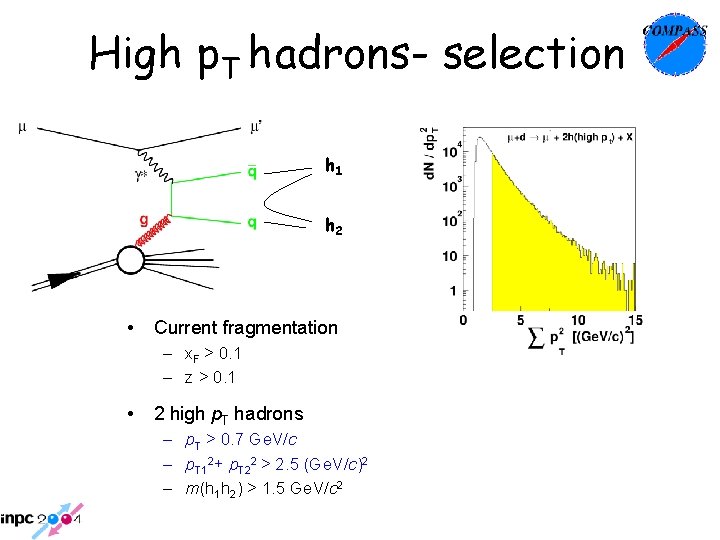
Photon Gluon Fusion C C h 1 D+* ps+ 62% D 0 4% h 2 Kp+ q=c, Open Charm Production Looking for charged K and p coming from D 0 and D±* decays q =u, d, s, c at high p. T Looking for high p. T hadron pairs
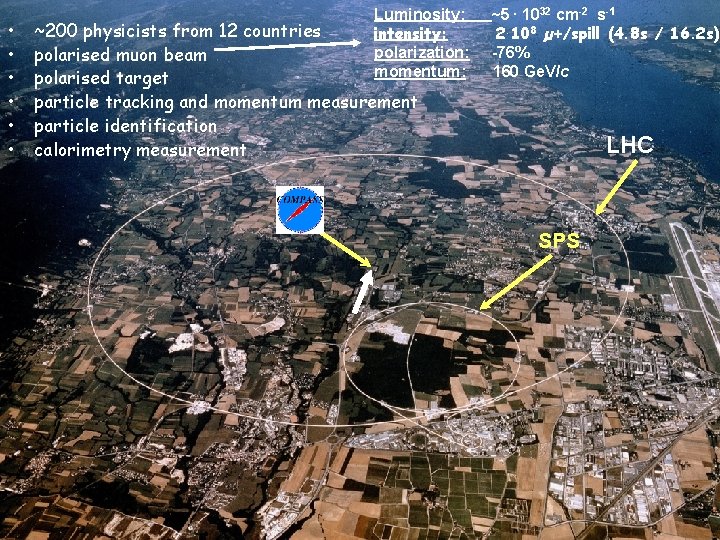
• • • Luminosity: intensity: polarization: momentum: ~200 physicists from 12 countries polarised muon beam polarised target particle tracking and momentum measurement particle identification calorimetry measurement Localisation ~5. 1032 cm-2 s-1 2. 108 µ+/spill (4. 8 s / 16. 2 s) -76% 160 Ge. V/c LHC SPS N
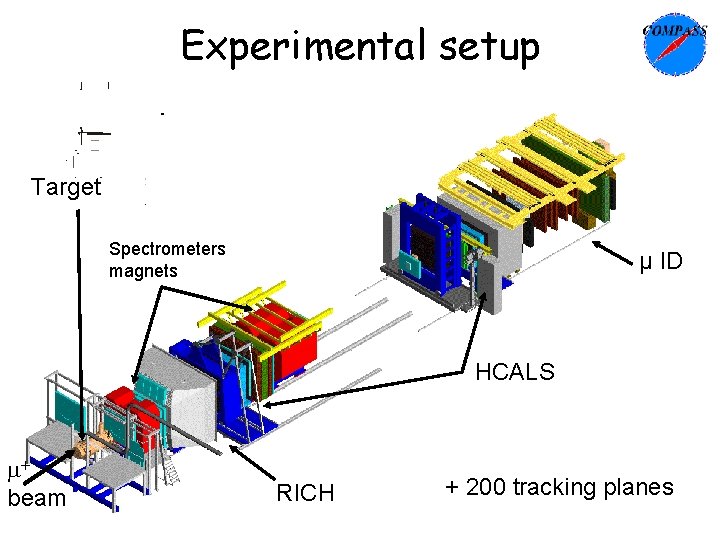
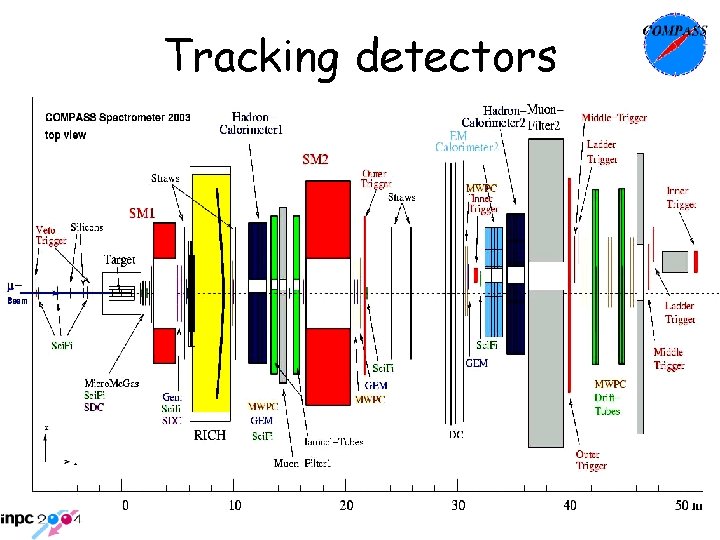
Experimental setup Target Spectrometers magnets μ ID HCALS m+ beam RICH + 200 tracking planes
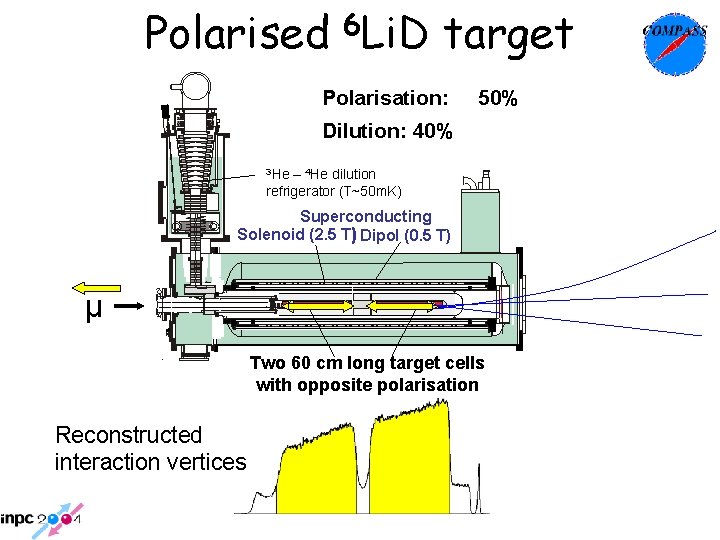
Polarised 6 Li. D target Polarisation: 50% Dilution: 40% 3 He – 4 He dilution refrigerator (T~50 m. K) Superconducting Solenoid (2. 5 T) Dipol (0. 5 T) μ Two 60 cm long target cells with opposite polarisation Reconstructed interaction vertices
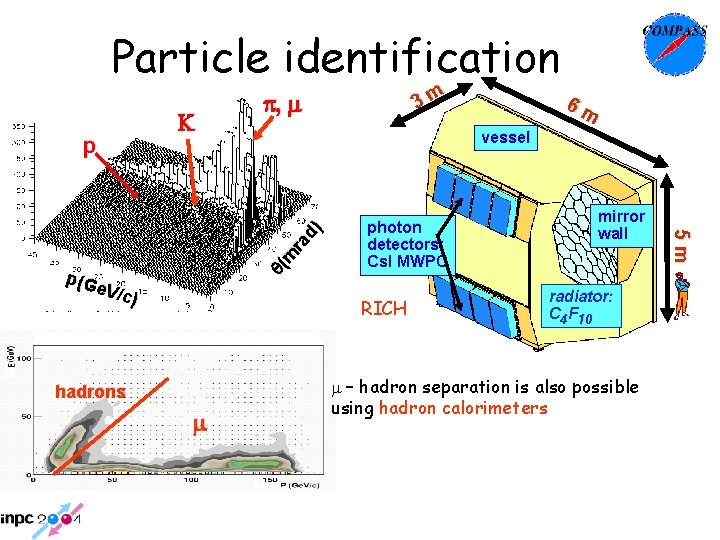
Particle identification photon detectors: Cs. I MWPC RICH hadrons m mirror wall radiator: C 4 F 10 m – hadron separation is also possible using hadron calorimeters 5 m p(G e. V/c ) 6 m vessel q( m ra d) p K 3 m p, m
Tracking detectors
Open charm – selection in COMPASS C C ps+ D+* D 0 Kp+ ~300 COMPASS 2002 data
High p. T hadrons- selection h 1 h 2 • Current fragmentation – x. F > 0. 1 – z > 0. 1 • 2 high p. T hadrons – p. T > 0. 7 Ge. V/c – p. T 12+ p. T 22 > 2. 5 (Ge. V/c)2 – m(h 1 h 2) > 1. 5 Ge. V/c 2
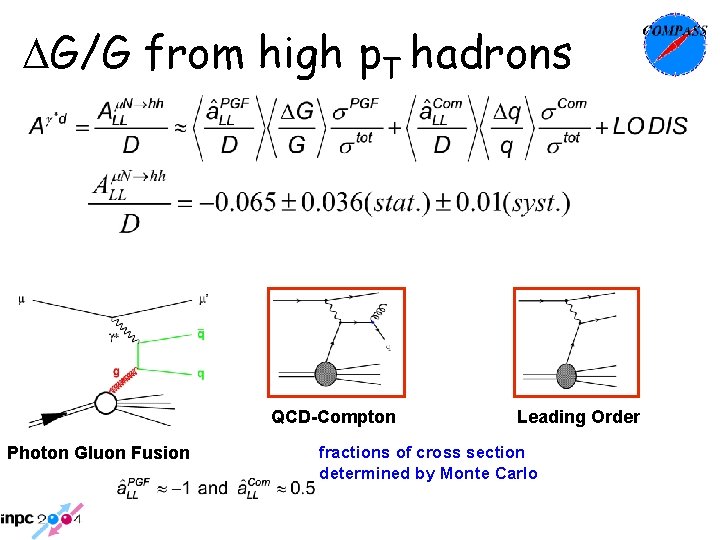
DG/G from high p. T hadrons QCD-Compton Photon Gluon Fusion Leading Order fractions of cross section determined by Monte Carlo
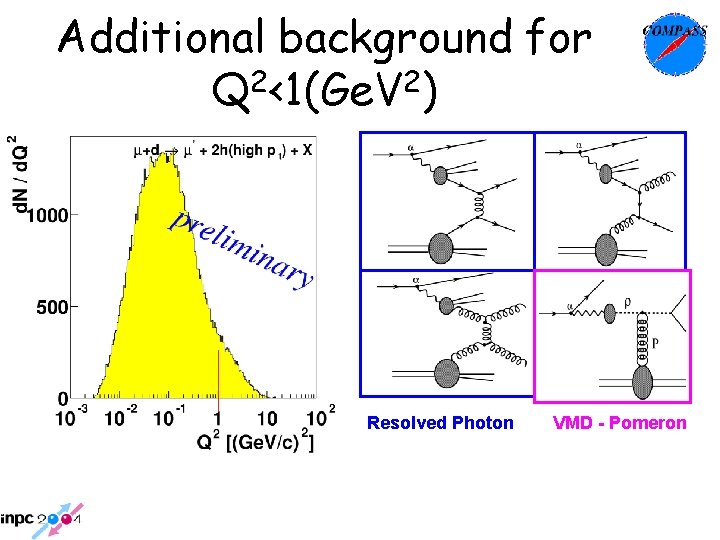
Additional background for 2 2 Q <1(Ge. V ) Resolved Photon VMD - Pomeron
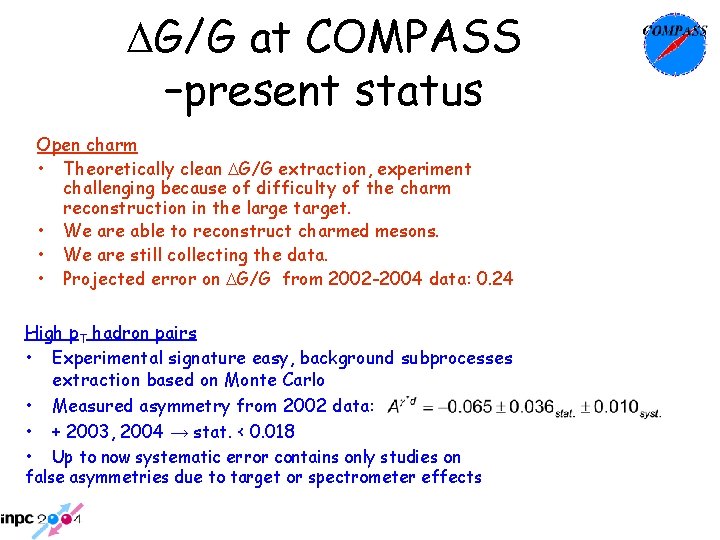
DG/G at COMPASS –present status Open charm • Theoretically clean DG/G extraction, experiment challenging because of difficulty of the charm reconstruction in the large target. • We are able to reconstruct charmed mesons. • We are still collecting the data. • Projected error on DG/G from 2002 -2004 data: 0. 24 High p. T hadron pairs • Experimental signature easy, background subprocesses extraction based on Monte Carlo • Measured asymmetry from 2002 data: • + 2003, 2004 → stat. < 0. 018 • Up to now systematic error contains only studies on false asymmetries due to target or spectrometer effects
SUMMARY • Quarks spin distribution is known. • Gluon spin contribution is going to be measured soon in different processes. • Orbital momentum components of the spin → next generation experiments. • Nucleon spin puzzle is still very exciting subject.