Det Net Configuration YANG Model draftgengdetnetconfyang01 Xuesong Geng
- Slides: 11
Det. Net Configuration YANG Model draft-geng-detnet-conf-yang-01 Xuesong Geng (gengxuesong@huawei. com) Mach Chen (mach. chen@huawei. com) Zhenqiang Li (lizhengqiang@chinamobile. com) Reshad Rahman(rrahman@cisco. com) 1
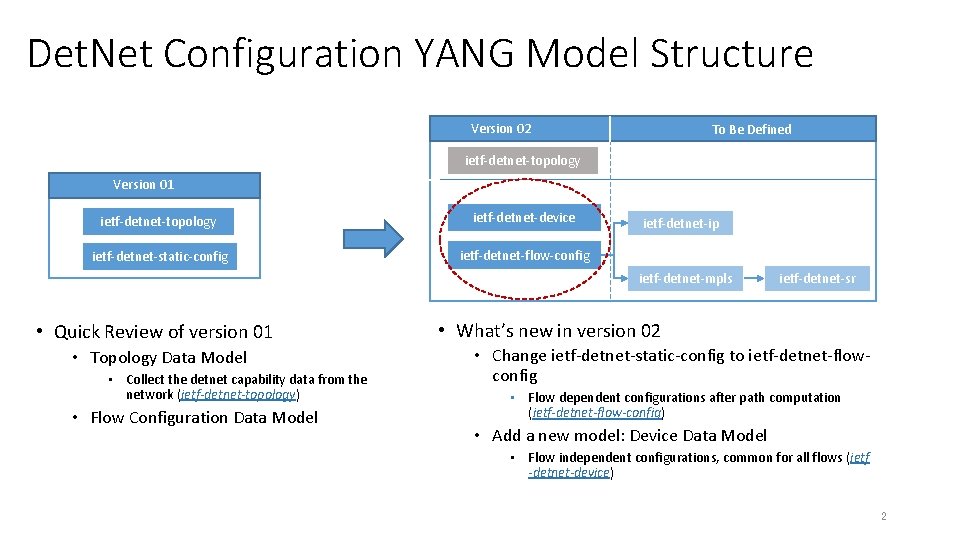
Det. Net Configuration YANG Model Structure Version 02 To Be Defined ietf-detnet-topology Version 01 ietf-detnet-topology ietf-detnet-device ietf-detnet-static-config ietf-detnet-flow-config ietf-detnet-ip ietf-detnet-mpls • Quick Review of version 01 • Topology Data Model • Collect the detnet capability data from the network (ietf-detnet-topology) • Flow Configuration Data Model ietf-detnet-sr • What’s new in version 02 • Change ietf-detnet-static-config to ietf-detnet-flowconfig • Flow dependent configurations after path computation (ietf-detnet-flow-config) • Add a new model: Device Data Model • Flow independent configurations, common for all flows (ietf -detnet-device) 2
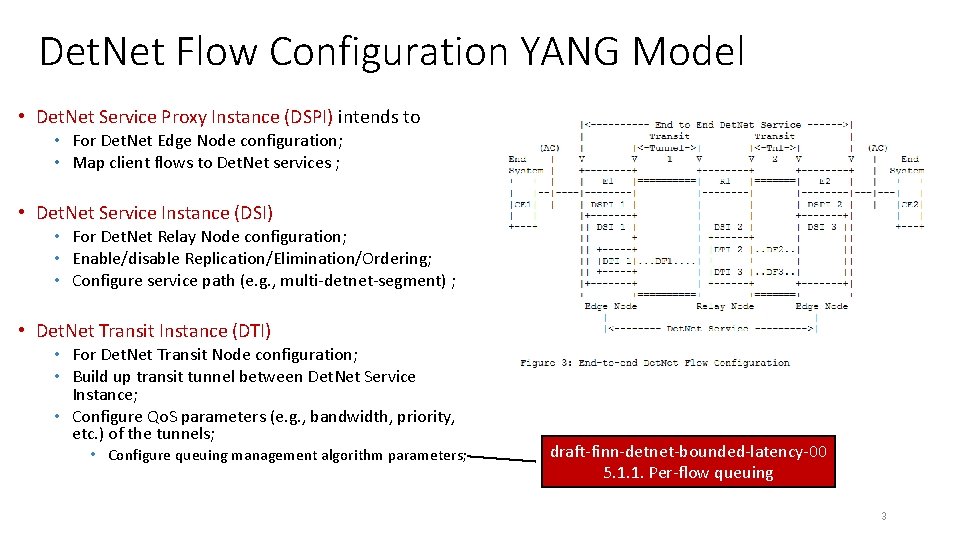
Det. Net Flow Configuration YANG Model • Det. Net Service Proxy Instance (DSPI) intends to • For Det. Net Edge Node configuration; • Map client flows to Det. Net services ; • Det. Net Service Instance (DSI) • For Det. Net Relay Node configuration; • Enable/disable Replication/Elimination/Ordering; • Configure service path (e. g. , multi-detnet-segment) ; • Det. Net Transit Instance (DTI) • For Det. Net Transit Node configuration; • Build up transit tunnel between Det. Net Service Instance; • Configure Qo. S parameters (e. g. , bandwidth, priority, etc. ) of the tunnels; • Configure queuing management algorithm parameters; draft-finn-detnet-bounded-latency-00 5. 1. 1. Per-flow queuing 3
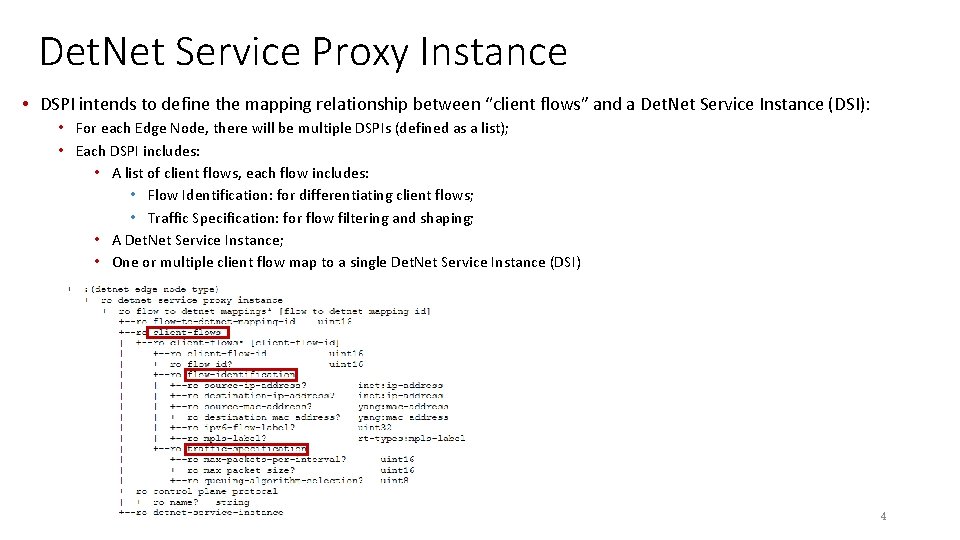
Det. Net Service Proxy Instance • DSPI intends to define the mapping relationship between “client flows” and a Det. Net Service Instance (DSI): • For each Edge Node, there will be multiple DSPIs (defined as a list); • Each DSPI includes: • A list of client flows, each flow includes: • Flow Identification: for differentiating client flows; • Traffic Specification: for flow filtering and shaping; • A Det. Net Service Instance; • One or multiple client flow map to a single Det. Net Service Instance (DSI) 4
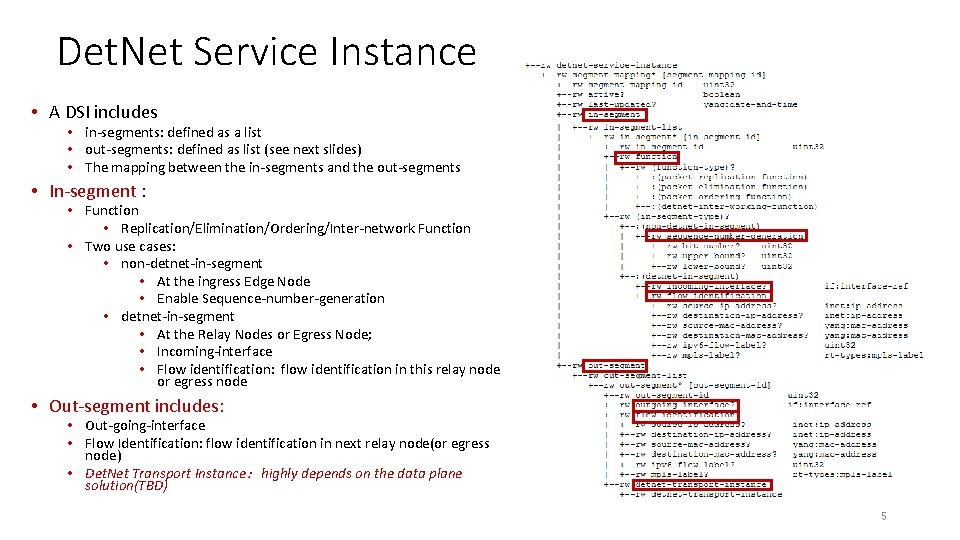
Det. Net Service Instance • A DSI includes • in-segments: defined as a list • out-segments: defined as list (see next slides) • The mapping between the in-segments and the out-segments • In-segment : • Function • Replication/Elimination/Ordering/Inter-network Function • Two use cases: • non-detnet-in-segment • At the ingress Edge Node • Enable Sequence-number-generation • detnet-in-segment • At the Relay Nodes or Egress Node; • Incoming-interface • Flow identification: flow identification in this relay node or egress node • Out-segment includes: • Out-going-interface • Flow Identification: flow identification in next relay node(or egress node) • Det. Net Transport Instance:highly depends on the data plane solution(TBD) 5
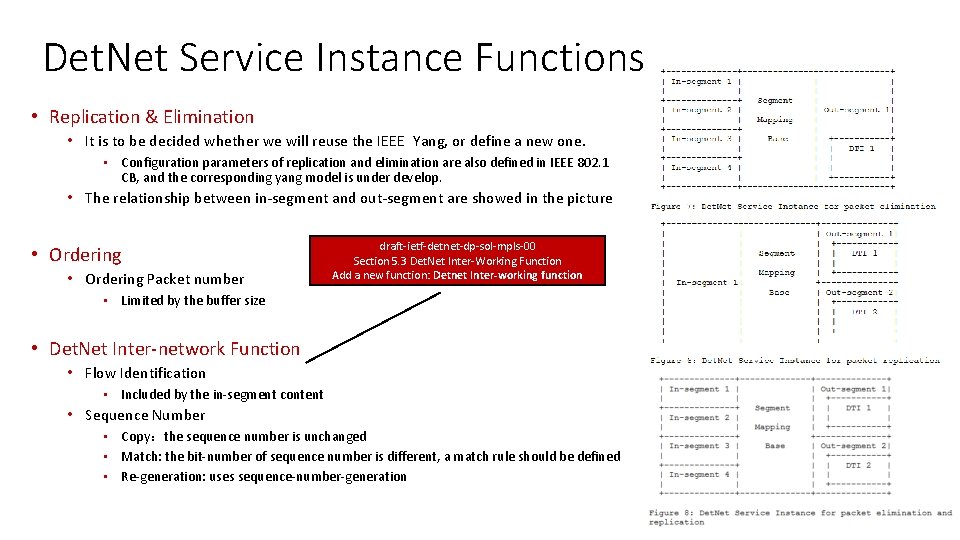
Det. Net Service Instance Functions • Replication & Elimination • It is to be decided whether we will reuse the IEEE Yang, or define a new one. • Configuration parameters of replication and elimination are also defined in IEEE 802. 1 CB, and the corresponding yang model is under develop. • The relationship between in-segment and out-segment are showed in the picture • Ordering Packet number draft-ietf-detnet-dp-sol-mpls-00 Section 5. 3 Det. Net Inter-Working Function Add a new function: Detnet Inter-working function • Limited by the buffer size • Det. Net Inter-network Function • Flow Identification • Included by the in-segment content • Sequence Number • Copy:the sequence number is unchanged • Match: the bit-number of sequence number is different, a match rule should be defined • Re-generation: uses sequence-number-generation 6
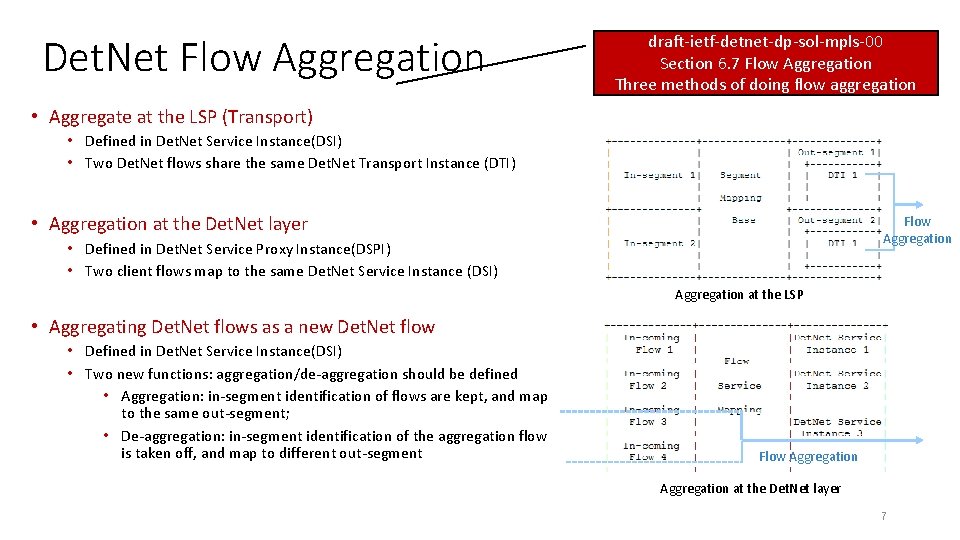
Det. Net Flow Aggregation draft-ietf-detnet-dp-sol-mpls-00 Section 6. 7 Flow Aggregation Three methods of doing flow aggregation • Aggregate at the LSP (Transport) • Defined in Det. Net Service Instance(DSI) • Two Det. Net flows share the same Det. Net Transport Instance (DTI) • Aggregation at the Det. Net layer Flow Aggregation • Defined in Det. Net Service Proxy Instance(DSPI) • Two client flows map to the same Det. Net Service Instance (DSI) Aggregation at the LSP • Aggregating Det. Net flows as a new Det. Net flow • Defined in Det. Net Service Instance(DSI) • Two new functions: aggregation/de-aggregation should be defined • Aggregation: in-segment identification of flows are kept, and map to the same out-segment; • De-aggregation: in-segment identification of the aggregation flow is taken off, and map to different out-segment Flow Aggregation at the Det. Net layer 7
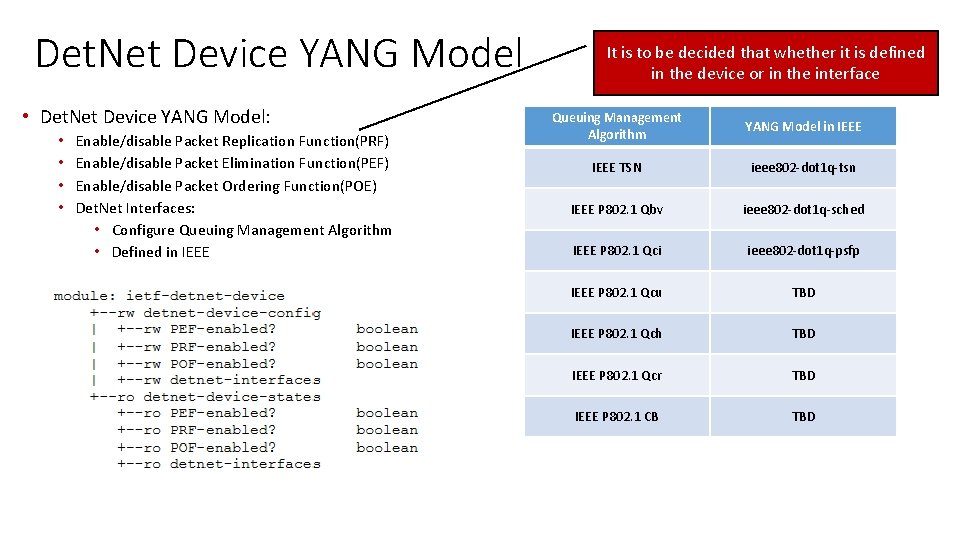
Det. Net Device YANG Model • Det. Net Device YANG Model: • • Enable/disable Packet Replication Function(PRF) Enable/disable Packet Elimination Function(PEF) Enable/disable Packet Ordering Function(POE) Det. Net Interfaces: • Configure Queuing Management Algorithm • Defined in IEEE It is to be decided that whether it is defined in the device or in the interface Queuing Management Algorithm YANG Model in IEEE TSN ieee 802 -dot 1 q-tsn IEEE P 802. 1 Qbv ieee 802 -dot 1 q-sched IEEE P 802. 1 Qci ieee 802 -dot 1 q-psfp IEEE P 802. 1 Qcu TBD IEEE P 802. 1 Qch TBD IEEE P 802. 1 Qcr TBD IEEE P 802. 1 CB TBD
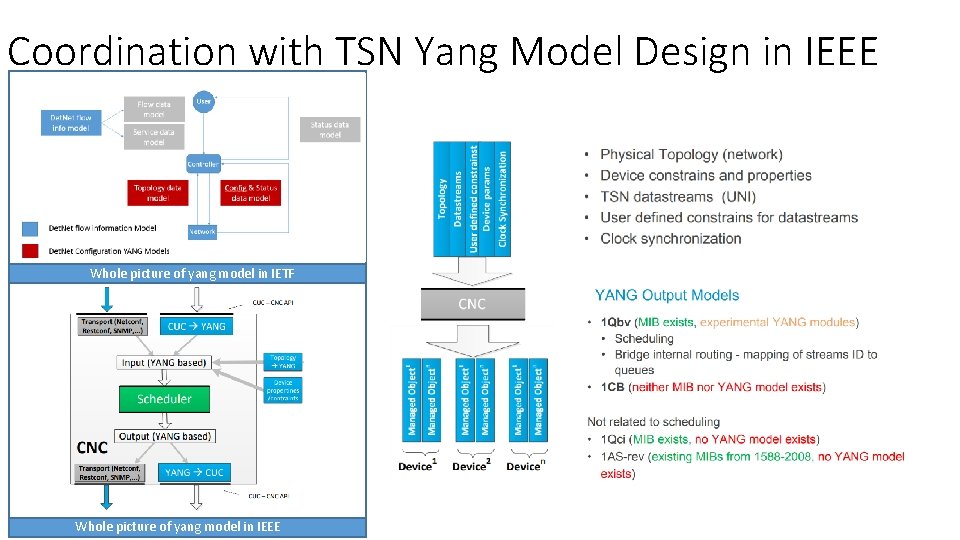
Coordination with TSN Yang Model Design in IEEE Whole picture of yang model in IETF Whole picture of yang model in IEEE
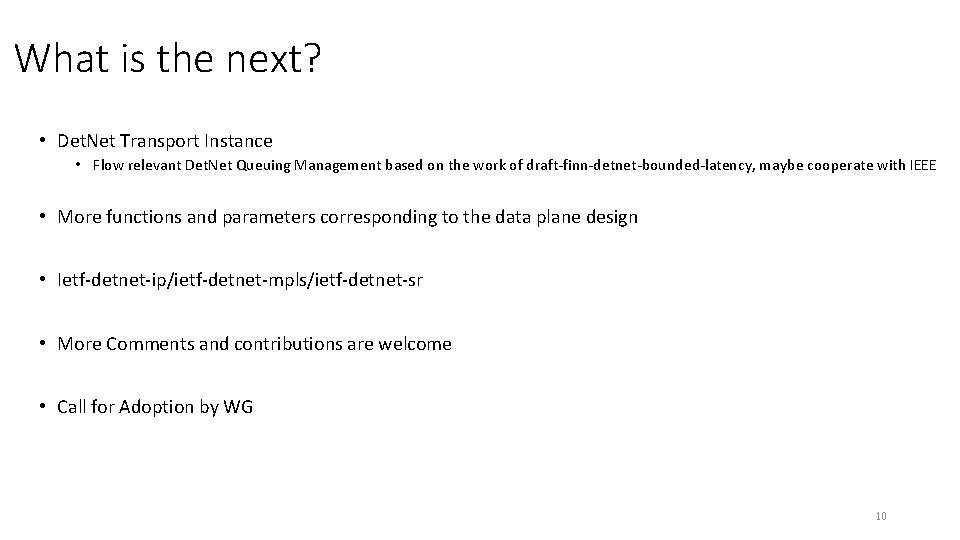
What is the next? • Det. Net Transport Instance • Flow relevant Det. Net Queuing Management based on the work of draft-finn-detnet-bounded-latency, maybe cooperate with IEEE • More functions and parameters corresponding to the data plane design • Ietf-detnet-ip/ietf-detnet-mpls/ietf-detnet-sr • More Comments and contributions are welcome • Call for Adoption by WG 10
Thanks 11