CSE 484 Introduction to Information Retrieval Rong Jin
- Slides: 40
CSE 484 Introduction to Information Retrieval Rong Jin 1
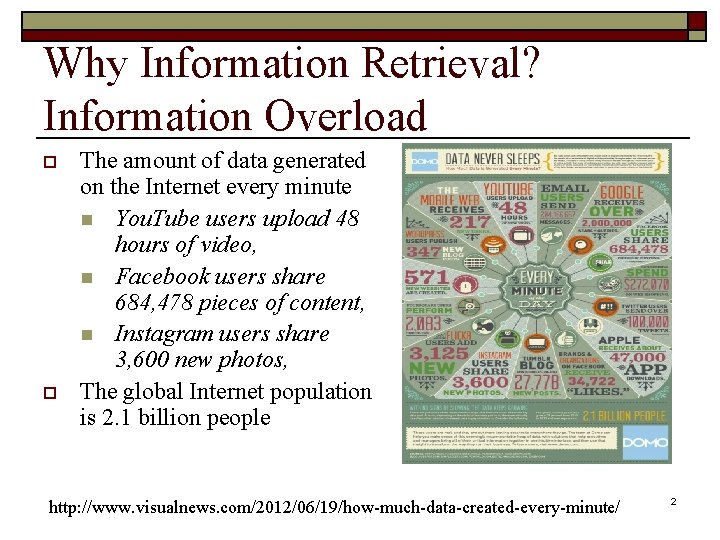
Why Information Retrieval? Information Overload o o The amount of data generated on the Internet every minute n You. Tube users upload 48 hours of video, n Facebook users share 684, 478 pieces of content, n Instagram users share 3, 600 new photos, The global Internet population is 2. 1 billion people http: //www. visualnews. com/2012/06/19/how-much-data-created-every-minute/ 2
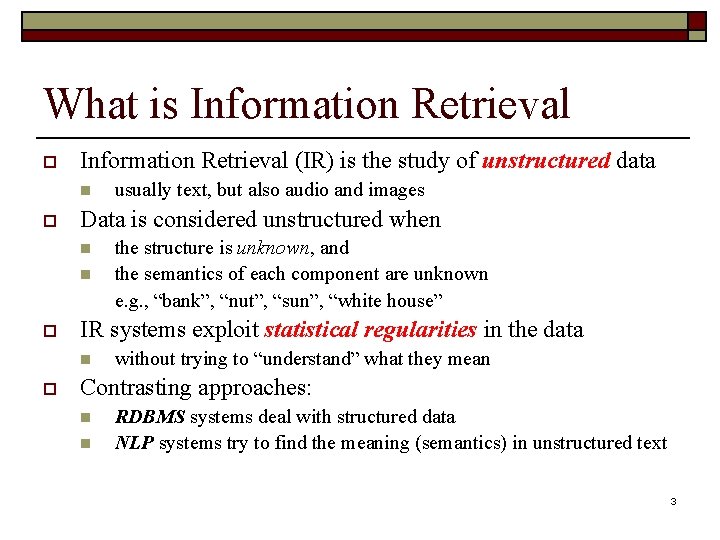
What is Information Retrieval o Information Retrieval (IR) is the study of unstructured data n o Data is considered unstructured when n n o the structure is unknown, and the semantics of each component are unknown e. g. , “bank”, “nut”, “sun”, “white house” IR systems exploit statistical regularities in the data n o usually text, but also audio and images without trying to “understand” what they mean Contrasting approaches: n n RDBMS systems deal with structured data NLP systems try to find the meaning (semantics) in unstructured text 3
Grading Policy o o Homework (70%) Project/Competition (30%) 4
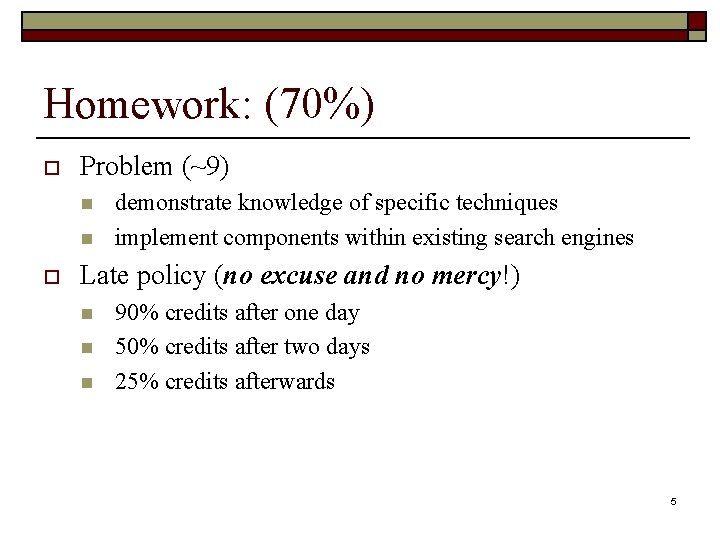
Homework: (70%) o Problem (~9) n n o demonstrate knowledge of specific techniques implement components within existing search engines Late policy (no excuse and no mercy!) n n n 90% credits after one day 50% credits after two days 25% credits afterwards 5
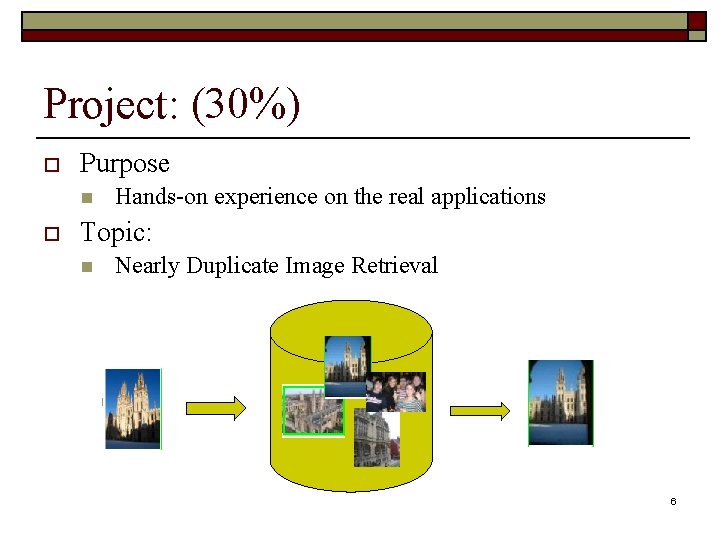
Project: (30%) o Purpose n o Hands-on experience on the real applications Topic: n Nearly Duplicate Image Retrieval 6
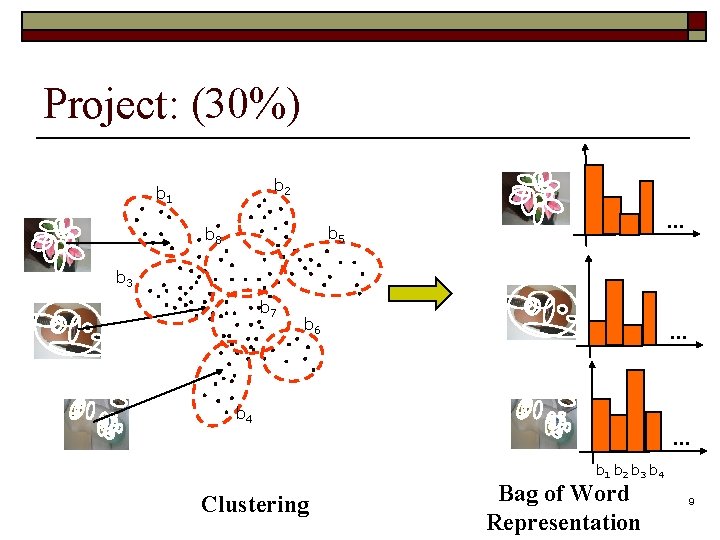
Project: (30%) b 2 b 1 … b 5 b 8 b 3 b 7 b 6 … b 4 … b 1 b 2 b 3 b 4 Clustering Bag of Word Representation 9
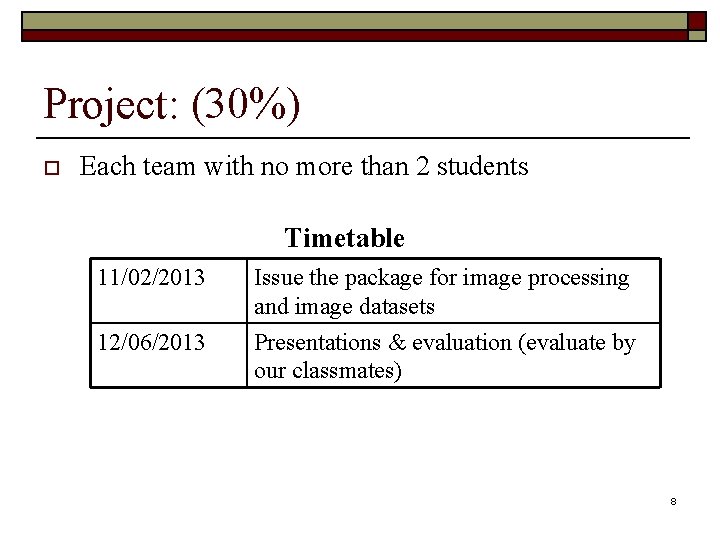
Project: (30%) o Each team with no more than 2 students Timetable 11/02/2013 Issue the package for image processing and image datasets 12/06/2013 Presentations & evaluation (evaluate by our classmates) 8
Support System o Textbook: n o o Other readings: see the course web page Course web page: n n o http: //www. cse. msu. edu/~cse 484 Syllabus, homework assignments, lecture notes, readings, etc. Office hours n o Search Engines: Information Retrieval in Practice (SEIR), by W. Bruce Croft, Donald Metzler, and Trevor Strohman, Addision Wesley, 2010 Myself: Mon/Wed: 4: 30 pm-5: 30 pm Feel free to contact me by rongjin@cse. msu. edu 9
Support System Ask Questions!!! 10
Why is IR Important? o Most communication between humans is unstructured information n o It is becoming common to store information in electronic form n n o text, images, audio word processing systems have been common for 20 -30 years storage devices (e. g. , disks) have become very inexpensive The Internet provides easy access to information worldwide, but… n n the information may be disorganized, or organized for other uses the information you need may be in a language you don’t speak 11
What is a Document? o Examples: n o web pages, email, books, news stories, scholarly papers, text messages, Word™, Powerpoint™, PDF, forum postings, patents, etc. Common properties n n Significant text content Some structure (e. g. , title, author, date for papers; subject, sender, destination for email)
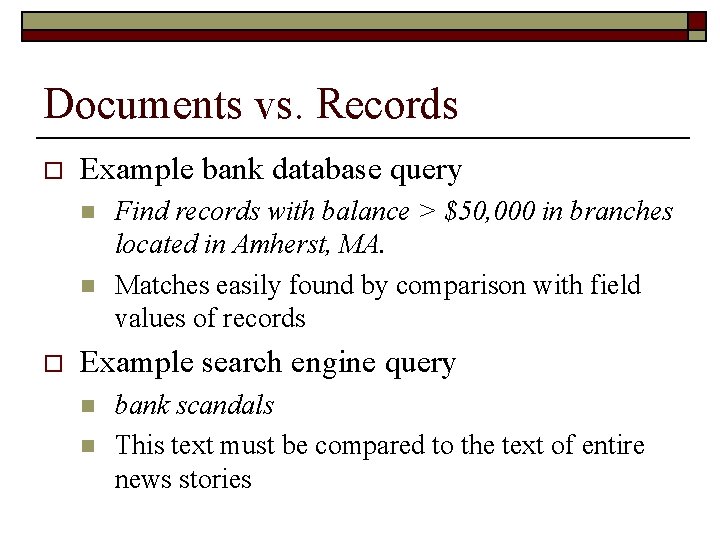
Documents vs. Database Records o Database records (or tuples in relational databases) are typically made up of welldefined fields (or attributes) n o o e. g. , bank records with account numbers, balances, names, addresses, social security numbers, dates of birth, etc. Easy to compare fields with well-defined semantics to queries in order to find matches Text is more difficult
Documents vs. Records o Example bank database query n n o Find records with balance > $50, 000 in branches located in Amherst, MA. Matches easily found by comparison with field values of records Example search engine query n n bank scandals This text must be compared to the text of entire news stories
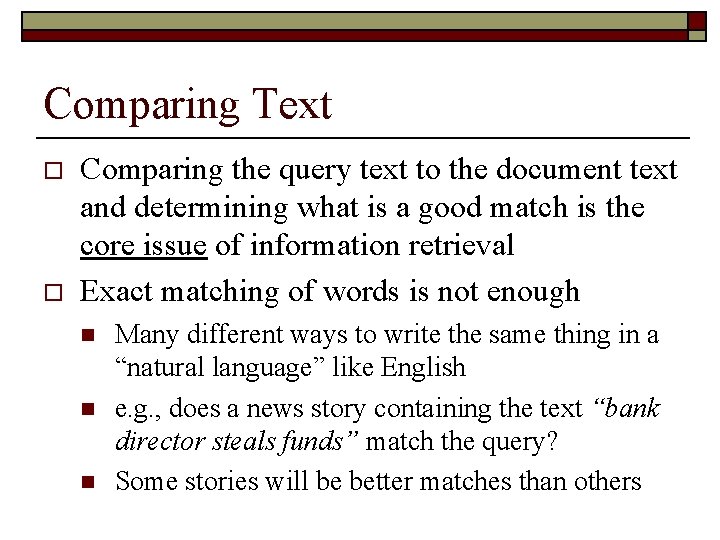
Comparing Text o o Comparing the query text to the document text and determining what is a good match is the core issue of information retrieval Exact matching of words is not enough n n n Many different ways to write the same thing in a “natural language” like English e. g. , does a news story containing the text “bank director steals funds” match the query? Some stories will be better matches than others
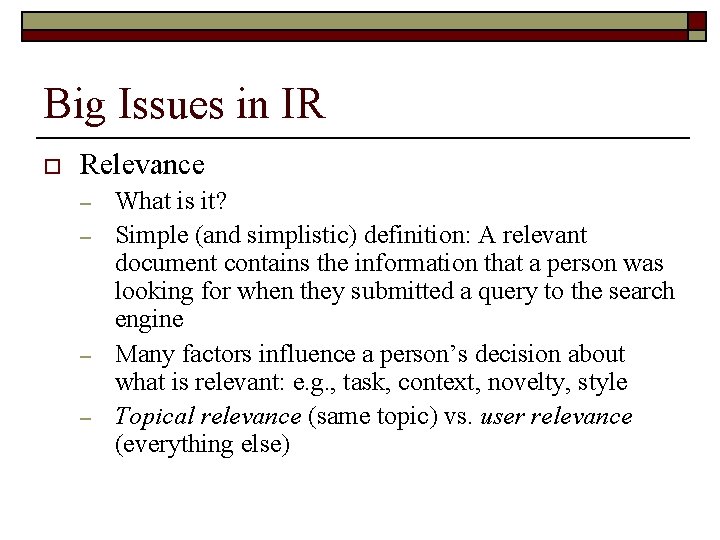
Big Issues in IR o Relevance – – What is it? Simple (and simplistic) definition: A relevant document contains the information that a person was looking for when they submitted a query to the search engine Many factors influence a person’s decision about what is relevant: e. g. , task, context, novelty, style Topical relevance (same topic) vs. user relevance (everything else)
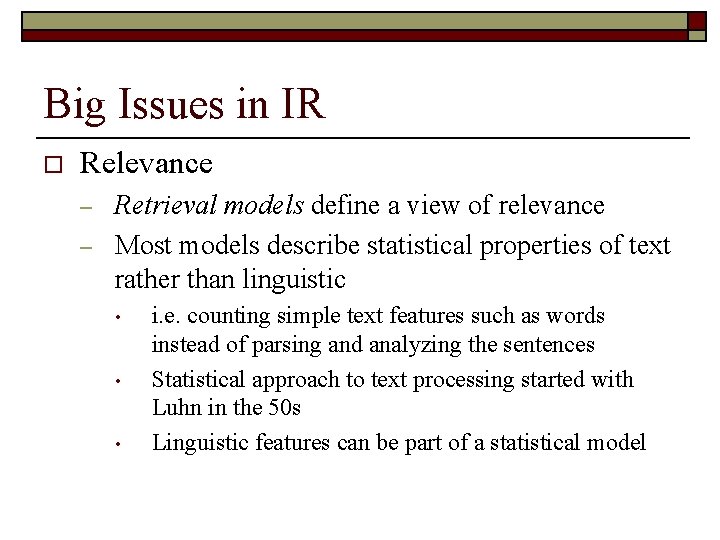
Big Issues in IR o Relevance – – Retrieval models define a view of relevance Most models describe statistical properties of text rather than linguistic • • • i. e. counting simple text features such as words instead of parsing and analyzing the sentences Statistical approach to text processing started with Luhn in the 50 s Linguistic features can be part of a statistical model
Big Issues in IR o Evaluation n Experimental procedures and measures for comparing system output with user expectations o n Typically use test collection of documents, queries, and relevance judgments o n Originated in Cranfield experiments in the 60 s Most commonly used are TREC collections Recall and precision are two examples of effectiveness measures
Big Issues in IR o Information Needs n n Search evaluation is user-centered Keyword queries are often poor descriptions of actual information needs Interaction and context are important for understanding user intent Query refinement techniques such as query expansion, query suggestion, relevance feedback improve ranking
IR and Search Engines o o A search engine is the practical application of information retrieval techniques to large scale text collections Web search engines are best-known examples, but many others n Open source search engines are important for research and development o o e. g. , Lucene, Lemur/Indri, Galago Big issues include main IR issues but also some others
Search Engine Issues o Performance n Measuring and improving the efficiency of search o n e. g. , reducing response time, increasing query throughput, increasing indexing speed Indexes are data structures designed to improve search efficiency o designing and implementing them are major issues for search engines
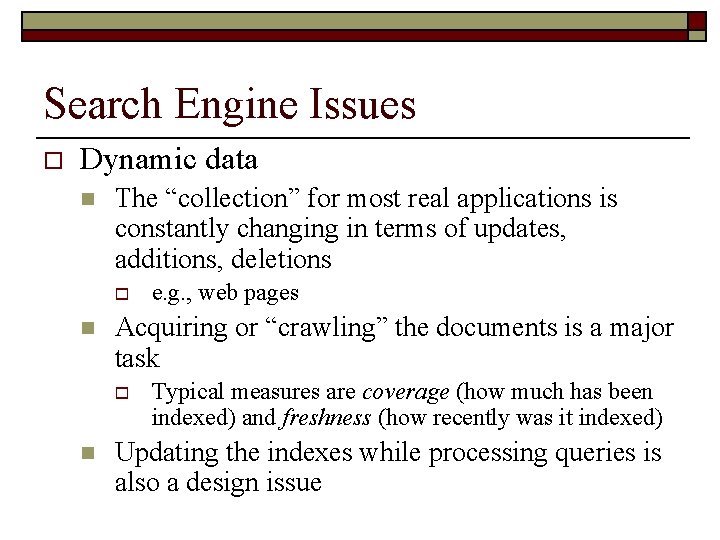
Search Engine Issues o Dynamic data n The “collection” for most real applications is constantly changing in terms of updates, additions, deletions o n Acquiring or “crawling” the documents is a major task o n e. g. , web pages Typical measures are coverage (how much has been indexed) and freshness (how recently was it indexed) Updating the indexes while processing queries is also a design issue
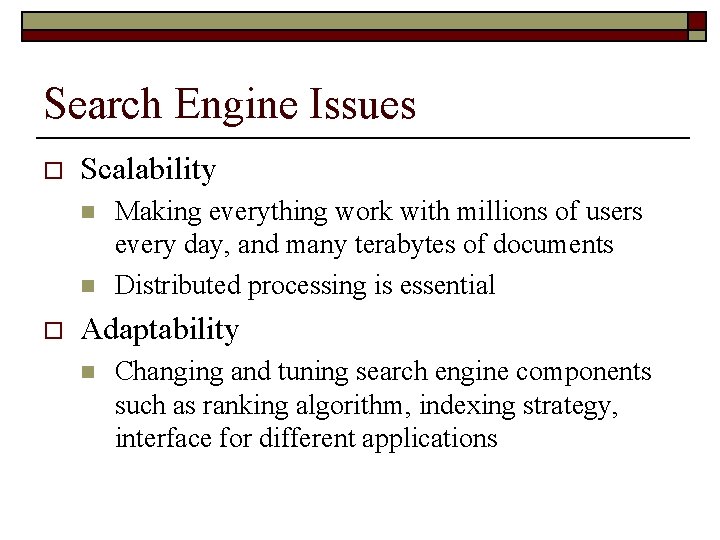
Search Engine Issues o Scalability n n o Making everything work with millions of users every day, and many terabytes of documents Distributed processing is essential Adaptability n Changing and tuning search engine components such as ranking algorithm, indexing strategy, interface for different applications
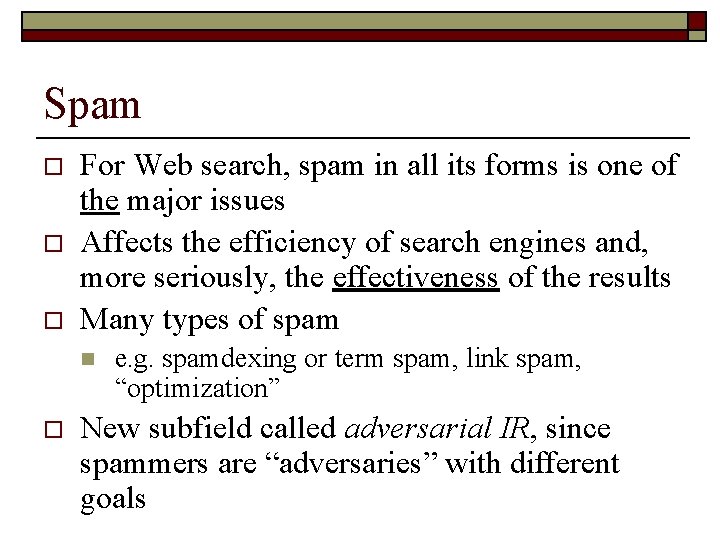
Spam o o o For Web search, spam in all its forms is one of the major issues Affects the efficiency of search engines and, more seriously, the effectiveness of the results Many types of spam n o e. g. spamdexing or term spam, link spam, “optimization” New subfield called adversarial IR, since spammers are “adversaries” with different goals
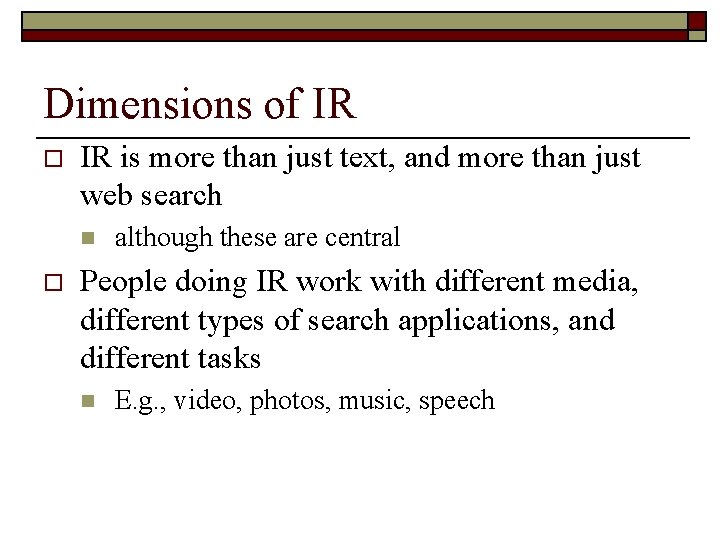
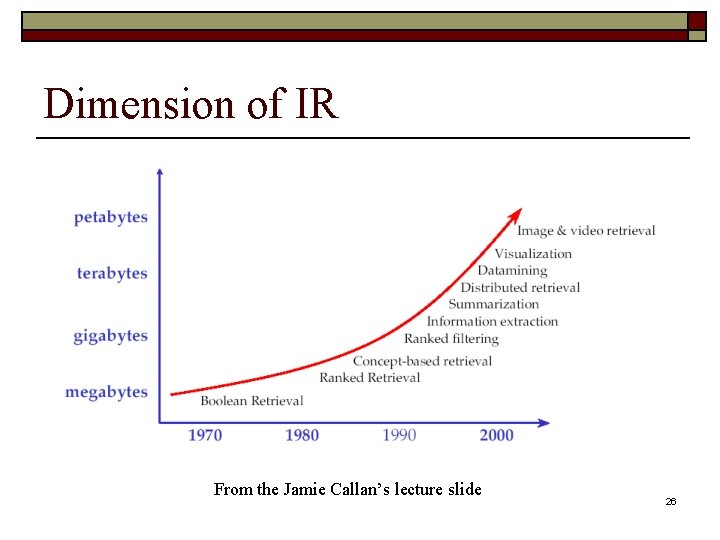
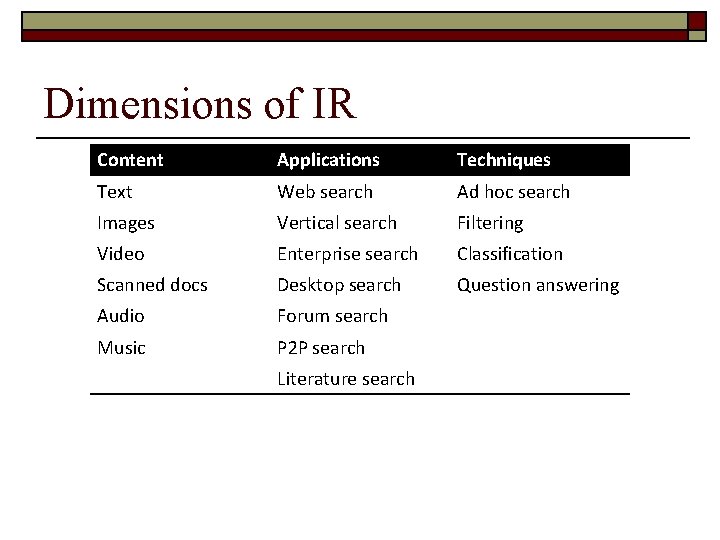
Dimensions of IR o IR is more than just text, and more than just web search n o although these are central People doing IR work with different media, different types of search applications, and different tasks n E. g. , video, photos, music, speech
Dimension of IR From the Jamie Callan’s lecture slide 26
Dimensions of IR Content Applications Techniques Text Web search Ad hoc search Images Vertical search Filtering Video Enterprise search Classification Scanned docs Desktop search Question answering Audio Forum search Music P 2 P search Literature search
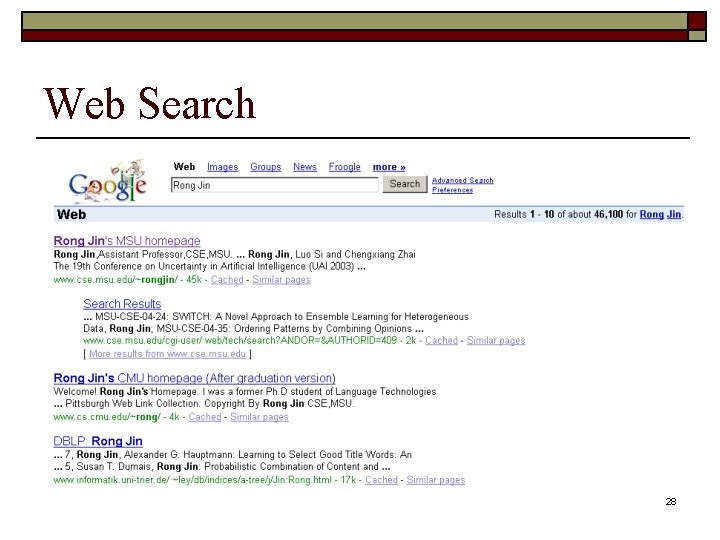
Web Search 28
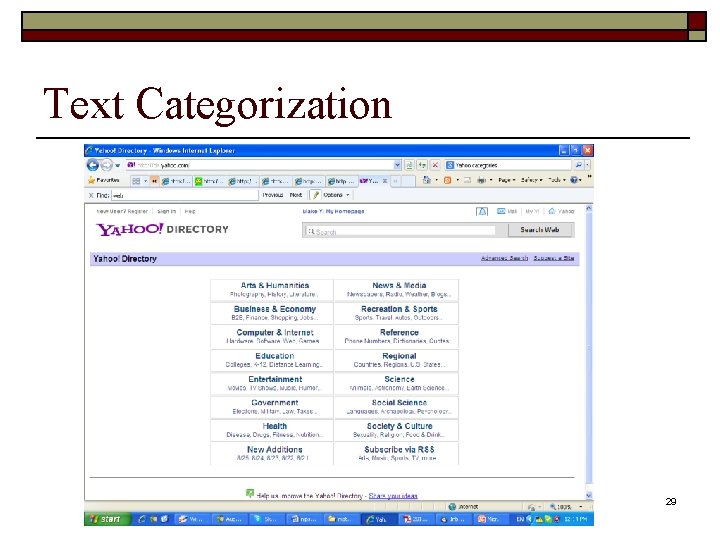
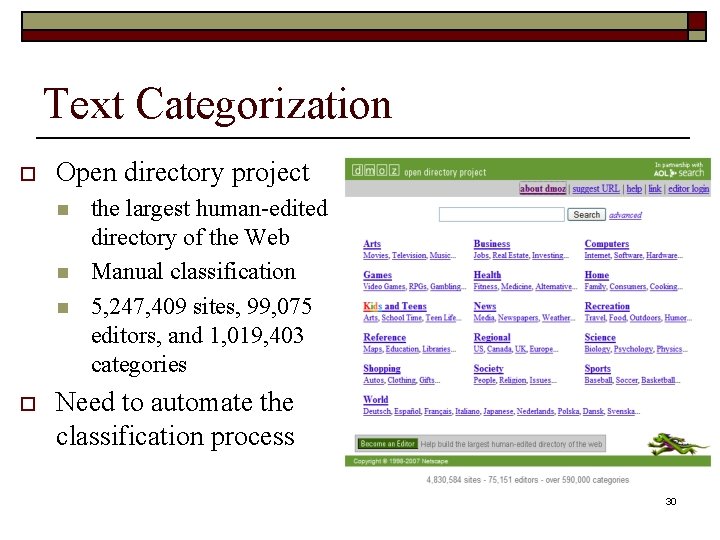
Text Categorization 29
Text Categorization o Open directory project n n n o the largest human-edited directory of the Web Manual classification 5, 247, 409 sites, 99, 075 editors, and 1, 019, 403 categories Need to automate the classification process 30
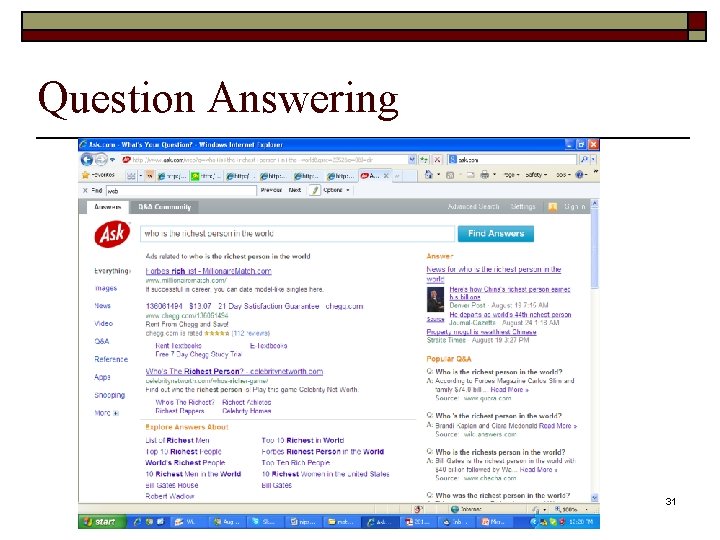
Question Answering 31
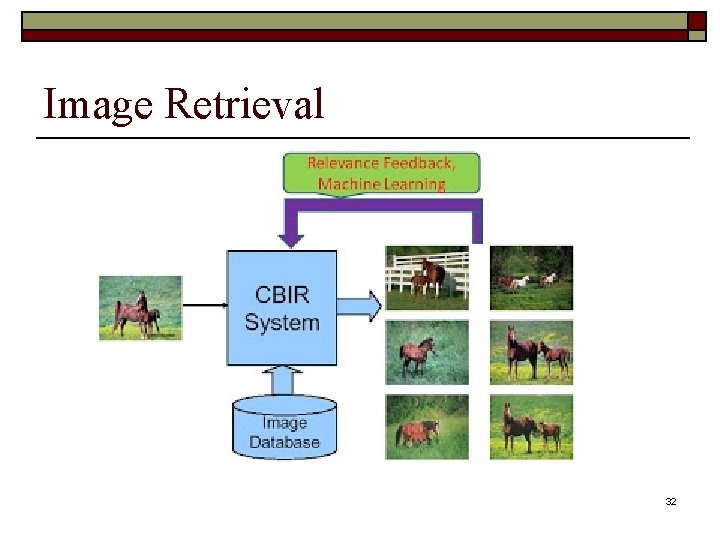
Image Retrieval 32
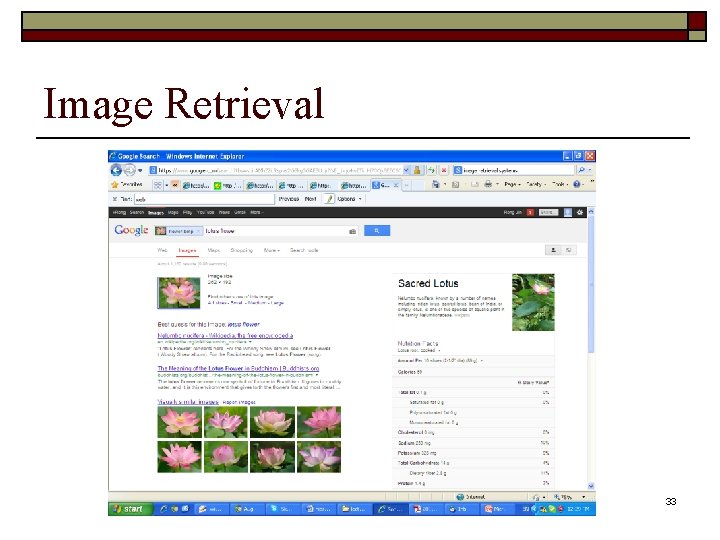
Image Retrieval 33
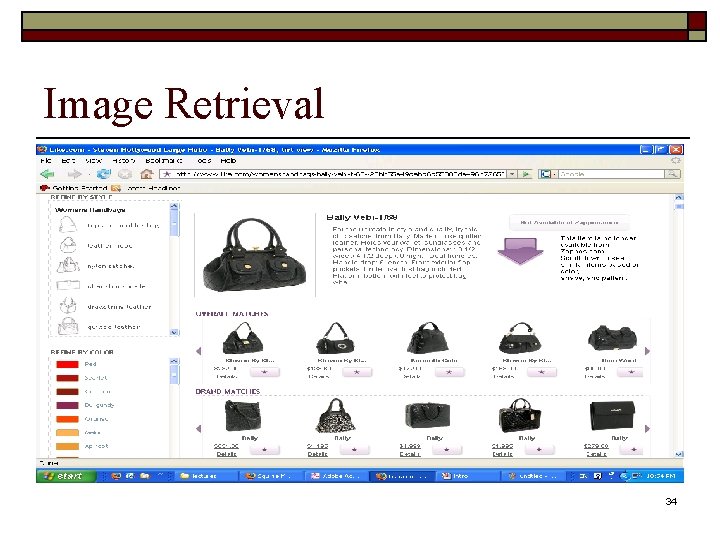
Image Retrieval 34
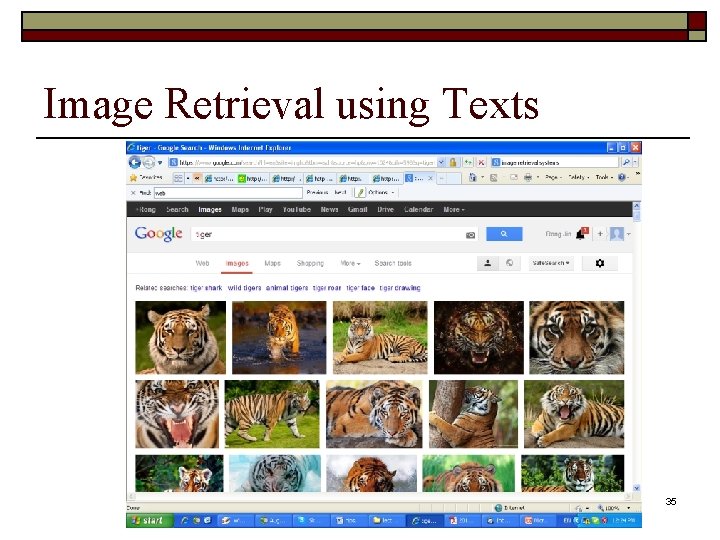
Image Retrieval using Texts 35
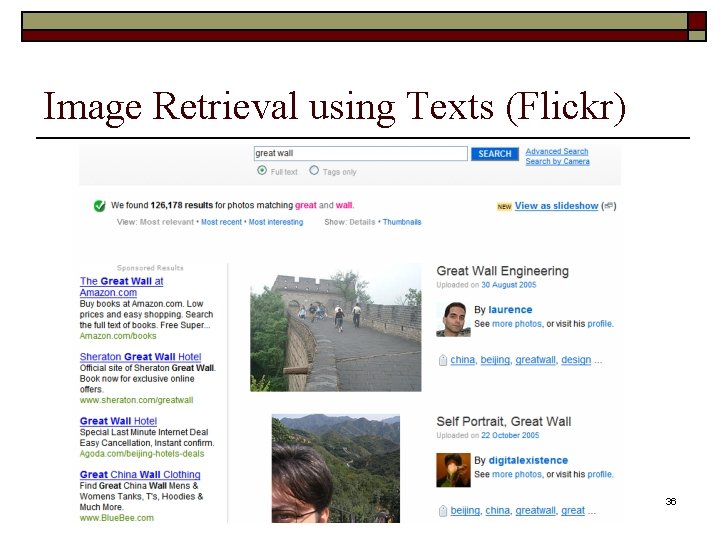
Image Retrieval using Texts (Flickr) 36
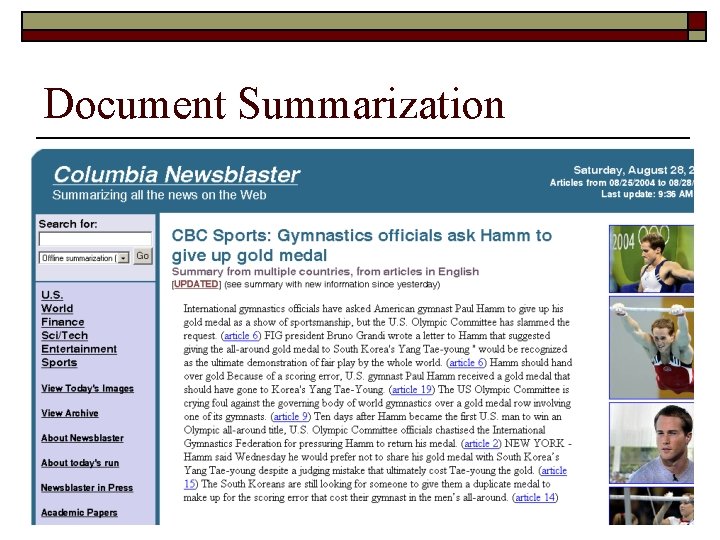
Document Summarization 37
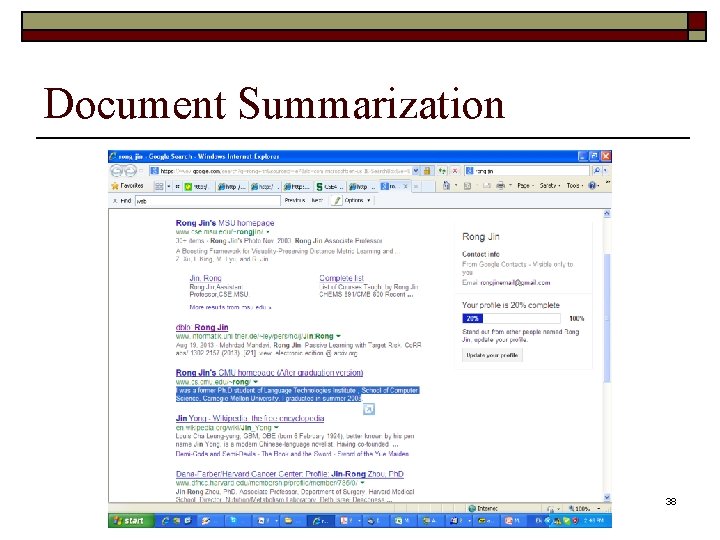
Document Summarization 38
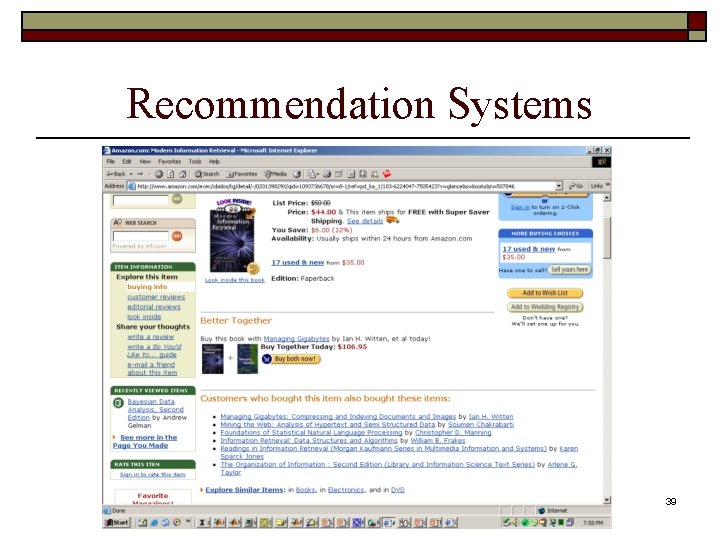
Recommendation Systems 39
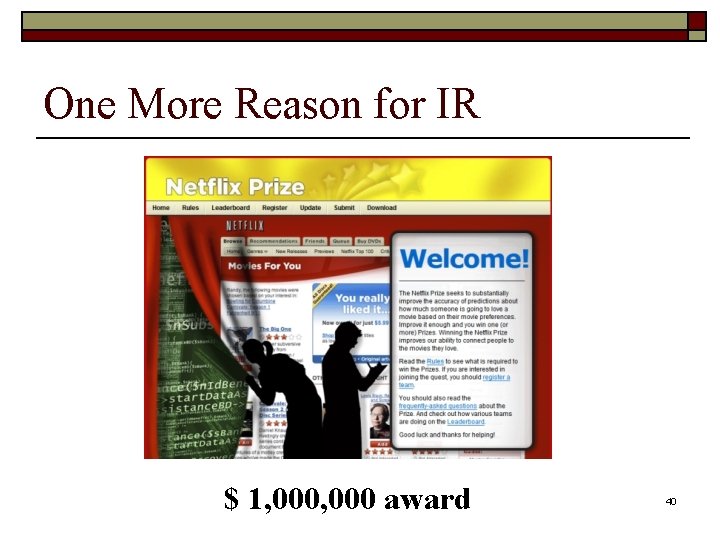
One More Reason for IR $ 1, 000 award 40