CSE 3302 Programming Languages notes Dr Carter Tiernan
- Slides: 23
CSE 3302 Programming Languages (notes? ) Dr. Carter Tiernan CSE 3302 CSE@UTA Programming Languages Ch. 13 1 jcmt
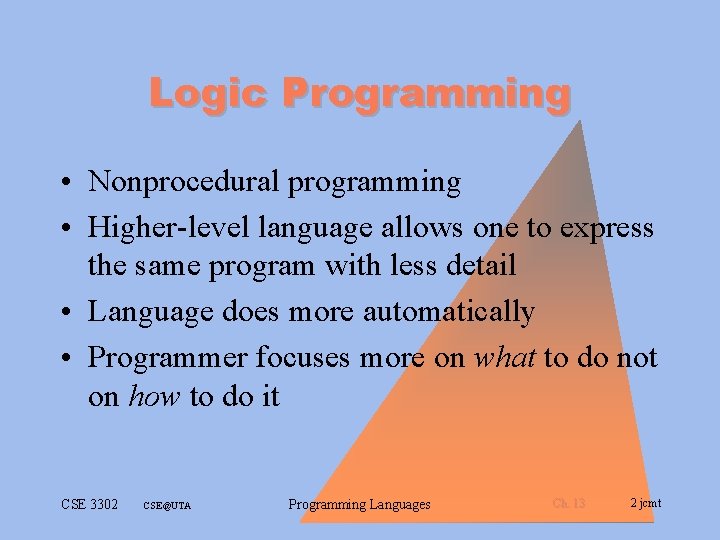
Logic Programming • Nonprocedural programming • Higher-level language allows one to express the same program with less detail • Language does more automatically • Programmer focuses more on what to do not on how to do it CSE 3302 CSE@UTA Programming Languages Ch. 13 2 jcmt
Automatic deduction • Automatic theorem proving – The development of programs that can construct formal proofs of propositions stated in symbolic language – Side effect of proof is construction of a result which demonstrates the proof • Programs expressed in the form of propositions that assert the existence of a desired result CSE 3302 CSE@UTA Programming Languages Ch. 13 3 jcmt
Prolog • Programs are structured like theorems – Clauses that define the problem domain – Facts (database of relationships among atomic individuals) – Goals • Is a fact provable? • Is there an individual satisfying the goal? • Is there a solution satisfying the goal? CSE 3302 CSE@UTA Programming Languages Ch. 13 4 jcmt
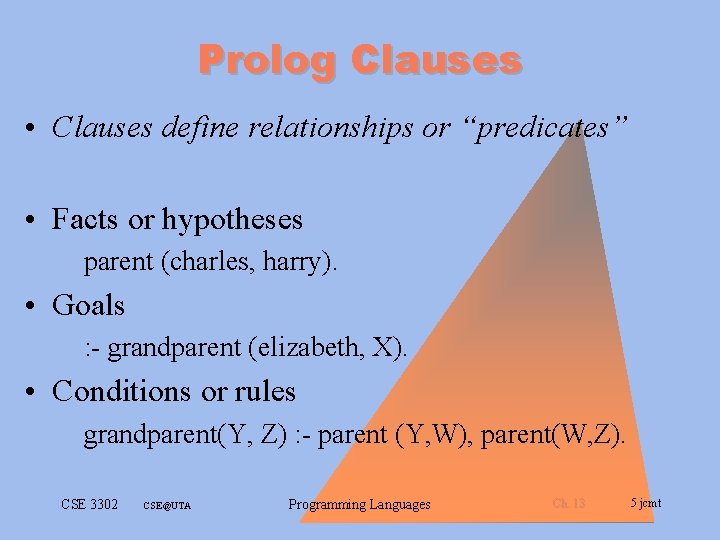
Prolog Clauses • Clauses define relationships or “predicates” • Facts or hypotheses parent (charles, harry). • Goals : - grandparent (elizabeth, X). • Conditions or rules grandparent(Y, Z) : - parent (Y, W), parent(W, Z). CSE 3302 CSE@UTA Programming Languages Ch. 13 5 jcmt
• <head> : - <body> • Predicates – Relationship applied to terms – Relationships • Properties of • Relations among – Terms • Atoms • Variables • Compound terms • Horn clause form CSE 3302 CSE@UTA Programming Languages Ch. 13 6 jcmt
Goals • Executing a goal – Match clauses in predicate by finding an assignment of values to the variables that makes the goal identical to the head of one of the clauses (unification) – Variables are bound (instantiated) to create subgoal – Recursive application and pattern matching CSE 3302 CSE@UTA Programming Languages Ch. 13 7 jcmt
Compound terms • Compound term allows us to describe individuals without naming them • Functor with atoms or variables d(X, plus(U, V), plus(DU, DV)) or d(X, U + V, DU + DV) • Similar to LISP list structure • Acts somewhat like a function but is not a function call CSE 3302 CSE@UTA Programming Languages Ch. 13 8 jcmt
Data structures • No constructors • Data structures are implicitly defined by their properties • Few primitives • Compound terms can provide logical description of structure – Some Prologs allow infix notation for functors CSE 3302 CSE@UTA Programming Languages Ch. 13 9 jcmt
Complex structures • Compound terms represent themselves – Symbolic notations can be defined directly – Good for mathematical relationships • Predicates can define structures – Predicates can replace compound terms – Expressions matched to clauses must exist within the Prolog “closed world” – Good for object-oriented relationships CSE 3302 CSE@UTA Programming Languages Ch. 13 10 jcmt
More data structures • Abstract data types - so abstract they’re only described • Infinite terms - “occurs check” • Representation of ‘infinite’ list is finite – Circular structure CSE 3302 CSE@UTA Programming Languages Ch. 13 11 jcmt
Control Structures • Separation of logic and control – Independent analysis • Order of clauses has no effect on meaning or logic • Control affects generation and unification of subgoals – Efficiency is an issue but not meaning CSE 3302 CSE@UTA Programming Languages Ch. 13 12 jcmt
Subgoal Generation • Top-down – Start from goal; try to reach hypotheses – Recursive approach • Bottom-up – Start with hypotheses; try to reach goal – Iterative approach CSE 3302 CSE@UTA Programming Languages Ch. 13 13 jcmt
Backtracking • Multiple matching clauses may be available • If a failure occurs after a choice point, execution backtracks to the last choice point • Another match is made and execution continues. • Implementation of efficient backtracking is crucial in logic programming CSE 3302 CSE@UTA Programming Languages Ch. 13 14 jcmt
Input / Output Parameters • Goals attempt to satisfy subgoals with whatever value is unified • Parameters are neither inherently input nor output. Which ever is supplied is used as input. • When no parameter values are given, the systems attempts to search for any solution that satisfies the pattern CSE 3302 CSE@UTA Programming Languages Ch. 13 15 jcmt
Searching in Prolog • Depth-first search is specified – Not pure logic programming • Attempts to satisfy goals in the order written • Will try matching clauses in the order in which they were entered into the DB CSE 3302 CSE@UTA Programming Languages Ch. 13 16 jcmt
Prolog vs. Logic Programming • Interpretation of arithmetic jumps beyond the bounds of strict logic programming unless handled as succ() • Efficiency requires the use underlying hardware support • ‘is’ gives an assignment • Binding forces ordering CSE 3302 CSE@UTA Programming Languages Ch. 13 17 jcmt
Search rationale • Breadth-first – searches paths in parallel – needs exponentially more space than depth-first • Depth-first – Can get caught in infinitely deep search – Programmer is required to order clauses to prevent endless search CSE 3302 CSE@UTA Programming Languages Ch. 13 18 jcmt
Nonmonotonic reasoning • Updateable database – Assert – Retract • Does not match logic • Does match world state changes over time CSE 3302 CSE@UTA Programming Languages Ch. 13 19 jcmt
Cuts • “You have found all the solutions there are; do not bother trying to find any others” • Predicate that always succeeds, but past which you can never backtrack • Used with repeat to provide looping CSE 3302 CSE@UTA Programming Languages Ch. 13 20 jcmt
Higher-order rules • Parameters must be terms not predicates • Logic programming is generally restricted to first-order logic • Resolution algorithm is complete only for first-order logic CSE 3302 CSE@UTA Programming Languages Ch. 13 21 jcmt
Negation • Unsatisfiability - cannot be proved true – Absence of data – Closed world assumption • Conclusions can be drawn about relationships that DO hold • NO conclusions can be made about relationships that do NOT hold • not( -- ) predicate succeeds if -- fails CSE 3302 CSE@UTA Programming Languages Ch. 13 22 jcmt
Equivalence • Term equality • Other types of equivalence cannot be defined – In terms of logical properties • Term inequality requires complete binding for correct interpretation CSE 3302 CSE@UTA Programming Languages Ch. 13 23 jcmt