CSCI 3160 Design and Analysis of Algorithms Tutorial

- Slides: 30
CSCI 3160 Design and Analysis of Algorithms Tutorial 9 Chengyu Lin
Outline • Stable Matching • Secretary Problem
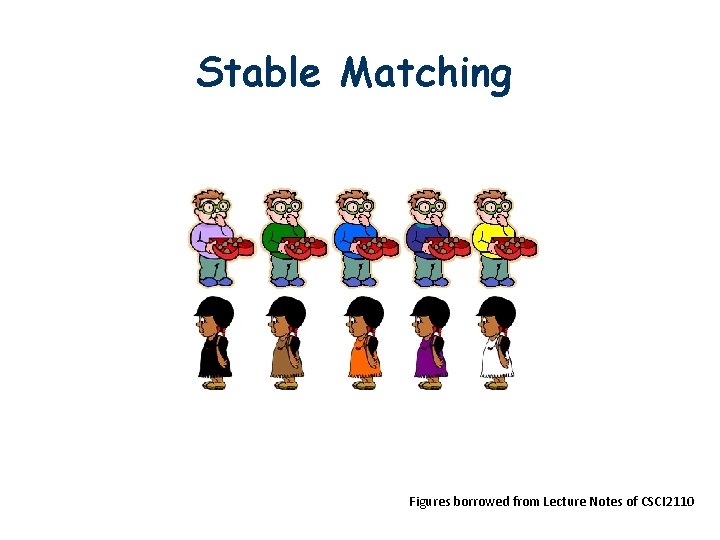
Stable Matching Figures borrowed from Lecture Notes of CSCI 2110
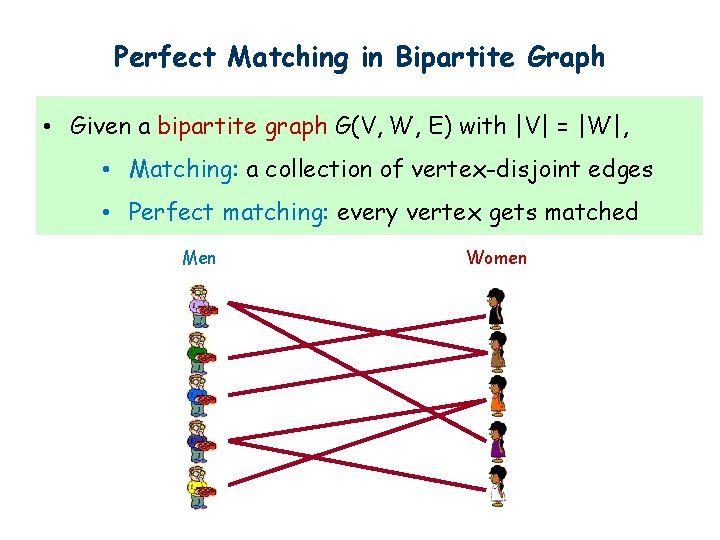
Perfect Matching in Bipartite Graph • Given a bipartite graph G(V, W, E) with |V| = |W|, • Matching: a collection of vertex-disjoint edges • Perfect matching: every vertex gets matched Men Women
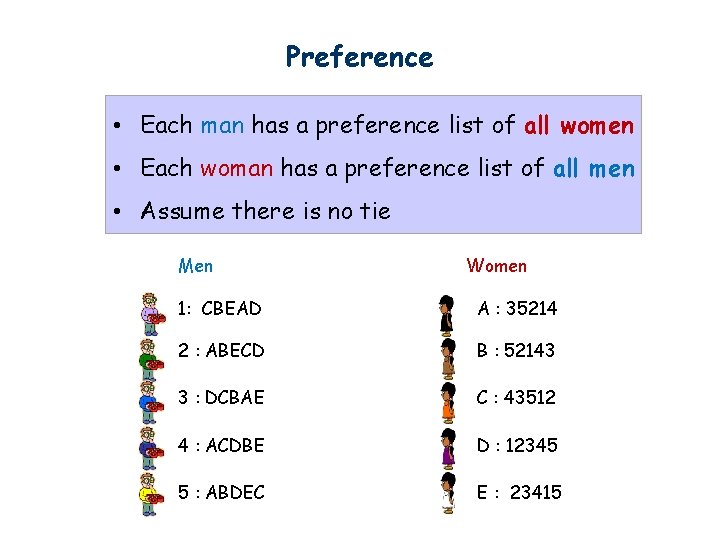
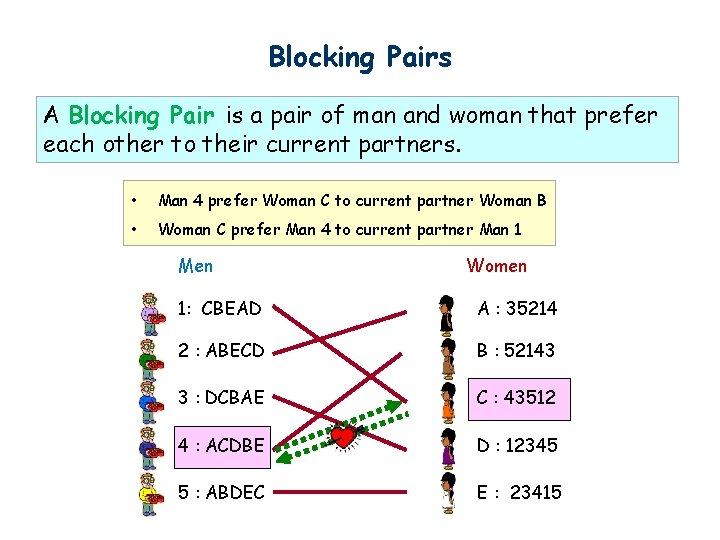
Preference • Each man has a preference list of all women • Each woman has a preference list of all men • Assume there is no tie Men Women 1: CBEAD A : 35214 2 : ABECD B : 52143 3 : DCBAE C : 43512 4 : ACDBE D : 12345 5 : ABDEC E : 23415
Blocking Pairs A Blocking Pair is a pair of man and woman that prefer each other to their current partners. • Man 4 prefer Woman C to current partner Woman B • Woman C prefer Man 4 to current partner Man 1 Men Women 1: CBEAD A : 35214 2 : ABECD B : 52143 3 : DCBAE C : 43512 4 : ACDBE D : 12345 5 : ABDEC E : 23415
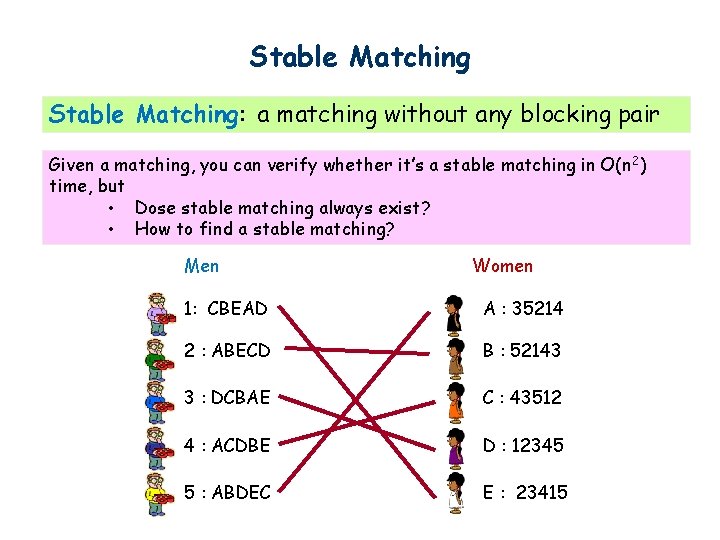
Stable Matching: a matching without any blocking pair Given a matching, you can verify whether it’s a stable matching in O(n 2) time, but • Dose stable matching always exist? • How to find a stable matching? Men Women 1: CBEAD A : 35214 2 : ABECD B : 52143 3 : DCBAE C : 43512 4 : ACDBE D : 12345 5 : ABDEC E : 23415
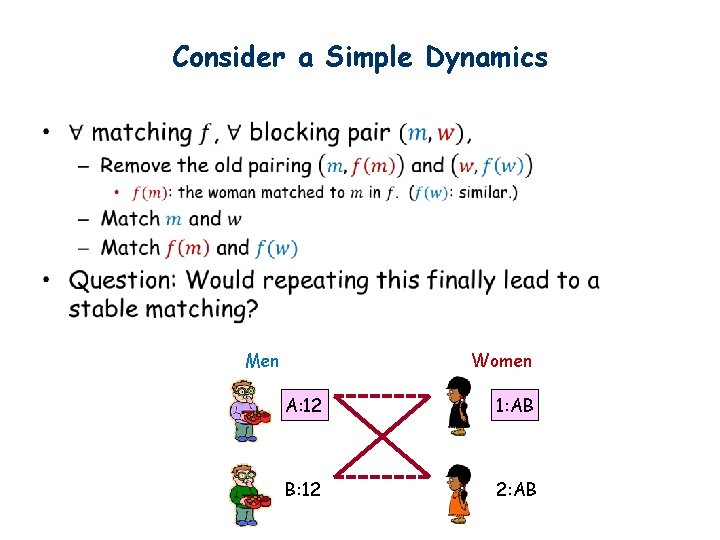
Consider a Simple Dynamics • Women Men A: 12 1: AB B: 12 2: AB
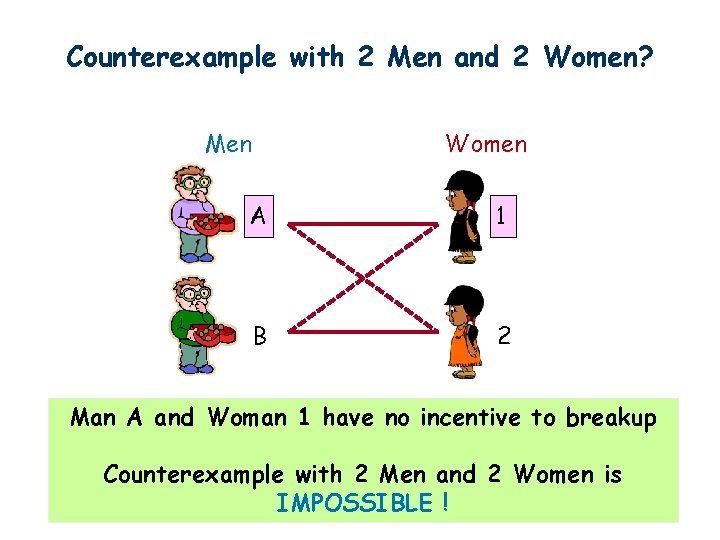
Counterexample with 2 Men and 2 Women? Men Women A 1 B 2 Man A and Woman 1 have no incentive to breakup Counterexample with 2 Men and 2 Women is IMPOSSIBLE !
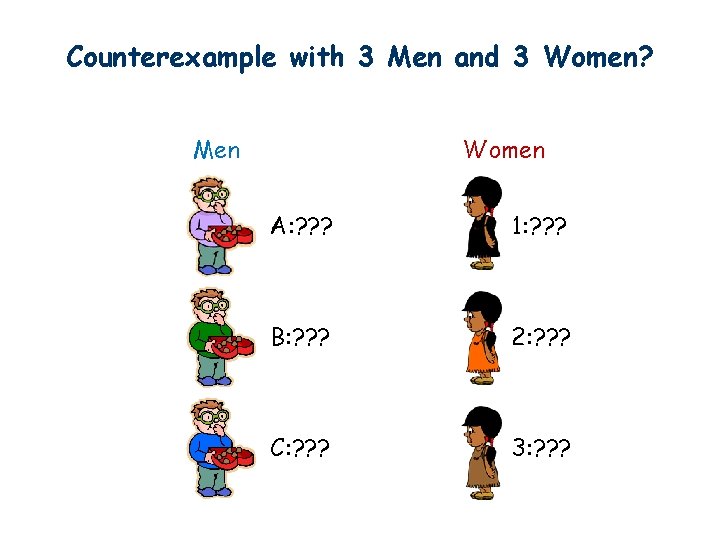
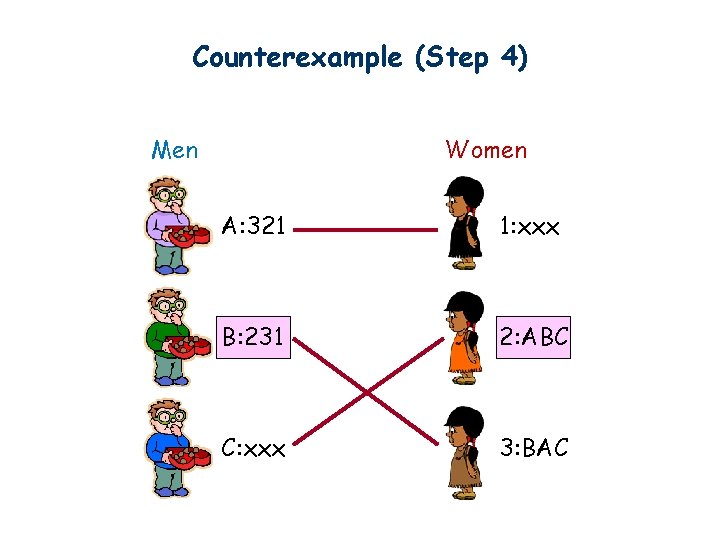
Counterexample with 3 Men and 3 Women? Women Men A: ? ? ? 1: ? ? ? B: ? ? ? 2: ? ? ? C: ? ? ? 3: ? ? ?
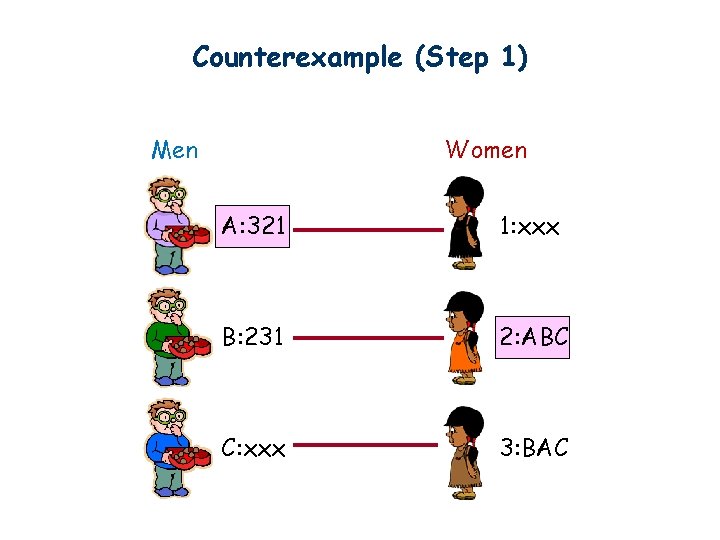
Counterexample (Step 1) Women Men A: 321 1: xxx B: 231 2: ABC C: xxx 3: BAC
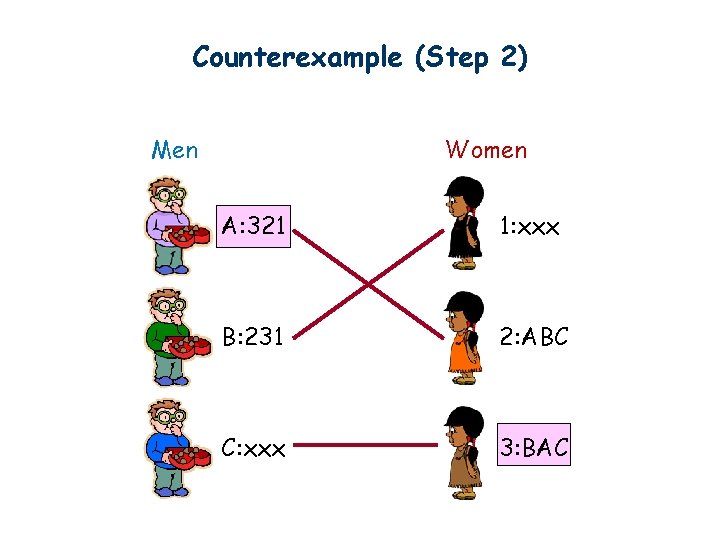
Counterexample (Step 2) Women Men A: 321 1: xxx B: 231 2: ABC C: xxx 3: BAC
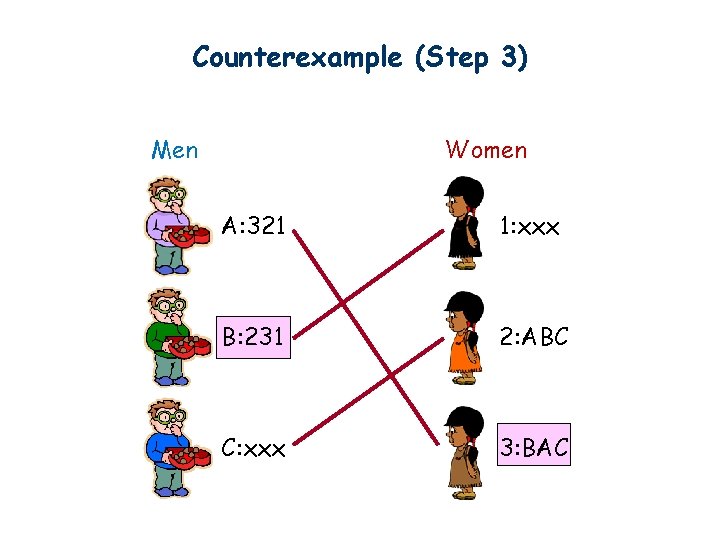
Counterexample (Step 3) Women Men A: 321 1: xxx B: 231 2: ABC C: xxx 3: BAC
Counterexample (Step 4) Women Men A: 321 1: xxx B: 231 2: ABC C: xxx 3: BAC
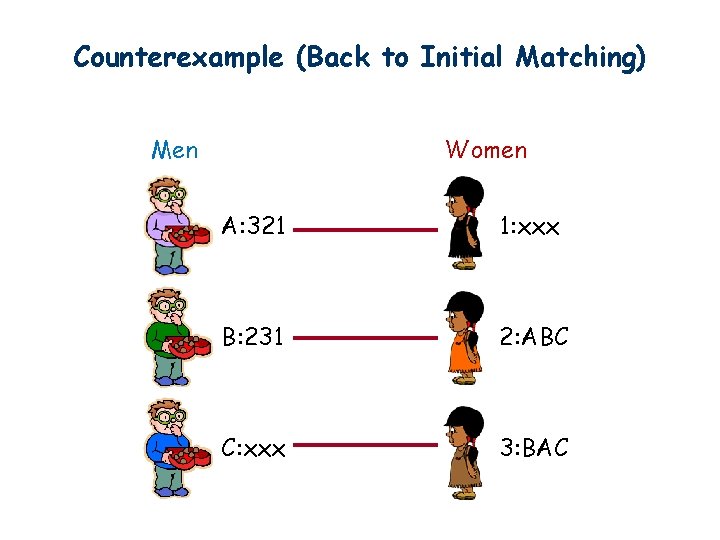
Counterexample (Back to Initial Matching) Women Men A: 321 1: xxx B: 231 2: ABC C: xxx 3: BAC
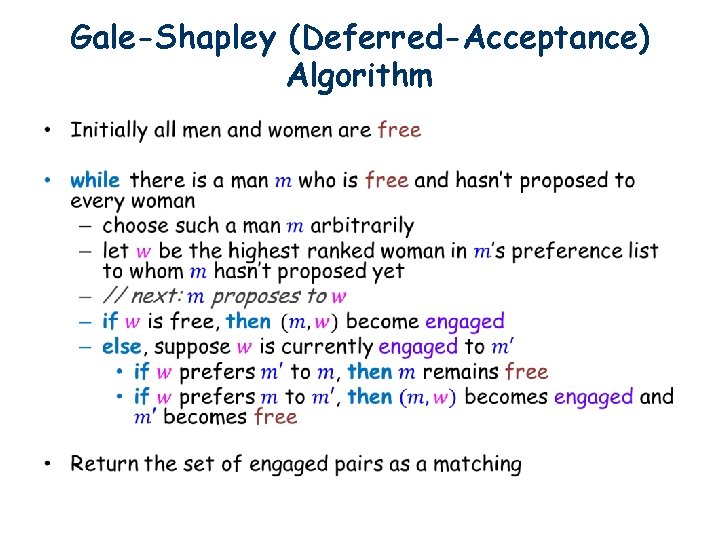
Gale-Shapley (Deferred-Acceptance) Algorithm •
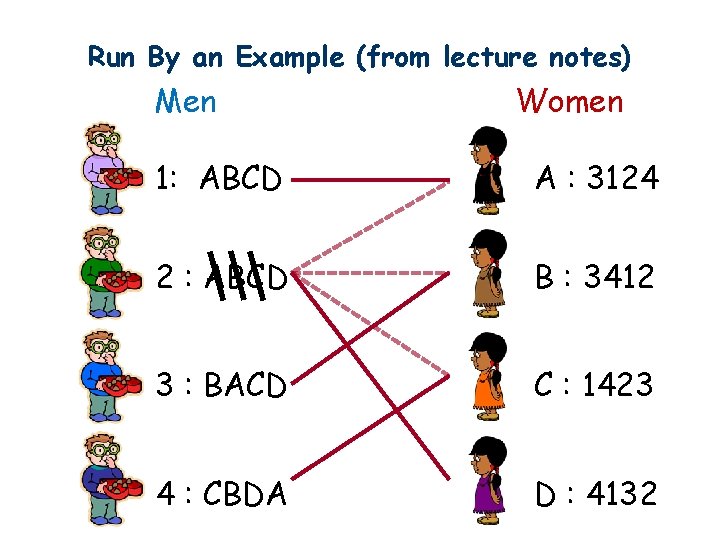
Run By an Example (from lecture notes) Men Women 1: ABCD A : 3124 2 : ABCD B : 3412 3 : BACD C : 1423 4 : CBDA D : 4132
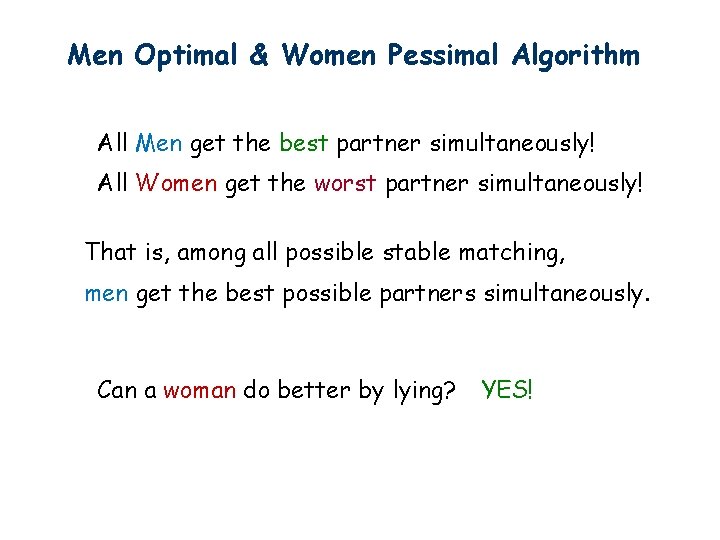
Men Optimal & Women Pessimal Algorithm All Men get the best partner simultaneously! All Women get the worst partner simultaneously! That is, among all possible stable matching, men get the best possible partners simultaneously. Can a woman do better by lying? YES!
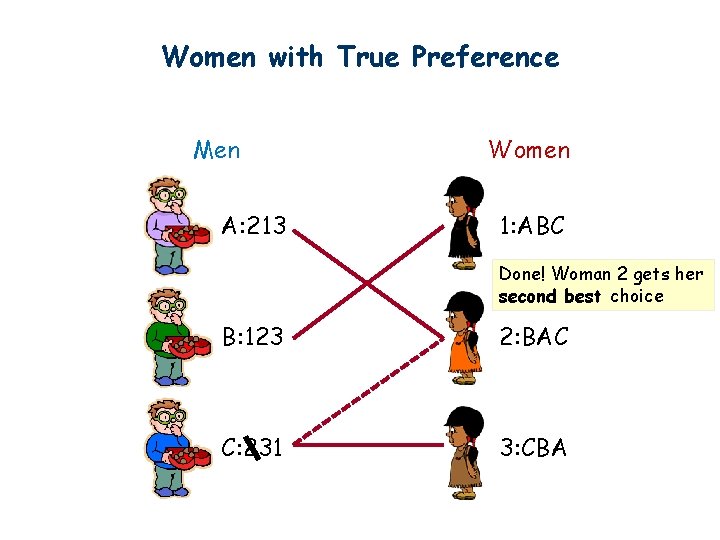
Women with True Preference Men A: 213 Women 1: ABC Done! Woman 2 gets her second best choice B: 123 2: BAC C: 231 3: CBA
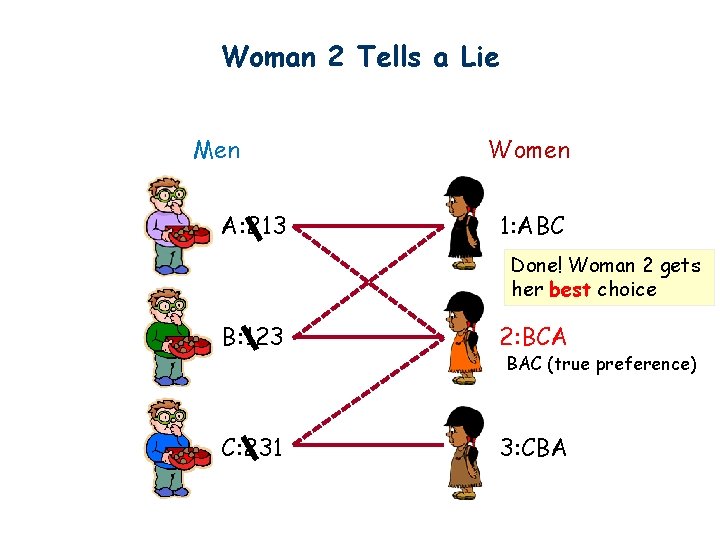
Woman 2 Tells a Lie Men A: 213 Women 1: ABC Done! Woman 2 gets her best choice B: 123 2: BCA C: 231 3: CBA BAC (true preference)
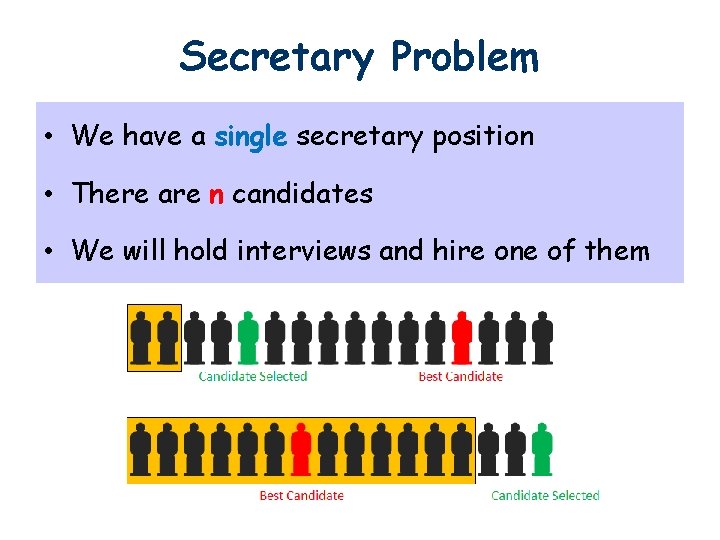
Secretary Problem • We have a single secretary position • There are n candidates • We will hold interviews and hire one of them
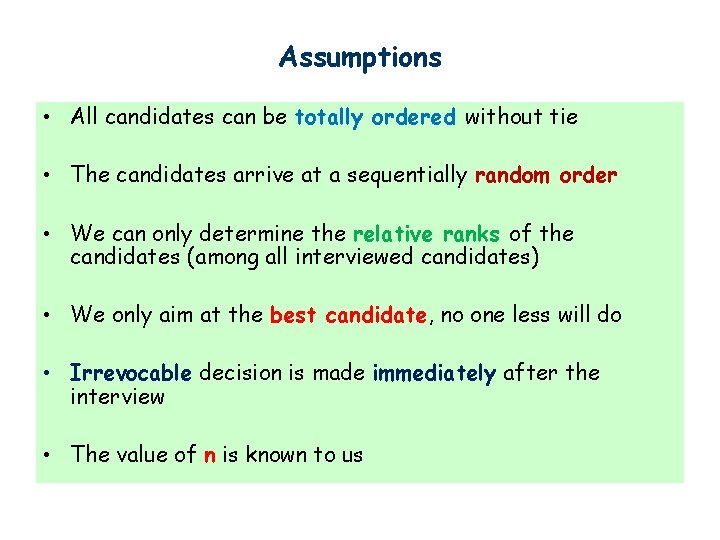
Assumptions • All candidates can be totally ordered without tie • The candidates arrive at a sequentially random order • We can only determine the relative ranks of the candidates (among all interviewed candidates) • We only aim at the best candidate, no one less will do • Irrevocable decision is made immediately after the interview • The value of n is known to us
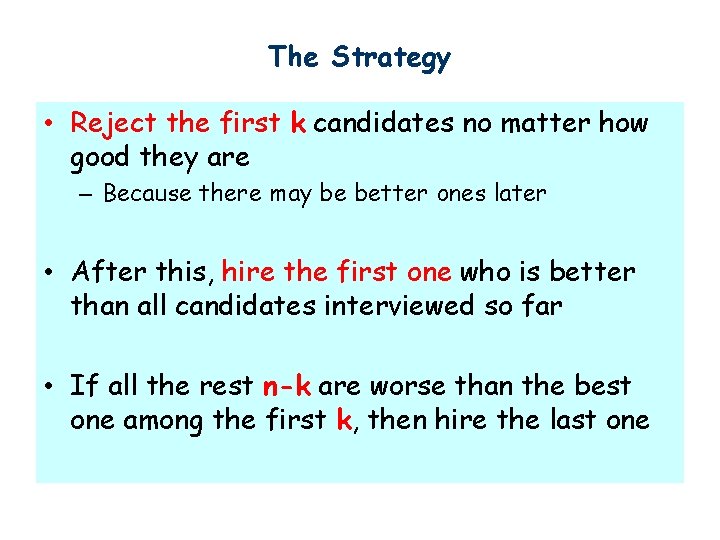
The Strategy • Reject the first k candidates no matter how good they are – Because there may be better ones later • After this, hire the first one who is better than all candidates interviewed so far • If all the rest n-k are worse than the best one among the first k, then hire the last one
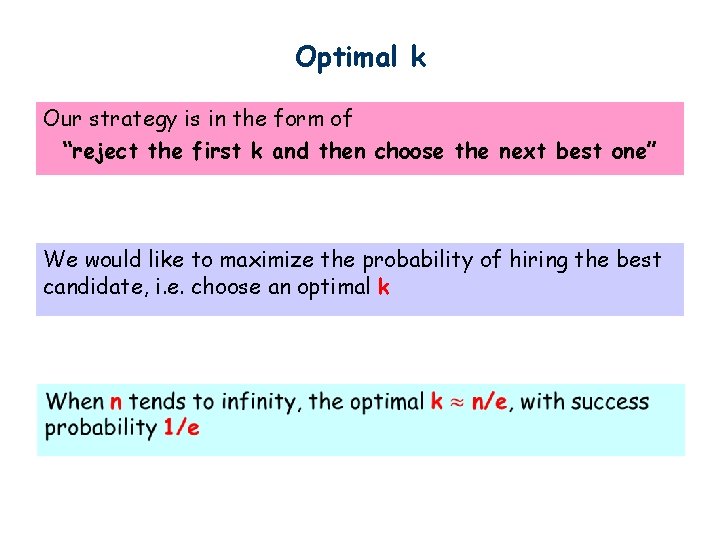
Optimal k Our strategy is in the form of “reject the first k and then choose the next best one” We would like to maximize the probability of hiring the best candidate, i. e. choose an optimal k
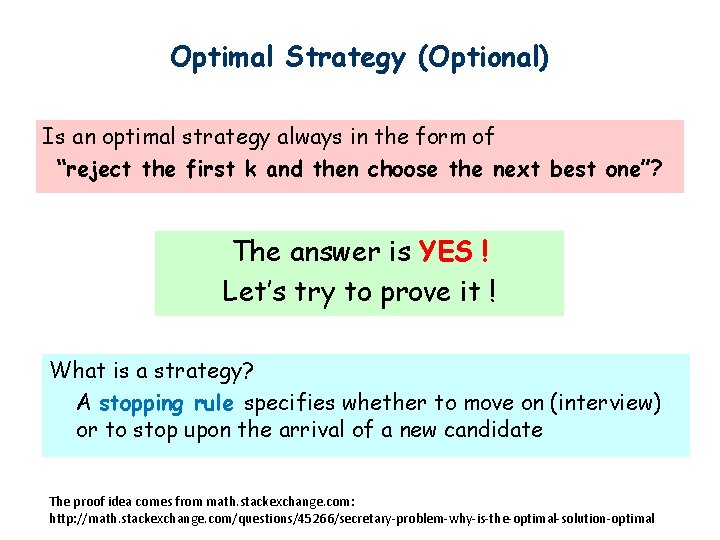
Optimal Strategy (Optional) Is an optimal strategy always in the form of “reject the first k and then choose the next best one”? The answer is YES ! Let’s try to prove it ! What is a strategy? A stopping rule specifies whether to move on (interview) or to stop upon the arrival of a new candidate The proof idea comes from math. stackexchange. com: http: //math. stackexchange. com/questions/45266/secretary-problem-why-is-the-optimal-solution-optimal
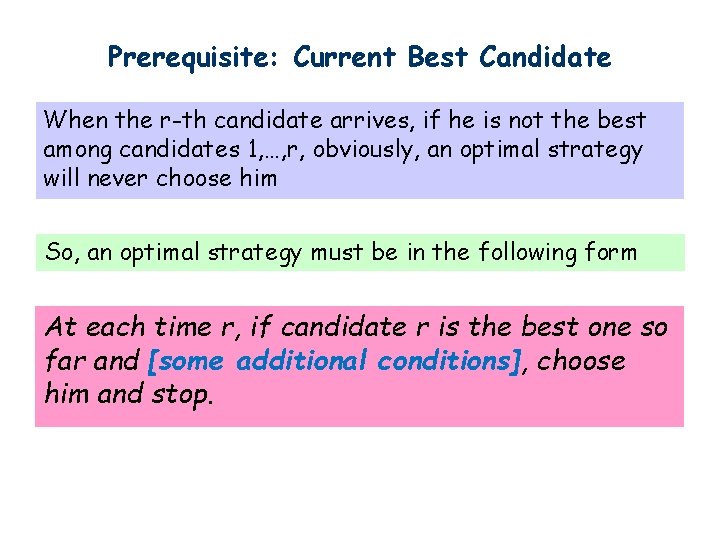
Prerequisite: Current Best Candidate When the r-th candidate arrives, if he is not the best among candidates 1, …, r, obviously, an optimal strategy will never choose him So, an optimal strategy must be in the following form At each time r, if candidate r is the best one so far and [some additional conditions], choose him and stop.
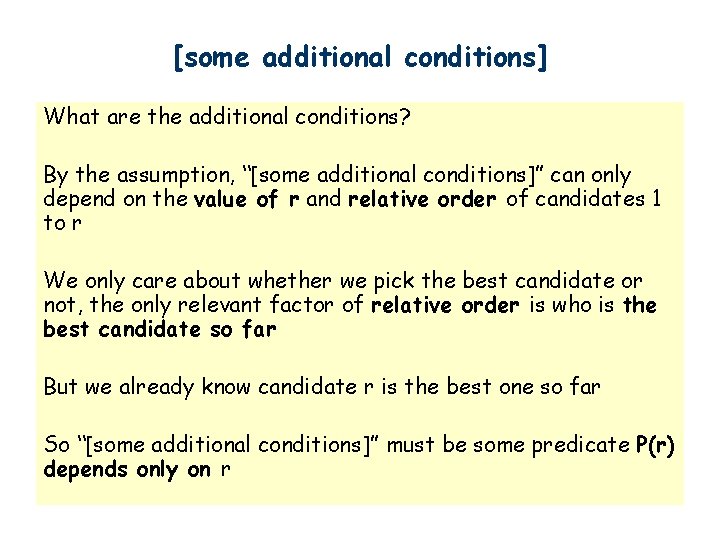
[some additional conditions] What are the additional conditions? By the assumption, “[some additional conditions]” can only depend on the value of r and relative order of candidates 1 to r We only care about whether we pick the best candidate or not, the only relevant factor of relative order is who is the best candidate so far But we already know candidate r is the best one so far So “[some additional conditions]” must be some predicate P(r) depends only on r
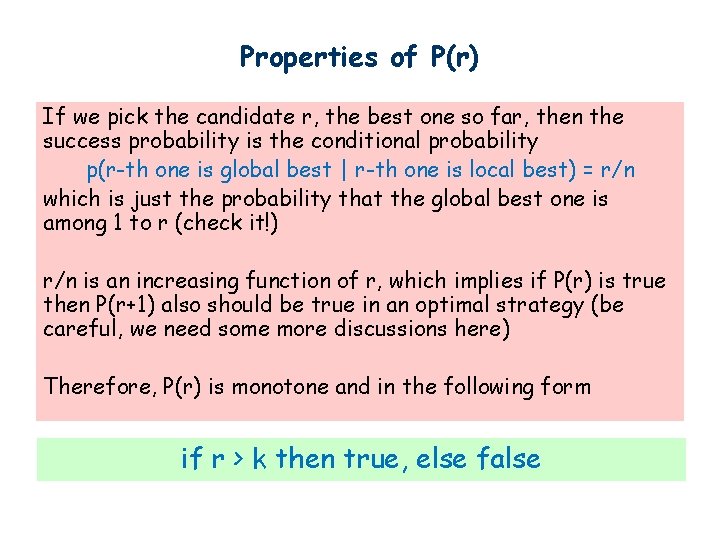
Properties of P(r) If we pick the candidate r, the best one so far, then the success probability is the conditional probability p(r-th one is global best | r-th one is local best) = r/n which is just the probability that the global best one is among 1 to r (check it!) r/n is an increasing function of r, which implies if P(r) is true then P(r+1) also should be true in an optimal strategy (be careful, we need some more discussions here) Therefore, P(r) is monotone and in the following form if r > k then true, else false
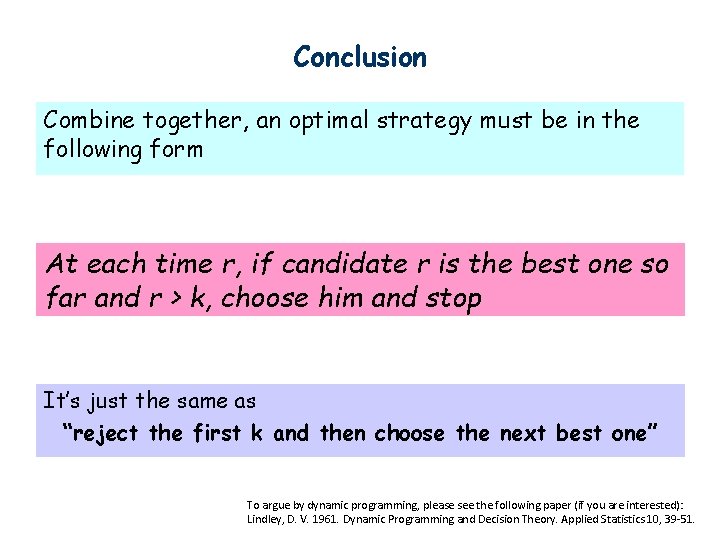
Conclusion Combine together, an optimal strategy must be in the following form At each time r, if candidate r is the best one so far and r > k, choose him and stop It’s just the same as “reject the first k and then choose the next best one” To argue by dynamic programming, please see the following paper (if you are interested): Lindley, D. V. 1961. Dynamic Programming and Decision Theory. Applied Statistics 10, 39 -51.
Thank You! Q&A?