CS 276 A Information Retrieval Lecture 9 Recap

- Slides: 43
CS 276 A Information Retrieval Lecture 9
Recap of the last lecture n n Results summaries Evaluating a search engine n n Benchmarks Precision and recall
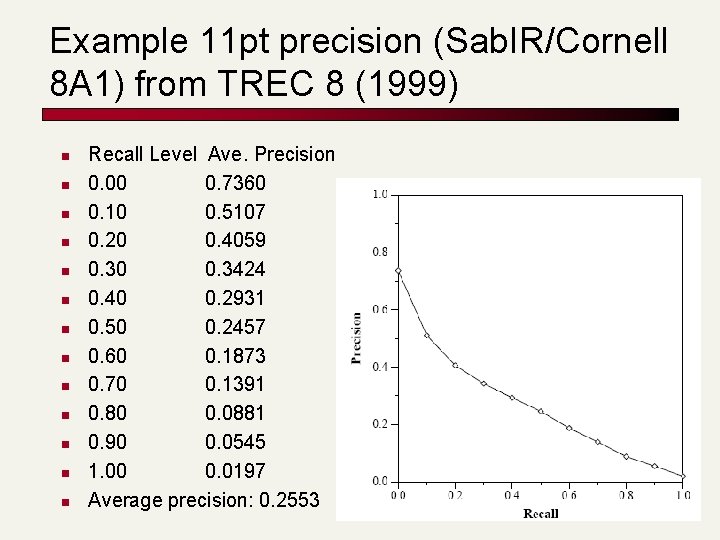
Example 11 pt precision (Sab. IR/Cornell 8 A 1) from TREC 8 (1999) n n n n Recall Level Ave. Precision 0. 00 0. 7360 0. 10 0. 5107 0. 20 0. 4059 0. 30 0. 3424 0. 40 0. 2931 0. 50 0. 2457 0. 60 0. 1873 0. 70 0. 1391 0. 80 0. 0881 0. 90 0. 0545 1. 00 0. 0197 Average precision: 0. 2553
This lecture n Improving results n n For high recall. E. g. , searching for aircraft didn’t match with plane; nor thermodynamic with heat Options for improving results… n n Relevance feedback The complete landscape n n Global methods n Query expansion n Thesauri n Automatic thesaurus generation Local methods n Relevance feedback n Pseudo relevance feedback
Relevance Feedback n Relevance feedback: user feedback on relevance of docs in initial set of results n n n User issues a (short, simple) query The user marks returned documents as relevant or non-relevant. The system computes a better representation of the information need based on feedback. Relevance feedback can go through one or more iterations. Idea: it may be difficult to formulate a good query when you don’t know the collection well, so iterate
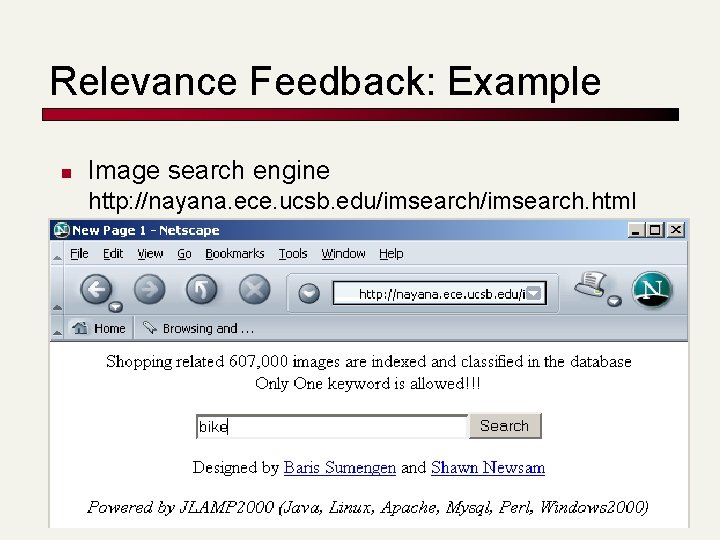
Relevance Feedback: Example n Image search engine http: //nayana. ece. ucsb. edu/imsearch. html
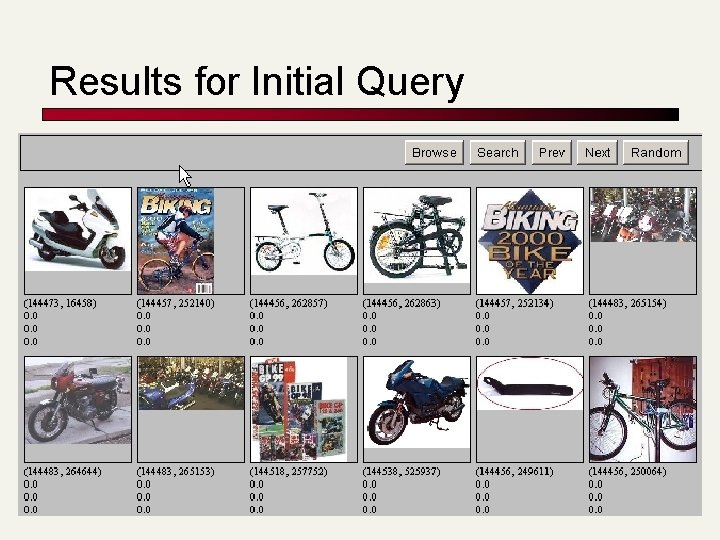
Results for Initial Query
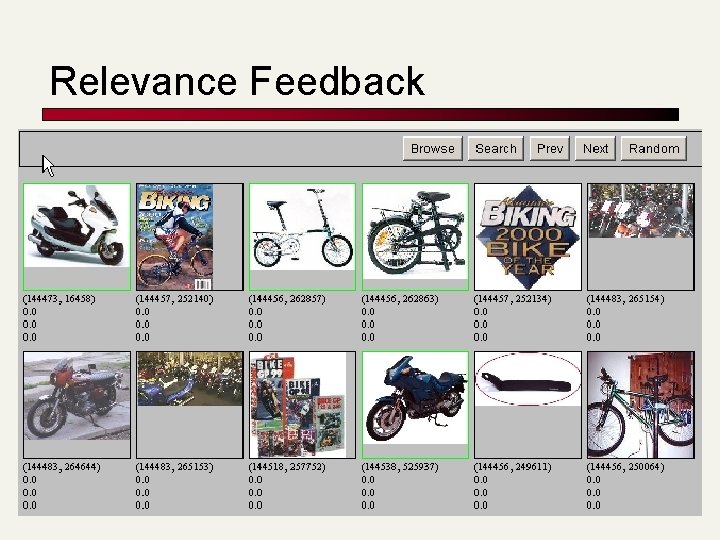
Relevance Feedback
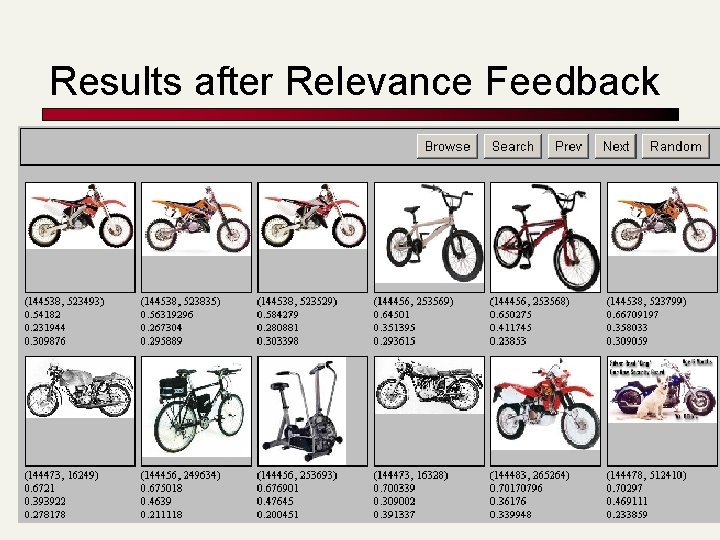
Results after Relevance Feedback
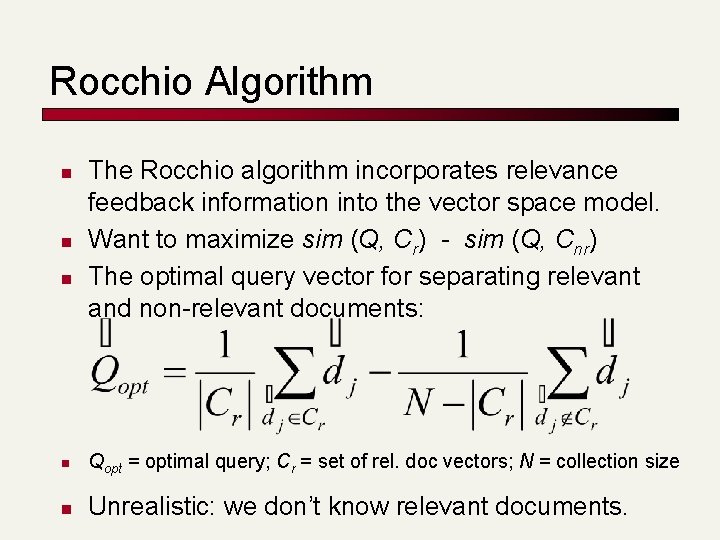
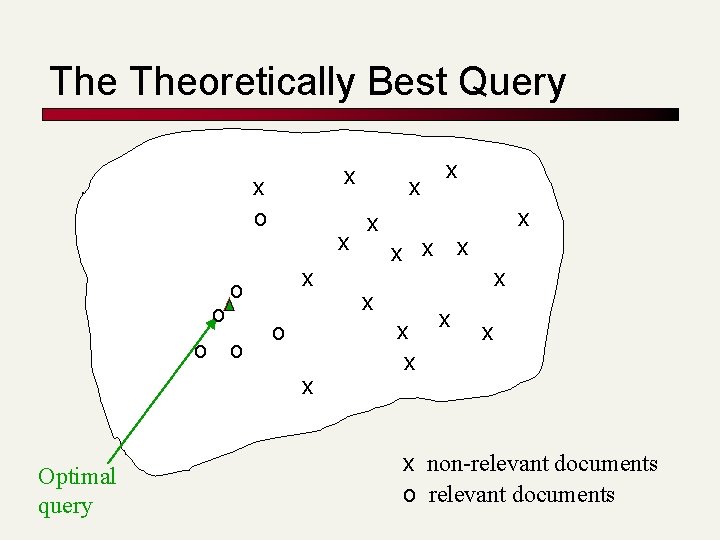
Rocchio Algorithm n n n The Rocchio algorithm incorporates relevance feedback information into the vector space model. Want to maximize sim (Q, Cr) - sim (Q, Cnr) The optimal query vector for separating relevant and non-relevant documents: n Qopt = optimal query; Cr = set of rel. doc vectors; N = collection size n Unrealistic: we don’t know relevant documents.
The Theoretically Best Query x x o o o x Optimal query x x x x non-relevant documents o relevant documents
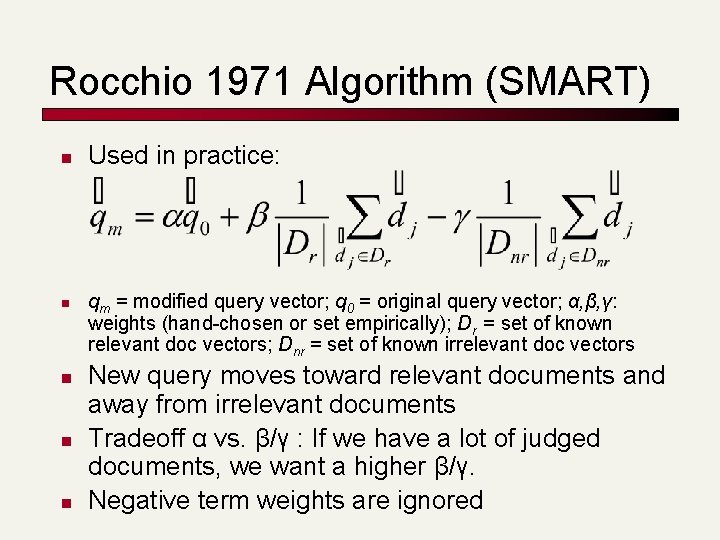
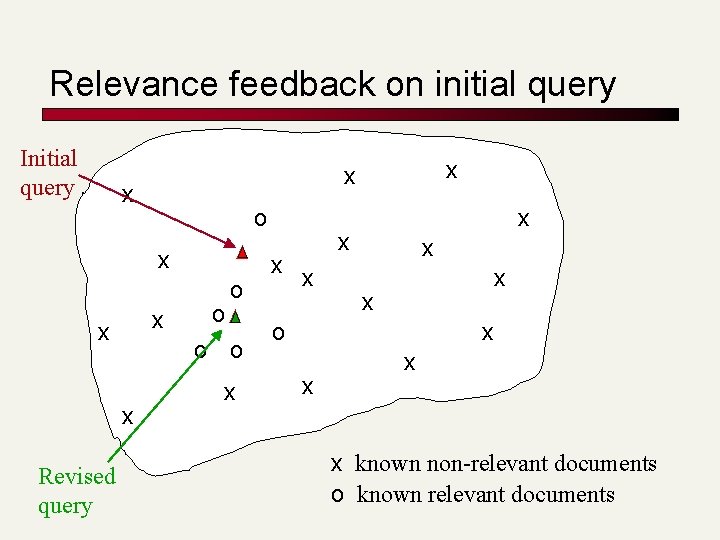
Rocchio 1971 Algorithm (SMART) n n n Used in practice: qm = modified query vector; q 0 = original query vector; α, β, γ: weights (hand-chosen or set empirically); Dr = set of known relevant doc vectors; Dnr = set of known irrelevant doc vectors New query moves toward relevant documents and away from irrelevant documents Tradeoff α vs. β/γ : If we have a lot of judged documents, we want a higher β/γ. Negative term weights are ignored
Relevance feedback on initial query Initial query x o x x x Revised query x x o o o x x x x o x x known non-relevant documents o known relevant documents
Relevance Feedback in vector spaces n n We can modify the query based on relevance feedback and apply standard vector space model. Use only the docs that were marked. Relevance feedback can improve recall and precision Relevance feedback is most useful for increasing recall in situations where recall is important n Users can be expected to review results and to take time to iterate
Positive vs Negative Feedback n n Positive feedback is more valuable than negative feedback (so, set < ; e. g. = 0. 25, = 0. 75). Many systems only allow positive feedback ( =0). W ? y h
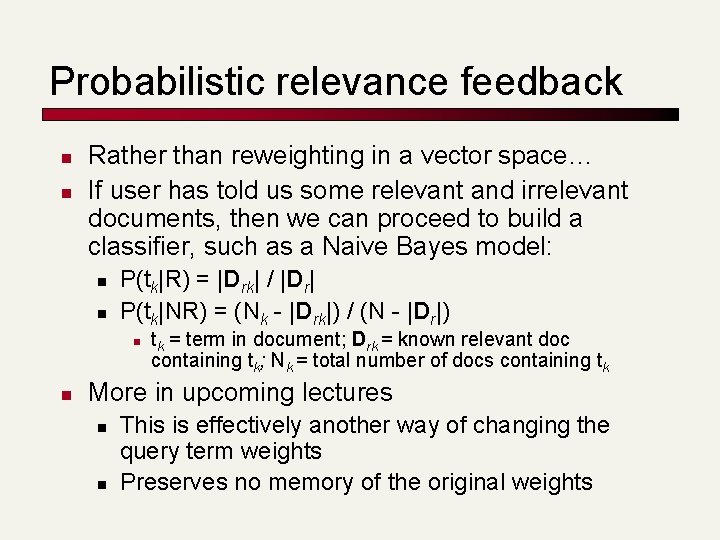
Probabilistic relevance feedback n n Rather than reweighting in a vector space… If user has told us some relevant and irrelevant documents, then we can proceed to build a classifier, such as a Naive Bayes model: n n P(tk|R) = |Drk| / |Dr| P(tk|NR) = (Nk - |Drk|) / (N - |Dr|) n n tk = term in document; Drk = known relevant doc containing tk; Nk = total number of docs containing tk More in upcoming lectures n n This is effectively another way of changing the query term weights Preserves no memory of the original weights
Relevance Feedback: Assumptions n n A 1: User has sufficient knowledge for initial query. A 2: Relevance prototypes are “well-behaved”. n n Term distribution in relevant documents will be similar Term distribution in non-relevant documents will be different from those in relevant documents n n n Either: All relevant documents are tightly clustered around a single prototype. Or: There are different prototypes, but they have significant vocabulary overlap. Similarities between relevant and irrelevant documents are small
Violation of A 1 n n User does not have sufficient initial knowledge. Examples: n n n Misspellings (Brittany Speers). Cross-language information retrieval (hígado). Mismatch of searcher’s vocabulary vs collection vocabulary n Cosmonaut/astronaut
Violation of A 2 n n There are several relevance prototypes. Examples: n n n Burma/Myanmar Contradictory government policies Pop stars that worked at Burger King Often: instances of a general concept Good editorial content can address problem n Report on contradictory government policies
Relevance Feedback: Cost n Long queries are inefficient for typical IR engine. n n n Long response times for user. High cost for retrieval system. Partial solution: n n n W hy ? Only reweight certain prominent terms n Perhaps top 20 by term frequency Users often reluctant to provide explicit feedback It’s often harder to understand why a particular document was retrieved
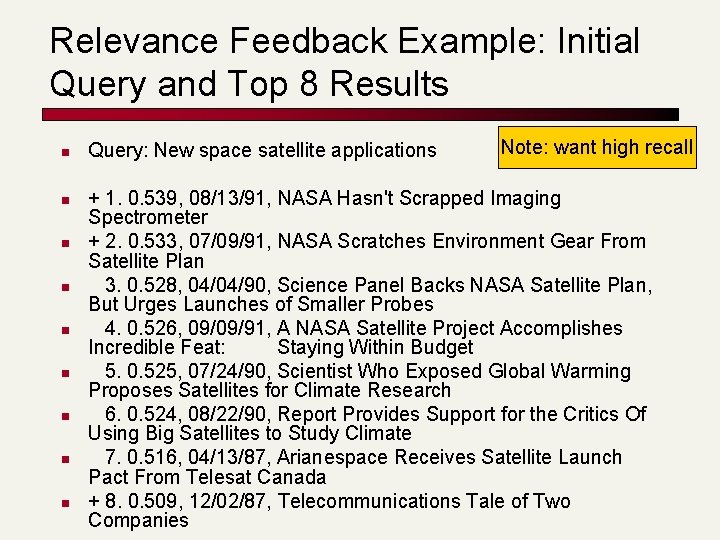
Relevance Feedback Example: Initial Query and Top 8 Results n n n n n Query: New space satellite applications Note: want high recall + 1. 0. 539, 08/13/91, NASA Hasn't Scrapped Imaging Spectrometer + 2. 0. 533, 07/09/91, NASA Scratches Environment Gear From Satellite Plan 3. 0. 528, 04/04/90, Science Panel Backs NASA Satellite Plan, But Urges Launches of Smaller Probes 4. 0. 526, 09/09/91, A NASA Satellite Project Accomplishes Incredible Feat: Staying Within Budget 5. 0. 525, 07/24/90, Scientist Who Exposed Global Warming Proposes Satellites for Climate Research 6. 0. 524, 08/22/90, Report Provides Support for the Critics Of Using Big Satellites to Study Climate 7. 0. 516, 04/13/87, Arianespace Receives Satellite Launch Pact From Telesat Canada + 8. 0. 509, 12/02/87, Telecommunications Tale of Two Companies
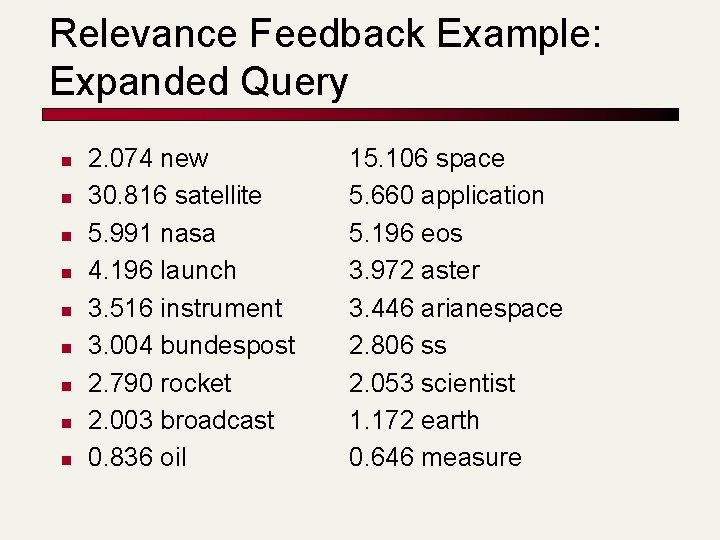
Relevance Feedback Example: Expanded Query n n n n n 2. 074 new 30. 816 satellite 5. 991 nasa 4. 196 launch 3. 516 instrument 3. 004 bundespost 2. 790 rocket 2. 003 broadcast 0. 836 oil 15. 106 space 5. 660 application 5. 196 eos 3. 972 aster 3. 446 arianespace 2. 806 ss 2. 053 scientist 1. 172 earth 0. 646 measure
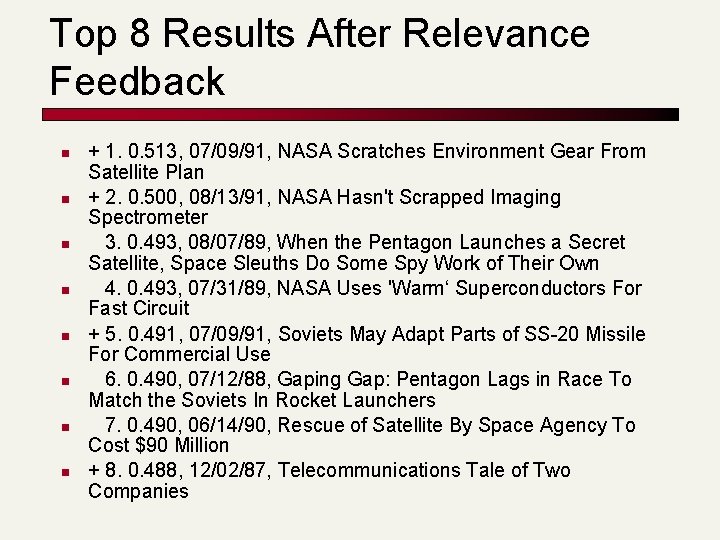
Top 8 Results After Relevance Feedback n n n n + 1. 0. 513, 07/09/91, NASA Scratches Environment Gear From Satellite Plan + 2. 0. 500, 08/13/91, NASA Hasn't Scrapped Imaging Spectrometer 3. 0. 493, 08/07/89, When the Pentagon Launches a Secret Satellite, Space Sleuths Do Some Spy Work of Their Own 4. 0. 493, 07/31/89, NASA Uses 'Warm‘ Superconductors For Fast Circuit + 5. 0. 491, 07/09/91, Soviets May Adapt Parts of SS-20 Missile For Commercial Use 6. 0. 490, 07/12/88, Gaping Gap: Pentagon Lags in Race To Match the Soviets In Rocket Launchers 7. 0. 490, 06/14/90, Rescue of Satellite By Space Agency To Cost $90 Million + 8. 0. 488, 12/02/87, Telecommunications Tale of Two Companies
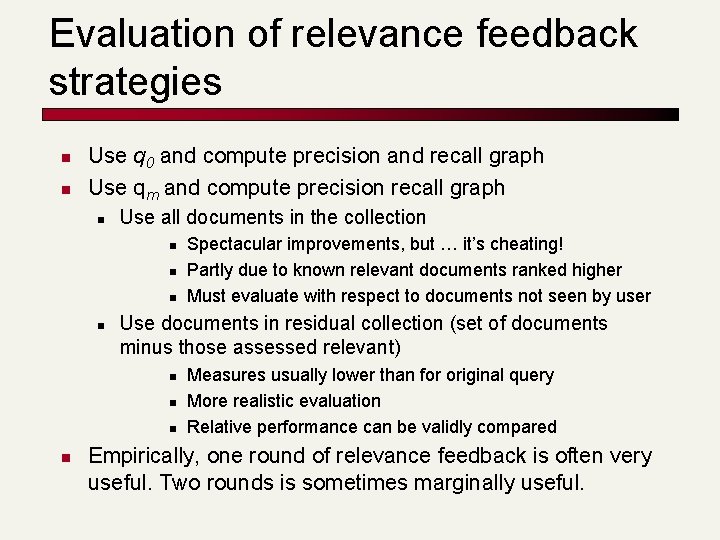
Evaluation of relevance feedback strategies n n Use q 0 and compute precision and recall graph Use qm and compute precision recall graph n Use all documents in the collection n n Use documents in residual collection (set of documents minus those assessed relevant) n n Spectacular improvements, but … it’s cheating! Partly due to known relevant documents ranked higher Must evaluate with respect to documents not seen by user Measures usually lower than for original query More realistic evaluation Relative performance can be validly compared Empirically, one round of relevance feedback is often very useful. Two rounds is sometimes marginally useful.
Relevance Feedback on the Web n Some search engines offer a similar/related pages feature (trivial form of relevance feedback) n n α/β/γ ? ? But some don’t because it’s hard to explain to average user: n n Google (link-based) Altavista Stanford web Alltheweb msn Yahoo Excite initially had true relevance feedback, but abandoned it due to lack of use.
Other Uses of Relevance Feedback n n n Following a changing information need Maintaining an information filter (e. g. , for a news feed) Active learning [Deciding which examples it is most useful to know the class of to reduce annotation costs]
Relevance Feedback Summary n Relevance feedback has been shown to be effective at improving relevance of results. n n n Requires enough judged documents, otherwise it’s unstable (≥ 5 recommended) For queries in which the set of relevant documents is medium to large Full relevance feedback is painful for the user. Full relevance feedback is not very efficient in most IR systems. Other types of interactive retrieval may improve relevance by as much with less work.
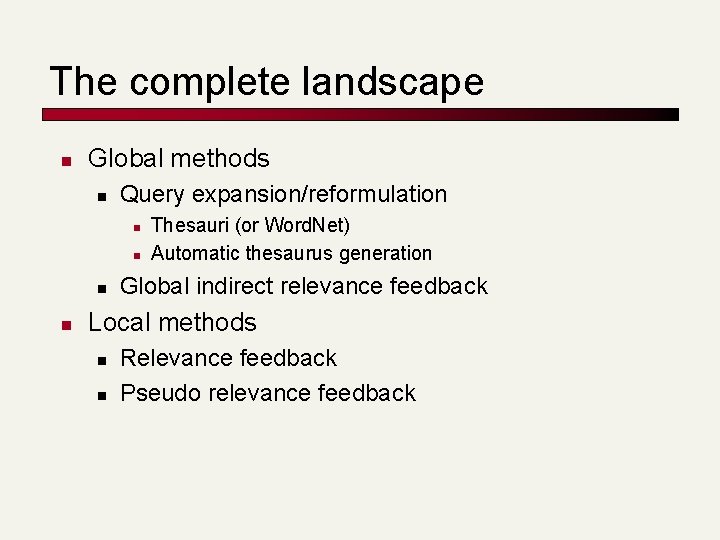
The complete landscape n Global methods n Query expansion/reformulation n n Thesauri (or Word. Net) Automatic thesaurus generation Global indirect relevance feedback Local methods n n Relevance feedback Pseudo relevance feedback
Query Reformulation: Vocabulary Tools n Feedback n n n Information about stop lists, stemming, etc. Numbers of hits on each term or phrase Suggestions n n n Thesaurus Controlled vocabulary Browse lists of terms in the inverted index
Query Expansion n n In relevance feedback, users give additional input (relevant/non-relevant) on documents, which is used to reweight terms in the documents In query expansion, users give additional input (good/bad search term) on words or phrases.
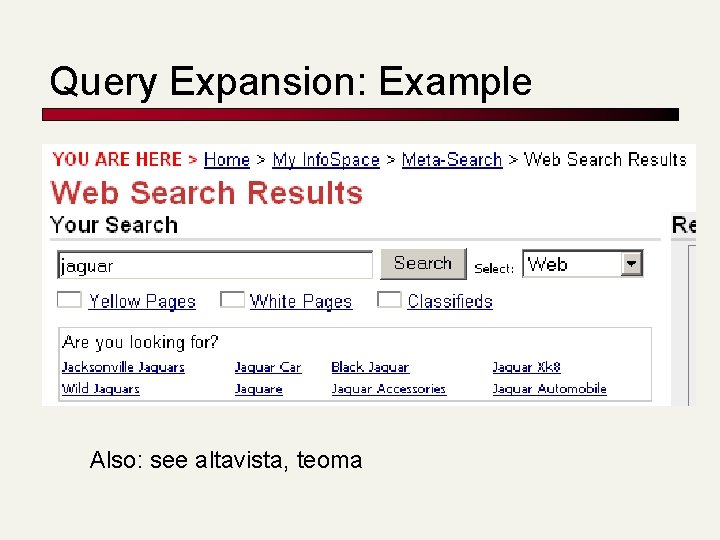
Query Expansion: Example Also: see altavista, teoma
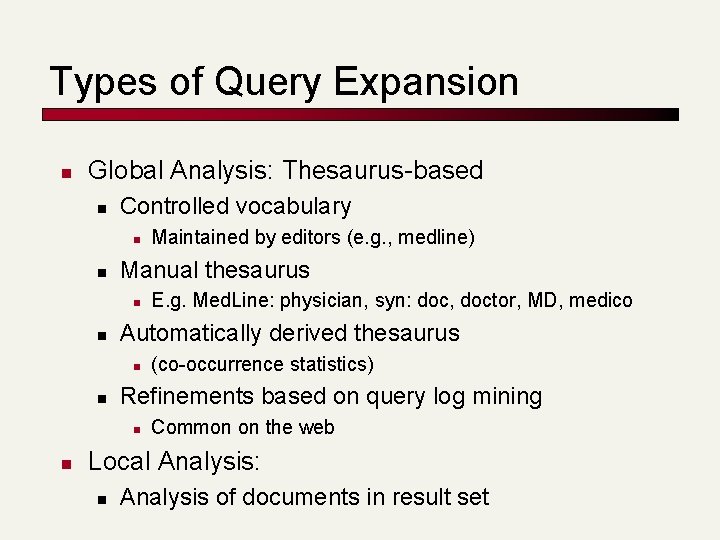
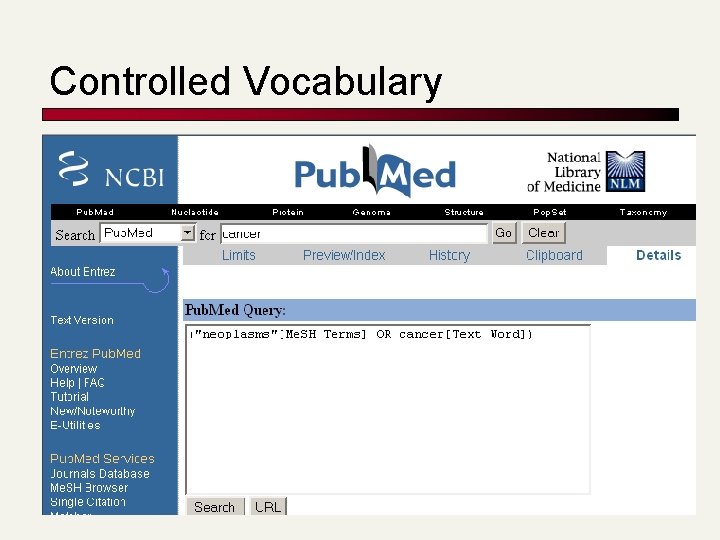
Types of Query Expansion n Global Analysis: Thesaurus-based n Controlled vocabulary n n Manual thesaurus n n (co-occurrence statistics) Refinements based on query log mining n n E. g. Med. Line: physician, syn: doc, doctor, MD, medico Automatically derived thesaurus n n Maintained by editors (e. g. , medline) Common on the web Local Analysis: n Analysis of documents in result set
Controlled Vocabulary
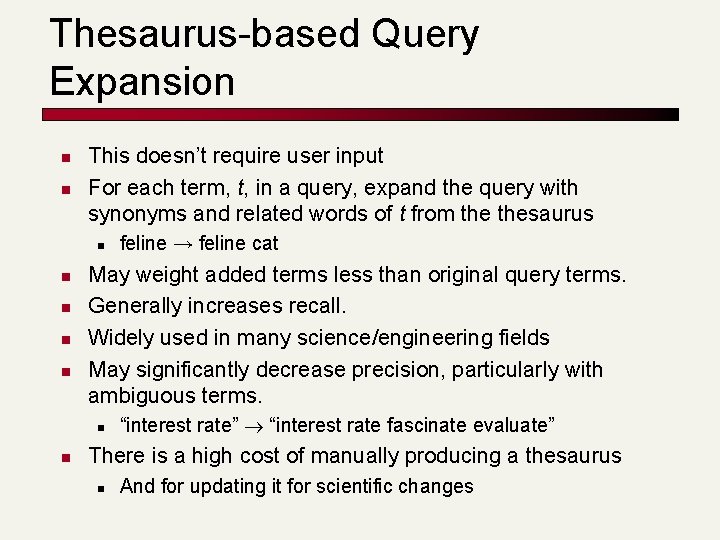
Thesaurus-based Query Expansion n n This doesn’t require user input For each term, t, in a query, expand the query with synonyms and related words of t from thesaurus n n n May weight added terms less than original query terms. Generally increases recall. Widely used in many science/engineering fields May significantly decrease precision, particularly with ambiguous terms. n n feline → feline cat “interest rate” “interest rate fascinate evaluate” There is a high cost of manually producing a thesaurus n And for updating it for scientific changes
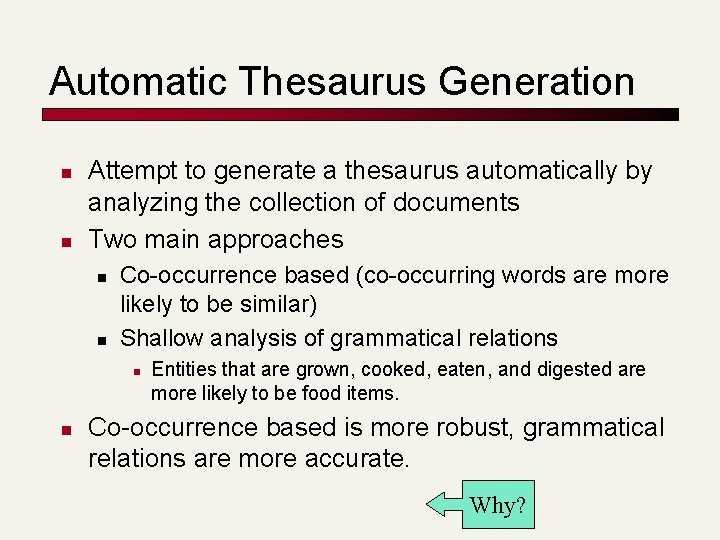
Automatic Thesaurus Generation n n Attempt to generate a thesaurus automatically by analyzing the collection of documents Two main approaches n n Co-occurrence based (co-occurring words are more likely to be similar) Shallow analysis of grammatical relations n n Entities that are grown, cooked, eaten, and digested are more likely to be food items. Co-occurrence based is more robust, grammatical relations are more accurate. Why?
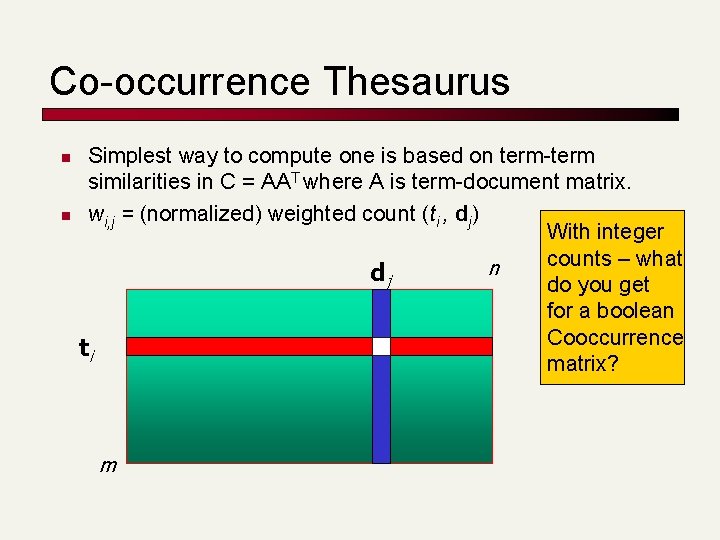
Co-occurrence Thesaurus n n Simplest way to compute one is based on term-term similarities in C = AAT where A is term-document matrix. wi, j = (normalized) weighted count (ti , dj) With integer counts – what n dj do you get for a boolean Cooccurrence ti matrix? m
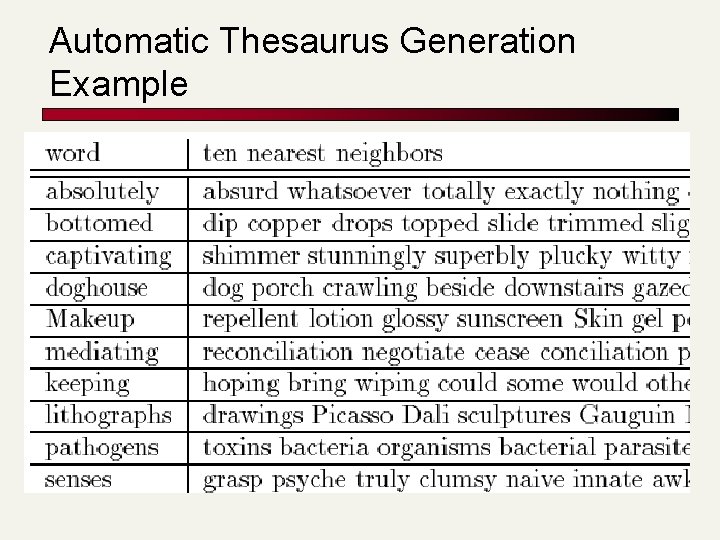
Automatic Thesaurus Generation Example
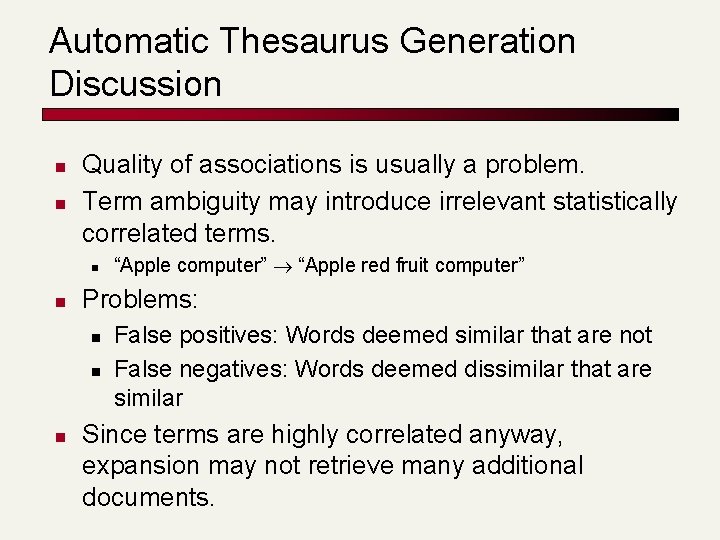
Automatic Thesaurus Generation Discussion n n Quality of associations is usually a problem. Term ambiguity may introduce irrelevant statistically correlated terms. n n Problems: n n n “Apple computer” “Apple red fruit computer” False positives: Words deemed similar that are not False negatives: Words deemed dissimilar that are similar Since terms are highly correlated anyway, expansion may not retrieve many additional documents.
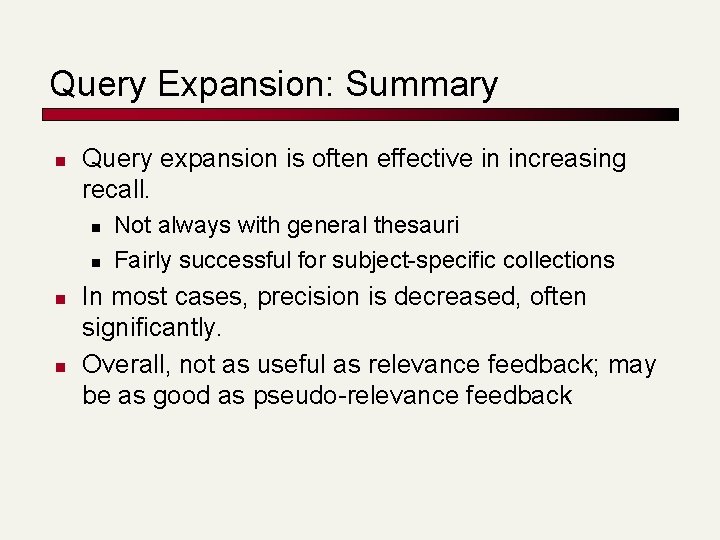
Query Expansion: Summary n Query expansion is often effective in increasing recall. n n Not always with general thesauri Fairly successful for subject-specific collections In most cases, precision is decreased, often significantly. Overall, not as useful as relevance feedback; may be as good as pseudo-relevance feedback
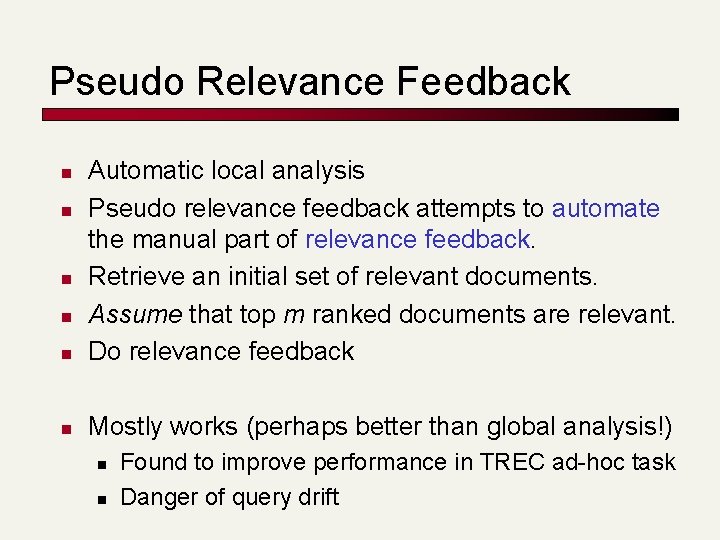
Pseudo Relevance Feedback n Automatic local analysis Pseudo relevance feedback attempts to automate the manual part of relevance feedback. Retrieve an initial set of relevant documents. Assume that top m ranked documents are relevant. Do relevance feedback n Mostly works (perhaps better than global analysis!) n n n Found to improve performance in TREC ad-hoc task Danger of query drift
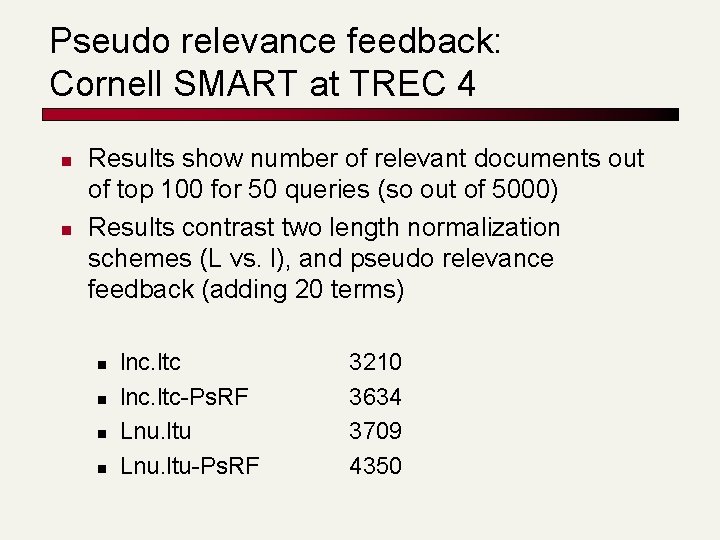
Pseudo relevance feedback: Cornell SMART at TREC 4 n n Results show number of relevant documents out of top 100 for 50 queries (so out of 5000) Results contrast two length normalization schemes (L vs. l), and pseudo relevance feedback (adding 20 terms) n n lnc. ltc-Ps. RF Lnu. ltu-Ps. RF 3210 3634 3709 4350
Indirect relevance feedback [Forward pointer to CS 276 B] n Direct. Hit introduced a form of indirect relevance feedback. n Direct. Hit ranked documents higher that users look at more often. n Global: Not user or query specific.
Resources MG Ch. 4. 7 MIR Ch. 5. 2 – 5. 4 Yonggang Qiu , Hans-Peter Frei, Concept based query expansion. SIGIR 16: 161– 169, 1993. Schuetze: Automatic Word Sense Discrimination, Computational Linguistics, 1998. Singhal, Mitra, Buckley: Learning routing queries in a query zone, ACM SIGIR, 1997. Buckley, Singhal, Mitra, Salton, New retrieval approaches using SMART: TREC 4, NIST, 1996. Gerard Salton and Chris Buckley. Improving retrieval performance by relevance feedback. Journal of the American Society for Information Science, 41(4): 288 -297, 1990. Harman, D. (1992): Relevance feedback revisited. SIGIR 15: 1 -10 Xu, J. , Croft, W. B. (1996): Query Expansion Using Local and Global Document Analysis, in SIGIR 19: 4 -11