Cryogenic Cooling System for the E 951 Pulsed
- Slides: 16
Cryogenic Cooling System for the E 951 Pulsed Solenoid Magnet • Basic System Description/ Cooling Scheme • Cooling Scheme Conceptual P&ID – Plan Arrangement, Heat Exchanger Detail & Picture • System Parameters – Circulation Pump Specifications • • Summary of Predicted Heat Exchanger Performances Experimental Safety Considerations and Plan Cryogen Usage and Case Dependant Operational Costs Phased Construction and Installation Costs Michael Iarocci E 951 Cryogenics Brookhaven National Laboratory February 9, 2002 Muon Collaboration Technical Board 1
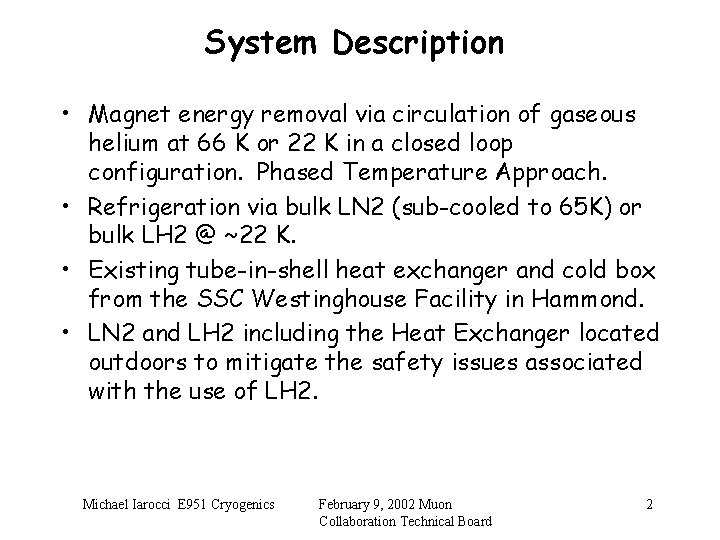
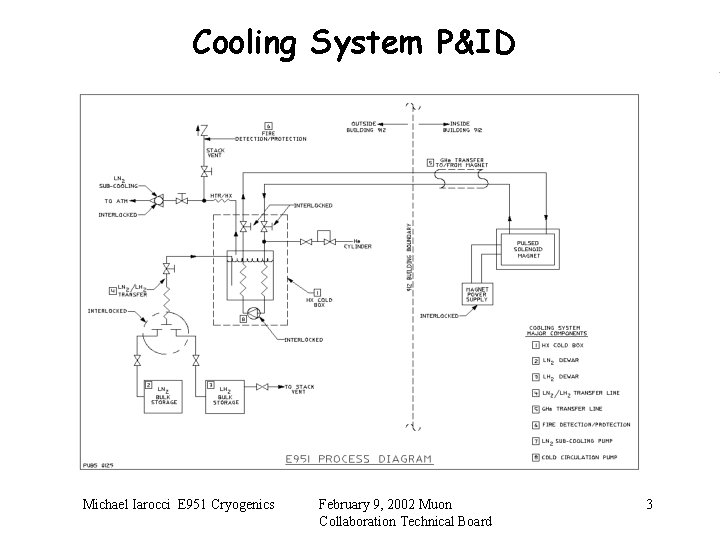
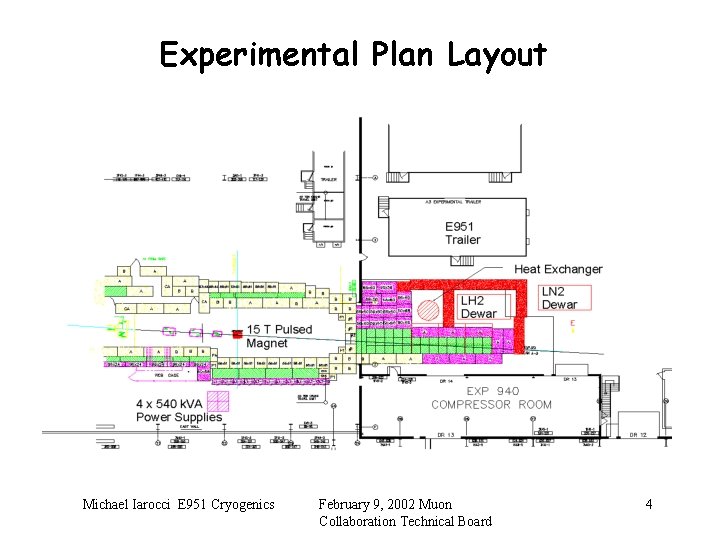
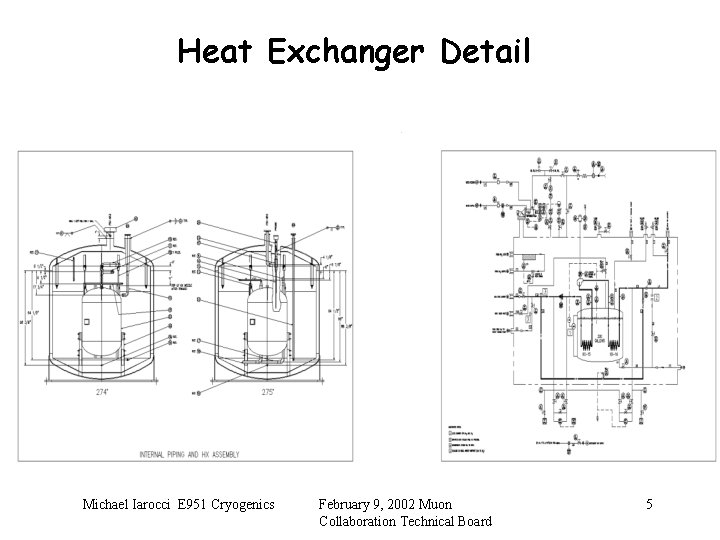
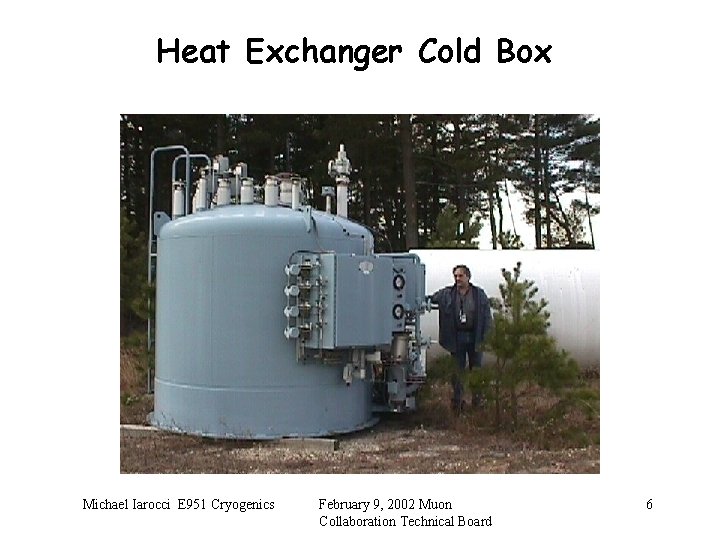
System Description • Magnet energy removal via circulation of gaseous helium at 66 K or 22 K in a closed loop configuration. Phased Temperature Approach. • Refrigeration via bulk LN 2 (sub-cooled to 65 K) or bulk LH 2 @ ~22 K. • Existing tube-in-shell heat exchanger and cold box from the SSC Westinghouse Facility in Hammond. • LN 2 and LH 2 including the Heat Exchanger located outdoors to mitigate the safety issues associated with the use of LH 2. Michael Iarocci E 951 Cryogenics February 9, 2002 Muon Collaboration Technical Board 2
Cooling System P&ID Michael Iarocci E 951 Cryogenics February 9, 2002 Muon Collaboration Technical Board 3
Experimental Plan Layout Michael Iarocci E 951 Cryogenics February 9, 2002 Muon Collaboration Technical Board 4
Heat Exchanger Detail Michael Iarocci E 951 Cryogenics February 9, 2002 Muon Collaboration Technical Board 5
Heat Exchanger Cold Box Michael Iarocci E 951 Cryogenics February 9, 2002 Muon Collaboration Technical Board 6
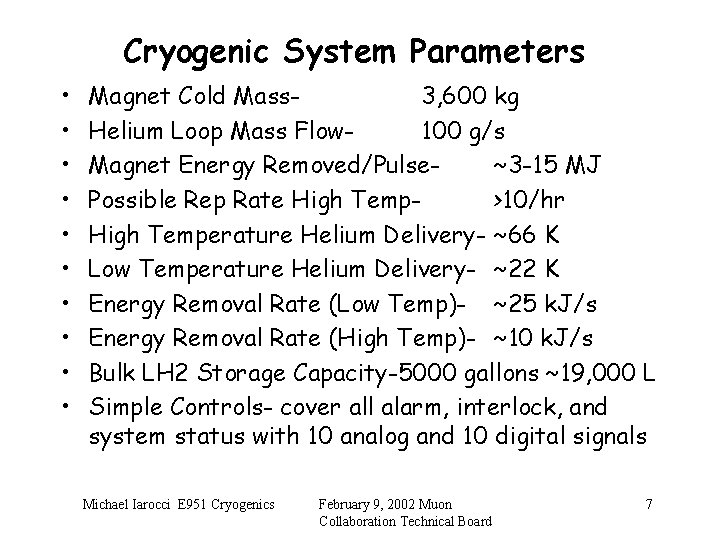
Cryogenic System Parameters • • • Magnet Cold Mass 3, 600 kg Helium Loop Mass Flow 100 g/s Magnet Energy Removed/Pulse~3 -15 MJ Possible Rep Rate High Temp>10/hr High Temperature Helium Delivery- ~66 K Low Temperature Helium Delivery- ~22 K Energy Removal Rate (Low Temp)- ~25 k. J/s Energy Removal Rate (High Temp)- ~10 k. J/s Bulk LH 2 Storage Capacity-5000 gallons ~19, 000 L Simple Controls- cover all alarm, interlock, and system status with 10 analog and 10 digital signals Michael Iarocci E 951 Cryogenics February 9, 2002 Muon Collaboration Technical Board 7
Circulation Pump Specifications • • Semi-hermetic Centrifugal Configuration Working Pressure 15 ATM Head Pressure 1. 5 ATM Mass Flow Rate 100 g/s Efficiency~ 45% Pump Work (66 K Mode)3. 2 k. W (~ 25%) Pump Work (22 K Mode)1. 1 k. W (~ 5%) Turn-down Ratio~ 4 (Standby operation) Michael Iarocci E 951 Cryogenics February 9, 2002 Muon Collaboration Technical Board 8
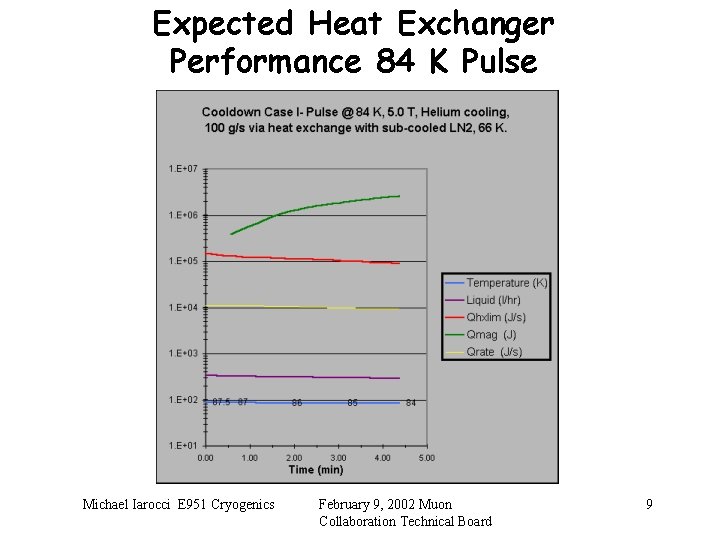
Expected Heat Exchanger Performance 84 K Pulse Michael Iarocci E 951 Cryogenics February 9, 2002 Muon Collaboration Technical Board 9
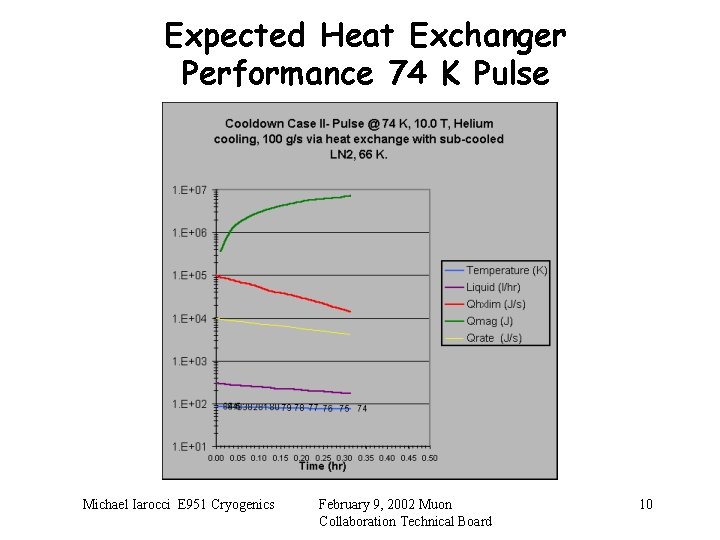
Expected Heat Exchanger Performance 74 K Pulse Michael Iarocci E 951 Cryogenics February 9, 2002 Muon Collaboration Technical Board 10
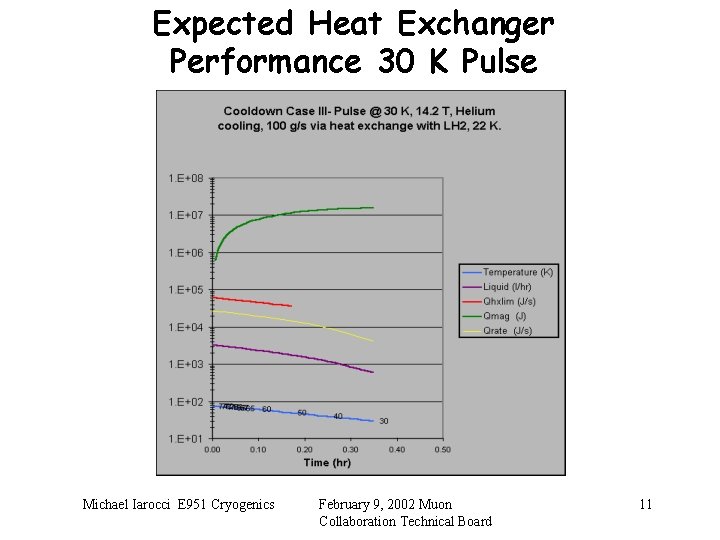
Expected Heat Exchanger Performance 30 K Pulse Michael Iarocci E 951 Cryogenics February 9, 2002 Muon Collaboration Technical Board 11
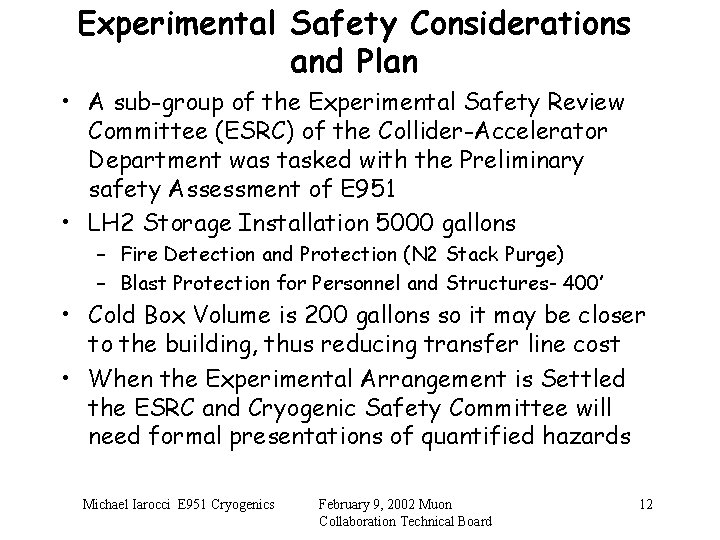
Experimental Safety Considerations and Plan • A sub-group of the Experimental Safety Review Committee (ESRC) of the Collider-Accelerator Department was tasked with the Preliminary safety Assessment of E 951 • LH 2 Storage Installation 5000 gallons – Fire Detection and Protection (N 2 Stack Purge) – Blast Protection for Personnel and Structures- 400’ • Cold Box Volume is 200 gallons so it may be closer to the building, thus reducing transfer line cost • When the Experimental Arrangement is Settled the ESRC and Cryogenic Safety Committee will need formal presentations of quantified hazards Michael Iarocci E 951 Cryogenics February 9, 2002 Muon Collaboration Technical Board 12
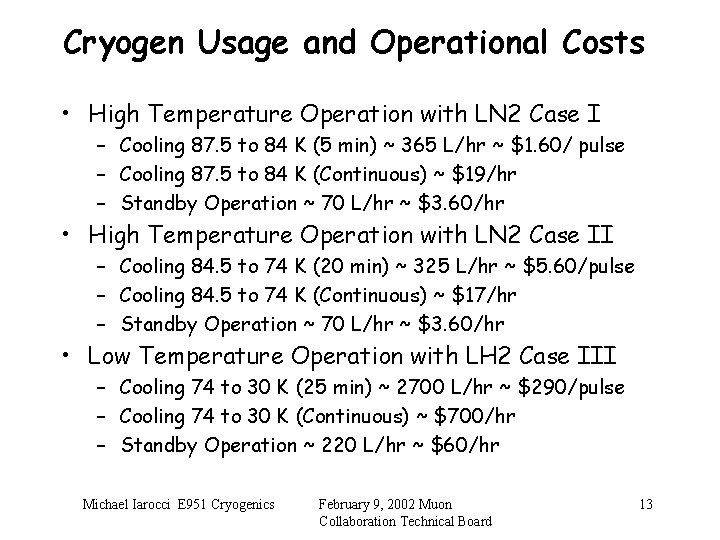
Cryogen Usage and Operational Costs • High Temperature Operation with LN 2 Case I – Cooling 87. 5 to 84 K (5 min) ~ 365 L/hr ~ $1. 60/ pulse – Cooling 87. 5 to 84 K (Continuous) ~ $19/hr – Standby Operation ~ 70 L/hr ~ $3. 60/hr • High Temperature Operation with LN 2 Case II – Cooling 84. 5 to 74 K (20 min) ~ 325 L/hr ~ $5. 60/pulse – Cooling 84. 5 to 74 K (Continuous) ~ $17/hr – Standby Operation ~ 70 L/hr ~ $3. 60/hr • Low Temperature Operation with LH 2 Case III – Cooling 74 to 30 K (25 min) ~ 2700 L/hr ~ $290/pulse – Cooling 74 to 30 K (Continuous) ~ $700/hr – Standby Operation ~ 220 L/hr ~ $60/hr Michael Iarocci E 951 Cryogenics February 9, 2002 Muon Collaboration Technical Board 13
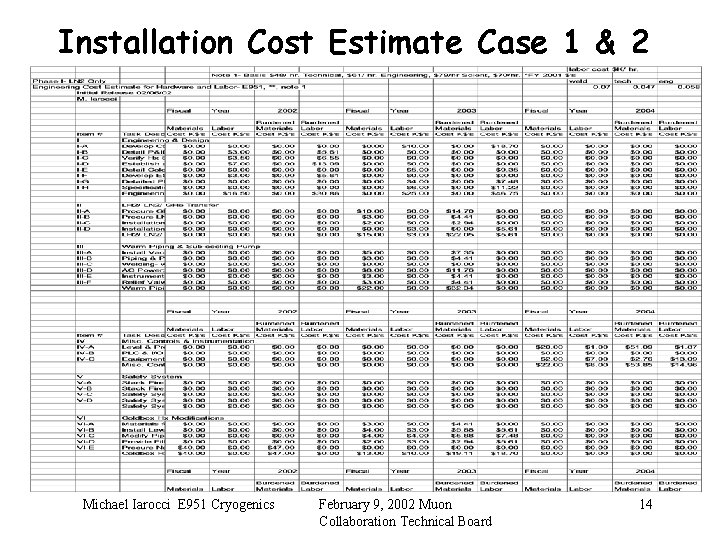
Installation Cost Estimate Case 1 & 2 Michael Iarocci E 951 Cryogenics February 9, 2002 Muon Collaboration Technical Board 14
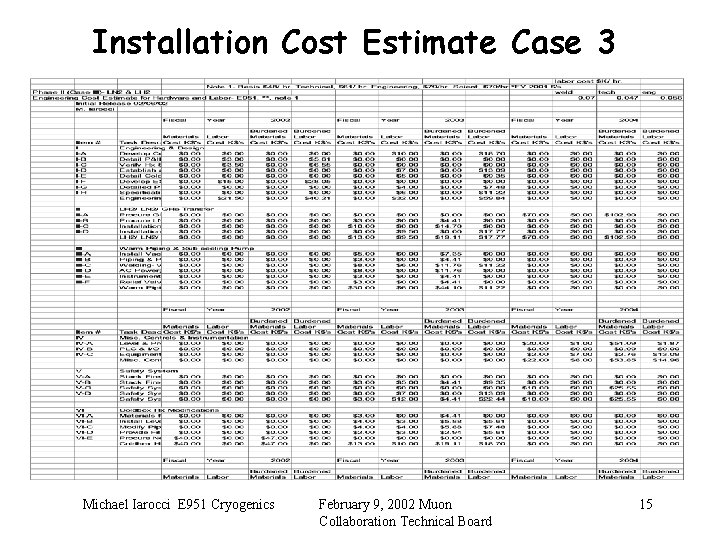
Installation Cost Estimate Case 3 Michael Iarocci E 951 Cryogenics February 9, 2002 Muon Collaboration Technical Board 15
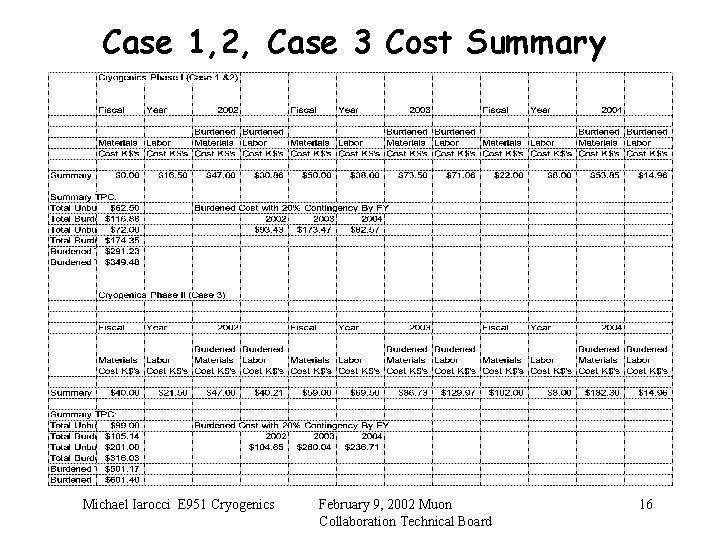
Case 1, 2, Case 3 Cost Summary Michael Iarocci E 951 Cryogenics February 9, 2002 Muon Collaboration Technical Board 16