Critique Jon Kolko Professor Austin Center for Design


- Slides: 13
Critique Jon Kolko Professor, Austin Center for Design
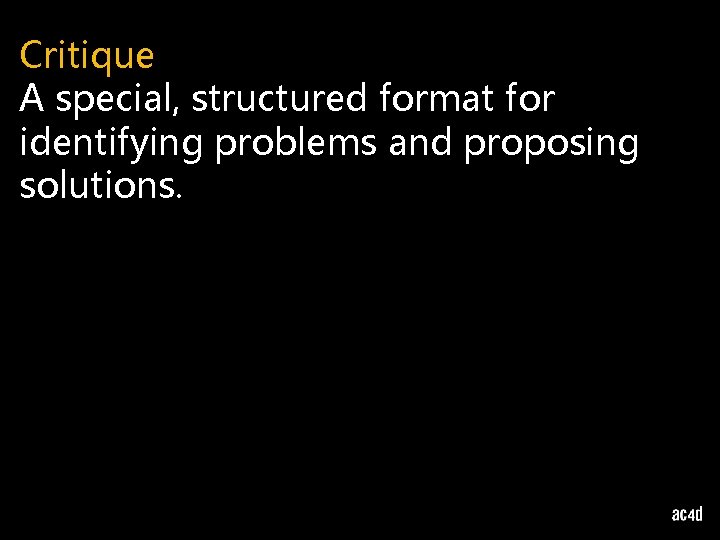
Critique A special, structured format for identifying problems and proposing solutions.
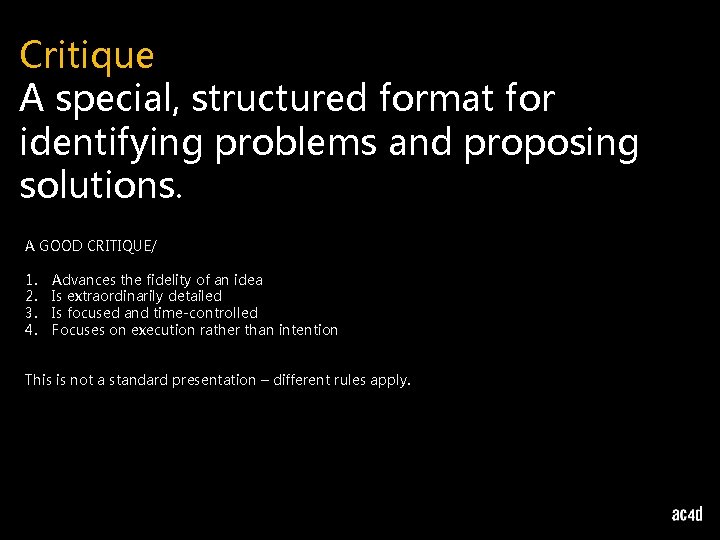
Critique A special, structured format for identifying problems and proposing solutions. A GOOD CRITIQUE/ 1. 2. 3. 4. Advances the fidelity of an idea Is extraordinarily detailed Is focused and time-controlled Focuses on execution rather than intention This is not a standard presentation – different rules apply.
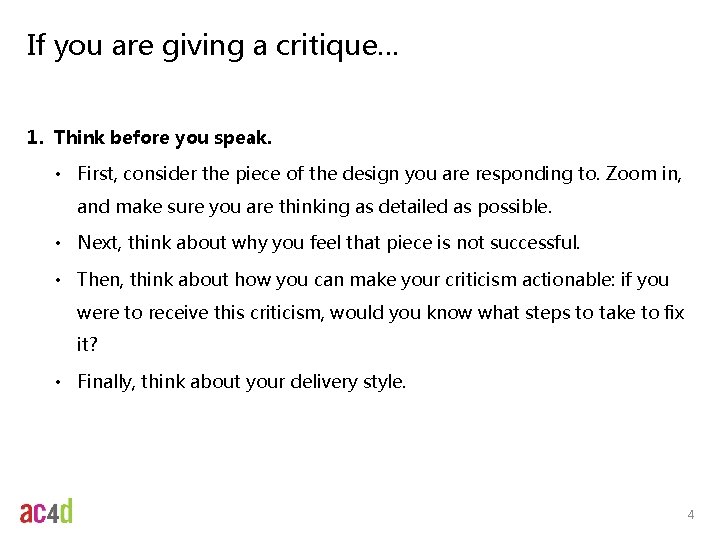
If you are giving a critique… 1. Think before you speak. • First, consider the piece of the design you are responding to. Zoom in, and make sure you are thinking as detailed as possible. • Next, think about why you feel that piece is not successful. • Then, think about how you can make your criticism actionable: if you were to receive this criticism, would you know what steps to take to fix it? • Finally, think about your delivery style. 4
If you are giving a critique… 2. Be succinct and very, very detailed. • A rambling critique is not about the design – it’s about you. Describe your criticism in as concise a manner as possible. • Be as specific as you can about the piece of the product you are responding to. • Be as specific as you can about what’s wrong with it. • Be as specific as you can about how you might fix it. 5
If you are giving a critique… 3. Do not point out something good (unless it’s relevant to make your point clearer) – no “shit sandwich”. • A critique is not intended to highlight the parts of a design that are successful – it’s intended to point out the parts that are not successful. • It may be useful to compare something that is working to something that is not working; this is a good use of positive criticism. 6
If you are giving a critique… 4. Critique the design, never the person. • Direct your comments exclusively to the work. “You didn’t…” is directed at a person. “The design doesn’t…” is directed at the work. 7
If you are being critiqued… 1. Offer a succinct walkthrough of your design. • Present the work at a meta level, so we know what we are responding to. • Direct the criticism. What do you want feedback on? What do you not want feedback on? • Do not self-deprecate. Your work is what it is; do not say things like: “I just didn’t have enough time…” “I know this isn’t great, but…” “I know what I need to change on these already…” 8
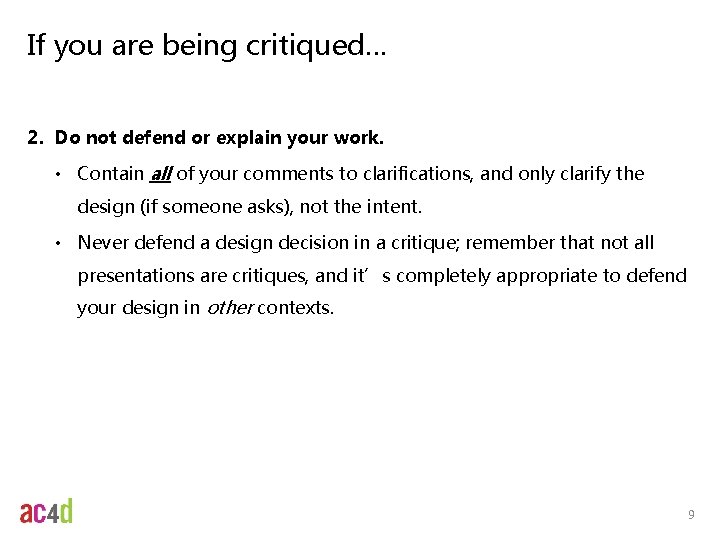
If you are being critiqued… 2. Do not defend or explain your work. • Contain all of your comments to clarifications, and only clarify the design (if someone asks), not the intent. • Never defend a design decision in a critique; remember that not all presentations are critiques, and it’s completely appropriate to defend your design in other contexts. 9
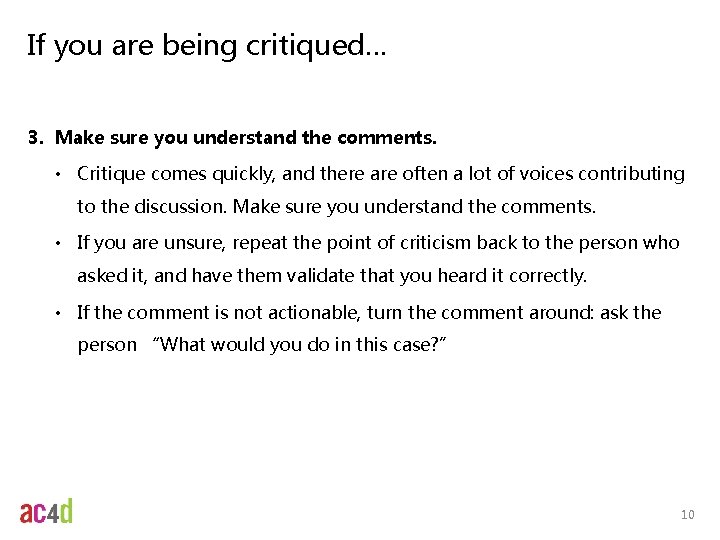
If you are being critiqued… 3. Make sure you understand the comments. • Critique comes quickly, and there are often a lot of voices contributing to the discussion. Make sure you understand the comments. • If you are unsure, repeat the point of criticism back to the person who asked it, and have them validate that you heard it correctly. • If the comment is not actionable, turn the comment around: ask the person “What would you do in this case? ” 10
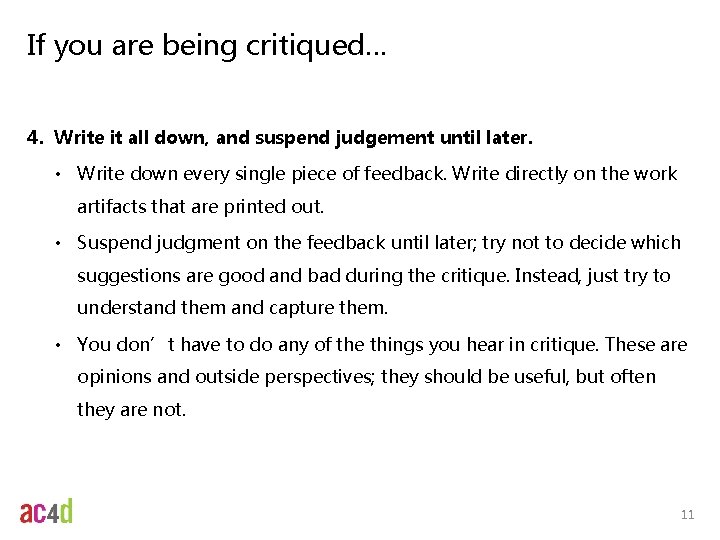
If you are being critiqued… 4. Write it all down, and suspend judgement until later. • Write down every single piece of feedback. Write directly on the work artifacts that are printed out. • Suspend judgment on the feedback until later; try not to decide which suggestions are good and bad during the critique. Instead, just try to understand them and capture them. • You don’t have to do any of the things you hear in critique. These are opinions and outside perspectives; they should be useful, but often they are not. 11
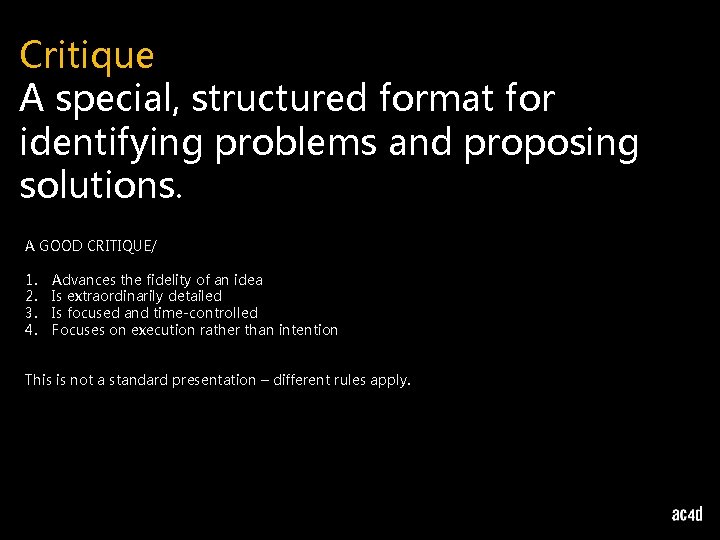
Critique A special, structured format for identifying problems and proposing solutions. A GOOD CRITIQUE/ 1. 2. 3. 4. Advances the fidelity of an idea Is extraordinarily detailed Is focused and time-controlled Focuses on execution rather than intention This is not a standard presentation – different rules apply.
Jon Kolko Director, Austin Center for Design jkolko@ac 4 d. com