Critical Infrastructure Emergency Risk Management Erik Maranik CPEng
- Slides: 12
Critical Infrastructure Emergency Risk Management Erik Maranik CPEng, FIEAust.
Characteristics of a CI Emergency • Major changes to operations • A need to work with many jurisdictions, Government intervention • Heightened community awareness / outrage, extensive media coverage • Unusual deployment and tasking of resources
Catastrophic Consequences • Long-term inability to deliver services • Large number of fatalities/loss-of-life or injuries requiring extended hospitalisation • Widespread displacement of people • Extensive property damage • Severe environmental impact, long-term or permanent damage • Extensive and widespread financial loss
Understanding Context • Ageing and complex services, facilities, and/or resources • Complex intra / interdependencies • Reduction of corporate knowledge and expertise (the ‘Beatles’ 1964) • Reliance on automation and remote control
Understanding Context • Diverse stakeholders / communities / customers / users • Complex decision making and contracts • Lack of modern experience with actual events • “Just-in-Time” procurement – long lead times
Risk Identification • Requires a logical analytical construct, both spatial and temporal, to discover latent risk • Understand the characteristics and interaction of the sources of risk interdependencies • A need to explore and involve a broad crosssection of experience and knowledge (“ 4 G”)
Critical Infrastructure Issues • Loss of the services, facilities and or resources • Extent of influence • Intra/interdependencies • Resources prioritisation and substitutability • Escalation (Incident to Catastrophe) • Magnification
Treatments & Mitigation • • • Operational – precautionary stance Technical possibilities Financial constraints Legal ramifications Social acceptability Environmental influences
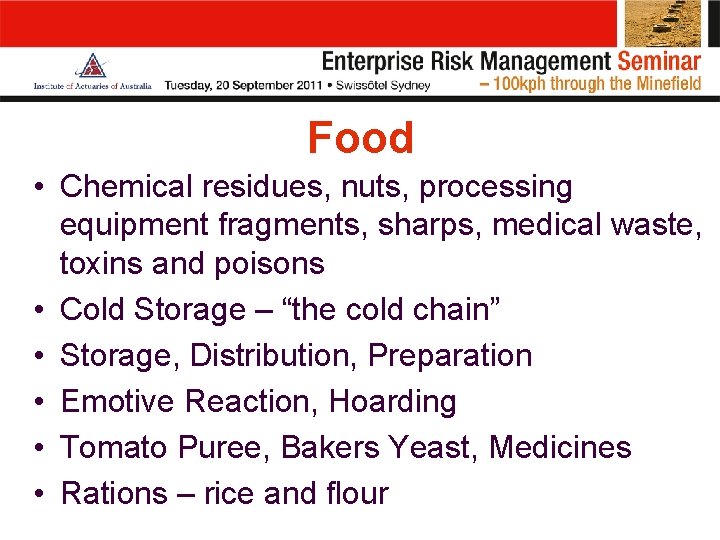
Food • Chemical residues, nuts, processing equipment fragments, sharps, medical waste, toxins and poisons • Cold Storage – “the cold chain” • Storage, Distribution, Preparation • Emotive Reaction, Hoarding • Tomato Puree, Bakers Yeast, Medicines • Rations – rice and flour
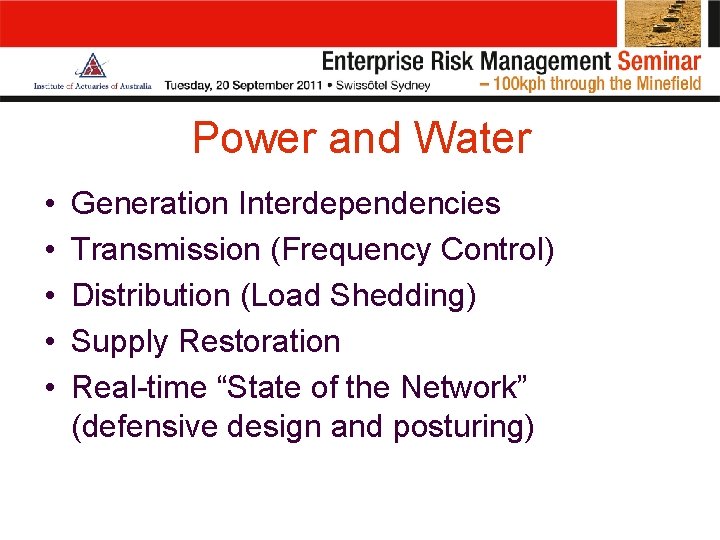
Power and Water • • • Generation Interdependencies Transmission (Frequency Control) Distribution (Load Shedding) Supply Restoration Real-time “State of the Network” (defensive design and posturing)
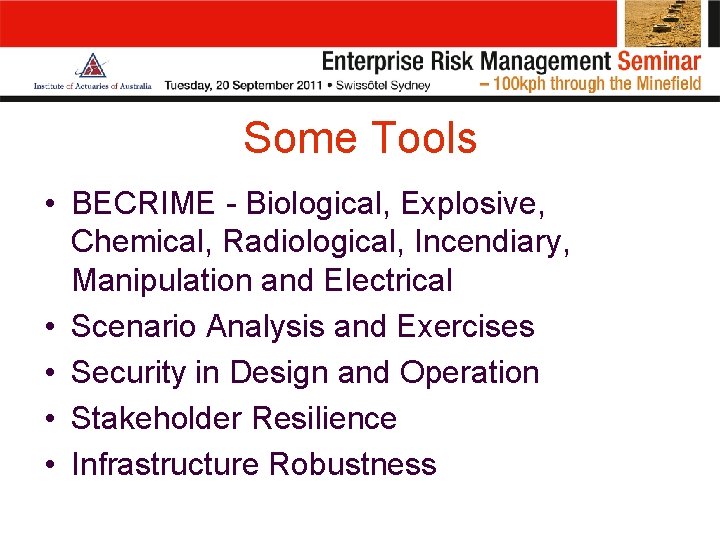
Some Tools • BECRIME - Biological, Explosive, Chemical, Radiological, Incendiary, Manipulation and Electrical • Scenario Analysis and Exercises • Security in Design and Operation • Stakeholder Resilience • Infrastructure Robustness
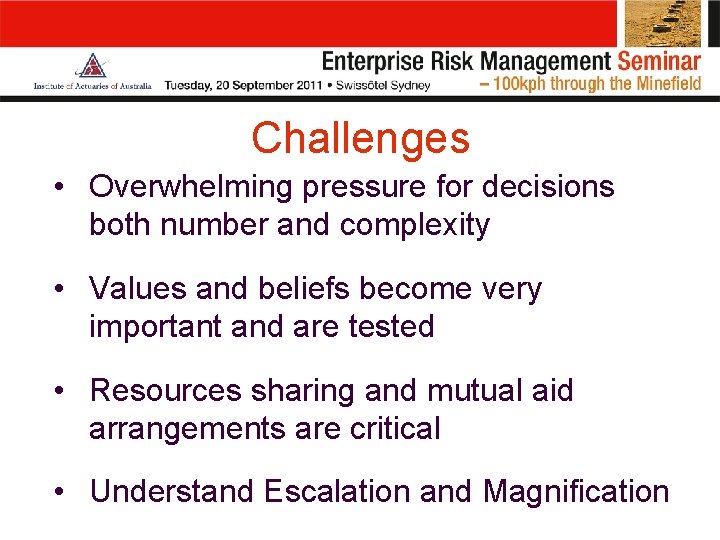
Challenges • Overwhelming pressure for decisions both number and complexity • Values and beliefs become very important and are tested • Resources sharing and mutual aid arrangements are critical • Understand Escalation and Magnification