Costs and Market Structure ECO 171 Costs and

- Slides: 21
Costs and Market Structure ECO 171: Costs and Market Structure 1
Basic ideas • Determinants of market structure: how many firms in an industry? • Economies of scale – Cost functions • Minimum efficient scale • Role of demand • Other determinants ECO 171: Costs and Market Structure 2
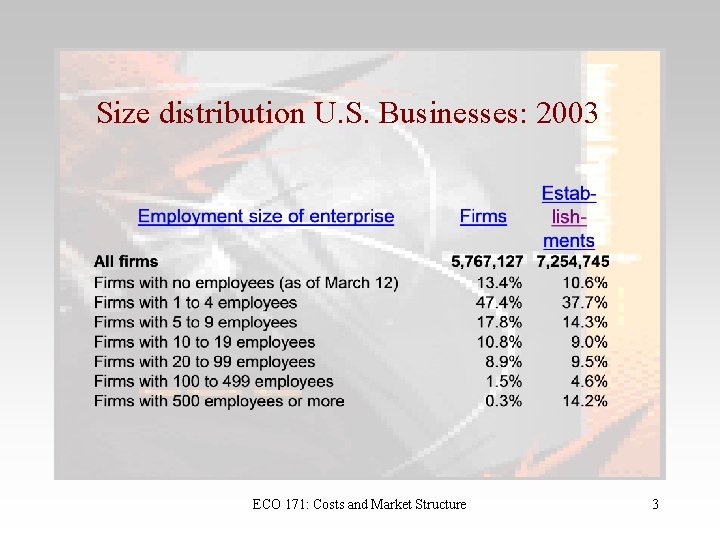
Size distribution U. S. Businesses: 2003 ECO 171: Costs and Market Structure 3
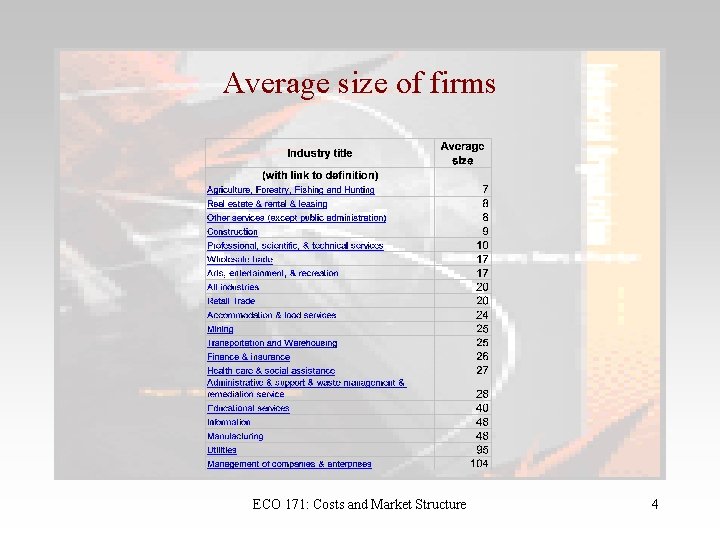
Average size of firms ECO 171: Costs and Market Structure 4
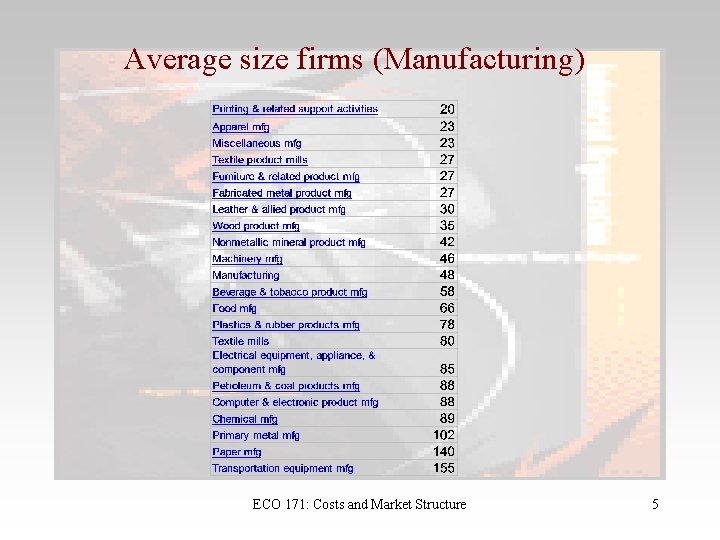
Average size firms (Manufacturing) ECO 171: Costs and Market Structure 5
Observations • • Huge variation in firm size Causes? Economies of scale Market size ECO 171: Costs and Market Structure 6
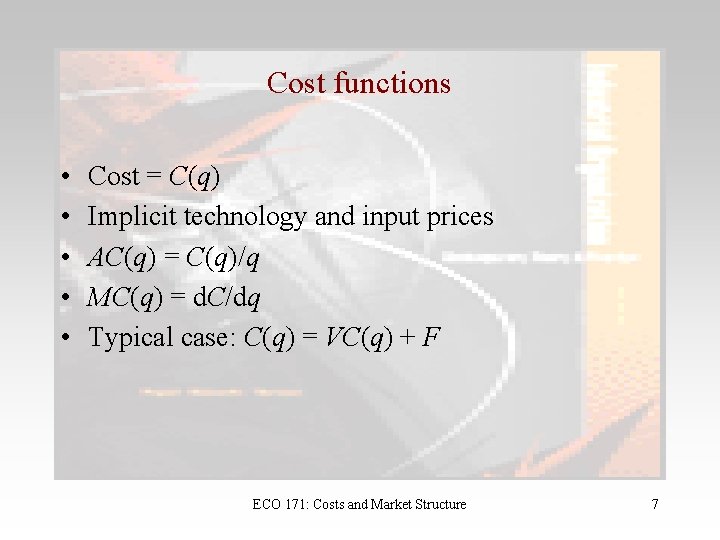
Cost functions • • • Cost = C(q) Implicit technology and input prices AC(q) = C(q)/q MC(q) = d. C/dq Typical case: C(q) = VC(q) + F ECO 171: Costs and Market Structure 7
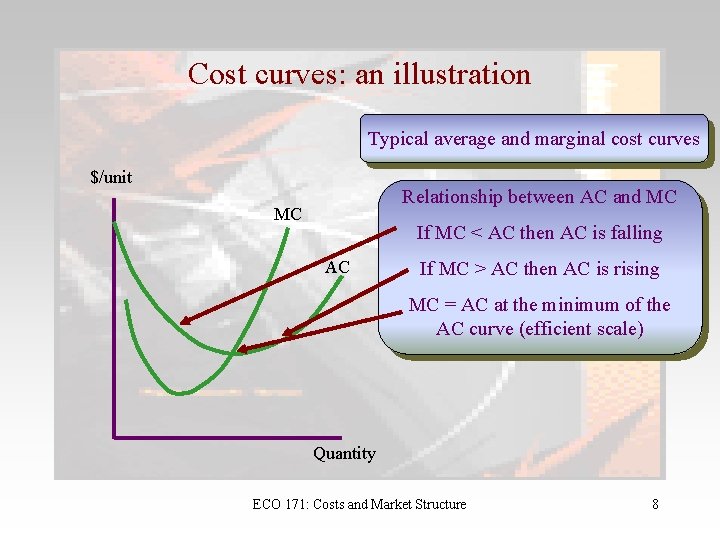
Cost curves: an illustration Typical average and marginal cost curves $/unit Relationship between AC and MC MC If MC < AC then AC is falling AC If MC > AC then AC is rising MC = AC at the minimum of the AC curve (efficient scale) Quantity ECO 171: Costs and Market Structure 8
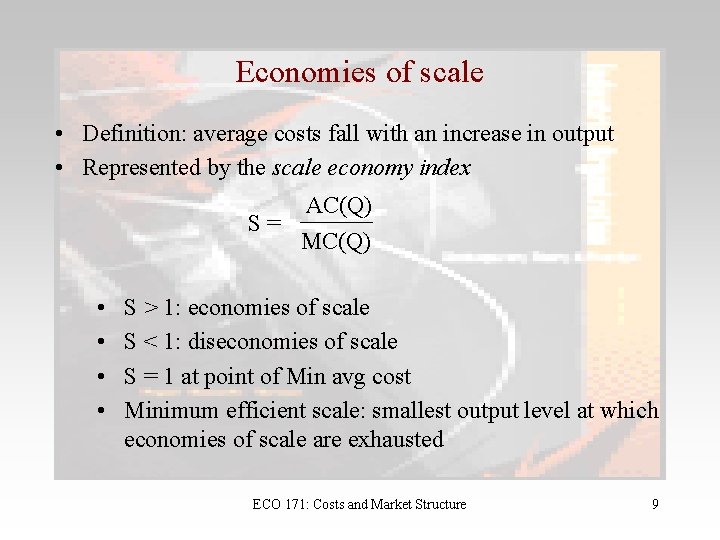
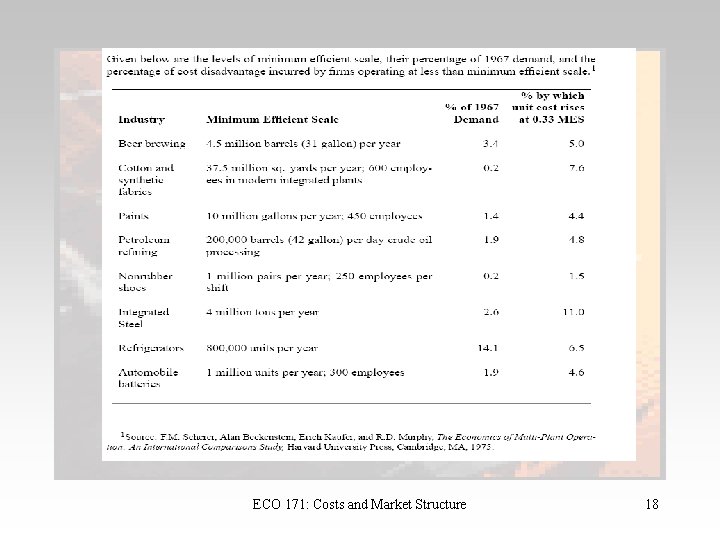
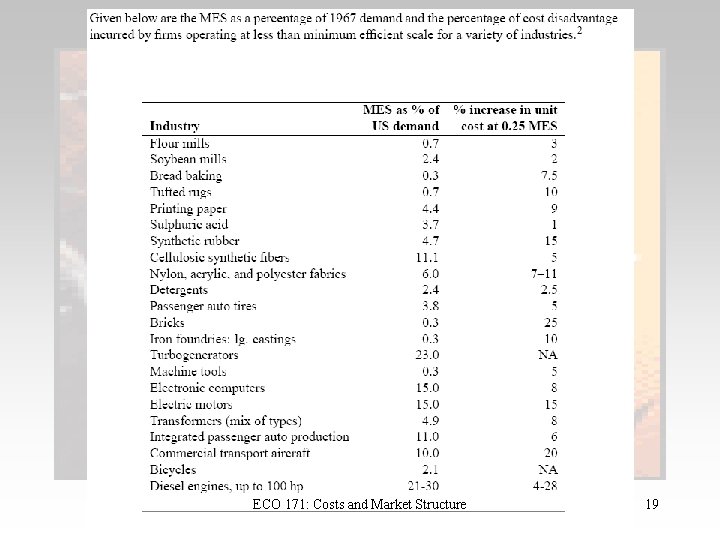
Economies of scale • Definition: average costs fall with an increase in output • Represented by the scale economy index AC(Q) S= MC(Q) • • S > 1: economies of scale S < 1: diseconomies of scale S = 1 at point of Min avg cost Minimum efficient scale: smallest output level at which economies of scale are exhausted ECO 171: Costs and Market Structure 9
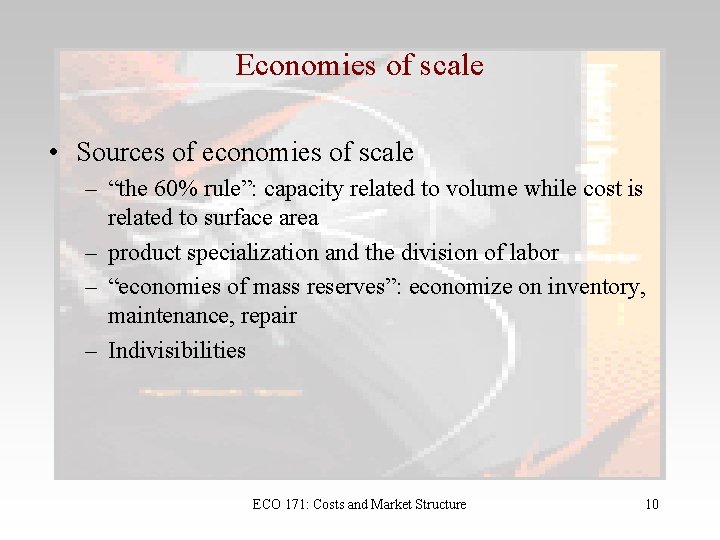
Economies of scale • Sources of economies of scale – “the 60% rule”: capacity related to volume while cost is related to surface area – product specialization and the division of labor – “economies of mass reserves”: economize on inventory, maintenance, repair – Indivisibilities ECO 171: Costs and Market Structure 10
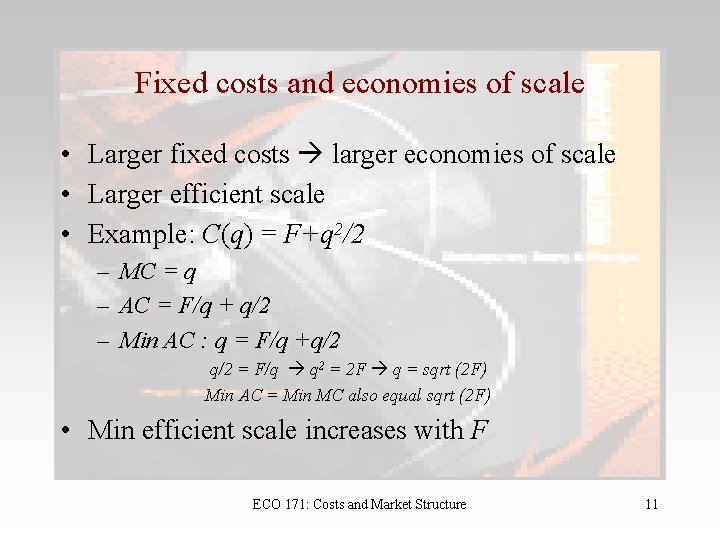
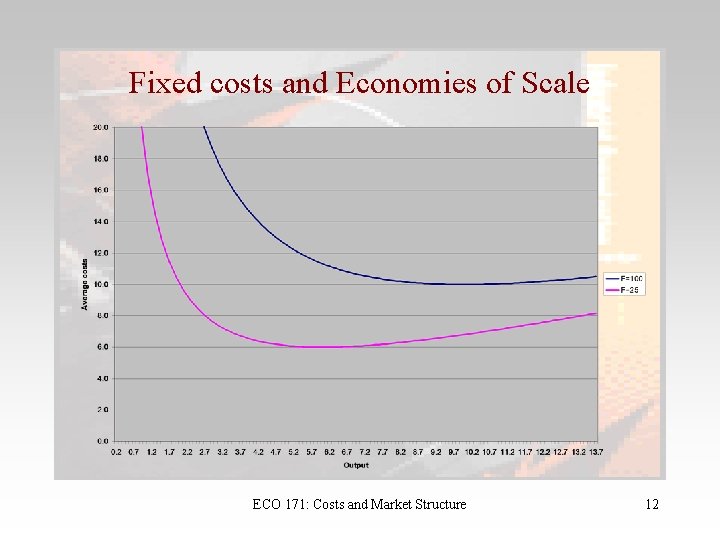
Fixed costs and economies of scale • Larger fixed costs larger economies of scale • Larger efficient scale • Example: C(q) = F+q 2/2 – MC = q – AC = F/q + q/2 – Min AC : q = F/q +q/2 = F/q q 2 = 2 F q = sqrt (2 F) Min AC = Min MC also equal sqrt (2 F) • Min efficient scale increases with F ECO 171: Costs and Market Structure 11
Fixed costs and Economies of Scale ECO 171: Costs and Market Structure 12
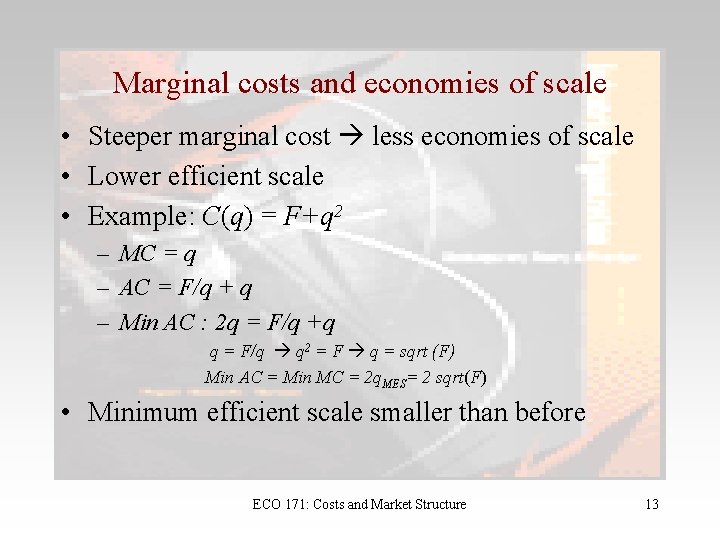
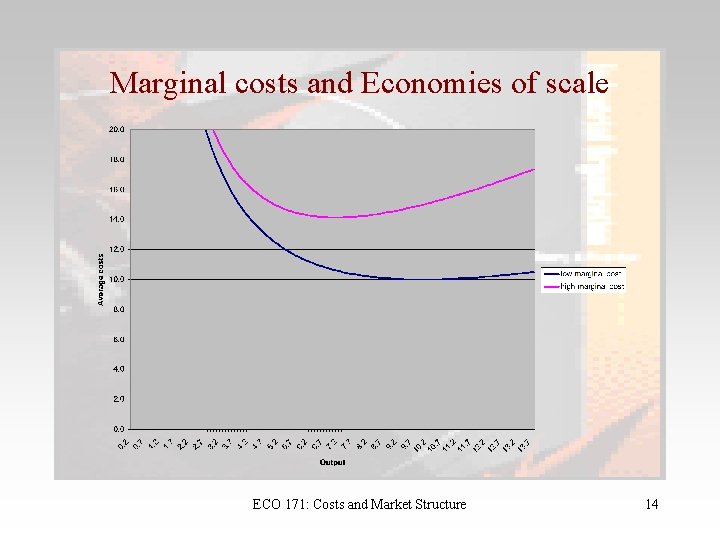
Marginal costs and economies of scale • Steeper marginal cost less economies of scale • Lower efficient scale • Example: C(q) = F+q 2 – MC = q – AC = F/q + q – Min AC : 2 q = F/q +q q = F/q q 2 = F q = sqrt (F) Min AC = Min MC = 2 q. MES= 2 sqrt(F) • Minimum efficient scale smaller than before ECO 171: Costs and Market Structure 13
Marginal costs and Economies of scale ECO 171: Costs and Market Structure 14
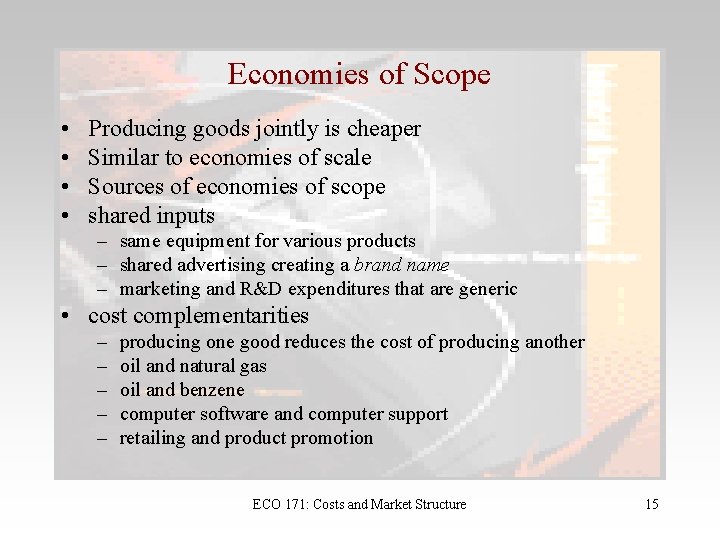
Economies of Scope • • Producing goods jointly is cheaper Similar to economies of scale Sources of economies of scope shared inputs – same equipment for various products – shared advertising creating a brand name – marketing and R&D expenditures that are generic • cost complementarities – – – producing one good reduces the cost of producing another oil and natural gas oil and benzene computer software and computer support retailing and product promotion ECO 171: Costs and Market Structure 15
Market Structure • Economies of scale and scope affect market structure but cannot be looked at in isolation. • They must be considered relative to market size. • Should see concentration decline as market size increases – Entry to the medical profession is going to be more extensive in Chicago than in Oxford, Miss – Find more extensive range of financial service companies in Wall Street, New York than in Frankfurt ECO 171: Costs and Market Structure 16
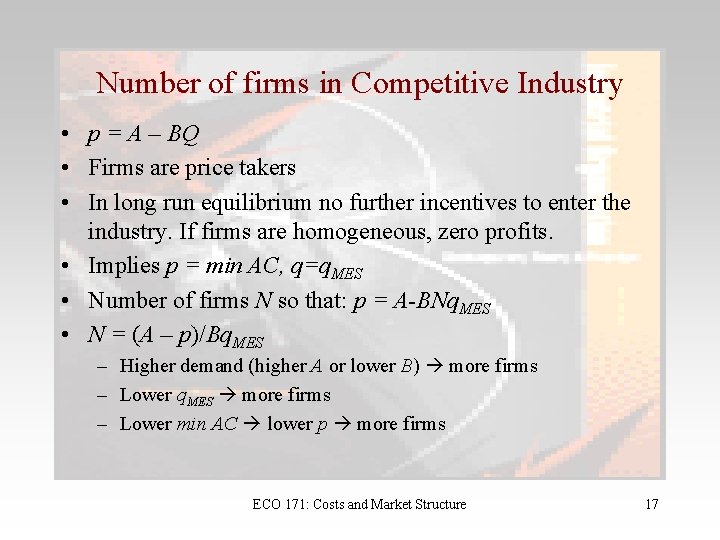
Number of firms in Competitive Industry • p = A – BQ • Firms are price takers • In long run equilibrium no further incentives to enter the industry. If firms are homogeneous, zero profits. • Implies p = min AC, q=q. MES • Number of firms N so that: p = A-BNq. MES • N = (A – p)/Bq. MES – Higher demand (higher A or lower B) more firms – Lower q. MES more firms – Lower min AC lower p more firms ECO 171: Costs and Market Structure 17
ECO 171: Costs and Market Structure 18
ECO 171: Costs and Market Structure 19
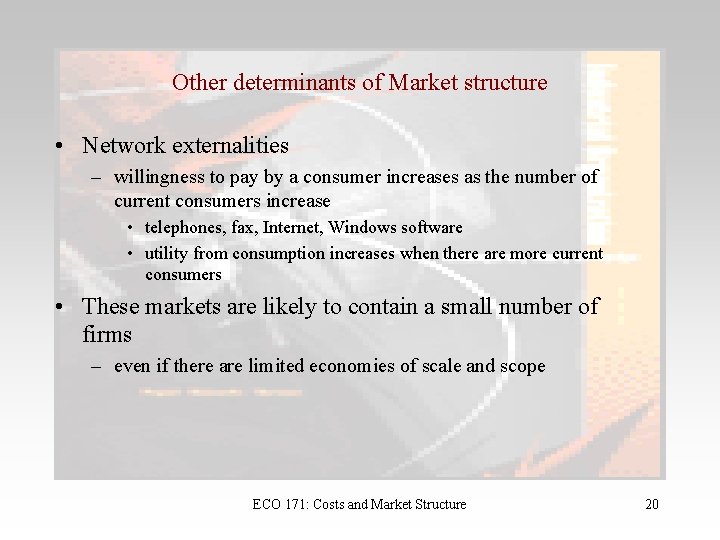
Other determinants of Market structure • Network externalities – willingness to pay by a consumer increases as the number of current consumers increase • telephones, fax, Internet, Windows software • utility from consumption increases when there are more current consumers • These markets are likely to contain a small number of firms – even if there are limited economies of scale and scope ECO 171: Costs and Market Structure 20
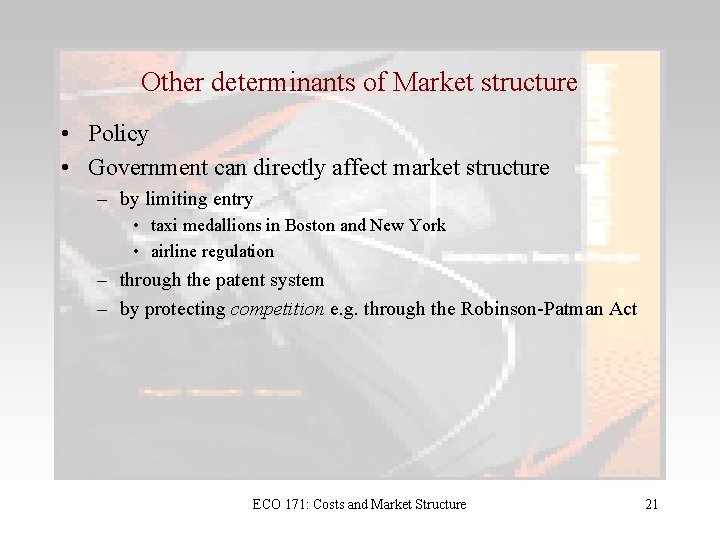
Other determinants of Market structure • Policy • Government can directly affect market structure – by limiting entry • taxi medallions in Boston and New York • airline regulation – through the patent system – by protecting competition e. g. through the Robinson-Patman Act ECO 171: Costs and Market Structure 21