Coordination Group for Meteorological Satellites CGMS A Coordinated


- Slides: 17
Coordination Group for Meteorological Satellites - CGMS A Coordinated Study of Atmospheric Motion Vector (AMV) Impact on NWP and Other Satellite Wind Highlights Jaime Daniels (NOAA/NESDIS) Mary Forsythe (Met Office) Regis Borde (EUMETSAT), Acting IWWG Co-Chairs Rapporteur: Johannes Schmetz (EUMETSAT) CGMS-40, November 2012, Lugano, Switzerland
Coordination Group for Meteorological Satellites - CGMS Outline • International Winds Working Group (IWWG) − Introduction to group − How the IWWG Operates • IWWG Achievements − Recent IWW 11 workshop − Collaborative Projects • IWW 11 Top Recommendations & Future Work Plans • Summary CGMS-40, November 2012, Lugano, Switzerland
Coordination Group for Meteorological Satellites - CGMS International Winds Working Group (IWWG) • Established in 1991 and became a formal working group of the Coordination Group for Meteorological Satellites (CGMS) in 1994. − Currently 50 -60 active members. • Provides a forum to discuss and coordinate operational and research developments in satellite-derived wind data production, verification/validation procedures, and assimilation techniques. − Geostationary and polar imagery (clouds and water vapor) − Radar backscatter & conical microwave radiometers (ocean surface winds) − Research instruments (ie. , MISR) − Future instruments (advanced imagers, space-borne LIDAR, Geo. Hyperspectral) CGMS-40, November 2012, Lugano, Switzerland
Coordination Group for Meteorological Satellites - CGMS How the IWWG Operates • Biennial Workshops − The most recent (IWW 11) workshop: February 20 -24, 2012 in Auckland, New Zealand − The first workshop (IWW 1): September 17 -19, 1991 in Washington, DC − Participants (~50) from operational satellite centers, NWP centers, industry, and academia • Internal Interactions – IWWG web site/wiki – Collaborative projects – Email lists CGMS-40, November 2012, Lugano, Switzerland
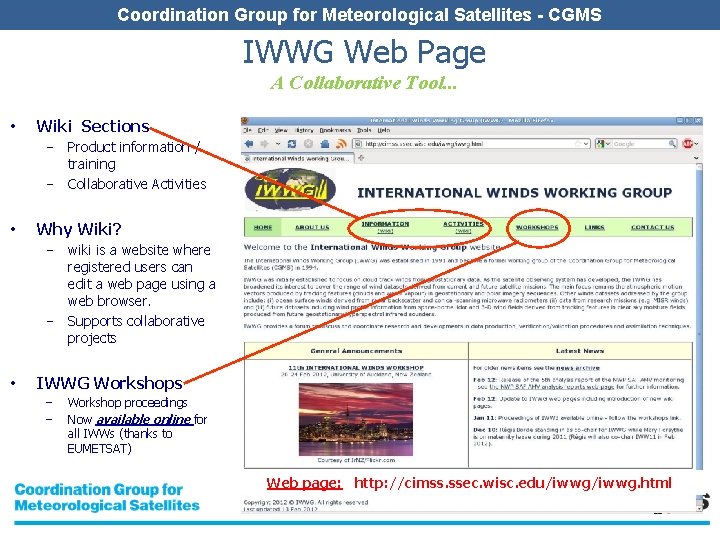
Coordination Group for Meteorological Satellites - CGMS IWWG Web Page A Collaborative Tool. . . • Wiki Sections − Product information / training − Collaborative Activities • Why Wiki? − wiki is a website where registered users can edit a web page using a web browser. − Supports collaborative projects • IWWG Workshops − − Workshop proceedings Now available online for all IWWs (thanks to EUMETSAT) Web page: November http: //cimss. ssec. wisc. edu/iwwg. html CGMS-40, 2012, Lugano, Switzerland
Coordination Group for Meteorological Satellites - CGMS Highlights from IWW 11 (Feb 2012) • Hosted by the University of Auckland, New Zealand (Local Host: Roger Davies) • Co-chaired by Jaime Daniels , Régis Borde • Attended by 56 scientists • NWP representation the best ever • Covered: − Updates on operational products − Latest developments in AMV derivation, characterisation, NWP applications − One session focussed on MISR winds − One session focussed on Doppler Wind Lidar • In addition to usual WGs, held focused group discussions on: − NWP winds impact study and high resolution winds − AMV intercomparison plan and simulated data studies − AMV open source software CGMS-40, November 2012, Lugano, Switzerland © Crown copyright Met Office
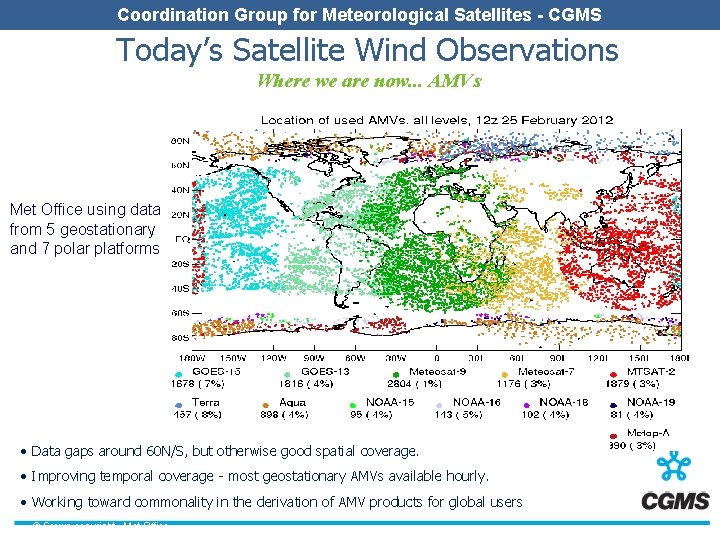
Coordination Group for Meteorological Satellites - CGMS Today’s Satellite Wind Observations Where we are now. . . AMVs Met Office using data from 5 geostationary and 7 polar platforms • Data gaps around 60 N/S, but otherwise good spatial coverage. • Improving temporal coverage - most geostationary AMVs available hourly. CGMS-40, November 2012, Lugano, Switzerland • Working toward commonality in the derivation of AMV products for global users © Crown copyright Met Office
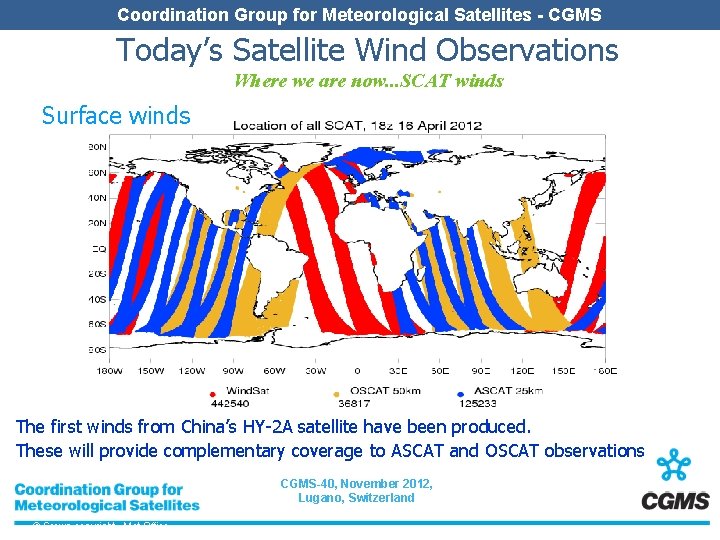
Coordination Group for Meteorological Satellites - CGMS Today’s Satellite Wind Observations Where we are now. . . SCAT winds Surface winds The first winds from China’s HY-2 A satellite have been produced. These will provide complementary coverage to ASCAT and OSCAT observations CGMS-40, November 2012, Lugano, Switzerland © Crown copyright Met Office
Coordination Group for Meteorological Satellites - CGMS Recent IWWG Achievements • Completion of a 2 nd NWP winds impact study (undertaken in 2011 -12) • Number of new or improved satellite wind derivation schemes • Inter-comparison Study of Atmospheric Motion Vectors (AMVs) (first study in 2006, second phase 2012 -13) • AMV simulated data studies (ECMWF: 2011 -12, University of Reading – ongoing) • Portable AMV derivation software (via NWC SAF) to support research efforts (ongoing) • AMV reprocessing capabilities achieved by numerous satellite operators (EUMETSAT, JMA, ) – supports SCOPE-CM effort CGMS-40, November 2012, Lugano, Switzerland © Crown copyright Met Office
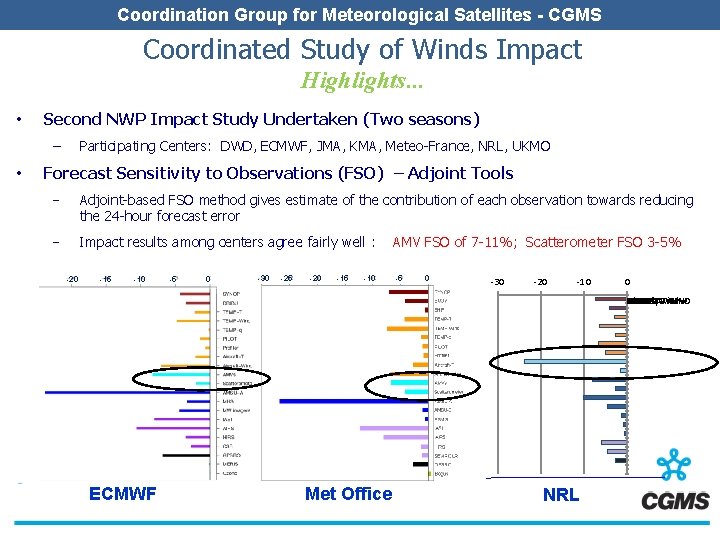
Coordination Group for Meteorological Satellites - CGMS Coordinated Study of Winds Impact Highlights. . . • Second NWP Impact Study Undertaken (Two seasons) − • Participating Centers: DWD, ECMWF, JMA, KMA, Meteo-France, NRL, UKMO Forecast Sensitivity to Observations (FSO) – Adjoint Tools − Adjoint-based FSO method gives estimate of the contribution of each observation towards reducing the 24 -hour forecast error − Impact results among centers agree fairly well : -20 -15 -10 -5 0 -30 -25 -20 -15 -10 AMV FSO of 7 -11%; Scatterometer FSO 3 -5% -5 0 -30 -20 -10 0 GPS SYNOP SCAT SSMIS-TPW TEMP-q Aircraft MHS IASI TEMP-T WINDSAT-TPW SFCwind WIND ECMWF CGMS-40, November 2012, Met Office Lugano, Switzerland NRL
Coordination Group for Meteorological Satellites - CGMS Coordinated Study of AMV Impact Conclusions. . . • Positive forecast impact is seen from AMVs across all NWP centers especially in • AMVs generally turn out to be in the top five most important contributors for the NWP centers (WMO 5 th Workshop on the Impact of Observing Systems on NWP) • Nearly all centers see a strong impact on the tropical mean wind analysis • Larger impact often seen for centers who use 3 DVAR or use fewer other observations, and for NRL whose FSO statistics suggest quite a different impact from the various components of the observing system • No geographical regions where the AMVs are performing consistently poorly among several centers. • In addition to the classic denial study, the FSO statistics further indicate upper troposphere; significant relative importance of the AMVs in the global observing system context CGMS-40, November 2012, Lugano, Switzerland Final report available soon…
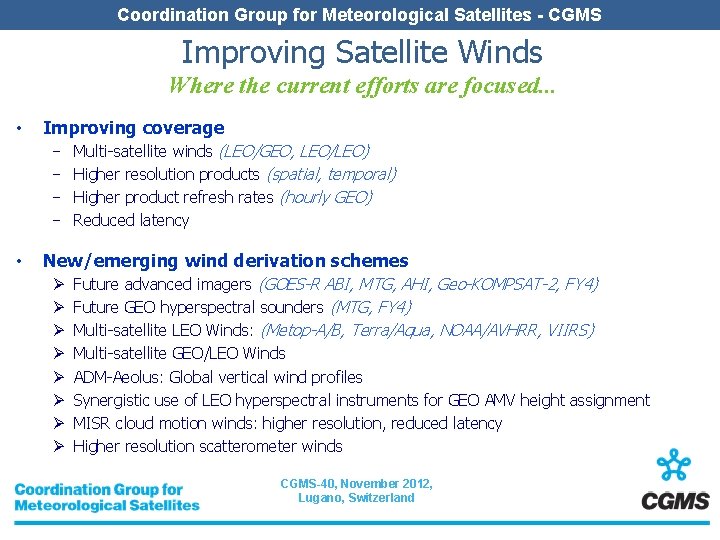
Coordination Group for Meteorological Satellites - CGMS Improving Satellite Winds Where the current efforts are focused. . . • Improving coverage − − • Multi-satellite winds (LEO/GEO, LEO/LEO) Higher resolution products (spatial, temporal) Higher product refresh rates (hourly GEO) Reduced latency New/emerging wind derivation schemes Ø Ø Ø Ø Future advanced imagers (GOES-R ABI, MTG, AHI, Geo-KOMPSAT-2, FY 4) Future GEO hyperspectral sounders (MTG, FY 4) Multi-satellite LEO Winds: (Metop-A/B, Terra/Aqua, NOAA/AVHRR, VIIRS) Multi-satellite GEO/LEO Winds ADM-Aeolus: Global vertical wind profiles Synergistic use of LEO hyperspectral instruments for GEO AMV height assignment MISR cloud motion winds: higher resolution, reduced latency Higher resolution scatterometer winds CGMS-40, November 2012, Lugano, Switzerland
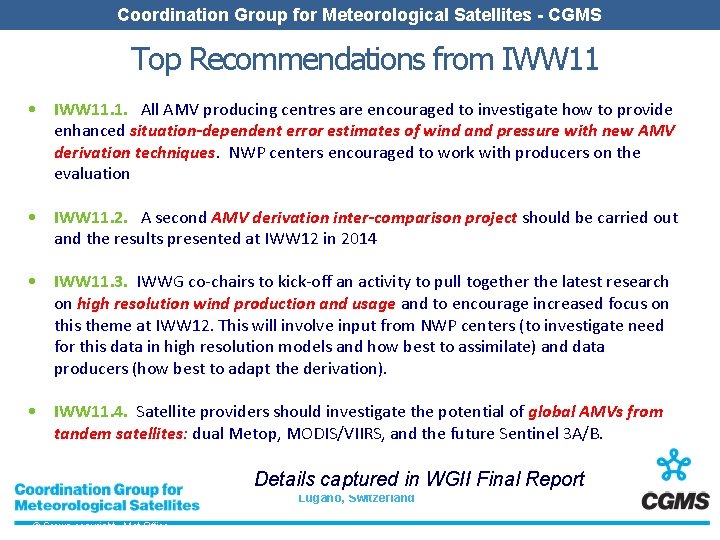
Coordination Group for Meteorological Satellites - CGMS Top Recommendations from IWW 11 • IWW 11. 1. All AMV producing centres are encouraged to investigate how to provide enhanced situation-dependent error estimates of wind and pressure with new AMV derivation techniques. NWP centers encouraged to work with producers on the evaluation • IWW 11. 2. A second AMV derivation inter-comparison project should be carried out and the results presented at IWW 12 in 2014 • IWW 11. 3. IWWG co-chairs to kick-off an activity to pull together the latest research on high resolution wind production and usage and to encourage increased focus on this theme at IWW 12. This will involve input from NWP centers (to investigate need for this data in high resolution models and how best to assimilate) and data producers (how best to adapt the derivation). • IWW 11. 4. Satellite providers should investigate the potential of global AMVs from tandem satellites: dual Metop, MODIS/VIIRS, and the future Sentinel 3 A/B. Details captured in WGII Final Report CGMS-40, November 2012, Lugano, Switzerland © Crown copyright Met Office
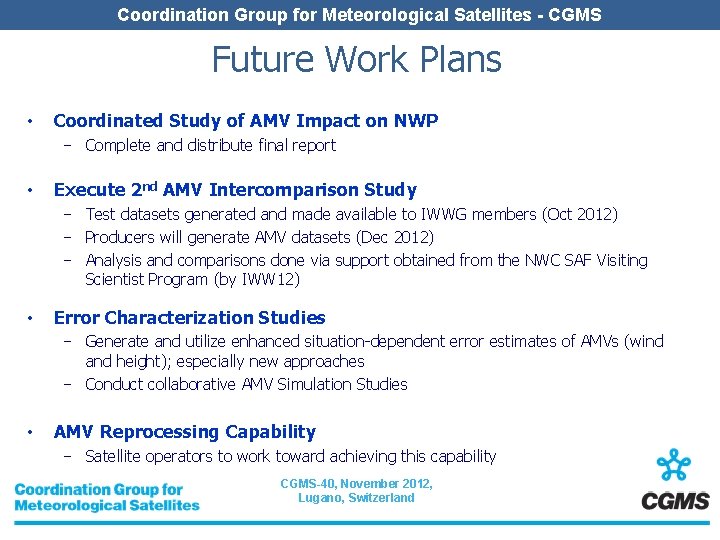
Coordination Group for Meteorological Satellites - CGMS Future Work Plans • Coordinated Study of AMV Impact on NWP − Complete and distribute final report • Execute 2 nd AMV Intercomparison Study − Test datasets generated and made available to IWWG members (Oct 2012) − Producers will generate AMV datasets (Dec 2012) − Analysis and comparisons done via support obtained from the NWC SAF Visiting Scientist Program (by IWW 12) • Error Characterization Studies − Generate and utilize enhanced situation-dependent error estimates of AMVs (wind and height); especially new approaches − Conduct collaborative AMV Simulation Studies • AMV Reprocessing Capability − Satellite operators to work toward achieving this capability CGMS-40, November 2012, Lugano, Switzerland
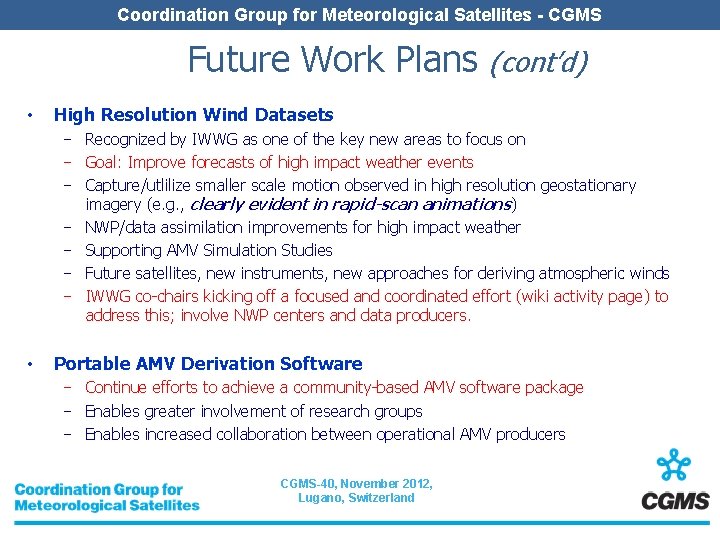
Coordination Group for Meteorological Satellites - CGMS Future Work Plans (cont’d) • High Resolution Wind Datasets − Recognized by IWWG as one of the key new areas to focus on − Goal: Improve forecasts of high impact weather events − Capture/utlilize smaller scale motion observed in high resolution geostationary imagery (e. g. , clearly evident in rapid-scan animations) − NWP/data assimilation improvements for high impact weather − Supporting AMV Simulation Studies − Future satellites, new instruments, new approaches for deriving atmospheric winds − IWWG co-chairs kicking off a focused and coordinated effort (wiki activity page) to address this; involve NWP centers and data producers. • Portable AMV Derivation Software − Continue efforts to achieve a community-based AMV software package − Enables greater involvement of research groups − Enables increased collaboration between operational AMV producers CGMS-40, November 2012, Lugano, Switzerland
Coordination Group for Meteorological Satellites - CGMS Summary • International Winds Working Group − Well focused, committed, and poised to address issues related to satellite winds; achieved through collaborative projects − Striving for commonality in products for the benefit of NWP users • IWWG has elevated the utility of AMV for NWP in recent years − IWWG coordinated study of AMV impact on NWP demonstrated the significant relative importance of the AMVs within the Global Observing System (GOS) • A number of new or improved satellite wind derivation schemes have or are being developed • IWWG is actively pursuing a more focused effort on high resolution (e. g. , mesoscale) winds – to help improve forecasts of high impact weather events CGMS-40, November 2012, Lugano, Switzerland
Coordination Group for Meteorological Satellites - CGMS Further Information Visit IWWG Web page: http: //cimss. ssec. wisc. edu/iwwg. ht ml CGMS-40, November 2012, Lugano, Switzerland