Convolutional Neural Network Language Models NgocQuan Pham German

- Slides: 13
Convolutional Neural Network Language Models Ngoc-Quan Pham, German Kruszewski, Gemma Boleda Center for Mind/Brain Sciences University of Trento presented by Ying-Wen Chen 2018/04/10
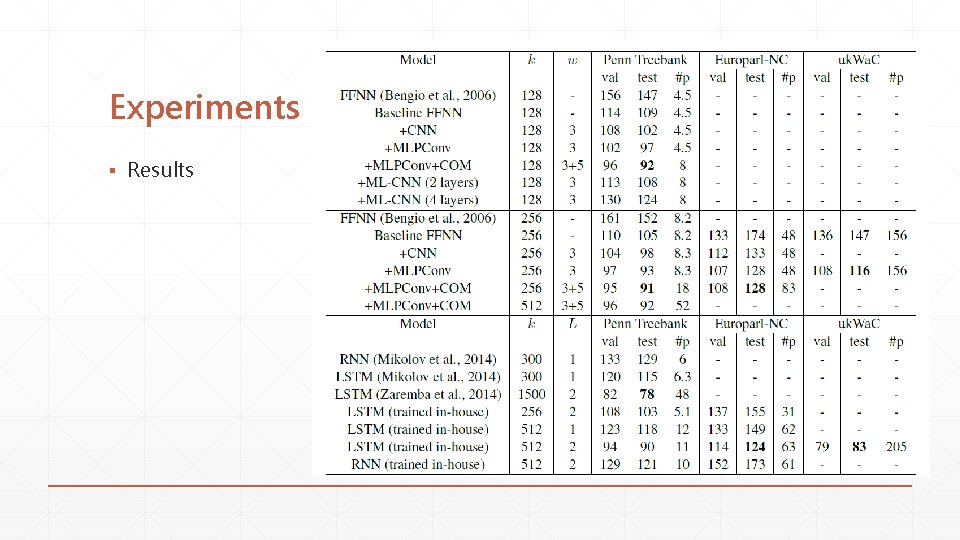
Introduction ▪ Convolutional Neural Networks (CNNs) have shown to yield very strong results in several Computer Vision tasks. Their application to language has received much less attention. ▪ In this work, we study the application of CNNs to language modeling, a sequential prediction task that needs models to capture local as well as longrange dependency information. ▪ We show that CNNs achieve 11 -26% better absolute performance than feedforward neural language models, as for recurrent models, our model outperforms RNNs but is below state of the art LSTM models.
Introduction ▪ Statistical language modeling, the task we tackle, differs from most of the tasks where CNNs have been applied before in multiple ways. ▪ First, the input typically consists of incomplete sequences of words rather than complete sentences. ▪ Second, as a classification problem, it features an extremely large number of classes (the words in a large vocabulary). ▪ Finally, temporal information, which can be safely discarded in many settings with little impact in performance, is critical here: An n-gram appearing close to the predicted word may be more informative, or yield different information, than the same n-gram appearing several tokens earlier.
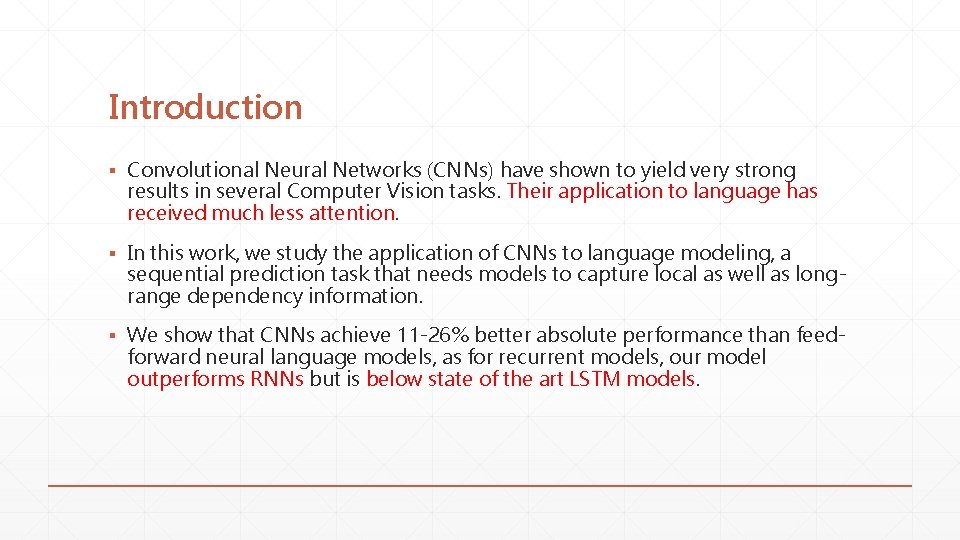
Model ▪ Baseline FFLM
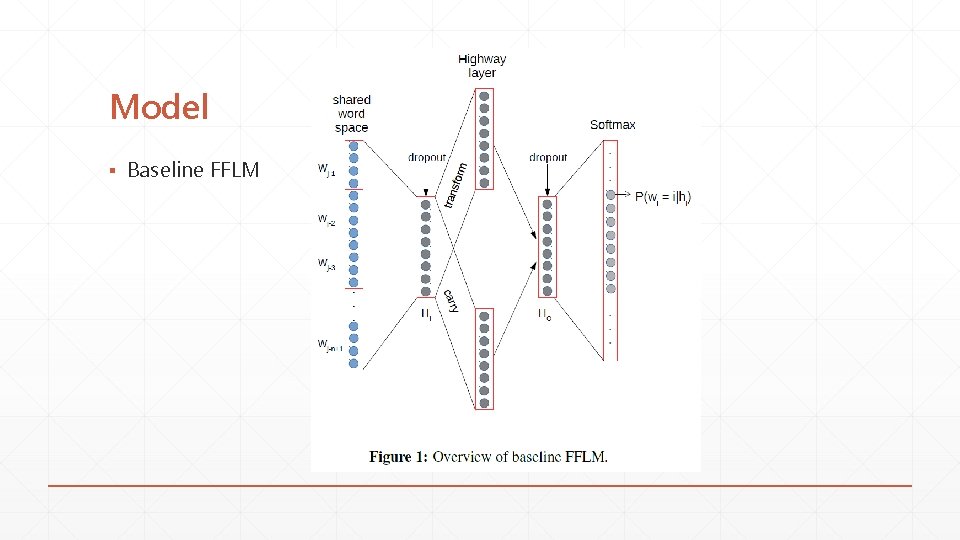
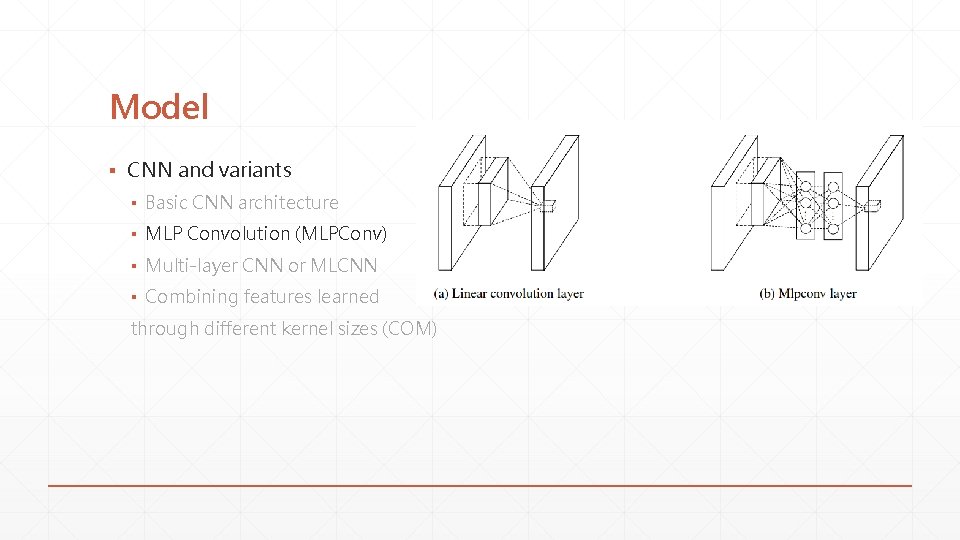
Model ▪ CNN and variants ▪ Basic CNN architecture ▪ MLP Convolution (MLPConv) ▪ Multi-layer CNN or MLCNN ▪ Combining features learned through different kernel sizes (COM)
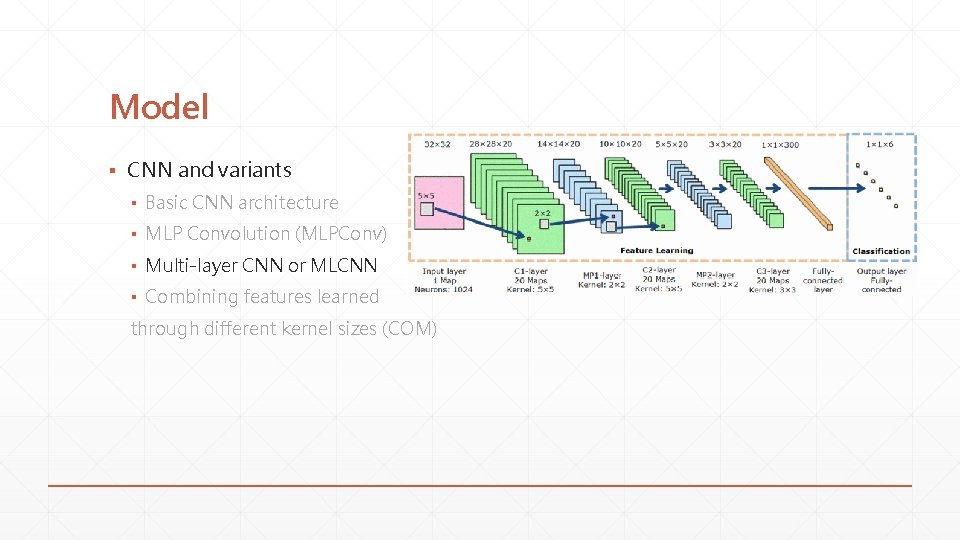
Model ▪ CNN and variants ▪ Basic CNN architecture ▪ MLP Convolution (MLPConv) ▪ Multi-layer CNN or MLCNN ▪ Combining features learned through different kernel sizes (COM)
Model ▪ CNN and variants ▪ Basic CNN architecture ▪ MLP Convolution (MLPConv) ▪ Multi-layer CNN or MLCNN ▪ Combining features learned through different kernel sizes (COM)
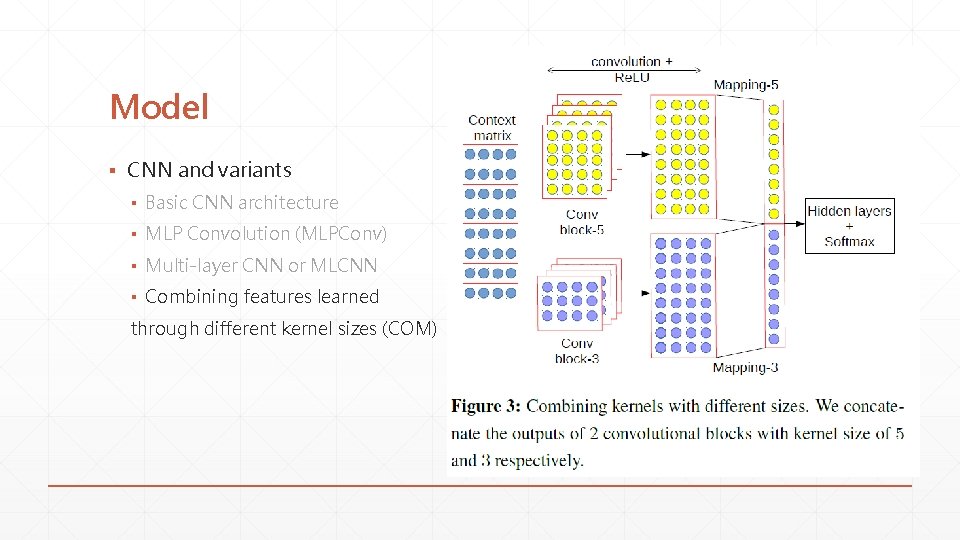
Model ▪ CNN and variants ▪ Basic CNN architecture ▪ MLP Convolution (MLPConv) ▪ Multi-layer CNN or MLCNN ▪ Combining features learned through different kernel sizes (COM)
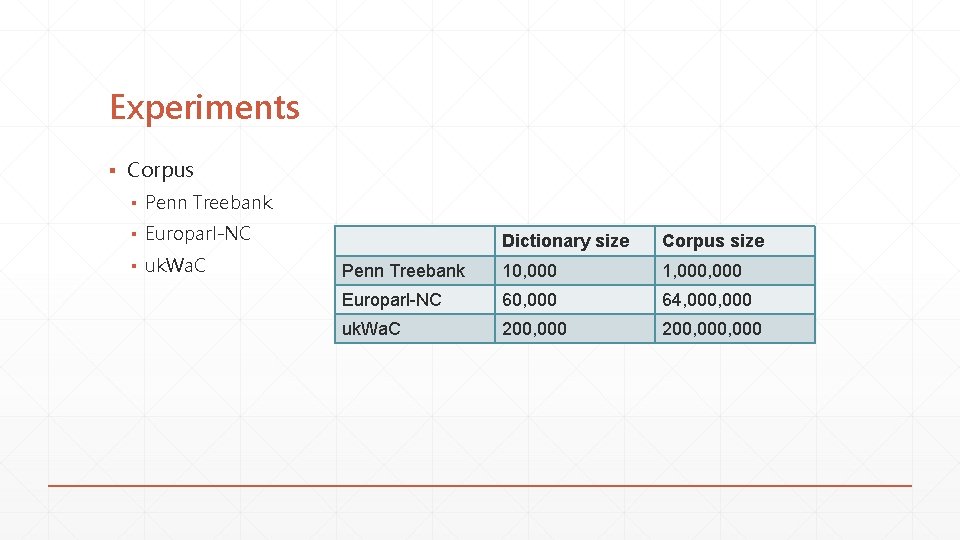
Experiments ▪ Corpus ▪ Penn Treebank ▪ Europarl-NC ▪ uk. Wa. C Dictionary size Corpus size Penn Treebank 10, 000 1, 000 Europarl-NC 60, 000 64, 000 uk. Wa. C 200, 000, 000
Experiments ▪ Results
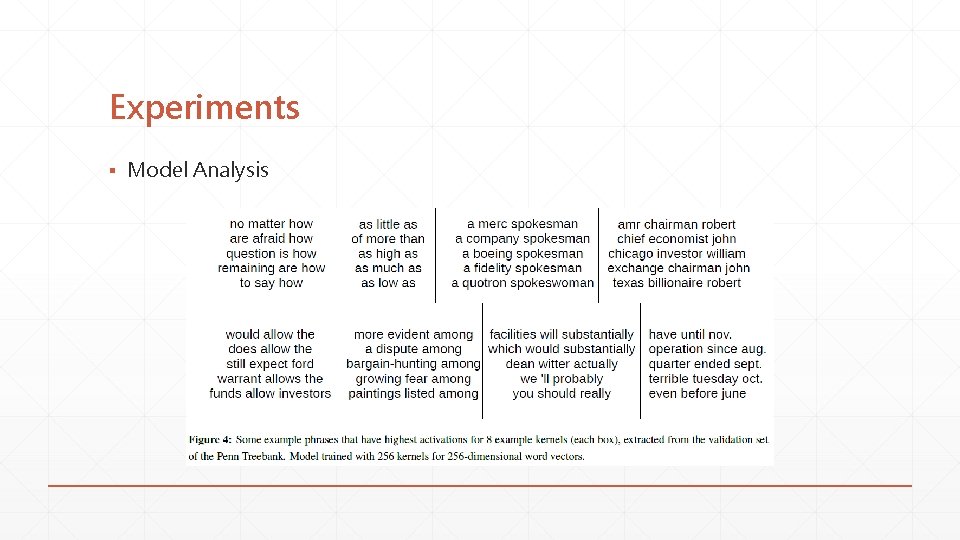
Experiments ▪ Model Analysis
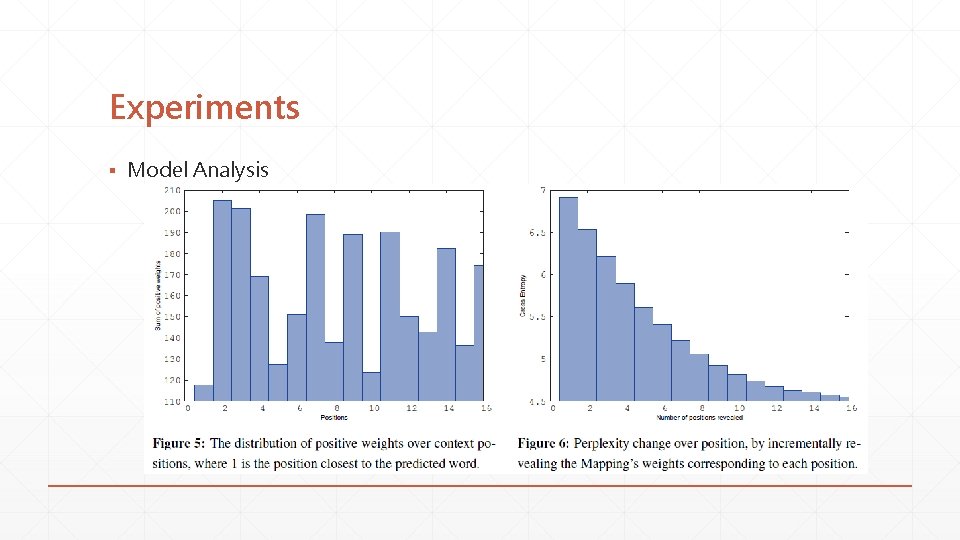
Experiments ▪ Model Analysis
Conclusion ▪ In this work, we have investigated the potential of Convolutional Neural Networks for one prominent NLP task, language modeling, a sequential prediction task.