Contents Multiples factors and primes A Factors A


- Slides: 32
Contents Multiples, factors and primes A Factors A Prime numbers A Prime factor decomposition A HCF and LCM 1 of 53 © Boardworks Ltd 2004
FACTORS 2 of 53 © Boardworks Ltd 2004
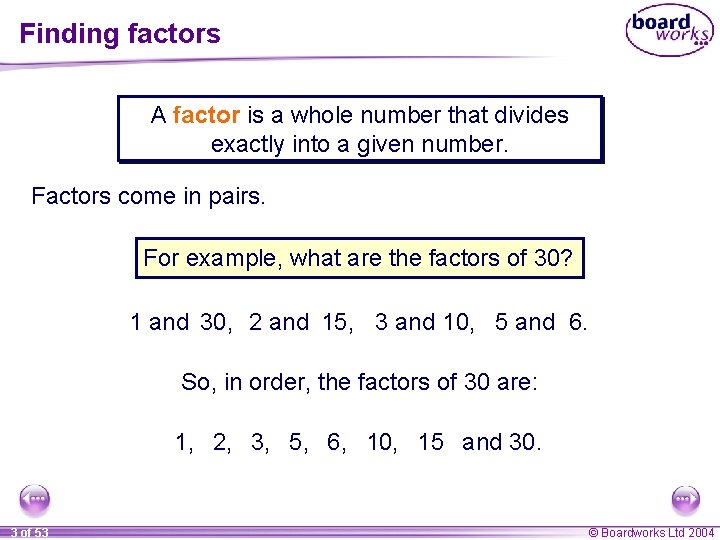
Finding factors A factor is a whole number that divides exactly into a given number. Factors come in pairs. For example, what are the factors of 30? 1 and 30, 2 and 15, 3 and 10, 5 and 6. So, in order, the factors of 30 are: 1, 2, 3, 5, 6, 10, 15 and 30. 3 of 53 © Boardworks Ltd 2004
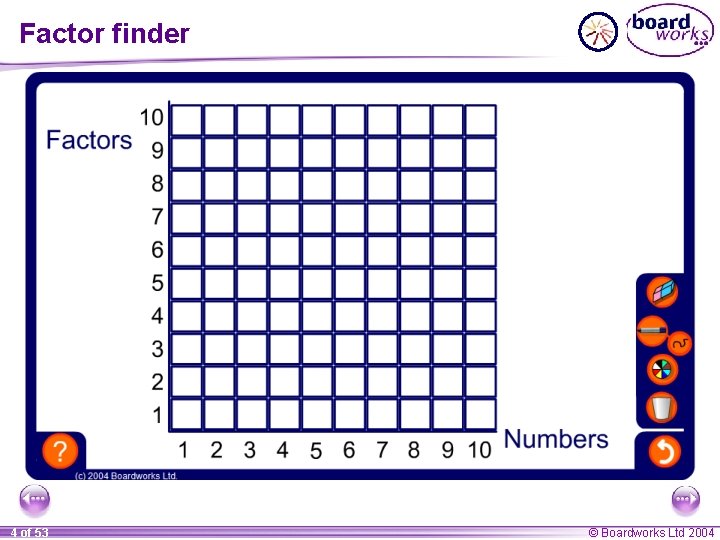
Factor finder 4 of 53 © Boardworks Ltd 2004
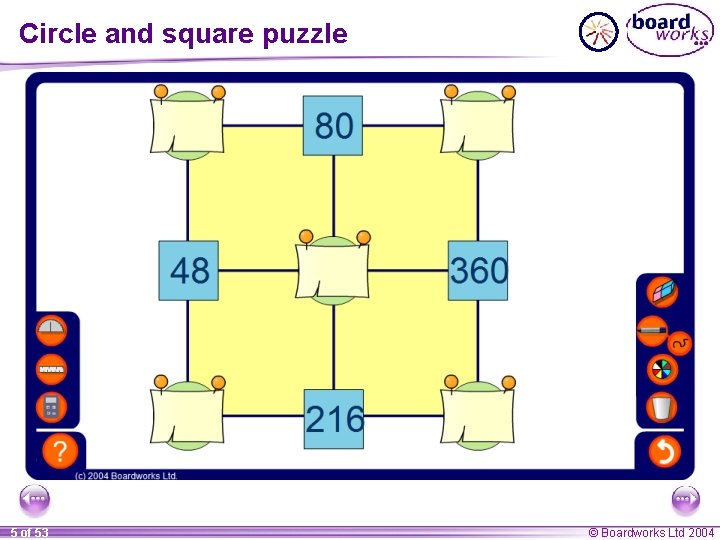
Circle and square puzzle 5 of 53 © Boardworks Ltd 2004
PRIME NUMBERS 6 of 53 © Boardworks Ltd 2004
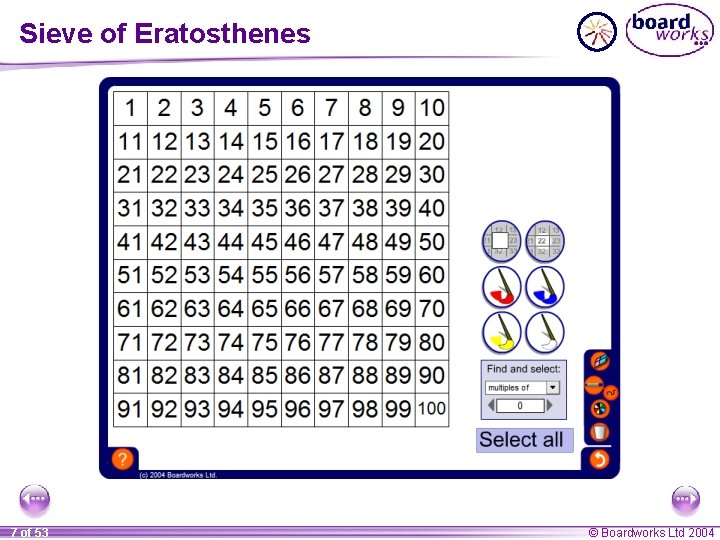
Sieve of Eratosthenes 7 of 53 © Boardworks Ltd 2004
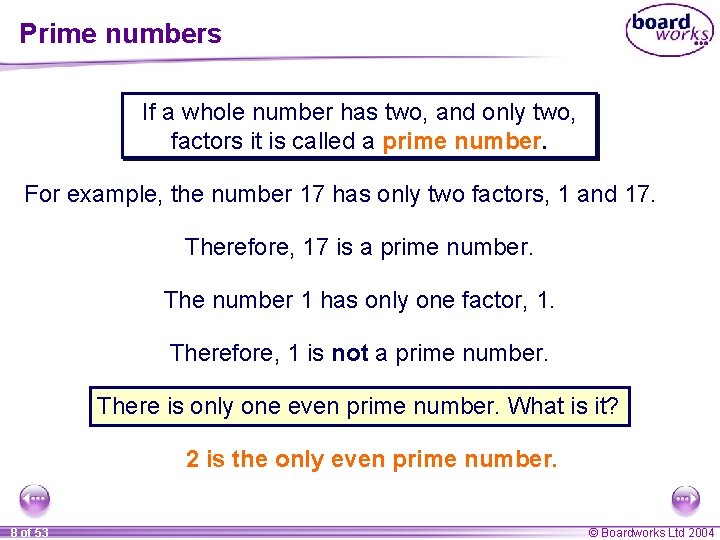
Prime numbers If a whole number has two, and only two, factors it is called a prime number. For example, the number 17 has only two factors, 1 and 17. Therefore, 17 is a prime number. The number 1 has only one factor, 1. Therefore, 1 is not a prime number. There is only one even prime number. What is it? 2 is the only even prime number. 8 of 53 © Boardworks Ltd 2004
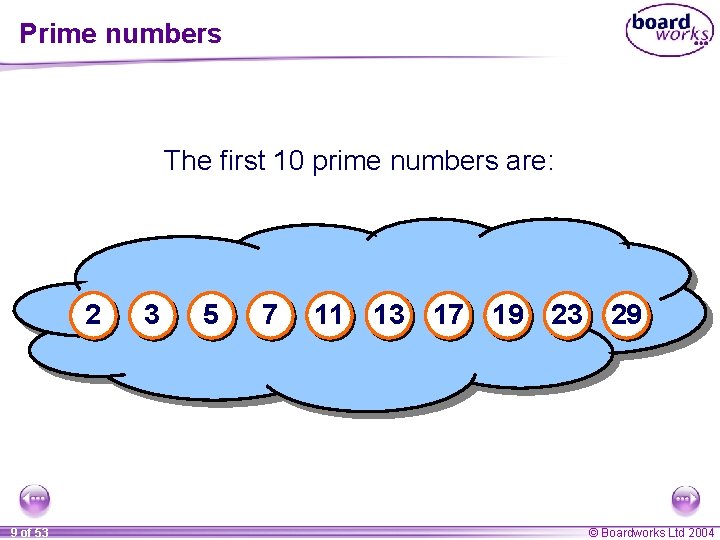
Prime numbers The first 10 prime numbers are: 2 9 of 53 3 5 7 11 13 17 19 23 29 © Boardworks Ltd 2004
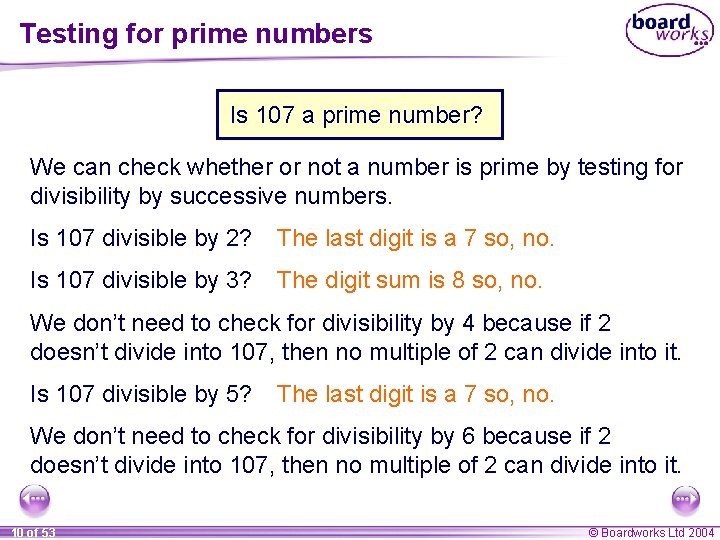
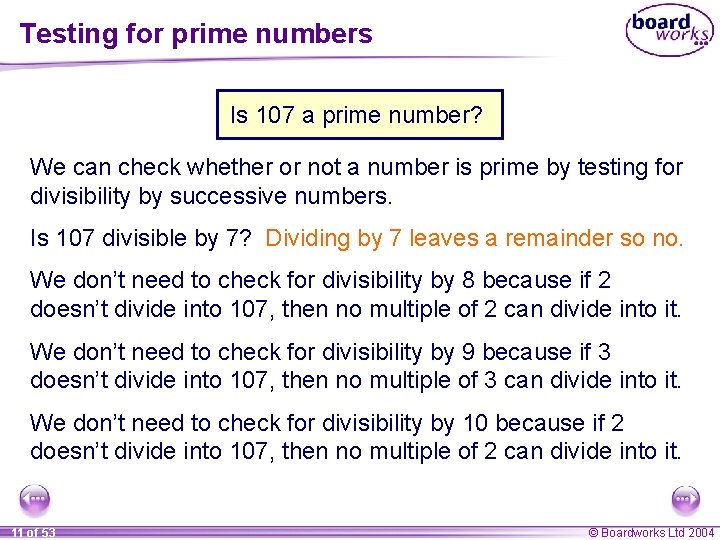
Testing for prime numbers Is 107 a prime number? We can check whether or not a number is prime by testing for divisibility by successive numbers. Is 107 divisible by 2? The last digit is a 7 so, no. Is 107 divisible by 3? The digit sum is 8 so, no. We don’t need to check for divisibility by 4 because if 2 doesn’t divide into 107, then no multiple of 2 can divide into it. Is 107 divisible by 5? The last digit is a 7 so, no. We don’t need to check for divisibility by 6 because if 2 doesn’t divide into 107, then no multiple of 2 can divide into it. 10 of 53 © Boardworks Ltd 2004
Testing for prime numbers Is 107 a prime number? We can check whether or not a number is prime by testing for divisibility by successive numbers. Is 107 divisible by 7? Dividing by 7 leaves a remainder so no. We don’t need to check for divisibility by 8 because if 2 doesn’t divide into 107, then no multiple of 2 can divide into it. We don’t need to check for divisibility by 9 because if 3 doesn’t divide into 107, then no multiple of 3 can divide into it. We don’t need to check for divisibility by 10 because if 2 doesn’t divide into 107, then no multiple of 2 can divide into it. 11 of 53 © Boardworks Ltd 2004
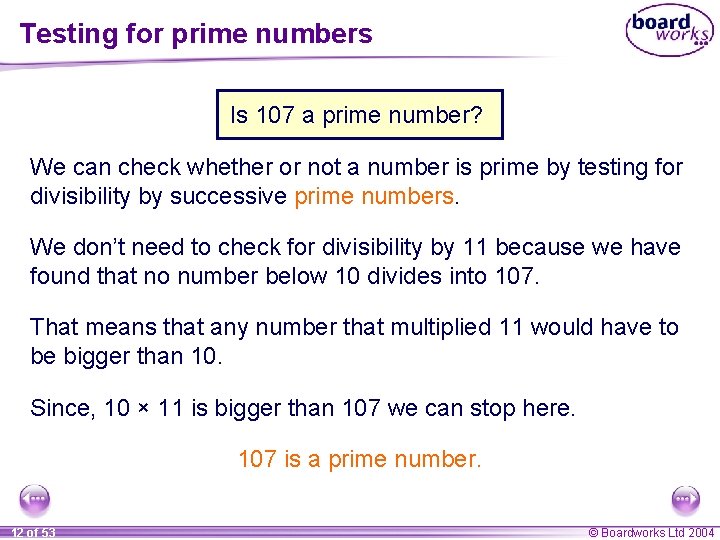
Testing for prime numbers Is 107 a prime number? We can check whether or not a number is prime by testing for divisibility by successive prime numbers. We don’t Why don’tneed we need to check for divisibility by 11 bybecause 11? we have found that no number below 10 divides into 107. That means that any number that multiplied 11 would have to be bigger than 10. Since, 10 × 11 is bigger than 107 we can stop here. 107 is a prime number. 12 of 53 © Boardworks Ltd 2004
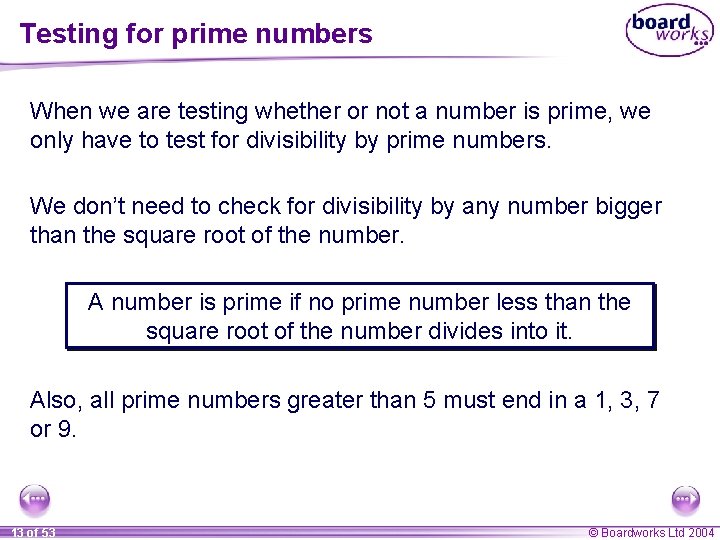
Testing for prime numbers When we are testing whether or not a number is prime, we only have to test for divisibility by prime numbers. We don’t need to check for divisibility by any number bigger than the square root of the number. A number is prime if no prime number less than the square root of the number divides into it. Also, all prime numbers greater than 5 must end in a 1, 3, 7 or 9. 13 of 53 © Boardworks Ltd 2004
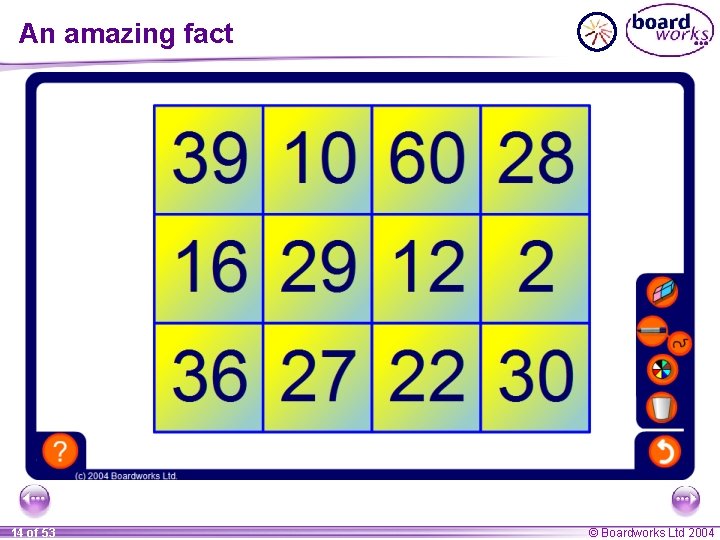
An amazing fact 14 of 53 © Boardworks Ltd 2004
PRIME FACTORS 15 of 53 © Boardworks Ltd 2004
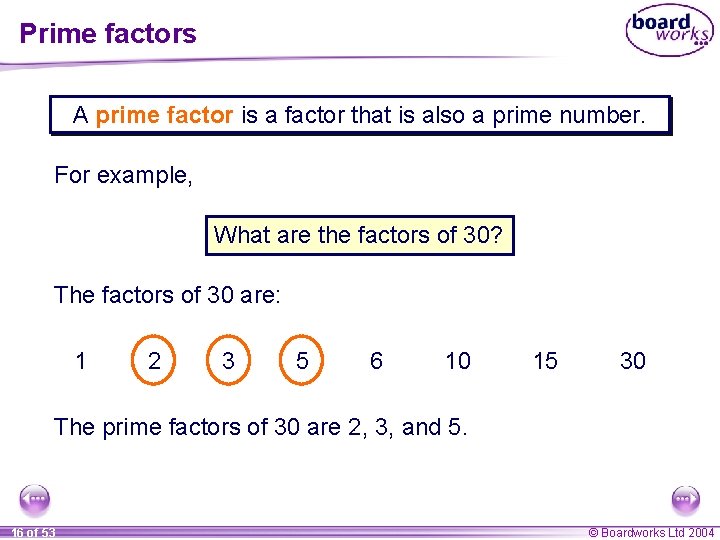
Prime factors A prime factor is a factor that is also a prime number. For example, What are the factors of 30? The factors of 30 are: 1 2 3 5 6 10 15 30 The prime factors of 30 are 2, 3, and 5. 16 of 53 © Boardworks Ltd 2004
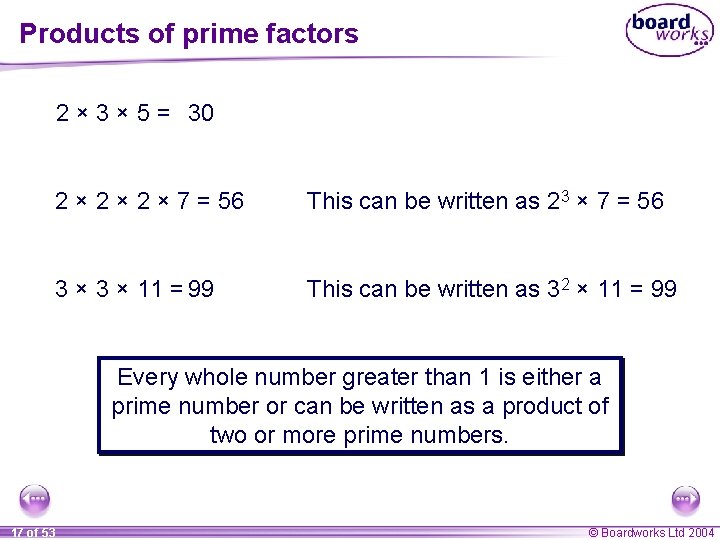
Products of prime factors 2 × 3 × 5 = 30 2 × 2 × 7 = 56 This can be written as 23 × 7 = 56 3 × 11 = 99 This can be written as 32 × 11 = 99 Every whole number greater than 1 is either a prime number or can be written as a product of two or more prime numbers. 17 of 53 © Boardworks Ltd 2004
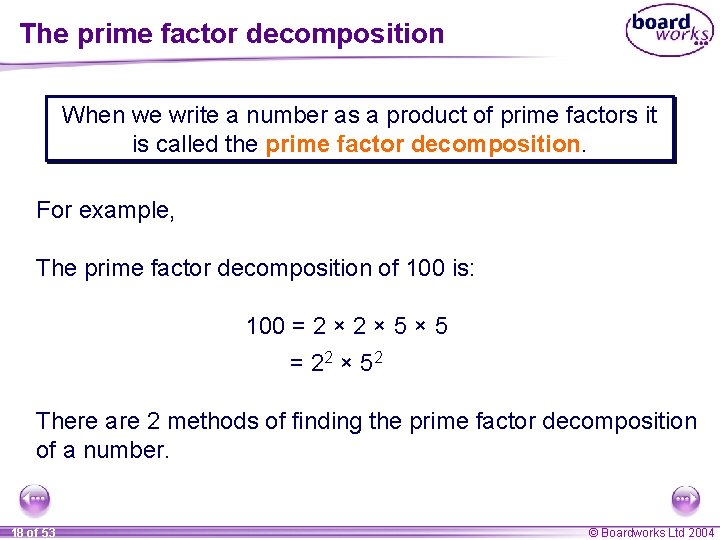
The prime factor decomposition When we write a number as a product of prime factors it is called the prime factor decomposition. For example, The prime factor decomposition of 100 is: 100 = 2 × 5 × 5 = 2 2 × 52 There are 2 methods of finding the prime factor decomposition of a number. 18 of 53 © Boardworks Ltd 2004
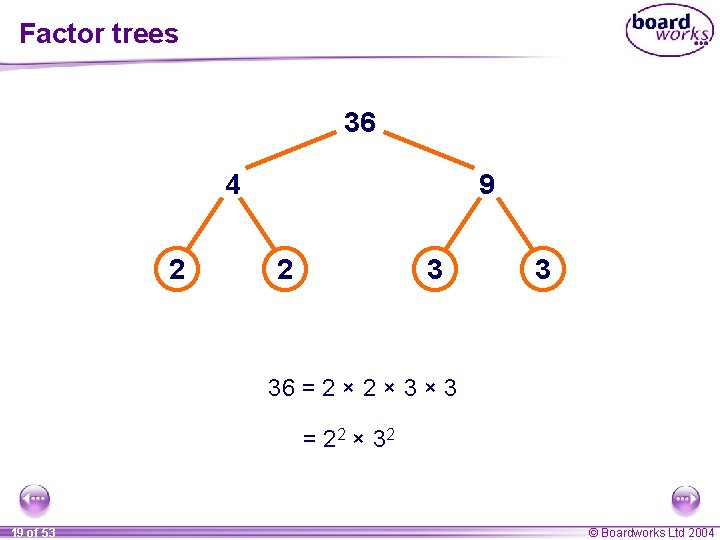
Factor trees 36 4 2 9 2 3 3 36 = 2 × 3 × 3 = 2 2 × 32 19 of 53 © Boardworks Ltd 2004
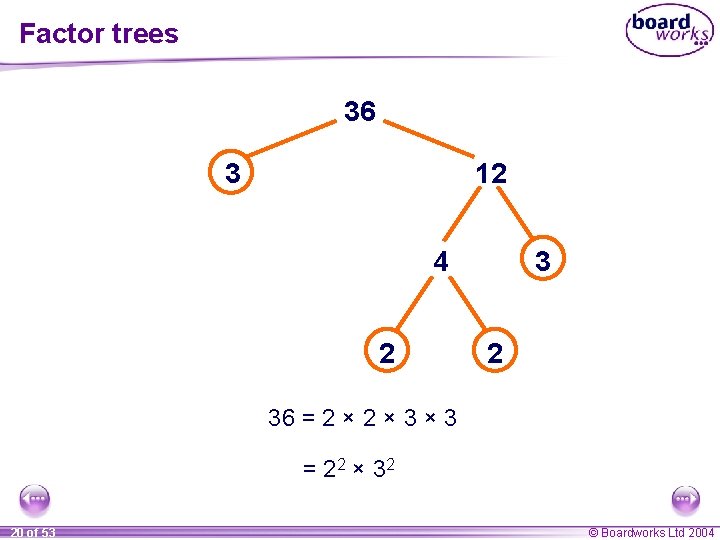
Factor trees 36 3 12 4 2 36 = 2 × 3 × 3 = 2 2 × 32 20 of 53 © Boardworks Ltd 2004
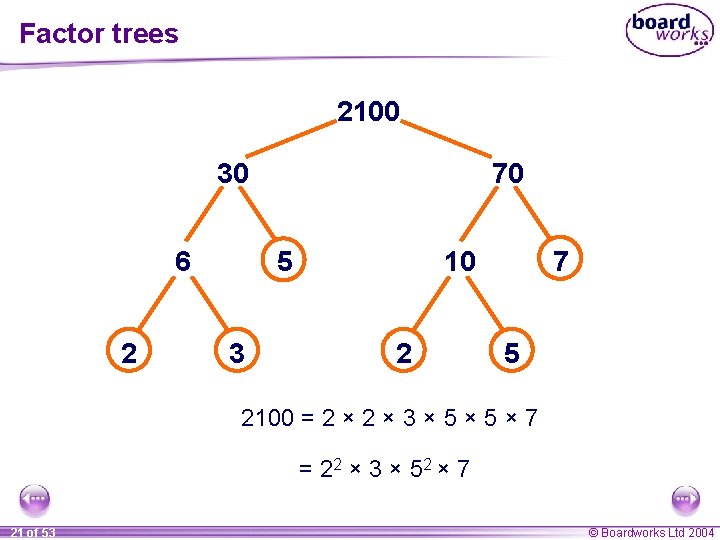
Factor trees 2100 30 6 2 70 5 3 10 2 7 5 2100 = 2 × 3 × 5 × 7 = 2 2 × 3 × 52 × 7 21 of 53 © Boardworks Ltd 2004
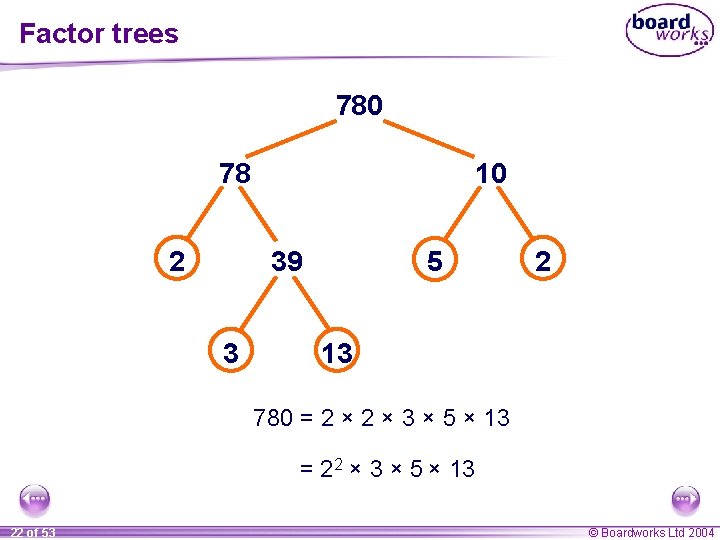
Factor trees 780 78 2 10 39 3 5 2 13 780 = 2 × 3 × 5 × 13 = 22 × 3 × 5 × 13 22 of 53 © Boardworks Ltd 2004
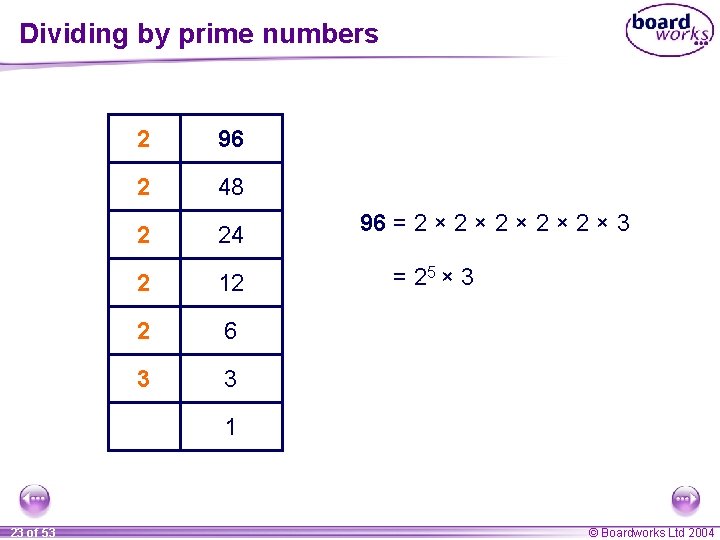
Dividing by prime numbers 2 96 2 48 2 24 2 12 2 6 3 3 96 = 2 × 2 × 2 × 3 = 25 × 3 1 23 of 53 © Boardworks Ltd 2004
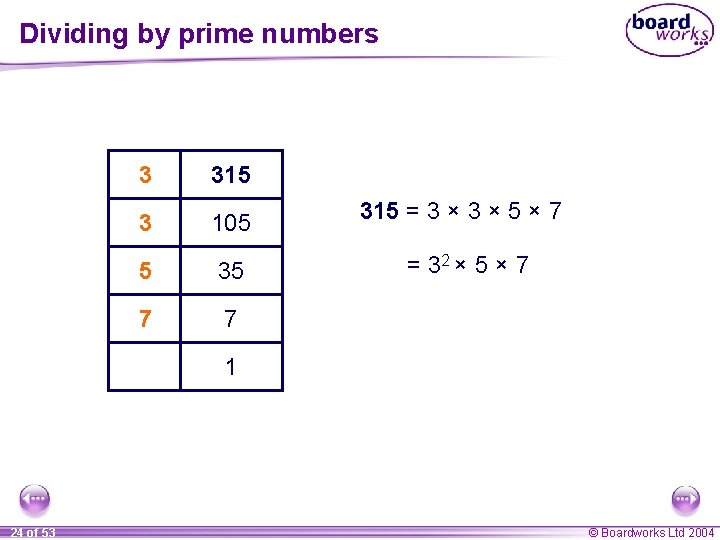
Dividing by prime numbers 3 315 3 105 315 = 3 × 5 × 7 5 35 = 32 × 5 × 7 7 7 1 24 of 53 © Boardworks Ltd 2004
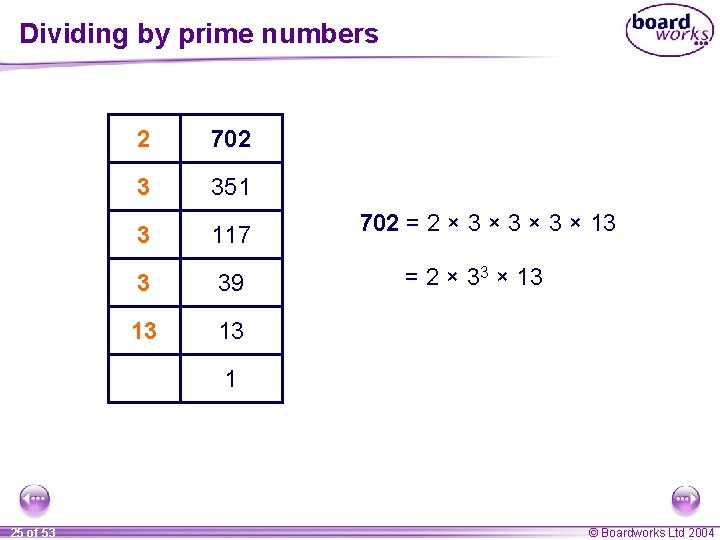
Dividing by prime numbers 2 702 3 351 3 117 3 39 13 13 702 = 2 × 3 × 3 × 13 = 2 × 33 × 13 1 25 of 53 © Boardworks Ltd 2004
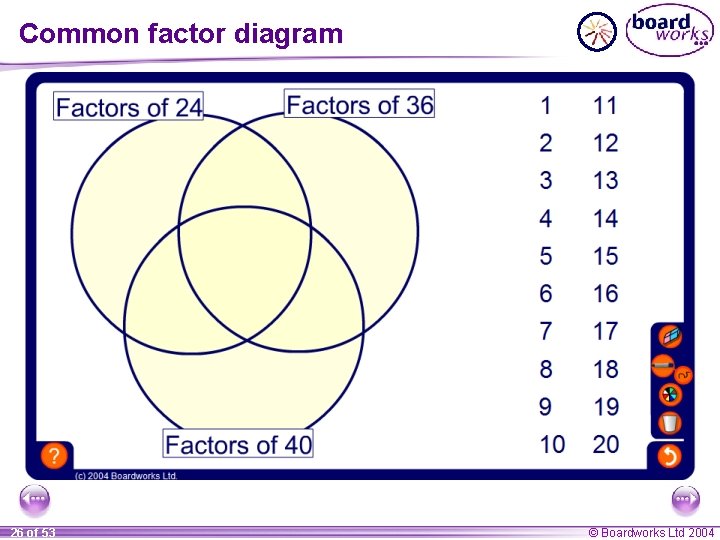
Common factor diagram 26 of 53 © Boardworks Ltd 2004
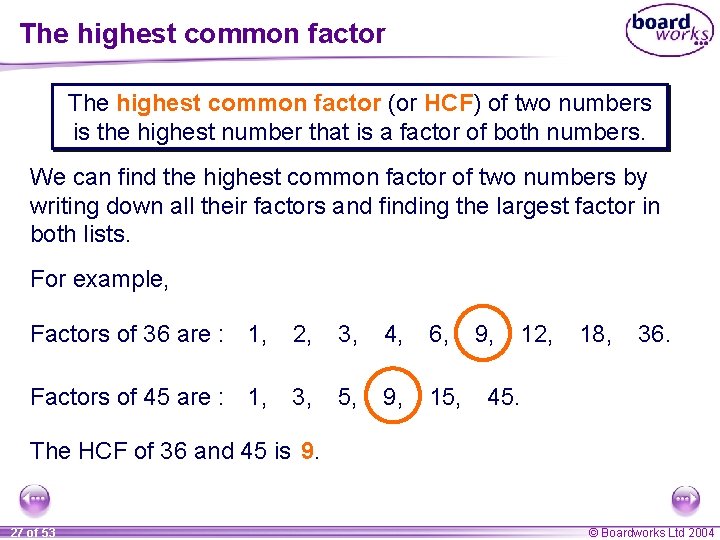
The highest common factor (or HCF) of two numbers is the highest number that is a factor of both numbers. We can find the highest common factor of two numbers by writing down all their factors and finding the largest factor in both lists. For example, Factors of 36 are : 1, 2, 3, 4, 6, Factors of 45 are : 1, 3, 5, 9, 12, 18, 36. 45. The HCF of 36 and 45 is 9. 27 of 53 © Boardworks Ltd 2004
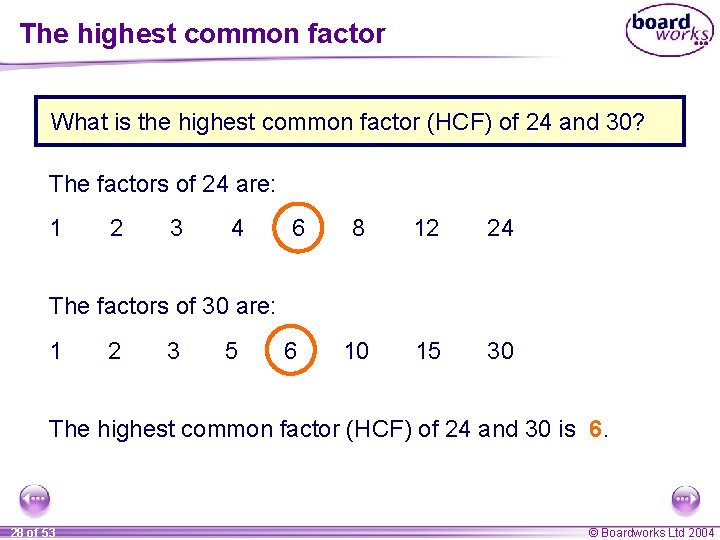
The highest common factor What is the highest common factor (HCF) of 24 and 30? The factors of 24 are: 1 2 3 4 6 8 12 24 10 15 30 The factors of 30 are: 1 2 3 5 6 The highest common factor (HCF) of 24 and 30 is 6. 28 of 53 © Boardworks Ltd 2004
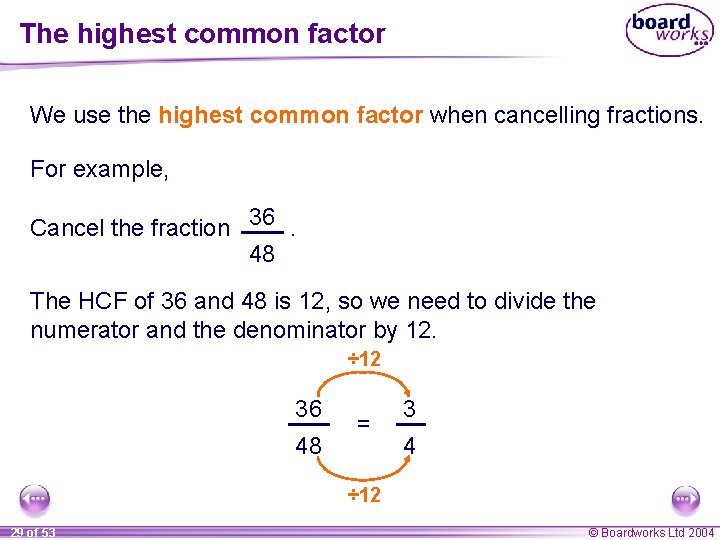
The highest common factor We use the highest common factor when cancelling fractions. For example, Cancel the fraction 36. 48 The HCF of 36 and 48 is 12, so we need to divide the numerator and the denominator by 12. ÷ 12 36 48 = 3 4 ÷ 12 29 of 53 © Boardworks Ltd 2004
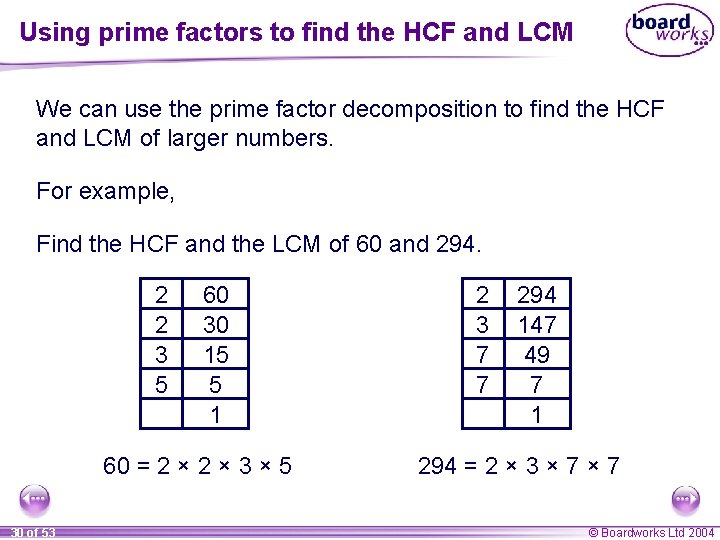
Using prime factors to find the HCF and LCM We can use the prime factor decomposition to find the HCF and LCM of larger numbers. For example, Find the HCF and the LCM of 60 and 294. 2 2 3 5 60 30 15 5 1 60 = 2 × 3 × 5 30 of 53 2 3 7 7 294 147 49 7 1 294 = 2 × 3 × 7 © Boardworks Ltd 2004
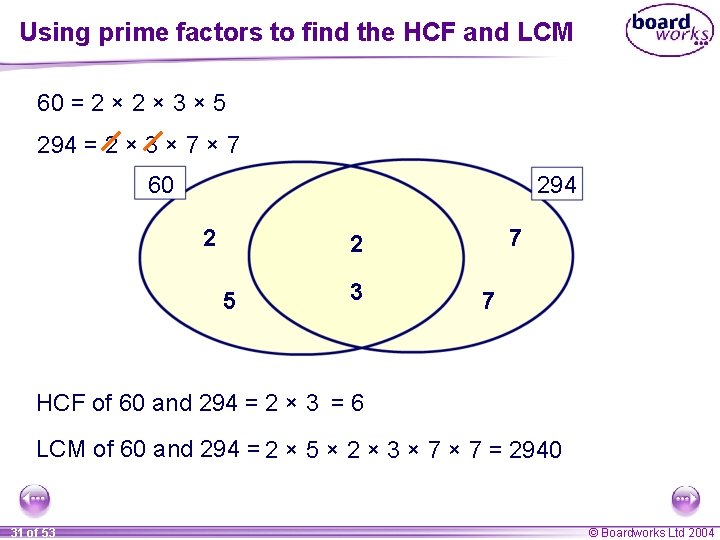
Using prime factors to find the HCF and LCM 60 = 2 × 3 × 5 294 = 2 × 3 × 7 60 294 2 7 2 5 3 7 HCF of 60 and 294 = 2 × 3 = 6 LCM of 60 and 294 = 2 × 5 × 2 × 3 × 7 = 2940 31 of 53 © Boardworks Ltd 2004
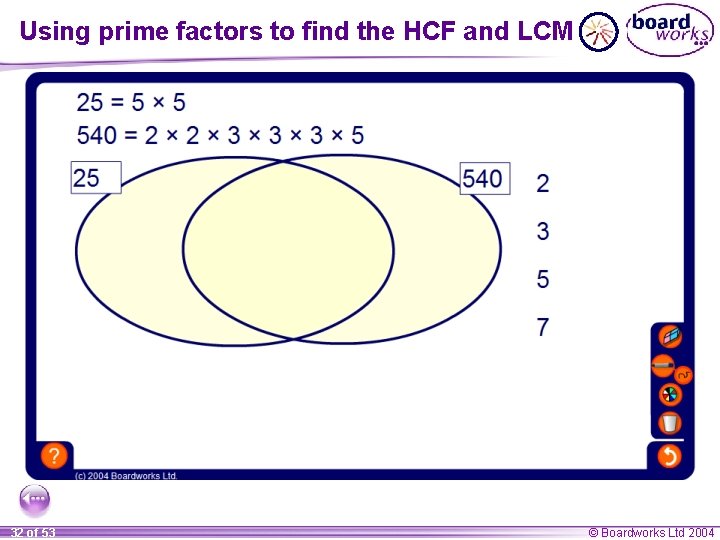
Using prime factors to find the HCF and LCM 32 of 53 © Boardworks Ltd 2004