Comparison of LASIK Flap Thicknesses with the Intra

- Slides: 12
Comparison of LASIK Flap Thicknesses with the Intra. Lase Compared to Microkeratomes in 10, 000 Eyes David Kent Christchurch, New Zealand The author has no financial interest in any of the products in this presentation
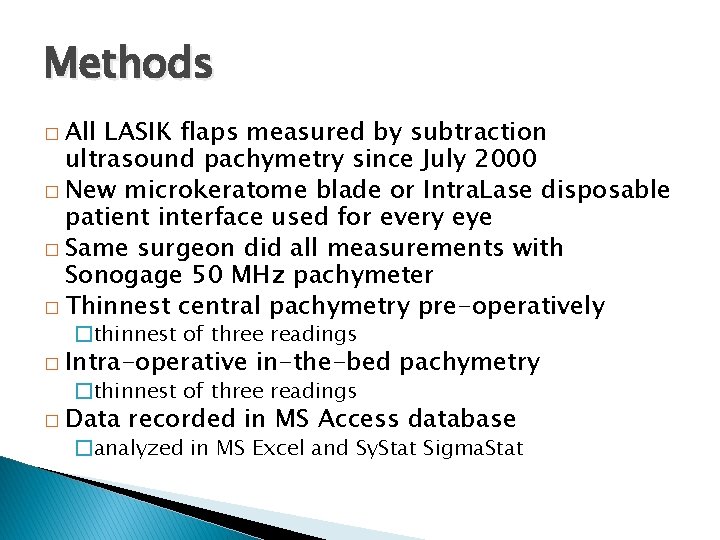
Methods � All LASIK flaps measured by subtraction ultrasound pachymetry since July 2000 � New microkeratome blade or Intra. Lase disposable patient interface used for every eye � Same surgeon did all measurements with Sonogage 50 MHz pachymeter � Thinnest central pachymetry pre-operatively �thinnest of three readings � Intra-operative in-the-bed pachymetry �thinnest of three readings � Data recorded in MS Access database �analyzed in MS Excel and Sy. Stat Sigma. Stat
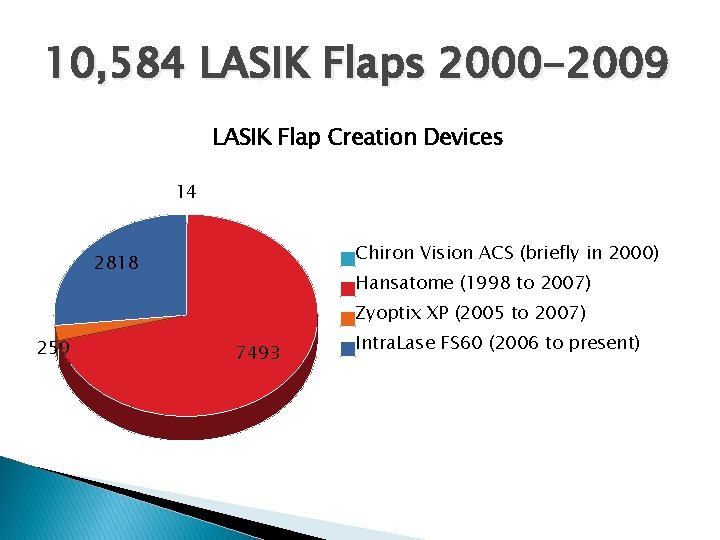
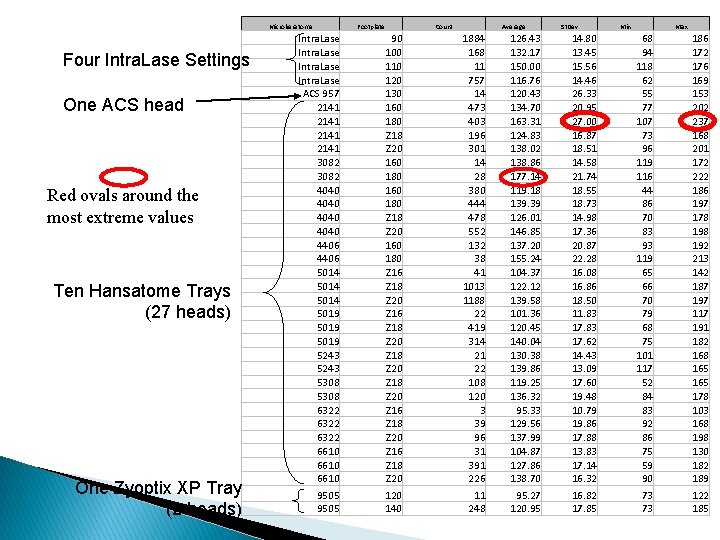
10, 584 LASIK Flaps 2000 -2009 LASIK Flap Creation Devices 14 Chiron Vision ACS (briefly in 2000) 2818 Hansatome (1998 to 2007) Zyoptix XP (2005 to 2007) 259 7493 Intra. Lase FS 60 (2006 to present)
Microkeratome Four Intra. Lase Settings One ACS head Red ovals around the most extreme values Ten Hansatome Trays (27 heads) One Zyoptix XP Tray (2 heads) Intra. Lase ACS 957 2141 3082 4040 4406 5014 5019 5243 5308 6322 6610 9505 Footplate Count 90 100 110 120 130 160 180 Z 18 Z 20 160 180 Z 16 Z 18 Z 20 Z 16 Z 18 Z 20 120 140 Average 1884 168 11 757 14 473 403 196 301 14 28 380 444 478 552 132 38 41 1013 1188 22 419 314 21 22 108 120 3 39 96 31 391 226 11 248 126. 43 132. 17 150. 00 116. 76 120. 43 134. 70 163. 31 124. 83 138. 02 138. 86 177. 14 119. 18 139. 39 126. 01 146. 85 137. 20 155. 24 104. 37 122. 12 139. 58 101. 36 120. 45 140. 04 130. 38 139. 86 119. 25 136. 32 95. 33 129. 56 137. 99 104. 87 127. 86 138. 70 95. 27 120. 95 St. Dev 14. 80 13. 45 15. 56 14. 46 26. 33 20. 95 27. 00 16. 87 18. 51 14. 58 21. 74 18. 55 18. 73 14. 98 17. 36 20. 87 22. 28 16. 08 16. 86 18. 50 11. 83 17. 62 14. 43 13. 09 17. 60 19. 48 10. 79 19. 86 17. 88 13. 83 17. 14 16. 32 16. 82 17. 85 Min Max 68 94 118 62 55 77 107 73 96 119 116 44 86 70 83 93 119 65 66 70 79 68 75 101 117 52 84 83 92 86 75 59 90 73 73 186 172 176 169 153 202 237 168 201 172 222 186 197 178 192 213 142 187 197 117 191 182 168 165 178 103 168 198 130 182 189 122 185
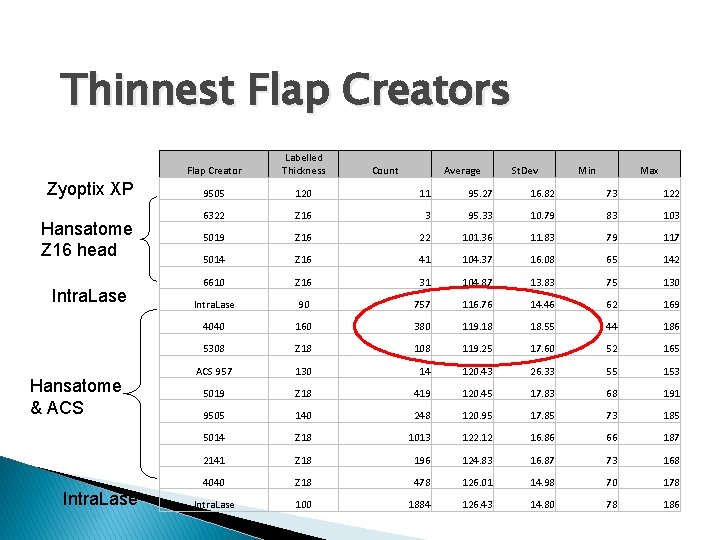
Thinnest Flap Creators Zyoptix XP Hansatome Z 16 head Intra. Lase Hansatome & ACS Intra. Lase Flap Creator Labelled Thickness 9505 120 11 95. 27 16. 82 73 122 6322 Z 16 3 95. 33 10. 79 83 103 5019 Z 16 22 101. 36 11. 83 79 117 5014 Z 16 41 104. 37 16. 08 65 142 6610 Z 16 31 104. 87 13. 83 75 130 Intra. Lase 90 757 116. 76 14. 46 62 169 4040 160 380 119. 18 18. 55 44 186 5308 Z 18 108 119. 25 17. 60 52 165 ACS 957 130 14 120. 43 26. 33 55 153 5019 Z 18 419 120. 45 17. 83 68 191 9505 140 248 120. 95 17. 85 73 185 5014 Z 18 1013 122. 12 16. 86 66 187 2141 Z 18 196 124. 83 16. 87 73 168 4040 Z 18 478 126. 01 14. 98 70 178 Intra. Lase 100 1884 126. 43 14. 80 78 186 Count Average St. Dev Min Max
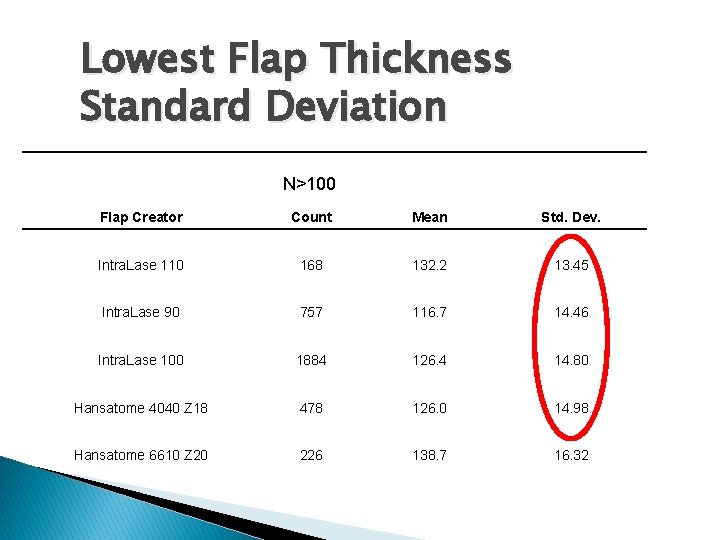
Lowest Flap Thickness Standard Deviation N>100 Flap Creator Count Mean Std. Dev. Intra. Lase 110 168 132. 2 13. 45 Intra. Lase 90 757 116. 7 14. 46 Intra. Lase 100 1884 126. 4 14. 80 Hansatome 4040 Z 18 478 126. 0 14. 98 Hansatome 6610 Z 20 226 138. 7 16. 32
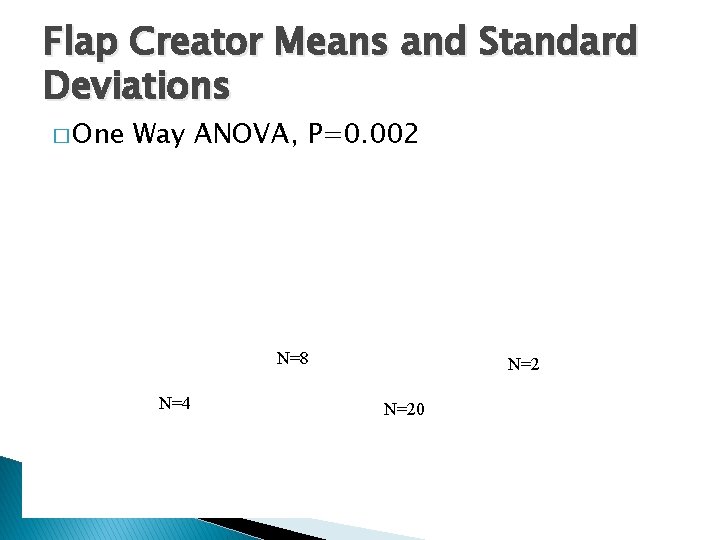
Flap Creator Means and Standard Deviations � One Way ANOVA, P=0. 002 P = 0. 002, One way ANOVA N=8 N=4 N=20
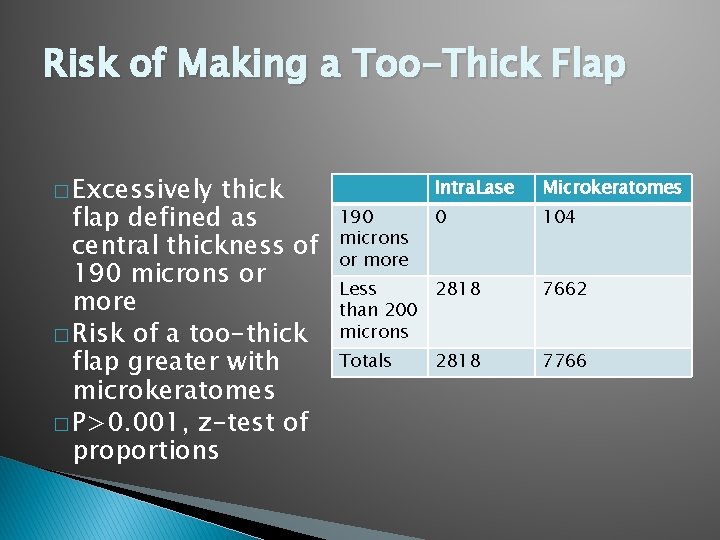
Risk of Making a Too-Thick Flap � Excessively thick flap defined as central thickness of 190 microns or more � Risk of a too-thick flap greater with microkeratomes � P>0. 001, z-test of proportions 190 microns or more Intra. Lase Microkeratomes 0 104 Less 2818 than 200 microns 7662 Totals 7766 2818
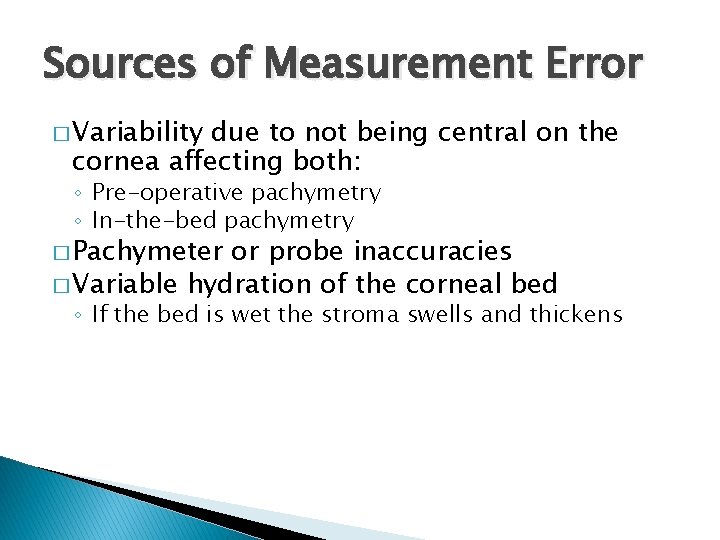
Sources of Measurement Error � Variability due to not being central on the cornea affecting both: ◦ Pre-operative pachymetry ◦ In-the-bed pachymetry � Pachymeter or probe inaccuracies � Variable hydration of the corneal bed ◦ If the bed is wet the stroma swells and thickens
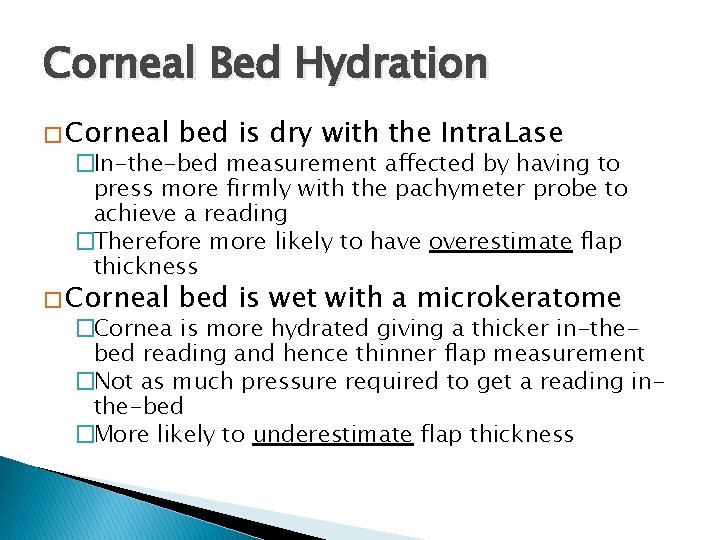
Corneal Bed Hydration � Corneal bed is dry with the Intra. Lase � Corneal bed is wet with a microkeratome �In-the-bed measurement affected by having to press more firmly with the pachymeter probe to achieve a reading �Therefore more likely to have overestimate flap thickness �Cornea is more hydrated giving a thicker in-thebed reading and hence thinner flap measurement �Not as much pressure required to get a reading inthe-bed �More likely to underestimate flap thickness
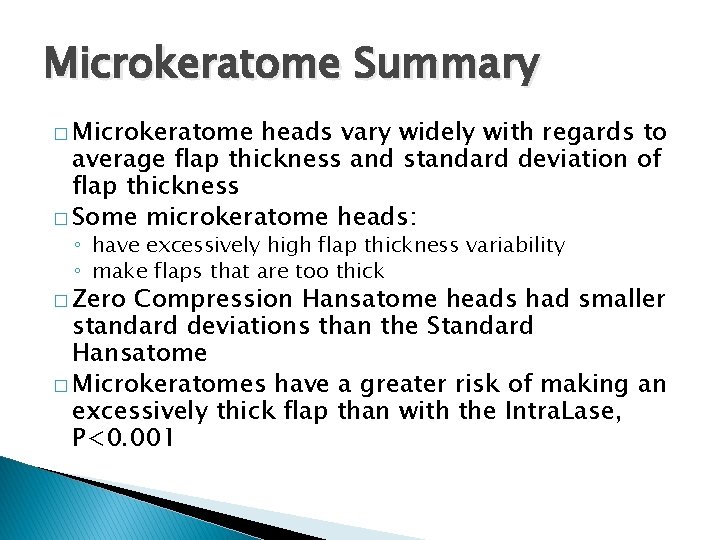
Microkeratome Summary � Microkeratome heads vary widely with regards to average flap thickness and standard deviation of flap thickness � Some microkeratome heads: ◦ have excessively high flap thickness variability ◦ make flaps that are too thick � Zero Compression Hansatome heads had smaller standard deviations than the Standard Hansatome � Microkeratomes have a greater risk of making an excessively thick flap than with the Intra. Lase, P<0. 001
Intra. Lase Flap Summary � Flap thickness standard deviation is lower with the Intra. Lase than with microkeratomes, P=0. 002 � The Intra. Lase 90 micron setting makes consistent thin flaps with a low standard deviation and a high level of safety � Intra. Lase 100 and 110 micron settings also have a low standard deviations � My Intra. Lase FS 60 makes flaps that measure about 20 -25 microns thicker on average than the nominal thickness