
Corneal Biomechanical Assessment using Dynamic Ultra HighSpeed Scheimpflug
Corneal Biomechanical Assessment using Dynamic Ultra High-Speed Scheimpflug Technology Non-Contact Tonometry (UHS-ST NCT): Preliminary Results R. Ambrósio Jr & Rio de Janeiro Corneal Tomography and Biomechanics Study Group Renato Ambrósio Jr. , MD, Ph. D* Diogo L. Caldas, MD Isaac C. Ramos, MD Rodrigo T. Santos, MD Leonardo N. Pimentel, MD Cynthia Roberts, Ph. D* Michael W. Belin, MD* Dr. Ambrósio & Dr. Belin are consultants for Oculus Optikgeräte Gmb. H (Wetzlar, Germany) and have received research funding and travel reimbursements © R. Ambrósio Jr, MD, Ph. D - 2011
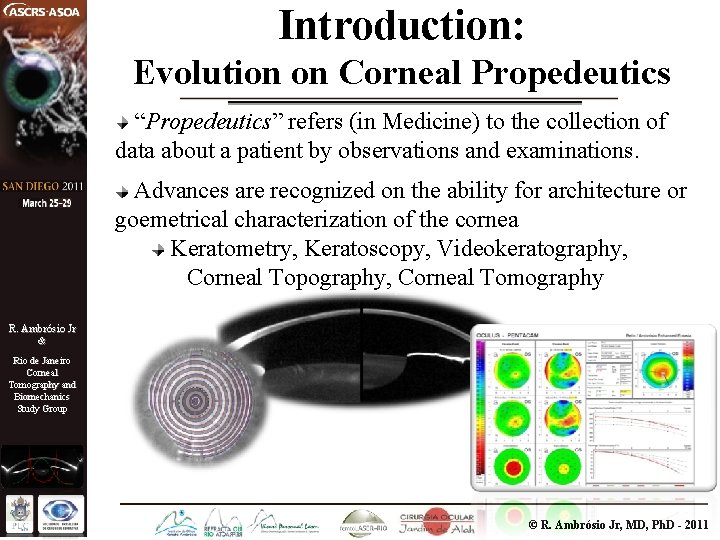
Introduction: Evolution on Corneal Propedeutics “Propedeutics” refers (in Medicine) to the collection of data about a patient by observations and examinations. Advances are recognized on the ability for architecture or goemetrical characterization of the cornea Keratometry, Keratoscopy, Videokeratography, Corneal Topography, Corneal Tomography R. Ambrósio Jr & Rio de Janeiro Corneal Tomography and Biomechanics Study Group © R. Ambrósio Jr, MD, Ph. D - 2011
Corneal Biomechanics: Relevance R. Ambrósio Jr & Rio de Janeiro Corneal Tomography and Biomechanics Study Group From Geometrical and Optical understanding, the next step is biological evaluation: healing response and biomechanics Ectasia mysteries* in Refractive Surgery had highlight the need for corneal biomechanical understanding (*ie: cases with no risk factors that develop ectasia after LASIK) Also to Customize Refractive Corneal Treatments; correctly measure IOP (intraocular pressure) and to possibly predict glaucoma risk Corneal biomechanical evaluations were limited to in vitro studies and to mathematical finite element models until the Ocular Response Analyzer (ORA-Reichert, Depew) in 2005 New techniques are under development for evaluating biomechanics This e-Poster presents a new system – The Corvis ST (Oculus, Wetzlar, Germany) with preliminary clinical results. © R. Ambrósio Jr, MD, Ph. D - 2011

The Oculus Corvis ST Ultra High-Speed (UHS ST) Scheimpflug Technology takes 4, 330 frames/sec with 8 mm horizontal coverage Monitors corneal deformation response to a symmetrically metered air pulse R. Ambrósio Jr & Rio de Janeiro Corneal Tomography and Biomechanics Study Group 1. Natural; (Ingoing Phase) 2. First Applanation (1 st A) Momentum; 3 and 4. Ingoing Concavity Phase; 5. Highest Concavity Momentum; 6. Oscillation Period; (Outgoing Phase); 7. Second Applanation (2 nd A) Momentum; 8. After Second Applanation; 9. Natural Back 1 st Applanation, Highest Concavity and 2 nd Applanation: Time and Length; Maximum Deformation; Maximum Velocity In and Out; Thickness © R. Ambrósio Jr, MD, Ph. D - 2011

Corvis ST: First Studies Experiment involving contact lenses mounted on an artifical pressurized chamber (Caldas et al. , e. Poster ASCRS 2011) found that the deformation response is influenced by lens properties and chamber pressure. The inspection of the actual deformation process details corneal characterization, which has a potential for distinguishing normal (A, B) and keratoconus (C, D) corneas (see video* Poster. ASCRS 2011_clip_RAmbrosio). Natural and Highest Deformation Momentum in a Normal (A, B) and a Keratoconic (C, D) Cornea R. Ambrósio Jr & Rio de Janeiro Corneal Tomography and Biomechanics Study Group © R. Ambrósio Jr, MD, Ph. D - 2011
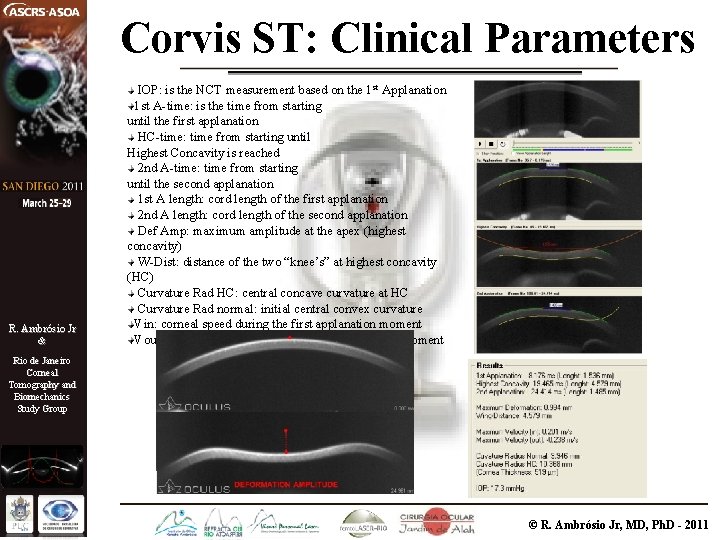
Corvis ST: Clinical Parameters R. Ambrósio Jr & IOP: is the NCT measurement based on the 1 st Applanation 1 st A-time: is the time from starting until the first applanation HC-time: time from starting until Highest Concavity is reached 2 nd A-time: time from starting until the second applanation 1 st A length: cord length of the first applanation 2 nd A length: cord length of the second applanation Def Amp: maximum amplitude at the apex (highest concavity) W-Dist: distance of the two “knee’s” at highest concavity (HC) Curvature Rad HC: central concave curvature at HC Curvature Rad normal: initial central convex curvature Vin: corneal speed during the first applanation moment Vout: corneal speed during the second applanation moment Rio de Janeiro Corneal Tomography and Biomechanics Study Group © R. Ambrósio Jr, MD, Ph. D - 2011
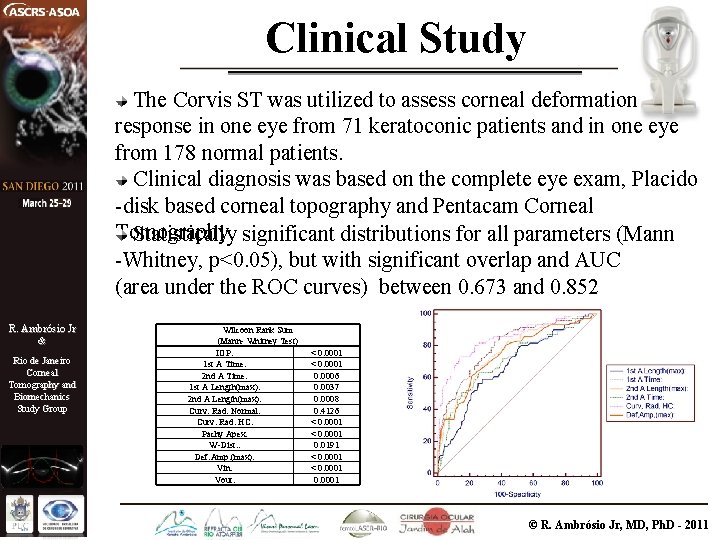
Clinical Study The Corvis ST was utilized to assess corneal deformation response in one eye from 71 keratoconic patients and in one eye from 178 normal patients. Clinical diagnosis was based on the complete eye exam, Placido -disk based corneal topography and Pentacam Corneal Tomography. Statistically significant distributions for all parameters (Mann -Whitney, p<0. 05), but with significant overlap and AUC (area under the ROC curves) between 0. 673 and 0. 852 R. Ambrósio Jr & Rio de Janeiro Corneal Tomography and Biomechanics Study Group Wilcoon Rank Sum (Mann- Whitney Test) IOP: 1 st A Time: 2 nd A Time: 1 st A Length(max): 2 nd A Length(max): Curv. Rad. Normal: Curv. Rad. HC: Pachy Apex: W-Dist. : Def. Amp. (max): Vin: Vout: < 0. 0001 0. 0006 0. 0037 0. 0008 0. 4126 < 0. 0001 0. 0191 < 0. 0001 © R. Ambrósio Jr, MD, Ph. D - 2011
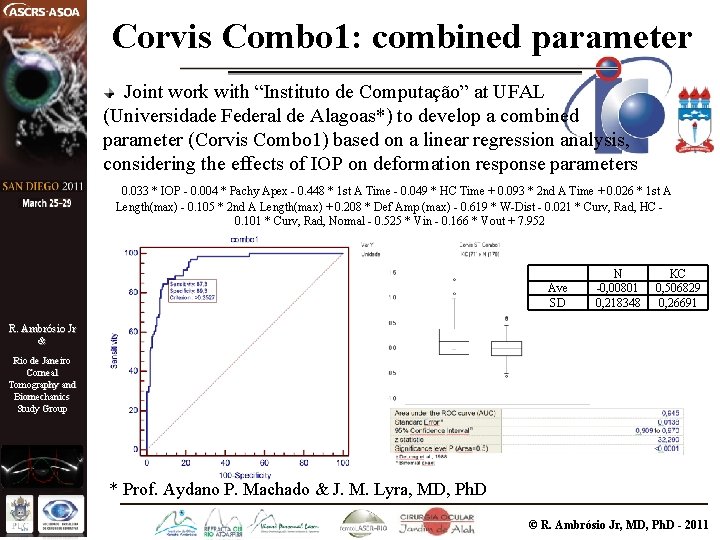
Corvis Combo 1: combined parameter Joint work with “Instituto de Computação” at UFAL (Universidade Federal de Alagoas*) to develop a combined parameter (Corvis Combo 1) based on a linear regression analysis, considering the effects of IOP on deformation response parameters 0. 033 * IOP - 0. 004 * Pachy Apex - 0. 448 * 1 st A Time - 0. 049 * HC Time + 0. 093 * 2 nd A Time + 0. 026 * 1 st A Length(max) - 0. 105 * 2 nd A Length(max) + 0. 208 * Def Amp (max) - 0. 619 * W-Dist - 0. 021 * Curv, Rad, HC - 0. 101 * Curv, Rad, Normal - 0. 525 * Vin - 0. 166 * Vout + 7. 952 Ave SD N -0, 00801 0, 218348 KC 0, 506829 0, 26691 R. Ambrósio Jr & Rio de Janeiro Corneal Tomography and Biomechanics Study Group * Prof. Aydano P. Machado & J. M. Lyra, MD, Ph. D © R. Ambrósio Jr, MD, Ph. D - 2011
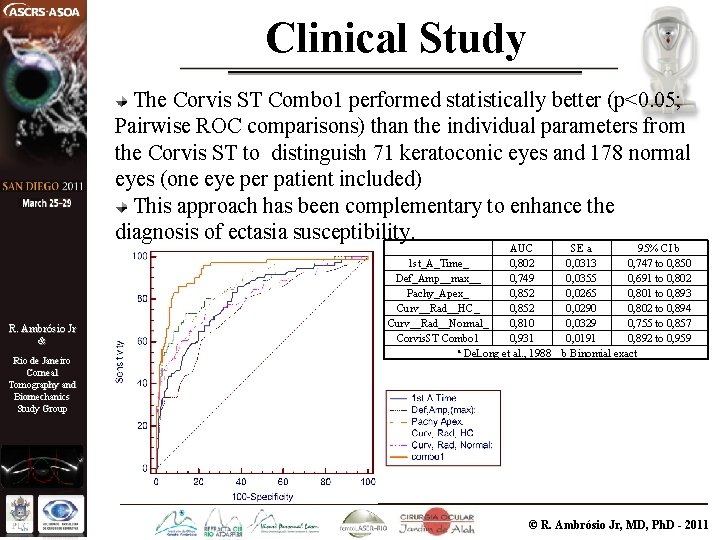
Clinical Study The Corvis ST Combo 1 performed statistically better (p<0. 05; Pairwise ROC comparisons) than the individual parameters from the Corvis ST to distinguish 71 keratoconic eyes and 178 normal eyes (one eye per patient included) This approach has been complementary to enhance the diagnosis of ectasia susceptibility. R. Ambrósio Jr & Rio de Janeiro Corneal Tomography and Biomechanics Study Group AUC SE a 95% CI b 0, 802 0, 0313 0, 747 to 0, 850 1 st_A_Time_ Def_Amp__max__ 0, 749 0, 0355 0, 691 to 0, 802 Pachy_Apex_ 0, 852 0, 0265 0, 801 to 0, 893 Curv__Rad__HC_ 0, 852 0, 0290 0, 802 to 0, 894 Curv__Rad__Normal_ 0, 810 0, 0329 0, 755 to 0, 857 Corvis. ST Combo 1 0, 931 0, 0191 0, 892 to 0, 959 a De. Long et al. , 1988 b Binomial exact © R. Ambrósio Jr, MD, Ph. D - 2011
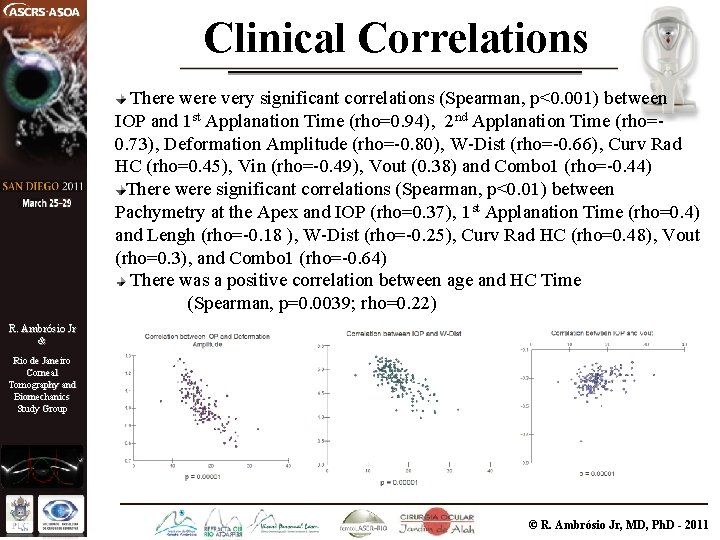
Clinical Correlations There were very significant correlations (Spearman, p<0. 001) between IOP and 1 st Applanation Time (rho=0. 94), 2 nd Applanation Time (rho=0. 73), Deformation Amplitude (rho=-0. 80), W-Dist (rho=-0. 66), Curv Rad HC (rho=0. 45), Vin (rho=-0. 49), Vout (0. 38) and Combo 1 (rho=-0. 44) There were significant correlations (Spearman, p<0. 01) between Pachymetry at the Apex and IOP (rho=0. 37), 1 st Applanation Time (rho=0. 4) and Lengh (rho=-0. 18 ), W-Dist (rho=-0. 25), Curv Rad HC (rho=0. 48), Vout (rho=0. 3), and Combo 1 (rho=-0. 64) There was a positive correlation between age and HC Time (Spearman, p=0. 0039; rho=0. 22) R. Ambrósio Jr & Rio de Janeiro Corneal Tomography and Biomechanics Study Group © R. Ambrósio Jr, MD, Ph. D - 2011
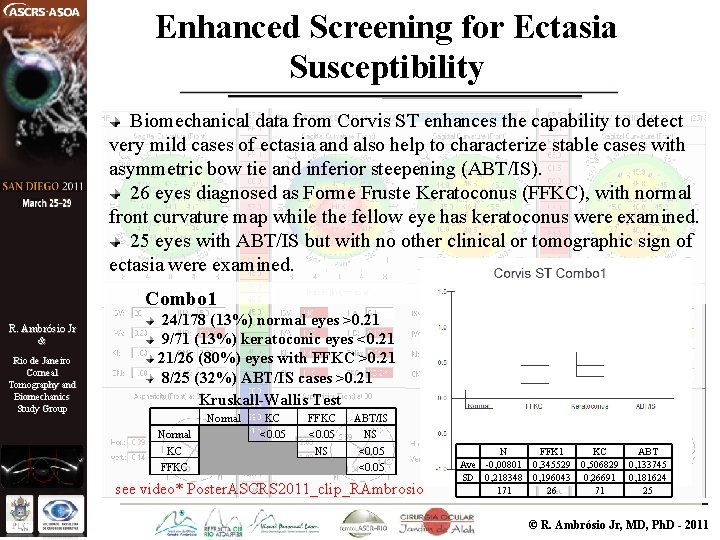
Enhanced Screening for Ectasia Susceptibility Biomechanical data from Corvis ST enhances the capability to detect very mild cases of ectasia and also help to characterize stable cases with asymmetric bow tie and inferior steepening (ABT/IS). 26 eyes diagnosed as Forme Fruste Keratoconus (FFKC), with normal front curvature map while the fellow eye has keratoconus were examined. 25 eyes with ABT/IS but with no other clinical or tomographic sign of ectasia were examined. Combo 1 R. Ambrósio Jr & Rio de Janeiro Corneal Tomography and Biomechanics Study Group 24/178 (13%) normal eyes >0. 21 9/71 (13%) keratoconic eyes <0. 21 21/26 (80%) eyes with FFKC >0. 21 8/25 (32%) ABT/IS cases >0. 21 Kruskall-Wallis Test Normal KC FFKC Normal KC <0. 05 FFKC <0. 05 NS ABT/IS NS <0. 05 see video* Poster. ASCRS 2011_clip_RAmbrosio N Ave -0, 00801 SD 0, 218348 171 FFK 1 0, 345529 0, 196043 26 KC 0, 506829 0, 26691 71 ABT 0, 133745 0, 181624 25 © R. Ambrósio Jr, MD, Ph. D - 2011
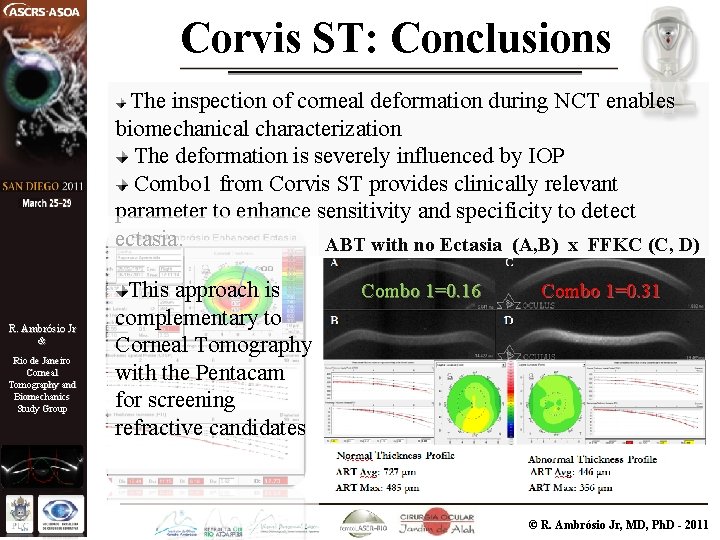
Corvis ST: Conclusions The inspection of corneal deformation during NCT enables biomechanical characterization The deformation is severely influenced by IOP Combo 1 from Corvis ST provides clinically relevant parameter to enhance sensitivity and specificity to detect ectasia. ABT with no Ectasia (A, B) x FFKC (C, D) R. Ambrósio Jr & Rio de Janeiro Corneal Tomography and Biomechanics Study Group This approach is complementary to Corneal Tomography with the Pentacam for screening refractive candidates Combo 1=0. 16 Combo 1=0. 31 © R. Ambrósio Jr, MD, Ph. D - 2011
- Slides: 12