Classifications of Matter Classifications of Matter Yes Can

- Slides: 12
Classifications of Matter
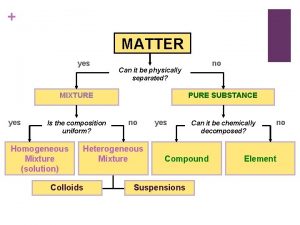
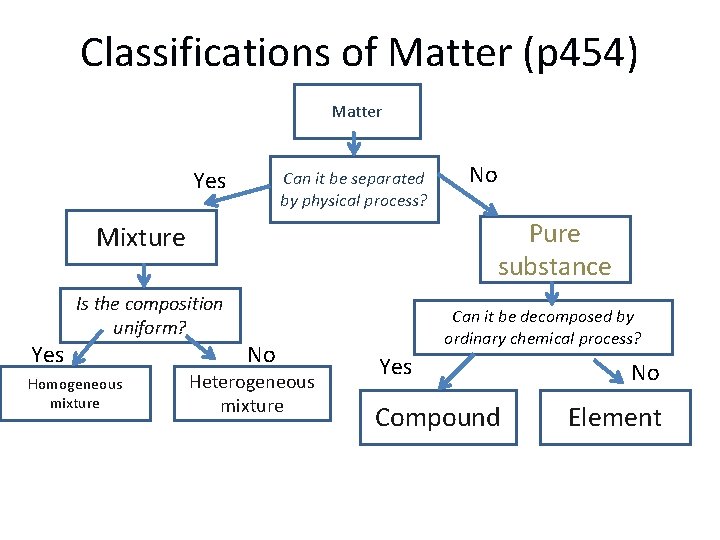
Classifications of Matter Yes Can it be separated by physical process? Pure substance Mixture Is the composition uniform? Yes Homogeneous mixture No No Heterogeneous mixture Can it be decomposed by ordinary chemical process? Yes Compound No Element
Physical Properties • Physical properties can be observed without changing the identity of the substance. – Appearance • Density, color, shininess, smell, taste – Behavior • specific heat, boiling temperature, melting temperature, conductivity, malleability, ductility, radioactivity – Size, shape, state (solid, liquid, gas, plasma)
Separating using Physical Properties • Settling (density) let stand or centrifuge • Screening or filtering (particle size) Magnetic separation – magnetism • Distillation (boiling temperature)
Chemical Properties • A characteristic of a substance that indicates how it reacts with other substances. Determining a chemical property changes the identity of the substance – Flammability- reaction with oxygen – Reactivity (how readily does it react with other substances)
Physical and Change • Physical Change is a change in a physical property – Change size, shape, state of matter • Chemical Change changes one substance into another substance – Release of energy- heat, light, sound – Absorption of heat – Formation of a gas indicated by bubbles – Formation of a precipitate (a solid forms in a liquid)
Classifications of Matter (p 454) Matter Yes Can it be separated by physical process? Pure substance Mixture Is the composition uniform? Yes Homogeneous mixture No No Heterogeneous mixture Can it be decomposed by ordinary chemical process? Yes Compound No Element
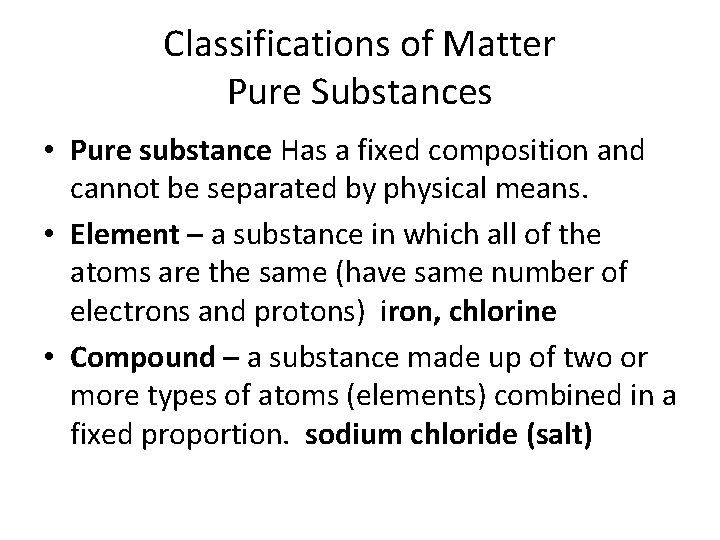
Classifications of Matter Pure Substances • Pure substance Has a fixed composition and cannot be separated by physical means. • Element – a substance in which all of the atoms are the same (have same number of electrons and protons) iron, chlorine • Compound – a substance made up of two or more types of atoms (elements) combined in a fixed proportion. sodium chloride (salt)
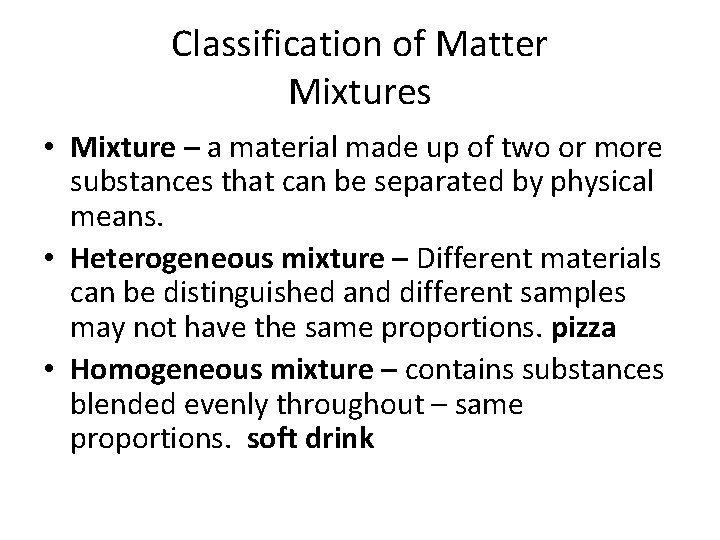
Classification of Matter Mixtures • Mixture – a material made up of two or more substances that can be separated by physical means. • Heterogeneous mixture – Different materials can be distinguished and different samples may not have the same proportions. pizza • Homogeneous mixture – contains substances blended evenly throughout – same proportions. soft drink
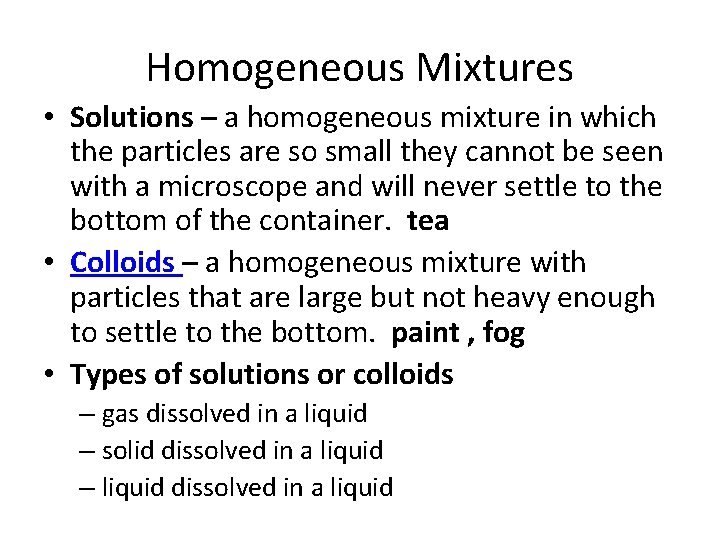
Homogeneous Mixtures • Solutions – a homogeneous mixture in which the particles are so small they cannot be seen with a microscope and will never settle to the bottom of the container. tea • Colloids – a homogeneous mixture with particles that are large but not heavy enough to settle to the bottom. paint , fog • Types of solutions or colloids – gas dissolved in a liquid – solid dissolved in a liquid – liquid dissolved in a liquid
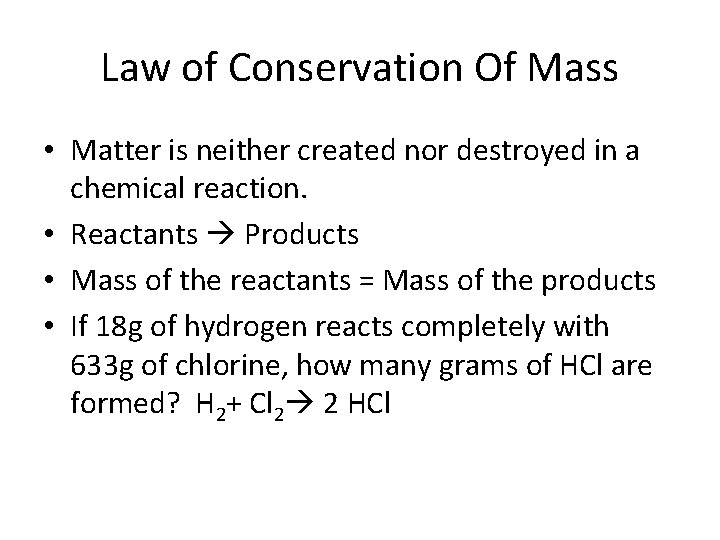
Law of Conservation Of Mass • Matter is neither created nor destroyed in a chemical reaction. • Reactants Products • Mass of the reactants = Mass of the products • If 18 g of hydrogen reacts completely with 633 g of chlorine, how many grams of HCl are formed? H 2+ Cl 2 2 HCl
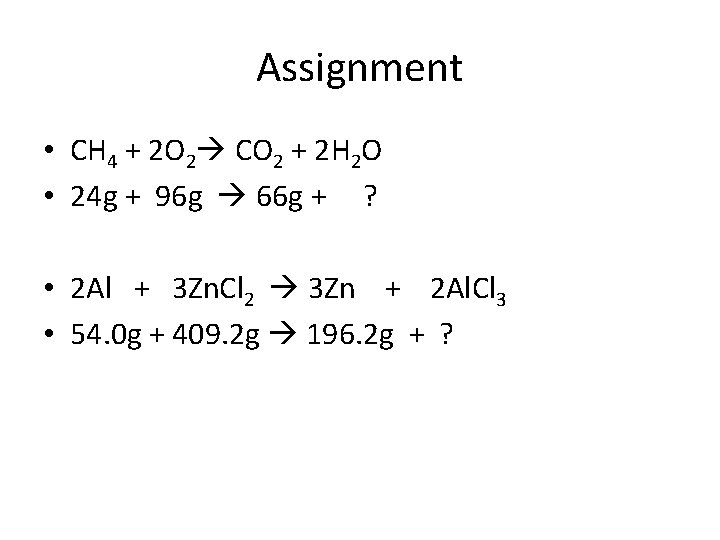
Assignment • CH 4 + 2 O 2 CO 2 + 2 H 2 O • 24 g + 96 g 66 g + ? • 2 Al + 3 Zn. Cl 2 3 Zn + 2 Al. Cl 3 • 54. 0 g + 409. 2 g 196. 2 g + ?