Civil Service Reforms FIJI PRINCIPALS ASSOCIATION 2018 Session
- Slides: 27
Civil Service Reforms FIJI PRINCIPALS ASSOCIATION 2018
Session Overview Session will cover: Overview of the reforms – Coordinated programme Guidelines and what is happening with implementation Open Merit Recruitment and Selection Discipline Job Evaluation and Civil Service Remuneration Performance Management Learning and Staff Development Other Activities –general orders, planning, where to get more information
Overview of the Reforms Civil Service Reform Management Unit (CSRMU) is responsible for working with Ministries to develop, coordinate and implement reform activities CSRMU is physically located on L 9, Ro Lalabalavu House, within the Ministry of Economy Budget under Head 50 Administratively under Ministry of Economy Director reports to Minister for Civil Service Ministry of Civil Service has no responsibility for reforms Big Picture Outcomes – a high performing civil service, implementing government priorities, responsive to and serving the public
Guidelines - OMRS Approved January 2016 – currently in the review, monitor and improve phase Transition and implementation in 2016 Open merit for all levels in the Civil Service – entry to any level Criteria for assessment must be only the knowledge, experience, skills and abilities required to perform the job Procedure Review Process implemented January 2017 Apply directly to the Public Service Commission Paper review of process – If process is not correct, will be redone Commission cannot determine merit and cannot appoint a different person Review of the Guideline - due to be presented to the PSC in their March 2018 meeting The review includes a random audit of selection of files from Ministries
OMRS IN THE MINISTRY OF EDUCATION Applies to all positions in the Ministry Classroom based recruitment Heads of Schools recruitment - Application writing training available from the Ministry of Civil Service Contact: Rejieli Tawaketini on rejieli. tawaketini@govnet. gov. fj
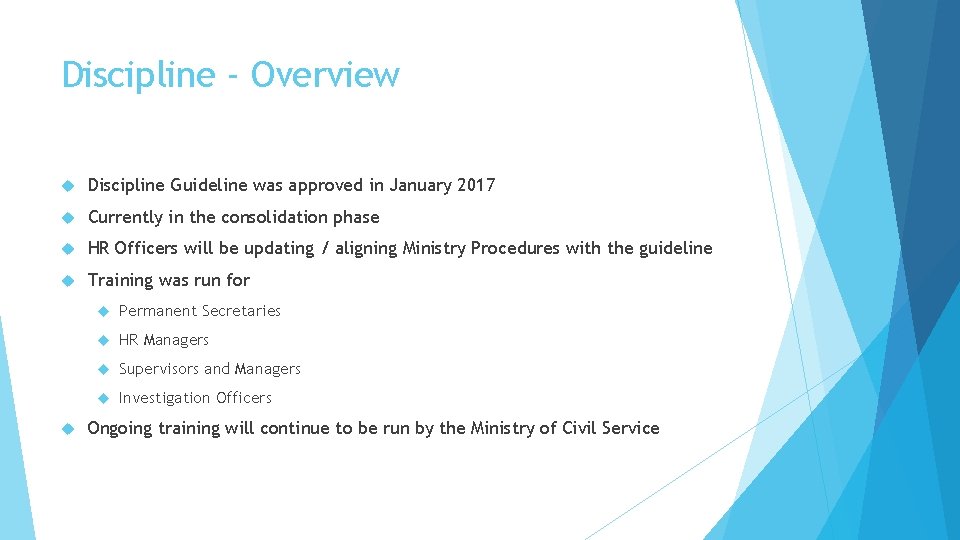
Discipline - Overview Discipline Guideline was approved in January 2017 Currently in the consolidation phase HR Officers will be updating / aligning Ministry Procedures with the guideline Training was run for Permanent Secretaries HR Managers Supervisors and Managers Investigation Officers Ongoing training will continue to be run by the Ministry of Civil Service
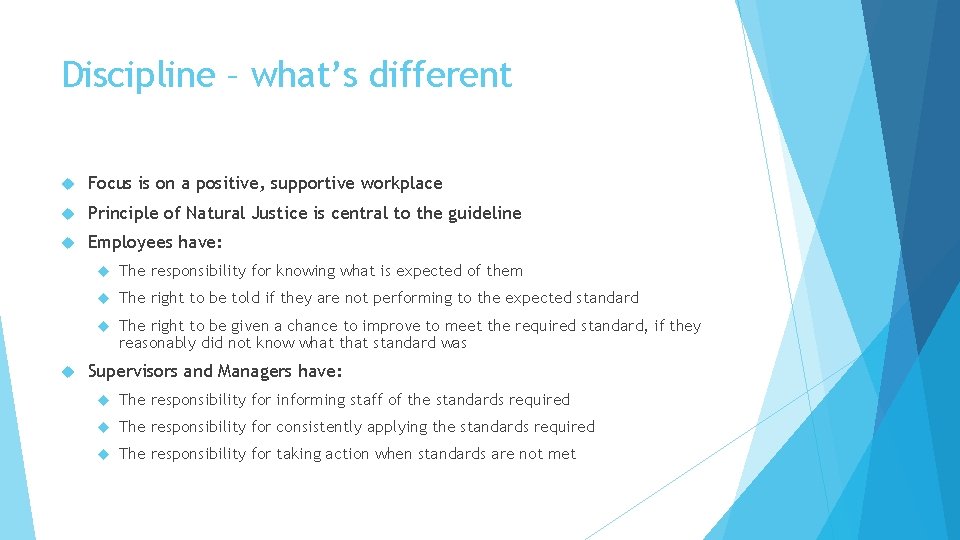
Discipline – what’s different Focus is on a positive, supportive workplace Principle of Natural Justice is central to the guideline Employees have: The responsibility for knowing what is expected of them The right to be told if they are not performing to the expected standard The right to be given a chance to improve to meet the required standard, if they reasonably did not know what that standard was Supervisors and Managers have: The responsibility for informing staff of the standards required The responsibility for consistently applying the standards required The responsibility for taking action when standards are not met
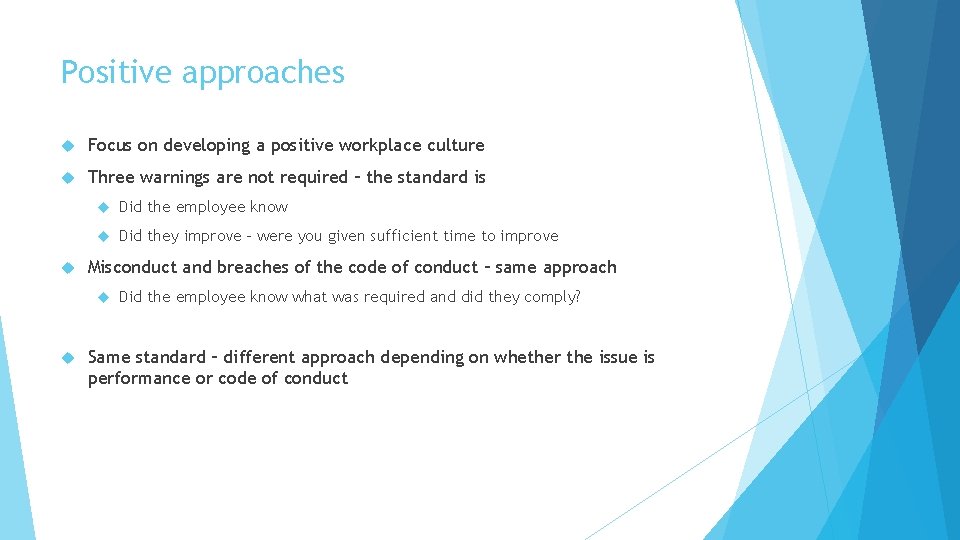
Positive approaches Focus on developing a positive workplace culture Three warnings are not required – the standard is Did the employee know Did they improve – were you given sufficient time to improve Misconduct and breaches of the code of conduct – same approach Did the employee know what was required and did they comply? Same standard – different approach depending on whether the issue is performance or code of conduct
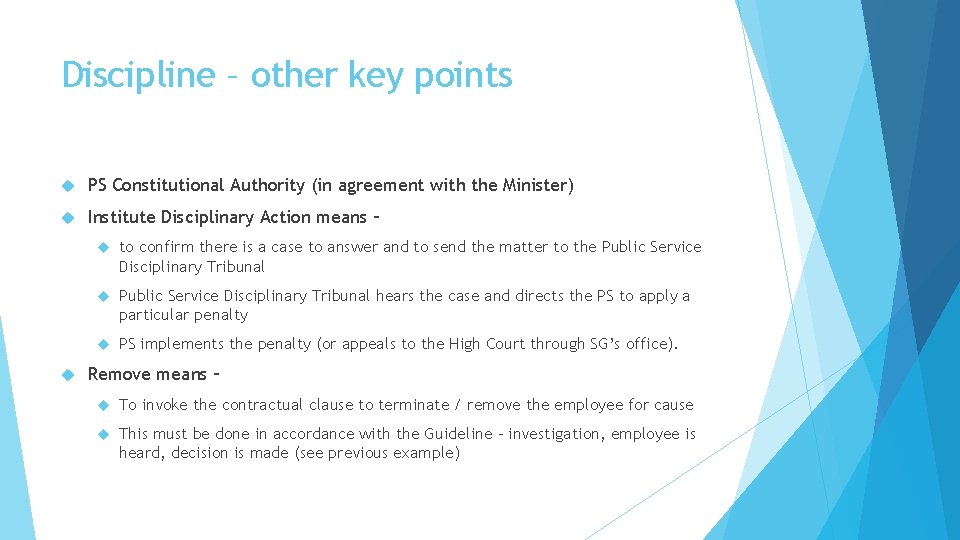
Discipline – other key points PS Constitutional Authority (in agreement with the Minister) Institute Disciplinary Action means – to confirm there is a case to answer and to send the matter to the Public Service Disciplinary Tribunal hears the case and directs the PS to apply a particular penalty PS implements the penalty (or appeals to the High Court through SG’s office). Remove means – To invoke the contractual clause to terminate / remove the employee for cause This must be done in accordance with the Guideline – investigation, employee is heard, decision is made (see previous example)
Discipline - regulations This Civil Service (General) and Civil Service (Discipline) regulations have been updated to align with the guideline Suspension – now on full pay while the matter is under investigation in the Ministry No pay once it is sent to the PSDT Apply to PSDT for quantum of salary Only if necessary – for safety or to ensure the integrity of the investigation Some changes to penalties – to align to all guidelines, modern management practice Gazetted 23 May 2017 PSDT have their own rules – Guideline covers up to the point of referral only
Discipline – more information Nominate to train as an investigation officer Supervisors and Managers - nominate and attend the training Talk to your supervisor Download the Guideline (PSC website) Read the Gazetted changes to the Regulations A note : it is your responsibility to stay informed, Regularly read the Gazette and check Hansard after all Parliamentary sittings to keep yourself up to date
Job Evaluation and Civil Service Remuneration (JECSR) Guideline approved and released in January 2017 Currently in the consolidation phase Ongoing process, does not stop with transition to the new bands Fundamental change - Position based pay Person and the position are considered separately Jobs are evaluated (not people) and placed on bands Qualification requirements are only one factor considered in evaluation If the person holds higher qualifications than that required, there is no additional pay for that – these people should perform better and will therefore be rewarded though performance assessment
ONGOING PROCESS Job Evaluation is not a “one off” Guideline has been written for ongoing evaluations Any substantial change to a position should be evaluated Before advertisement – should check the band If employee does not think the band is correct – can request evaluation Education has recently confirmed a re-evaluation of teaching positions More than 200 accredited evaluators across all Ministries – 17 trained evaluators in the Ministry of Education Evaluations approved by PS Moderated by the Job Evaluation Leadership Team (JELT) to maintain consistency
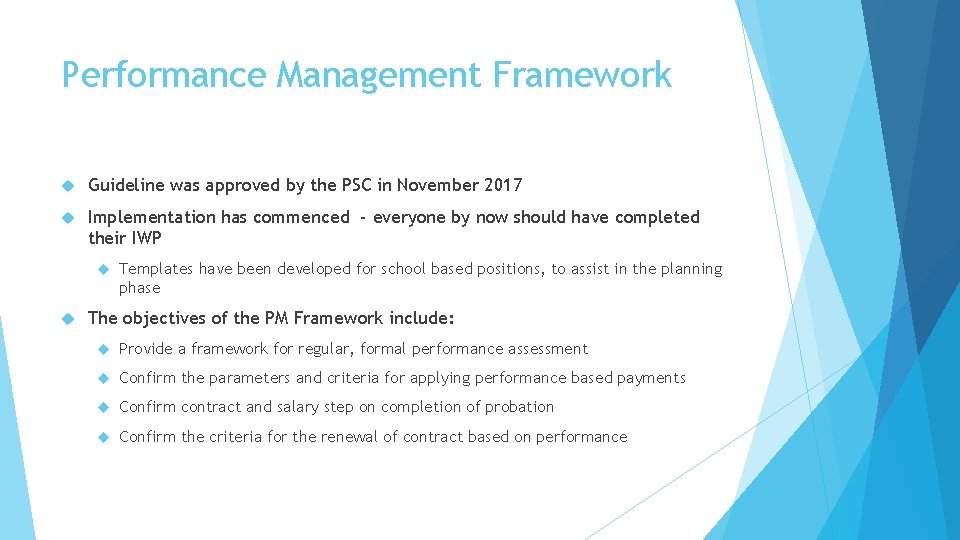
Performance Management Framework Guideline was approved by the PSC in November 2017 Implementation has commenced - everyone by now should have completed their IWP Templates have been developed for school based positions, to assist in the planning phase The objectives of the PM Framework include: Provide a framework for regular, formal performance assessment Confirm the parameters and criteria for applying performance based payments Confirm contract and salary step on completion of probation Confirm the criteria for the renewal of contract based on performance
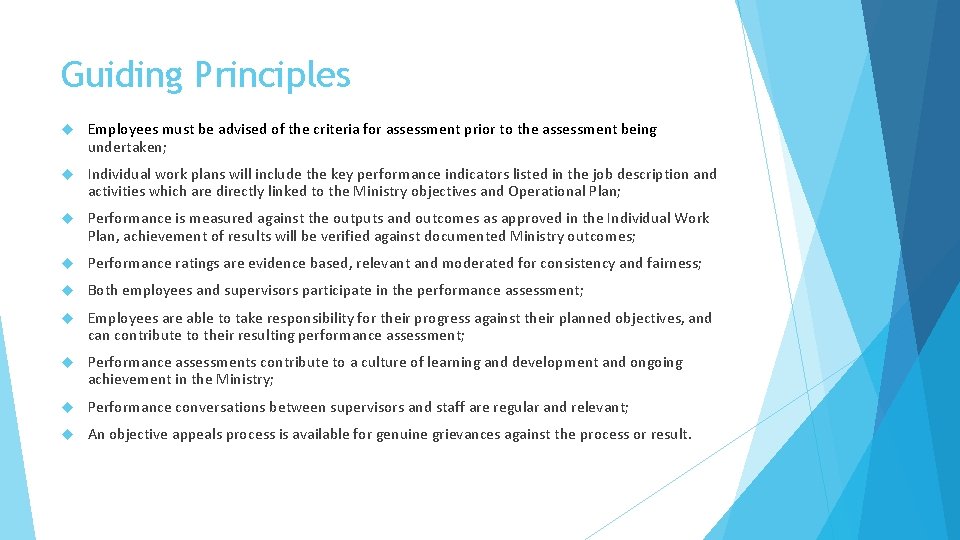
Guiding Principles Employees must be advised of the criteria for assessment prior to the assessment being undertaken; Individual work plans will include the key performance indicators listed in the job description and activities which are directly linked to the Ministry objectives and Operational Plan; Performance is measured against the outputs and outcomes as approved in the Individual Work Plan, achievement of results will be verified against documented Ministry outcomes; Performance ratings are evidence based, relevant and moderated for consistency and fairness; Both employees and supervisors participate in the performance assessment; Employees are able to take responsibility for their progress against their planned objectives, and can contribute to their resulting performance assessment; Performance assessments contribute to a culture of learning and development and ongoing achievement in the Ministry; Performance conversations between supervisors and staff are regular and relevant; An objective appeals process is available for genuine grievances against the process or result.
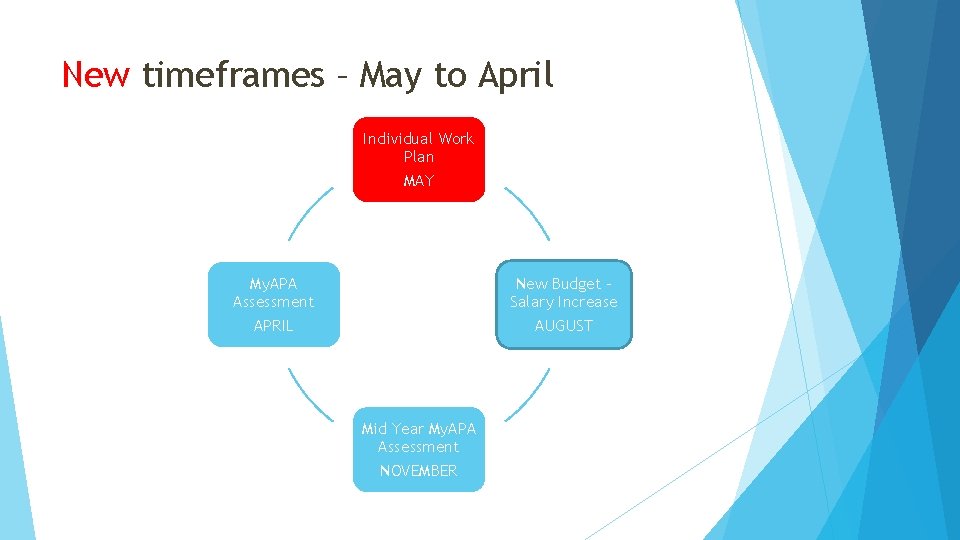
New timeframes – May to April Individual Work Plan MAY My. APA Assessment New Budget – Salary Increase APRIL AUGUST Mid Year My. APA Assessment NOVEMBER
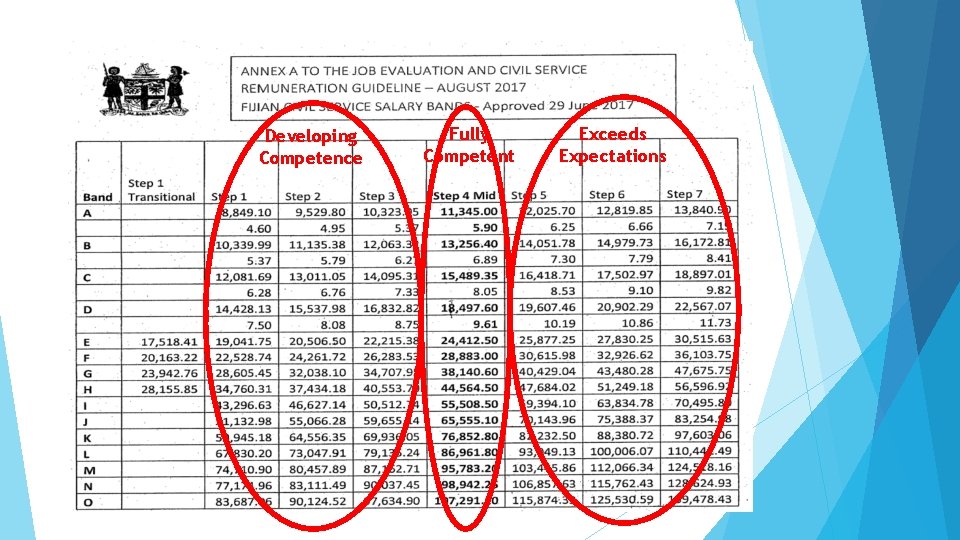
Developing Competence Fully Competent Exceeds Expectations 17
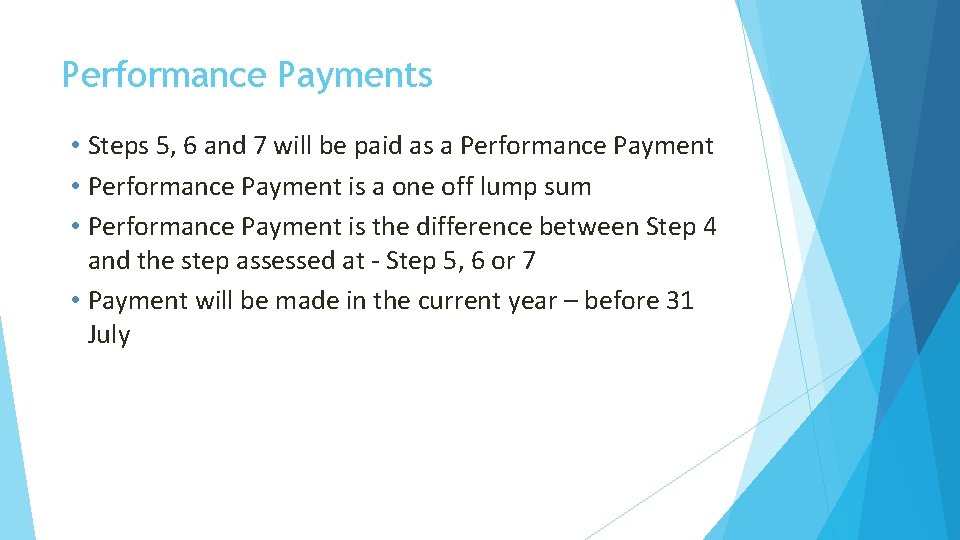
Performance Payments • Steps 5, 6 and 7 will be paid as a Performance Payment • Performance Payment is a one off lump sum • Performance Payment is the difference between Step 4 and the step assessed at - Step 5, 6 or 7 • Payment will be made in the current year – before 31 July
Who completes My. APA? My. APA § All Ministry employees § A Ministry employee is on a current contract or permanently employed, wage or salary person § My. APA applies to those employees with 9 months of continuous service in the position for which they will be assessed 19
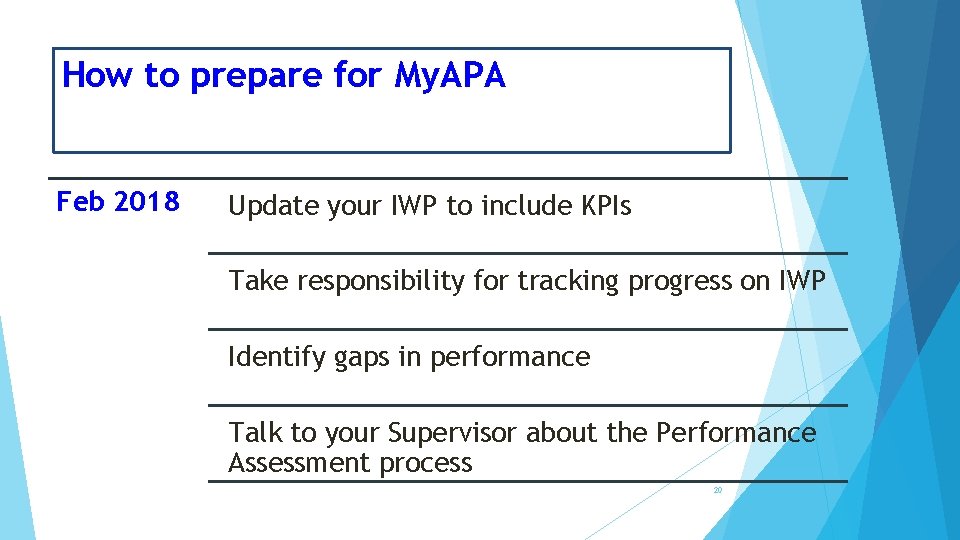
How to prepare for My. APA Feb 2018 Update your IWP to include KPIs Take responsibility for tracking progress on IWP Identify gaps in performance Talk to your Supervisor about the Performance Assessment process 20
PS Performance Assessment Framework PS have a similar system, approved by the Public Service Commission and implemented in 2017 PS PAF – includes measures for (to list just a few) Achievement of planned outcomes Efficiencies, effectiveness, compliance with Public Financial Management and all legislation, guidelines etc Documentary evidence to confirm, eg selection files, discipline files Improvements to business processes to improve effectiveness Note the emphasis on evidence based assessments, same as yours
Learning and Staff Development Last of the guidelines Anticipate development early 2018 Presentation to PSC by April 2018 Will cover: Return on investment Focus for study / training on improvements for the Ministry outcomes Selection procedures for long term / overseas study
Other Activities –General Orders Review of General Orders and the GWE Terms and Conditions has commenced Will collect all circulars, the GO / GWE T & C and consolidate / modernise Expect to see one document covering all employees Simplified versions wherever possible Chapter by chapter review – whole book won’t be done at once Released as they are approved Highest priorities (so far) Allowances including scarce skills allowance Leave
Other Activities - Planning Key changes to timing for planning, budget, reporting Involves the mandated submission of the Ministry’s Costed Operational Plans Schools should have a simplified version of the Costed Operational Plan
Other Activities – business process improvements Permanent Secretary PAF emphasizes efficiency, effectiveness and proven improvements to business processing CSRMU has TA available to train Ministry officers in how to Map processes Identify problems Improve processes Focus is on improving client service and responsiveness to the public
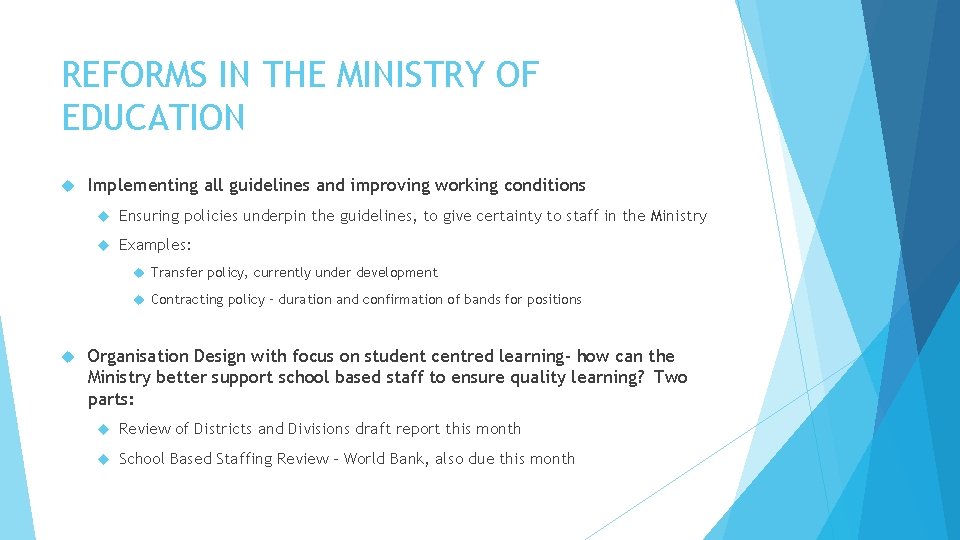
REFORMS IN THE MINISTRY OF EDUCATION Implementing all guidelines and improving working conditions Ensuring policies underpin the guidelines, to give certainty to staff in the Ministry Examples: Transfer policy, currently under development Contracting policy – duration and confirmation of bands for positions Organisation Design with focus on student centred learning- how can the Ministry better support school based staff to ensure quality learning? Two parts: Review of Districts and Divisions draft report this month School Based Staffing Review – World Bank, also due this month
More information? Contact your HR Department: meha. hrenquiries@gmail. com Contact our Reforms Enquiry email address : csrmu. enquiries@gmail. com Attend the next sessions, updated monthly to reflect changes that are occurring Any Questions?