Chapter 8 Further Applications of Integration Stewart Calculus
- Slides: 40
Chapter 8 Further Applications of Integration Stewart, Calculus: Early Transcendentals, 8 th Edition. © 2016 Cengage. All Rights Reserved. May not be scanned, copied or duplicated, or posted to a publicly accessible website, in whole or in part.
8. 3 Applications to Physics and Engineering Stewart, Calculus: Early Transcendentals, 8 th Edition. © 2016 Cengage. All Rights Reserved. May not be scanned, copied or duplicated, or posted to a publicly accessible website, in whole or in part.
Applications to Physics and Engineering Among the many applications of integral calculus to physics and engineering, we consider two here: force due to water pressure and centers of mass. Stewart, Calculus: Early Transcendentals, 8 th Edition. © 2016 Cengage. All Rights Reserved. May not be scanned, copied or duplicated, or posted to a publicly accessible website, in whole or in part.
Hydrostatic Pressure and Force Stewart, Calculus: Early Transcendentals, 8 th Edition. © 2016 Cengage. All Rights Reserved. May not be scanned, copied or duplicated, or posted to a publicly accessible website, in whole or in part.
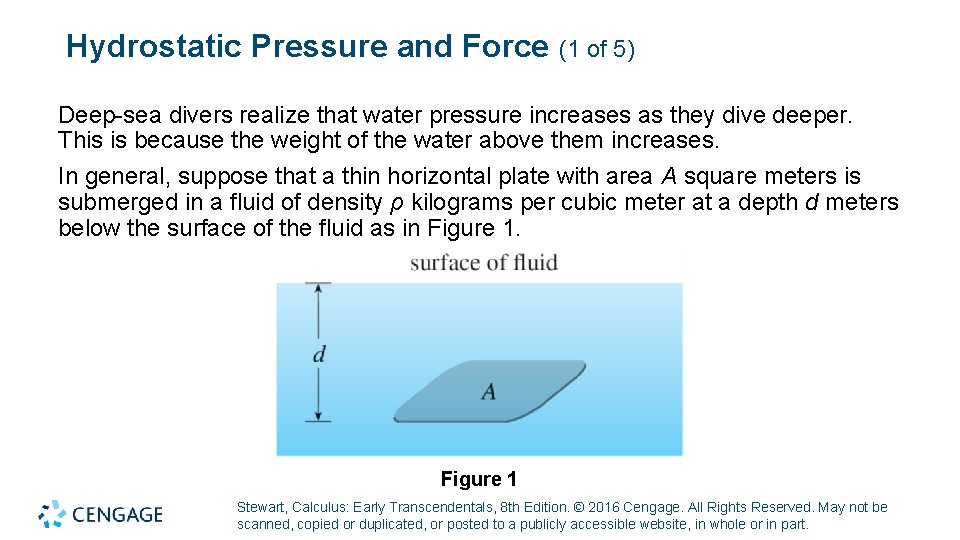
Hydrostatic Pressure and Force (1 of 5) Deep-sea divers realize that water pressure increases as they dive deeper. This is because the weight of the water above them increases. In general, suppose that a thin horizontal plate with area A square meters is submerged in a fluid of density ρ kilograms per cubic meter at a depth d meters below the surface of the fluid as in Figure 1 Stewart, Calculus: Early Transcendentals, 8 th Edition. © 2016 Cengage. All Rights Reserved. May not be scanned, copied or duplicated, or posted to a publicly accessible website, in whole or in part.
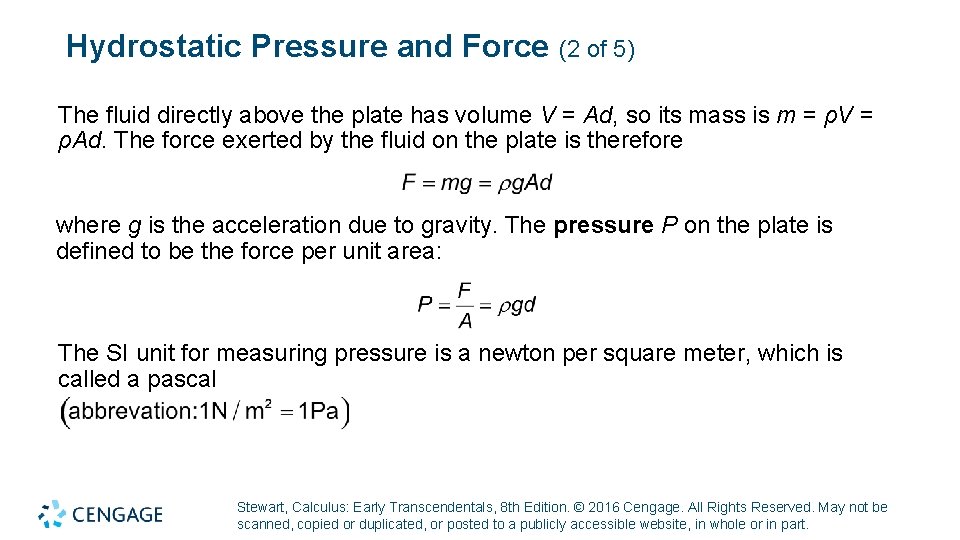
Hydrostatic Pressure and Force (2 of 5) The fluid directly above the plate has volume V = Ad, so its mass is m = ρV = ρAd. The force exerted by the fluid on the plate is therefore where g is the acceleration due to gravity. The pressure P on the plate is defined to be the force per unit area: The SI unit for measuring pressure is a newton per square meter, which is called a pascal Stewart, Calculus: Early Transcendentals, 8 th Edition. © 2016 Cengage. All Rights Reserved. May not be scanned, copied or duplicated, or posted to a publicly accessible website, in whole or in part.
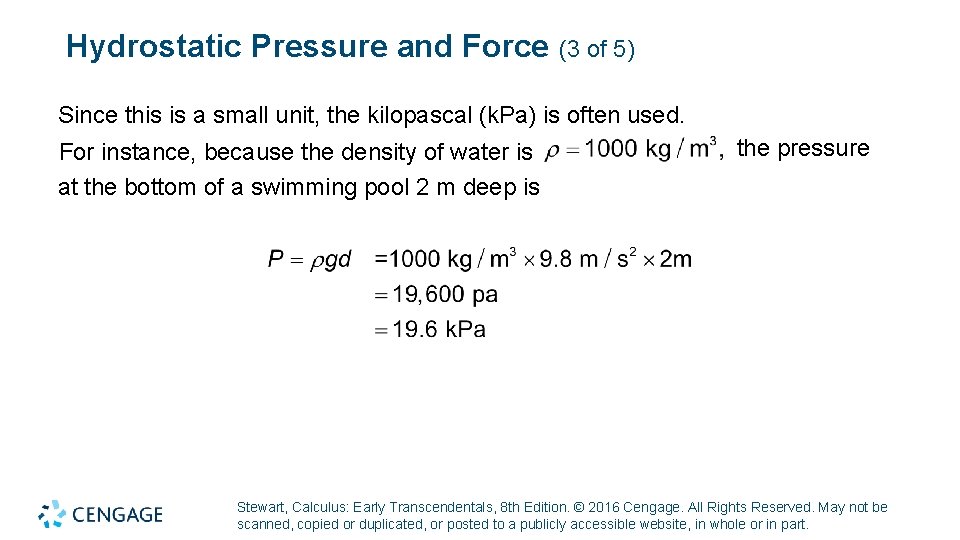
Hydrostatic Pressure and Force (3 of 5) Since this is a small unit, the kilopascal (k. Pa) is often used. For instance, because the density of water is at the bottom of a swimming pool 2 m deep is the pressure Stewart, Calculus: Early Transcendentals, 8 th Edition. © 2016 Cengage. All Rights Reserved. May not be scanned, copied or duplicated, or posted to a publicly accessible website, in whole or in part.
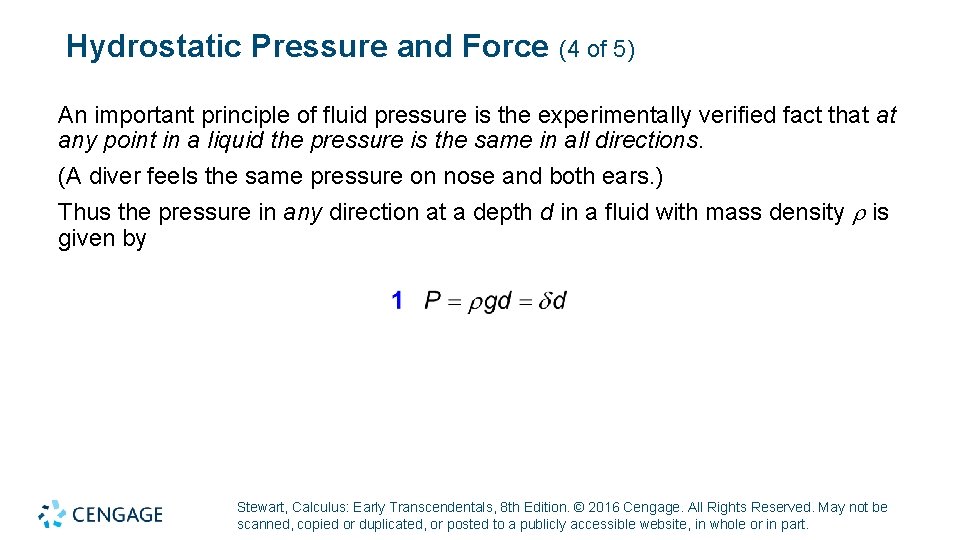
Hydrostatic Pressure and Force (4 of 5) An important principle of fluid pressure is the experimentally verified fact that at any point in a liquid the pressure is the same in all directions. (A diver feels the same pressure on nose and both ears. ) Thus the pressure in any direction at a depth d in a fluid with mass density is given by Stewart, Calculus: Early Transcendentals, 8 th Edition. © 2016 Cengage. All Rights Reserved. May not be scanned, copied or duplicated, or posted to a publicly accessible website, in whole or in part.
Hydrostatic Pressure and Force (5 of 5) This helps us determine the hydrostatic force against a vertical plate or wall or dam in a fluid. This is not a straightforward problem because the pressure is not constant but increases as the depth increases Stewart, Calculus: Early Transcendentals, 8 th Edition. © 2016 Cengage. All Rights Reserved. May not be scanned, copied or duplicated, or posted to a publicly accessible website, in whole or in part.
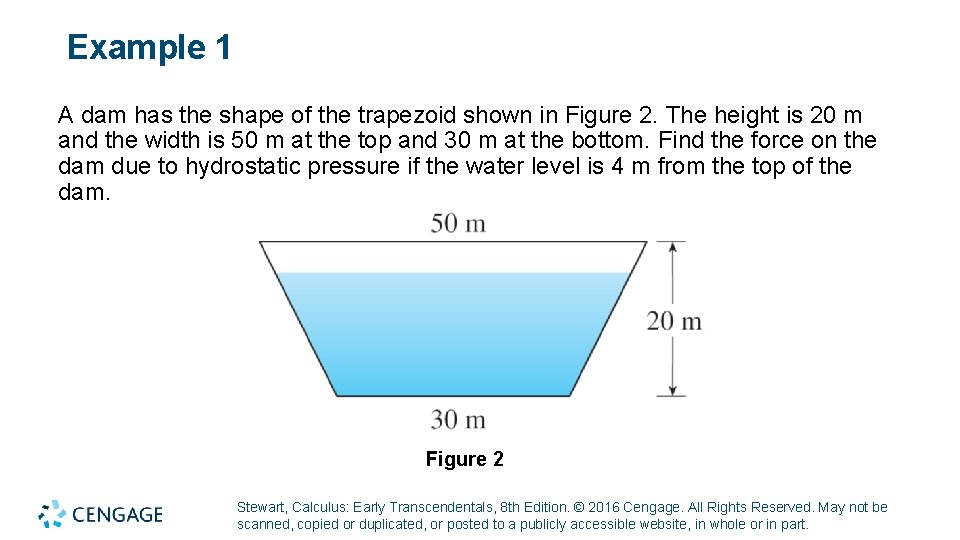
Example 1 A dam has the shape of the trapezoid shown in Figure 2. The height is 20 m and the width is 50 m at the top and 30 m at the bottom. Find the force on the dam due to hydrostatic pressure if the water level is 4 m from the top of the dam. Figure 2 Stewart, Calculus: Early Transcendentals, 8 th Edition. © 2016 Cengage. All Rights Reserved. May not be scanned, copied or duplicated, or posted to a publicly accessible website, in whole or in part.
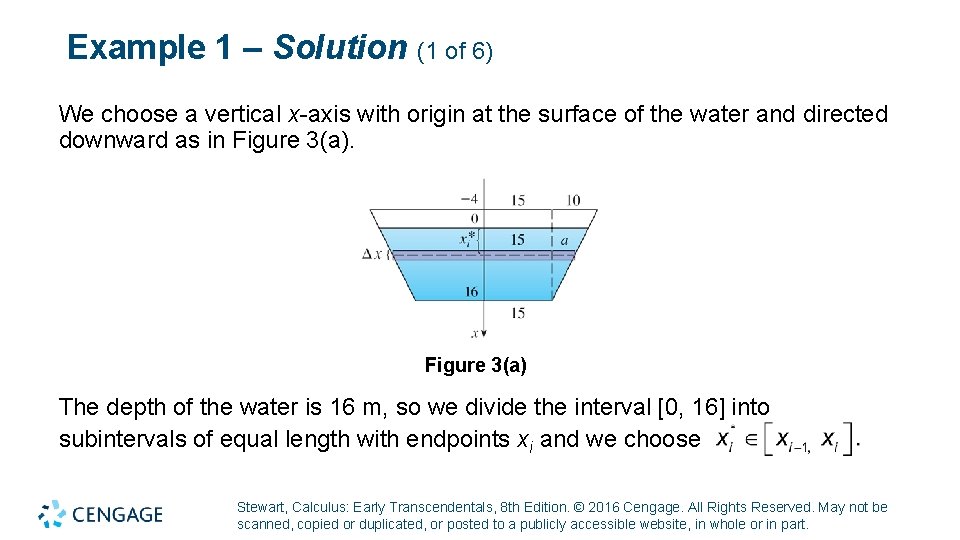
Example 1 – Solution (1 of 6) We choose a vertical x-axis with origin at the surface of the water and directed downward as in Figure 3(a) The depth of the water is 16 m, so we divide the interval [0, 16] into subintervals of equal length with endpoints xi and we choose Stewart, Calculus: Early Transcendentals, 8 th Edition. © 2016 Cengage. All Rights Reserved. May not be scanned, copied or duplicated, or posted to a publicly accessible website, in whole or in part.
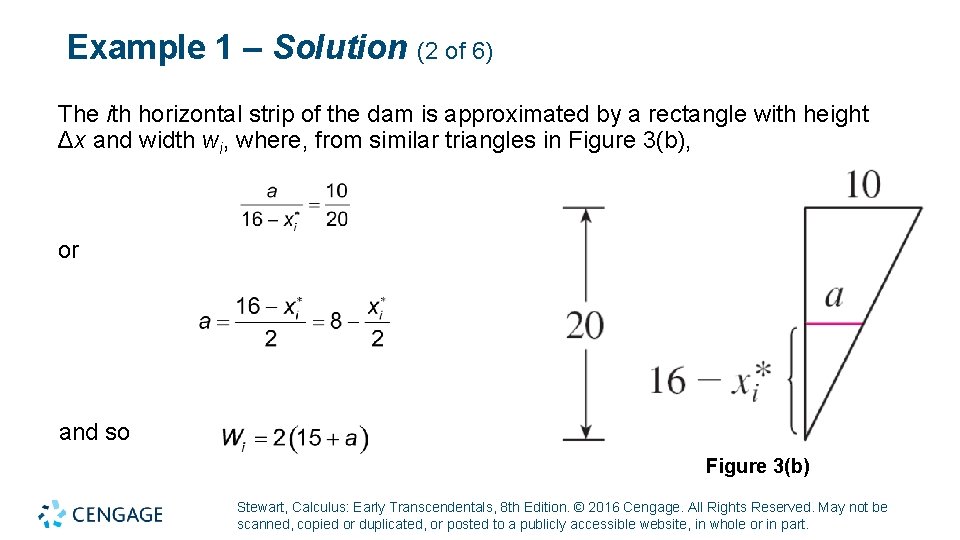
Example 1 – Solution (2 of 6) The ith horizontal strip of the dam is approximated by a rectangle with height Δx and width wi, where, from similar triangles in Figure 3(b), or and so Figure 3(b) Stewart, Calculus: Early Transcendentals, 8 th Edition. © 2016 Cengage. All Rights Reserved. May not be scanned, copied or duplicated, or posted to a publicly accessible website, in whole or in part.
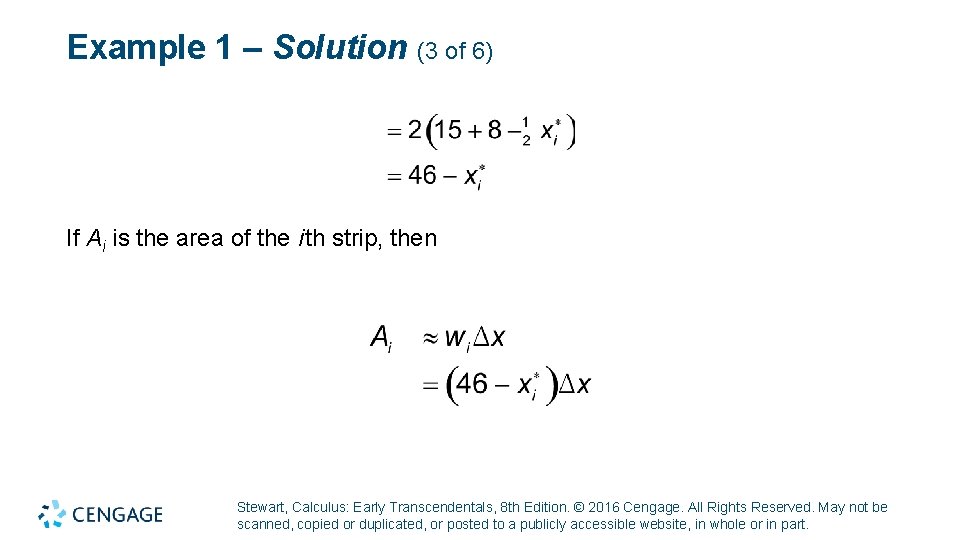
Example 1 – Solution (3 of 6) If Ai is the area of the i th strip, then Stewart, Calculus: Early Transcendentals, 8 th Edition. © 2016 Cengage. All Rights Reserved. May not be scanned, copied or duplicated, or posted to a publicly accessible website, in whole or in part.
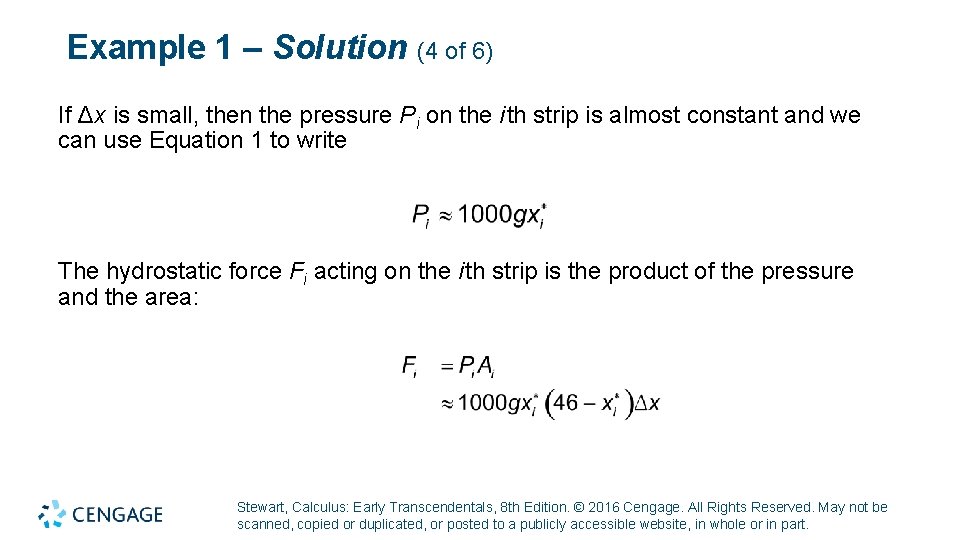
Example 1 – Solution (4 of 6) If Δx is small, then the pressure Pi on the i th strip is almost constant and we can use Equation 1 to write The hydrostatic force Fi acting on the i th strip is the product of the pressure and the area: Stewart, Calculus: Early Transcendentals, 8 th Edition. © 2016 Cengage. All Rights Reserved. May not be scanned, copied or duplicated, or posted to a publicly accessible website, in whole or in part.
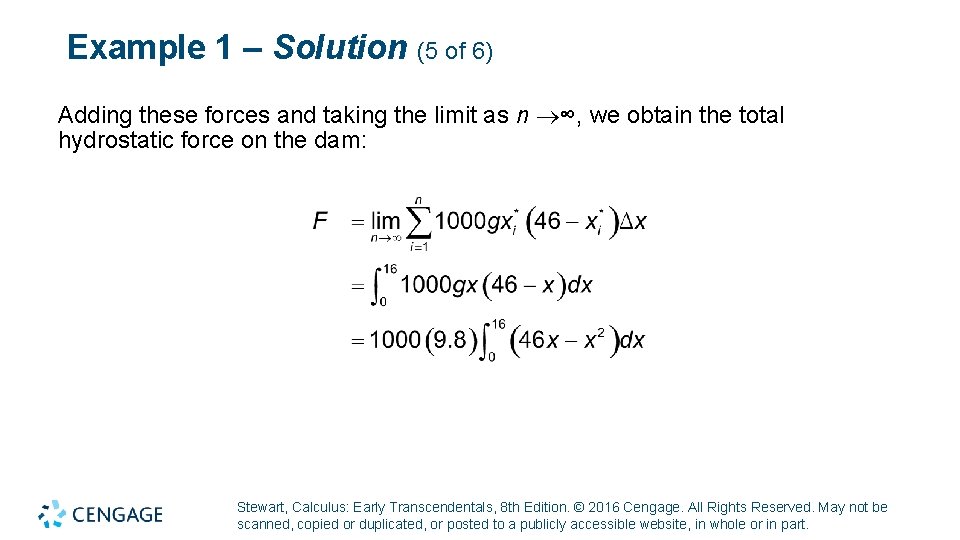
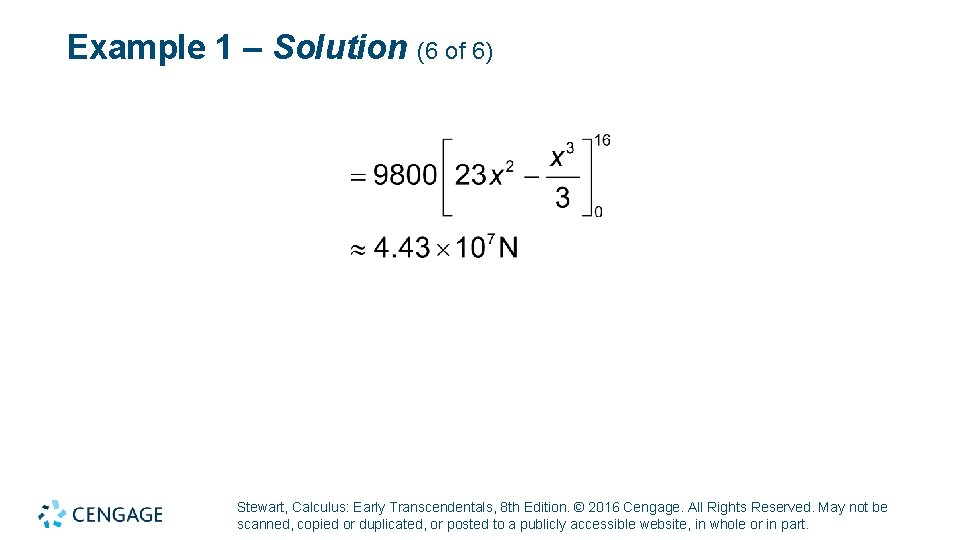
Example 1 – Solution (5 of 6) Adding these forces and taking the limit as n ∞, we obtain the total hydrostatic force on the dam: Stewart, Calculus: Early Transcendentals, 8 th Edition. © 2016 Cengage. All Rights Reserved. May not be scanned, copied or duplicated, or posted to a publicly accessible website, in whole or in part.
Example 1 – Solution (6 of 6) Stewart, Calculus: Early Transcendentals, 8 th Edition. © 2016 Cengage. All Rights Reserved. May not be scanned, copied or duplicated, or posted to a publicly accessible website, in whole or in part.
Moments and Centers of Mass Stewart, Calculus: Early Transcendentals, 8 th Edition. © 2016 Cengage. All Rights Reserved. May not be scanned, copied or duplicated, or posted to a publicly accessible website, in whole or in part.
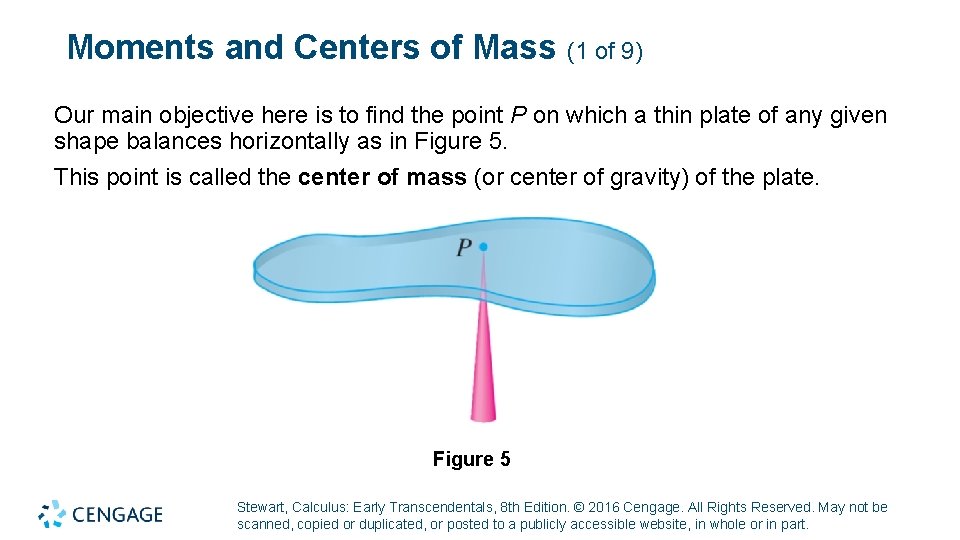
Moments and Centers of Mass (1 of 9) Our main objective here is to find the point P on which a thin plate of any given shape balances horizontally as in Figure 5. This point is called the center of mass (or center of gravity) of the plate. Figure 5 Stewart, Calculus: Early Transcendentals, 8 th Edition. © 2016 Cengage. All Rights Reserved. May not be scanned, copied or duplicated, or posted to a publicly accessible website, in whole or in part.
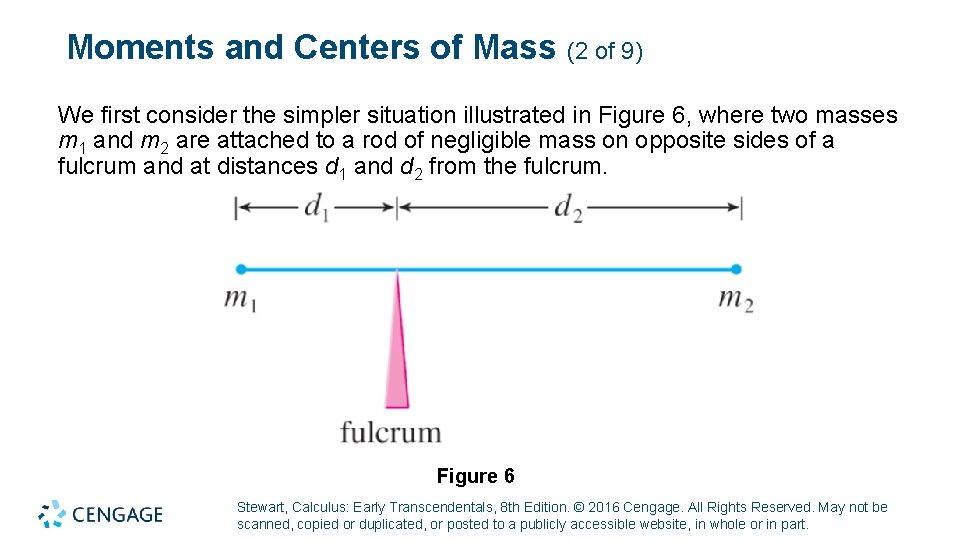
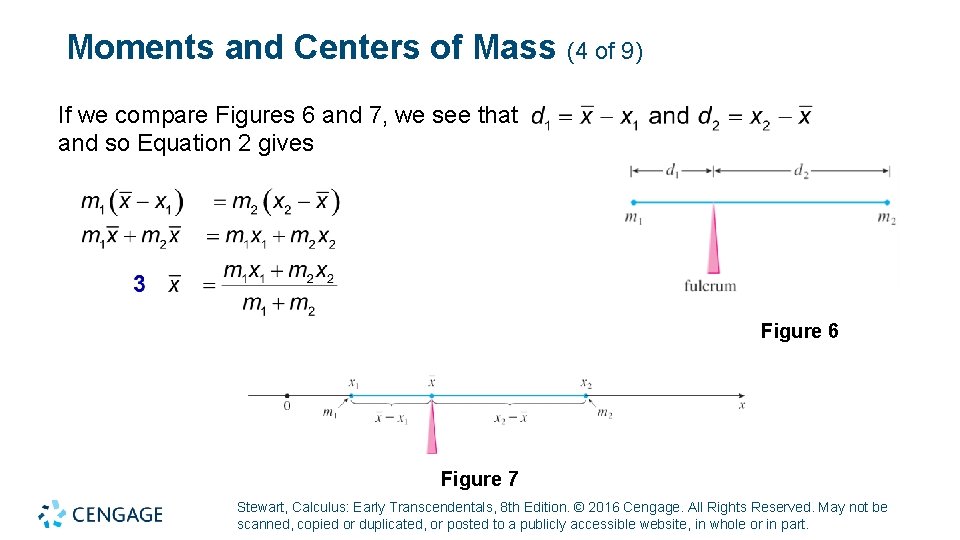
Moments and Centers of Mass (2 of 9) We first consider the simpler situation illustrated in Figure 6, where two masses m 1 and m 2 are attached to a rod of negligible mass on opposite sides of a fulcrum and at distances d 1 and d 2 from the fulcrum. Figure 6 Stewart, Calculus: Early Transcendentals, 8 th Edition. © 2016 Cengage. All Rights Reserved. May not be scanned, copied or duplicated, or posted to a publicly accessible website, in whole or in part.
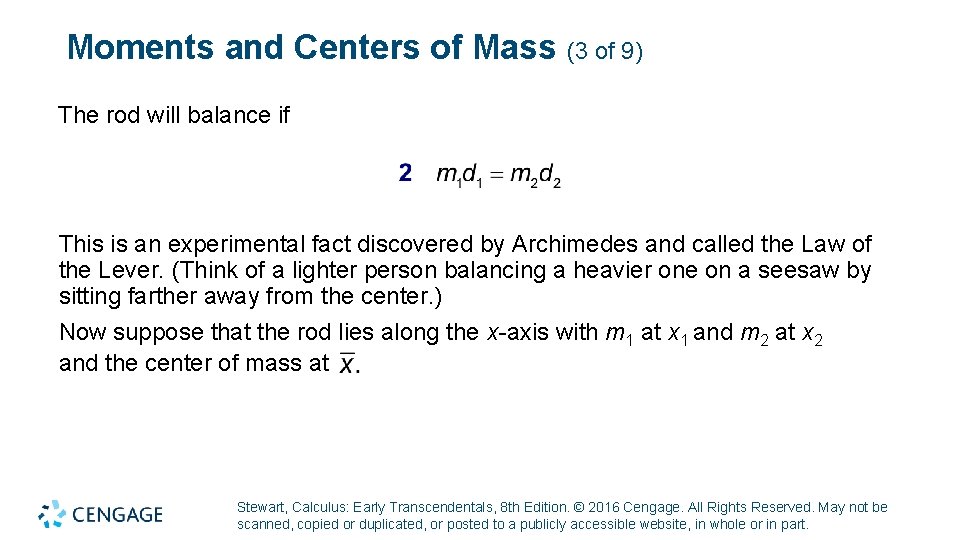
Moments and Centers of Mass (3 of 9) The rod will balance if This is an experimental fact discovered by Archimedes and called the Law of the Lever. (Think of a lighter person balancing a heavier one on a seesaw by sitting farther away from the center. ) Now suppose that the rod lies along the x-axis with m 1 at x 1 and m 2 at x 2 and the center of mass at Stewart, Calculus: Early Transcendentals, 8 th Edition. © 2016 Cengage. All Rights Reserved. May not be scanned, copied or duplicated, or posted to a publicly accessible website, in whole or in part.
Moments and Centers of Mass (4 of 9) If we compare Figures 6 and 7, we see that and so Equation 2 gives Figure 6 Figure 7 Stewart, Calculus: Early Transcendentals, 8 th Edition. © 2016 Cengage. All Rights Reserved. May not be scanned, copied or duplicated, or posted to a publicly accessible website, in whole or in part.
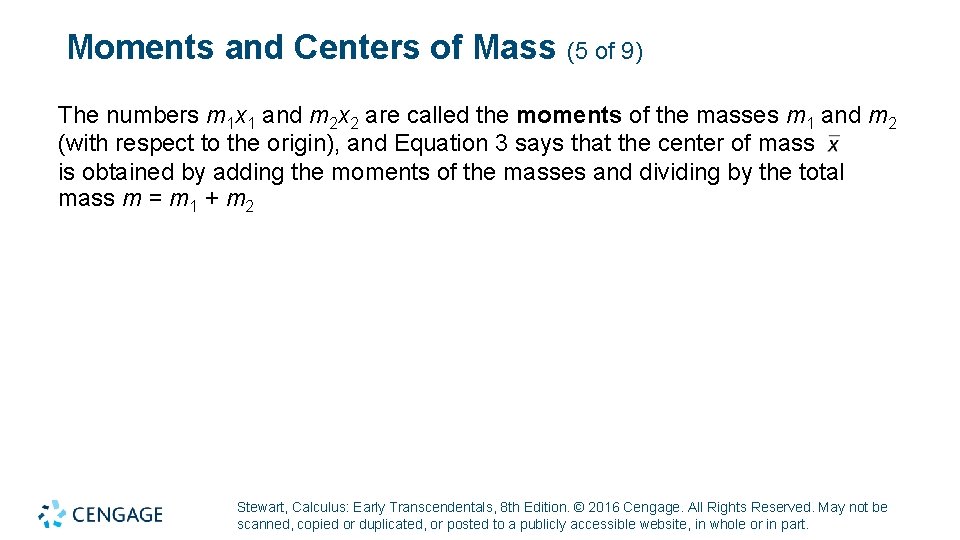
Moments and Centers of Mass (5 of 9) The numbers m 1 x 1 and m 2 x 2 are called the moments of the masses m 1 and m 2 (with respect to the origin), and Equation 3 says that the center of mass is obtained by adding the moments of the masses and dividing by the total mass m = m 1 + m 2 Stewart, Calculus: Early Transcendentals, 8 th Edition. © 2016 Cengage. All Rights Reserved. May not be scanned, copied or duplicated, or posted to a publicly accessible website, in whole or in part.
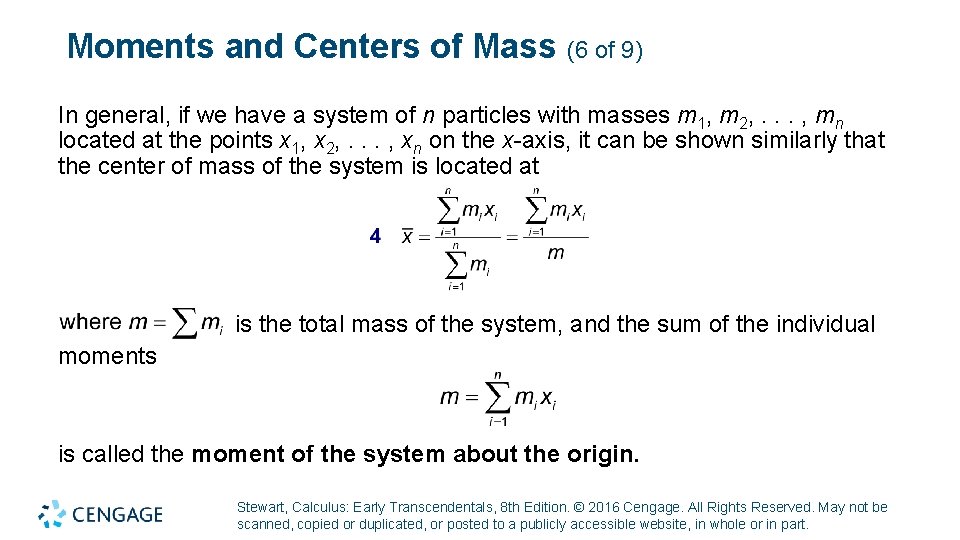
Moments and Centers of Mass (6 of 9) In general, if we have a system of n particles with masses m 1, m 2, . . . , mn located at the points x 1, x 2, . . . , xn on the x-axis, it can be shown similarly that the center of mass of the system is located at is the total mass of the system, and the sum of the individual moments is called the moment of the system about the origin. Stewart, Calculus: Early Transcendentals, 8 th Edition. © 2016 Cengage. All Rights Reserved. May not be scanned, copied or duplicated, or posted to a publicly accessible website, in whole or in part.
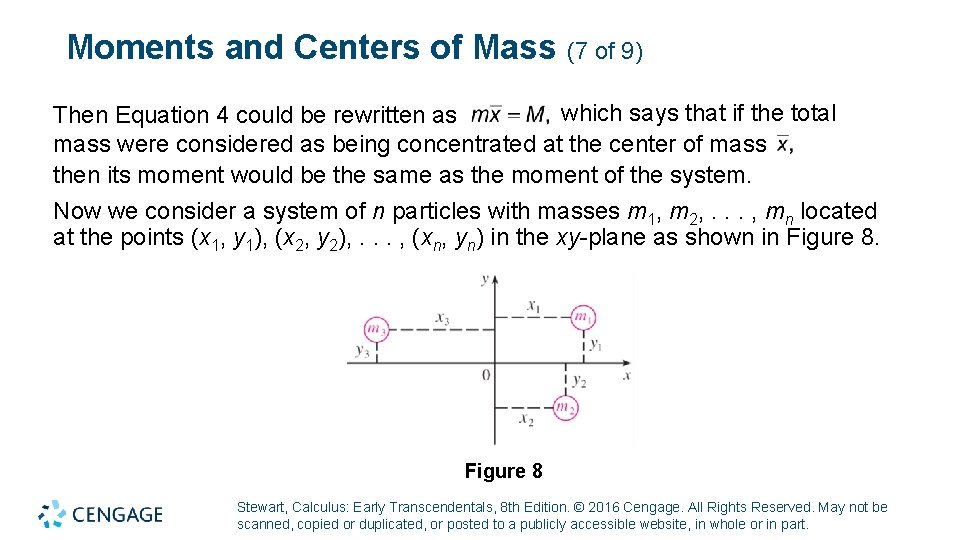
Moments and Centers of Mass (7 of 9) which says that if the total Then Equation 4 could be rewritten as mass were considered as being concentrated at the center of mass then its moment would be the same as the moment of the system. Now we consider a system of n particles with masses m 1, m 2, . . . , mn located at the points (x 1, y 1), (x 2, y 2), . . . , (xn, yn) in the xy-plane as shown in Figure 8 Stewart, Calculus: Early Transcendentals, 8 th Edition. © 2016 Cengage. All Rights Reserved. May not be scanned, copied or duplicated, or posted to a publicly accessible website, in whole or in part.
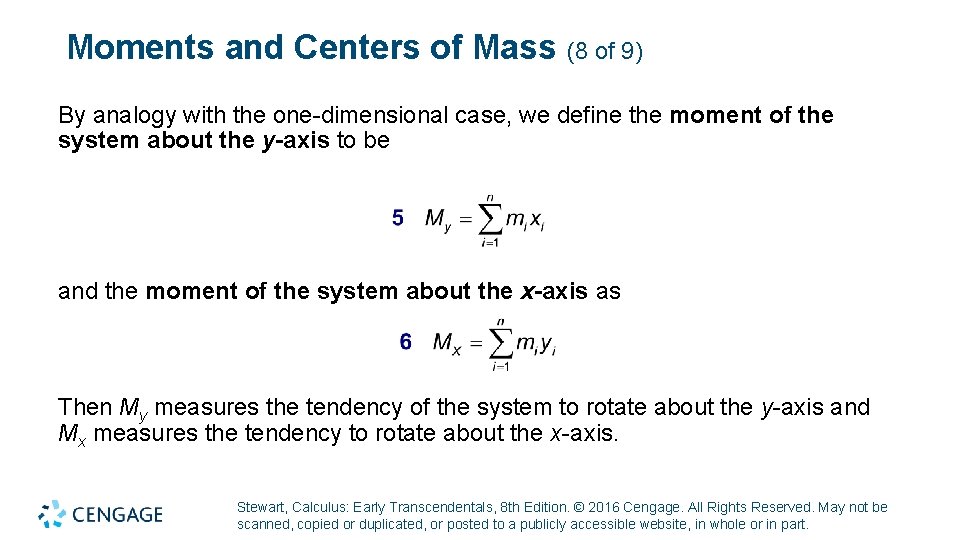
Moments and Centers of Mass (8 of 9) By analogy with the one-dimensional case, we define the moment of the system about the y-axis to be and the moment of the system about the x-axis as Then My measures the tendency of the system to rotate about the y-axis and Mx measures the tendency to rotate about the x-axis. Stewart, Calculus: Early Transcendentals, 8 th Edition. © 2016 Cengage. All Rights Reserved. May not be scanned, copied or duplicated, or posted to a publicly accessible website, in whole or in part.
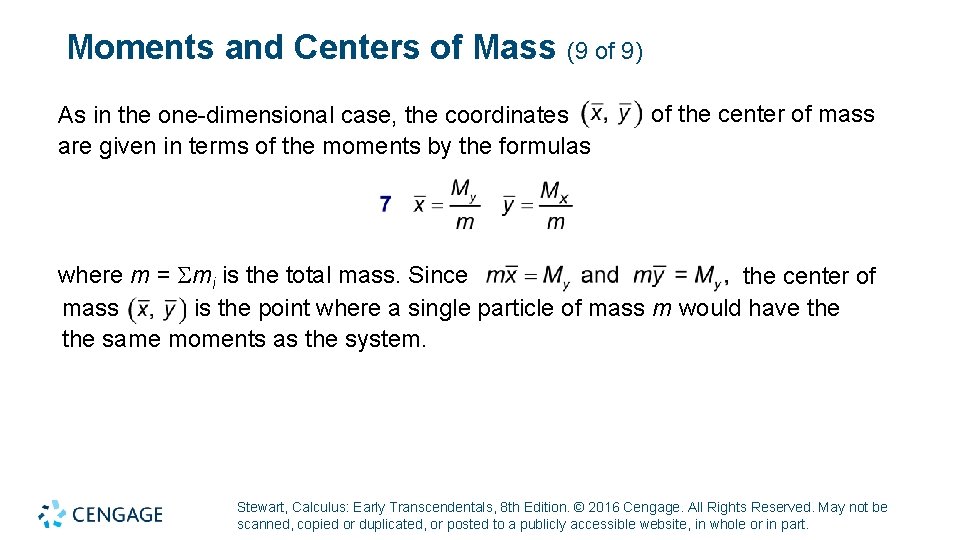
Moments and Centers of Mass (9 of 9) As in the one-dimensional case, the coordinates are given in terms of the moments by the formulas of the center of mass where m = mi is the total mass. Since the center of is the point where a single particle of mass m would have the mass the same moments as the system. Stewart, Calculus: Early Transcendentals, 8 th Edition. © 2016 Cengage. All Rights Reserved. May not be scanned, copied or duplicated, or posted to a publicly accessible website, in whole or in part.
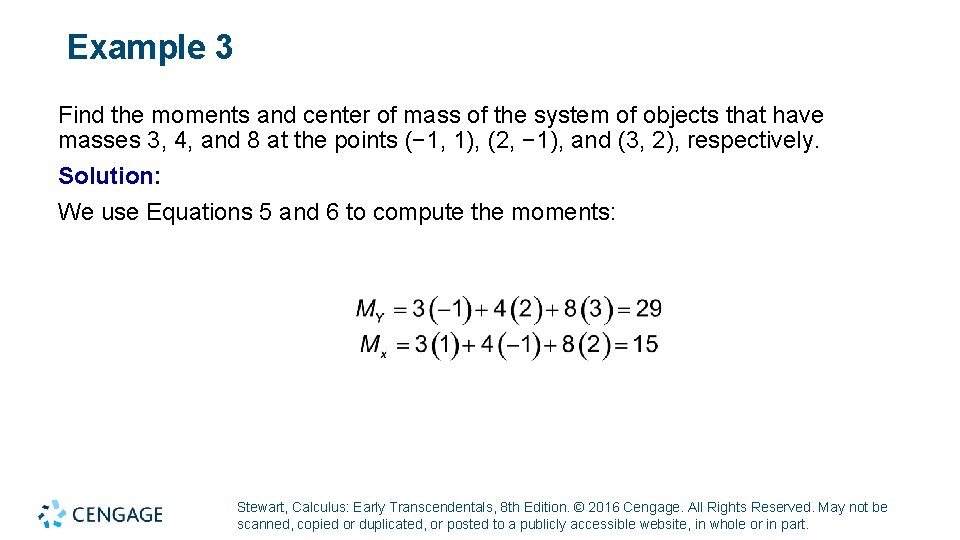
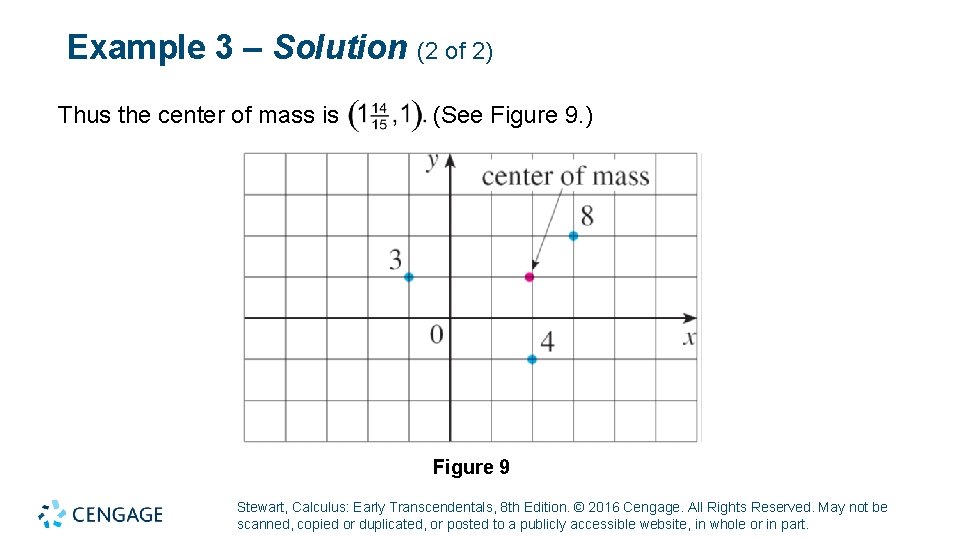
Example 3 Find the moments and center of mass of the system of objects that have masses 3, 4, and 8 at the points (− 1, 1), (2, − 1), and (3, 2), respectively. Solution: We use Equations 5 and 6 to compute the moments: Stewart, Calculus: Early Transcendentals, 8 th Edition. © 2016 Cengage. All Rights Reserved. May not be scanned, copied or duplicated, or posted to a publicly accessible website, in whole or in part.
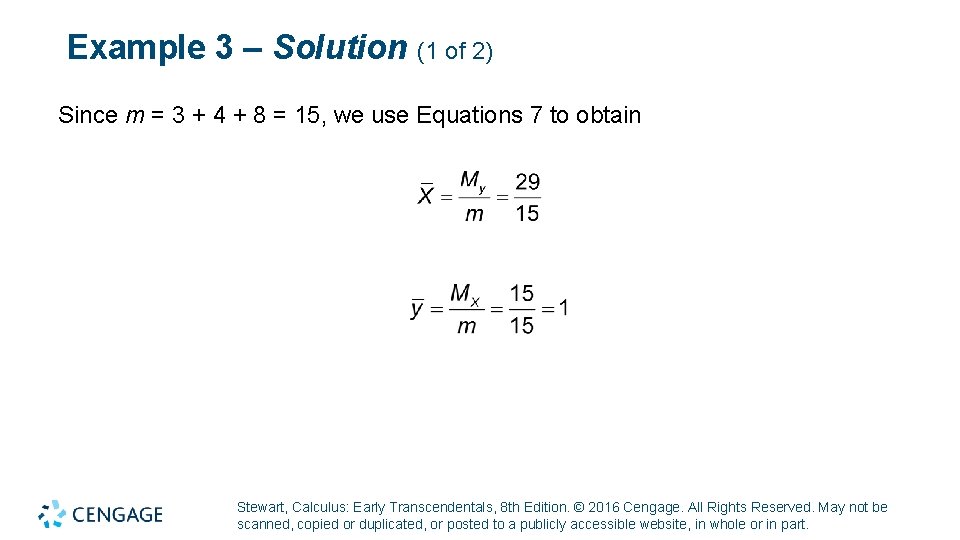
Example 3 – Solution (1 of 2) Since m = 3 + 4 + 8 = 15, we use Equations 7 to obtain Stewart, Calculus: Early Transcendentals, 8 th Edition. © 2016 Cengage. All Rights Reserved. May not be scanned, copied or duplicated, or posted to a publicly accessible website, in whole or in part.
Example 3 – Solution (2 of 2) Thus the center of mass is (See Figure 9. ) Figure 9 Stewart, Calculus: Early Transcendentals, 8 th Edition. © 2016 Cengage. All Rights Reserved. May not be scanned, copied or duplicated, or posted to a publicly accessible website, in whole or in part.
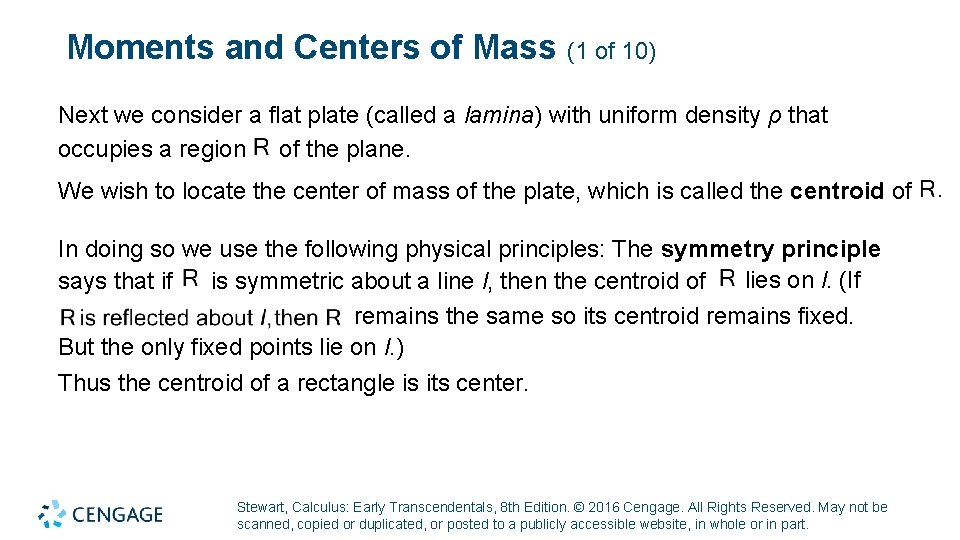
Moments and Centers of Mass (1 of 10) Next we consider a flat plate (called a lamina) with uniform density ρ that occupies a region of the plane. We wish to locate the center of mass of the plate, which is called the centroid of In doing so we use the following physical principles: The symmetry principle lies on l. (If says that if is symmetric about a line l, then the centroid of remains the same so its centroid remains fixed. But the only fixed points lie on l. ) Thus the centroid of a rectangle is its center. Stewart, Calculus: Early Transcendentals, 8 th Edition. © 2016 Cengage. All Rights Reserved. May not be scanned, copied or duplicated, or posted to a publicly accessible website, in whole or in part.
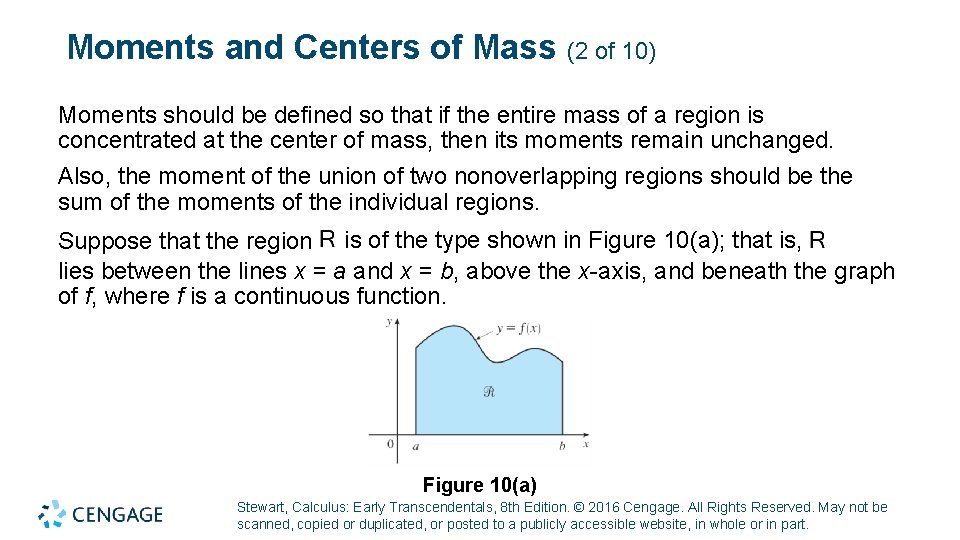
Moments and Centers of Mass (2 of 10) Moments should be defined so that if the entire mass of a region is concentrated at the center of mass, then its moments remain unchanged. Also, the moment of the union of two nonoverlapping regions should be the sum of the moments of the individual regions. Suppose that the region is of the type shown in Figure 10(a); that is, lies between the lines x = a and x = b, above the x-axis, and beneath the graph of f, where f is a continuous function. Figure 10(a) Stewart, Calculus: Early Transcendentals, 8 th Edition. © 2016 Cengage. All Rights Reserved. May not be scanned, copied or duplicated, or posted to a publicly accessible website, in whole or in part.
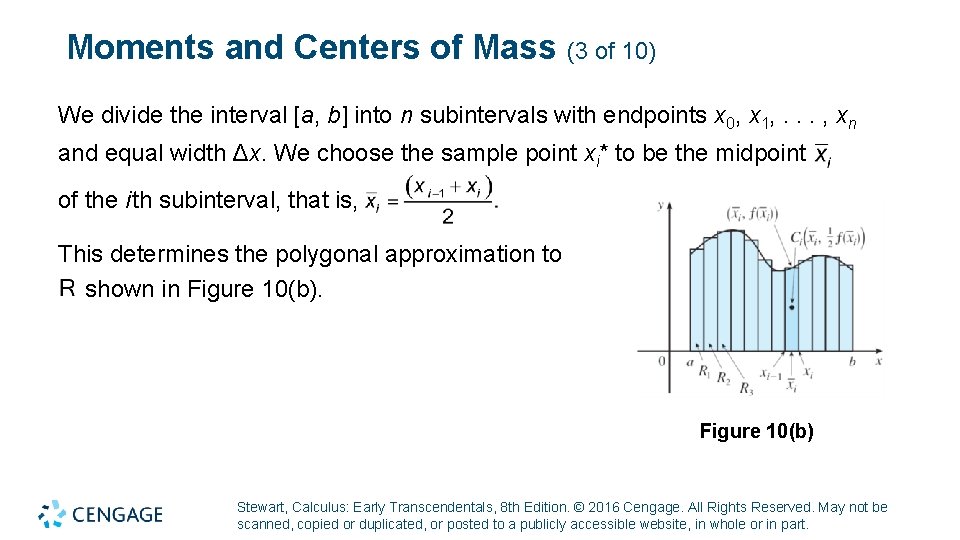
Moments and Centers of Mass (3 of 10) We divide the interval [a, b] into n subintervals with endpoints x 0, x 1, . . . , xn and equal width Δx. We choose the sample point xi* to be the midpoint of the i th subinterval, that is, This determines the polygonal approximation to shown in Figure 10(b) Stewart, Calculus: Early Transcendentals, 8 th Edition. © 2016 Cengage. All Rights Reserved. May not be scanned, copied or duplicated, or posted to a publicly accessible website, in whole or in part.
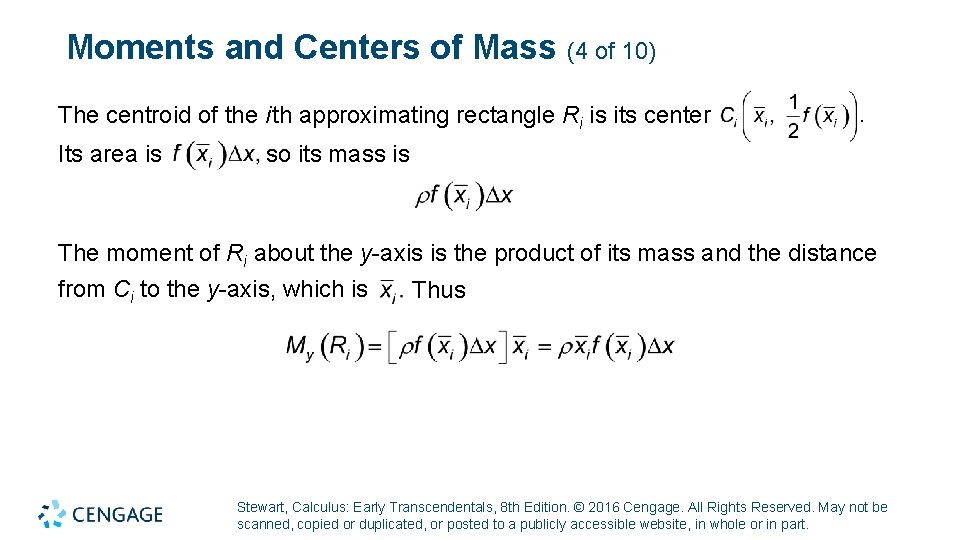
Moments and Centers of Mass (4 of 10) The centroid of the i th approximating rectangle Ri is its center Its area is so its mass is The moment of Ri about the y-axis is the product of its mass and the distance from Ci to the y-axis, which is Thus Stewart, Calculus: Early Transcendentals, 8 th Edition. © 2016 Cengage. All Rights Reserved. May not be scanned, copied or duplicated, or posted to a publicly accessible website, in whole or in part.
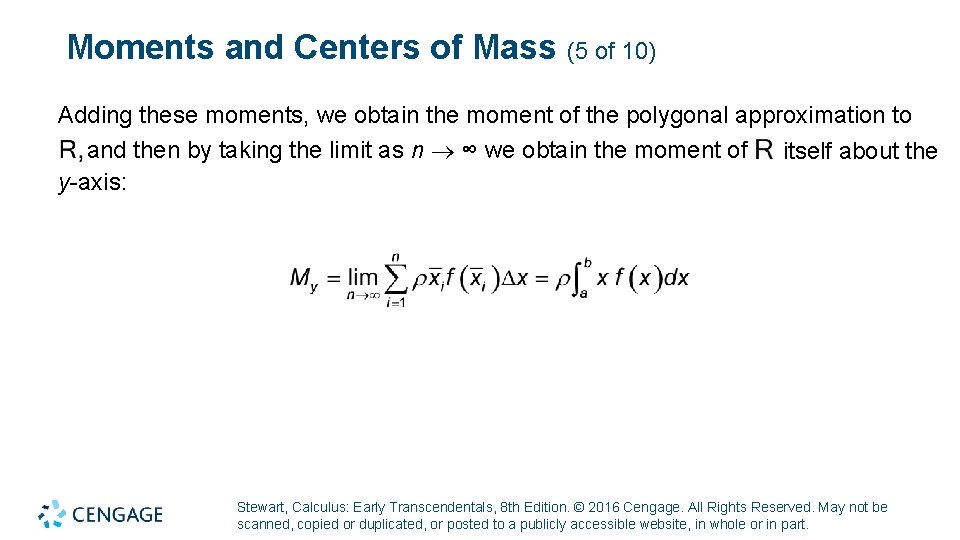
Moments and Centers of Mass (5 of 10) Adding these moments, we obtain the moment of the polygonal approximation to and then by taking the limit as n ∞ we obtain the moment of itself about the y-axis: Stewart, Calculus: Early Transcendentals, 8 th Edition. © 2016 Cengage. All Rights Reserved. May not be scanned, copied or duplicated, or posted to a publicly accessible website, in whole or in part.
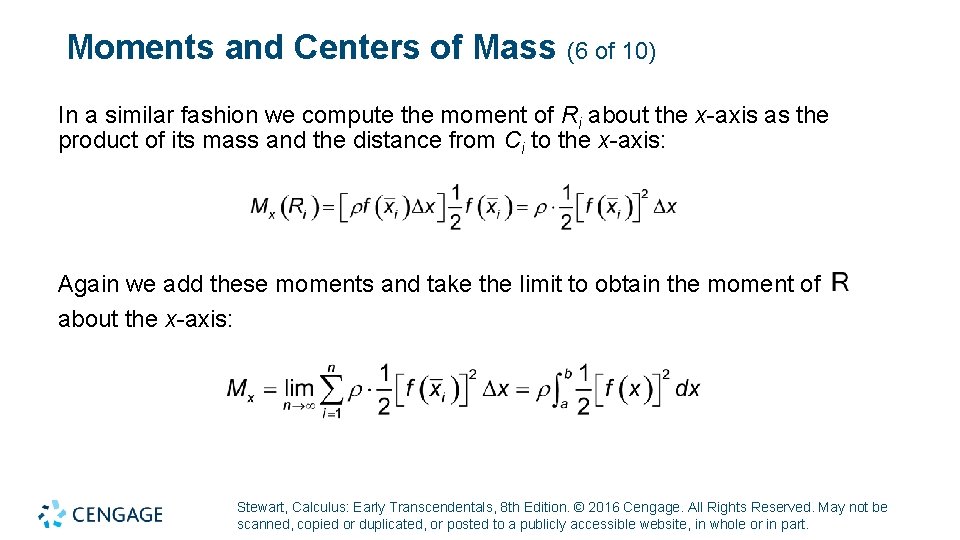
Moments and Centers of Mass (6 of 10) In a similar fashion we compute the moment of Ri about the x-axis as the product of its mass and the distance from Ci to the x-axis: Again we add these moments and take the limit to obtain the moment of about the x-axis: Stewart, Calculus: Early Transcendentals, 8 th Edition. © 2016 Cengage. All Rights Reserved. May not be scanned, copied or duplicated, or posted to a publicly accessible website, in whole or in part.
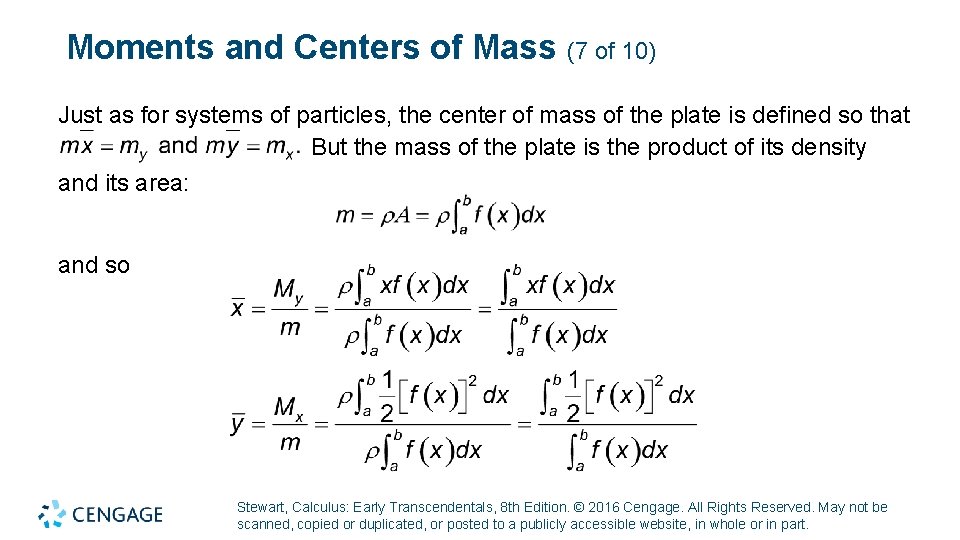
Moments and Centers of Mass (7 of 10) Just as for systems of particles, the center of mass of the plate is defined so that But the mass of the plate is the product of its density and its area: and so Stewart, Calculus: Early Transcendentals, 8 th Edition. © 2016 Cengage. All Rights Reserved. May not be scanned, copied or duplicated, or posted to a publicly accessible website, in whole or in part.
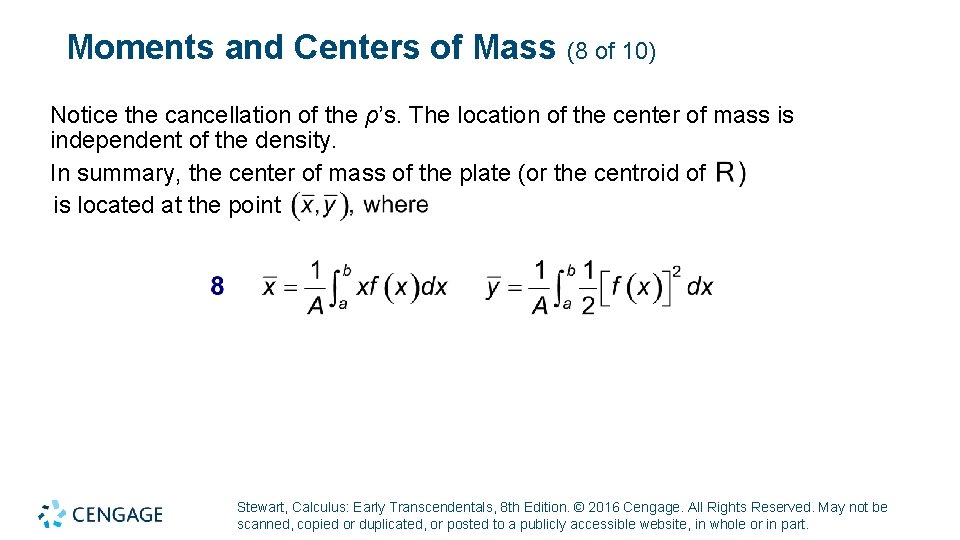
Moments and Centers of Mass (8 of 10) Notice the cancellation of the ρ’s. The location of the center of mass is independent of the density. In summary, the center of mass of the plate (or the centroid of is located at the point Stewart, Calculus: Early Transcendentals, 8 th Edition. © 2016 Cengage. All Rights Reserved. May not be scanned, copied or duplicated, or posted to a publicly accessible website, in whole or in part.
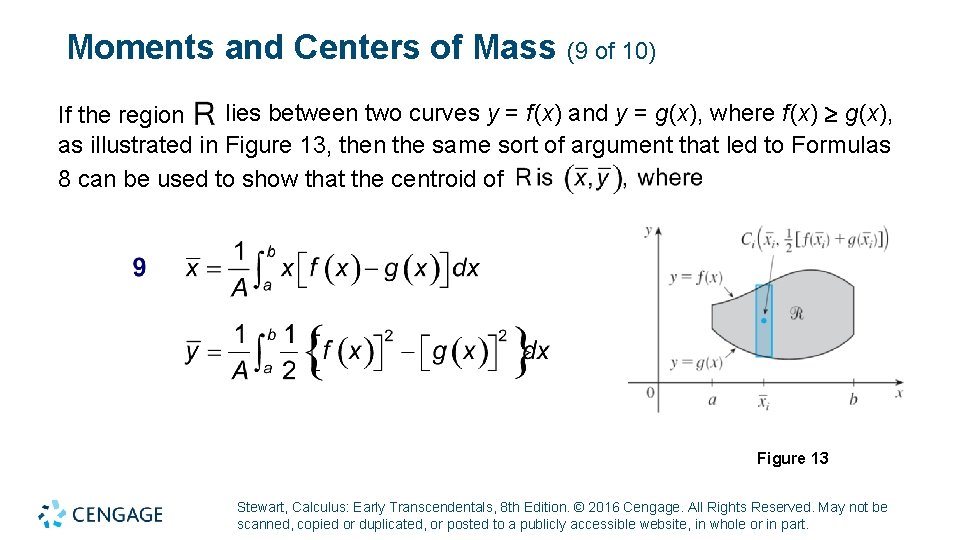
Moments and Centers of Mass (9 of 10) lies between two curves y = f (x) and y = g (x), where f (x) g (x), If the region as illustrated in Figure 13, then the same sort of argument that led to Formulas 8 can be used to show that the centroid of Figure 13 Stewart, Calculus: Early Transcendentals, 8 th Edition. © 2016 Cengage. All Rights Reserved. May not be scanned, copied or duplicated, or posted to a publicly accessible website, in whole or in part.
Moments and Centers of Mass (10 of 10) We end this section by showing a surprising connection between centroids and volumes of revolution. be a plane region that lies entirely on one side of a Theorem of Pappus Let is rotated about l, then the volume of the resulting line l in the plane. If solid is the product of the area A of and the distance d traveled by the centroid of Stewart, Calculus: Early Transcendentals, 8 th Edition. © 2016 Cengage. All Rights Reserved. May not be scanned, copied or duplicated, or posted to a publicly accessible website, in whole or in part.
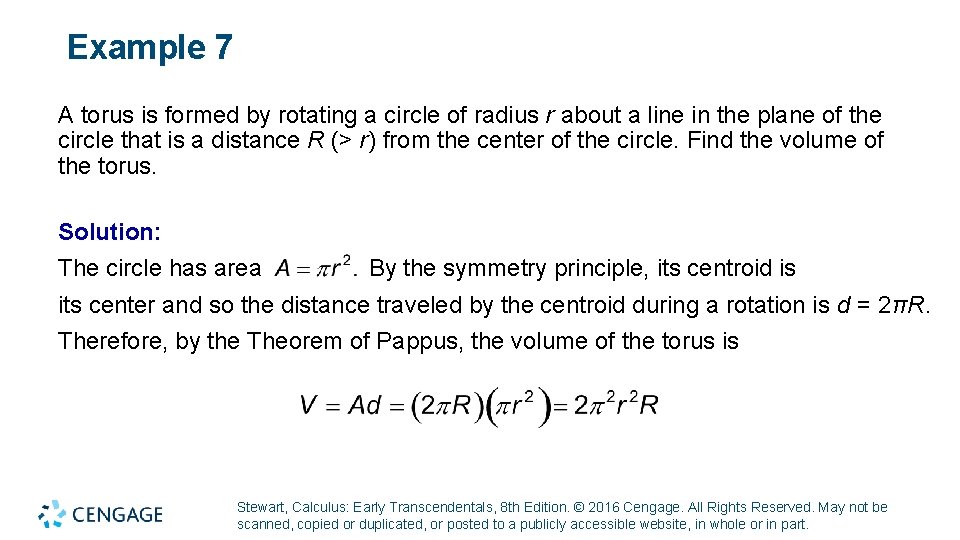
Example 7 A torus is formed by rotating a circle of radius r about a line in the plane of the circle that is a distance R (> r) from the center of the circle. Find the volume of the torus. Solution: The circle has area By the symmetry principle, its centroid is its center and so the distance traveled by the centroid during a rotation is d = 2πR. Therefore, by the Theorem of Pappus, the volume of the torus is Stewart, Calculus: Early Transcendentals, 8 th Edition. © 2016 Cengage. All Rights Reserved. May not be scanned, copied or duplicated, or posted to a publicly accessible website, in whole or in part.