Chapter 8 CENTRAL NERVOUS SYSTEM 2004 Delmar Learning


- Slides: 19
Chapter 8 CENTRAL NERVOUS SYSTEM © 2004 Delmar Learning, a division of Thomson Learning, Inc.
INTRODUCTION TO THE CENTRAL NERVOUS SYSTEM • Functions of the central nervous system: – Communication and coordination system in the body • Receives messages from stimuli • Brain interprets message • Brain responds and carries out activity – Reasoning and intelligence © 2004 Delmar Learning, a division of Thomson Learning, Inc.
INTRODUCTION TO THE CENTRAL NERVOUS SYSTEM • Nervous tissue consists of two types of nerve cells: – Neuroglia - cells that insulate, support and protect neurons – Neurons - pass nerve impulses • Sensory neurons (afferent) • Motor neurons (efferent) • Associative neurons (interneurons) © 2004 Delmar Learning, a division of Thomson Learning, Inc.
INTRODUCTION TO THE CENTRAL NERVOUS SYSTEM © 2004 Delmar Learning, a division of Thomson Learning, Inc.
INTRODUCTION TO THE CENTRAL NERVOUS SYSTEM • Membrane excitability is the electric charge created by impulses in the nerve • Synapse - messages go from one cell to the next – Synaptic cleft - space between axon or one cell and dendrite of another © 2004 Delmar Learning, a division of Thomson Learning, Inc.
DIVISIONS OF THE NERVOUS SYSTEM • There are 3 divisions of the nervous system: – Central nervous system - brain and spinal cord – Peripheral nervous system - nerves of the body – Autonomic nervous system peripheral nerves and ganglia © 2004 Delmar Learning, a division of Thomson Learning, Inc.
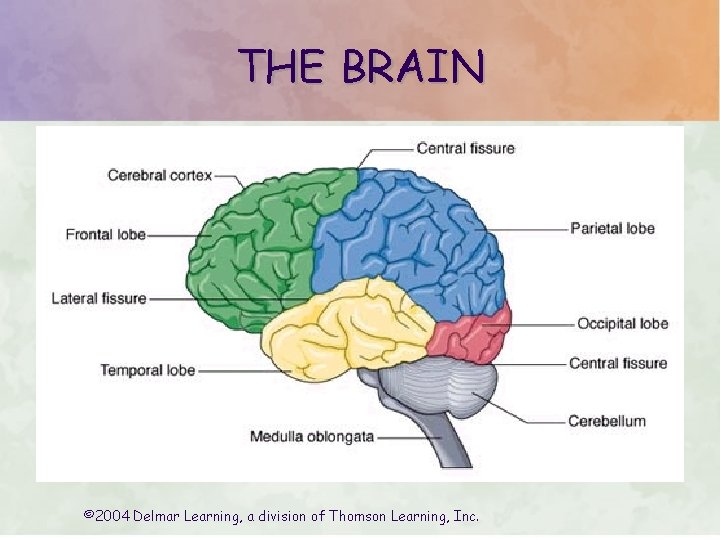
THE BRAIN • Memory – Short term – Long term • Coverings of the brain – Dura mater – Arachnoid mater – Pia mater © 2004 Delmar Learning, a division of Thomson Learning, Inc.
THE BRAIN • The brain contains four lined cavities called cerebral ventricles – Right lateral ventricle – Left lateral ventricle – Third ventricle – Fourth ventricle • Cerebral fluid serves as liquid shock absorber © 2004 Delmar Learning, a division of Thomson Learning, Inc.
THE BRAIN © 2004 Delmar Learning, a division of Thomson Learning, Inc.
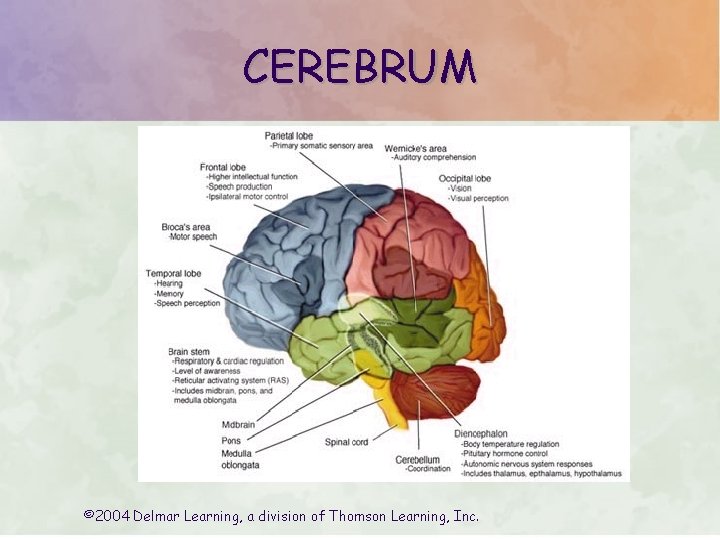
CEREBRUM • The cerebrum is divided into 2 hemispheres; each hemisphere is divided into: – frontal lobe – parietal lobe – occipital lobe – temporal lobe © 2004 Delmar Learning, a division of Thomson Learning, Inc.
CEREBRUM • The cerebral surface is covered with furrows and ridges – Sulci - Shallow grooves – Fissures - deeper grooves • Longitudinal fissure • Transverse fissure • Central fissure • Lateral fissure • Parieto-occipital fissure © 2004 Delmar Learning, a division of Thomson Learning, Inc.
CEREBRUM • Each lobe of the cerebral hemispheres control different functions – Frontal lobe - motor functions – Parietal lobe - sensory – Occipital lobe - eyesight – Temporal lobe - auditory and olfactory senses © 2004 Delmar Learning, a division of Thomson Learning, Inc.
CEREBRUM © 2004 Delmar Learning, a division of Thomson Learning, Inc.
DIENCEPHALON • Thalamus – Located between the cerebrum and midbrain – Acts as a relay station for incoming and outgoing nerve impulses © 2004 Delmar Learning, a division of Thomson Learning, Inc.
DIENCEPHALON • Hypothalamus – Autonomic nervous control – Cardiovascular control – Temperature control – Appetite control – Water balance – Manufacture of oxytocin – Gastrointestinal control – Emotional state – Sleep control © 2004 Delmar Learning, a division of Thomson Learning, Inc.
CEREBELLUM • Consists of two hemispheres – Right cerebellar hemisphere – Left cerebellar hemisphere • Controls all skeletal muscle body functions: – Maintenance of balance – Maintenance of muscle tone – Coordination of muscle movement © 2004 Delmar Learning, a division of Thomson Learning, Inc.
BRAIN STEM • Brain stem is made of 3 parts: – Midbrain – Pons – Medulla © 2004 Delmar Learning, a division of Thomson Learning, Inc.
SPINAL CORD • The spinal cord functions as both a reflex center and a conduction pathway to and from the brain © 2004 Delmar Learning, a division of Thomson Learning, Inc.
DISORDERS OF THE CENTRAL NERVOUS SYSTEM • • • Meningitis Encephalitis Epilepsy Cerebral palsy Poliomyelitis Parkinson’s disease • • Hydrocephalus Multiple sclerosis Dementia Alzheimer’s disease • Brain tumors • Hematoma © 2004 Delmar Learning, a division of Thomson Learning, Inc.