Chapter 34 Franklin Roosevelt and the Shadow of

- Slides: 18
Chapter 34 Franklin Roosevelt and the Shadow of War
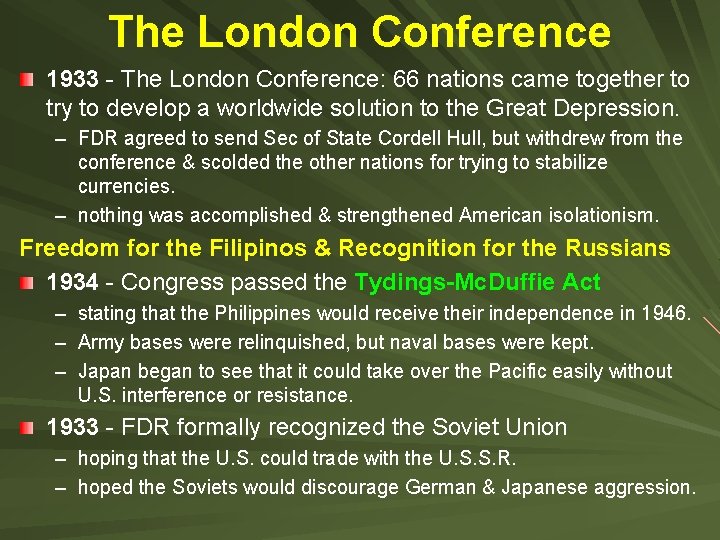
The London Conference 1933 - The London Conference: 66 nations came together to try to develop a worldwide solution to the Great Depression. – FDR agreed to send Sec of State Cordell Hull, but withdrew from the conference & scolded the other nations for trying to stabilize currencies. – nothing was accomplished & strengthened American isolationism. Freedom for the Filipinos & Recognition for the Russians 1934 - Congress passed the Tydings-Mc. Duffie Act – stating that the Philippines would receive their independence in 1946. – Army bases were relinquished, but naval bases were kept. – Japan began to see that it could take over the Pacific easily without U. S. interference or resistance. 1933 - FDR formally recognized the Soviet Union – hoping that the U. S. could trade with the U. S. S. R. – hoped the Soviets would discourage German & Japanese aggression.
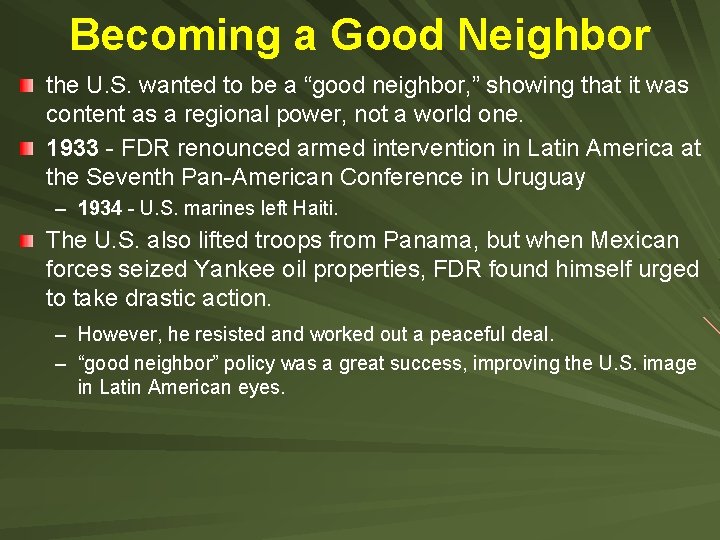
Becoming a Good Neighbor the U. S. wanted to be a “good neighbor, ” showing that it was content as a regional power, not a world one. 1933 - FDR renounced armed intervention in Latin America at the Seventh Pan-American Conference in Uruguay – 1934 - U. S. marines left Haiti. The U. S. also lifted troops from Panama, but when Mexican forces seized Yankee oil properties, FDR found himself urged to take drastic action. – However, he resisted and worked out a peaceful deal. – “good neighbor” policy was a great success, improving the U. S. image in Latin American eyes.
Secretary Hull’s Reciprocal Trade Agreement Secretary of State Hull believed that trade was a two-way street, and he had a part in Congress’s passing of the Reciprocal Trade Agreements Act in 1934 which activated low-tariff policies while aiming at relief and recovery by boosting American trade. – This act whittled down the most objectionable schedules of the Hawley-Smoot law by amending them, lowering rates by as much as half, provided that the other country would do the same toward the United States. The Reciprocal Trade Agreements Act reversed the traditional high-tariff policy that had damaged America before and paved the way for the American-led free-trade international economic system that was implemented after World War II.
Storm-Cellar Isolationism After WW I, many dictatorships sprang up, including Joseph Stalin (U. S. S. R), Benito Mussolini (Italy), and Adolph Hitler (Germany). – Hitler was the most dangerous – because he was a great orator and persuader – made the German people think that he could lead the country back to greatness and out of this time of poverty and depression. 1935 - Mussolini attacked Ethiopia, but the League of Nations failed to take effective action against the aggressors. 1936 - Nazi Hitler & Fascist Mussolini allied themselves in the Rome-Berlin Axis. America continued to hide behind the shell of isolationism, believing everything would be good if the U. S. wasn’t drawn into any international embroilments. – 1934 - Johnson Debt Default Act forbade any countries that still owed the U. S. money from borrowing any more cash.
Congress Legislates Neutrality Acts (1935 -37) – passed to prevent America from being sucked into another war – stated that when the president proclaimed the existence of a foreign war, certain restrictions would automatically go into effect: no American could legally sail on a belligerent ship or sell or transport munitions to a belligerent, or make loans to a belligerent. – the flaw - these acts were designed to prevent America from being pulled into a war like WW I, but WW II would prove to be different. America Dooms Loyalist Spain Spanish Civil War (1936 -39) - Spanish rebels led by fascist Francisco Franco rose up against the republican government. – the U. S. put an embargo on both the loyalist government (supported by the USSR) and the rebels (aided by Hitler and Mussolini). – America failed to build up its navy, since most people believed that huge fleets led to huge wars. – 1938 - Congress passed a billion-dollar naval construction act, but then it was too little, too late.
Appeasing Japan and Germany 1937 - Japan essentially invaded China – FDR didn’t call this combat “a war, ” allowing the Chinese to still get arms from the U. S. – Gave his “Quarantine Speech, ” asking America to stay neutral but morally side against fascist nations. – this angered many isolationists, & FDR backed down a bit from any more direct actions. Dec 1937 - Japan bombed and sank the American gunboat, the Panay, but then made the necessary apologies, “saving” America from entering war. – To vent their frustration, the Japanese resorted to humiliating white civilians in China through slappings and strippings. – The Panay incident further supports America’s determination to stay neutral.
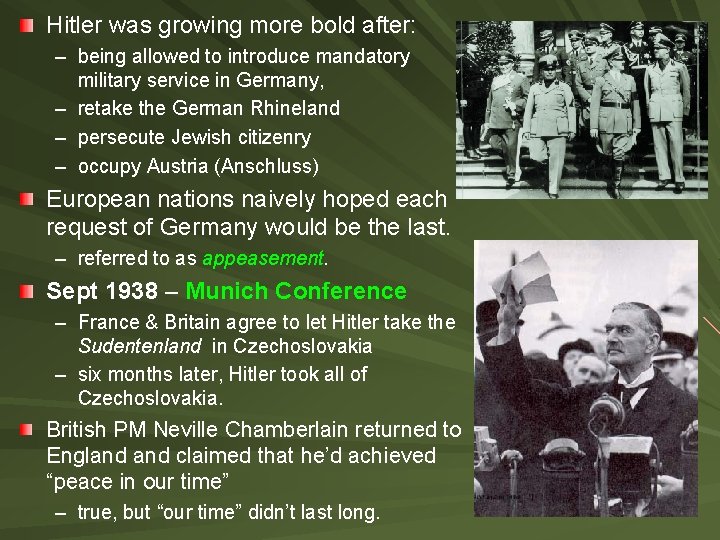
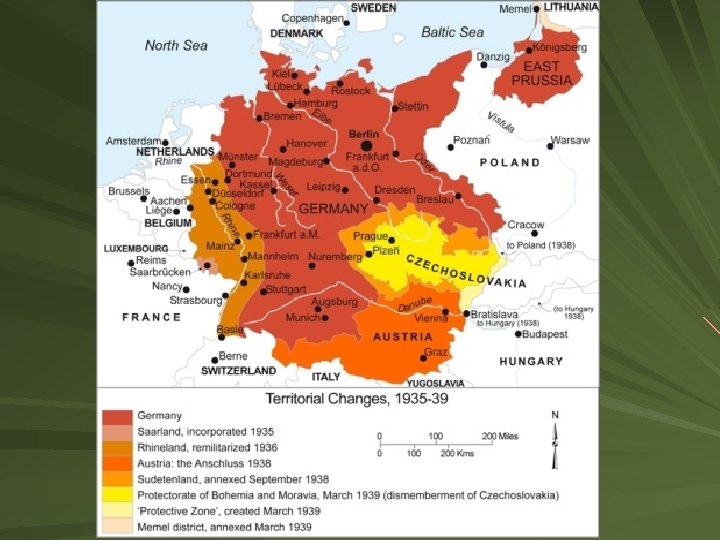
Hitler was growing more bold after: – being allowed to introduce mandatory military service in Germany, – retake the German Rhineland – persecute Jewish citizenry – occupy Austria (Anschluss) European nations naively hoped each request of Germany would be the last. – referred to as appeasement. Sept 1938 – Munich Conference – France & Britain agree to let Hitler take the Sudentenland in Czechoslovakia – six months later, Hitler took all of Czechoslovakia. British PM Neville Chamberlain returned to England claimed that he’d achieved “peace in our time” – true, but “our time” didn’t last long.
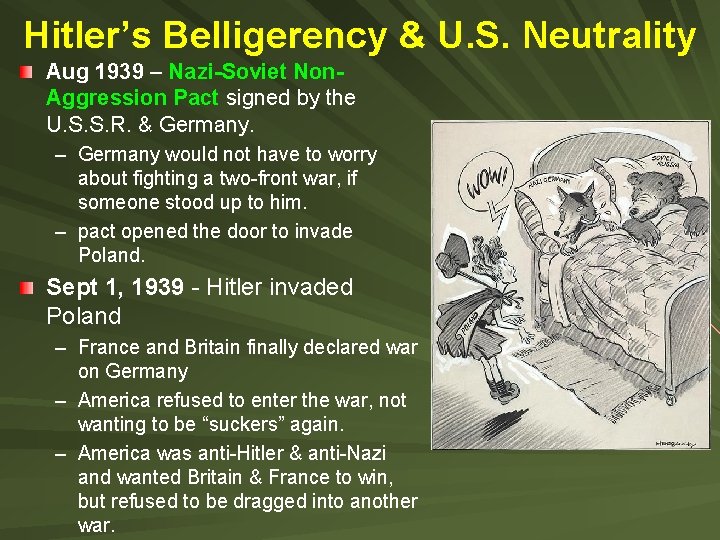
Hitler’s Belligerency & U. S. Neutrality Aug 1939 – Nazi-Soviet Non. Aggression Pact signed by the U. S. S. R. & Germany. – Germany would not have to worry about fighting a two-front war, if someone stood up to him. – pact opened the door to invade Poland. Sept 1, 1939 - Hitler invaded Poland – France and Britain finally declared war on Germany – America refused to enter the war, not wanting to be “suckers” again. – America was anti-Hitler & anti-Nazi and wanted Britain & France to win, but refused to be dragged into another war.
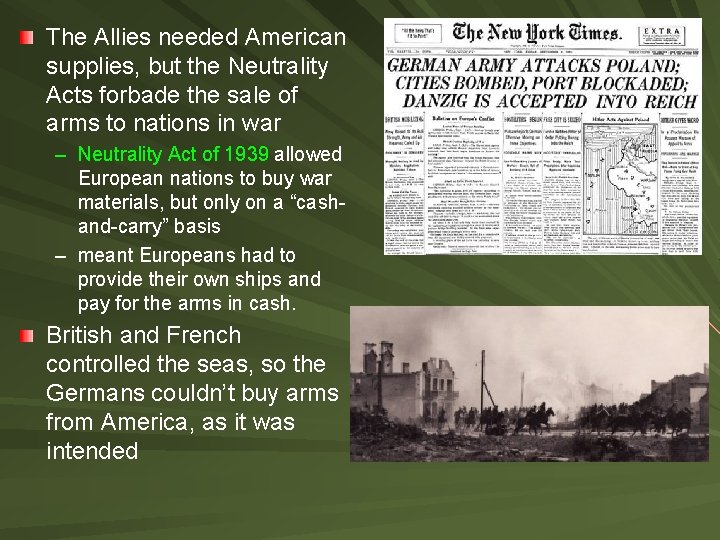
The Allies needed American supplies, but the Neutrality Acts forbade the sale of arms to nations in war – Neutrality Act of 1939 allowed European nations to buy war materials, but only on a “cashand-carry” basis – meant Europeans had to provide their own ships and pay for the arms in cash. British and French controlled the seas, so the Germans couldn’t buy arms from America, as it was intended
The Fall of France After the fall of Poland, Hitler positioned his forces to attack France which led to a lull in the war – the invasion of Poland was now called the “phony war 1940 - the “phony war” ended, Hitler overran Denmark and Norway, and then took over the Netherlands & Belgium. – used blitzkrieg (lightening war) tactics – Blitzing without mercy, he then struck a paralyzing blow toward France, which was forced to surrender by late June of that year. – the speed of which France fell was shocking all that stood between Hitler and the world was Britain – if the English lost, Hitler would have all of Europe in which to operate. Roosevelt called for the nation to begin building-up its armed forces – expenses totaling more than $37 million. – Sept 6, 1940 - Congress passed 1 st peacetime draft in U. S. history. – 1. 2 million troops and 800, 000 reserves would be trained.
Bolstering Britain with the Destroyer Deal With Britain the only power fighting Germany, FDR had to decide whether to remain neutral or help Britain. Aug 1940 –Battle of Britain begins – devastating aerial bombardments & Hitler planned for invasion in Sept. , but the defense of the British Royal Air Force ruined invasion plans. Opposing support groups formed in America – Committee to Defend America by Aiding the Allies – supported US involvement to help Britain. – America First Committee – supported isolationism. Sept 1940 - Britain need destroyers FDR boldly moved to transfer 50 left-over from WWI – the U. S. got eight defensive base sites from Newfoundland to South America which would stay in American ownership for 99 years. Still over a year from entering the war, FDR was preparing for the eventuality of war.
FDR Shatters the Two-Term Tradition 1940 - Wendell L. Willkie, became the dark horse Rep. candidate against Dem. candidate Franklin D. Roosevelt. – Willkie and FDR weren’t really different in the realm of foreign affairs, but Willkie hit hard with his attacks on the third term issue. – voters felt that, should war come, FDR was the best man to lead America. Congress Passes Lend-Lease Law Britain - running out of money & FDR didn’t want the hassles that came with calling back debts came up with the idea of a lend-lease program – in which the arms and ships, etc. that the U. S. lent to the nations that needed them would be returned when they were no longer needed. – Critics retorted that the U. S. wouldn’t want them back because it would be like lending chewing gum then taking it back after it’d been chewed.
The lend-lease bill was argued over heatedly in Congress, but it passed – by war’s end, America had sent about $50 billion worth of arms and equipment. – The lend-lease act was basically the abandonment of the neutrality policy, and Hitler recognized this. German submarines had avoided attacking U. S. ships, but after the passage, they started to fire upon U. S. ships as well, such as the May 21, 1941 torpedoing of the Robin Moor. Hitler’s Assault on the Soviet Union Spawns the Atlantic Charter June 22, 1941 - Hitler attacks Russia (Operation Barbarosa) – Hitler always planned on invading Russia but his need of natural resources moved up his timetable. the valor of the Red army, U. S. aid to the U. S. S. R. (through lendlease), and an early and bitter winter stranded the German force at Moscow and shifted the tide against Germany.
The Atlantic Conference was held in August 1941, and the result was the eight-point Atlantic Charter. Main points included… – no territorial changes contrary to the wishes of the natives. – affirmed the right for people to choose their rulers (self-determination). – declared disarmament & a peace of security, also a new League of Nations. – Critics claimed “neutral America” was interfering, ignoring that America was no longer neutral. U. S. Destroyers & Hitler’s U-Boats Clash To ensure that arms sent to Britain would reach there, FDR finally agreed that a convoy would have to escort the arms as far as Iceland, as Britain would take over from there. – U. S. destroyers like the Greer, the Kearny, and the Reuben James were attacked by the Germans. mid-Nov. 1941 - Congress annuls the now-useless Neutrality Act of 1939.
Surprise Assault at Pearl Harbor Japan was still embroiled in war with China – 1940 - US imposed embargoes on key supplies on Japan – Japan had to either back off of China or attack the U. S. The US had broken the Japanese code and knew that they would declare war soon – most Americans thought that the Japanese would attack British Malaya or the Philippines. Dec. 7, 1941 - the paralyzing blow struck Pearl Harbor – Where almost the entire U. S. fleet was located – wiped out many ships & killing/wounding 3, 000 men.
America’s Transformation from Bystander to Belligerent Dec. 8, 1941 - “a date which will live in infamy” FDR goes before Congress to ask for a declaration of war Dec. 11, 1941 - Germany & Italy declared war on the U. S. Until the Pearl Harbor attack, most Americans still wanted to stay out of war, but afterwards the American people were completely infuriated & wanted to go to war. – the U. S. had wanted to stay out of war, but had still supported Britain more and more – the U. S. had been against the Japanese aggression but had failed to take a firm stand on either side. The government had decided that appeasement didn’t work against “iron wolves, ” and that total war was needed to keep the world safe for democracy vs. anarchy and dictatorship.