CHAPTER 32 AN INTRODUCTION TO ANIMAL DIVERSITY 1

- Slides: 42
CHAPTER 32 AN INTRODUCTION TO ANIMAL DIVERSITY 1
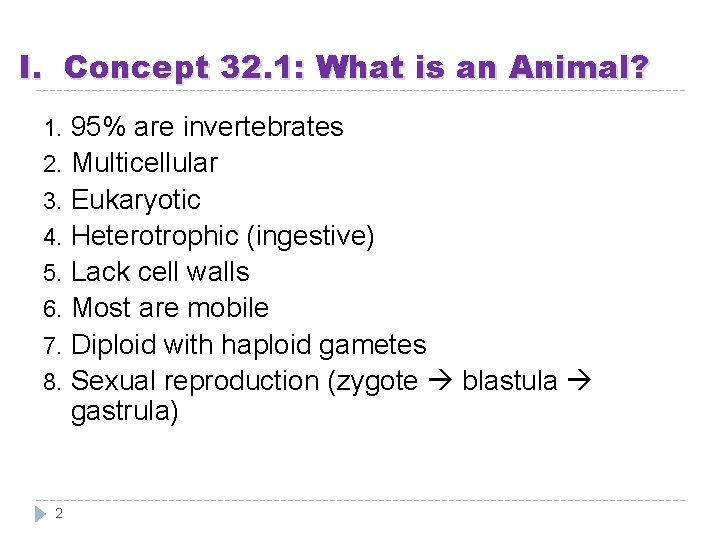
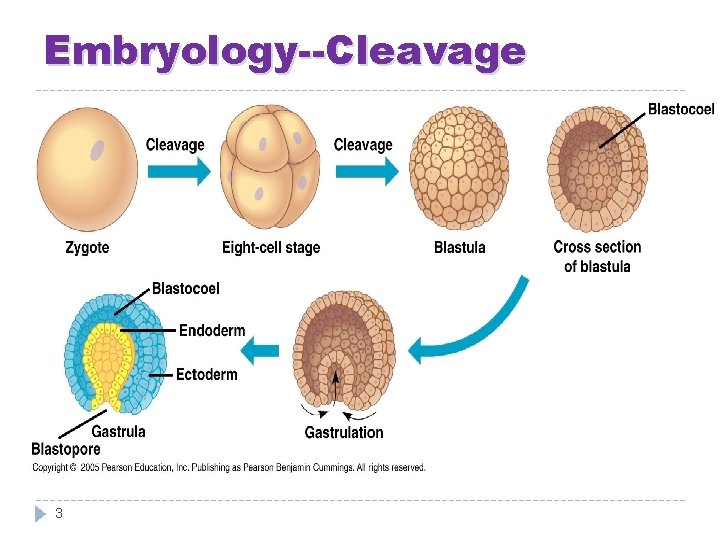
I. Concept 32. 1: What is an Animal? 95% are invertebrates 2. Multicellular 3. Eukaryotic 4. Heterotrophic (ingestive) 5. Lack cell walls 6. Most are mobile 7. Diploid with haploid gametes 8. Sexual reproduction (zygote blastula gastrula) 1. 2
Embryology--Cleavage 3
9. Carbohydrates stored as glycogen 10. Some produce larva which undergo metamorphosis 11. Specialized systems 12. Two unique types of tissue: nervous tissue and muscle tissue 13. Share the unique homeobox-containing family of regulatory genes know as Hox genes �Hox genes play an important role in development of animal embryos 4
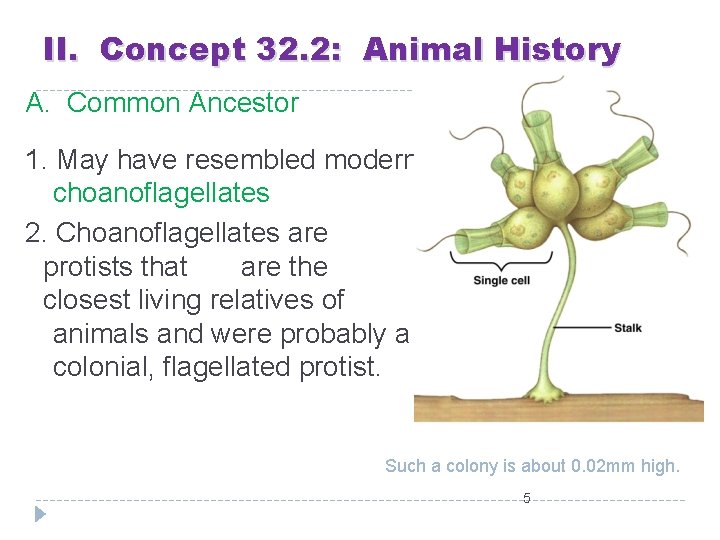
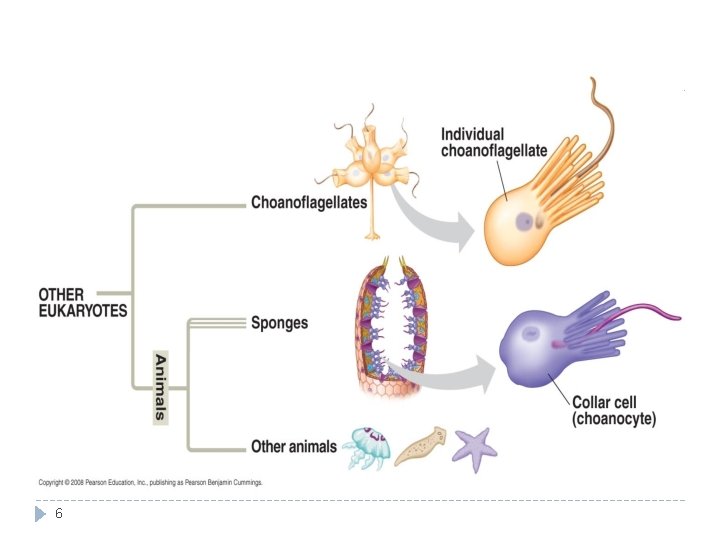
II. Concept 32. 2: Animal History A. Common Ancestor 1. May have resembled modern choanoflagellates 2. Choanoflagellates are protists that are the closest living relatives of animals and were probably a colonial, flagellated protist. Such a colony is about 0. 02 mm high. 5
6
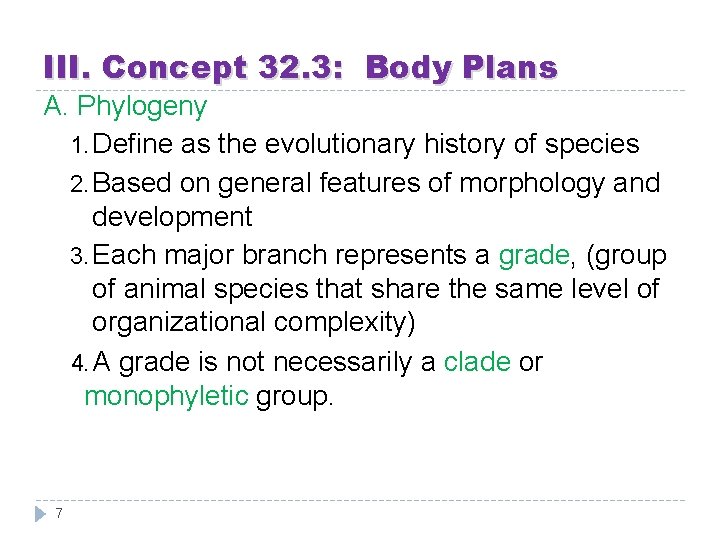
III. Concept 32. 3: Body Plans A. Phylogeny 1. Define as the evolutionary history of species 2. Based on general features of morphology and development 3. Each major branch represents a grade, (group of animal species that share the same level of organizational complexity) 4. A grade is not necessarily a clade or monophyletic group. 7
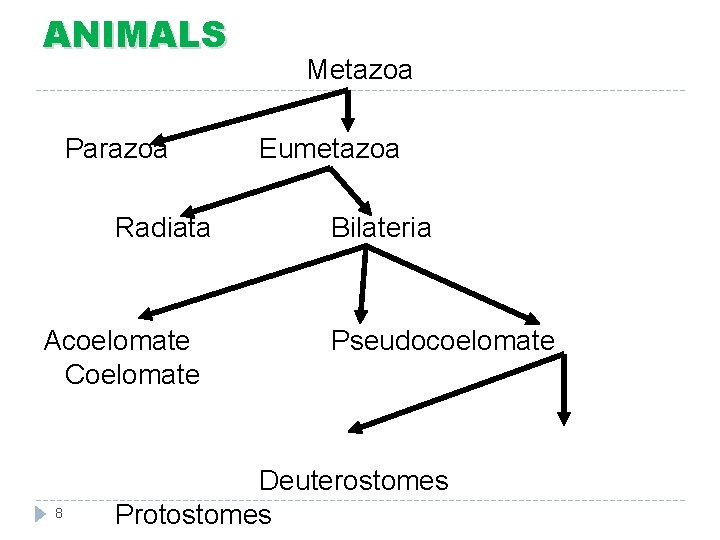
ANIMALS Parazoa Radiata Acoelomate Coelomate 8 Metazoa Eumetazoa Bilateria Pseudocoelomate Deuterostomes Protostomes
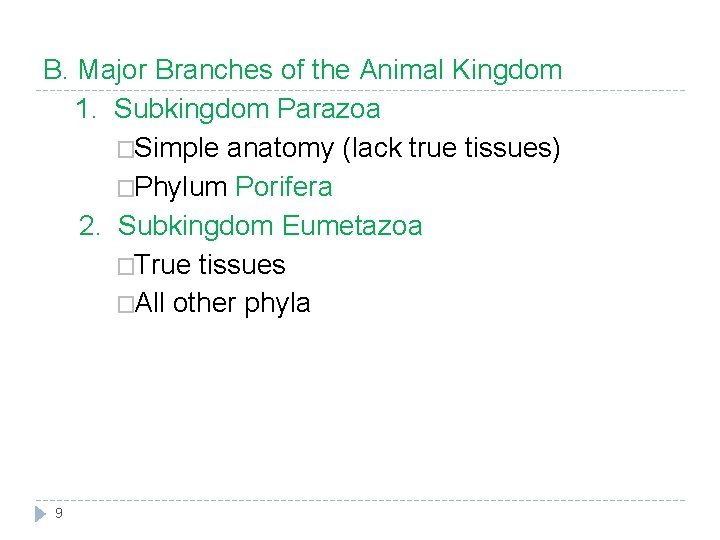
B. Major Branches of the Animal Kingdom 1. Subkingdom Parazoa �Simple anatomy (lack true tissues) �Phylum Porifera 2. Subkingdom Eumetazoa �True tissues �All other phyla 9
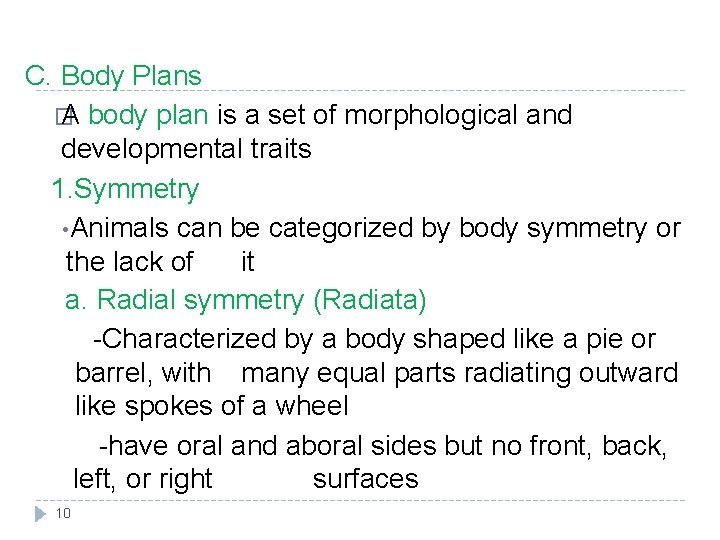
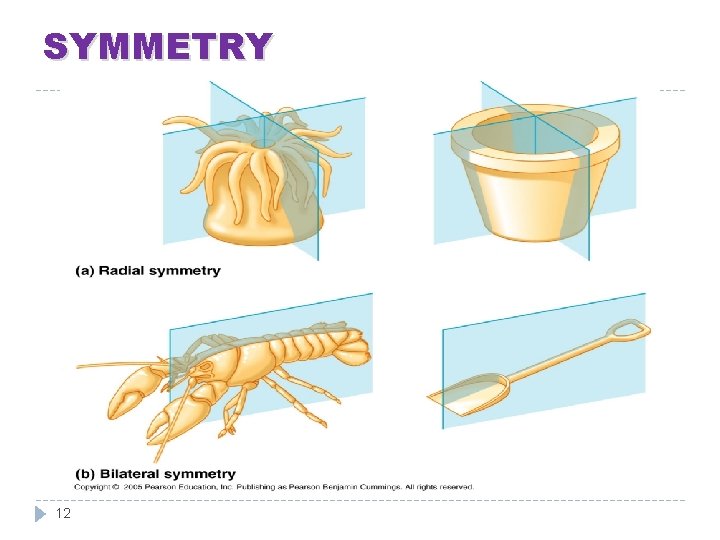
C. Body Plans � A body plan is a set of morphological and developmental traits 1. Symmetry • Animals can be categorized by body symmetry or the lack of it a. Radial symmetry (Radiata) -Characterized by a body shaped like a pie or barrel, with many equal parts radiating outward like spokes of a wheel -have oral and aboral sides but no front, back, left, or right surfaces 10
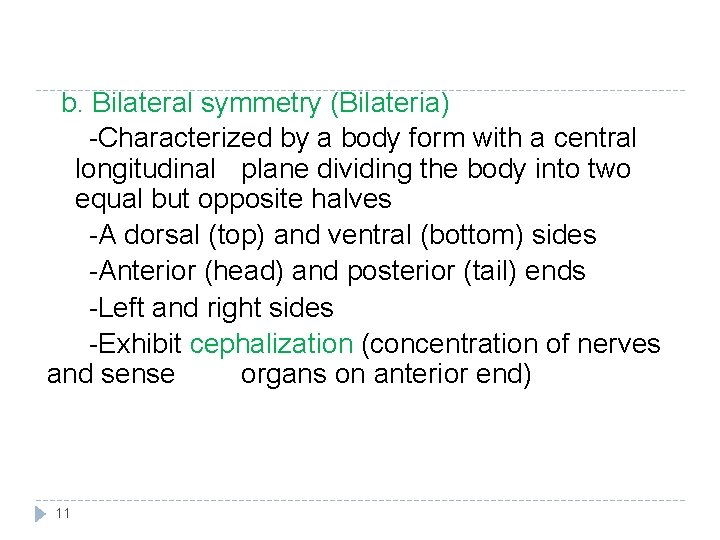
b. Bilateral symmetry (Bilateria) -Characterized by a body form with a central longitudinal plane dividing the body into two equal but opposite halves -A dorsal (top) and ventral (bottom) sides -Anterior (head) and posterior (tail) ends -Left and right sides -Exhibit cephalization (concentration of nerves and sense organs on anterior end) 11
SYMMETRY 12
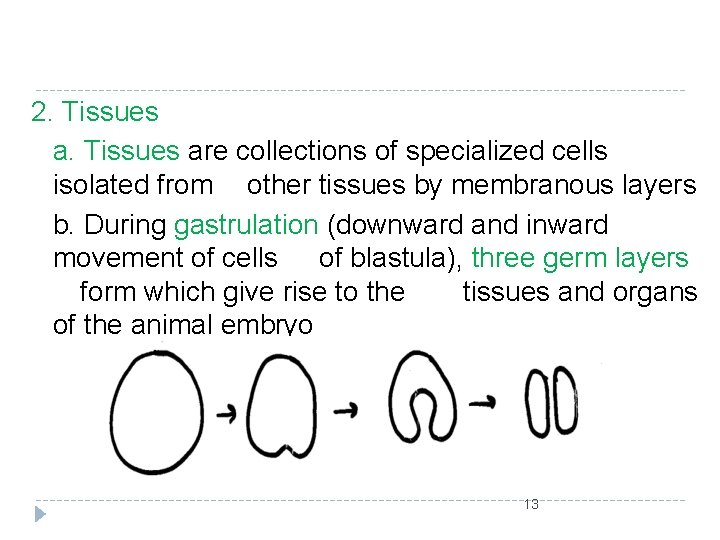
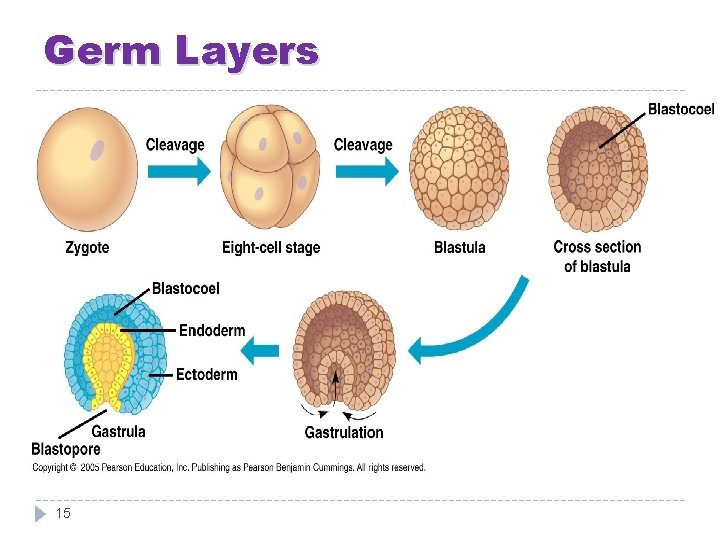
2. Tissues are collections of specialized cells isolated from other tissues by membranous layers b. During gastrulation (downward and inward movement of cells of blastula), three germ layers form which give rise to the tissues and organs of the animal embryo 13
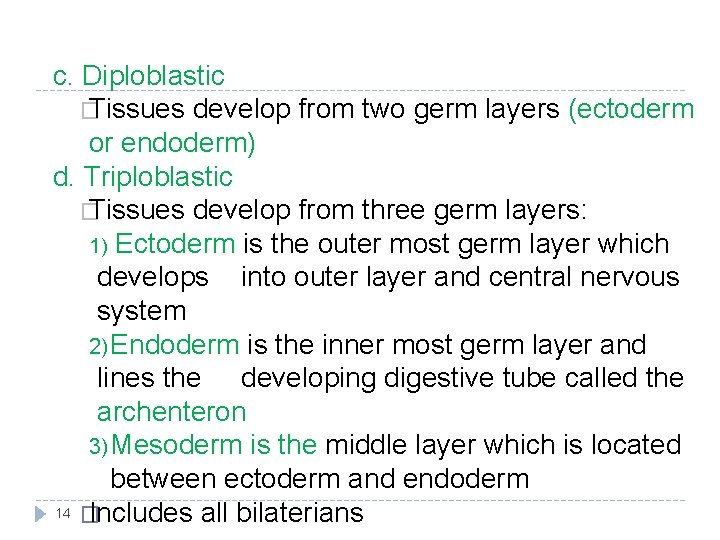
c. Diploblastic � Tissues develop from two germ layers (ectoderm or endoderm) d. Triploblastic � Tissues develop from three germ layers: 1) Ectoderm is the outer most germ layer which develops into outer layer and central nervous system 2) Endoderm is the inner most germ layer and lines the developing digestive tube called the archenteron 3) Mesoderm is the middle layer which is located between ectoderm and endoderm 14 � Includes all bilaterians
Germ Layers 15
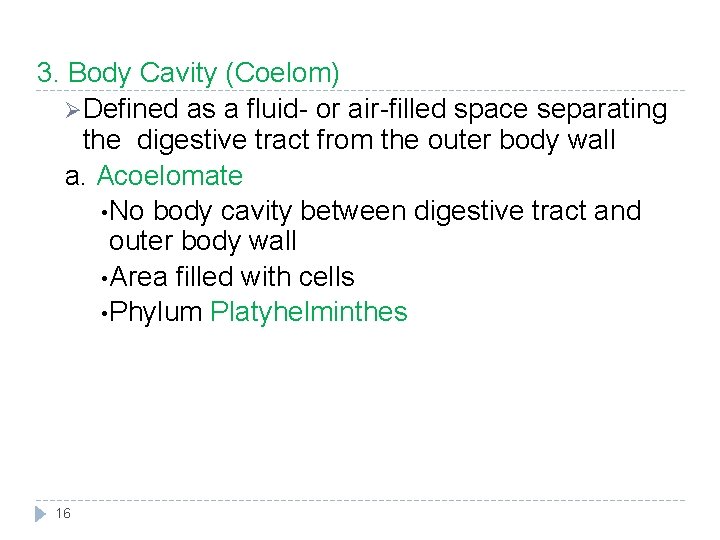
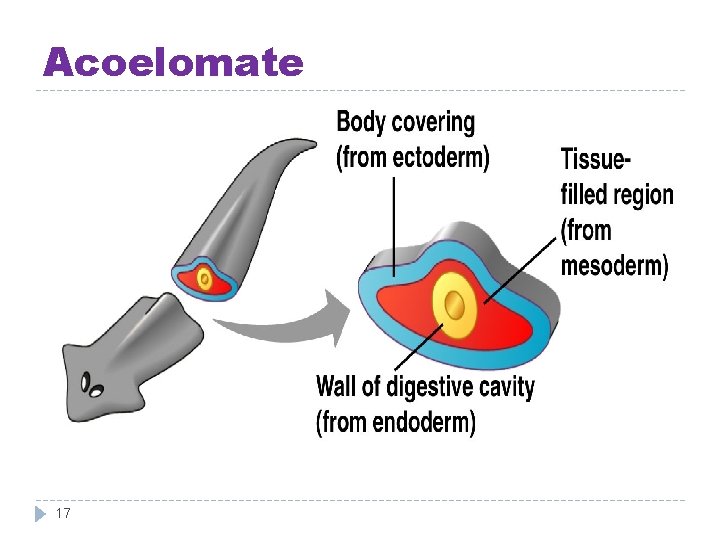
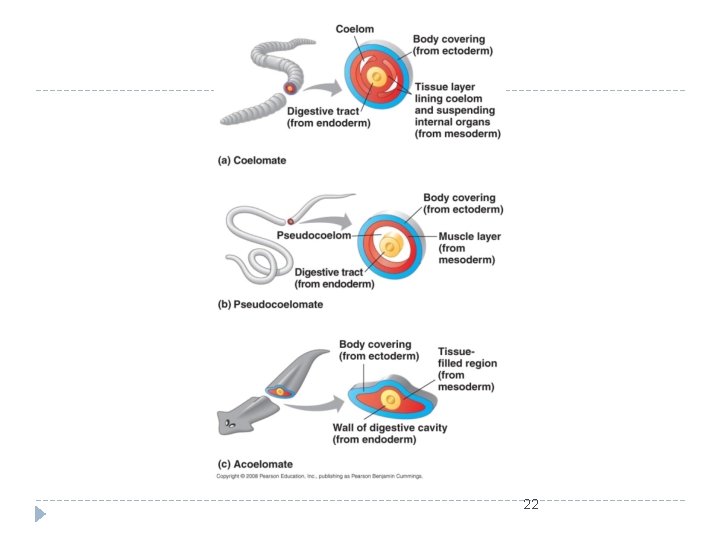
3. Body Cavity (Coelom) Ø Defined as a fluid- or air-filled space separating the digestive tract from the outer body wall a. Acoelomate • No body cavity between digestive tract and outer body wall • Area filled with cells • Phylum Platyhelminthes 16
Acoelomate 17
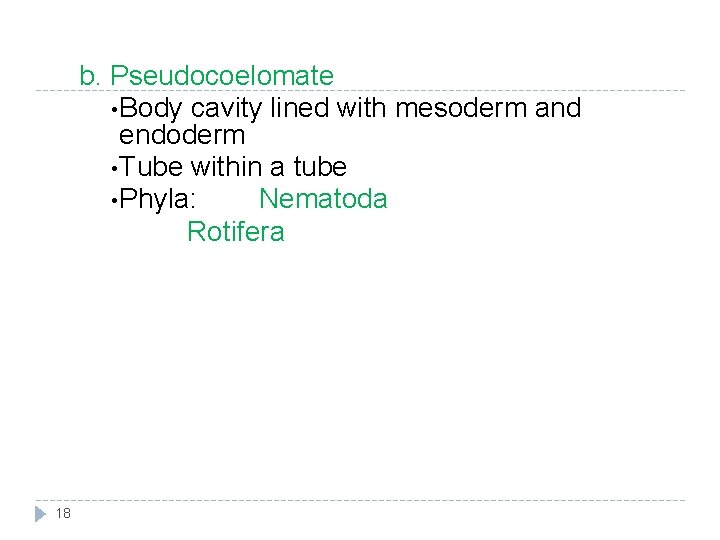
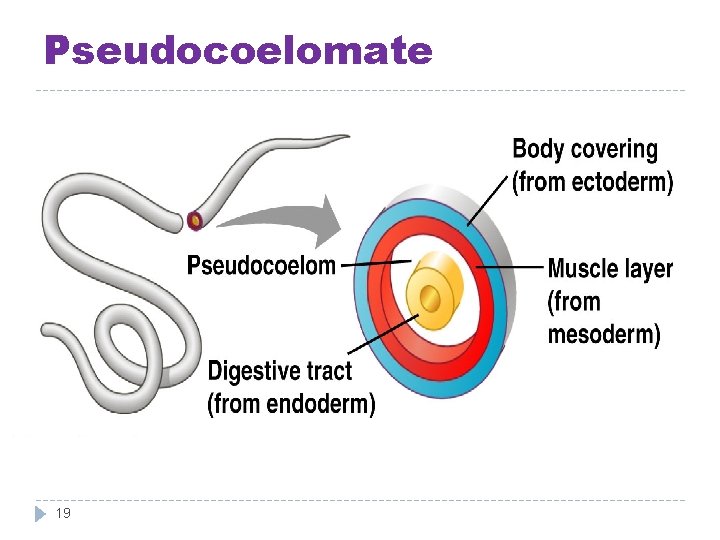
b. Pseudocoelomate • Body cavity lined with mesoderm and endoderm • Tube within a tube • Phyla: Nematoda Rotifera 18
Pseudocoelomate 19
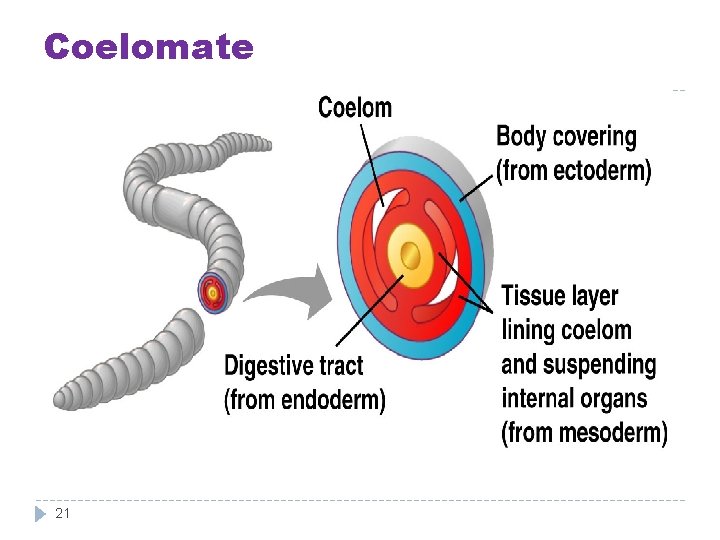
c. Coelomate (true body cavity) • Body cavity lined with mesoderm • Mesenteries connect outer and inner mesoderm and suspend internal organs • Phyla: Echinodermata Arthropoda Mollusca Chordata Annelida ØFunctions of the body cavity 1. Fluid cushions the suspended organs, helping to prevent internal injury 2. In soft-bodied coelomates, functions as a hydrostatic skeleton against which muscles can work 3. Enables internal organs to grow and move 20 independently of the other body wall
Coelomate 21
22
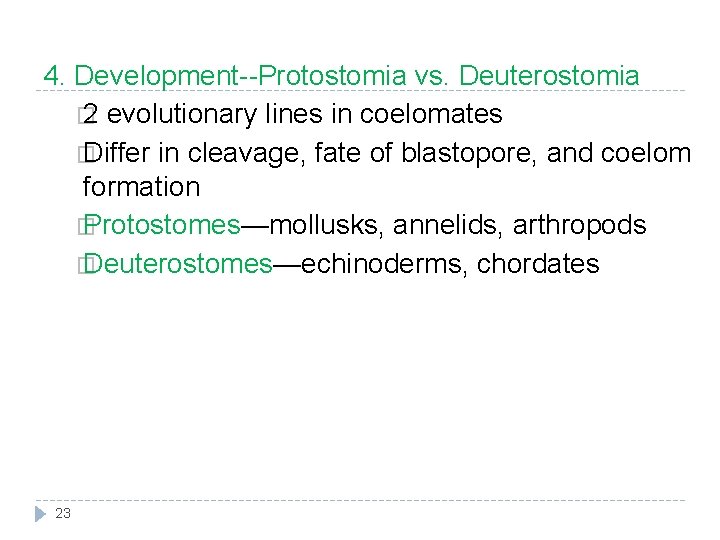
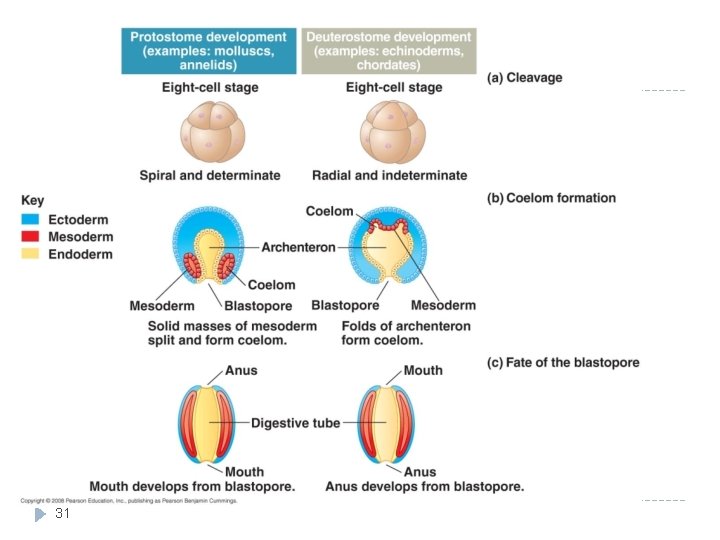
4. Development--Protostomia vs. Deuterostomia � 2 evolutionary lines in coelomates � Differ in cleavage, fate of blastopore, and coelom formation � Protostomes—mollusks, annelids, arthropods � Deuterostomes—echinoderms, chordates 23
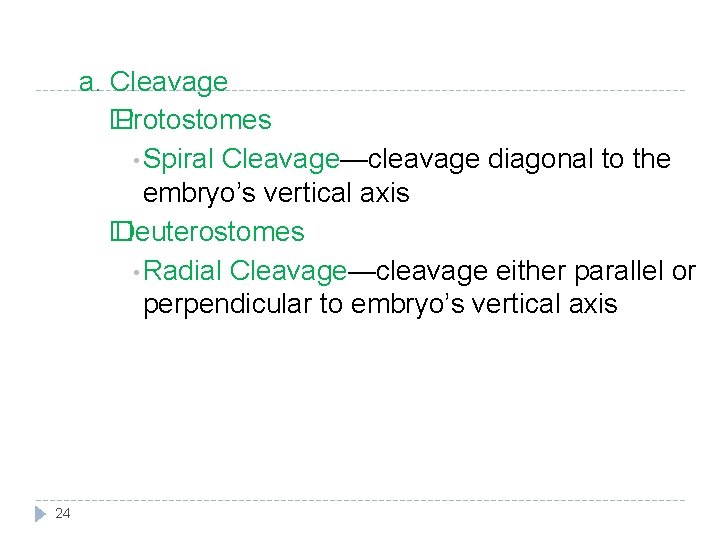
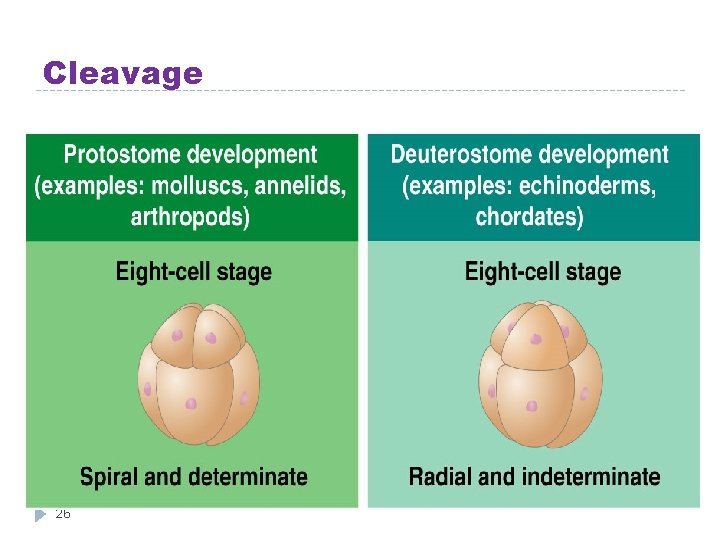
a. Cleavage � Protostomes • Spiral Cleavage—cleavage diagonal to the embryo’s vertical axis � Deuterostomes • Radial Cleavage—cleavage either parallel or perpendicular to embryo’s vertical axis 24
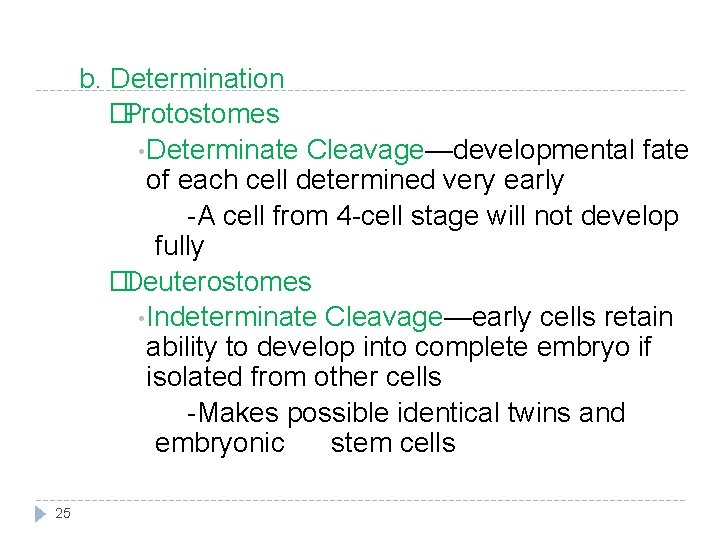
b. Determination �Protostomes • Determinate Cleavage—developmental fate of each cell determined very early -A cell from 4 -cell stage will not develop fully �Deuterostomes • Indeterminate Cleavage—early cells retain ability to develop into complete embryo if isolated from other cells -Makes possible identical twins and embryonic stem cells 25
Cleavage 26
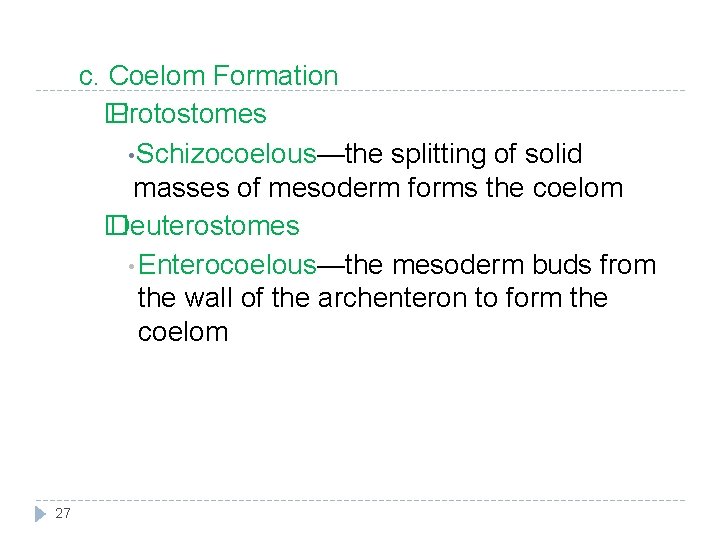
c. Coelom Formation � Protostomes • Schizocoelous—the splitting of solid masses of mesoderm forms the coelom � Deuterostomes • Enterocoelous—the mesoderm buds from the wall of the archenteron to form the coelom 27
Coelom Formation 28
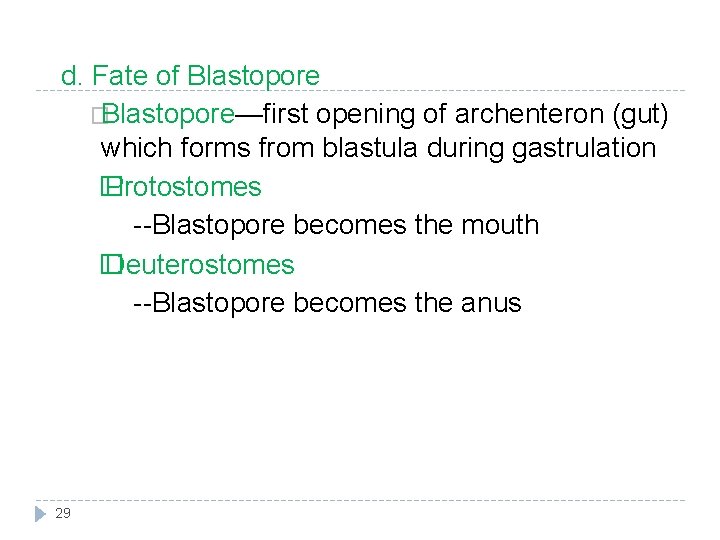
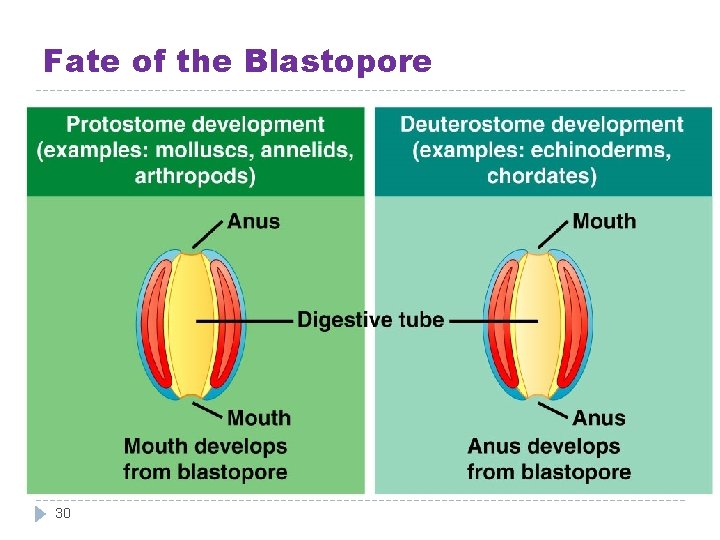
d. Fate of Blastopore �Blastopore—first opening of archenteron (gut) which forms from blastula during gastrulation � Protostomes --Blastopore becomes the mouth � Deuterostomes --Blastopore becomes the anus 29
Fate of the Blastopore 30
31
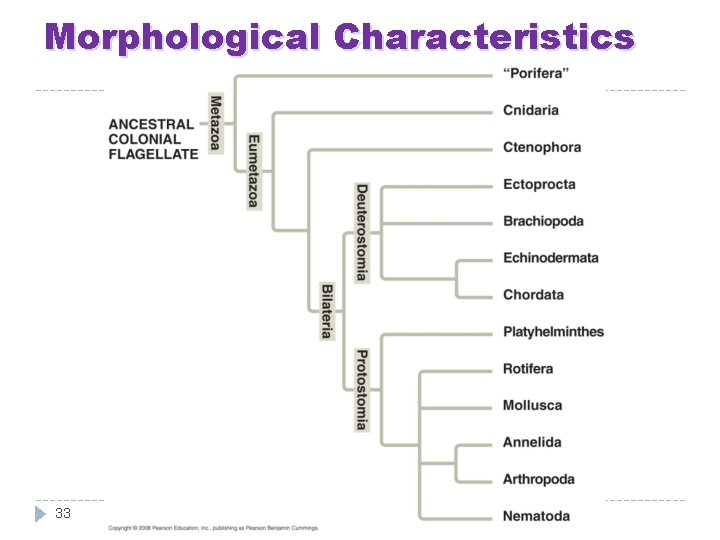
IV. Concept 32. 4: New Views of Animal Phylogeny �One hypothesis of animal phylogeny is based mainly on morphological and developmental comparisons 32
Morphological Characteristics 33
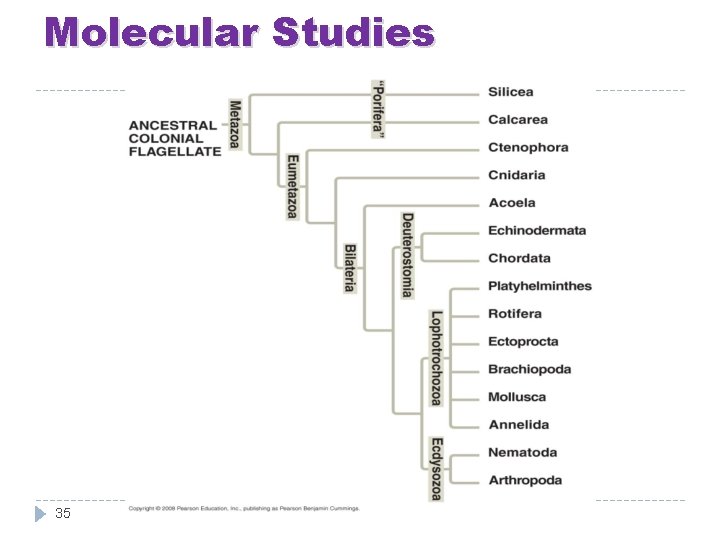
�One hypothesis of animal phylogeny is based mainly on molecular data 34
Molecular Studies 35
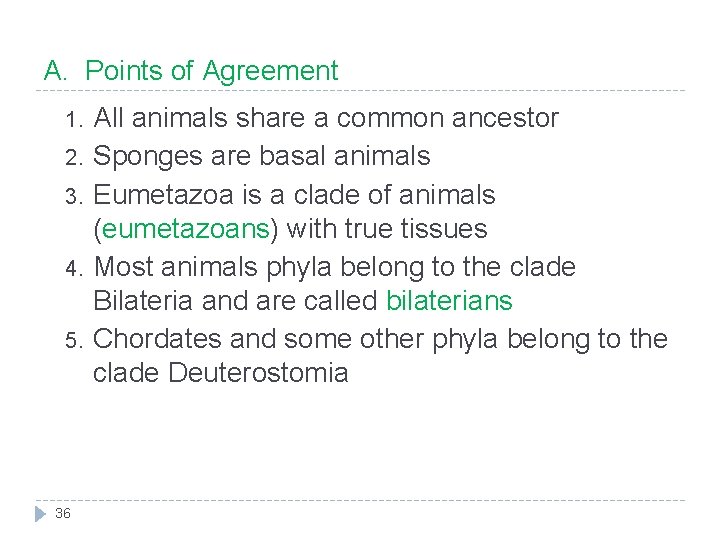
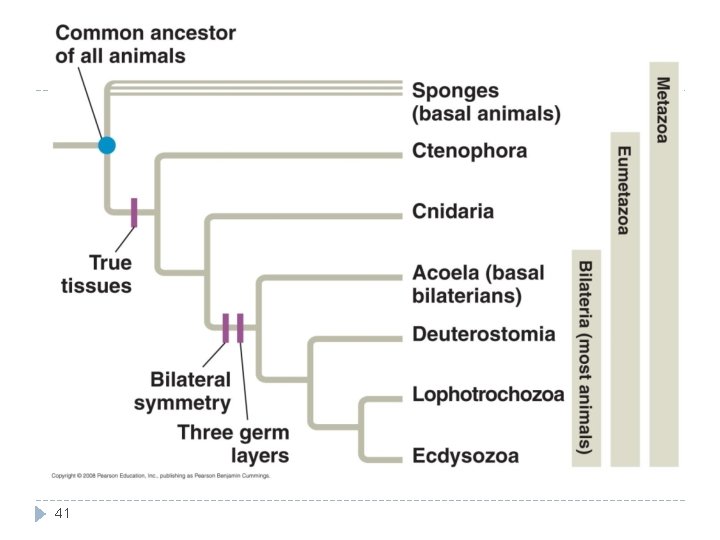
A. Points of Agreement 1. 2. 3. 4. 5. 36 All animals share a common ancestor Sponges are basal animals Eumetazoa is a clade of animals (eumetazoans) with true tissues Most animals phyla belong to the clade Bilateria and are called bilaterians Chordates and some other phyla belong to the clade Deuterostomia
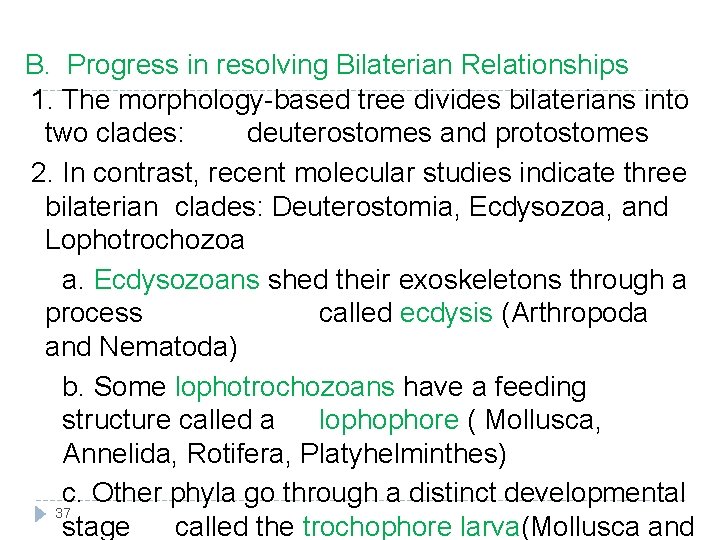
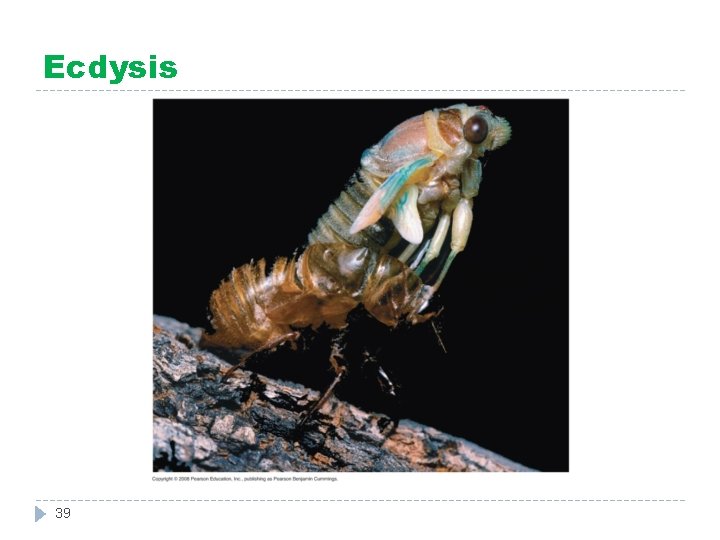
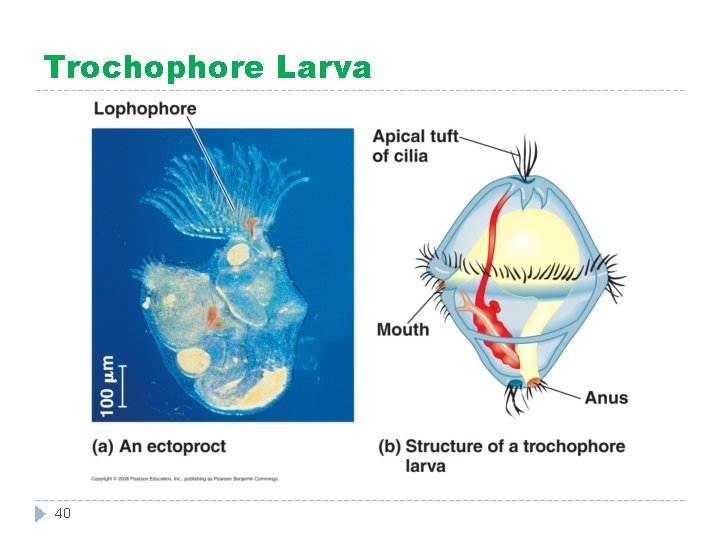
B. Progress in resolving Bilaterian Relationships 1. The morphology-based tree divides bilaterians into two clades: deuterostomes and protostomes 2. In contrast, recent molecular studies indicate three bilaterian clades: Deuterostomia, Ecdysozoa, and Lophotrochozoa a. Ecdysozoans shed their exoskeletons through a process called ecdysis (Arthropoda and Nematoda) b. Some lophotrochozoans have a feeding structure called a lophophore ( Mollusca, Annelida, Rotifera, Platyhelminthes) c. Other phyla go through a distinct developmental 37 stage called the trochophore larva(Mollusca and
TERMS: � Zygote � Cleavages � Blastula � Gastrula � Ectoderm � Endoderm � Mesoderm � Blastopore � Archenteron � Metamorphosis 38 � Radial symmetry � Bilateral symmetry � Cephalization � Acoelomate � Pseudocoelomate � Coelomate � Anterior � Posterior � Dorsal � Ventral
Ecdysis 39
Trochophore Larva 40
41
You should now be able to: 1. 2. 3. 4. 42 List the characteristics that combine to define animals Distinguish between the following pairs or sets of terms: radial and bilateral symmetry; grade and clade of animal taxa; diploblastic and triploblastic; spiral and radial cleavage; determinate and indeterminate cleavage; acoelomate, pseudocoelomate, and coelomate grades Compare the developmental differences between protostomes and deuterostomes Compare the alternate relationships of annelids and arthropods presented by two different proposed phylogenetic trees