Chapter 3 The Time Value of Money Part

- Slides: 34
Chapter 3 The Time Value of Money Part B 3. 1 Van Horne and Wachowicz, Fundamentals of Financial Management, 13 th edition. © Pearson Education Limited 2009. Created by Gregory Kuhlemeyer.
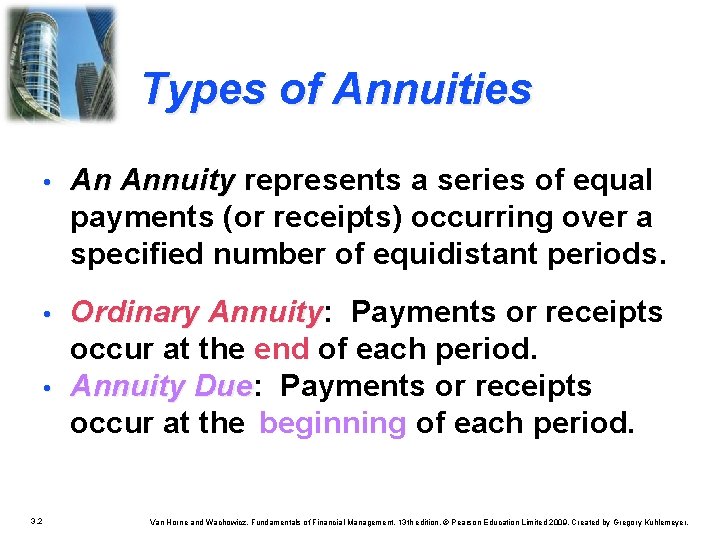
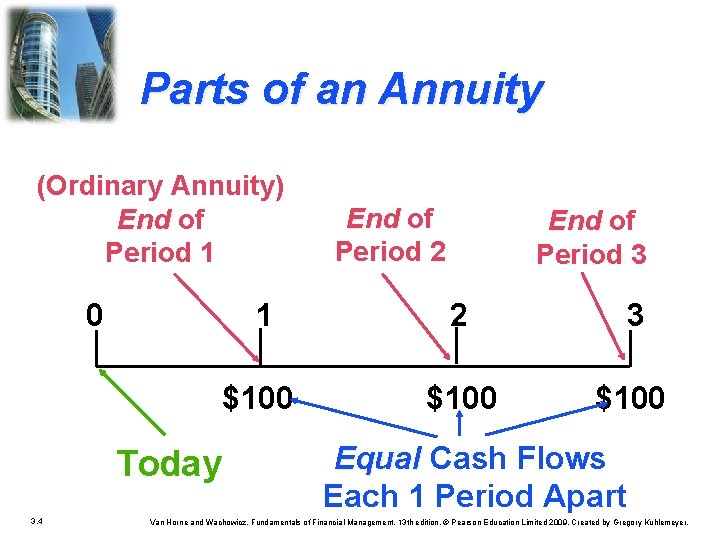
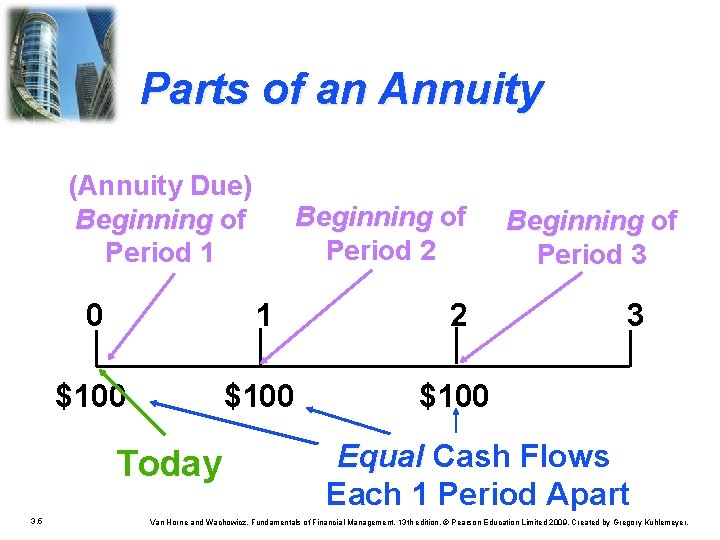
Types of Annuities • An Annuity represents a series of equal payments (or receipts) occurring over a specified number of equidistant periods. • Ordinary Annuity: Annuity Payments or receipts occur at the end of each period. Annuity Due: Due Payments or receipts occur at the beginning of each period. • 3. 2 Van Horne and Wachowicz, Fundamentals of Financial Management, 13 th edition. © Pearson Education Limited 2009. Created by Gregory Kuhlemeyer.
Examples of Annuities • • • 3. 3 Student Loan Payments Car Loan Payments Insurance Premiums Mortgage Payments Retirement Savings Van Horne and Wachowicz, Fundamentals of Financial Management, 13 th edition. © Pearson Education Limited 2009. Created by Gregory Kuhlemeyer.
Parts of an Annuity (Ordinary Annuity) End of Period 1 0 Today 3. 4 End of Period 2 End of Period 3 1 2 3 $100 Equal Cash Flows Each 1 Period Apart Van Horne and Wachowicz, Fundamentals of Financial Management, 13 th edition. © Pearson Education Limited 2009. Created by Gregory Kuhlemeyer.
Parts of an Annuity (Annuity Due) Beginning of Period 1 0 1 2 $100 Today 3. 5 Beginning of Period 2 Beginning of Period 3 3 Equal Cash Flows Each 1 Period Apart Van Horne and Wachowicz, Fundamentals of Financial Management, 13 th edition. © Pearson Education Limited 2009. Created by Gregory Kuhlemeyer.
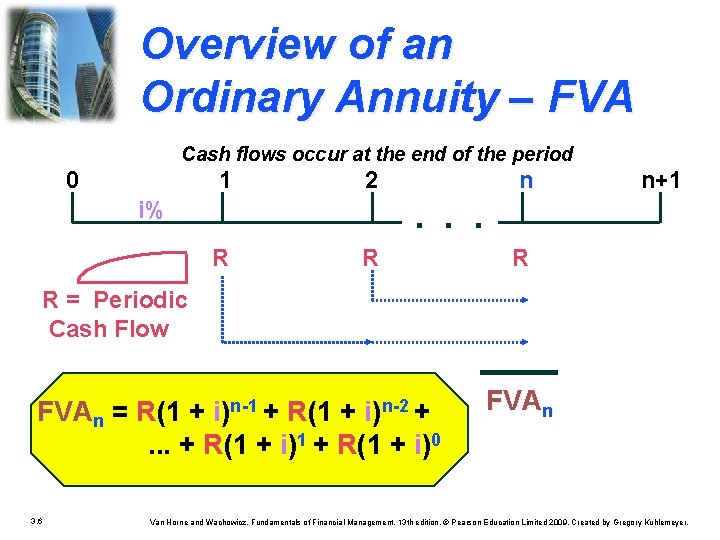
Overview of an Ordinary Annuity – FVA Cash flows occur at the end of the period 0 1 2 n n+1 . . . i% R R = Periodic Cash Flow FVAn = R(1 + i)n-1 + R(1 + i)n-2 +. . . + R(1 + i)1 + R(1 + i)0 3. 6 FVAn Van Horne and Wachowicz, Fundamentals of Financial Management, 13 th edition. © Pearson Education Limited 2009. Created by Gregory Kuhlemeyer.
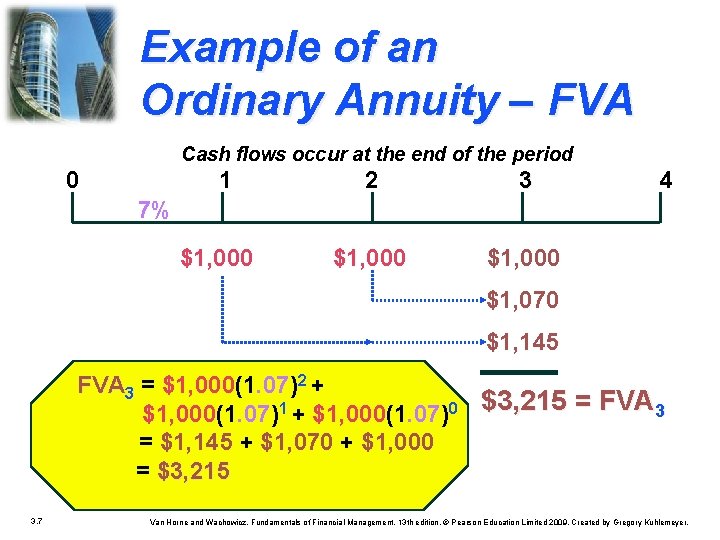
Example of an Ordinary Annuity – FVA Cash flows occur at the end of the period 0 1 2 3 $1, 000 4 7% $1, 000 $1, 070 $1, 145 FVA 3 = $1, 000(1. 07)2 + $1, 000(1. 07)1 + $1, 000(1. 07)0 $3, 215 = FVA 3 = $1, 145 + $1, 070 + $1, 000 = $3, 215 3. 7 Van Horne and Wachowicz, Fundamentals of Financial Management, 13 th edition. © Pearson Education Limited 2009. Created by Gregory Kuhlemeyer.
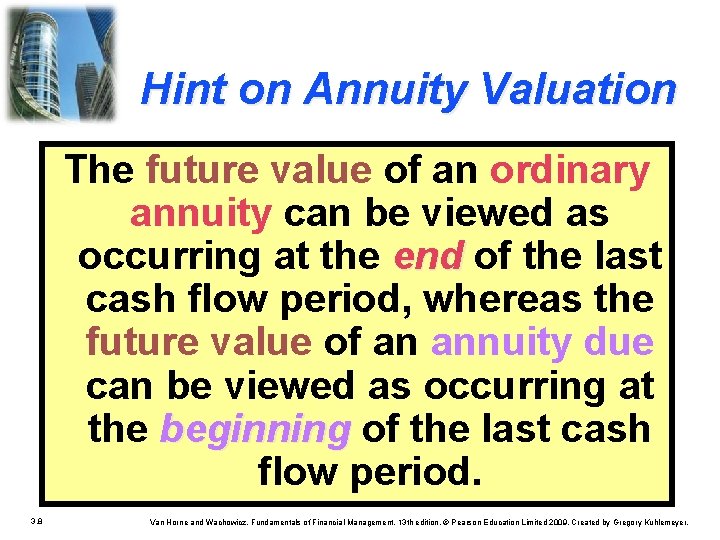
Hint on Annuity Valuation The future value of an ordinary annuity can be viewed as occurring at the end of the last cash flow period, whereas the future value of an annuity due can be viewed as occurring at the beginning of the last cash flow period. 3. 8 Van Horne and Wachowicz, Fundamentals of Financial Management, 13 th edition. © Pearson Education Limited 2009. Created by Gregory Kuhlemeyer.
Valuation Using Table III FVAn FVA 3 3. 9 = R (FVIFAi%, n) = $1, 000 (FVIFA 7%, 3) = $1, 000 (3. 215) = $3, 215 Van Horne and Wachowicz, Fundamentals of Financial Management, 13 th edition. © Pearson Education Limited 2009. Created by Gregory Kuhlemeyer.
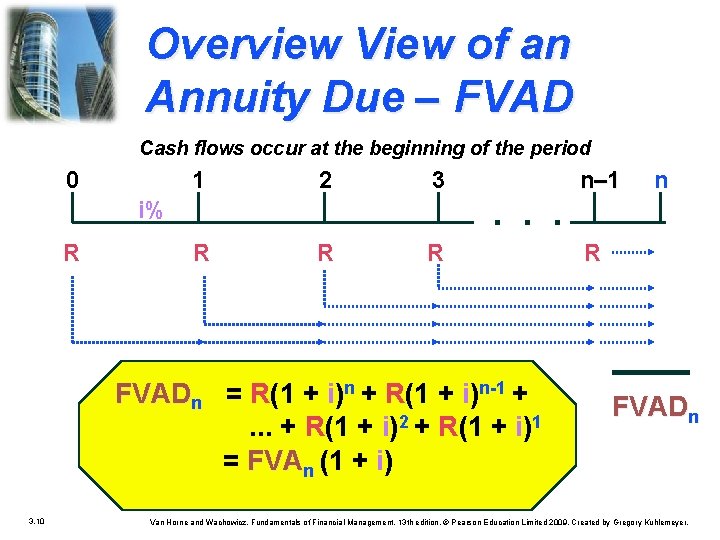
Overview View of an Annuity Due – FVAD Cash flows occur at the beginning of the period 0 1 2 3 R R R i% R . . . FVADn = R(1 + i)n + R(1 + i)n-1 +. . . + R(1 + i)2 + R(1 + i)1 = FVAn (1 + i) 3. 10 n– 1 n R FVADn Van Horne and Wachowicz, Fundamentals of Financial Management, 13 th edition. © Pearson Education Limited 2009. Created by Gregory Kuhlemeyer.
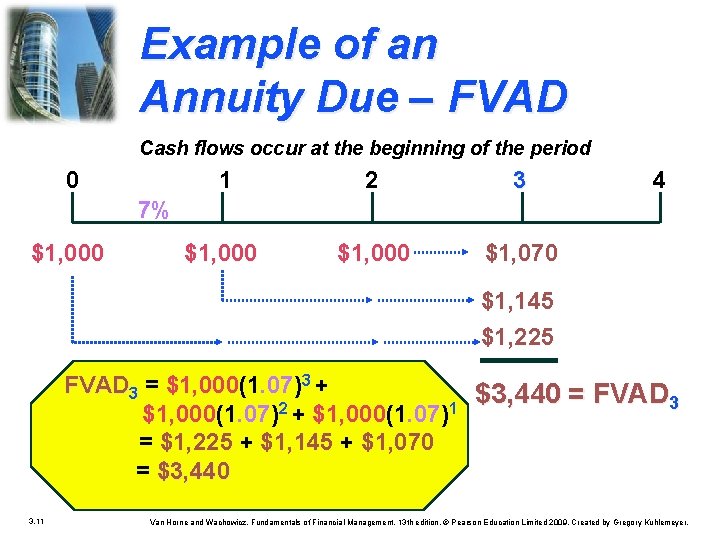
Example of an Annuity Due – FVAD Cash flows occur at the beginning of the period 0 1 2 3 $1, 000 $1, 070 4 7% $1, 000 $1, 145 $1, 225 FVAD 3 = $1, 000(1. 07)3 + $3, 440 = FVAD 3 2 1 $1, 000(1. 07) + $1, 000(1. 07) = $1, 225 + $1, 145 + $1, 070 = $3, 440 3. 11 Van Horne and Wachowicz, Fundamentals of Financial Management, 13 th edition. © Pearson Education Limited 2009. Created by Gregory Kuhlemeyer.
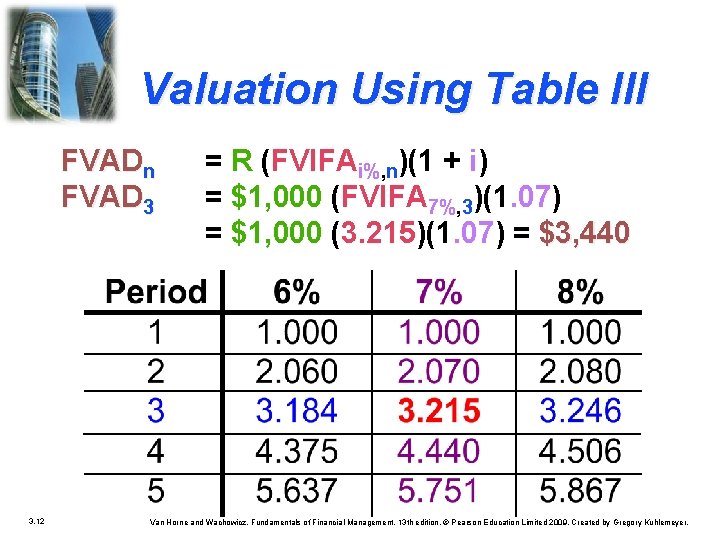
Valuation Using Table III FVADn FVAD 3 3. 12 = R (FVIFAi%, n)(1 + i) = $1, 000 (FVIFA 7%, 3)(1. 07) = $1, 000 (3. 215)(1. 07) = $3, 440 Van Horne and Wachowicz, Fundamentals of Financial Management, 13 th edition. © Pearson Education Limited 2009. Created by Gregory Kuhlemeyer.
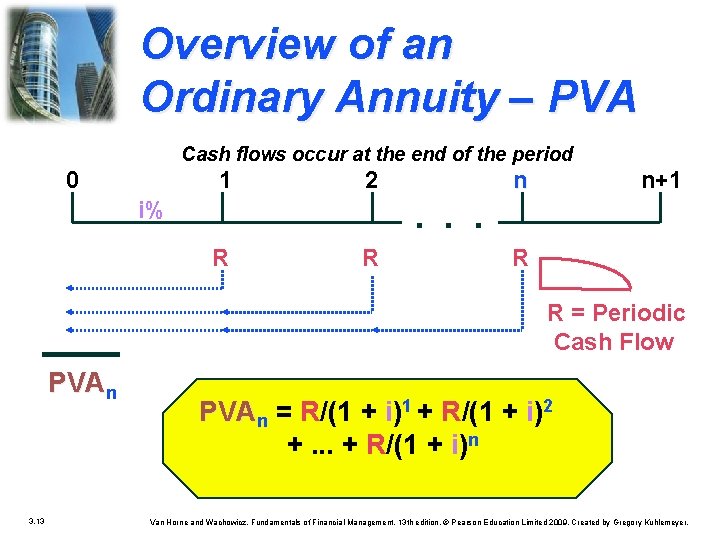
Overview of an Ordinary Annuity – PVA Cash flows occur at the end of the period 0 1 2 n n+1 . . . i% R R = Periodic Cash Flow PVAn 3. 13 PVAn = R/(1 + i)1 + R/(1 + i)2 +. . . + R/(1 + i)n Van Horne and Wachowicz, Fundamentals of Financial Management, 13 th edition. © Pearson Education Limited 2009. Created by Gregory Kuhlemeyer.
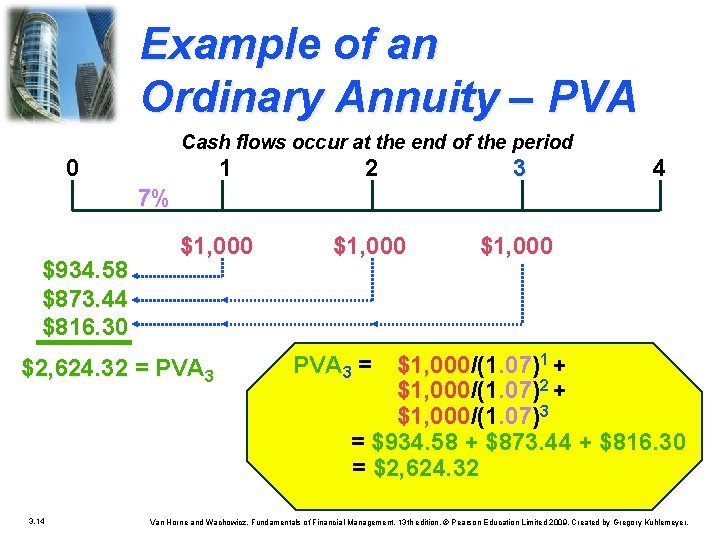
Example of an Ordinary Annuity – PVA Cash flows occur at the end of the period 0 1 2 3 $1, 000 4 7% $934. 58 $873. 44 $816. 30 $1, 000 $2, 624. 32 = PVA 3 3. 14 PVA 3 = $1, 000/(1. 07)1 + $1, 000/(1. 07)2 + $1, 000/(1. 07)3 = $934. 58 + $873. 44 + $816. 30 = $2, 624. 32 Van Horne and Wachowicz, Fundamentals of Financial Management, 13 th edition. © Pearson Education Limited 2009. Created by Gregory Kuhlemeyer.
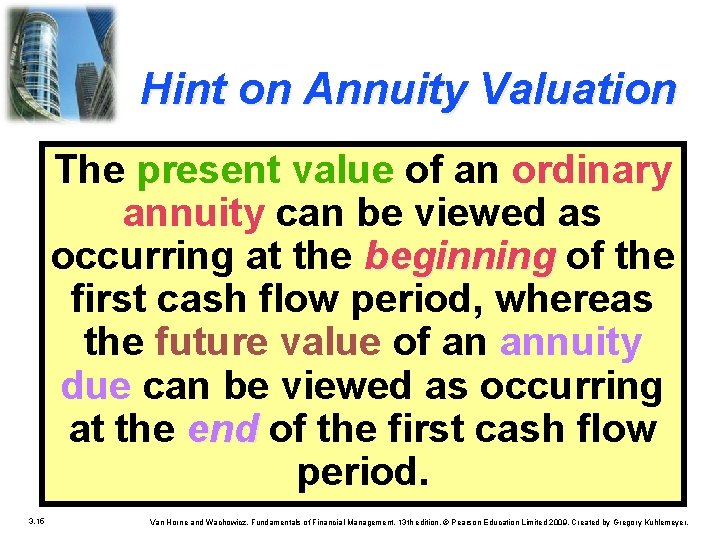
Hint on Annuity Valuation The present value of an ordinary annuity can be viewed as occurring at the beginning of the first cash flow period, whereas the future value of an annuity due can be viewed as occurring at the end of the first cash flow period. 3. 15 Van Horne and Wachowicz, Fundamentals of Financial Management, 13 th edition. © Pearson Education Limited 2009. Created by Gregory Kuhlemeyer.
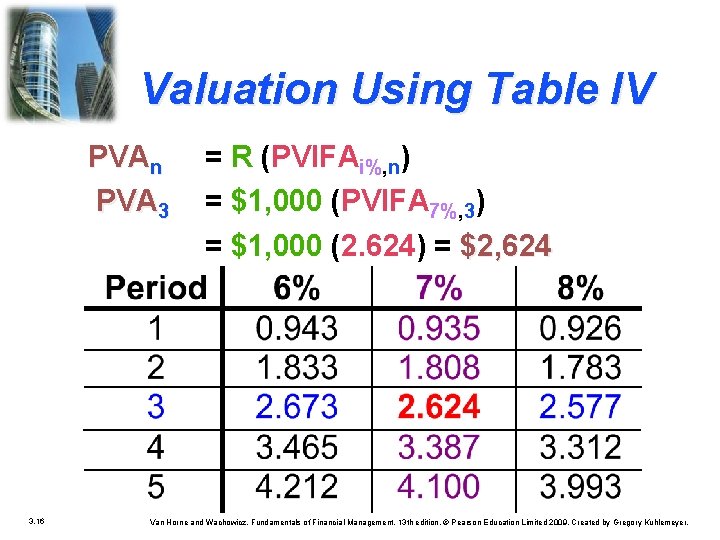
Valuation Using Table IV PVAn PVA 3 3. 16 = R (PVIFAi%, n) = $1, 000 (PVIFA 7%, 3) = $1, 000 (2. 624) = $2, 624 Van Horne and Wachowicz, Fundamentals of Financial Management, 13 th edition. © Pearson Education Limited 2009. Created by Gregory Kuhlemeyer.
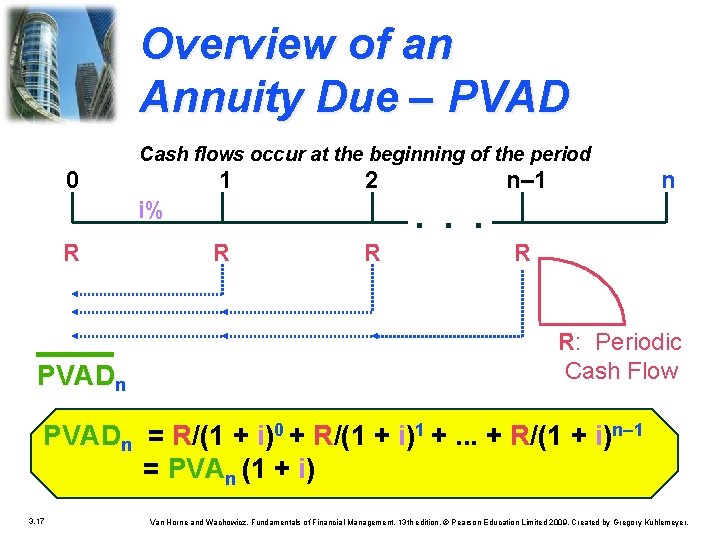
Overview of an Annuity Due – PVAD Cash flows occur at the beginning of the period 0 1 2 PVADn n . . . i% R n– 1 R R: Periodic Cash Flow PVADn = R/(1 + i)0 + R/(1 + i)1 +. . . + R/(1 + i)n– 1 = PVAn (1 + i) 3. 17 Van Horne and Wachowicz, Fundamentals of Financial Management, 13 th edition. © Pearson Education Limited 2009. Created by Gregory Kuhlemeyer.
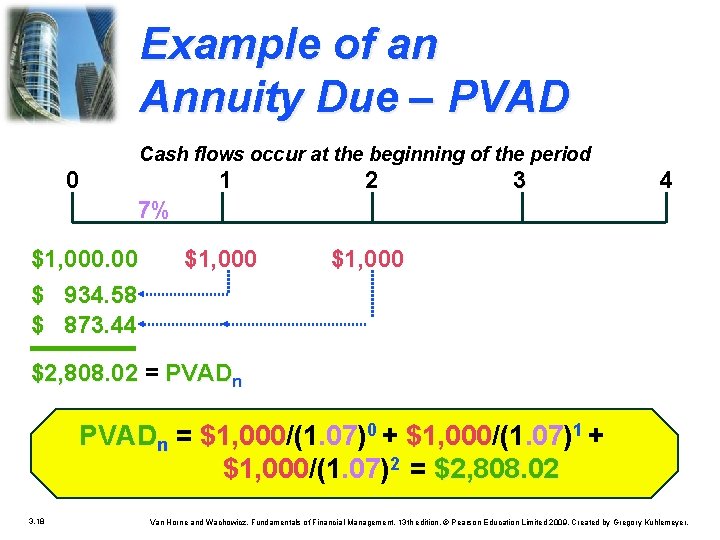
Example of an Annuity Due – PVAD Cash flows occur at the beginning of the period 0 1 2 $1, 000 3 4 7% $1, 000. 00 $ 934. 58 $ 873. 44 $2, 808. 02 = PVADn = $1, 000/(1. 07)0 + $1, 000/(1. 07)1 + $1, 000/(1. 07)2 = $2, 808. 02 3. 18 Van Horne and Wachowicz, Fundamentals of Financial Management, 13 th edition. © Pearson Education Limited 2009. Created by Gregory Kuhlemeyer.
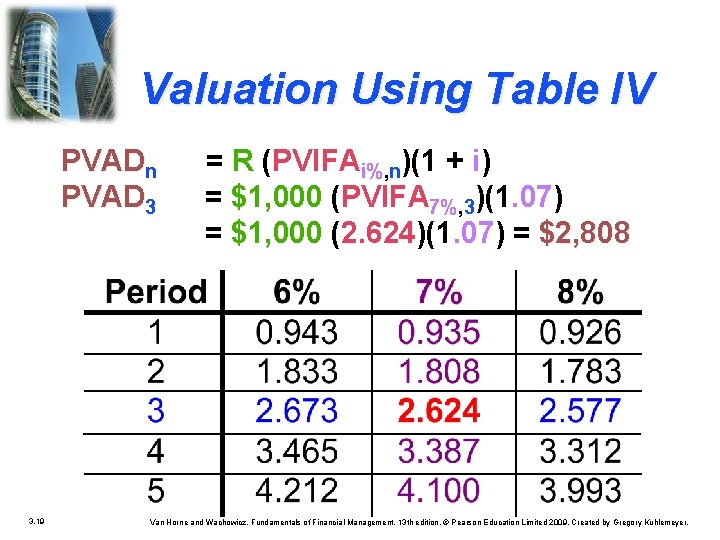
Valuation Using Table IV PVADn PVAD 3 3. 19 = R (PVIFAi%, n)(1 + i) = $1, 000 (PVIFA 7%, 3)(1. 07) = $1, 000 (2. 624)(1. 07) = $2, 808 Van Horne and Wachowicz, Fundamentals of Financial Management, 13 th edition. © Pearson Education Limited 2009. Created by Gregory Kuhlemeyer.
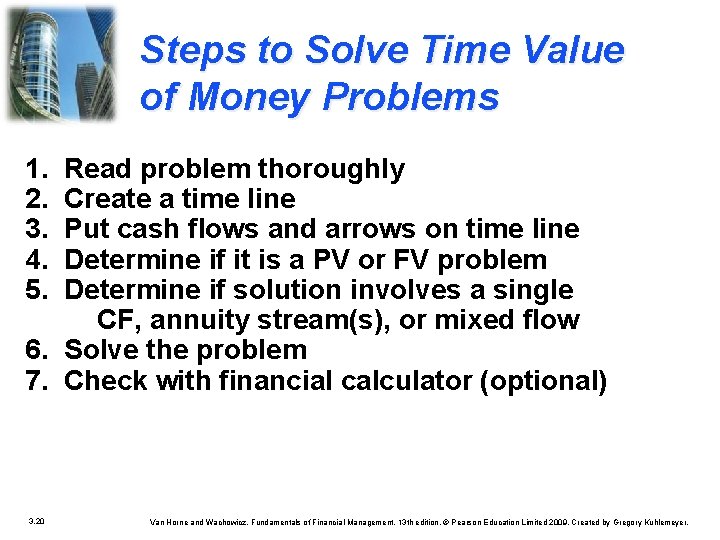
Steps to Solve Time Value of Money Problems 1. 2. 3. 4. 5. Read problem thoroughly Create a time line Put cash flows and arrows on time line Determine if it is a PV or FV problem Determine if solution involves a single CF, annuity stream(s), or mixed flow 6. Solve the problem 7. Check with financial calculator (optional) 3. 20 Van Horne and Wachowicz, Fundamentals of Financial Management, 13 th edition. © Pearson Education Limited 2009. Created by Gregory Kuhlemeyer.
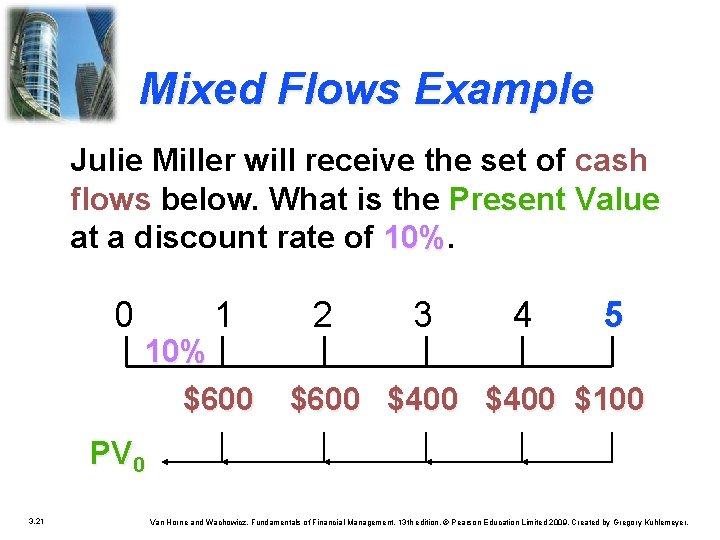
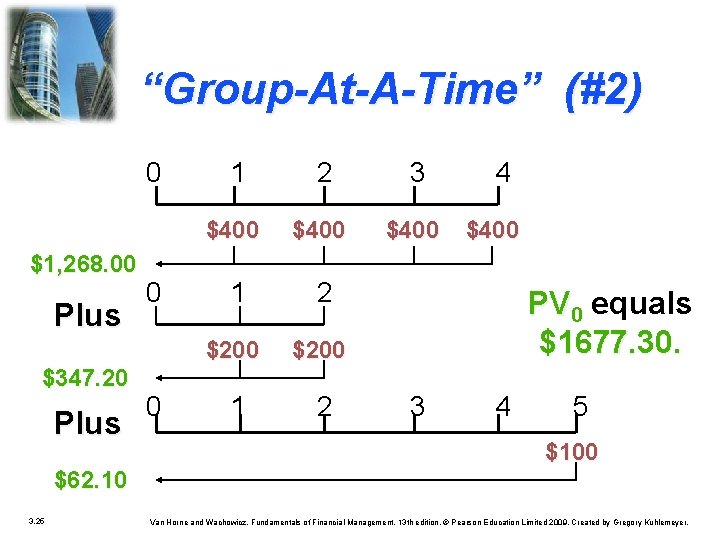
Mixed Flows Example Julie Miller will receive the set of cash flows below. What is the Present Value at a discount rate of 10% 0 1 10% $600 2 3 4 5 $600 $400 $100 PV 0 3. 21 Van Horne and Wachowicz, Fundamentals of Financial Management, 13 th edition. © Pearson Education Limited 2009. Created by Gregory Kuhlemeyer.
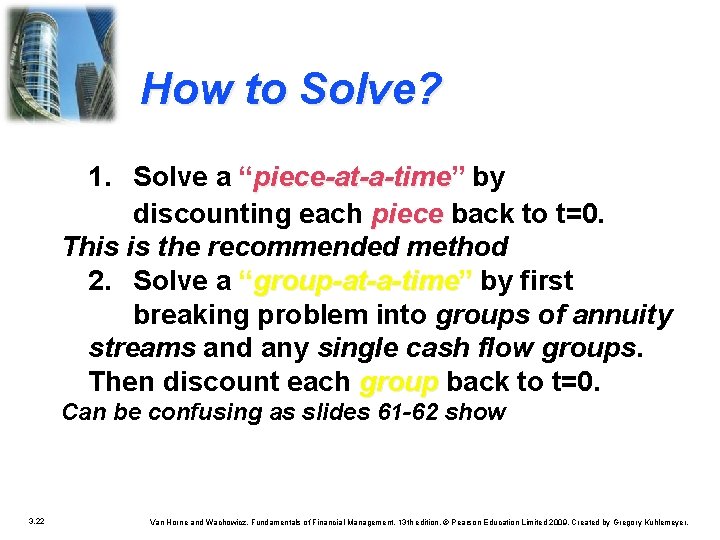
How to Solve? 1. Solve a “piece-at-a-time” piece-at-a-time by discounting each piece back to t=0. This is the recommended method 2. Solve a “group-at-a-time” group-at-a-time by first breaking problem into groups of annuity streams and any single cash flow groups. Then discount each group back to t=0. Can be confusing as slides 61 -62 show 3. 22 Van Horne and Wachowicz, Fundamentals of Financial Management, 13 th edition. © Pearson Education Limited 2009. Created by Gregory Kuhlemeyer.
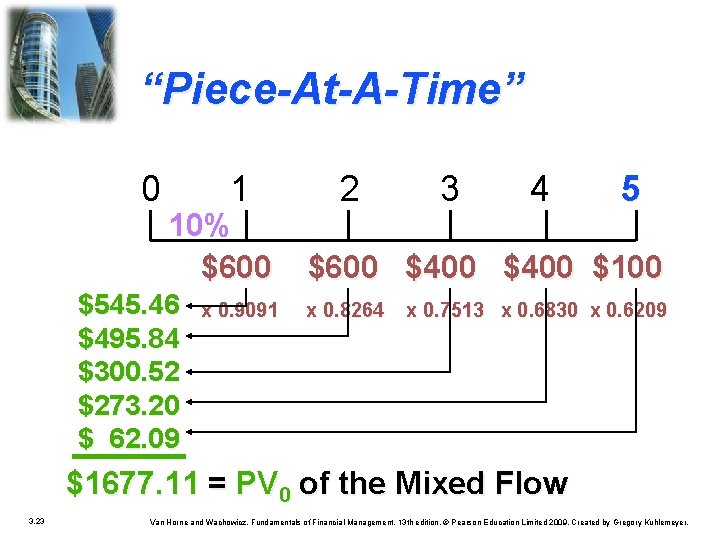
“Piece-At-A-Time” 0 1 10% $600 $545. 46 $495. 84 $300. 52 $273. 20 $ 62. 09 x 0. 9091 2 3 4 5 $600 $400 $100 x 0. 8264 x 0. 7513 x 0. 6830 x 0. 6209 $1677. 11 = PV 0 of the Mixed Flow 3. 23 Van Horne and Wachowicz, Fundamentals of Financial Management, 13 th edition. © Pearson Education Limited 2009. Created by Gregory Kuhlemeyer.
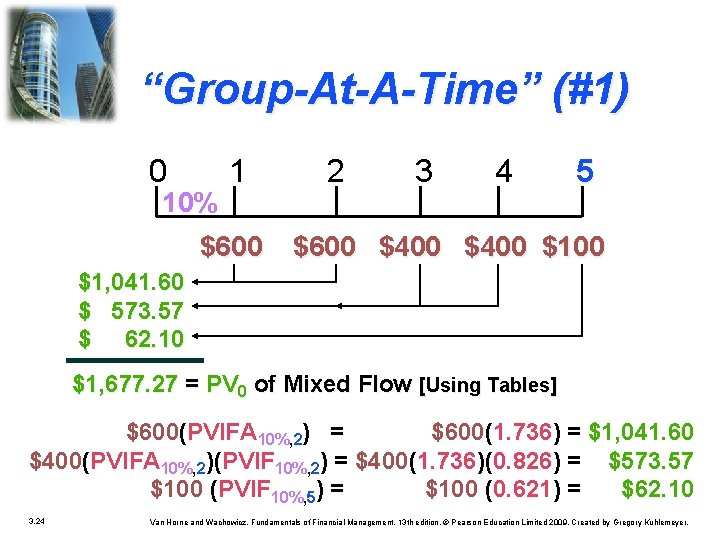
“Group-At-A-Time” (#1) 0 10% 1 $600 2 3 4 5 $600 $400 $1, 041. 60 $ 573. 57 $ 62. 10 $1, 677. 27 = PV 0 of Mixed Flow [Using Tables] $600(PVIFA 10%, 2) = $600(1. 736) = $1, 041. 60 $400(PVIFA 10%, 2)(PVIF 10%, 2) = $400(1. 736)(0. 826) = $573. 57 $100 (PVIF 10%, 5) = $100 (0. 621) = $62. 10 3. 24 Van Horne and Wachowicz, Fundamentals of Financial Management, 13 th edition. © Pearson Education Limited 2009. Created by Gregory Kuhlemeyer.
“Group-At-A-Time” (#2) 0 $1, 268. 00 Plus $347. 20 Plus $62. 10 3. 25 0 0 1 2 3 $400 1 2 $200 1 2 4 $400 PV 0 equals $1677. 30. 3 4 5 $100 Van Horne and Wachowicz, Fundamentals of Financial Management, 13 th edition. © Pearson Education Limited 2009. Created by Gregory Kuhlemeyer.
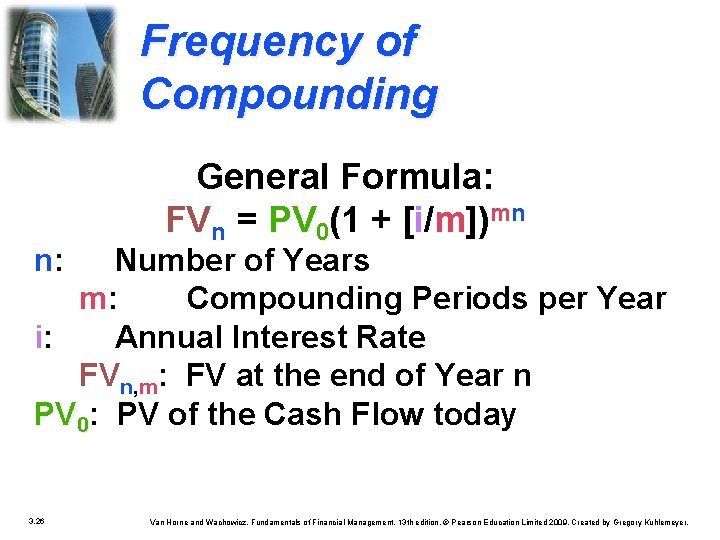
Frequency of Compounding n: General Formula: FVn = PV 0(1 + [i/m])mn Number of Years m: Compounding Periods per Year i: Annual Interest Rate FVn, m: FV at the end of Year n PV 0: PV of the Cash Flow today 3. 26 Van Horne and Wachowicz, Fundamentals of Financial Management, 13 th edition. © Pearson Education Limited 2009. Created by Gregory Kuhlemeyer.
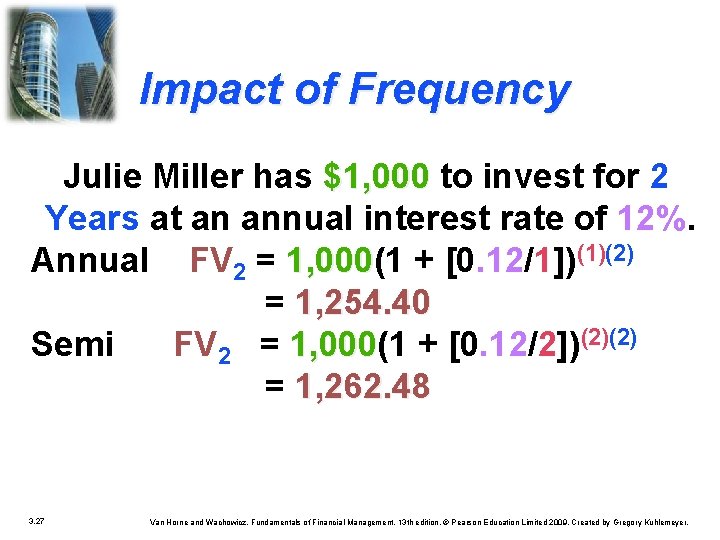
Impact of Frequency Julie Miller has $1, 000 to invest for 2 Years at an annual interest rate of 12%. Annual FV 2 = 1, 000(1 1, 000 + [0. 12/1])(1)(2) = 1, 254. 40 Semi FV 2 = 1, 000(1 1, 000 + [0. 12/2])(2)(2) = 1, 262. 48 3. 27 Van Horne and Wachowicz, Fundamentals of Financial Management, 13 th edition. © Pearson Education Limited 2009. Created by Gregory Kuhlemeyer.
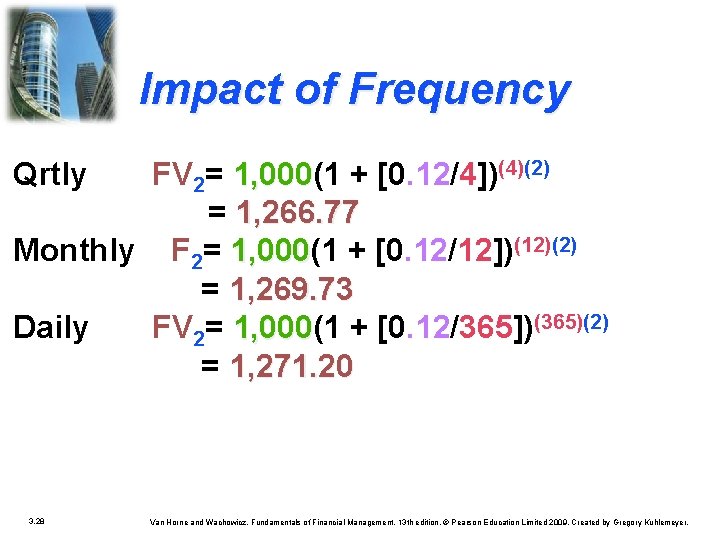
Impact of Frequency Qrtly FV 2= 1, 000(1 1, 000 + [0. 12/4])(4)(2) = 1, 266. 77 Monthly F 2= 1, 000(1 1, 000 + [0. 12/12])(12)(2) = 1, 269. 73 Daily FV 2= 1, 000(1 1, 000 + [0. 12/365])(365)(2) = 1, 271. 20 3. 28 Van Horne and Wachowicz, Fundamentals of Financial Management, 13 th edition. © Pearson Education Limited 2009. Created by Gregory Kuhlemeyer.
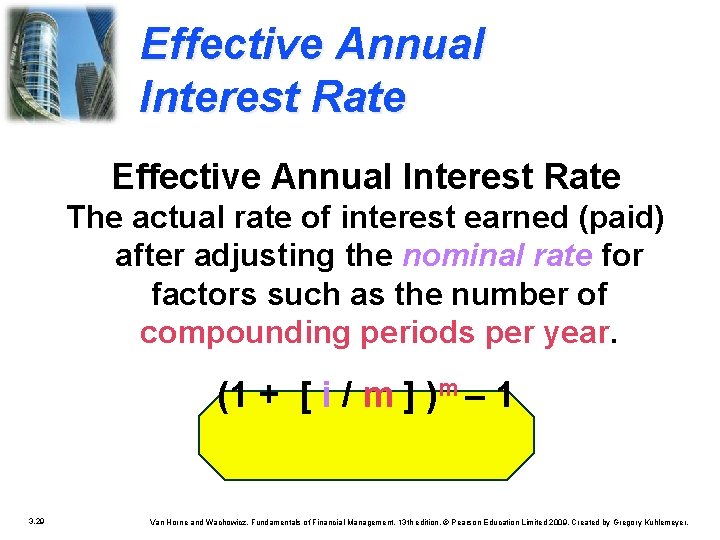
Effective Annual Interest Rate The actual rate of interest earned (paid) after adjusting the nominal rate for factors such as the number of compounding periods per year. (1 + [ i / m ] )m – 1 3. 29 Van Horne and Wachowicz, Fundamentals of Financial Management, 13 th edition. © Pearson Education Limited 2009. Created by Gregory Kuhlemeyer.
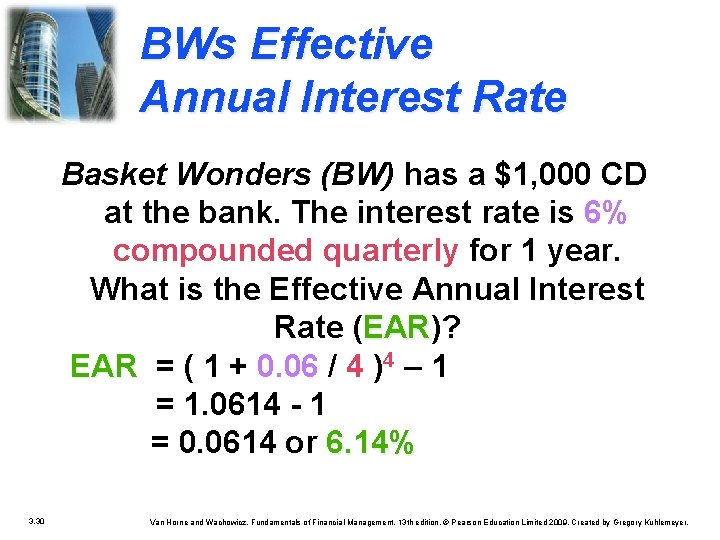
BWs Effective Annual Interest Rate Basket Wonders (BW) has a $1, 000 CD at the bank. The interest rate is 6% compounded quarterly for 1 year. What is the Effective Annual Interest Rate (EAR)? EAR = ( 1 + 0. 06 / 4 )4 – 1 = 1. 0614 - 1 = 0. 0614 or 6. 14% 3. 30 Van Horne and Wachowicz, Fundamentals of Financial Management, 13 th edition. © Pearson Education Limited 2009. Created by Gregory Kuhlemeyer.
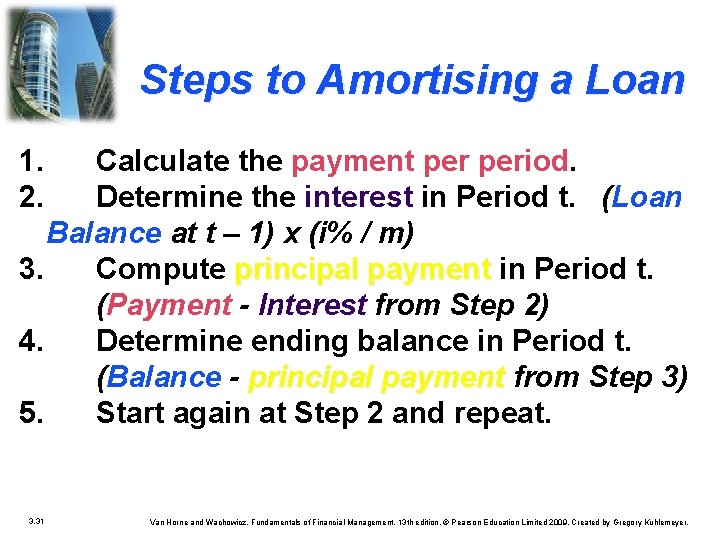
Steps to Amortising a Loan 1. 2. Calculate the payment period. Determine the interest in Period t. (Loan Balance at t – 1) x (i% / m) 3. Compute principal payment in Period t. (Payment - Interest from Step 2) 4. Determine ending balance in Period t. (Balance - principal payment from Step 3) 5. Start again at Step 2 and repeat. 3. 31 Van Horne and Wachowicz, Fundamentals of Financial Management, 13 th edition. © Pearson Education Limited 2009. Created by Gregory Kuhlemeyer.
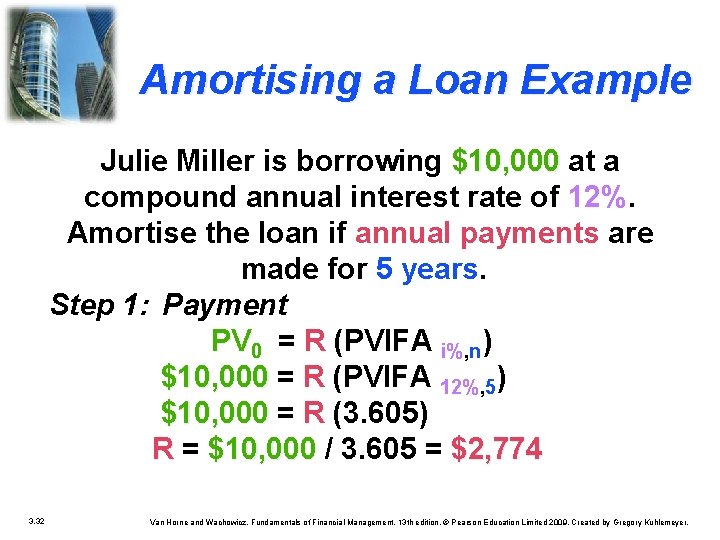
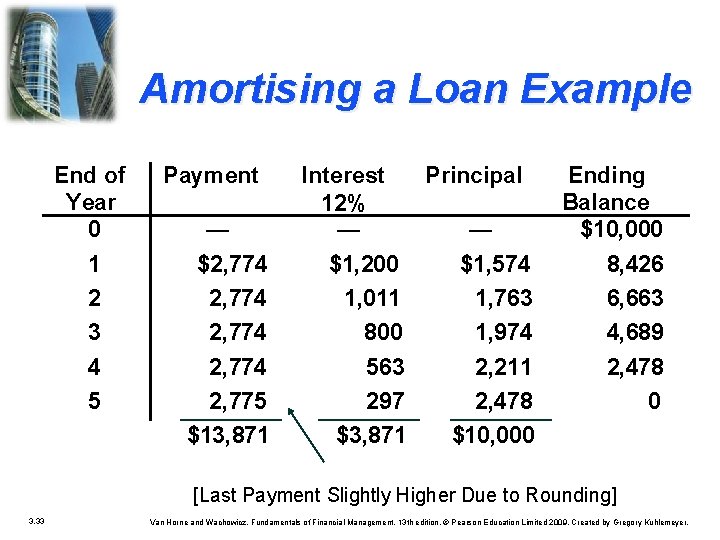
Amortising a Loan Example Julie Miller is borrowing $10, 000 at a compound annual interest rate of 12%. Amortise the loan if annual payments are made for 5 years. Step 1: Payment PV 0 = R (PVIFA i%, n) $10, 000 = R (PVIFA 12%, 5) $10, 000 = R (3. 605) R = $10, 000 / 3. 605 = $2, 774 3. 32 Van Horne and Wachowicz, Fundamentals of Financial Management, 13 th edition. © Pearson Education Limited 2009. Created by Gregory Kuhlemeyer.
Amortising a Loan Example End of Year 0 1 2 3 4 5 Payment — $2, 774 2, 775 $13, 871 Interest Principal 12% — — $1, 200 $1, 574 1, 011 1, 763 800 1, 974 563 2, 211 297 2, 478 $3, 871 $10, 000 Ending Balance $10, 000 8, 426 6, 663 4, 689 2, 478 0 [Last Payment Slightly Higher Due to Rounding] 3. 33 Van Horne and Wachowicz, Fundamentals of Financial Management, 13 th edition. © Pearson Education Limited 2009. Created by Gregory Kuhlemeyer.
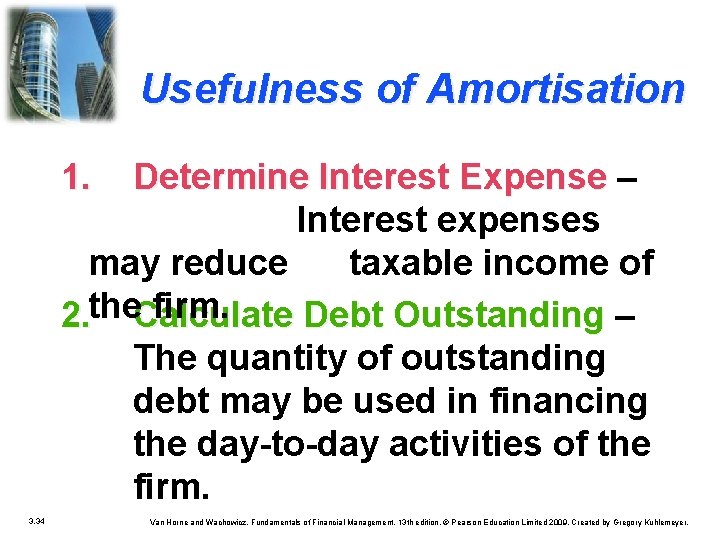
Usefulness of Amortisation 1. Determine Interest Expense – Interest expenses may reduce taxable income of firm. 2. the. Calculate Debt Outstanding – The quantity of outstanding debt may be used in financing the day-to-day activities of the firm. 3. 34 Van Horne and Wachowicz, Fundamentals of Financial Management, 13 th edition. © Pearson Education Limited 2009. Created by Gregory Kuhlemeyer.