Chapter 2 Income Sources Copyright 2007 Thomson SouthWestern
- Slides: 25
Chapter 2 Income Sources Copyright 2007 Thomson South-Western
Types of Earned Income • Wages – pay per hour. – Minimum wage – the lowest pay rate allowed by law for each hour worked. – Overtime pay – at least 1 ½ times regular pay for over 40 hours per week. • Salaries – set amount for a period of time. Workers usually do not keep time cards or count hours worked. 2 -1 Earned Income and Benefits Slide 2
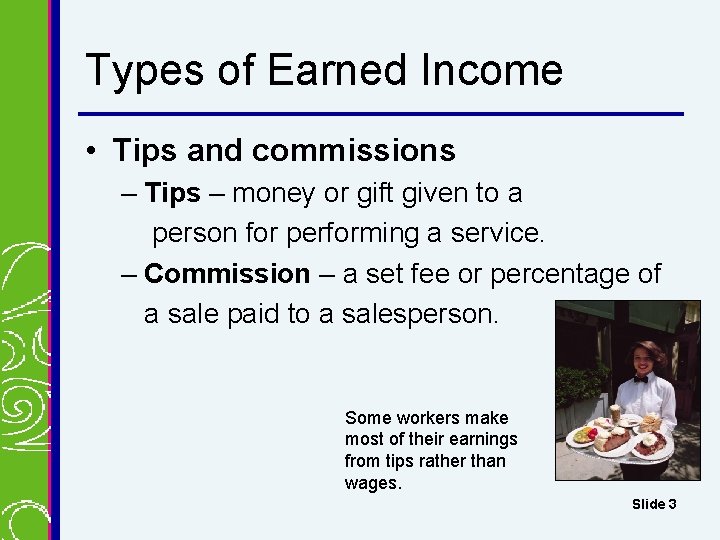
Types of Earned Income • Tips and commissions – Tips – money or gift given to a person for performing a service. – Commission – a set fee or percentage of a sale paid to a salesperson. Some workers make most of their earnings from tips rather than wages. Slide 3
Self-Employment • An entrepreneur takes the risks of being self-employed or owning a business • Advantages – You can make decisions about how to work or run the business – You can keep profits from your work or the business 2 -1 Earned Income and Benefits Slide 4
Self-Employment • Disadvantages – Involves high risk (If the business fails, the money invested in the business may be lost). – Often requires long work hours Profit is the amount left after all costs are deducted from the income of a business. Slide 5
Employee Benefits • Benefits are forms of pay other than salary or wages. (Example: paid vacation and holidays, insurance, 401 k, Stock Options). Slide 6
Employee Benefits • Disposable income is the money a person has available to spend or save after taxes have been paid. – Other benefits have the effect of increasing disposable income. Example: health insurance bought through a company plan may be cheaper than an individual policy. Slide 7
Ethics Using Sick Leave • Sick leave is a valuable benefit • Employers have rules regarding use of sick leave • Ethical behavior requires following the company’s sick leave rules 2 -1 Earned Income and Benefits Slide 8
Check In #1 1. What does the term minimum wage mean? What is the minimum wage here in Missouri? 2. What is overtime pay? How much is overtime pay compared to regular pay? 3. What are employee benefits? Give 2 examples. 4. Give 2 examples of perks that employees might want. 5. What is disposable income? Slide 9
Unearned Income • Is money received from sources other than working in a job • Is taxable • Comes from private and government sources – Examples from private sources: interest (money earned on savings) and dividends (money shared with stock-holders when a corporation makes a profit) 2 -2 Unearned Income Slide 10
Taxes • Are required payments to a government • Are collected from many sources – Examples: income taxes, use taxes, and excise taxes • Are paid on earned and unearned income 2 -2 Unearned Income Slide 11
Types of Taxes • Income taxes are paid on earned and unearned income. • Use taxes are paid by people who use certain goods or services provided by the government. (Ex. National parks or toll bridges) • Excise taxes are charged on the purchase of specific goods. (Ex. phone, cigarettes, fuel) Slide 12
Types of Taxes • Luxury tax is an excise tax on a product that is not considered essential for a normal standard of living (Ex. expensive car) Slide 13
Costs of Paying Taxes • Paying taxes reduces disposable income • Less money is left to spend or save • Lower spending may affect the economy 2 -2 Unearned Income Slide 14
Focus on. . . Social Security Benefits • Workers pay into the Social Security fund and receive a statement each year • Payments are matched by employers • The worker receives monthly benefit checks when retired 2 -2 Unearned Income Slide 15
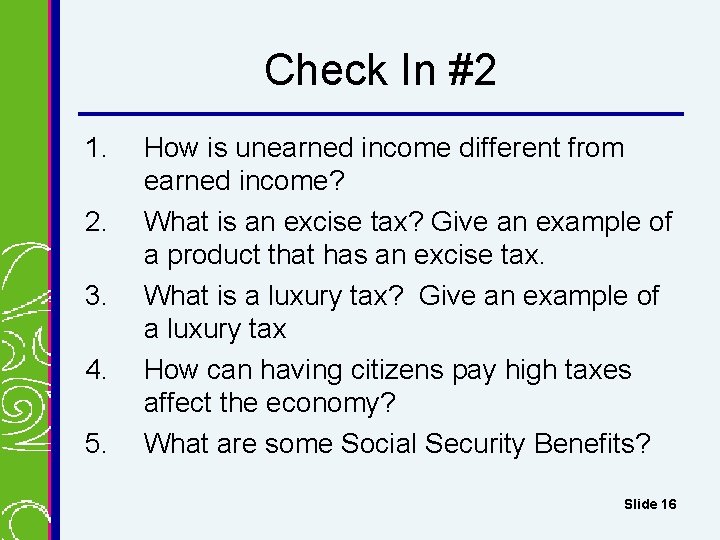
Check In #2 1. 2. 3. 4. 5. How is unearned income different from earned income? What is an excise tax? Give an example of a product that has an excise tax. What is a luxury tax? Give an example of a luxury tax How can having citizens pay high taxes affect the economy? What are some Social Security Benefits? Slide 16
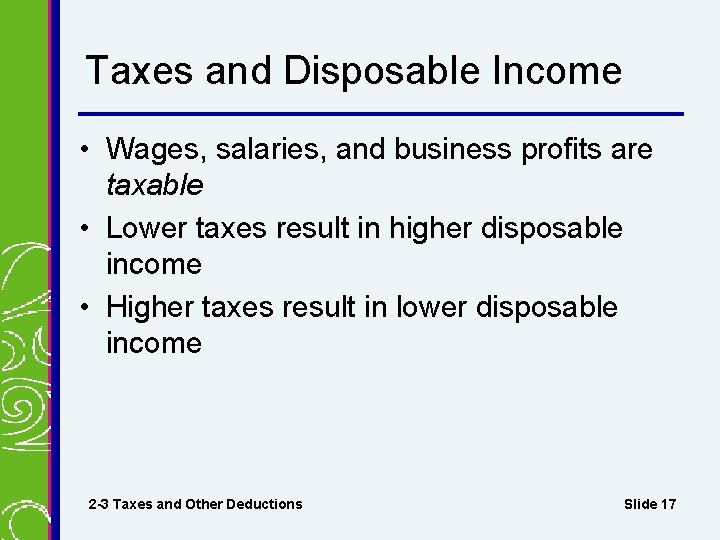
Taxes and Disposable Income • Wages, salaries, and business profits are taxable • Lower taxes result in higher disposable income • Higher taxes result in lower disposable income 2 -3 Taxes and Other Deductions Slide 17
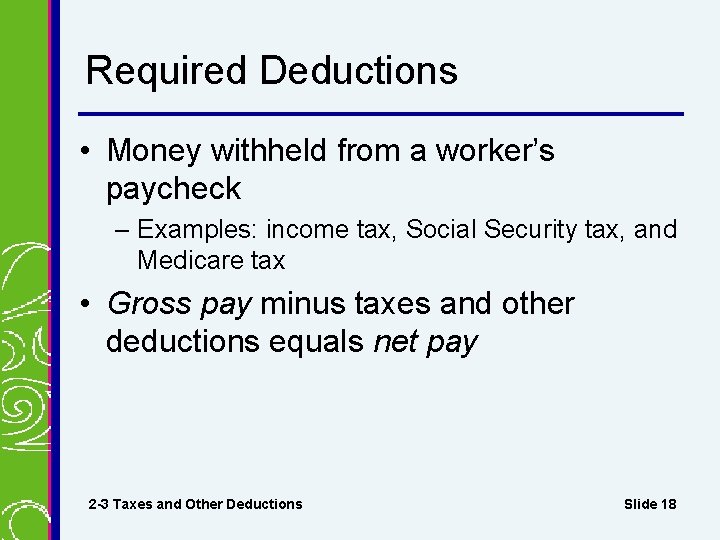
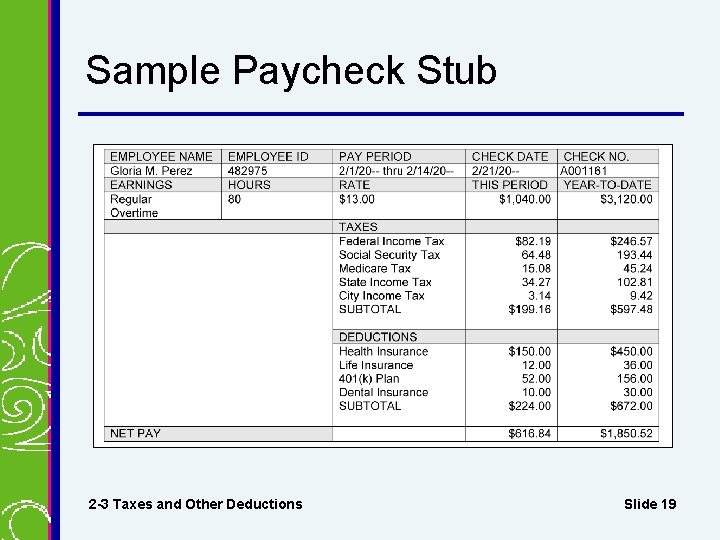
Required Deductions • Money withheld from a worker’s paycheck – Examples: income tax, Social Security tax, and Medicare tax • Gross pay minus taxes and other deductions equals net pay 2 -3 Taxes and Other Deductions Slide 18
Sample Paycheck Stub 2 -3 Taxes and Other Deductions Slide 19
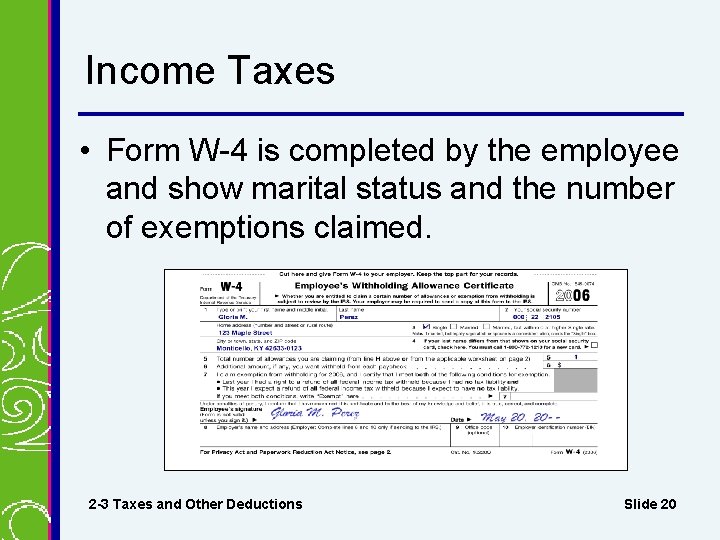
Income Taxes • Form W-4 is completed by the employee and show marital status and the number of exemptions claimed. 2 -3 Taxes and Other Deductions Slide 20
Social Security Tax • Is withheld by the federal government (Currently 6. 2% on earnings up to $110, 100) • Provides a system of old-age, survivors, and disability insurance • Requires employers to verify that workers are eligible for employment • Requires workers to complete parts of Form I-9, Employment Eligibility Verification 2 -3 Taxes and Other Deductions Slide 21
Medicare Tax • Is withheld by the federal government • Pays for medical care for retired persons and those who receive Social Security benefits • Is paid by workers and employers (Current rate is 1. 45% with no earnings limit). 2 -3 Taxes and Other Deductions Slide 22
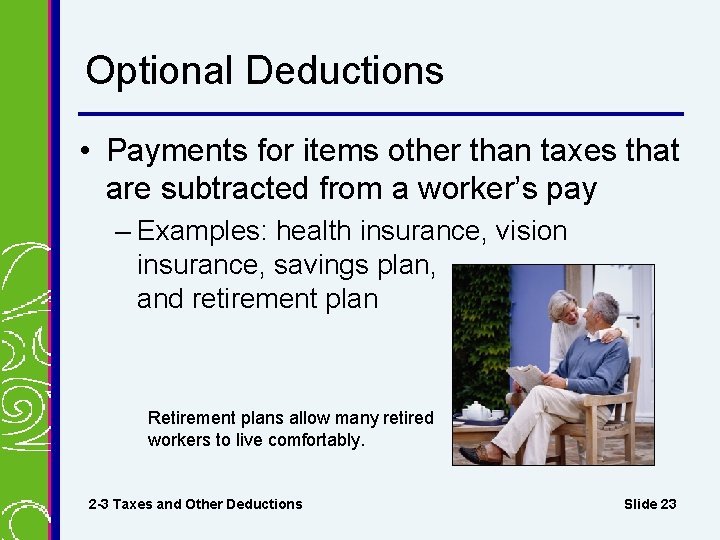
Optional Deductions • Payments for items other than taxes that are subtracted from a worker’s pay – Examples: health insurance, vision insurance, savings plan, and retirement plan Retirement plans allow many retired workers to live comfortably. 2 -3 Taxes and Other Deductions Slide 23
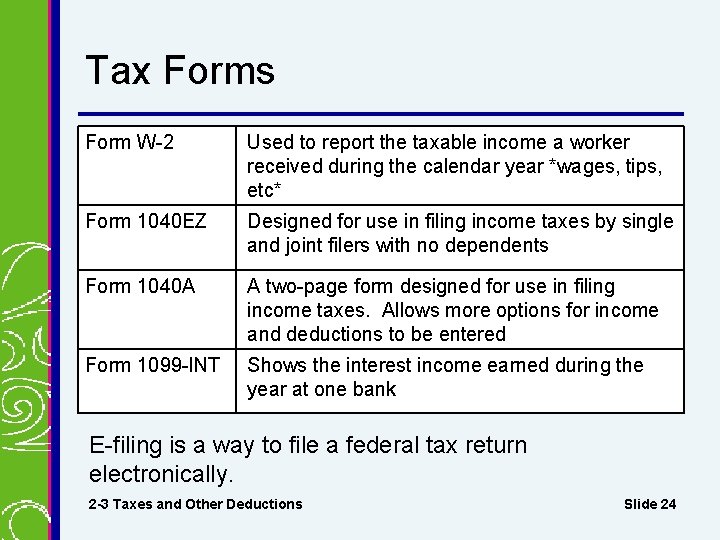
Tax Forms Form W-2 Used to report the taxable income a worker received during the calendar year *wages, tips, etc* Form 1040 EZ Designed for use in filing income taxes by single and joint filers with no dependents Form 1040 A A two-page form designed for use in filing income taxes. Allows more options for income and deductions to be entered Form 1099 -INT Shows the interest income earned during the year at one bank E-filing is a way to file a federal tax return electronically. 2 -3 Taxes and Other Deductions Slide 24
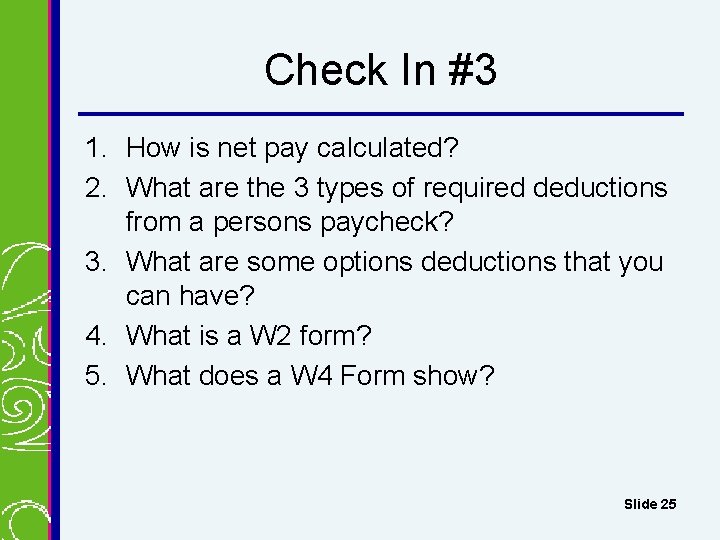
Check In #3 1. How is net pay calculated? 2. What are the 3 types of required deductions from a persons paycheck? 3. What are some options deductions that you can have? 4. What is a W 2 form? 5. What does a W 4 Form show? Slide 25