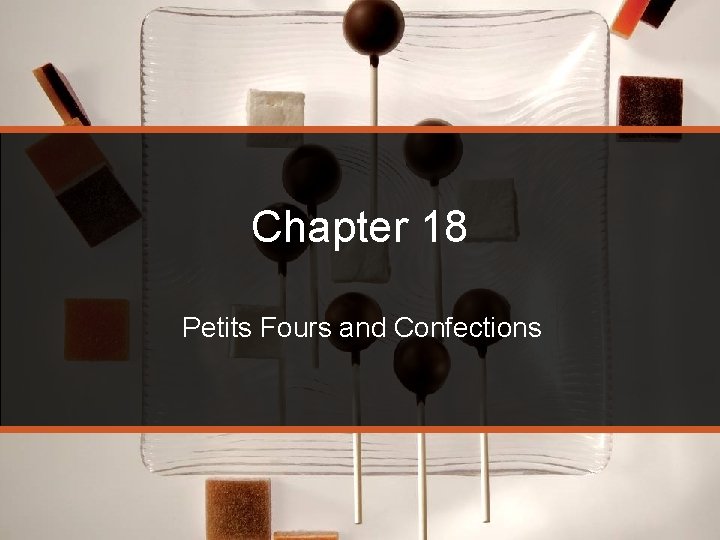
Chapter 18 Petits Fours and Confections Introduction History
- Slides: 35
Chapter 18 Petits Fours and Confections
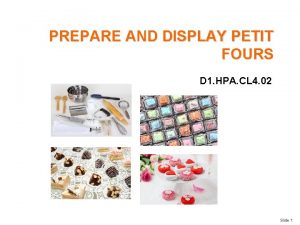
Introduction: History and Evolution of Petits Fours • Petits Fours: miniature cookies, tartlets and cakes • Refers to small size and delicacy – can be adapted from many traditional items • Traditional and contemporary • Mignardise, friandise, amuses bouche CHAPTER 18
Introduction: History and Evolution of Petits Fours • Categories of Petits Fours – Petits Fours Sec – Petits Fours Glacé – Petits Fours Frais – Petits Fours Déguisé – Petits Fours Prestige CHAPTER 18
Introduction: History and Evolution of Petits Fours • Categories of Petits Fours – Petits Fours Sec • Dry and crisp cookies that are not filled • Icebox, molded, piped or sheet cookies • Common dough: shortbread, sable Breton, puff pastry • Parisian macaroon – “curing” in refrigerator – Filled with butter cream or ganache – The color represents the flavor CHAPTER 18
Introduction: History and Evolution of Petits Fours • Categories of Petits Fours – Petits Fours Glacé • Bite-sized cakes with a thin glaze • Thin layer of marzipan on top of the cake • Delicate piping on top surface – Petits Fours Frais • Served on the day they are made • Éclairs, tartlets, Parisian macaroon with fresh fruits • Almond cakes, madelines and financiers CHAPTER 18
Introduction: History and Evolution of Petits Fours • Categories of Petits Fours – Petits Fours Déguisé • Fresh, dried or candied fruits coated in cooked sugar, fondant or chocolate • The fruits can be wrapped in marzipan • The moisture softens the sugar • Considerations for Dipping Fruits in Sugar – The fruits must be properly cleaned and completely dried – Fruits with high moisture content should be coated in marzipan CHAPTER 18
Introduction: History and Evolution of Petits Fours • Categories of Petits Fours – Petits Fours Prestige • Smaller version of contemporary entremets or other desserts • Advanced techniques CHAPTER 18
Storage and Service • Considerations depend on the individual characteristics of each item • Temperature and humidity control • Freezing of the bases and doughs CHAPTER 18
An Introduction to Sugar Confections • Chocolate confections • Flour confections • Sugar Confections in History – The method to extract sugar from sugar cane was established in India – Persians, Arabs, Spanish and countries in North Africa adapted the technique – Used as a sweet flavoring in medicine, electuaries and sold pills CHAPTER 18
An Introduction to Sugar Confections • Sugar Solutions – Lowers the ratio of water by boiling the solution – Before thermometer was invented, the degree of cooking was determined by dropping a small amount of sugar in cold water and feeling the texture CHAPTER 18
An Introduction to Sugar Confections CHAPTER • Sugar Solutions – Saturation of sugar • Solution is saturated when the maximum quantity of sugar is dissolved water • Supersaturated solutions • Agitations or foreign material (seed) can cause crystallization 18
An Introduction to Sugar Confections • Sugar Solutions – Crystallization • Crystalline and non-crystalline confections • Guideline to avoid crystallization – Avoid Impurities – Cooking Temperature – Sugar Grains – Agitation • Doctors – Glucose – Inverted sugar – Acids CHAPTER 18
An Introduction to Sugar Confections • Sugar Solutions CHAPTER 18 – Caramelization and the Maillard Reaction • Sugar caramelizes when it is heated above 320°F • Changes the sweet flavor into richer, nutty and bitter flavor • Maillard reaction occurs when protein and sugar are combined under heat • Leads many familiar flavors such as caramels, bread, coffee beans, chocolate, dark beers
Categories of Sugar Confections • Crystalline confections • Non-crystalline confections • Aerated confections • Jelly CHAPTER 18
Categories of Sugar Confections CHAPTER • Crystalline Confections – Sugar crystals are formed during the process – Based on supersaturated sugar solution – Crystal size is determined by how quickly the sugar solution was cooled down – The number of crystal depends on the level of agitation during the cooling process 18
Categories of Sugar Confections • Crystalline Confections – Fondant • Pastry fondant – Used as a glaze – Less viscous, more fluid • Confectionary fondant – The crystals are finer and viscosity is greater – The sugar syrup cooked to higher temperature – Able to take up additional flavorings and oils – Can be poured into starch molds to set until firm CHAPTER 18
Categories of Sugar Confections • Crystalline Confections – Fondant • Technique for Fondant – Combine the ingredients and cook to the required temperature – Stir in salt at the end of cooking process – Cool the mixture on a granite slab to 122°F – Place the seed on top of the syrup if using – Agitate to a desired level – Keep in an airtight container and allow to mature overnight CHAPTER 18
Categories of Sugar Confections • Crystalline Confections – Fondant • Starch Molds for Fondant Fillings – Used to form a fine crust on soft fondant – The fondant is melted to 150°F and liqueur or flavoring is added – The mixture is deposited into the starch molds and allowed to set – Technique for fondant CHAPTER 18
Categories of Sugar Confections • Crystalline Confections CHAPTER 18 – Fudge • Based on the formulation of fondant with additional ingredients, such as dairy products, fat, nuts and chocolate • The additional ingredients affect on stability by altering the texture, appearance and shelf life • The fudge should be enrobed or wrapped immediately after cutting – Technique for fudge
Categories of Sugar Confections • Crystalline Confections – Liqueur Cordials • A fine crystalline shell surrounds liqueur-flavored supersaturated sugar solution • Can be molded in chocolate • Alcohol content of the liqueur affects on the rate of crystallization • Technique for Liqueur Cordial CHAPTER 18
Categories of Sugar Confections • Crystalline Confections CHAPTER 18 – Dragees • Roasted nuts that are coated in sugar and then coated again in a smooth sugar or chocolate coating • Cook in a round-bottomed copper pot • Technique for Dragee – Panning • The process for coating confectionary centers (i. e. nuts) • Soft sugar panning, hard sugar panning, chocolate panning
Categories of Sugar Confections • Non-Crystalline Confections – No crystal formation during the cooing process – Dairy products are common ingredients which triggers the Maillard reaction – Tips to prevent the crystallization CHAPTER 18
Categories of Sugar Confections • Non-Crystalline Confections CHAPTER 18 – Hard Candies • Minimal water content in the final product creates the texture • Glucose is added to prevent crystallization and to make the sugar moldable • Acids prevent crystallization but also retracts moisture • Pulled sugar technique • Hard candy technique
Categories of Sugar Confections • Non-Crystalline Confections CHAPTER 18 – Brittles • Crunchy sugar confection with added nuts or seeds • The sugar is cooked to a high temperature to evaporate the maximum amount of liquid, caramelized flavor and color • Baking soda lightens the texture • Brittle process
Categories of Sugar Confections • Non-Crystalline Confections CHAPTER 18 – Caramel and Toffee • The difference is the moisture content at the end of the cooking process • The texture of caramel ranges from soft to hard • Toffee is usually hard and crunchy • Common dairy ingredients: cream, milk, evaporated milk or condensed milk • Process for caramel and toffee
Categories of Sugar Confections • Aerated Confections – Consist of a stable foam – Marshmallow and nougat – Added gelling agents – Ingredients responsible for stabilizing the structure • Cooking of egg whites while whipping • Gelatin whipped with sugar CHAPTER 18
Categories of Sugar Confections • Aerated Confections – Marshmallows • Derived from Egypt, originally used for medical purposes • Marshmallows made with or without egg whites • Egg whites and gelatin stabilizes the light structure • Process for Marshmallow with Egg Whites and Gelatin • Process for Marshmallow with Gelatin CHAPTER 18
Categories of Sugar Confections • Aerated Confections – Nougat • A dense aerated confection with various textures • The temperature controls the texture of the final product • Nougat de Montelimar • A caution on the temperature of additional ingredients • Process for Nougat CHAPTER 18
Categories of Sugar Confections • Jellies – Many varieties are commercially available – Consist of a supersaturated sugar solution, flavorings and binding agents – Gelatin, pectin, agar and starch CHAPTER 18
Categories of Sugar Confections CHAPTER 18 • Jellies – Jellification Ingredient Technology • A supersaturated sugar solution in the formula provides the sweetness, texture and shelf life • The amount of moisture in the mixture determines the softness • Flavorings – Range from natural fruit juices or puree to acidic powders – Acid may be needed for a proper jellification in pectin-based jellies
Categories of Sugar Confections CHAPTER 18 • Jellies – Jellification Ingredient Technology • Binding Agents – Gelatin » Most common gelling agent in confection industry » Thermo-reversible » 4. 5 -7. 5% of the total weight of the candy » Protein in gelatin denatures above 176°F/80°C » Acid and certain natural enzymes in some fruits can denature protein
Categories of Sugar Confections CHAPTER 18 • Jellies – Jellification Ingredient Technology • Binding Agents – Agar Powder » Substituted with gelatin when animal product can not be used » Extracted from seaweed and red algae » Thermo-reversible » Only 0. 5 -1. 5% of the total weight of the candy » Short and rubbery texture » Hysteresis
Categories of Sugar Confections CHAPTER 18 • Jellies – Jellification Ingredient Technology • Binding Agents – Pectin » Yellow Pectin (apple pectin) » Pectin NH » Medium Rapid Set Pectin » Heat triggers the jellification properties » Solid content » Acid level
Binding Agents: Pectin CHAPTER 18 • Jellies – Jellification Ingredient Technology • Pates de Fruits – Fruit juice or puree, sugar, glucose, yellow pectin and an acid – Slightly firm in texture but still tender – The color range from opaque to translucent – The concentration of sugar solution affects on the texture – The process must be closely followed to yield the desired property of the candy – Pates de Fruits Method
Conclusion • Petit fours items can include a miniature version of the items already offered CHAPTER 18 • More labor cost but less ingredient cost • Maintain a balance of products for presentation and display