Chapter 13 Family Life What is a Family

- Slides: 29
Chapter 13 Family Life
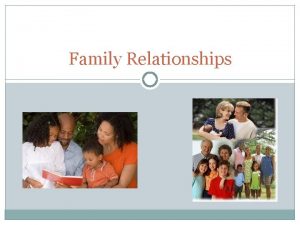
What is a Family? ¡ ¡ ¡ Family – social institution that unites individuals in cooperative groups that care for members, regulate sexual relations, and oversee the bearing and raising of children Nuclear Family- one or two parents and their children Extended Family- parents and children, plus grandparents, aunts, uncles, and cousins, who often live close to one another and operate as a family unit
What is a Family? ¡ Marriage- a lawful relationship-expected to be lasting-involving economic cooperation, sexual activity, usually childbearing ¡ Most societies link marriage with children
Debate over Definitions ¡ ¡ ¡ A lot of variability in the definition and meaning of a family Traditional view- married couple and their children Families of affinity- people with or without legal or blood ties, who feel that they belong together and wish to define themselves as a family
Living Together: Do we Need to Marry? Cohabitation ¡ The sharing of a household by an unmarried couple ¡ From 500, 000 in 1970 to over five million today ¡ 600, 000 same sex couples ¡ Five million heterosexual couples
Living Together: Do we Need to Marry? ¡ ¡ Critics of cohabitation ¡ Marriage provides more stability ¡ Puts woman and children at risk ¡ Discourages marriage Supporters of cohabitation ¡ Living together a private matter ¡ Meets the needs of a diverse society
Postponing Marriage Delaying marriage is a function of ¡ Changing definition of marriage ¡ Cohabitation ¡ Spending more time in education ¡ Economic factors ¡ Birth control
Parenting: Is One Enough? ¡ ¡ ¡ In 2005, one in three families with children under the age of eighteen had just one parent in the household Not all children are affected the same Children with one parent are often disadvantaged ¡ Economically ¡ Socially and emotionally
Families, Race and Poverty ¡ ¡ ¡ Single parent households cut across racial boundaries Reasons behind single parent households ¡ Divorce ¡ Death of a parent ¡ Out of wedlock births Rate of single parent households are higher among African-Americans
Families, Race and Poverty The Moynihan Report (1965) ¡ African American families were in a state of crisis because of the number of children growing up without the presence of a father ¡ Single mothers struggling against the tide of poverty while raising children Today among some the view is: ¡ African-American families often not as much a family problem as an economic problem.
African American Families: A Closer Look q ¡ ¡ ¡ Five stereotypes of African-American families 1. African Americans do not form strong families 2. African American men do not make good husbands or fathers 3. The African American family is a matriarchy 4. African American women have children for more welfare money 5. African Americans have the same opportunities as everyone else
Parenting: Race and Poverty Strengths of African American Families ¡ ¡ Strong Kinship Bonds Traditional Religious Beliefs Resources of Grandparents Networks of Mutual Assistance
Conflict Between Work and Family Life ¡ ¡ ¡ Industrial Revolution and the shift of work from family to factory Shuffling between work roles and family roles Informational technology and the shift of work back into the home
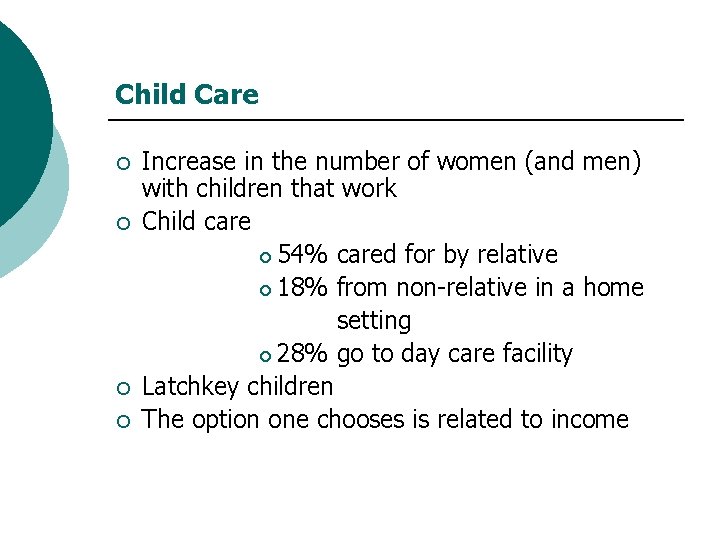
Child Care ¡ ¡ Increase in the number of women (and men) with children that work Child care ¡ 54% cared for by relative ¡ 18% from non-relative in a home setting ¡ 28% go to day care facility Latchkey children The option one chooses is related to income
Divorce ¡ The rate of divorce increased throughout the twentieth century and has now leveled off No-Fault Divorce ¡ Divorce based on irreconcilable differences ¡ Made divorces easier to obtain ¡ Reduced the cases of alimony ¡ Effects family (women’s) income ¡ More so for women because of less cultural capital
Too Much Divorce? ¡ ¡ ¡ Conservatives are more critical of the high rate of divorce than liberals ¡ Divorce suggests a “me” first attitude Liberals see divorce as away out of troubled marriages ¡ Abusive marriages The emergence of covenant marriage laws ¡ An attempt to discourage divorce
Child Support ¡ ¡ ¡ The problem of nonsupport after separation or divorce Not all children are awarded support by the courts ¡ Courts award support to 59% of children Fifty five percent of children receive only partial payment or no payment
Child Support ¡ ¡ In comparing only non custodial parents, women are less likely to make support ¡ Function that women have less income than men In 1998 congress passed the Deadbeat Parents Punishment Act ¡ Felony to refuse to provide support payments to a child living in another state
Remarriage: Problems of Blended Families ¡ ¡ ¡ Blended families-families in which children live with some combination of biological parents and stepparents Blended families offer the advantage of higher income Blended family problems ¡ Children learn a new social environment ¡ Parenting and sibling relationships ¡ Managing relationship with exspouse
Gay and Lesbian Families ¡ ¡ Gay couples face legal obstacles to marriage and marital rights Some states have passed domestic partnership laws conferring some legal rights on gay couples “Full Faith and Credit” clause of the U. S. Constitution and gay marriages ¡ One state=all states Congress passed the Defense of Marriage Act (1996) ¡ One man one woman
What about Gay Parenting? ¡ ¡ About 250, 000 gay couples in the United States are raising children Public opinion is divided on gays raising children Research shows gay and lesbian parents are just as effective at parenting as heterosexual couples Stigma and problems of gay couples
Brave New Families: High-Tech Reproduction In Vitro Fertilization-uniting eggs and sperm in a laboratory ¡ Expensive and beyond the cost of many infertile couples ¡ Ethical and moral questions
Brave New Families: High-Tech Reproduction Surrogate Motherhood ¡ an arrangement by which one woman carries and bears a child for another ¡ Question about class exploitation ¡ Legal questions over child support ¡ Moral and ethical issues
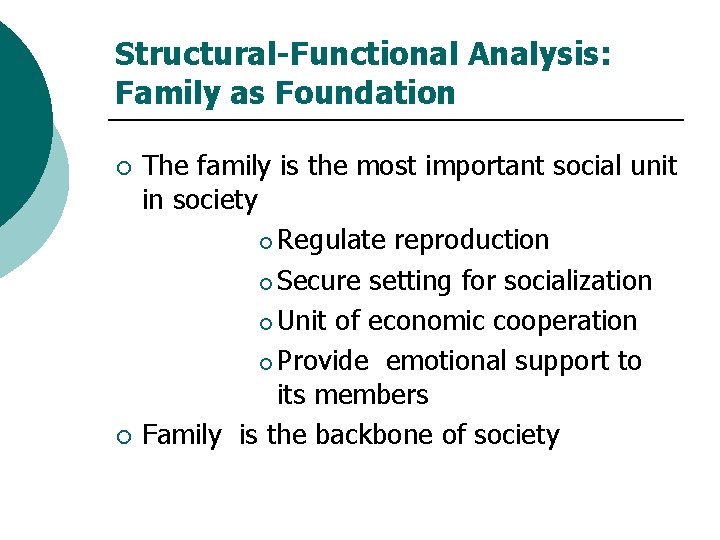
Structural-Functional Analysis: Family as Foundation ¡ ¡ The family is the most important social unit in society ¡ Regulate reproduction ¡ Secure setting for socialization ¡ Unit of economic cooperation ¡ Provide emotional support to its members Family is the backbone of society
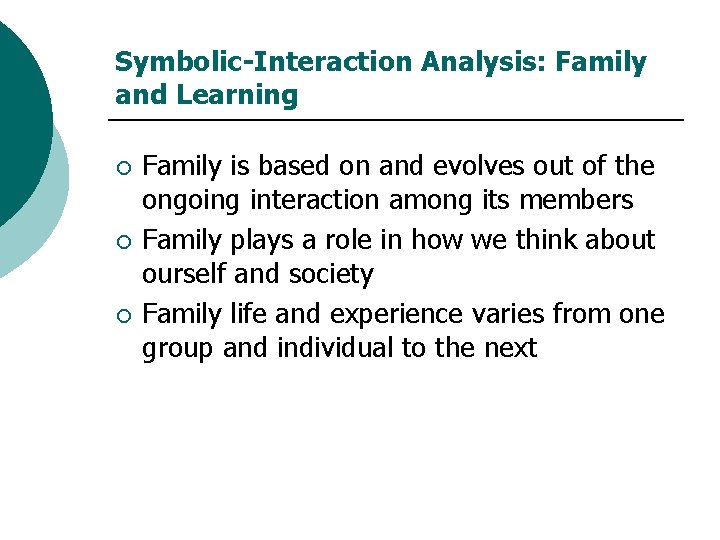
Symbolic-Interaction Analysis: Family and Learning ¡ ¡ ¡ Family is based on and evolves out of the ongoing interaction among its members Family plays a role in how we think about ourself and society Family life and experience varies from one group and individual to the next
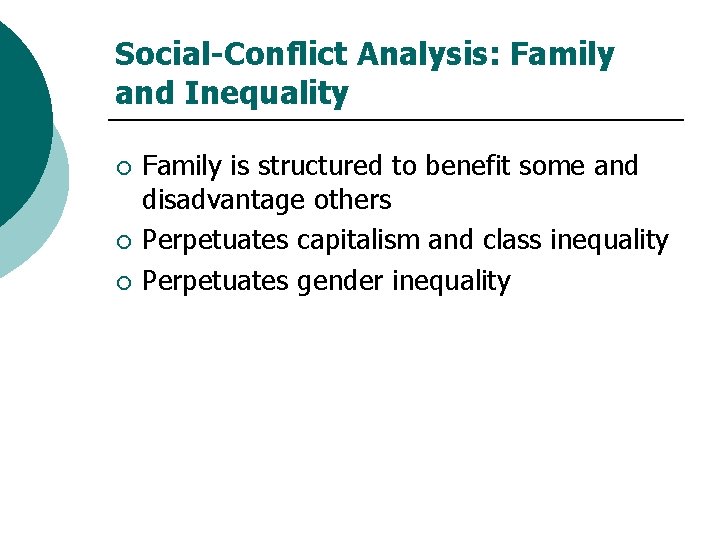
Social-Conflict Analysis: Family and Inequality ¡ ¡ ¡ Family is structured to benefit some and disadvantage others Perpetuates capitalism and class inequality Perpetuates gender inequality
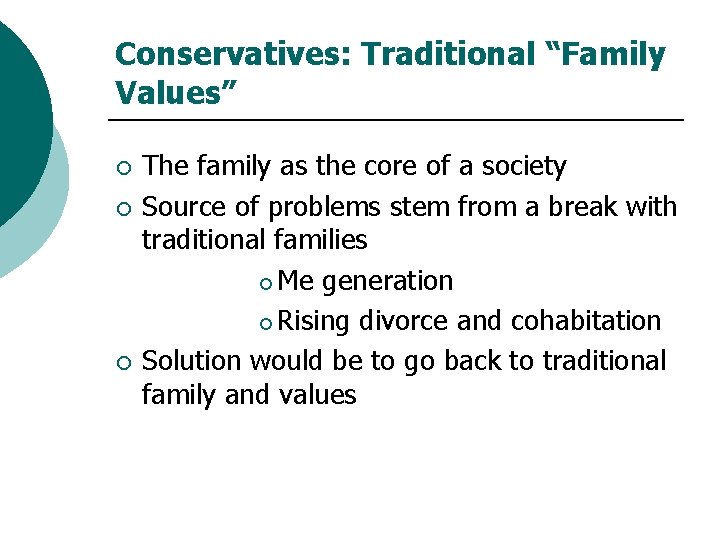
Conservatives: Traditional “Family Values” ¡ ¡ ¡ The family as the core of a society Source of problems stem from a break with traditional families ¡ Me generation ¡ Rising divorce and cohabitation Solution would be to go back to traditional family and values
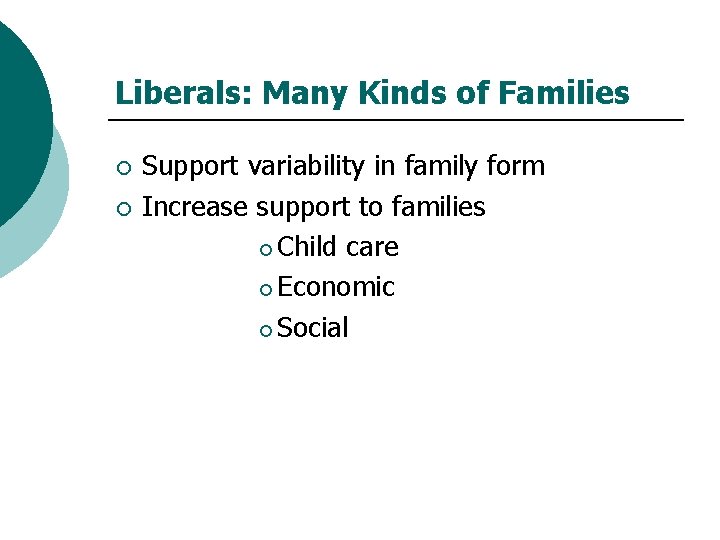
Liberals: Many Kinds of Families ¡ ¡ Support variability in family form Increase support to families ¡ Child care ¡ Economic ¡ Social
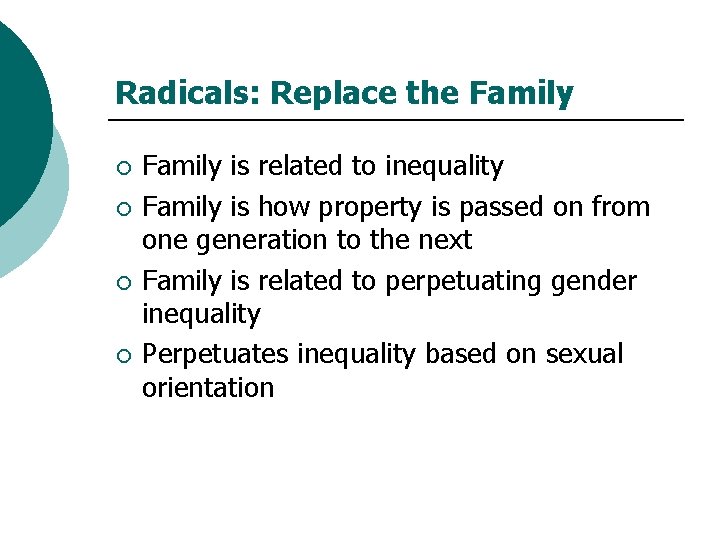
Radicals: Replace the Family ¡ ¡ Family is related to inequality Family is how property is passed on from one generation to the next Family is related to perpetuating gender inequality Perpetuates inequality based on sexual orientation