
Family Life part 1 Family vocabulary and future

Family Life - part 1 Family vocabulary and future forms Adapted from English File Intermediate 3 rd Edition, Christina Latham-Koenig and Clive Oxenden, Oxford University Press
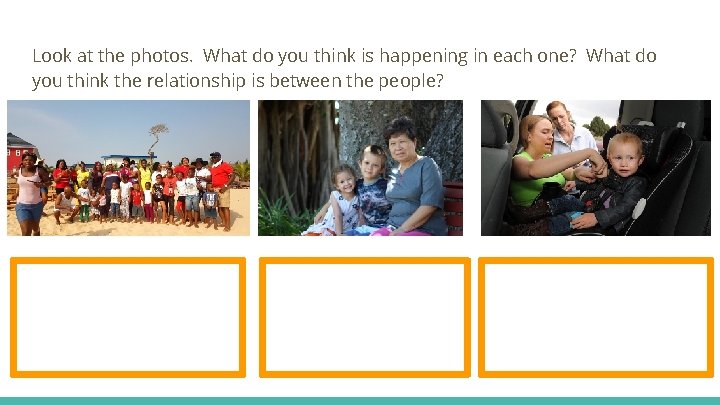
Look at the photos. What do you think is happening in each one? What do you think the relationship is between the people?
Write the difference between each pair. The first one has been done for you. 1. father / parent 2. mother / stepmother 3. brother / brother-in-law 4. grandfather/ great-grandfather 5. nephew / niece 6. child / only child 7. immediate family/ extended family 1. A father is the male parent of a child, a parent is a person’s mother or father. 2. __________________________________________________ 3. _________________________ 4. __________________________________________________ 5. __________________________________________________ 6. __________________________________________________ 7. __________________________________________________

The answers. . . 1. A father is the male parent of a child, a parent is a person’s mother or father. 2. Your stepmother is the woman who is married to your father, but she isn’t your real mother. 3. Your brother-in-law is the brother of your husband / wife, or your sister’s husband. 4. Your grandfather is the father of your mother or father. Your greatgrandfather is the grandfather of your mother or father. 5. A nephew is the son of your brother or sister. A niece is the daughter of your brother of sister. 6. A child is a young human who is not yet and adult and an only child is a child that has no brothers or sisters. 7. Your immediate family are your parents, children, brothers and sisters. Your extended family are your immediate family and your uncles, aunts
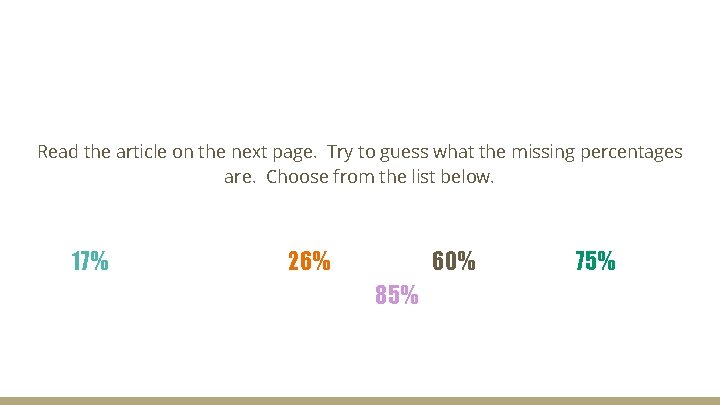
Read the article on the next page. Try to guess what the missing percentages are. Choose from the list below. 17% 26% 60% 85% 75%
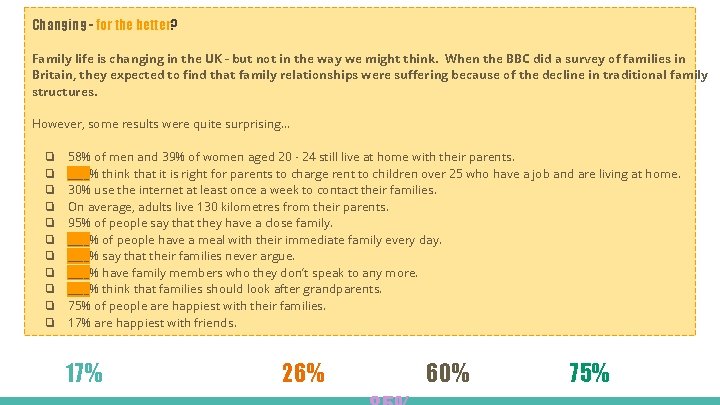
Changing - for the better? Family life is changing in the UK - but not in the way we might think. When the BBC did a survey of families in Britain, they expected to find that family relationships were suffering because of the decline in traditional family structures. However, some results were quite surprising… ❏ ❏ ❏ 58% of men and 39% of women aged 20 - 24 still live at home with their parents. ____% think that it is right for parents to charge rent to children over 25 who have a job and are living at home. 30% use the internet at least once a week to contact their families. On average, adults live 130 kilometres from their parents. 95% of people say that they have a close family. ____% of people have a meal with their immediate family every day. ____% say that their families never argue. ____% have family members who they don’t speak to any more. ____% think that families should look after grandparents. 75% of people are happiest with their families. 17% are happiest with friends. 17% 26% 60% 75%
The answers. . . Click here and listen to find out if you were right: Do any of the statistics (numbers) surprise you? Which ones? _________________________________________________________________________________ Which ones do you think would be very different if the survey was carried out in the country or countries your family comes from? _________________________________________________________________________________
Giving your opinion We often use should + verb to say what we think is the right thing or a good thing to do. For example: ‘I think families should have dinner together every day because…. ’ ‘I don’t think parents should be friends with their children on Facebook because…’
Giving your opinion Read the statements below. Do you agree or disagree? Write what you think next to each one. 1. Families should have a meal together every day. 2. Children should leave home as soon as they can afford to. 3. Parents should charge their children rent if they live at home and have a job. 4. Parents should be ‘friends’ with their children on Facebook. 5. Elderly parents should live with their children when they are too old to live alone. 1. 2. 3. 4. 5. .
- Slides: 9