
Part Two Buyer Behavior and Target Market Selection

Part Two Buyer Behavior and Target Market Selection 7 Target Markets: Segmentation and Evaluation Copyright © Houghton Mifflin Company. All rights reserved. Power. Point Presentation by Charlie Cook
Chapter Learning Objectives • To learn what a market is • To understand the differences among general targeting strategies • To become familiar with the major segmentation variables • To know what segment profiles are and how they are used • To understand how to evaluate market segments • To identify the factors that influence the selection of specific market segments for use as target markets • To become familiar with sales forecasting methods Copyright © Houghton Mifflin Company. All rights reserved. 2
Chapter Outline • What Are Markets? • Target Market Selection Process – Step 1: Identify the Appropriate Targeting Strategy – Step 2: Determine Which Segmentation Variables to Use – Step 3: Develop Market Segment Profiles – Step 4: Evaluate Relevant Market Segments – Step 5: Select Specific Target Markets • Developing Sales Forecasts Copyright © Houghton Mifflin Company. All rights reserved. 3
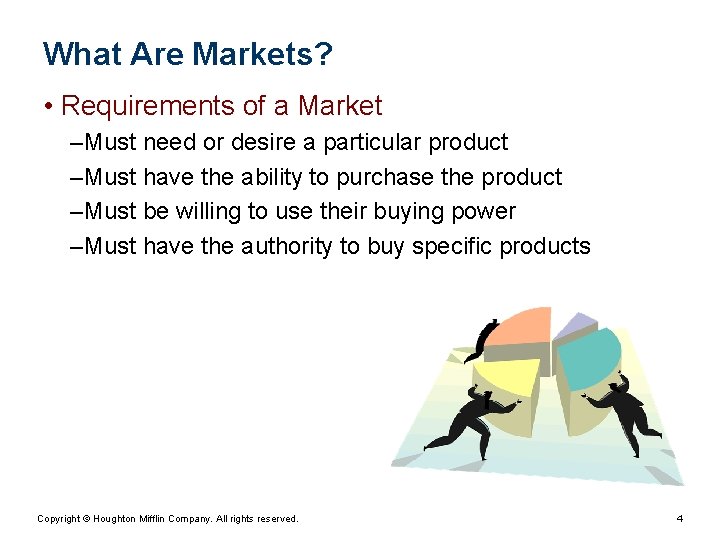
What Are Markets? • Requirements of a Market – Must need or desire a particular product – Must have the ability to purchase the product – Must be willing to use their buying power – Must have the authority to buy specific products Copyright © Houghton Mifflin Company. All rights reserved. 4
What Are Markets? (cont’d) • Types of Markets – Consumer markets • Purchasers and individuals in households • Purchases are for personal consumption, not profit – Business markets • Individuals and groups that purchase products for resale, direct use to produce other products, or use in daily business operations • Purchasers classed as producers, resellers, government, and institutional markets Copyright © Houghton Mifflin Company. All rights reserved. 5
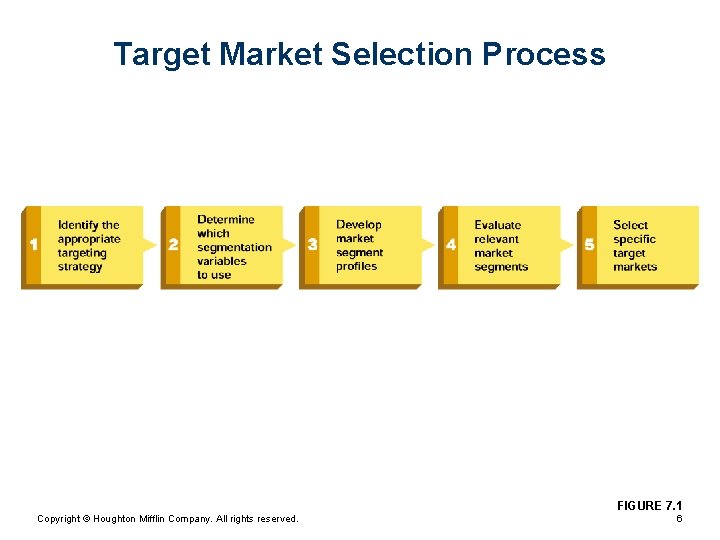
Target Market Selection Process FIGURE 7. 1 Copyright © Houghton Mifflin Company. All rights reserved. 6
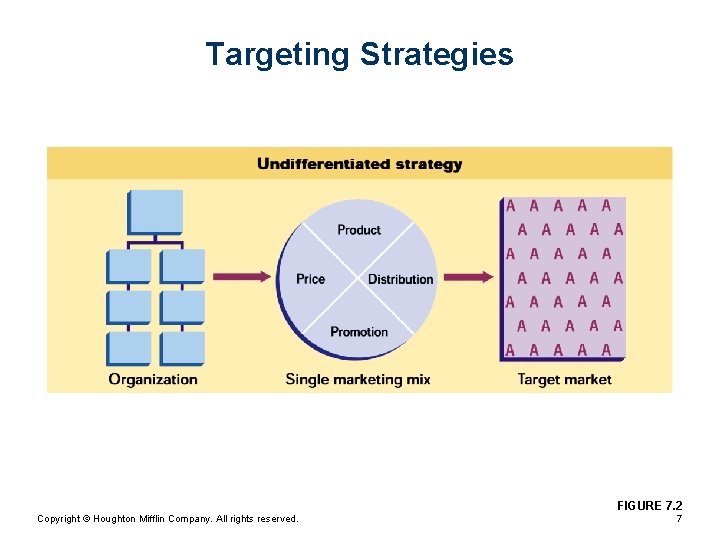
Targeting Strategies FIGURE 7. 2 Copyright © Houghton Mifflin Company. All rights reserved. 7
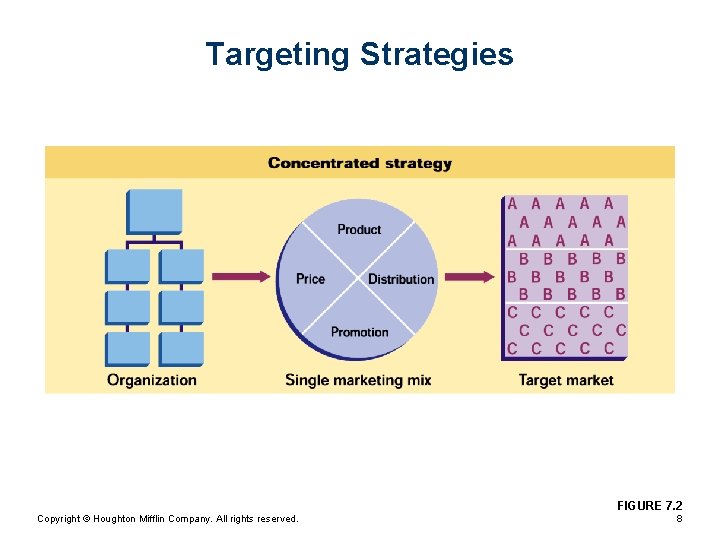
Targeting Strategies FIGURE 7. 2 Copyright © Houghton Mifflin Company. All rights reserved. 8
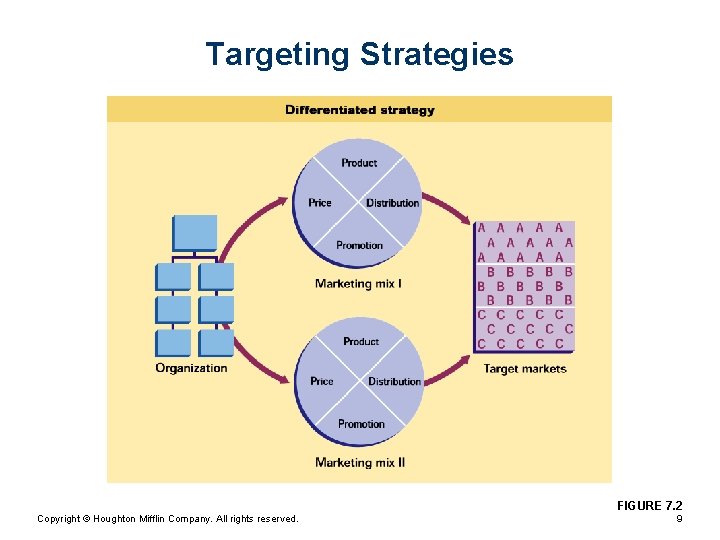
Targeting Strategies FIGURE 7. 2 Copyright © Houghton Mifflin Company. All rights reserved. 9
Step 1: Identify the Appropriate Targeting Strategy • Undifferentiated Strategy – Defining an entire market for a particular product as the target market (homogeneous market) – Designing a single market mix for, and directing it at the total market Copyright © Houghton Mifflin Company. All rights reserved. 10

Step 1: Identify the Appropriate Targeting Strategy (cont’d) • Concentrated Strategy Through Market Segmentation – Segmenting (dividing) the total market into groups with similar product needs (heterogeneous markets) to design marketing mixes that match those needs – Concentrated targeting strategy focuses on a single market segment using one marketing mix Copyright © Houghton Mifflin Company. All rights reserved. 11
Step 1: Identify the Appropriate Targeting Strategy (cont’d) • Differentiated Strategy Through Market Segmentation – Targeting two or more segments by developing a marketing mix for each – Competitive advantage is marketing mixes are aimed at more people Copyright © Houghton Mifflin Company. All rights reserved. 12
Step 2: Determine Which Segmentation Variables to Use • Segmentation Variables – Characteristics of individuals, groups, or organizations used to divide a market into segments Copyright © Houghton Mifflin Company. All rights reserved. 13
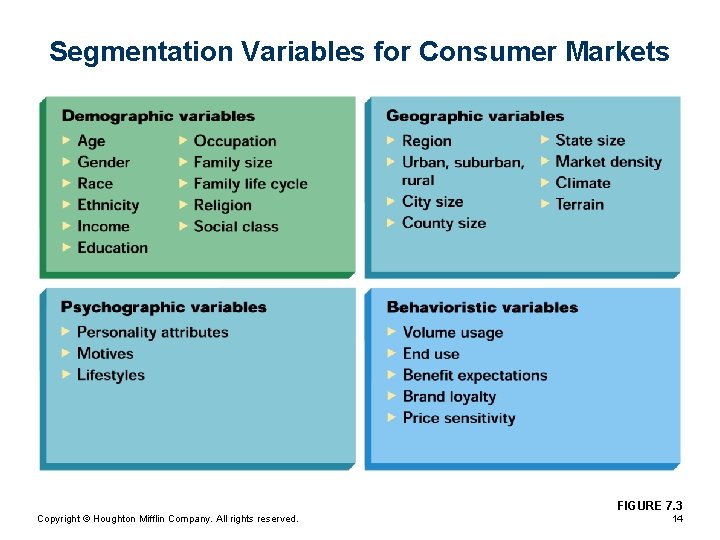
Segmentation Variables for Consumer Markets FIGURE 7. 3 Copyright © Houghton Mifflin Company. All rights reserved. 14
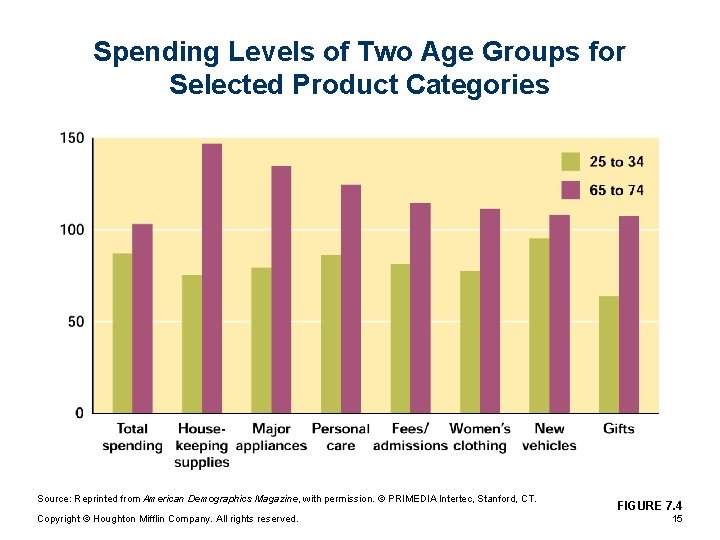
Spending Levels of Two Age Groups for Selected Product Categories Source: Reprinted from American Demographics Magazine, with permission. © PRIMEDIA Intertec, Stanford, CT. Copyright © Houghton Mifflin Company. All rights reserved. FIGURE 7. 4 15
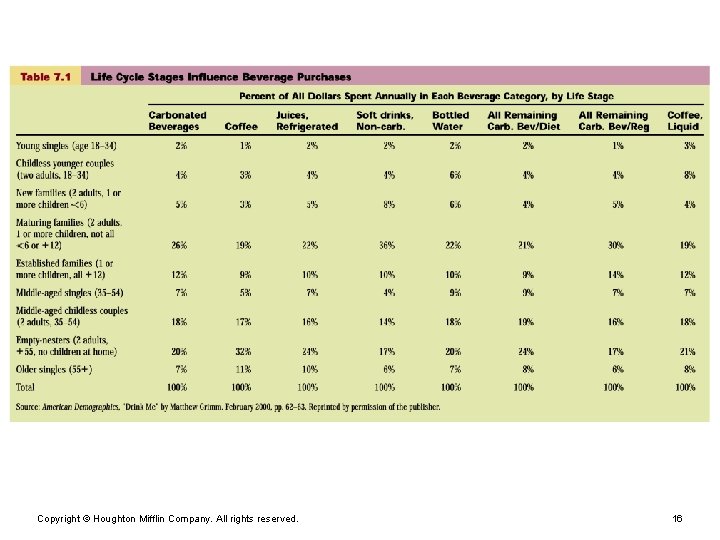
Copyright © Houghton Mifflin Company. All rights reserved. 16
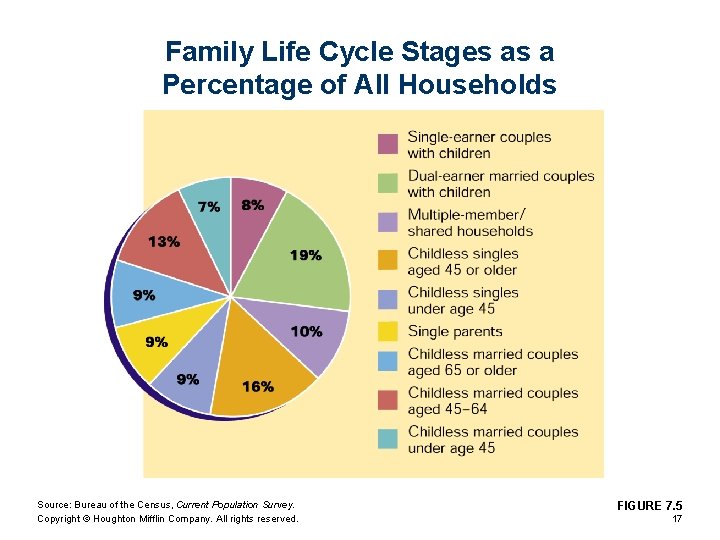
Family Life Cycle Stages as a Percentage of All Households Source: Bureau of the Census, Current Population Survey. Copyright © Houghton Mifflin Company. All rights reserved. FIGURE 7. 5 17
Step 2: Determine Which Segmentation Variables to Use (cont’d) • Demographic Variables – Population characteristics such as age, gender, race, ethnicity, income, education • Geographic Variables – Customer product needs are influenced by climate, terrain, city size, population density, and urban/rural areas • Market Density – The number of potential customers within a unit of land area Copyright © Houghton Mifflin Company. All rights reserved. 18
Step 2: Determine Which Segmentation Variables to Use (cont’d) • Geodemographic Segmentation – Marketing segmentation that clusters people in zip code areas and smaller neighborhood units based on lifestyle and demographic information • Micromarketing – An approach to market segmentation in which organizations focus precise marketing efforts on very small geographic markets Copyright © Houghton Mifflin Company. All rights reserved. 19
Step 2: Determine Which Segmentation Variables to Use (cont’d) • Psychographic Variables – Personality characteristics • Marketers appeal to positive/favorable personal characteristics to influence the purchase decision. – Motives • Marketers use individuals’ differing purchase motives to segment a product market. – Lifestyles • Marketers segment markets according to how individuals choose to spend their time in various activities, their income, their interest and opinions, and their education. Copyright © Houghton Mifflin Company. All rights reserved. 20
Step 2: Determine Which Segmentation Variables to Use (cont’d) • Behavioristic Variables – Benefit segmentation • The division of a market according to benefits that customers want from the product • Individuals purchase and use products that provide them with benefits that meet their needs. – Effective segmentation requires: • Benefits of the product be identifiable • Benefits actually divide market into segments • One or more segments be accessible to the marketing effort Copyright © Houghton Mifflin Company. All rights reserved. 21
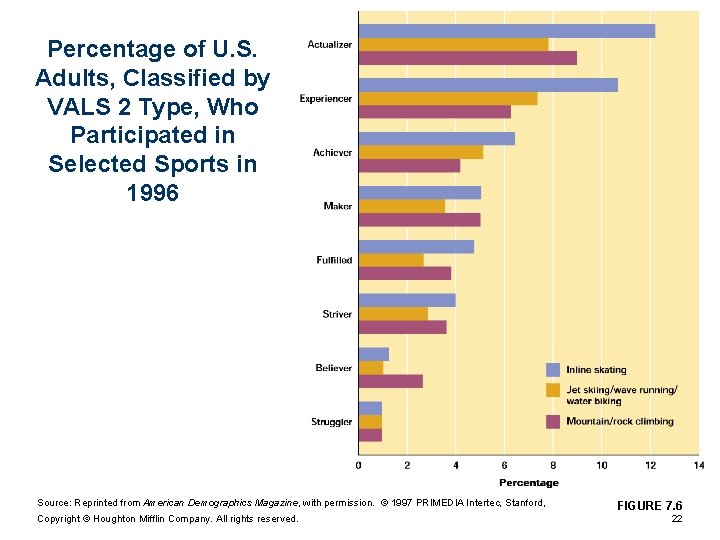
Percentage of U. S. Adults, Classified by VALS 2 Type, Who Participated in Selected Sports in 1996 Source: Reprinted from American Demographics Magazine, with permission. © 1997 PRIMEDIA Intertec, Stanford, Copyright © Houghton Mifflin Company. All rights reserved. FIGURE 7. 6 22
Step 2: Determine Which Segmentation Variables to Use (cont’d) • Variables for Segmenting Business Markets – Geographic location • Location affects the level of product demand. – Type of organization • Variations in firms’ characteristics leads to segmentation by type. – Customer size • Larger customers strongly influence how they are treated in the marketplace. – Product use • Firms use basic inputs in ways different from one another. Copyright © Houghton Mifflin Company. All rights reserved. 23
Step 3: Develop Market Segment Profiles • Market Segment Profile – Describes the similarities among potential customers within a segment – Covers demographic characteristics, geographic factors, benefits sought, lifestyles, brand preferences, and usage rates Copyright © Houghton Mifflin Company. All rights reserved. 24
Step 4: Evaluate Relevant Market Segments • Sales Estimates – Market potential – Company sales potential • Measuring Sales Potential • Breakdown approach: top-down analysis • Build-up approach: bottom-up analysis • Competitive Assessment • Who, how many, how large, and how strong? • Cost Estimates • The expense of developing a marketing mix • Costs of reaching segment relative to competitors’ costs Copyright © Houghton Mifflin Company. All rights reserved. 25
Step 5: Select Specific Target Markets • Issues in Selecting a Target Market – Do customers’ needs differ enough to warrant the use of market segmentation? – In which market segment(s) should the firm participate? – Does the firm have the resources and skills to compete effectively in the target market? Copyright © Houghton Mifflin Company. All rights reserved. 26
Developing Sales Forecasts • Sales Forecast • The amount of a product a company expects to sell during a specific period at a specified level of marketing activities • Common Forecasting Techniques – Executive judgment • Based on the intuition of the firm’s managers – Surveys • • Sales force forecasting survey Customer forecasting Expert forecasting survey Delphi technique (panel of experts) Copyright © Houghton Mifflin Company. All rights reserved. 27
Developing Sales Forecasts (cont’d) • Common Forecasting Techniques (cont’d) – Time-series analysis • Patterns in historical data yield information for use in trend analysis – Trend analysis • Cycle analysis • Seasonal analysis • Random factor analysis Copyright © Houghton Mifflin Company. All rights reserved. 28
Step 5: Select Specific Target Markets (cont’d) • Regression Analysis – Predicting sales based on the relationship between past sales and one or more variables. • Market Tests – Making a product available in the marketplace and measuring purchases and consumer responses • Using Multiple Forecasting Methods – A combination of forecasting methods yields better Copyright © Houghton Mifflin Company. All rights reserved. 29
After reviewing this chapter you should: • Have learned what a market is. • Understand the differences among general targeting strategies. • Be familiar with the major segmentation variables. • Know what segment profiles are and how they are used. • Understand how to evaluate market segments. • Be able to identify the factors that influence the selection of specific market segments for use as target markets. • Be familiar with sales forecasting methods. Copyright © Houghton Mifflin Company. All rights reserved. 30

Chapter 7 Supplemental Slides Copyright © Houghton Mifflin Company. All rights reserved. 7– 31
Key Terms and Concepts • The following slides (a listing of terms and concepts) are intended for use at the instructor’s discretion. • To rearrange the slide order or alter the content of the presentation – select “Slide Sorter” under View on the main menu. – left click on an individual slide to select it; hold and drag the slide to a new position in the slide show. – To delete an individual slide, click on the slide to select, and press the Delete key. – Select “Normal” under View on the main menu to return to normal view. Copyright © Houghton Mifflin Company. All rights reserved. 32
Important Terms • Consumer Markets – Purchasers and individuals in households – Purchases are for personal consumption, not profit • Business Markets – Individuals and groups that purchase products for resale, direct use to produce other products, or use in daily business operations – Purchasers classed as producers, resellers, government, and institutional markets Copyright © Houghton Mifflin Company. All rights reserved. 33
Important Terms • Undifferentiated Strategy – Defining an entire market for a particular product as the target market (homogeneous market) – Designing a single market mix for, and directing it at the total market • Concentrated Strategy Through Market Segmentation – Segmenting (dividing) the total market into groups with similar product needs (heterogeneous markets) to design marketing mixes that match those needs – Concentrated targeting strategy focuses on a single market segment using one marketing mix Copyright © Houghton Mifflin Company. All rights reserved. 34
Important Terms • Segmentation Variables – Characteristics of individuals, groups, or organizations used to divide a market into segments • Differentiated Strategy Through Market Segmentation – Targeting two or more segments by developing a marketing mix for each – Competitive advantage is marketing mixes are aimed at more people • Market Density – The number of potential customers within a unit of land area Copyright © Houghton Mifflin Company. All rights reserved. 35
Important Terms • Geodemographic Segmentation – Marketing segmentation that clusters people in zip code areas and smaller neighborhood units based on lifestyle and demographic information • Micromarketing – An approach to market segmentation in which organizations focus precise marketing efforts on very small geographic markets • Psychographic Variables – Personality characteristics – Motives – Lifestyles Copyright © Houghton Mifflin Company. All rights reserved. 36
Important Terms • Behavioristic Variables – Benefit segmentation • Effective segmentation requires: – Benefits of the product be identifiable – Benefits actually divide market into segments – One or more segments be accessible to the marketing effort Copyright © Houghton Mifflin Company. All rights reserved. 37
Important Terms • Variables for Segmenting Business Markets – Geographic Location – Type of Organization – Customer Size – Product Use Copyright © Houghton Mifflin Company. All rights reserved. 38
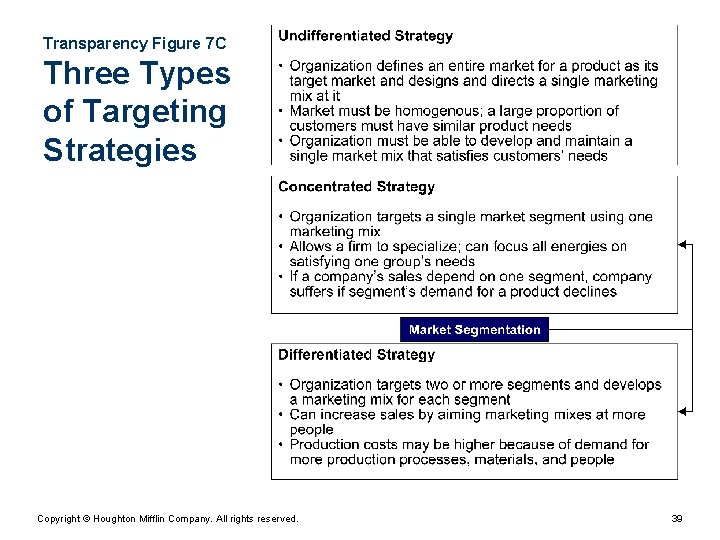
Transparency Figure 7 C Three Types of Targeting Strategies Copyright © Houghton Mifflin Company. All rights reserved. 39
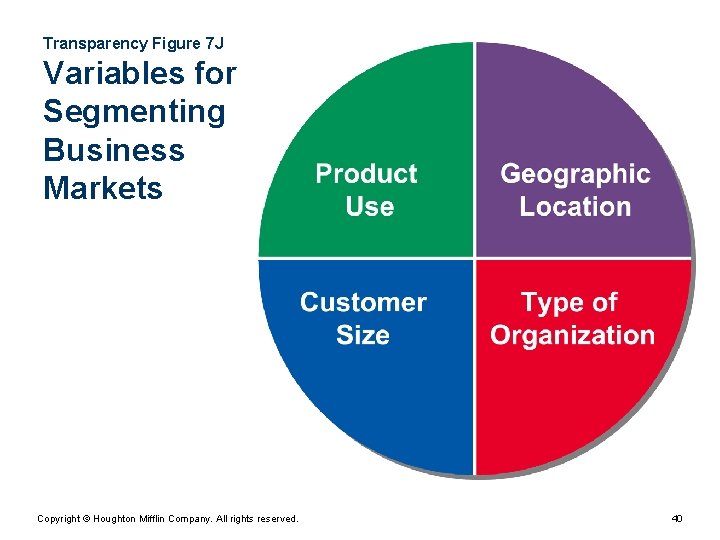
Transparency Figure 7 J Variables for Segmenting Business Markets Copyright © Houghton Mifflin Company. All rights reserved. 40
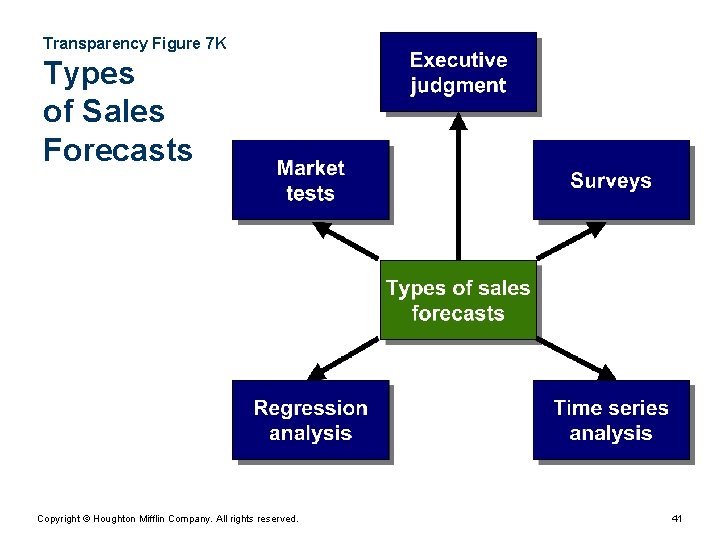
Transparency Figure 7 K Types of Sales Forecasts Copyright © Houghton Mifflin Company. All rights reserved. 41
- Slides: 41