CHAPTER 13 A World in Flames Section 1
- Slides: 11
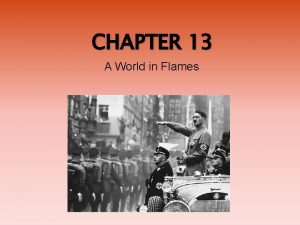
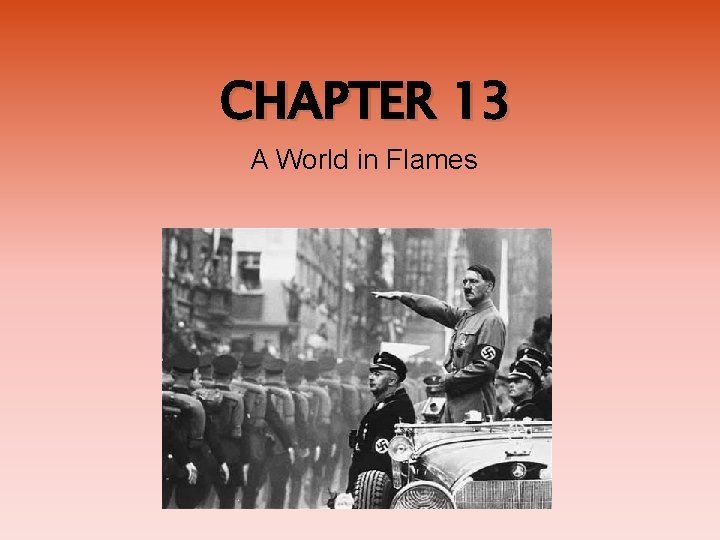
CHAPTER 13 A World in Flames
Section 1 – America and the World � � The devastation of World War I, coupled with the very real fear of a communist revolution, left Italy and Germany susceptible to the rise of strong, military dictators. The countries of Europe suffered through worse conditions during the Great Depression than even the United States. The economic hardships they faced created great political instability.
The Rise of Nations � � 1852 -U. S. Commodore Perry opens Japan up to the outside world. By 1890 Japan is building its own powerful navy. 1861 – The Italian states unify into the nation of Italy. 1871 – The Prussian states unify into the nation of Germany. 1917 – The Bolsheviks successfully overthrow the Czar of Russia. Communism is established in 1922.
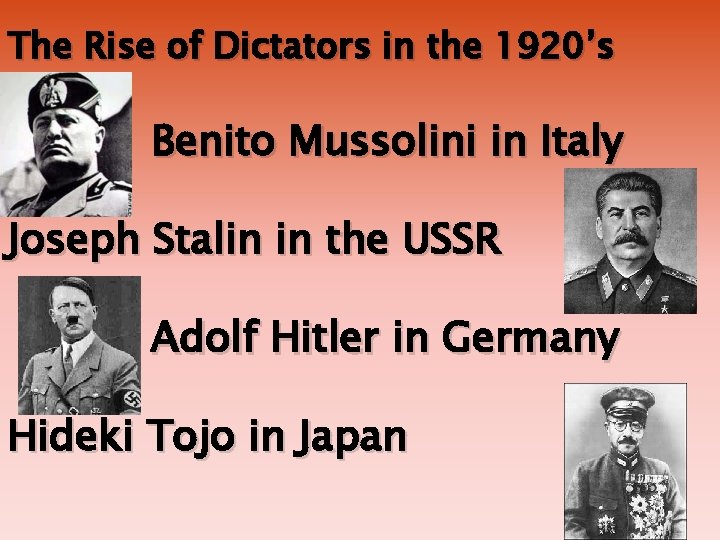
The Rise of Dictators in the 1920’s Benito Mussolini in Italy Joseph Stalin in the USSR Adolf Hitler in Germany Hideki Tojo in Japan
Section 1 – Questions 1. Summarize the paths that Mussolini, Stalin, Hitler and the Japanese Military took to gain dictatorial powers in their respective countries. (I’m looking for 4 distinct summaries. ) 2. Why was the United States so firmly committed to the policy of neutrality? What specific steps did the government take to ensure our neutrality? 3. Make a case, for and against, the United States remaining neutral in world affairs. (You may use either the era we are studying or you may use the modern era for your arguments. ) When do you think it would be acceptable or necessary for the United States to get involved in international affairs?
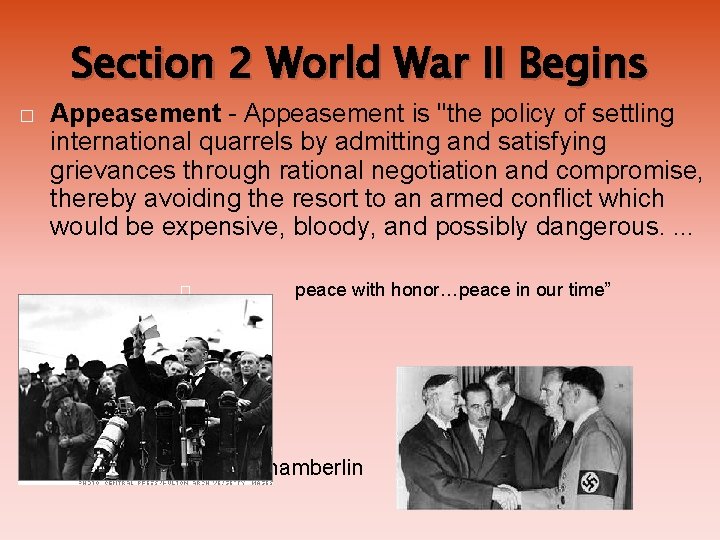
Section 2 World War II Begins � Appeasement - Appeasement is "the policy of settling international quarrels by admitting and satisfying grievances through rational negotiation and compromise, thereby avoiding the resort to an armed conflict which would be expensive, bloody, and possibly dangerous. . � peace with honor…peace in our time” Neville Chamberlin
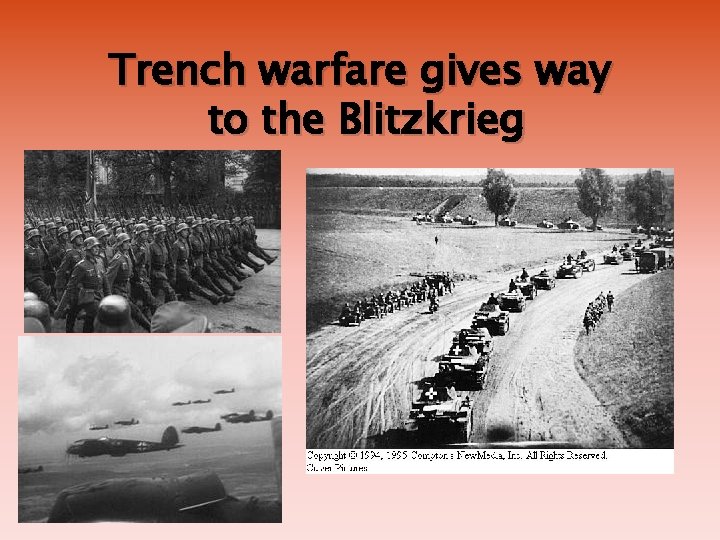
Trench warfare gives way to the Blitzkrieg
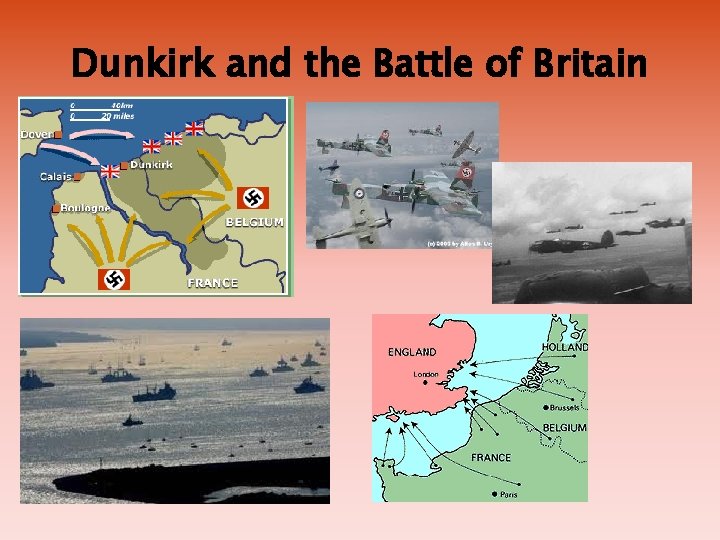
Dunkirk and the Battle of Britain
Section 2 Questions 1. Describe the 8 events from 1937 to 1939 that led to World War II. (1937, Feb. 38, March 38, Sept. 38, Oct. 38, March 39, Aug. 39, Sept. 39) 2. How had the French planned to defend themselves from a German attack? What strategies did the Germans use to get past this defense? 3. Why was the miracle at Dunkirk so important for the Allies? 4. What was the Battle of Brittan and how did its outcome change World War II?
Section 3 Questions 1. Describe the evolution of Nazi persecution against the Jews in Germany from 19351942. 2. What was the purpose of the Wannsee Conference? How did the Nazi’s decide the fate of their victims? 3. Do you think the German people or other nations could have prevented the Holocaust? Why or why not?
Section 4 Questions 1. Describe the steps Roosevelt took to give aid to Great Britain, Russia and China, without fully committing the U. S. to war. Do you think Roosevelt overstepped his authority at any time? 2. What conflict was drawing the U. S closer to war with Germany? 3. Why did the U. S. enact a trade embargo against Japan and how did Japan respond?