
Candle flames dancing Casting shadows on the wall

- Slides: 5
Candle flames dancing, Casting shadows on the wall. Ghostly images. By A. Knight Butterfly wings flutter, Souls leaving this world too soon. Tears remember forever. By C. Vengroff Tender willow almost gold, almost amber, almost light… By Jose Juan Tablada Not a breath of aironly a water bug mars the pine’s reflection. By Marjory Bates Pratt late afternoon: cattle lie in billboard shade spring rain in this new mud the worm’s pink skin By Penny Harter In the falling snow A laughing boy holds out his palms Until they are white By Richard Wright Still damp earth the unglazed bowl By Peggy Willis Lyles walking the snow-crust not sinking
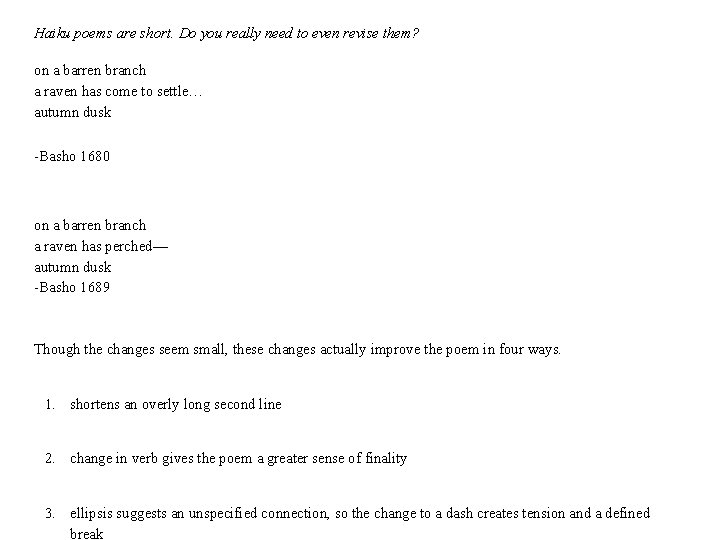
Haiku poems are short. Do you really need to even revise them? on a barren branch a raven has come to settle… autumn dusk -Basho 1680 on a barren branch a raven has perched— autumn dusk -Basho 1689 Though the changes seem small, these changes actually improve the poem in four ways. 1. shortens an overly long second line 2. change in verb gives the poem a greater sense of finality 3. ellipsis suggests an unspecified connection, so the change to a dash creates tension and a defined break
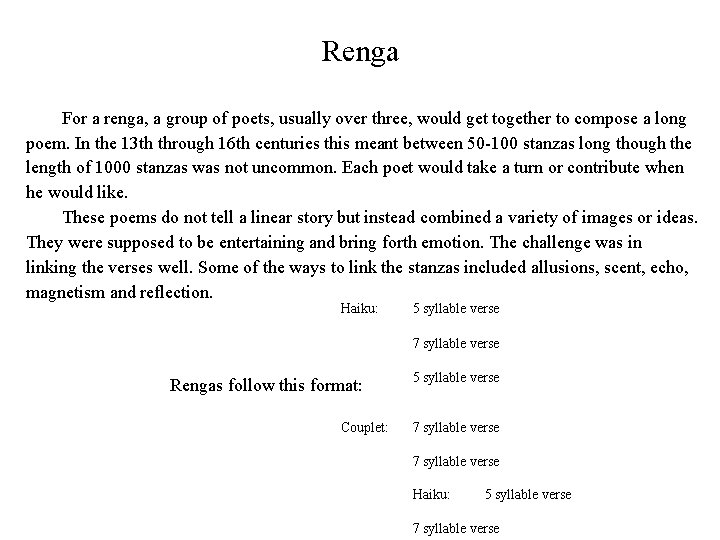
Renga For a renga, a group of poets, usually over three, would get together to compose a long poem. In the 13 th through 16 th centuries this meant between 50 -100 stanzas long though the length of 1000 stanzas was not uncommon. Each poet would take a turn or contribute when he would like. These poems do not tell a linear story but instead combined a variety of images or ideas. They were supposed to be entertaining and bring forth emotion. The challenge was in linking the verses well. Some of the ways to link the stanzas included allusions, scent, echo, magnetism and reflection. Haiku: 5 syllable verse 7 syllable verse Rengas follow this format: Couplet: 5 syllable verse 7 syllable verse Haiku: 5 syllable verse 7 syllable verse
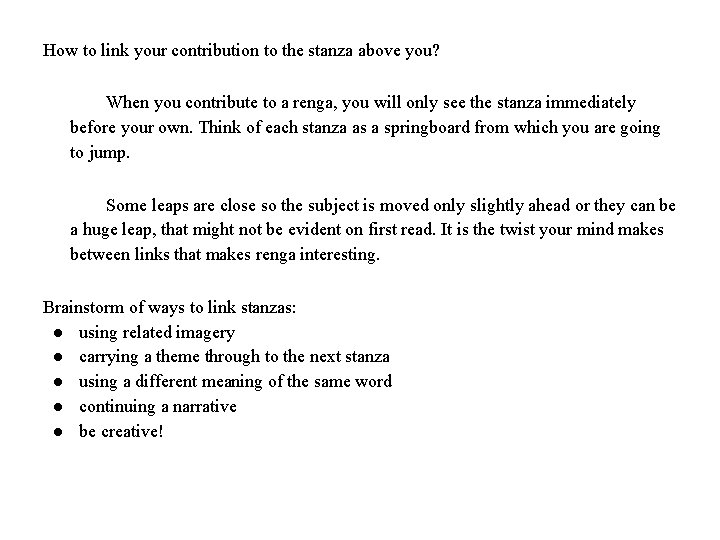
How to link your contribution to the stanza above you? When you contribute to a renga, you will only see the stanza immediately before your own. Think of each stanza as a springboard from which you are going to jump. Some leaps are close so the subject is moved only slightly ahead or they can be a huge leap, that might not be evident on first read. It is the twist your mind makes between links that makes renga interesting. Brainstorm of ways to link stanzas: ● using related imagery ● carrying a theme through to the next stanza ● using a different meaning of the same word ● continuing a narrative ● be creative!
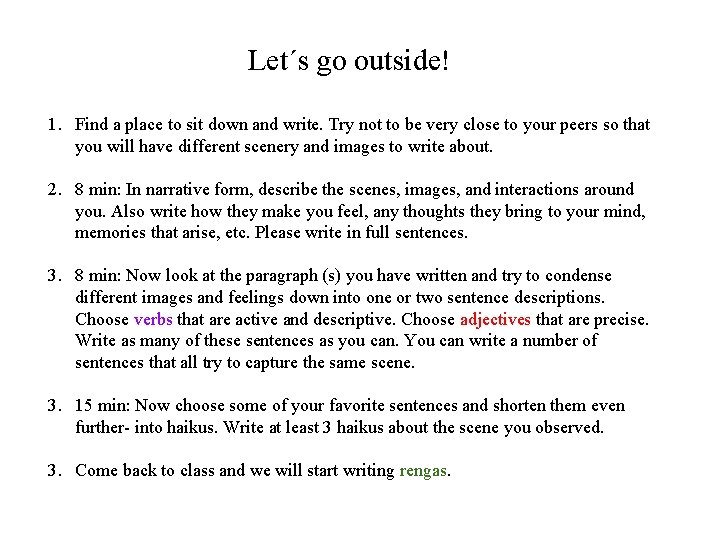
Let´s go outside! 1. Find a place to sit down and write. Try not to be very close to your peers so that you will have different scenery and images to write about. 2. 8 min: In narrative form, describe the scenes, images, and interactions around you. Also write how they make you feel, any thoughts they bring to your mind, memories that arise, etc. Please write in full sentences. 3. 8 min: Now look at the paragraph (s) you have written and try to condense different images and feelings down into one or two sentence descriptions. Choose verbs that are active and descriptive. Choose adjectives that are precise. Write as many of these sentences as you can. You can write a number of sentences that all try to capture the same scene. 3. 15 min: Now choose some of your favorite sentences and shorten them even further- into haikus. Write at least 3 haikus about the scene you observed. 3. Come back to class and we will start writing rengas.